A vessel sink sits on top of the counter like a bowl, so it needs a taller faucet than a standard undermount or drop-in basin. Some faucets are deck mounted beside the bowl, while others mount to the wall. Before you shop, measure the height of the rim above the counter, the distance from the back of the bowl and the number of holes in your counter. Those measurements decide whether a faucet will reach the basin.
We have not used these products ourselves, so this guide does not claim personal experience with any of them. Instead it shows how to choose: which features matter, what to confirm on a product page and which common mistakes to avoid. Plumbing steps can be tricky, so read the manual and ask a qualified plumber if you are unsure.
As an Amazon Associate we earn from qualifying purchases. Links on this site are affiliate links, and they do not change the information we give.
In this guide
Quick Picks
| Pick | Product | Best For |
|---|---|---|
| Best Overall | KRAUS Indy Single Handle Vessel Bathroom Faucet (KVF-1400MB) | Most vessel bowls, modern matte black look |
| Best Waterfall Design | Phiestina Tall Waterfall Vessel Sink Faucet (NS-SF01-BN-V) | Open-spout waterfall flow in brushed nickel |
| Best for Farmhouse Style | HEYMYTAP Waterfall Vessel Sink Faucet (Oil Rubbed Bronze) | Rustic and farmhouse vanities |
| Best Value with Drain Included | KENES Tall Vessel Sink Faucet (LJ-9031A-2) | Complete kit with pop-up drain and hoses |
| Best Swivel Spout | gotonovo Single Handle Vessel Sink Faucet (Antique Brass) | Wide bowls where aiming the stream matters |
Our Picks

1. KRAUS Indy Single Handle Vessel Bathroom Faucet (KVF-1400MB) — Best Overall
The Indy is Kraus’s purpose-built vessel faucet, and its dimensions suit the job the guide describes: the spout sits 9 1/4 inches above the deck with a 5 1/8-inch reach, so the stream clears a typical countertop bowl rim and lands inside the basin rather than on its edge. The overall height is 10 7/8 inches. Inside, a 25mm ceramic cartridge handles the drip-free shutoff the guide flags under flow and valve, and the body is solid brass with a lead-free brass waterway. Flow is rated at 1.2 gpm at 60 psi, in line with WaterSense-style bathroom faucets. It mounts through a single 1 3/8-inch hole on decks up to 1 1/2 inches thick, and the maker supplies long integrated nylon waterlines, which helps when the faucet sits behind a deep bowl. The soft-touch silicone aerator can be adjusted by hand. This is the pick for most people: a named maker, published dimensions that match vessel geometry, and a matte black finish that pairs easily with matching drains and towel bars.


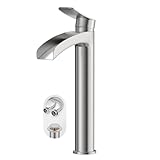
2. Phiestina Tall Waterfall Vessel Sink Faucet (NS-SF01-BN-V) — Best Waterfall Design
Where the guide talks about spout style, the Phiestina takes the open-channel route: instead of an aerated jet, water sheets over a flat waterfall spout, which suits glass and stone feature bowls. The listing gives an overall height of 10.24 inches and a notably long 6.24-inch spout reach, useful when the faucet must sit behind a wide bowl and still deliver water near its centre. The body and handle are stainless steel, the valve is ceramic, and the maker rates it for deck thicknesses of about 0.79 to 1.18 inches in a single-hole deck mount. Helpfully, the box includes a metal pop-up drain and water supply lines, so the finish of the drain matches the brushed nickel faucet without a separate purchase — the guide reminds readers to match finishes across drain and fixtures. Waterfall spouts can splash more in shallow bowls, so it fits deeper vessels best. Choose it if the waterfall look is the point of the vanity and you want the drain included.

3. HEYMYTAP Waterfall Vessel Sink Faucet (Oil Rubbed Bronze) — Best for Farmhouse Style
Oil rubbed bronze is the finish traditional and farmhouse vanities usually call for, and this HEYMYTAP pairs it with a tall brass body and an open waterfall spout. The single lever sits on top of the column and mixes hot and cold, keeping the one-handle layout the guide describes as the space-saving option beside a bowl. The listing states the faucet ships with a pop-up drain and cUPC-certified supply hoses, so the visible drain hardware matches the bronze finish and the connections are covered in the same box. Brass construction is the material the guide’s care section favours for longevity. The seller promotes a quick single-hole install, though as the guide advises, the real checks are your rim height against the spout and the deck hole you already have. Pick this one for a rustic vanity, a wood counter or a bronze-themed fixture set where a chrome or black faucet would clash.


4. KENES Tall Vessel Sink Faucet (LJ-9031A-2) — Best Value with Drain Included
The KENES LJ-9031A-2 covers the guide’s checklist in one box: a tall stainless steel body with a spout height of 10.2 inches and a 5.1-inch reach, a maximum flow of 1.2 gallons per minute, and a single lever for temperature and flow. Critically for a vessel setup, the bundle includes the pop-up drain stopper and the water supply hoses, so there is no second order for the parts that have to match the matte black finish. Stainless steel resists the rust and spotting the care section warns about, and the single-hole deck mount fits the standard 1 3/8-inch drilling used by most vanities. Because the spout is a conventional aerated outlet rather than a waterfall, splashing is easier to control in shallower bowls. This is the sensible budget route: published dimensions, included drain and hoses, and no separate finish-matching guesswork afterwards.


5. gotonovo Single Handle Vessel Sink Faucet (Antique Brass) — Best Swivel Spout
Most vessel faucets are fixed, so the gotonovo stands out with a spout that swivels a full 360 degrees — handy when a wide or offset bowl makes the standard spout position awkward, a reach problem the guide highlights. The body is brass with an antique brass finish, a warm traditional tone that suits vintage and country bathrooms. A single lever controls flow and temperature, and the listing states a matching pop-up drain is included, which sorts the finish-matching step for the drain at the same time. It installs in a single hole on the deck beside the bowl, the most common vessel arrangement. The swivel joint is also a practical cleaning plus: you can swing the spout aside to wipe the counter behind the bowl. Choose it for an antique-styled vanity, or for any setup where a fixed spout would land too close to the bowl’s edge.

What to Look For
| Factor | Why it matters | What to check |
|---|---|---|
| Spout height | The spout must clear the rim of the bowl | Compare the stated height with your vessel rim above the counter |
| Spout reach | Water should land in the bowl, not on the rim | Check the distance from the base to the spout opening |
| Mounting type | Deck and wall mounts need different rough work | Confirm the hole count and whether the wall needs a rough-in valve |
| Handle style | Single and two-handle designs control water differently | Decide on the feel and the space you have beside the bowl |
| Finish | Matching finishes make a tidy look | Compare the finish with the drain, towel bar and fixtures |
| Flow and valve | The valve affects drips and lifespan | Read the maker’s stated flow figure and valve type |
Setup and Care Tips
- Shut off the water supply lines before installing or changing the faucet.
- Dry fit the faucet and mark the position before you tighten anything.
- Use the gaskets and washers supplied so the base sits firmly.
- Flush the lines briefly before attaching the aerator to clear any debris.
- Wipe the finish with a soft cloth and avoid harsh scrubbing pads.
Mistakes to Avoid
- Buying a standard-height faucet for a raised bowl.
- Ignoring spout reach and ending up with water hitting the rim.
- Forgetting the extra rough-in parts for a wall mount.
- Choosing a finish that clashes with the other fixtures.
- Assuming the drain is included when it is sold separately.
Working Out the Right Faucet Height
The key measurement for a vessel faucet is how the spout height relates to the top of the bowl. The spout opening should sit above the rim of the vessel so water falls cleanly into the bowl and you can fit your hands underneath. Measure from the counter surface to the rim of the vessel, then compare it with the faucet’s stated height. Faucets are usually listed with a total height, measured from the counter to the top of the spout, and sometimes a spout clearance, which is the vertical space beneath the spout opening.
A faucet that sits only slightly above the rim can feel cramped, while one that is far too tall may splash. Many people look for a spout opening that sits several centimeters above the rim, but there is no single rule, so decide based on how you use the sink. Try holding a measuring tape or a similar object in place to visualize it.
Bowl shape changes the answer. A deep, narrow bowl and a shallow, wide bowl behave differently, and the water stream must reach the lower center of the bowl. Check the bowl dimensions and drain position. Think about the counter height too. A high counter plus a tall vessel can add up, and some users may find the sink too high. Keep comfort in mind for everyone who will use it, including children.
Spout Reach, Angle and Splash Control
Once height is settled, check reach, the horizontal distance from the center of the faucet base to the spout opening. The water should land close to the drain or at least well inside the bowl. If the stream hits the side wall or the rim, it will splash and be hard to use. If it lands too far forward, it may spill over the edge.
Work out where the faucet will sit. Measure the distance from the back edge of the counter to the bowl, and the space between the bowl and the wall. Then compare it with the base size and spout reach. Mark the position on the counter with painter’s tape, and hold a ruler or string to simulate the spout. Check that the handle can move freely and does not hit the wall or the vessel.
The spout shape affects the stream. Arched spouts direct water forward and down, while straight spouts may produce a steeper drop. Waterfall or open-spout designs flow in a sheet, which looks distinct but can behave differently with splash and flow rate. Aerators, which mix air into the stream, can reduce splashing and flow, and some faucets include one. Read what the listing says about aerator type and whether it can be replaced or cleaned.
Pay attention to the flow rate, as it affects splash and water use. Local rules or labels in some regions may cap flow, so check the listing.
Deck Mount, Wall Mount and Single-Hole Considerations
Mounting style decides how the faucet connects to the counter or wall, and it has a big impact on installation. A deck-mounted faucet attaches to a hole in the countertop beside the vessel. Single-hole designs combine spout and handle on one base, while widespread or two-handle types need multiple holes. Check the hole count, the hole diameter and the thickness of the counter, because the faucet shank must fit through it. If your counter does not have a hole in the right position, you will need to drill one, which calls for care and often a professional, especially with stone.
A wall-mounted faucet comes out of the wall above the vessel. This frees the counter and can make cleaning easier, but it needs a rough-in valve inside the wall and a precise spout reach to line up with the bowl. The valve must be installed at the right height and depth, and the finish wall must match the trim. Plan this before the wall is closed up. If the wall is already finished, consider whether opening it is acceptable.
Check the supply lines and connections. Deck-mounted faucets typically use flexible supply hoses with a standard thread, but verify the length and the connector type. You may need an angle stop valve at the wall. Look at the drain too. A vessel sink typically needs a specific drain, sometimes with an overflow or without. Check that the drain finish matches the faucet.
Valves, Finishes and Water Quality
Inside the faucet, the valve controls the flow and temperature, and its type affects how long the faucet lasts. Ceramic disc cartridges are common in modern faucets, and makers often describe them as durable and drip resistant. Other designs exist. Look at the listing for the cartridge type and whether replacement cartridges are available. A faucet with accessible parts can be repaired instead of replaced.
Finish is both a style and a care decision. Polished chrome, brushed nickel, matte black, bronze and brass are all common, and each shows spots and wear differently. Polished finishes show fingerprints and water marks, while brushed or matte finishes can hide them. Living finishes, which change over time, need particular care. Coordinate the faucet with other fixtures such as the drain, towel bars and lights, but remember that exact matches between brands can vary.
Water quality affects both. Hard water leaves mineral spots and can clog aerators, and soft water has its own effects. Rinse and wipe the faucet regularly, and use only cleaners that the maker approves. Abrasive pads and strong chemicals can damage plated surfaces.
Check for certifications on the listing, such as lead-free compliance statements that apply in your area, and read them as the maker’s claims. Make sure the materials suit your plumbing, and keep the packaging and manual for warranty purposes.
Installing, Testing and Troubleshooting
Before installing, gather the tools the manual lists. These usually include an adjustable wrench, a basin wrench, plumber’s tape or sealant if recommended, a bucket and a flashlight. Shut off the water at the angle stops or the main, and open the old faucet to relieve pressure. Dry fit the new faucet to confirm the height and reach before final tightening.
Thread the supply lines on carefully to avoid cross-threading, and tighten snugly without over-tightening. Use all gaskets and mounting parts supplied. Run water without the aerator for a minute to clear debris, then attach it. Check every connection for leaks, both right away and again after several hours. Wipe connections dry so any moisture is easy to spot.
If water splashes, review the spout position and try adjusting the aerator. If the handle feels stiff or the flow is weak, check the aerator and the supply valves. A drip from the spout can mean a worn cartridge or debris. Leaks at the base may be a missing gasket or loose mounting nut.
Here are common signs the faucet needs attention or replacement:
- Persistent dripping after cartridge cleaning or replacement.
- Corrosion, pitting or peeling finish.
- Loose spout or handle that cannot be tightened.
- Reduced flow that does not improve after cleaning the aerator.
- Leaks in supply lines, which should be replaced promptly.
If you are not confident with plumbing, hire a plumber. Keep the receipt, manual and any spare parts.
FAQ
Can I use a regular faucet with a vessel sink?
Usually not. A regular faucet is too short and its spout may end above the bowl edge, causing splashing. Look for a faucet whose product page names vessel use or lists a taller spout.
Deck mount or wall mount?
Deck mount is simpler if your counter already has a hole. A wall mount gives a clean counter but needs a valve in the wall, so plan this before the wall is finished. Whichever you choose, hold the faucet next to the bowl and check that the stream lands near the drain.
How high above the vessel rim should the spout be?
There is no fixed rule. Aim for enough clearance to wash hands comfortably without the water hitting the rim. Compare your rim height with the listed spout clearance and test with a mock-up.
Can I use a single-hole faucet?
Yes, if your counter has one hole in the right place and the faucet base fits. Single-hole designs are common for vessel sinks, but check the hole size and the spout reach.
Do I need a special drain?
Vessel sinks usually use a specific vessel drain, which may be sold separately. Check whether your sink has an overflow, and confirm the finish matches the faucet.
Is a wall mount harder to install?
Generally it takes more planning, since the valve sits in the wall and the spout reach must line up with the bowl. It is easiest to plan before the wall is closed. Consider a professional.
What is the typical hole size for a faucet?
It varies, so check the shank diameter in the listing and compare it with your counter hole. Do not enlarge holes in stone or ceramic without proper tools and care.
How do I clean mineral spots from the finish?
Use a soft cloth and a mild cleaner that the maker approves. Avoid abrasives and strong acids. Dry the surface after cleaning to prevent new spots.
Can a vessel faucet be used on a standard sink?
Sometimes, but a tall spout can splash in a shallow basin. Check the reach and the stream's landing point, and compare it with the sink's depth and drain location.
Choosing vessel sink faucets in Practice: A Deeper Look at the Details That Matter
The short checklists earlier in this guide name the main things to compare, but most buyers only discover what really matters after the first few weeks of use, when the vessel sink faucet has to fit into a real routine in bathrooms with above-counter vessel basins. This section slows the decision down and looks at each factor on its own, so you can weigh the trade-offs calmly instead of guessing from a product photo. None of these points replaces the maker’s own specifications or instructions, and you should always confirm the exact details on the listing for the model you are considering. What this section gives you is a way to read those listings with better questions in mind, and a clearer sense of which compromises are harmless for your situation and which ones will annoy you every single time you reach for the vessel sink faucet.
Height matched to your vessel
The faucet must clear the vessel’s rim with comfortable room for hands beneath the spout, and that total height depends on your basin’s depth and counter. Measure the vessel first, because a faucet that is merely tall is not the same as a faucet tall enough for your sink. For a vessel sink faucet, this matters more than it first appears, because it shapes how the filling and using a vessel sink comfortably goes on an ordinary day rather than on the one careful occasion when everything is set up perfectly. Compare this point across the picks in this guide using the same test each time: picture the job you do most often, in the place you do it, with the time and space you actually have. If a model looks strong on paper but awkward under that test, trust the test. It is also worth writing down the one or two requirements you will not compromise on before you start comparing, because listings are designed to pull your attention toward whatever each maker does best, and a written priority list keeps the comparison honest from the first model to the last.
Spout reach and water landing point
Water should land in the bowl, not on its back edge or against the front where it splashes the user. Reach is the overlooked twin of height, and the two together decide whether the pairing feels designed or accidental. For a vessel sink faucet, this matters more than it first appears, because it shapes how the filling and using a vessel sink comfortably goes on an ordinary day rather than on the one careful occasion when everything is set up perfectly. Compare this point across the picks in this guide using the same test each time: picture the job you do most often, in the place you do it, with the time and space you actually have. If a model looks strong on paper but awkward under that test, trust the test. It is also worth writing down the one or two requirements you will not compromise on before you start comparing, because listings are designed to pull your attention toward whatever each maker does best, and a written priority list keeps the comparison honest from the first model to the last.
Style of flow: standard or waterfall
Waterfall spouts pour a wide, gentle sheet that suits the vessel aesthetic and can splash less at low flow, while standard spouts give a focused, familiar stream. Choose by how you use the sink: quick hand rinses forgive either, while filling and shaving routines have preferences. For a vessel sink faucet, this matters more than it first appears, because it shapes how the filling and using a vessel sink comfortably goes on an ordinary day rather than on the one careful occasion when everything is set up perfectly. Compare this point across the picks in this guide using the same test each time: picture the job you do most often, in the place you do it, with the time and space you actually have. If a model looks strong on paper but awkward under that test, trust the test. It is also worth writing down the one or two requirements you will not compromise on before you start comparing, because listings are designed to pull your attention toward whatever each maker does best, and a written priority list keeps the comparison honest from the first model to the last.
Handle type and placement
Single-lever designs on the faucet body or side are the norm, and their placement must be reachable without dripping across the counter. Consider who uses the sink, including children and guests, because a clever handle in an odd place confuses everyone once. For a vessel sink faucet, this matters more than it first appears, because it shapes how the filling and using a vessel sink comfortably goes on an ordinary day rather than on the one careful occasion when everything is set up perfectly. Compare this point across the picks in this guide using the same test each time: picture the job you do most often, in the place you do it, with the time and space you actually have. If a model looks strong on paper but awkward under that test, trust the test. It is also worth writing down the one or two requirements you will not compromise on before you start comparing, because listings are designed to pull your attention toward whatever each maker does best, and a written priority list keeps the comparison honest from the first model to the last.
Finish coordination and durability
The faucet is the bathroom’s most-touched metal object, so its finish must coordinate with the vessel, drain, and other fittings and tolerate daily water and cleaning. Finishes age at different rates, and a premium finish on the tap is money spent where eyes and hands actually go. For a vessel sink faucet, this matters more than it first appears, because it shapes how the filling and using a vessel sink comfortably goes on an ordinary day rather than on the one careful occasion when everything is set up perfectly. Compare this point across the picks in this guide using the same test each time: picture the job you do most often, in the place you do it, with the time and space you actually have. If a model looks strong on paper but awkward under that test, trust the test. It is also worth writing down the one or two requirements you will not compromise on before you start comparing, because listings are designed to pull your attention toward whatever each maker does best, and a written priority list keeps the comparison honest from the first model to the last.
Drain compatibility and included hardware
Vessel sinks need the right drain type, with or without overflow, and some faucets include a matching drain while others assume you will source one. Confirm the whole set works together before ordering, because a beautiful faucet with the wrong drain is a project, not a purchase. For a vessel sink faucet, this matters more than it first appears, because it shapes how the filling and using a vessel sink comfortably goes on an ordinary day rather than on the one careful occasion when everything is set up perfectly. Compare this point across the picks in this guide using the same test each time: picture the job you do most often, in the place you do it, with the time and space you actually have. If a model looks strong on paper but awkward under that test, trust the test. It is also worth writing down the one or two requirements you will not compromise on before you start comparing, because listings are designed to pull your attention toward whatever each maker does best, and a written priority list keeps the comparison honest from the first model to the last.
Real-World Situations: Matching vessel sink faucets to How You Will Actually Use Them
Specifications are tidy, but real use is not. The same vessel sink faucet can feel like exactly the right purchase in one household and like a mistake in another, and the difference is usually the situation rather than the product itself. The scenarios below describe the patterns that come up most often for buyers of vessel sink faucets. Find the one that sounds most like your life, and let it steer which pick you lean toward and which features you treat as essential rather than nice to have. If two scenarios both sound familiar, weight the one that happens more often, because a vessel sink faucet earns its keep in the repeated weekly routine, not in the rare special case.
The statement guest bathroom
A dramatic vessel deserves a faucet with presence, a waterfall or a tall sculptural design, and guests forgive a little theatre. Prioritise the pairing’s looks and a flow that does not splash a dressed guest, in that order. In this situation, the sensible approach is to judge the vessel sink faucet by how it behaves when you are busy, tired, or short on time, not by how it performs in a careful first trial. Think about where it will live between uses, who else might use it, and what happens on the day something goes slightly wrong. Buyers who think through those unglamorous details in advance tend to be far happier months later, because the frustrations that make people give up on a purchase are almost always about fit, access, and routine rather than about headline performance. A model that fits the routine survives; one that fights the routine ends up ignored, however impressive its listing looked.
The busy family bathroom
Daily use by everyone argues for a sturdy single lever, a focused stream that behaves, and a finish that hides water spots. In this room the faucet is an appliance, and reliability plus easy cleaning beat drama. In this situation, the sensible approach is to judge the vessel sink faucet by how it behaves when you are busy, tired, or short on time, not by how it performs in a careful first trial. Think about where it will live between uses, who else might use it, and what happens on the day something goes slightly wrong. Buyers who think through those unglamorous details in advance tend to be far happier months later, because the frustrations that make people give up on a purchase are almost always about fit, access, and routine rather than about headline performance. A model that fits the routine survives; one that fights the routine ends up ignored, however impressive its listing looked.
The compact cloakroom vessel
Small vessels on narrow counters need proportionate faucets: enough height, modest reach, and no visual shouting. Measure twice here, because a full-size faucet over a small bowl looks and splashes wrong in equal measure. In this situation, the sensible approach is to judge the vessel sink faucet by how it behaves when you are busy, tired, or short on time, not by how it performs in a careful first trial. Think about where it will live between uses, who else might use it, and what happens on the day something goes slightly wrong. Buyers who think through those unglamorous details in advance tend to be far happier months later, because the frustrations that make people give up on a purchase are almost always about fit, access, and routine rather than about headline performance. A model that fits the routine survives; one that fights the routine ends up ignored, however impressive its listing looked.
The rustic or farmhouse scheme
Finishes like oil-rubbed bronze and designs with cross handles suit the story, provided the height and reach still serve the vessel. Style-led choices succeed when the measurements were done first and the style chosen among the faucets that fit them. In this situation, the sensible approach is to judge the vessel sink faucet by how it behaves when you are busy, tired, or short on time, not by how it performs in a careful first trial. Think about where it will live between uses, who else might use it, and what happens on the day something goes slightly wrong. Buyers who think through those unglamorous details in advance tend to be far happier months later, because the frustrations that make people give up on a purchase are almost always about fit, access, and routine rather than about headline performance. A model that fits the routine survives; one that fights the routine ends up ignored, however impressive its listing looked.
The accessible bathroom
Lever handles that operate with limited grip, comfortable spout height, and controls reachable from a seated position matter most. Choose with the actual user testing handle action if possible, because accessibility lives in these small mechanics. In this situation, the sensible approach is to judge the vessel sink faucet by how it behaves when you are busy, tired, or short on time, not by how it performs in a careful first trial. Think about where it will live between uses, who else might use it, and what happens on the day something goes slightly wrong. Buyers who think through those unglamorous details in advance tend to be far happier months later, because the frustrations that make people give up on a purchase are almost always about fit, access, and routine rather than about headline performance. A model that fits the routine survives; one that fights the routine ends up ignored, however impressive its listing looked.
Getting Started Step by Step
A careful first session sets the pattern for everything that follows. Rushing the first use of a new vessel sink faucet is how small mistakes turn into habits, and habits are much harder to fix than a single slow start. Work through the steps below in order the first time, even if some of them feel obvious, and keep the maker’s manual open alongside them, because the manual is the authority for your exact model and this sequence is the general routine that applies across the picks in this guide.
Step 1: Measure the vessel and counter layout
Record the vessel’s height above the counter, its position, and where the faucet will mount, on the counter, the vessel itself, or the wall. These three facts narrow the entire market to faucets that can actually serve your sink. Take your time over this step rather than treating it as a formality. Small checks made now are far cheaper than corrections made later, and they teach you how your particular vessel sink faucet behaves, which makes every later session faster and calmer. If something feels wrong at this point, stop and re-read the relevant part of the manual instead of pushing on and hoping it settles, because forcing a setup that is not right rarely improves it and can turn a simple adjustment into real damage or a job that has to be started again from the beginning.
Step 2: Confirm supply and drain compatibility
Check the supply connections, the drain type your vessel needs, and whether the faucet includes it, before ordering. Plumbing compatibility is unglamorous and absolute, and discovering a mismatch with the old faucet already removed is the classic bathroom misery. Take your time over this step rather than treating it as a formality. Small checks made now are far cheaper than corrections made later, and they teach you how your particular vessel sink faucet behaves, which makes every later session faster and calmer. If something feels wrong at this point, stop and re-read the relevant part of the manual instead of pushing on and hoping it settles, because forcing a setup that is not right rarely improves it and can turn a simple adjustment into real damage or a job that has to be started again from the beginning.
Step 3: Shut off water and remove the old fitting cleanly
Isolate the supplies, drain the lines, and remove the old faucet and drain as directed, cleaning the mounting surfaces. If any step exceeds your confidence or local rules, a plumber’s hour is cheaper than a leak’s month. Take your time over this step rather than treating it as a formality. Small checks made now are far cheaper than corrections made later, and they teach you how your particular vessel sink faucet behaves, which makes every later session faster and calmer. If something feels wrong at this point, stop and re-read the relevant part of the manual instead of pushing on and hoping it settles, because forcing a setup that is not right rarely improves it and can turn a simple adjustment into real damage or a job that has to be started again from the beginning.
Step 4: Mount and connect following the maker’s sequence
Fit the faucet and drain with the seals and hardware provided, in the order the instructions give, tightening evenly without forcing. Vessel glass and ceramic crack under point stress, so gentle, even fitting is a material requirement, not a style. Take your time over this step rather than treating it as a formality. Small checks made now are far cheaper than corrections made later, and they teach you how your particular vessel sink faucet behaves, which makes every later session faster and calmer. If something feels wrong at this point, stop and re-read the relevant part of the manual instead of pushing on and hoping it settles, because forcing a setup that is not right rarely improves it and can turn a simple adjustment into real damage or a job that has to be started again from the beginning.
Step 5: Test flow, landing point, and drainage
Run the water at several pressures, watch where the stream lands across the flow range, and check every joint dry-eyed while the sink fills and drains. Splash patterns and slow drips only appear under real water, so test like you mean it. Take your time over this step rather than treating it as a formality. Small checks made now are far cheaper than corrections made later, and they teach you how your particular vessel sink faucet behaves, which makes every later session faster and calmer. If something feels wrong at this point, stop and re-read the relevant part of the manual instead of pushing on and hoping it settles, because forcing a setup that is not right rarely improves it and can turn a simple adjustment into real damage or a job that has to be started again from the beginning.
Step 6: Adjust and finish
Set handle stops or temperature limits if the design offers them, wipe everything down, and keep the maker’s care guidance for the finish where you will find it. The first week will teach you the pairing’s habits; adjust promptly rather than adapting around a fixable splash. Take your time over this step rather than treating it as a formality. Small checks made now are far cheaper than corrections made later, and they teach you how your particular vessel sink faucet behaves, which makes every later session faster and calmer. If something feels wrong at this point, stop and re-read the relevant part of the manual instead of pushing on and hoping it settles, because forcing a setup that is not right rarely improves it and can turn a simple adjustment into real damage or a job that has to be started again from the beginning.
More Questions Buyers Ask
How tall should a vessel sink faucet be?
Tall enough that the spout clears the vessel rim with comfortable hand room beneath it, which depends on your vessel’s height and how it sits on the counter. Measure from the mounting surface to above the rim and compare with the faucet’s stated spout height, because catalogue words like tall describe a range, not your sink. As a general rule, check the maker’s guidance for your exact model before acting, because details vary between designs even within the same category of vessel sink faucets. If your situation is unusual, such as very frequent use, a shared setting, or a user with specific physical needs, weight that factor more heavily than general advice, including the advice in this guide. The right answer for the typical buyer is a good starting point, but your routine is the final authority on what will work for you day after day.
Do waterfall faucets splash more?
At gentle flows a waterfall sheet is calm and quiet, but at full pressure in a shallow vessel any faucet can splash, and wide sheets meeting curved bowls have their own habits. The pairing with your vessel decides it, so favour designs whose flow you can moderate easily and test at several pressures after fitting. As a general rule, check the maker’s guidance for your exact model before acting, because details vary between designs even within the same category of vessel sink faucets. If your situation is unusual, such as very frequent use, a shared setting, or a user with specific physical needs, weight that factor more heavily than general advice, including the advice in this guide. The right answer for the typical buyer is a good starting point, but your routine is the final authority on what will work for you day after day.
Can I fit a vessel faucet to my existing sink?
If the mounting holes, supply positions, and heights align, often yes, but vessel pairings are less standardised than ordinary basins. Measure your vessel and mounting arrangement against the new faucet’s requirements exactly, because close enough in plumbing usually means a return journey. As a general rule, check the maker’s guidance for your exact model before acting, because details vary between designs even within the same category of vessel sink faucets. If your situation is unusual, such as very frequent use, a shared setting, or a user with specific physical needs, weight that factor more heavily than general advice, including the advice in this guide. The right answer for the typical buyer is a good starting point, but your routine is the final authority on what will work for you day after day.
Does the drain need to match the faucet?
Are single-lever faucets better than separate handles?
The Short Version
Measure rim height, reach and hole count first. Then compare mounting type, handle style, finish and valve details, and confirm that the faucet is made for a raised bowl.
Related Guides
- 6 Best Bathroom Faucets for Vanities: Sink Fit Guide (2026)
- 6 Best Garden Tubs: Drop-In Tubs and Roman Faucets (2026)
- 6 Best Vessel Sinks for Bathroom: Ceramic and Glass (2026)
- 6 Best Faucets for Bathroom Sinks: Single-Hole to Widespread (2026)
- 6 Best Double Sink Vanities: 48 to 72 Inch Options (2026)


