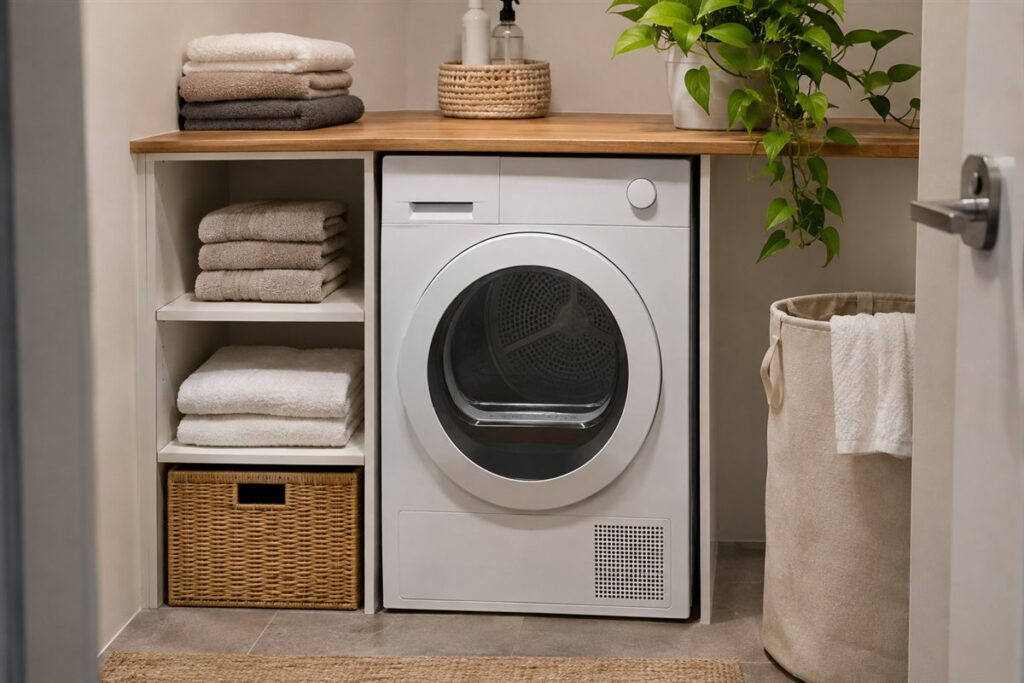
A ventless dryer dries clothes without a duct to the outside. Instead of blowing moist air out, it either condenses the water into a tank or drain, or it uses a heat pump to recycle warm air. That flexibility suits apartments, closets and rooms where a vent is hard to add. Before you shop, measure the space, check your power supply and decide how large a load you usually dry.
We have not used these products ourselves, so this guide does not claim personal experience with any of them. Instead it shows how to choose: which features matter, what to confirm on a product page and which common mistakes to avoid. Installation needs vary with each model, so read the manual and use a qualified installer where required.
As an Amazon Associate we earn from qualifying purchases. Links on this site are affiliate links, and they do not change the information we give.
In this guide
Quick Picks
| Pick | Product | Best For |
|---|---|---|
| 1 | LG DLHC1455W 24-Inch Heat Pump Dryer | Lowest running costs |
| 2 | Kenmore 4.0 Cu. Ft. Ventless Compact Dryer (26-81202) | Tight closets and apartments |
| 3 | GE GFT14ESSMWW 24-Inch Ventless Condenser Dryer | Proven condenser design |
| 4 | Samsung DV22N6800HW Heat Pump Dryer | Quick small loads |
| 5 | KoolMore FLD-5CWHP Ventless Heat Pump Dryer | Most capacity at 24 inches |
Our Picks
1. LG DLHC1455W 24-Inch Heat Pump Dryer — Best for lowest running costs
LG’s DLHC1455W is the efficiency pick of this list. Its Dual Inverter heat pump system reheats and recirculates the same air instead of blowing hot air outside, which is why this 4.2 cu. ft. dryer carries an ENERGY STAR rating with a CEF of 6.4 — strong numbers for a compact electric dryer. The 24-inch cabinet stacks over a matching washer or stands alone, and the reversible door helps in tight laundry closets. Inside, the NeveRust stainless steel drum is gentle on fabrics, while Sensor Dry checks moisture levels and ends the cycle when clothes reach the dryness you selected, so loads are not baked longer than needed. ThinQ Wi-Fi lets you start, stop and monitor cycles from your phone, and the 240V connection keeps dry times reasonable for a heat pump design. Choose it if low running costs matter more than raw speed.
View LG DLHC1455W 24-Inch Heat Pump Dryer on Amazon
2. Kenmore 4.0 Cu. Ft. Ventless Compact Dryer (26-81202) — Best for tight closets and apartments
The Kenmore 26-81202 is built for the spaces ventless dryers exist for: apartment closets, under-counter installs and small laundry rooms. The 4.0 cu. ft. condenser design needs no duct run at all — moisture is condensed inside the machine instead of being exhausted, so placement only depends on power and a way to empty or drain the collected water. At roughly 23.5 inches wide, 33.2 inches high and 24 inches deep, it fits where a full-size dryer will not. Sensor drying watches the load and stops the cycle when clothes are dry rather than running a fixed timer, which protects fabrics and trims energy use, and the LED display keeps cycle status readable at a glance. It is ENERGY STAR certified, and the compact cabinet can still stack or pair with a compact washer. Pick it when the footprint is the hard limit.
View Kenmore 4.0 Cu. Ft. Ventless Compact Dryer (26-81202) on Amazon
3. GE GFT14ESSMWW 24-Inch Ventless Condenser Dryer — Best for a proven condenser design
GE’s GFT14ESSMWW is the traditional condenser option here. The 4.1 cu. ft., 24-inch dryer pulls moisture out of the air with a condenser rather than a heat pump, runs on a 240V/30A circuit, and holds ENERGY STAR certification. The stainless steel basket resists snags, and the cycle set covers the everyday spread — Cottons, Mixed Loads, Delicates, Towels, Timed Dry and a Damp Dry option for pieces you plan to iron — with five temperature settings from High down to Air Fluff and four dryness levels. The trade-off of the condenser layout is upkeep: the condenser unit slides out from the bottom front and should be rinsed every few months to keep drying times from creeping up, a quick job GE documents step by step in the manual. Choose the GE if you prefer a simpler, proven condenser design from a mainstream brand.
View GE GFT14ESSMWW 24-Inch Ventless Condenser Dryer on Amazon
4. Samsung DV22N6800HW Heat Pump Dryer — Best for quick small loads
Samsung’s DV22N6800HW shows how frugal a heat pump dryer can be. It earned ENERGY STAR Most Efficient recognition with a CEF of 5.85 and an estimated 145 kWh per year, helped by the heat pump keeping drying temperatures low and gentle on clothes. The 4.0 cu. ft. drum sits in a 24-inch frame about 23.6 inches wide and 33.5 inches high, and Sensor Dry manages the 12 preset cycles. The standout is the 40 Minute Express Cycle, which takes a small load of about two pounds from wet to wearable quickly — handy for work clothes and gym gear. Condensed water can sit in the built-in tank for emptying, or leave through a drain hose if you have a floor drain or standpipe nearby. It runs on 240V like the other full performers here. Pick it for small, frequent loads.
View Samsung DV22N6800HW Heat Pump Dryer on Amazon
5. KoolMore FLD-5CWHP Ventless Heat Pump Dryer — Best for the most capacity at 24 inches
The KoolMore FLD-5CWHP squeezes the biggest drum on this list into a 24-inch cabinet: 4.4 cu. ft., where most compact ventless models stop at 4.0 to 4.2. The ventless heat pump system offers 16 drying cycles, including quick dry, wrinkle release and delicates programs, and sensor drying adjusts the time to the load instead of running a fixed countdown. KoolMore says the heat pump keeps temperatures below 120°F, which is kinder to elastic, prints and technical fabrics than conventional high-heat drying, and the model is ENERGY STAR certified. The zinc-coated steel drum and 240V supply keep it aimed at real household loads rather than just delicates, and at about 23.4 inches wide and 33.5 inches high it still fits a standard compact laundry spot and stacks. Choose it when you want maximum capacity without giving up the ventless install.
View KoolMore FLD-5CWHP Ventless Heat Pump Dryer on Amazon
What to Look For
| Factor | Why it matters | What to check |
|---|---|---|
| Dryer design | Condenser and heat pump models work differently | Read how the maker describes the heat source and the drying time |
| Drum capacity | Small drums mean more loads | Compare the stated capacity with your usual laundry load |
| Water removal | Collected moisture has to go somewhere | Check whether it uses a tank you empty or a drain hose |
| Cycle options | Delicates and bulky items need different settings | Look at the cycle list and any sensors that detect dryness |
| Size and power | Compact units fit tight spaces but may need special outlets | Measure width, depth and height, and confirm the voltage required |
| Lint filter and upkeep | Filters and heat exchangers need regular cleaning | See where the filters are and how easy they are to reach |
Setup and Care Tips
- Place the dryer on a level floor with the clearance the manual lists.
- Empty the water tank after each cycle if the model has one.
- Clean the lint filter every time and follow the maker’s steps for the condenser.
- Do not overload the drum, and shake out wet items before loading.
- Keep the room well aired, since the unit gives off some warmth.
Mistakes to Avoid
- Ignoring the electrical requirement in the room.
- Forgetting that the tank needs emptying or a drain connection.
- Choosing a compact drum for large family loads.
- Skipping filter cleaning between loads.
- Buying without measuring door swing and the stacking option.
Heat Pump or Condenser: Which Technology Fits Your Home
Ventless dryers fall into two broad families, and the difference affects how you live with the machine every week. A condenser model heats air, passes it through the drum, then cools it so the moisture turns to water. A heat pump model uses a sealed refrigerant circuit to do the same job, reusing most of the warmth instead of making fresh heat on every cycle.
In general terms, heat pump designs use less electricity per load and run at gentler temperatures, which many people like for knits and delicate fabrics. The trade-off is that cycles are usually longer and the unit often costs more to buy. Condenser designs tend to be simpler, sometimes quicker, and may suit a household that does small, frequent loads and wants a lower entry cost.
Neither type is automatically better. If your laundry is heavy and constant, the efficiency of a heat pump adds up over the years. If you dry only a few loads a week, the simpler machine may make more sense. Check the listing for the technology named in the specifications, and read the maker’s manual for exact cycle behaviour before you decide.
Reading the Specification Sheet Without Getting Lost
Product pages pack in numbers, and only a few of them change your day-to-day experience. Begin with drum capacity, which is quoted in cubic feet. A bigger drum lets clothes tumble freely, which usually helps them dry more evenly. Next, look at the outer dimensions, because a dryer that fits your closet on paper may not leave room for door swing or airflow around the cabinet.
Then check these details:
- Electrical needs: the voltage and plug type, since some models run from a standard outlet and others need a dedicated circuit.
- Water handling: whether the condensate goes to a removable tank, a drain hose, or both.
- Cycle list: sensor drying, a timed option, a delicate setting and an anti-crease option.
- Door: hinge side and whether it can be reversed.
- Noise: any decibel figure, which is only useful when compared across the same maker’s method.
Treat marketing phrases with care and favour measurable facts. When a figure seems unclear, the product listing or the maker’s support pages should settle it.
Planning the Electrical and Drainage Side
Because there is no vent to cut through a wall, people sometimes assume installation is trivial. It is simpler than ducting, but two things still need thought: power and water.
For power, confirm what the dryer requires and what your outlet provides. If a new circuit or outlet is needed, that is work for a licensed electrician, not a weekend experiment. Follow the maker’s installation instructions and local rules for anything involving household wiring.
For water, decide how the condensate leaves the machine. A tank is easy and needs no plumbing, but someone must empty it, and a full tank can interrupt a cycle on some models. A drain hose can run to a laundry sink or standpipe, which removes that chore. Hose length, height limits and secure fastening are covered in the manual, so read that section before you pick a spot. If you would rather not empty a tank daily, favour a model with a clear drain option.
Sizing the Machine to Your Household
Drum size should follow the way you really wash. A single person or couple who washes a few items at a time can live happily with a compact drum. A family that washes bedding, towels and school clothes needs something larger, or the dryer becomes a bottleneck.
Match the dryer to your washer if you can. A washer that holds more than the dryer means you split loads or leave damp items behind. Heat pump and condenser dryers also dry better when the drum is not crammed full, so leave space for air to move through clothes.
| Household | Typical laundry pattern | What to prioritise |
|---|---|---|
| One or two people | Small loads, a few times a week | Compact footprint, easy drainage |
| Small family | Daily mixed loads | Mid-size drum, sensor drying, efficient operation |
| Large family | Bedding and towels in bulk | Largest drum that fits, reliable drain setup |
| Shared building | Occasional loads, limited space | Slim cabinet, simple controls |
Fabric Care and Cycle Choices
The cycle menu is where a ventless dryer pays you back or lets you down. Sensor cycles measure moisture and stop when the load is ready, which protects fabrics from being overdried. Timed cycles give control when you want a short refresh or when you are finishing a damp item.
Always follow the care label on each garment. Items marked for low heat or air drying should not go into a regular cycle just because the machine offers many programs. Wool, silk, some activewear and anything with delicate trim are common examples where the label rules.
Sort loads by fabric weight too. Mixing a heavy towel with a thin shirt leaves the shirt dry and the towel damp, so the cycle runs longer than needed. Shake out tangled items before loading, and avoid stuffing a drum to the top. If you have a sanitise or steam option, treat it as a convenience feature and rely on the manual for what it actually does.
Maintenance Habits That Keep Performance Steady
Ventless machines are sensitive to lint and dust because the air circulates inside a closed path. A blocked filter or coated heat exchanger makes cycles slower and can make the unit work harder. The routine is short, but it needs to be regular.
- Clear the lint filter after every load, and rinse it now and then if the mesh looks filmy from fabric softener residue.
- Empty the water tank after each cycle if your model uses one.
- Wipe the door seal and the area around it so lint does not build up.
- Clean the condenser or heat exchanger on the schedule the manual describes, using the method the maker recommends.
- Keep the area around the cabinet clear so the machine can shed heat.
Some models show a reminder light for the heat exchanger or filter. Do not ignore it. If a part needs more than ordinary cleaning, contact the maker or a qualified technician rather than forcing panels open.
Troubleshooting Long Cycles and Damp Clothes
When laundry comes out damp, resist the urge to run another full cycle straight away. Work through a few likely causes first.
Check the load
An overloaded drum is the most common reason clothes stay wet. Remove a few items and try again with a smaller batch, or split bulky pieces into separate loads.
Check airflow and room conditions
Lint on the filter or heat exchanger slows everything down. A very cold or very hot room can also change how long a cycle takes, since the machine relies on room air for its work. Leave space behind and beside the unit.
Check the drain
A full tank or a kinked drain hose can stop or slow a cycle. Empty the tank and straighten the hose before blaming the dryer itself.
Check the washer
If the washer leaves clothes dripping, the dryer inherits the problem. A faster spin speed in the washer cuts drying time more than almost any dryer setting. If problems persist after these checks, use the maker’s support line.
Who Should Choose Which Type, and Who Should Skip
A heat pump dryer suits people who run loads often, care about running costs over many years, and want gentler treatment of fabrics. It may not suit someone who needs very fast turnaround, because longer cycles are common.
A condenser dryer suits a smaller budget, a lighter laundry routine, or a spot where a simple machine is preferable. It may not be the right pick for a busy household that cares about every bit of efficiency.
Skip a ventless dryer altogether if you already have a working vent and a spacious laundry room, since a conventional vented model may meet your needs more simply. Skip very compact units if you regularly wash comforters or large bedding, because they will not tumble properly.
Quick Pre-Purchase Checklist
- Measure the space, including door swing and clearance.
- Confirm the outlet and any electrical requirement with the maker’s instructions.
- Decide between tank and drain hose.
- Compare drum size to your washer.
- Read the care and cleaning section of the manual before buying.
Noise, Heat and Where the Machine Lives
A ventless dryer does not send warm, damp air outside, so a little of that energy stays in the room. Condenser models can make a small space feel warmer during a cycle, while heat pump models usually add less. If the dryer sits in a closet, make sure the door can stay open or louvred during use, and follow the maker’s guidance on ventilation around the cabinet.
Noise matters more than people expect when the laundry area is next to a bedroom or an open-plan living room. Compressors, fans and tumbling clothes each add sound. A figure in decibels on a listing gives a rough idea, but different makers measure differently, so use it only as a loose guide. Placing the machine on a firm, level floor and adjusting the feet as the manual describes reduces vibration and rattling.
A Worked Example: Choosing for a Small Apartment
Picture a two-person apartment with a washer and dryer closet that measures only slightly wider than a standard appliance. They wash two or three loads a week and have no way to run a vent. Step one is measuring the opening width, height and depth, then subtracting room for the door and hoses. Step two is checking the outlet. Step three is picking a drainage method: a laundry sink nearby makes a drain hose possible, otherwise the tank route is the sensible choice.
With that done, they compare two models. One has a larger drum but barely fits; the other is slimmer and leaves breathing room. In a tight closet the slimmer unit is the safer pick, because poor airflow slows every cycle. The lesson is to let the space and the plumbing decide first, and use features to break ties.
Short Glossary of Terms You Will Meet
- Condensate: the water removed from clothes during drying.
- Heat exchanger: the part that cools moist air so water drops out; it needs periodic cleaning.
- Sensor drying: a program that ends when the load reaches a preset dryness.
- Anti-crease: a tumble pattern after the cycle that reduces wrinkles.
- Reversible door: a door whose hinge can be switched to the other side.
Finally, keep the manual somewhere easy to find. Cycle names and cleaning steps differ between makers, and a quick look at the correct page often solves a problem faster than guessing.
FAQ
Do ventless dryers take longer?
Many makers state that cycles can be longer than with a vented model, especially for heat pump designs that dry at a lower temperature. Check the cycle details on the product page and think about whether that fits your routine. Lower drying temperatures are often described as gentler on fabrics, but that is the maker’s own claim, so read the care labels on your clothes too.
Can I stack it on a washer?
Some compact models are designed for stacking with a matching washer, often with a kit. Confirm this on the product page, because not every dryer supports it. Also check the door swing, since a reversible door can be useful in a tight closet or hallway, and leave room behind the unit for hoses and cords.
Choosing ventless dryers in Practice: A Deeper Look at the Details That Matter
The short checklists earlier in this guide name the main things to compare, but most buyers only discover what really matters after the first few weeks of use, when the ventless dryer has to fit into a real routine in apartments, closets, and homes without external venting. This section slows the decision down and looks at each factor on its own, so you can weigh the trade-offs calmly instead of guessing from a product photo. None of these points replaces the maker’s own specifications or instructions, and you should always confirm the exact details on the listing for the model you are considering. What this section gives you is a way to read those listings with better questions in mind, and a clearer sense of which compromises are harmless for your situation and which ones will annoy you every single time you reach for the ventless dryer.
Technology: heat pump or condenser
Heat pump dryers reuse their heat and use notably less energy, running cooler and gentler, while condenser models are simpler and often faster. Both collect water in a tank or drain it away, and the choice shapes running costs, cycle times, and how warm the room gets. For a ventless dryer, this matters more than it first appears, because it shapes how the drying laundry without a vent to the outside goes on an ordinary day rather than on the one careful occasion when everything is set up perfectly. Compare this point across the picks in this guide using the same test each time: picture the job you do most often, in the place you do it, with the time and space you actually have. If a model looks strong on paper but awkward under that test, trust the test. It is also worth writing down the one or two requirements you will not compromise on before you start comparing, because listings are designed to pull your attention toward whatever each maker does best, and a written priority list keeps the comparison honest from the first model to the last.
Capacity against your washer and loads
Compact ventless dryers hold less than full-size vented machines, so match capacity to your actual load sizes rather than your ambitions. A dryer that forces two cycles for every wash load doubles its apparent slowness, whatever its technology. For a ventless dryer, this matters more than it first appears, because it shapes how the drying laundry without a vent to the outside goes on an ordinary day rather than on the one careful occasion when everything is set up perfectly. Compare this point across the picks in this guide using the same test each time: picture the job you do most often, in the place you do it, with the time and space you actually have. If a model looks strong on paper but awkward under that test, trust the test. It is also worth writing down the one or two requirements you will not compromise on before you start comparing, because listings are designed to pull your attention toward whatever each maker does best, and a written priority list keeps the comparison honest from the first model to the last.
Cycle times and expectations
Ventless drying, especially heat pump drying, takes longer than old vented machines, and planning around that fact is the difference between satisfaction and resentment. Judge the machine by whether its rhythm fits your laundry habits, not by a stopwatch borrowed from vented drying. For a ventless dryer, this matters more than it first appears, because it shapes how the drying laundry without a vent to the outside goes on an ordinary day rather than on the one careful occasion when everything is set up perfectly. Compare this point across the picks in this guide using the same test each time: picture the job you do most often, in the place you do it, with the time and space you actually have. If a model looks strong on paper but awkward under that test, trust the test. It is also worth writing down the one or two requirements you will not compromise on before you start comparing, because listings are designed to pull your attention toward whatever each maker does best, and a written priority list keeps the comparison honest from the first model to the last.
Water handling: tank or drain
Models collect condensed water in a tank you empty, or drain it via a hose to a sink or standpipe. If a drain is available, plumbed drainage removes a chore; if not, tank size and how easy it is to empty become weekly facts. For a ventless dryer, this matters more than it first appears, because it shapes how the drying laundry without a vent to the outside goes on an ordinary day rather than on the one careful occasion when everything is set up perfectly. Compare this point across the picks in this guide using the same test each time: picture the job you do most often, in the place you do it, with the time and space you actually have. If a model looks strong on paper but awkward under that test, trust the test. It is also worth writing down the one or two requirements you will not compromise on before you start comparing, because listings are designed to pull your attention toward whatever each maker does best, and a written priority list keeps the comparison honest from the first model to the last.
Heat and moisture in the room
Ventless dryers keep their moisture in the water tank, but they still warm the room and add some humidity, heat pumps least of all. Small, unventilated closets need thought about airflow around the machine, which makers specify as clearances. For a ventless dryer, this matters more than it first appears, because it shapes how the drying laundry without a vent to the outside goes on an ordinary day rather than on the one careful occasion when everything is set up perfectly. Compare this point across the picks in this guide using the same test each time: picture the job you do most often, in the place you do it, with the time and space you actually have. If a model looks strong on paper but awkward under that test, trust the test. It is also worth writing down the one or two requirements you will not compromise on before you start comparing, because listings are designed to pull your attention toward whatever each maker does best, and a written priority list keeps the comparison honest from the first model to the last.
Noise and vibration in living spaces
Apartments put dryers near bedrooms and neighbours, so noise levels and anti-vibration behaviour matter more than in a distant utility room. A compact machine on an upper floor that walks across the boards will be run less and resented more. For a ventless dryer, this matters more than it first appears, because it shapes how the drying laundry without a vent to the outside goes on an ordinary day rather than on the one careful occasion when everything is set up perfectly. Compare this point across the picks in this guide using the same test each time: picture the job you do most often, in the place you do it, with the time and space you actually have. If a model looks strong on paper but awkward under that test, trust the test. It is also worth writing down the one or two requirements you will not compromise on before you start comparing, because listings are designed to pull your attention toward whatever each maker does best, and a written priority list keeps the comparison honest from the first model to the last.
Real-World Situations: Matching ventless dryers to How You Will Actually Use Them
Specifications are tidy, but real use is not. The same ventless dryer can feel like exactly the right purchase in one household and like a mistake in another, and the difference is usually the situation rather than the product itself. The scenarios below describe the patterns that come up most often for buyers of ventless dryers. Find the one that sounds most like your life, and let it steer which pick you lean toward and which features you treat as essential rather than nice to have. If two scenarios both sound familiar, weight the one that happens more often, because a ventless dryer earns its keep in the repeated weekly routine, not in the rare special case.
The apartment without venting
This is the ventless dryer’s home ground: no external wall vent exists, and the choice is ventless or the launderette. Compact size, a water tank or nearby drain, and tolerable noise define the right model, and heat pump efficiency suits metered electricity. In this situation, the sensible approach is to judge the ventless dryer by how it behaves when you are busy, tired, or short on time, not by how it performs in a careful first trial. Think about where it will live between uses, who else might use it, and what happens on the day something goes slightly wrong. Buyers who think through those unglamorous details in advance tend to be far happier months later, because the frustrations that make people give up on a purchase are almost always about fit, access, and routine rather than about headline performance. A model that fits the routine survives; one that fights the routine ends up ignored, however impressive its listing looked.
The small household doing small loads
Singles and couples washing modest loads find compact capacity sufficient and cycle times painless, because loads dry while life happens. Right-sizing here saves money, space, and energy compared with a full-size machine run half empty. In this situation, the sensible approach is to judge the ventless dryer by how it behaves when you are busy, tired, or short on time, not by how it performs in a careful first trial. Think about where it will live between uses, who else might use it, and what happens on the day something goes slightly wrong. Buyers who think through those unglamorous details in advance tend to be far happier months later, because the frustrations that make people give up on a purchase are almost always about fit, access, and routine rather than about headline performance. A model that fits the routine survives; one that fights the routine ends up ignored, however impressive its listing looked.
The family adding a second dryer
Some households add a compact ventless unit for delicates, baby clothes, or overflow where venting is impossible. In this supporting role, gentleness and placement flexibility matter more than raw capacity. In this situation, the sensible approach is to judge the ventless dryer by how it behaves when you are busy, tired, or short on time, not by how it performs in a careful first trial. Think about where it will live between uses, who else might use it, and what happens on the day something goes slightly wrong. Buyers who think through those unglamorous details in advance tend to be far happier months later, because the frustrations that make people give up on a purchase are almost always about fit, access, and routine rather than about headline performance. A model that fits the routine survives; one that fights the routine ends up ignored, however impressive its listing looked.
The energy-focused home
Heat pump models are the efficiency champions of laundry, and for households watching running costs or carbon, the slower cycle is a fair trade. Over years of weekly loads, the energy difference is the purchase argument that keeps paying. In this situation, the sensible approach is to judge the ventless dryer by how it behaves when you are busy, tired, or short on time, not by how it performs in a careful first trial. Think about where it will live between uses, who else might use it, and what happens on the day something goes slightly wrong. Buyers who think through those unglamorous details in advance tend to be far happier months later, because the frustrations that make people give up on a purchase are almost always about fit, access, and routine rather than about headline performance. A model that fits the routine survives; one that fights the routine ends up ignored, however impressive its listing looked.
The closet installation
A ventless dryer in a closet needs its clearances, a door arrangement that allows airflow as the maker specifies, and thought about the warmth it adds. Installed thoughtfully it disappears into the home; installed tightly it underperforms and overheats its cupboard. In this situation, the sensible approach is to judge the ventless dryer by how it behaves when you are busy, tired, or short on time, not by how it performs in a careful first trial. Think about where it will live between uses, who else might use it, and what happens on the day something goes slightly wrong. Buyers who think through those unglamorous details in advance tend to be far happier months later, because the frustrations that make people give up on a purchase are almost always about fit, access, and routine rather than about headline performance. A model that fits the routine survives; one that fights the routine ends up ignored, however impressive its listing looked.
Getting Started Step by Step
A careful first session sets the pattern for everything that follows. Rushing the first use of a new ventless dryer is how small mistakes turn into habits, and habits are much harder to fix than a single slow start. Work through the steps below in order the first time, even if some of them feel obvious, and keep the maker’s manual open alongside them, because the manual is the authority for your exact model and this sequence is the general routine that applies across the picks in this guide.
Step 1: Confirm space, clearances, and power first
Measure the alcove including door swing, check the maker’s clearance requirements for airflow, and confirm the electrical supply matches. Compact dryers often fit where vented ones cannot, but they still need to breathe and to be reached for filter cleaning. Take your time over this step rather than treating it as a formality. Small checks made now are far cheaper than corrections made later, and they teach you how your particular ventless dryer behaves, which makes every later session faster and calmer. If something feels wrong at this point, stop and re-read the relevant part of the manual instead of pushing on and hoping it settles, because forcing a setup that is not right rarely improves it and can turn a simple adjustment into real damage or a job that has to be started again from the beginning.
Step 2: Decide tank or drain before installation
If a drain hose can reach a sink or standpipe as the maker allows, set it up at installation and forget the tank. If not, place the machine so the tank is easy to reach, because you will empty it constantly and awkward access becomes skipped access. Take your time over this step rather than treating it as a formality. Small checks made now are far cheaper than corrections made later, and they teach you how your particular ventless dryer behaves, which makes every later session faster and calmer. If something feels wrong at this point, stop and re-read the relevant part of the manual instead of pushing on and hoping it settles, because forcing a setup that is not right rarely improves it and can turn a simple adjustment into real damage or a job that has to be started again from the beginning.
Step 3: Level the machine carefully
Adjust the feet until the dryer sits level and steady, especially on upper floors. An unlevel compact dryer vibrates, wanders, and drums its way through every cycle, and five minutes with a spirit level prevents years of it. Take your time over this step rather than treating it as a formality. Small checks made now are far cheaper than corrections made later, and they teach you how your particular ventless dryer behaves, which makes every later session faster and calmer. If something feels wrong at this point, stop and re-read the relevant part of the manual instead of pushing on and hoping it settles, because forcing a setup that is not right rarely improves it and can turn a simple adjustment into real damage or a job that has to be started again from the beginning.
Step 4: Sort loads for ventless success
Avoid overloading, separate heavy cottons from light synthetics where programmes allow, and shake items out as they go in. Ventless dryers reward reasonable loads with reasonable times, and punish the stuffed drum with marathon cycles. Take your time over this step rather than treating it as a formality. Small checks made now are far cheaper than corrections made later, and they teach you how your particular ventless dryer behaves, which makes every later session faster and calmer. If something feels wrong at this point, stop and re-read the relevant part of the manual instead of pushing on and hoping it settles, because forcing a setup that is not right rarely improves it and can turn a simple adjustment into real damage or a job that has to be started again from the beginning.
Step 5: Learn the programmes on real laundry
Run your typical loads through the likely programmes in the first weeks and note which settings actually dry your clothes, not the theoretical ones. Every household’s laundry mix is different, and your own programme map is the manual supplement you will actually use. Take your time over this step rather than treating it as a formality. Small checks made now are far cheaper than corrections made later, and they teach you how your particular ventless dryer behaves, which makes every later session faster and calmer. If something feels wrong at this point, stop and re-read the relevant part of the manual instead of pushing on and hoping it settles, because forcing a setup that is not right rarely improves it and can turn a simple adjustment into real damage or a job that has to be started again from the beginning.
Step 6: Build the filter habit from day one
Decide now that the lint filter gets cleaned after every load, without exception. In ventless machines the filters and condenser care are the performance, and the habit is trivially easy at the start and strangely hard to retrofit. Take your time over this step rather than treating it as a formality. Small checks made now are far cheaper than corrections made later, and they teach you how your particular ventless dryer behaves, which makes every later session faster and calmer. If something feels wrong at this point, stop and re-read the relevant part of the manual instead of pushing on and hoping it settles, because forcing a setup that is not right rarely improves it and can turn a simple adjustment into real damage or a job that has to be started again from the beginning.
The Short Version
Measure the space and check the power supply first. Compare the dryer design, drum size, water removal method and filter upkeep, and read the installation guide before you order.
Related Guides
- Vented vs Ventless Dryers Made Simple: What Sets Them Apart
- How to Choose the Best Gas Dryers: Buyer's Guide (2026)
- How to Choose the Best Heat Pump Dryers: Buyer's Guide (2026)
- How to Choose the Best Pet Grooming Dryers: Buyer's Guide (2026)
- 6 Best Electric Dryers: Compact 110V and 120V Models (2026)