Disclosure: airfryerkitchensupply.com is reader-supported. When you buy through links on our site, we may earn an affiliate commission at no extra cost to you.
Where to Buy
All six picks are on Amazon:
- SEBO AIRBELT K2 Kombi
- Atrix Lil Red Canister
- Shark Navigator NV360
- Bissell Hard Floor Expert 1547
- Eureka 3670H Canister
- Hoover PortaPower Canister
Choosing the best vacuum for braided rugs is really choosing what touches the rug. A braided rug is sewn or woven in loops and rows, and an aggressive spinning brush bar can catch those loops, fuzz the fibres and work stitches loose over time — while a vacuum with no way to calm down can pull at a lightweight braid hard enough to bunch it. The features that matter are therefore specific: a nozzle made for bare floors and area rugs, a brushroll you can switch off, or a motor whose speed you can turn down. Every pick in this guide has at least one of those gentling features stated in its verified listing title.
One honesty rule runs through the whole guide: no vacuum is ‘safe for every braided rug’, and this article will not claim otherwise. Braids differ — wool, cotton, jute, synthetic, reversible, antique — and the rug maker’s care guidance always outranks a vacuum review. What a good pick does is give you control: the right nozzle, an off switch for the brush, or variable speed, so you can clean thoroughly at the gentlest effective setting. Prices move constantly in this category, so check the current price on Amazon for the machine that matches your rugs and your floors.
Key Takeaways
- Control beats power: a rug nozzle, a brushroll shutoff or a variable-speed dial.
- No vacuum is safe for every braided rug — the rug maker’s care label outranks any review.
- Canisters keep weight off the braid; four of the six picks are canisters.
- Vacuum the underside and the floor beneath monthly — hidden grit is the real wear.
In this guide
Quick Picks
Best Overall for Braided Rugs — SEBO AIRBELT K2 Kombi Canister Vacuum (9679AM): Braided rug owners who want the gentlest mainstream tool and vacuum often. Check price on Amazon
Best Variable Speed Control — Atrix Lil Red Canister Vacuum (AHSC-1): Small homes and anyone who wants a suction dial as their braided-rug safety control. Check price on Amazon
Best Upright with Brushroll Shutoff — Shark Navigator Lift-Away NV360: Families who need one upright for the whole house and will use the shutoff on their braided rugs. Check price on Amazon
Best Bagless Canister — Bissell Hard Floor Expert Multi-Cyclonic Canister (1547): Bagless loyalists with mostly hard floors and braided rugs as the soft surfaces. Check price on Amazon
Best Lightweight Canister — Eureka 3670H Bagged Canister Vacuum: Budget-minded owners who want a light, simple canister for rugs and hard floors. Check price on Amazon
Best Portable Canister — Hoover PortaPower Lightweight Canister Vacuum: Apartment dwellers and anyone who wants a carry-it-anywhere canister for rugs and floors. Check price on Amazon
How These Picks Were Chosen
Vacuums were verified through Amazon listing held for this site, then filtered by a single question: does the title state a feature that lets the machine clean gently and controllably? The survivors qualify in different ways — a Kombi nozzle described as made for bare floors and area rugs only, a variable speed motor, a brushroll shutoff, and canister formats whose floor tools are inherently calmer than a driven brush bar. Suction figures were not invented for any pick: where a title states no suction number, none appears here, because braided-rug care is about control, not raw power.
The six were balanced across budgets of effort as much as money: a premium German canister for households that vacuum daily, a compact variable-speed canister for small homes, an upright with a shutoff for families who need one machine for everything, a bagless hard-floor canister, and two lightweight bagged canisters that are easy to carry to the rug instead of dragging the rug to them. Each review states plainly which gentling feature qualifies the machine — and what it does not promise.
One category was deliberately left out: robot vacuums. Several use rotating brushes similar in effect to an upright’s brush bar, and their behaviour on a braid’s edge — climbing, bunching, tugging — varies too much by model and rug to certify in a guide that refuses blanket safety claims. If you run a robot and own braided rugs, the FAQ explains the cautious way to test it. Everything recommended here is a machine whose gentling feature could be verified in its own listing title, and that verifiability — not brand, not price — is what earned each pick its place.
The 6 Best Vacuum for Braided Rugs

SEBO AIRBELT K2 Kombi Canister Vacuum (9679AM) — Best Overall for Braided Rugs
The SEBO K2 Kombi leads because its title states the ideal braided-rug tool: a Kombi nozzle made for bare floors and area rugs only — suction cleaning, no driven brush bar.
Strengths
- Kombi nozzle is designed for bare floors and area rugs — suction cleaning without a driven brush bar worrying the braid
- Canister format glides the tool across the rug instead of pushing a heavy upright over it
- 37 ft operating radius means the canister stays put while you work a large rug
Trade-offs
- Premium machine at a premium tier — check price on Amazon against simpler canisters
- Suction-only cleaning is gentler but slower on deep grit than a brush bar on ordinary carpet
- Bagged format means ongoing bag costs, the price of its filtration
| Specification | Detail (from verified listing title) |
|---|---|
| Floor tool (per title) | Kombi nozzle — made for bare floors and area rugs only |
| Filtration (per title) | S-class filtration |
| Reach (per title) | 37 ft operating radius |
| Warranty (per title) | 7-year motor warranty |
Most vacuum buying is a hunt for more aggression; braided rugs reward the opposite. The Kombi nozzle is a combination floor tool that cleans by suction across a smooth sole, which means nothing rotating touches the braid’s loops and stitches while it works. That single design decision removes the main mechanical risk braided rugs face from vacuuming. The canister format helps too: the heavy motor stays behind you while a light tool crosses the rug, so you control pressure precisely, and the 37-foot operating radius in the title means large rugs are cleaned without constantly relocating the machine. S-class filtration and a seven-year motor warranty, both stated in the title, mark this as a buy-once machine. The honest costs are price tier and pace — suction-only cleaning takes a little longer to lift deep grit than a brush bar would on ordinary carpet, and bags are a running cost. For a rug you intend to keep for decades, that trade is the right way round.
Best for: Braided rug owners who want the gentlest mainstream tool and vacuum often / Not suited for: Anyone wanting one aggressive machine for deep-pile carpet above all else
Check the current price on Amazon

Atrix Lil Red Canister Vacuum (AHSC-1) — Best Variable Speed Control
The Lil Red’s qualifying feature is control: a variable speed motor, stated in its title, in a portable canister with a HEPA filter.
Strengths
- Variable speed motor in the title — turn suction down for a delicate or lightweight braid, up for the rest of the house
- Compact portable canister is easy to carry to the rug and store in small homes
- HEPA filter in a 2 quart system suits homes that vacuum up fine dust regularly
Trade-offs
- Compact capacity means more frequent emptying or bag changes in big homes
- Title names no dedicated rug nozzle — technique (slow passes, low speed) does the gentling
- Not the pick for wall-to-wall deep carpet cleaning across a large house
| Specification | Detail (from verified listing title) |
|---|---|
| Motor (per title) | Variable speed motor |
| Filtration (per title) | 2 quart HEPA filter |
| Format | Portable canister |
| Suction figure | Not stated in title |
If the SEBO’s answer to braided rugs is the right nozzle, the Atrix answer is the right dial. A variable speed motor lets you start a delicate or lightweight braid on a low setting — enough to lift surface dust without dragging the rug across the floor or stressing its stitches — and only turn up as far as the rug tolerates. That adjustability is also what makes the machine useful beyond rugs: full speed for hard floors and upholstery, low speed for curtains and the braid. The portable canister format suits smaller homes and anyone who stores the vacuum in a cupboard rather than a utility room, and the HEPA filter in the title is a genuine plus for the fine dust that braided natural fibres shed. The limits are scale and specificity: a 2 quart system fills faster in a big house, and with no named rug nozzle in the title, gentle technique — slow passes, low speed first — is part of the deal. As a control-first pick, it earns its place.
Best for: Small homes and anyone who wants a suction dial as their braided-rug safety control / Not suited for: Large homes needing big capacity, or buyers wanting a named rug-specific floor tool
Check the current price on Amazon

Shark Navigator Lift-Away NV360 — Best Upright with Brushroll Shutoff
The NV360 is the upright that respects braids: its title states a brushroll shutoff, so the brush spins on carpet and stops on your braided rug.
Strengths
- Brushroll shutoff stated in the title — cross a braided rug with the brush off, suction only
- Lift-away pod detaches for stairs, edges and above-floor cleaning around the rug
- One machine covers carpet, hard floors and rugs for households that want a single vacuum
Trade-offs
- An upright is heavier to push across a delicate rug than a canister tool — lift-away mode helps
- 0.9 qt cup fills quickly in pet homes
- Brush-off suction cleans a braid more gently but less deeply than brush-on carpet cleaning
| Specification | Detail (from verified listing title) |
|---|---|
| Key feature (per title) | Brushroll shutoff |
| Format | Lift-away pod upright |
| Dust cup (per title) | 0.9 qt |
| Filtration (per title) | HEPA |
The brushroll shutoff is the single most useful upright feature for braided rug owners, and the NV360’s title states it plainly. The routine it enables is exactly right: brush on for the fitted carpet, brush off as you cross onto the braid, so the rug gets suction cleaning without a rotating bar worrying its loops. Shark’s lift-away pod adds the second act — detach it and the machine becomes a portable can for the rug’s edges, the stairs and the skirting where braid-adjacent dust collects, with the upholstery and crevice tools named in the title. HEPA filtration rounds out a genuinely family-grade machine. Honesty requires the format caveat: even with the brush off, an upright carries its weight over the rug on its wheels, and on a very delicate or antique braid a canister’s light floor tool is still the gentler instrument. For the common case — a sturdy modern braid in a busy family home — the NV360’s shutoff makes it the most practical one-machine answer here.
Best for: Families who need one upright for the whole house and will use the shutoff on their braided rugs / Not suited for: Purists who want a canister-only routine for valuable or antique braids
Check the current price on Amazon
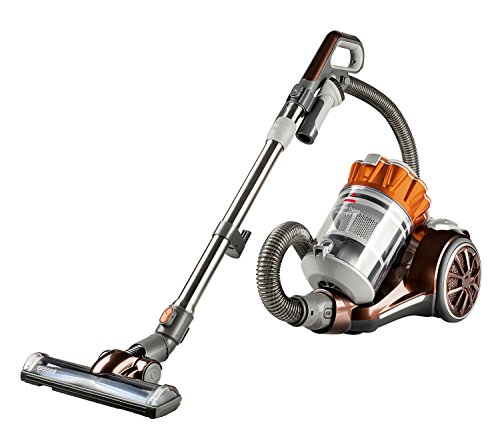
Bissell Hard Floor Expert Multi-Cyclonic Canister (1547) — Best Bagless Canister
Bissell’s Hard Floor Expert is the bagless canister pick: a multi-cyclonic machine built around hard floors, whose gentle floor-tool approach suits braided rugs laid on them.
Strengths
- Hard-floor-first canister design — a calm floor tool rather than an aggressive carpet head
- Bagless multi-cyclonic system means no bags to buy for routine rug and floor care
- Canister format keeps the tool light across braided surfaces
Trade-offs
- Title states no variable speed or rug-specific nozzle — gentle technique still matters
- Bagless bins need regular emptying and filter care to keep suction honest
- Hard-floor focus means it is not the deep-carpet specialist of a house full of pile
| Specification | Detail (from verified listing title) |
|---|---|
| Format | Bagless canister, corded |
| Positioning (per title) | Hard Floor Expert |
| Dust system (per title) | Multi-cyclonic |
| Suction figure | Not stated in title |
Braided rugs usually live on hard floors, and a vacuum designed hard-floor-first starts from the right temperament: its floor tool is made to glide and lift by suction rather than to beat a pile into submission. In canister form, that tool crosses a braid lightly, with the machine’s weight trailing behind you instead of pressing through the head. The bagless multi-cyclonic system suits households that vacuum often and dislike consumables — empty the bin, keep the filters clean, and suction stays consistent for the quick, frequent passes that braided rugs actually prefer over rare deep assaults. The review must be plain about what the title does not say: no variable speed and no rug-specific nozzle are claimed, so the gentleness here is format and temperament rather than a dedicated control, and on a fragile braid the SEBO’s Kombi tool or the Atrix dial remain the more deliberate choices. For everyday braids on hard floors, it is a sound, economical formula.
Best for: Bagless loyalists with mostly hard floors and braided rugs as the soft surfaces / Not suited for: Deep-carpet households, or anyone wanting a stated speed control or rug nozzle
Check the current price on Amazon

Eureka 3670H Bagged Canister Vacuum — Best Lightweight Canister
The Eureka 3670H is the light-and-simple canister: bagged, easy to carry, with a blower function — a gentle format for braided rugs at a value tier.
Strengths
- Lightweight canister — carry it to the rug; the light floor tool is kind to braids
- Bagged system keeps fine dust contained, a plus with natural-fibre rugs
- Blower function clears the porch and garage where rug-shaking happens
Trade-offs
- Title states no speed control or brush shutoff — gentleness comes from the canister format
- Compact canisters have smaller bags; busy homes will change them often
- A value-tier machine — manage expectations on fit and finish
| Specification | Detail (from verified listing title) |
|---|---|
| Format | Bagged canister, lightweight |
| Supplied (per title) | Includes 2 bags |
| Extra (per title) | Blower function |
| Stated use (per title) | Hardwood floor, carpet, pet, car |
Sometimes the right vacuum for a braided rug is not a flagship; it is a light canister you will actually fetch. The 3670H’s virtues are exactly that: it is light enough to carry one-handed to wherever the rug lives, its floor tool cleans by suction in the calm canister manner, and the bagged system keeps the fine dust that braids shed sealed away when you empty it — a small mercy for allergy-prone households. The title’s blower function earns a mention for rug owners specifically: the same machine that vacuums the braid can blow out the porch or garage floor where you shake it. The compromises are the value tier’s usual ones, stated plainly: no speed control or shutoff appears in the title, bags are small and will turn over quickly in a busy house, and fit and finish will not match the SEBO. As an honest, gentle, inexpensive rug-and-floors machine, it does its job.
Best for: Budget-minded owners who want a light, simple canister for rugs and hard floors / Not suited for: Anyone wanting premium filtration, a long warranty story or deep-carpet power
Check the current price on Amazon

Hoover PortaPower Lightweight Canister Vacuum — Best Portable Canister
Hoover’s PortaPower is the commercial portable: a lightweight bagged canister with attachments and a blower mode, made to be carried wherever the cleaning is.
Strengths
- Commercial-grade portability — built to be carried room to room all day
- Attachments included for edges, upholstery and the details around a braided rug
- Bagged canister format keeps the floor tool light and suction-led across braids
Trade-offs
- Commercial styling is utilitarian — it looks like the tool it is
- Title states no speed control; gentle passes are the technique
- Smaller format suits apartments and single-rug homes better than whole-house deep cleans
| Specification | Detail (from verified listing title) |
|---|---|
| Format | Bagged canister with attachments |
| Extra (per title) | 2-in-1 vac and blower |
| Positioning (per title) | Commercial lightweight canister |
| Suction figure | Not stated in title |
The PortaPower has been a janitorial staple for decades for one reason: it is light, tough and simple, and it goes where the dirt is instead of anchoring you to one room. For braided rug owners, that portability translates into a light suction-led floor tool and a full set of attachments for the places rugs shed dust — edges, skirting, the upholstery beside them. The 2-in-1 blower function, stated in the title, shares the Eureka’s trick of clearing the space where rugs get shaken and aired. As a commercial machine it makes no lifestyle promises, and this review makes none for it: no speed control is stated, the styling is pure utility, and its compact format is happiest in apartments, smaller homes and spot-duty in larger ones. Within that honest brief — a durable, portable, gentle-format canister — it is a proven tool, and proven tools are what long-lived rugs are cleaned with.
Best for: Apartment dwellers and anyone who wants a carry-it-anywhere canister for rugs and floors / Not suited for: Large homes wanting a full-size upright or premium canister system
Check the current price on Amazon
Comparison Table
| Pick | Badge | Key spec | Best for | Amazon |
|---|---|---|---|---|
| SEBO AIRBELT K2 Kombi Canister Vacuum (9679AM) | Best Overall for Braided Rugs | Floor tool (per title): Kombi nozzle — made for bare floors and area rugs only | Braided rug owners who want the gentlest mainstream tool and vacuum often | Check price |
| Atrix Lil Red Canister Vacuum (AHSC-1) | Best Variable Speed Control | Motor (per title): Variable speed motor | Small homes and anyone who wants a suction dial as their braided-rug safety control | Check price |
| Shark Navigator Lift-Away NV360 | Best Upright with Brushroll Shutoff | Key feature (per title): Brushroll shutoff | Families who need one upright for the whole house and will use the shutoff on their braided rugs | Check price |
| Bissell Hard Floor Expert Multi-Cyclonic Canister (1547) | Best Bagless Canister | Format: Bagless canister, corded | Bagless loyalists with mostly hard floors and braided rugs as the soft surfaces | Check price |
| Eureka 3670H Bagged Canister Vacuum | Best Lightweight Canister | Format: Bagged canister, lightweight | Budget-minded owners who want a light, simple canister for rugs and hard floors | Check price |
| Hoover PortaPower Lightweight Canister Vacuum | Best Portable Canister | Format: Bagged canister with attachments | Apartment dwellers and anyone who wants a carry-it-anywhere canister for rugs and floors | Check price |
How to Choose a Vacuum for Braided Rugs: Control Beats Power
Shop for control features, not suction numbers. The three features that protect a braid are a suction-only floor tool or nozzle (the SEBO Kombi in this guide is titled for bare floors and area rugs only), a brushroll shutoff on an upright (stated in the Shark’s title), and a variable speed motor (stated in the Atrix title) that lets you start gently. Any one of them converts a general vacuum into a braided-rug vacuum. Raw power figures, by contrast, tell you almost nothing useful here — an excessively strong machine at full tilt can lift and bunch a lightweight braid, and this guide prints no suction figures at all, because the verified titles do not state them and the number would not help you choose.
Format is the second decision. Canisters keep the heavy motor off the rug and put a light tool in your hand, which is why four of the six picks are canisters; they reward slow, overlapping passes and let you feel when the tool starts to drag the rug. Uprights are the one-machine compromise — entirely workable with the brush off, and better for homes where the braided rug shares the floor plan with fitted carpet. Finally, respect the rug’s own hierarchy of advice: the maker’s care label and any ‘no beater bar’ guidance outrank this guide, and antique, loosely stitched or jute braids deserve the gentlest tool you own, used at its gentlest setting.
Know Your Braid Before You Vacuum It
Braided rugs are a family, not a material. Wool braids are resilient and tolerate regular suction cleaning well. Cotton braids are softer and can be lighter — the bunching risk is higher, so lower settings and a second person or furniture anchoring the far edge helps. Jute and other plant-fibre braids dislike both moisture and rough handling; keep them to gentle suction and never wet-clean them on a vacuum’s say-so. Synthetic braids are the most forgiving of all and the usual residents of kitchens and halls. Reversible braids should be cleaned on both sides in rotation, because grit falls through a braid and then grinds it from beneath against the floor.
Stitching is the braid’s weak point whatever the fibre. A brush bar does its damage at the stitches, catching and working them over hundreds of passes. That is why the features in this guide matter more than any brand: they all remove or tame the rotating brush at the rug. Inspect your braid’s stitches a few times a year, vacuum the underside and the floor beneath monthly — grit under a braid is sandpaper with a grudge — and a well-made braided rug will outlast several vacuums, which is exactly the order of things.
Attachments and Settings: Getting the Most From a Gentle Machine
The attachments in the box matter more on braided rugs than on any other surface. A crevice tool cleans the shadow line where a braid meets the skirting — the strip where dust visibly collects and a floor head cannot reach. An upholstery tool, named in the Shark’s title in this guide, handles the furniture that sits on and around the rug without dragging the main head across delicate edges. A dusting brush, used at low suction or even with the machine off as a pre-sweep, lifts surface lint from natural-fibre braids before the main pass. Owners who use the full attachment set need fewer aggressive passes with the main tool, which is the whole strategy in miniature.
Settings deserve the same attention. On a variable-speed machine, mark your braid setting — literally, with a dot of tape beside the dial — so every user in the household returns to it instead of guessing. On an upright with a shutoff, make brush-off the default for the rug’s room, not an exception you must remember at the threshold. On a suction-only canister, the setting is your pace: slower passes lift more per pass and let you hear the tool begin to drag the rug, which is the signal to ease off. Technique is a feature; these habits are how it gets installed.
Filtration is the quiet third factor. Braided rugs, especially natural-fibre ones, shed fine dust that a weak filter returns to the room. The HEPA and S-class filtration stated in several titles here is therefore not an allergy luxury but part of thorough rug care — what the vacuum lifts from the braid should leave with the vacuum. Keep filters clean and bags changed on schedule; a clogged machine loses the gentle, even suction this whole method depends on and tempts its owner to compensate with pressure and aggression, which is precisely what the rug cannot afford.
Storing and Maintaining the Vacuum That Cares for Your Rugs
A gentle vacuum stays gentle only if it is maintained, and the maintenance is mostly about suction quality. A machine with a full bag, a clogged filter or a blocked hose does not lose power evenly — it loses the smooth, controllable suction this guide’s method depends on, and its owner compensates by pressing harder and passing more, which is how a gentle machine becomes a rough one. Change bags before they are packed full, clean or replace filters on the maker’s schedule, and check the floor tool’s sole for the grit and hair that accumulate exactly where it meets your rug.
Storage matters more for rug households than most. Keep the vacuum somewhere it can be reached in under a minute — the gentle-and-often routine dies in any home where fetching the vacuum is a project. The compact canisters in this guide, the Atrix, Eureka and Hoover especially, were partly chosen for that cupboard-friendly reality. Coil cords properly, keep attachments with the machine rather than in a drawer elsewhere, and the ten-minute braid routine stays a ten-minute routine instead of a treasure hunt.
Once a year, give the machine the inspection you give the rug: wheels and casters for embedded grit that could scratch floors on the way to the rug, the hose for splits that leak suction, the floor tool’s edges for burrs. A vacuum is a long-term partner in a braided rug’s long life — the SEBO in this guide carries a seven-year motor warranty in its title, which is the category’s way of saying so — and a small annual kindness keeps the partnership gentle on both sides.
The Grit Problem: Why Braided Rugs Need Frequent, Gentle Cleaning
Braided construction has gaps by design, and grit falls through them. Once under the rug, every footstep grinds that grit between the braid and the floor, wearing the fibres from the side you cannot see. This is why braided rugs reward the opposite routine from fitted carpet: frequent, gentle surface passes to stop grit migrating down, plus a monthly lift to vacuum the underside and the floor beneath. A powerful monthly assault with a brush bar is worse for the rug than a light weekly pass with the brush off — frequency and gentleness beat intensity, every time.
The same logic applies to spot cleaning. Lift spills by blotting, never by scrubbing across the rows, which distorts the braid’s lie and frays stitching. Keep wet extraction machines off braided rugs unless the rug’s own maker approves them, and be especially careful with plant fibres. The vacuums in this guide were chosen to support that gentle-and-often routine — light enough to fetch, controllable enough to trust — because for braided rugs, the best vacuum is the one whose use you never have to ration.
When Not to Vacuum: Hand Care and Professional Cleaning
Some braided rugs should rarely meet a vacuum at all. Antique braids, hand-stitched family pieces, braids with already-loose stitching and very loosely woven plant-fibre rugs are better served by hand methods: a stiff hand brush worked along the rows, a gentle shake outdoors, and a suction tool held just above the surface — or used through a mesh screen laid over the rug, an old conservator’s trick that lets suction lift dust while the screen prevents the tool from pulling at loops and stitches. If a rug matters enough to worry about, it matters enough for the screen.
Professional cleaning has its place in the rotation too. A deep clean every year or two — by a cleaner who knows braided construction and will state their method before starting — removes the embedded grit that home routines cannot, and a good cleaner will re-stitch the small failures that vacuuming inspections catch. Ask any cleaner the same question this guide asks of vacuums: what touches the rug, and can it be gentled? A cleaner who answers in specifics is a cleaner to trust with a braid.
Repairs belong in the same conversation. Braided rugs are unusually repairable — a loose stitch can be re-sewn, a worn row can be reinforced, an edge can be rebound — and catching damage early, during the inspection step of your vacuuming routine, keeps those repairs small. The vacuum’s role in a braid’s long life is therefore double: it removes the grit that wears the rug, and its routine puts your eyes and hands on the rug often enough to catch trouble while trouble is still cheap. That is the real case for the gentle-and-often method this guide recommends.
Braided Rugs in Different Rooms: One Vacuum, Several Temperaments
The same braid lives differently in different rooms, and a good vacuum routine adapts. Hall and entry braids take the household’s grit full-force and want the most frequent gentle passes, plus the doormat discipline that stops grit arriving at all. Kitchen braids add crumbs and the occasional spill to the brief — suction first, blot spills immediately, and never let a wet mess meet a vacuum not built for liquids. Bedroom braids live gently and need the least: a weekly light pass and the monthly underside routine keep them essentially new for years.
Living-room braids, usually the largest and best in the house, deserve the full ceremony from this guide’s how-to: shake where possible, gentle setting, slow passes with the rows, edges with the crevice tool, rotation between sides if reversible. Children’s room and playroom braids sit somewhere between hall and living room — high grit, high love, and a routine heavy on frequency. One vacuum with real control features covers all of these temperaments without changing machines, which is the practical reason this guide prizes adjustable, convertible machines over single-purpose power.
A Simple Seasonal Routine for Braided Rug Homes
Pull the threads of this guide together into a calendar and braided rug care becomes almost automatic. Weekly: gentle surface passes on traffic lanes, brush off or suction-only, with a shake outdoors for smaller rugs when the weather allows. Monthly: the underside and the floor beneath, an inspection of stitching while the rug is up, and a check of the vacuum’s bag, filter and floor tool. Seasonally: rotate reversible rugs to their other side, move furniture-footed sections so compression points rest, and review whether any braid has graduated to the hand-care or professional category.
None of that requires the most expensive machine in this guide — it requires a controllable one, used little and often, by a household that has made the routine a habit rather than an event. That is the real conclusion the picks point toward: the SEBO’s nozzle, the Atrix’s dial and the Shark’s shutoff are three different ways of buying the same thing, which is control. Add the routine, and a braided rug stops being a delicate possession and becomes what it was made to be — the hardest-working textile in the house, ageing gracefully for decades.
How to Vacuum a Braided Rug Without Damaging It
Technique protects a braid as much as equipment does. This routine works with any pick in this guide and takes about ten minutes for a room-size rug.
- Shake it outside first: take the rug out and shake or beat it gently to remove loose grit before vacuuming. Smaller braids can be shaken weekly; it halves the vacuum’s work.
- Set the machine gentle: brushroll off on an upright, the suction-only tool on a canister, or the lowest effective speed on a variable-speed model. Start gentle; you can always add power.
- Anchor a lightweight braid: stand on one edge or leave furniture on the far side so suction does not drag and bunch the rug as you work.
- Vacuum with the rows, slowly: move in the direction of the braid’s rows in slow, overlapping passes. Let suction do the work — pressing down adds friction, not cleanliness.
- Flip and repeat in rotation: reversible braids get both sides across alternate cleans. Once a month, vacuum the underside thoroughly and the floor beneath it.
- Inspect as you finish: run a hand over the stitching. A loose stitch caught now is a two-minute repair; caught after a season of vacuuming, it is a unravelled row.
If a braid is antique, hand-stitched or labelled against machine vacuuming, believe the label: use a hand brush and a gentle suction tool at a distance, or have it cleaned professionally. No vacuum setting overrides the maker’s instructions.
Common Buying Mistakes
Vacuuming a braid with the brush bar spinning
The rotating bar catches loops and worries stitching with every pass — the damage is slow, cumulative and irreversible. If your upright has a shutoff, use it on every braid, every time; if it does not, a canister tool is the safer instrument.
Assuming more suction is better
Excess suction lifts and bunches lightweight braids, stresses stitches and can distort a rug’s shape over time. The best setting is the lowest one that lifts the dirt — which is why variable speed and gentle tools headline this guide.
Never cleaning underneath
Grit that falls through a braid grinds it from below with every step. Monthly underside and floor vacuuming is not thoroughness for its own sake; it is where much of a braid’s wear actually happens.
Scrubbing spills across the rows
Rubbing a spill works it deeper and distorts the braid’s rows. Blot from the outside in, keep plant-fibre braids dry, and let the rug maker’s care guidance — not the vacuum’s marketing — decide anything involving water.
Trusting a ‘safe for all rugs’ claim
No vacuum is safe for every braided rug; materials and construction vary too widely. Treat universal claims as marketing, check your rug’s care label, and test any new machine on a corner of the braid first.
Final Recommendation
For most braided rug owners, the SEBO K2 Kombi is the deliberate choice — a nozzle titled for bare floors and area rugs only, in a buy-once canister; check price on Amazon first. If control through a dial suits you better, take the Atrix Lil Red and its variable speed. Households needing one machine for everything should take the Shark NV360 and use its brushroll shutoff religiously, while bagless hard-floor homes fit the Bissell, and value-minded or portable-canister buyers are split between the Eureka 3670H and the Hoover PortaPower.
Whichever machine you choose, the routine matters as much as the purchase: brush off, suction low, passes slow, underside monthly. Braided rugs are built to last decades, and a vacuum chosen for control is how they get there.
Shortlist: SEBO AIRBELT K2 Kombi Canister Vacuum (9679AM), Atrix Lil Red Canister Vacuum (AHSC-1), Shark Navigator Lift-Away NV360 — check price on Amazon for each before you decide.
Related guides on this site: Best Braided Wool Rugs Best Area Rug That Vacuums Easily Best Vacuums For Bare Floors And Pet Hair Best Jute Rugs That Don’t Shed Best Area Rugs For Family Rooms
Frequently Asked Questions
Can you vacuum a braided rug at all?
Yes — braided rugs need vacuuming, because grit that settles into and under the braid wears it out. The safe method is gentle: suction-only tools, a brushroll switched off, or low variable speed, with slow passes along the rows. Always follow the rug maker’s own care guidance where it exists, especially for antique or plant-fibre braids.
Why is a spinning brush bar bad for braided rugs?
A brush bar beats and pulls at the surface it crosses. On a braided rug, that action catches the loops and works at the stitching row by row, fuzzing fibres and loosening construction over time. Suction cleaning lifts dirt without that mechanical attack, which is why every pick in this guide offers a brush-free or brush-off way to clean.
What vacuum type is best for braided rugs — canister or upright?
Canisters have the natural advantage: the motor’s weight stays off the rug and the floor tool is light and suction-led, which is why four of six picks here are canisters. An upright is perfectly workable if it has a brushroll shutoff, like the Shark in this guide, and suits homes that also have fitted carpet to clean.
How much suction does a braided rug need?
Less than marketing suggests, and this guide deliberately prints no suction figures — the verified titles do not state them, and control matters more. Start at the lowest setting that lifts surface dirt; lightweight braids can be dragged and bunched by excessive suction. Frequent gentle passes beat occasional maximum-power ones.
How often should I vacuum a braided rug?
Surface-vacuum high-traffic braids weekly with a gentle setting, and vacuum the underside plus the floor beneath about once a month — grit under the rug is a major hidden source of wear. Shake smaller braids outside whenever you can; it makes every vacuum pass more effective.
Is a robot vacuum safe on braided rugs?
It depends on the rug and the robot’s brush design, and this guide makes no blanket claim. Many robots use rotating brushes similar to an upright’s bar, and their climbing onto a braid’s edge can bunch lightweight rugs. Test supervised on your own rug, and keep fragile, antique or loosely stitched braids on the manual, gentle routine described here.


