Disclosure: airfryerkitchensupply.com is reader-supported. When you buy through links on our site, we may earn an affiliate commission at no extra cost to you.
Where to buy
Every tub on this list was cross-checked against Amazon’s own catalog data before it earned a link, and the fastest way to confirm current availability, drain finish options, and delivery terms is the product page itself:
- WOODBRIDGE 48″ Acrylic Freestanding Bathtub — Check on Amazon
- WOODBRIDGE 48″ Japanese Soaking Tub — Check on Amazon
- Empava 48″ Air Jetted Bathtub — Check on Amazon
- BCANHOME 51″ Stone Resin Freestanding Bathtub — Check on Amazon
- DeerValley 55″ Acrylic Freestanding Bathtub — Check on Amazon
- WOODBRIDGE 55″ Stone Resin Freestanding Soaking Tub — Check on Amazon
Small tubs sell in low volumes and finishes rotate, so if a drain finish shows as unavailable, check the same listing’s other finish options before you give up on the model — the tub itself is usually still in stock.
Introduction: Small Bathrooms Deserve a Real Soak
If you are shopping for the best tubs for small spaces, you have probably already discovered the awkward truth of this category: most “compact” tubs are compact in the wrong direction. They are short but shallow, or narrow but so low that the water barely reaches your waist. A tub that fits a small bathroom has to do two jobs at once — shrink the footprint while protecting the soak. The good news is that a small group of manufacturers now designs specifically for that brief. The six tubs below are all 55 inches or shorter, and every one of them was chosen because it preserves depth, shoulder room, or heat retention instead of simply being a scaled-down version of a standard tub.
Length is the number everyone shops by, but in a small bathroom the real constraints are usually width, the swing of the door, the path the tub has to travel through the house to reach the bathroom, and whether your floor structure and water heater are up to the job. A 48-inch Japanese-style soaking tub holds a surprising amount of water because it is deep rather than long. A 55-inch oval freestanding tub fits a footprint barely larger than a standard alcove tub while feeling dramatically more generous inside. This guide covers both philosophies, plus a jetted option for people who want the spa experience in a footprint under four feet.
One honest note before the picks: truly tiny tubs — under 45 inches — are almost all either inflatable, foldable, or foot-bath products rather than real bathtubs. If your alcove is genuinely that small, a deep Japanese-style tub from this list, turned to sit across the short wall, is usually a better answer than hunting for a 40-inch acrylic tub that barely exists as a quality product. We would rather tell you that plainly than pad this list with products that would disappoint you.
In this guide
Quick Picks
- Best Overall: WOODBRIDGE 48″ Acrylic Freestanding Bathtub — the shortest full-immersion freestanding tub on this list, with a brushed nickel drain and overflow included. Check on Amazon
- Best Deep Soak: WOODBRIDGE 48″ Japanese Soaking Tub — a square-profile tub with a pre-molded seat that lets you sit upright and soak to your shoulders in a four-foot footprint. Check on Amazon
- Best for a Spa Feel: Empava 48″ Air Jetted Bathtub — 36 air jets and a 20.45-inch soaking depth in the smallest jetted footprint we could verify. Check on Amazon
- Best Stone Resin: BCANHOME 51″ Stone Resin Freestanding Bathtub — matte white solid-surface construction that holds heat noticeably longer than thin acrylic. Check on Amazon
- Best Room to Stretch Out: DeerValley 55″ Acrylic Freestanding Bathtub — the most interior length here, with a center drain and integrated overflow. Check on Amazon
- Best Premium: WOODBRIDGE 55″ Stone Resin Freestanding Soaking Tub — a modern oval solid-surface tub with an integrated slotted overflow and drain included. Check on Amazon
How These Picks Were Chosen
We started with a hard size ceiling: nothing over 55 inches long was considered, because a “small spaces” list that quietly includes 67-inch tubs — the most common size in freestanding catalogs — is not actually solving your problem. Within that ceiling we looked for tubs that compensate for short length in at least one meaningful way: extra soaking depth, a molded seat that supports an upright soak, heat-retaining material, or a jetted system that adds value beyond simple immersion.
Every product name, size, and feature mentioned in the reviews below comes from the manufacturer’s own Amazon listing data, which we cross-checked before assigning any link. Where a listing confirms a specification — length, material, drain position, jet count, soaking depth — you will find it in the mini spec box. Where a specification is not confirmed by the listing data, we leave it out rather than guessing. That is why some spec boxes are shorter than others: they reflect what is verifiable, not what would look tidy.
We also weighed practical ownership factors that matter more in small bathrooms than anywhere else. Can the tub be cleaned around, or does it trap a moat of dust against the wall? Is the drain reachable for a plumber after installation? Does the tub ship with its drain and overflow, or is that a second purchase? Does its water capacity stay within what a typical 40- or 50-gallon water heater can actually deliver in one fill? A beautiful tub that fails two of those tests is a renovation regret, so the reviews call those points out pick by pick.
Finally, we deliberately mixed installation types and materials. Acrylic freestanding tubs are light enough for one or two people to carry up stairs and gentle on older floor structures. Stone resin (solid surface) tubs are far heavier but hold heat longer and feel substantially more premium. A jetted tub adds a blower, a power requirement, and maintenance duties. Which trade-off is right depends on your bathroom, your building, and how you actually bathe — the buying guide later in this article walks through that decision in detail.
The 6 Best Tubs for Small Spaces

WOODBRIDGE 48″ Acrylic Freestanding Bathtub — Best Overall
Forty-eight inches is about as short as a genuine freestanding bathtub gets, and this WOODBRIDGE model is the benchmark for the format. It suits small primary bathrooms, guest baths converted from closets or storage nooks, and anyone replacing a cramped alcove tub who wants the freestanding look without giving up floor area they do not have. Because it is acrylic, it is also one of the few tubs on this list that two people can realistically carry through a narrow hallway and up a flight of stairs without a furniture dolly and a prayer.
Strengths
- Genuinely compact 48-inch footprint that fits bathrooms where a standard 60-inch tub cannot turn the corner, let alone sit flat.
- Ships with a brushed nickel drain and overflow, so the headline purchase is the whole purchase — no surprise second order for trim.
- Acrylic construction keeps the empty weight manageable for upper-floor bathrooms and older joists.
Trade-offs
- Tall bathers will soak with knees bent; at 48 inches this is a sit-and-soak tub, not a stretch-out tub.
- Acrylic loses heat faster than stone resin, so long soaks benefit from starting the water a little hotter.
- The compact oval means one bather only — there is no honest way to call this a two-person tub.
| Spec | Detail |
|---|---|
| Length | 48 inches |
| Material | Acrylic |
| Drain / overflow | Brushed nickel drain and overflow included (model BTA1703) |
| Type | Freestanding soaking tub |
The reason this tub works is proportion. WOODBRIDGE did not simply shrink a 67-inch design; the interior is shaped so your back rests at a comfortable recline and the waterline sits high relative to the tub’s length. In practice that means a bather of average height gets a genuine shoulders-down soak by sitting with knees raised — the same posture you would use in a Japanese soaking tub — rather than the half-submerged sprawl a shallow short tub forces on you. The rim is wide enough to hold a book or a drink, which sounds trivial until you remember that small bathrooms rarely have anywhere else to put either.
Installation is the other quiet strength. Freestanding tubs in small rooms live or die on whether the drain can be roughed in without moving the existing waste line very far, and a compact tub gives your plumber more positional freedom than a long one. Leave a few inches of clearance on the long side if you can; a tub hard against the wall looks tidy in photos and becomes a cleaning trap in real life. Paired with a floor-mount or wall-mount filler, this is the lowest-drama route to a freestanding look in a small bathroom.
Best for: small bathrooms that need a true freestanding tub in the shortest honest footprint / Not suited for: tall bathers who want to fully extend their legs, or couples hoping to share.

WOODBRIDGE 48″ Japanese Soaking Tub — Best Deep Soak
The Japanese soaking tub answers a different question: what if the soak matters more than the stretch? This square-profile WOODBRIDGE tub is 48 inches long but built around depth and a pre-molded seat, so you sit upright with water up to your shoulders — the traditional ofuro posture. It suits small bathrooms in apartments and older homes, people who soak for sore muscles or evening wind-down rather than for lounging, and anyone whose bathroom has more vertical generosity than floor space.
Strengths
- Pre-molded seat supports a stable upright soaking posture, so depth does the work that length does in a conventional tub.
- Square footprint tucks into corners and short walls where an oval tub wastes curved space.
- Brushed nickel pop-up drain and overflow option included in the listing configuration.
Trade-offs
- Upright sitting is a different experience from reclining; bathers who love to lie back will not convert.
- Deep tubs mean a higher step-over to get in and out — a real consideration for anyone with limited mobility.
- The seated format is strictly single-occupancy.
| Spec | Detail |
|---|---|
| Length | 48 inches |
| Material | Acrylic |
| Seat | Pre-molded seat |
| Drain / overflow | Brushed nickel pop-up drain and overflow option (model B0070) |
Depth changes the physics of a small tub in your favor. A deep tub uses less floor area per gallon of immersion, and because your torso is vertical, the water covers your shoulders without needing the volume of a long tub filled to the brim. That also makes this style surprisingly compatible with modest water heaters: you are heating a deep but narrow column of water, not a six-foot lake. People who take long evening soaks often report that the upright posture keeps their head and book dry and their breathing easy in a way reclined soaking does not.
Plan the entry carefully. A grab bar on the adjacent wall is not an accessory with a deep tub; it is part of the design, and it is far easier to anchor during the renovation than after the tile is up. Also confirm your floor drain position early — square tubs sit close to walls, and the drain tailpiece has less wiggle room than under a long oval. Get those two details right and this is the most satisfying soak per square foot on this list.
Best for: deep, shoulder-high soaking in the smallest footprint, especially in corner layouts / Not suited for: bathers who recline, or anyone who needs a low step-over height.

Empava 48″ Air Jetted Bathtub — Best for a Spa Feel
Most jetted tubs start at 59 or 67 inches, which is why this Empava matters: it packs 36 air jets into a 48-inch freestanding Japanese-style soaking tub with a seat and a stated 20.45-inch soaking depth and 50-gallon capacity. It suits small-bathroom owners who assumed a jetted tub was off the table, and anyone whose soak is really about warm-water massage for tired legs and a stiff back after work or training.
Strengths
- 36 air jets deliver bubble massage in a footprint under four feet — a combination that barely exists elsewhere.
- Deep 20.45-inch soak with a molded seat, so the jets work on a properly submerged body rather than splashing a shallow one.
- Air jets are inherently easier to keep clean than water jets, because the lines carry air, not bathwater.
Trade-offs
- Needs an electrical supply for the blower — budget for an electrician if your bathroom lacks a suitable protected circuit.
- Air bubbles cool the water slightly as they run, so very long sessions may need a top-up of hot water.
- More components than a soaking tub means more long-term maintenance, full stop.
| Spec | Detail |
|---|---|
| Length | 48 inches |
| Jets | 36 air jets |
| Soaking depth | 20.45 inches |
| Capacity | 50 gallons |
| Material | Acrylic |
Air-jet systems deserve a word of explanation, because buyers often confuse them with whirlpool jets. A whirlpool recirculates bathwater through a pump and out of directional jets; an air system pushes warmed air through many small ports, producing a champagne-bubble effervescence rather than a targeted pounding stream. For most home soakers the air system is the better small-bathroom choice: the sensation is gentler, the plumbing is simpler, and the hygiene story is far easier, since there are no water-filled lines sitting stagnant between baths. You still need to run the blower briefly after draining to purge the air channels, a habit that takes seconds.
Be realistic about installation. The tub needs power, the blower needs air, and your plumber and electrician both need access — in a small bathroom that coordination is the project. Confirm the electrical plan before the tub arrives, not while it is sitting in your hallway. If your renovation already includes opening a wall or floor, the marginal cost is modest; as a standalone swap into a finished bathroom, it is the most involved pick on this list.
Best for: spa-style bubble massage in a genuinely small bathroom / Not suited for: simple swap-in renovations with no electrical work planned.

BCANHOME 51″ Stone Resin Freestanding Bathtub — Best Stone Resin
At 51 inches, the BCANHOME splits the difference between the ultra-compact 48-inch tubs and the roomier 55-inch models, and it does so in stone resin — a solid-surface material with a matte white finish that feels closer to carved stone than to glossy plastic. The listing itself positions it for small bathrooms, and the oval shape keeps the silhouette soft. It suits design-led small bathrooms, long soakers who hate how fast acrylic sheds heat, and anyone who wants a tub that reads as a permanent fixture rather than an appliance.
Strengths
- Stone resin holds heat far longer than standard acrylic, so the water stays comfortable through a long soak.
- Matte solid-surface finish hides minor water spotting and feels warm and substantial to the touch.
- 51-inch length buys noticeably more legroom than the 48-inch picks while staying honestly compact.
Trade-offs
- Stone resin is heavy — plan on a two-person (or more) carry and confirm your floor can take the filled weight.
- Matte surfaces prefer non-abrasive cleaners; scouring powders are off the table.
- Costs and feels like a premium product, which may be more tub than a rental-grade bathroom needs.
| Spec | Detail |
|---|---|
| Length | 51 inches |
| Material | Stone resin (solid surface) |
| Finish | Matte white |
| Type | Oval freestanding soaking tub |
Heat retention is the practical heart of the stone resin argument. In a thin acrylic tub, a 40-minute soak often ends with a hot-water top-up; the mass of a solid-surface tub absorbs heat early and then gives it back slowly, flattening the temperature curve. If your small bathroom is also a cold bathroom — an exterior wall, an older house — that difference is the difference between a soak you finish and a soak you abandon. The matte finish also photographs less and lives better: it does not show every dried droplet the way high-gloss acrylic does.
Do the structural homework before ordering. A filled stone resin tub plus a bather concentrates serious weight on a small footprint, and small bathrooms in older homes are exactly where joists may have been notched for plumbing over the decades. A quick look from below, or a contractor’s opinion during the renovation, is cheap insurance. Delivery deserves the same respect: measure the whole path — door widths, stair turns, hallway corners — because a rigid 51-inch oval cannot be coaxed through a gap the way a sofa sometimes can.
Best for: long, hot soaks and a premium matte look in a small footprint / Not suited for: fragile floors, tight staircases, or abrasive-cleaner households.
DeerValley 55″ Acrylic Freestanding Bathtub — Best Room to Stretch Out
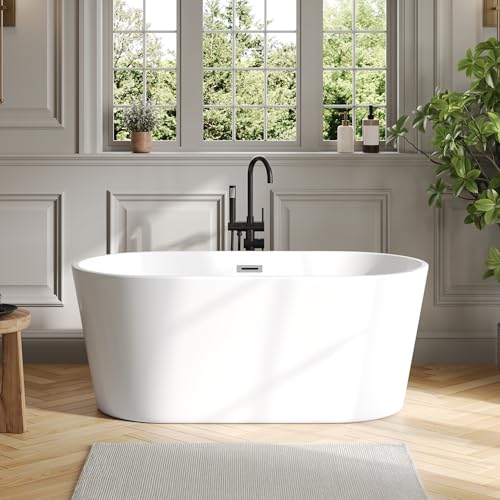
If your bathroom can spare 55 inches, this DeerValley is where a small-space tub starts to feel like a normal tub. The listing describes a deep soaking design with a center drain and integrated overflow, and the extra seven inches over the 48-inch picks go straight into legroom. It suits bathers on the taller side who refuse to give up reclining, and small primary bathrooms where the tub is the main bathing fixture rather than an occasional luxury.
Strengths
- The most interior stretch-out room on this list while staying under the 60-inch standard.
- Center drain means neither end is the “wrong” end — you can recline facing either way, which helps when the filler position is fixed.
- Integrated overflow keeps the rim line clean and removes a separate trim decision.
Trade-offs
- At 55 inches it will not fit the tiniest bathrooms that the 48-inch picks serve.
- Acrylic heat loss still applies on very long soaks.
- Center-drain rough-in may not line up with an existing end-drain waste position — check before you order.
| Spec | Detail |
|---|---|
| Length | 55 inches |
| Material | Acrylic |
| Drain | Center drain with integrated overflow (model DV-1T0582) |
| Type | Freestanding deep soaking tub |
The center drain is a bigger deal than it sounds. In a small bathroom, the tub’s orientation is usually dictated by the room, not by your preference — the filler comes out of one wall, the window sits over one end, the door swings toward the other. An end-drain tub forces your head to the drain end or your feet onto the drain cover. A center drain makes both ends bathing ends, so the room’s constraints stop mattering to your comfort. It also tends to mean a symmetric interior slope, which many bathers find more comfortable than a single steep backrest.
Because this is the largest acrylic tub here, it is also the one where water capacity deserves a check against your heater. A deep 55-inch tub filled to a satisfying level can challenge a small tank heater, especially in winter when incoming water is cold. If your household already runs the shower cold after two consecutive uses, ask a plumber about the heater before you fall in love with any deep tub — the fix may be simple, but it is better sequenced before the tub goes in.
Best for: taller bathers and primary bathrooms that can spare 55 inches / Not suited for: the very smallest bathrooms, or end-drain rough-ins that cannot move.
WOODBRIDGE 55″ Stone Resin Freestanding Soaking Tub — Best Premium
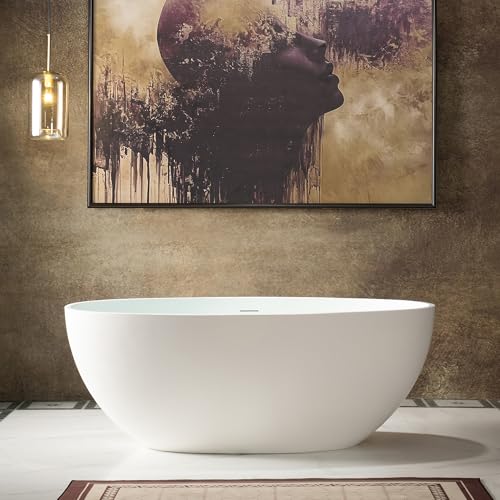
The premium end of small is this WOODBRIDGE solid-surface oval: 55 inches of stone resin with an integrated slotted overflow and the drain included, in a matte white finish. It suits a small primary bathroom being renovated properly — floor checked, plumbing planned, budget allocated — where the tub is meant to be the room’s centerpiece for the next twenty years rather than a placeholder.
Strengths
- Solid-surface stone resin delivers the longest heat retention and the most substantial feel in this roundup.
- Integrated slotted overflow disappears into the tub wall — no visible overflow plate interrupting the design.
- Drain included, and the modern oval proportions give a 55-inch tub an unexpectedly generous interior.
Trade-offs
- The heaviest style of tub here when filled; structural confirmation is not optional.
- Premium material means premium handling — this is not a tub to drag through a tight stairwell on a hunch.
- Matte solid surface wants gentle, non-abrasive cleaning products.
| Spec | Detail |
|---|---|
| Length | 55 inches |
| Material | Stone resin (solid surface) |
| Overflow | Integrated slotted overflow |
| Drain | Included (model B0043) |
| Finish | Matte white |
What you are paying for at this tier is not a feature list; it is the absence of compromises. The wall thickness that makes the tub heavy also makes it quiet — water sounds muted rather than hollow — and the rim has a carved, continuous quality that molded acrylic cannot imitate. The slotted overflow is characteristic of the tier: instead of a chrome disc bolted through the tub wall, a discreet slot near the rim handles overflow, so the interior reads as one uninterrupted surface. In a small bathroom, where the tub fills your field of vision, that kind of visual calm is worth real money to many renovators.
Treat the purchase as a small construction project and it will go well: confirm structure, plan the delivery route with actual measurements, rough the drain to the manufacturer’s sheet rather than to habit, and keep a few inches of cleaning clearance if the room allows. If those steps sound like more than your project can absorb, the BCANHOME above gives you most of the stone-resin experience at 51 inches — but if you can do it properly, this is the tub the other five are measured against.
Best for: full renovations of small primary bathrooms that want a lasting centerpiece / Not suited for: quick swaps, weak floors, or difficult delivery routes.
Comparison Table
| Pick | Badge | Key spec | Best for |
|---|---|---|---|
| WOODBRIDGE 48″ Acrylic Freestanding | Best Overall | 48″ acrylic, brushed nickel drain included | Smallest honest freestanding footprint |
| WOODBRIDGE 48″ Japanese Soaking Tub | Best Deep Soak | 48″ acrylic, pre-molded seat | Upright, shoulder-deep soaking in corners |
| Empava 48″ Air Jetted | Best for a Spa Feel | 36 air jets, 20.45″ depth, 50 gal | Bubble massage in under four feet |
| BCANHOME 51″ Stone Resin | Best Stone Resin | 51″ solid surface, matte white | Long hot soaks, design-led rooms |
| DeerValley 55″ Acrylic | Best Room to Stretch Out | 55″ acrylic, center drain | Taller bathers, primary bathrooms |
| WOODBRIDGE 55″ Stone Resin | Best Premium | 55″ solid surface, slotted overflow | Full renovations wanting a centerpiece |
How to Choose the Right Tub for a Small Space
Start with the room, not the catalog. Measure the available footprint in three dimensions: length along the wall, depth out from the wall, and the height of any window sill, wainscot, or sloped ceiling the rim must clear. Then measure the delivery route — front door, hallway turns, staircase width, bathroom door — because a rigid tub is only as installable as its tightest doorway. Write all of it down before you look at a single product page; small-bathroom renovations go wrong when the tub is chosen first and measured later.
Next, decide your soaking posture honestly. If you bathe to stretch out and read, length is your currency and the 55-inch picks are your shortlist. If you bathe to immerse — shoulders under, muscles warm, mind off — depth is your currency and the Japanese-style tubs deliver more soak per inch of floor. Many people discover their true preference only after imagining their actual last ten baths: were you reclined with legs extended, or sitting in water up to your chest? Buy for the bath you take, not the bath in the advertisement.
Then weigh material against your building. Acrylic is light, warm to the touch on contact, forgiving of older floors, and easy to carry into walk-up apartments; its costs are faster heat loss and a less substantial feel. Stone resin reverses the trade: superb heat retention and a carved, quiet solidity, paid for in weight that demands structural confidence and a planned delivery. In a small bathroom on an upper floor of an older home, acrylic is often the responsible choice even when stone resin is the romantic one.
Finally, audit the unglamorous systems. Water capacity versus water heater size decides whether your deep soak ends in tepid disappointment. Drain position — center versus end — decides whether your existing waste line works or moves. Filler type decides whether you need a floor-mount filler (and the floor access it requires), a wall-mount spout, or a deck-mount on a wide rim. And if you are considering the jetted pick, the electrical plan is part of the tub decision, not an afterthought. A small bathroom rewards the buyer who sequences these questions before ordering.
What “Small” Actually Means in Tub Sizes
Tub sizes cluster into bands, and knowing the bands keeps you from comparing unlike products. Standard alcove tubs run 60 inches, which is exactly what most small bathrooms cannot spare. The compact freestanding band runs 48 to 55 inches — every pick in this guide lives there. Below 48 inches, the market changes character: you find Japanese deep tubs (which compensate with depth), corner tubs (which compensate with width), and then a cliff edge into portable, inflatable, and foldable products that are bathing accessories rather than bathtubs. If a listing promises a full bathtub at 40 inches, read it very carefully — it is usually measuring something other than what you hope.
Width deserves as much attention as length. Compact tubs range roughly from 28 to 32 inches wide, and those four inches decide whether the tub fits between a vanity and a wall, whether the door still swings, and whether you can clean beside it. Interior width matters too: two tubs with identical exterior dimensions can differ by several inches of shoulder room depending on wall thickness and shape. Stone resin tubs, with thinner but stronger walls than their bulk suggests, often win back interior space; double-walled acrylic designs spend some of theirs on insulation. When a listing publishes interior dimensions, trust those over the headline numbers.
How to Measure and Plan a Small-Bathroom Tub Installation
Begin with a tape measure and a honest hour. Record the room’s length and width, the position and swing of the door, the toilet’s projection, and the vanity depth; then tape the tub’s footprint on the floor with painter’s tape and live with it for a day. Sit in the taped outline’s neighborhood — on the toilet, at the sink — and check that knees, elbows, and the door all still work. This low-tech rehearsal catches more problems than any rendering.
Confirm the drain rough-in next. Note where your existing waste line sits relative to the taped footprint, and compare it with the new tub’s drain position from the manufacturer’s specification sheet. A freestanding tub’s drain tailpiece must land close to the floor drain; flexible connectors forgive a little, not a lot. If the line has to move, that is a floor-opening conversation with your plumber — normal in a renovation, unwelcome as a surprise. While the floor is open, it is also the moment to verify joist condition under a heavy stone resin tub.
Plan the filler at the same time. A wall-mount spout needs the right projection to clear the rim and land the stream inside the tub; a floor-mount filler needs supply lines in the floor and enough clearance behind the tub; a deck-mount needs a rim wide enough to drill, which many compact ovals do not offer. Then walk the delivery route with your tape, measuring every door and turn, and photograph tight spots to show the delivery crew. The day the tub arrives should contain no discoveries.
Freestanding, Alcove, or Corner: Choosing the Format for a Tight Room
The format decision shapes everything else, and small bathrooms punish the wrong one. A compact freestanding tub — every pick in this guide — offers the most placement freedom: it can sit on any wall, angle into a corner, or float with plumbing concealed beneath the floor. It also reads as furniture, which matters in a room where the tub dominates the view. Its costs are the cleaning perimeter it needs and the filler question it raises, since there is no tub deck and often no adjacent wall plumbing where you want it.
An alcove tub remains the pragmatic rival. Built into a three-wall or two-wall enclosure with an apron front, it pairs naturally with a shower — and in a small bathroom that is also the household’s only shower, that combination may be non-negotiable. Compact alcove tubs around 54 to 60 inches with extra depth exist and deserve a look if your household showers in the tub daily. What you give up is the sculptural look and some interior width, because the enclosure and apron consume inches a freestanding tub spends on water.
Corner tubs are the overlooked third option. By pushing the bathing well diagonally into a corner, they can offer a wide, sometimes two-person interior on a footprint that is short along both walls. The trade is that they consume the corner completely, complicate shower pairing, and look dated if the styling is wrong. For a small bathroom with one genuinely free corner and no shower duty, though, a corner format can deliver the roomiest soak of all — measure diagonally before you dismiss it, and confirm the filler and drain geometry twice, because corner rough-ins are the least forgiving.
Fillers, Drains, and the Small Print That Decides the Budget
Buyers budget for the tub and get surprised by everything that connects to it. A freestanding tub needs a filler: wall-mount spouts are the economical route when the tub sits near a wall and the projection reaches the tub’s interior; floor-mount fillers look superb and cost more, in both hardware and the floor work to feed them. Either way, match the filler’s flow rate to the tub — a deep 50-gallon tub fed by a low-flow spout turns filling into a long, heat-losing wait.
Drain hardware is the second surprise. Several picks here include the drain and overflow, which removes a real cost and a compatibility hunt; where a tub does not include them, buy the manufacturer’s matched trim rather than a generic set, because thread standards and overflow geometry vary. If your home has older plumbing, tell your plumber the tub’s drain position and tailpiece height before the rough-in appointment, not during it.
Finally, think about the floor finish meeting the tub. Freestanding tubs sit on finished flooring, so the floor must be complete, level, and waterproofed before the tub lands — a sequencing detail that changes the renovation order. A small bead of sealant at the base, where the manufacturer recommends it, keeps mop water from migrating underneath. None of this is glamorous, and all of it is the difference between a tub that delights for a decade and one that generates a slow drip of annoyances.
Common Buying Mistakes
Shopping by length alone. A shallow 55-inch tub can deliver a worse soak than a deep 48-inch one. Compare soaking depth and interior dimensions, not just the headline length.
Forgetting the delivery route. More small-tub projects stall on staircases and door frames than on plumbing. Measure the whole path, including the turn at the top of the stairs.
Ignoring filled weight. Water weighs about 8.3 pounds per gallon, and the bather adds more. A deep stone resin tub on old joists is a structural question, not a style question.
Outrunning the water heater. Deep compact tubs can hold as much water as long shallow ones. If your heater already struggles, the tub will expose it every single bath.
Jamming the tub against the wall. A freestanding tub needs cleaning clearance. Two to four inches of gap transforms maintenance; zero gap transforms it into a grime reservoir you cannot reach.
Treating a jetted tub like a soaking tub purchase. The Empava’s blower needs power and a maintenance habit. Buy it as the small appliance it is, with the electrical plan settled first.
Final Recommendation
For most small bathrooms, start with the WOODBRIDGE 48″ Acrylic Freestanding Bathtub: it is the shortest path to a real freestanding soak, light enough for real-world delivery, and complete with its drain trim. If your soak is about depth rather than length, the WOODBRIDGE 48″ Japanese Soaking Tub gives you shoulder-high immersion in the same footprint. Want the spa version of small? The Empava 48″ Air Jetted Bathtub is the only jetted pick we could verify at this size — just settle the electrical plan first.
If your room can take 51 to 55 inches, the decision becomes material and posture. The BCANHOME 51″ Stone Resin is the heat-retaining middle path; the DeerValley 55″ Acrylic is the stretch-out choice with a forgiving center drain; and the WOODBRIDGE 55″ Stone Resin is the one to build a full renovation around. Measure first, choose posture second, and any of the six will serve a small bathroom well.
Related guides in this series: Best Bathtubs For Apartments · Best Acrylic Freestanding Bathtubs · Best Affordable Tubs · Best Big Bathtubs For Tiny Houses · Best 6ft Soaking Bathtubs
Frequently Asked Questions
What is the smallest size for a real bathtub?
Around 48 inches is the practical floor for a rigid, plumbed bathtub that an adult can genuinely soak in. Below that, products are mostly Japanese-style deep tubs (which stay viable a little shorter because of their depth), portable tubs, or foot baths. If your space is under 48 inches, a deep Japanese tub placed across the short wall is usually the best real answer.
Can a tall person use a 48-inch tub?
Yes, but in a seated posture with knees bent — the way you would use a Japanese soaking tub — rather than stretched out. Tall bathers who know they recline should step up to the 55-inch picks, where the extra length goes directly into legroom. Trying a seated soak in a regular tub before ordering is a fair test of whether the style suits you.
How much water does a small tub use compared with a standard tub?
Less than most people fear, and sometimes not less at all. A shallow 60-inch tub and a deep 48-inch tub can hold similar volumes, because depth replaces length. The Empava on this list is rated at 50 gallons. Check your water heater’s capacity against the tub you choose, especially for back-to-back baths.
Are freestanding tubs practical in very small bathrooms?
They are, provided you keep a few inches of clearance for cleaning and your filler plan works. A compact freestanding tub can actually make a small room feel larger than an alcove tub with a shower curtain, because the visible floor continues around it. The impractical version is a large freestanding tub wedged wall-to-wall — that is the worst of both formats.
Does a stone resin tub really keep water hotter?
Yes. The material’s mass absorbs heat and returns it slowly, while thin acrylic lets heat escape through its walls more quickly. The difference shows up on longer soaks — twenty minutes in, the stone resin tub is noticeably closer to its starting temperature. It is the main functional reason, beyond looks and feel, to accept the extra weight.
Should I choose a deep short tub or a longer shallow tub?
Choose depth if you soak to immerse and unwind, and length if you soak to recline. Deep short tubs also tend to suit smaller water heaters, because their volume concentrates in a narrow footprint, while long shallow tubs spread the same water thin and cool it faster. If you genuinely do both — some evenings seated with a book, others stretched out — the 55-inch deep-soaking picks are the honest compromise, which is exactly why two of them anchor this list.
What should I check before ordering any small tub?
Four things: the taped footprint in your actual room, the delivery route measurements, the drain position versus your existing waste line, and your water heater’s ability to fill the tub you chose. Add a structural check if you are buying stone resin for an upper floor. Those five checks prevent nearly every small-tub disappointment we hear about.


