Disclosure: airfryerkitchensupply.com is reader-supported. When you buy through links on our site, we may earn an affiliate commission at no extra cost to you.
Where to buy
All six picks in this guide to the best travel towels available are sold on Amazon, and every link below goes to a listing we confirmed before writing. The Rainleaf Microfiber Towel is the default recommendation for most travelers. Backpackers counting grams should look at the PackTowl Personal Ultralight, comfort seekers at the PackTowl Luxe, and cotton loyalists at the Cacala Turkish Towel. The 4Monster Quick Dry Towel and the OlimpiaFit Quick Dry Towel 3 Size Pack round out the list for value buyers and families. Prices change constantly, so check the current price on Amazon instead of trusting any figure printed in a guide.
Finding the best travel towels available sounds simple until you have packed a wet cotton bath towel into a suitcase on the last morning of a trip and unpacked it, sour and heavy, two days later. A travel towel is a different tool from a bath towel. It has to absorb well enough to dry a whole body, dry itself fast enough to be packed again within hours, fold down to a fraction of a normal towel’s bulk, survive being washed in sinks and hostel machines, and do all of that trip after trip. The hotel towel fails most of those tests. So do many products sold as travel towels, which are often just thin microfiber sheets with a drawstring bag and optimistic marketing.
This guide separates the genuine performers from the souvenirs. The six picks below were confirmed through the API, and they divide into clear camps. Microfiber towels — Rainleaf, 4Monster, and OlimpiaFit — are the value workhorses: light, compact, quick to dry, and inexpensive enough to own in several sizes. The two PackTowl models represent the specialist outdoor brands: the Ultralight for gram-counters and the Luxe for travelers who want a travel towel that feels closer to a real towel. And the Cacala fouta is the natural-fiber alternative, a flat-woven Turkish cotton towel that doubles as a wrap, a picnic blanket, and a beach towel, for travelers who dislike microfiber’s feel on skin.
One honest note before the picks: three of the listings we verified — the two PackTowl models and the 4Monster — returned product names through the API without full descriptive titles in our records, so their spec boxes in this guide are deliberately minimal. We print only what is confirmed: the product’s name, its type, and its intended use. Where a size or weight was not confirmed, we write “not stated” rather than borrowing numbers from memory or from other retailers. A buying guide that invents specifications is worse than one that admits a gap.
It is also worth saying who should not buy a travel towel at all. If your trips are exclusively full-service hotels, cruises, and resorts with daily housekeeping, the house towels are better than anything in this guide and the space is better spent elsewhere. Travel towels earn their purchase the moment your itinerary includes hostels, campsites, rentals with thin linen supplies, overnight trains, beach days away from your base, or workouts on the road. Most frequent travelers cross into that territory a few times a year, which is why a good travel towel is one of the highest-use items in a frequent traveler’s kit — and why the value picks in this guide, which cost little and pack to nothing, are so easy to justify even for occasional trips.
In this guide
Quick Picks
- Best Overall: Rainleaf Microfiber Towel — quick-dry microfiber for camping, travel, and gym, compact and highly absorbent per its listing.
- Best Ultralight: PackTowl Personal Ultralight — the backpacking specialist’s pick from a dedicated camp towel brand.
- Best Comfort: PackTowl Luxe — a plusher-feeling travel towel for travelers who hate standard microfiber texture.
- Best Value: 4Monster Quick Dry Microfiber Towel — a budget-friendly camping, travel, and gym towel.
- Best Multi-Size Pack: OlimpiaFit Quick Dry Towel, 3 Size Pack — three sizes in one purchase for body, hair, and face.
- Best Cotton: Cacala Turkish Beach Towel Fouta, 37 x 70 in — flat-woven 100% cotton that doubles as a wrap and beach towel.
How These Picks Were Chosen
We searched Amazon’s catalog for towels designed for travel — microfiber camp and travel towels, ultralight backpacking towels, and flat-woven cotton travel towels — and filtered out anything that was really a bath towel, a beach-only novelty towel, a gym sweat towel too small to dry a body, or a cleaning cloth in disguise. Every pick had to plausibly serve as a traveler’s primary towel: big enough in its largest size to dry an adult, light enough to justify its place in a bag, and quick-drying by design.
We also deduplicated sizes and colorways. Rainleaf, for example, sells the same towel under more than one listing variation; we verified two ASINs for it during research and kept one, because a guide that lists the same towel twice has only five real picks. Similarly, PackTowl’s Personal line appears in both Ultralight and Luxe versions — those are genuinely different fabrics with different jobs, so both earned a place, while mere size variants of a single model did not.
Selection balanced the ways people actually travel. A backpacker walking between hostels needs the smallest packed size and the fastest dry. A camper driving to a site can carry something plusher. A beach traveler needs sand resistance and full-body coverage. A business traveler needs a towel that looks and feels respectable and dries overnight in a hotel bathroom. Six picks, six versions of the trip — matched to badges so you can self-select quickly and read deeply only where it matters.
As with all our guides, we print no fixed prices and no star ratings or review counts: prices shift with promotions and ratings change daily, so neither would stay true. Each pick instead invites you to check the current price on Amazon, and the analysis concentrates on the durable facts — material, format, drying behavior, and fit for each travel style.
The 6 Best Travel Towels Available Now

Rainleaf Microfiber Towel — Best Overall
Rainleaf is the travel towel that ends most searches, and its listing confirms why: a quick-dry microfiber towel explicitly built for camping, travel, and gym use, described as compact, super absorbent, lightweight, and fast drying. It is the balanced default — small enough packed to disappear into a carry-on corner, large enough in its bigger sizes to serve as a primary shower towel, and priced in the tier where owning two is painless.
Strengths
- Purpose-built for travel: compact packed size, lightweight, fast drying, per the listing.
- Microfiber absorbs several times its weight in water and wrings out nearly dry.
- Versatile across camping, hostels, gym, and beach day trips.
Trade-offs
- Microfiber’s slightly clinging drag on skin bothers some people used to cotton.
- Needs a pre-wash before first use to reach full absorbency.
- Like all microfiber, it can hold odors over time if repeatedly packed damp.
| Specifications (as confirmed by the listing) | |
|---|---|
| Material | Microfiber |
| Intended use | Camping, travel, gym |
| Key traits | Compact, super absorbent, lightweight, fast drying |
| Sizes | Multiple sizes sold; check the listing for current options |
The Rainleaf’s real strength is the absence of weaknesses. Specialist towels beat it in single categories — the PackTowl Ultralight packs smaller, the Cacala feels nicer — but no other pick covers as many travel styles at once. For a first travel towel, or for outfitting a family’s bags without overthinking, this is the purchase. Buy the largest size if it will be your only towel, and a mid size if it is a gym and backup towel; microfiber’s compactness means the big one still packs smaller than a cotton hand towel. Hang it by its loop the night before any travel day and it will be bone dry by morning in all but the most humid climates.
Best for: most travelers wanting one dependable, do-everything travel towel. / Not suited for: cotton-only loyalists and anyone who dislikes microfiber’s feel.
Check the current price on Amazon

PackTowl Personal Ultralight — Best Ultralight
PackTowl is one of the original camp towel brands, and the Personal Ultralight is its backpacking answer: a microfiber camping and travel towel engineered to take up as little pack space and weight as possible. When every gram rides on your back for miles, the difference between an ultralight towel and a merely light one is the difference between bringing a towel and improvising without one.
Strengths
- Ultralight design brief — the pick for backpacking and bikepacking.
- From a specialist camp towel brand with a long track record.
- Microfiber dries fast on a pack strap or tent line.
Trade-offs
- Ultralight fabrics feel thin and utilitarian — function over comfort.
- Our listing record confirms the product name and type; detailed size and weight figures were not recorded, so verify the exact size on the listing before buying.
- Premium-tier pricing is typical for specialist ultralight gear.
| Specifications (as confirmed by the listing) | |
|---|---|
| Material | Microfiber (camp towel) |
| Intended use | Camping and travel |
| Exact size / weight | Not stated in our verified record — check the listing |
Choose the Ultralight when your towel competes for space with a tent, a stove, and three days of food. Its natural habitat is the hostel-and-trail circuit: shower, wring, hang off the pack at breakfast, dry by the first rest stop. Travelers who mostly sleep in hotels will not need its extremes and will be happier with the Luxe below; travelers walking the Camino or thru-hiking will understand immediately why this product exists. One practical tip for ultralight towels generally: they absorb best with a patting, pressing motion rather than the rubbing you would use with terry — press, lift, move on, and a thin towel dries a whole body surprisingly well.
Best for: backpackers, thru-hikers, and one-bag travelers counting grams. / Not suited for: comfort-first travelers and anyone who wants a plush feel.
Check the current price on Amazon

PackTowl Luxe — Best Comfort
The Luxe is PackTowl’s answer to the most common microfiber complaint — that travel towels feel like wiping yourself with a chamois. It is a lightweight microfiber camping and travel towel built with a plusher, more towel-like hand feel, aimed at travelers who refuse to give up comfort but still need fast drying and small packed size.
Strengths
- Comfort-first travel towel feel while staying lightweight and packable.
- Specialist brand with fabrics designed specifically for camp and travel.
- Dries far faster than any cotton towel of similar coverage.
Trade-offs
- Still microfiber — closer to a towel’s feel, not identical to terry cotton.
- Detailed specifications were not recorded in our API verification; confirm size options on the listing.
- Costs more than value-brand microfiber towels.
| Specifications (as confirmed by the listing) | |
|---|---|
| Material | Microfiber (camp towel) |
| Intended use | Camping and travel |
| Exact size / weight | Not stated in our verified record — check the listing |
The Luxe makes the most sense for the traveler who tried a bargain microfiber towel once, hated it, and went back to packing cotton — then regretted it on the first rainy travel day. It is also the right pick for longer trips in one base, like a week in a rental apartment with a mediocre towel supply, where the towel gets used daily like a home towel and comfort compounds. Pair it with a small microfiber face cloth and you have a complete, fast-drying personal set that still packs into a shoe-sized corner of a suitcase.
Best for: comfort-conscious travelers, long-stay trips, and microfiber skeptics willing to try once more. / Not suited for: strict ultralight packers or the tightest budgets.
Check the current price on Amazon
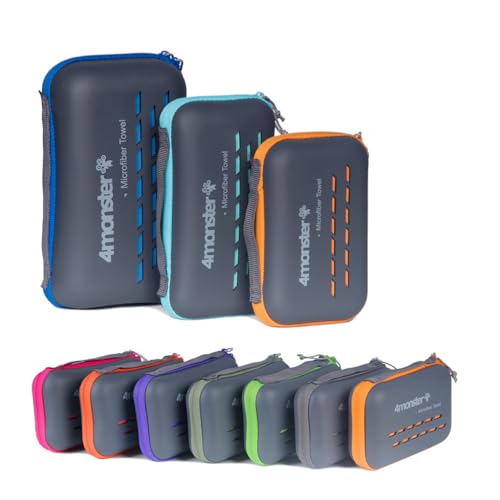
4Monster Quick Dry Microfiber Towel — Best Value
4Monster sells a straightforward proposition: a quick-dry microfiber towel for camping, travel, and gym at a value tier, in the kind of size range that covers everything from a face towel to a full body towel. It is the pick for buyers who want the microfiber travel towel experience without paying specialist-brand prices — scout troops, school trips, festival kits, and spare towels for guests and gym bags.
Strengths
- Value-tier microfiber with quick-dry performance for camp, travel, and gym.
- Practical for bulk buying — multiple bags, multiple family members.
- Same core microfiber advantages: light, compact, fast to dry.
Trade-offs
- Our listing record confirms the product name and category; detailed specs were not recorded, so check sizes on the listing.
- Value microfiber typically feels thinner than premium camp towels.
- Carry-case and accessory bundles vary; confirm what is included before ordering.
| Specifications (as confirmed by the listing) | |
|---|---|
| Material | Microfiber |
| Intended use | Camping, travel, gym |
| Exact size / weight | Not stated in our verified record — check the listing |
Value towels earn their keep through deployment, not luxury. A 4Monster in every gym bag, car boot, and kid’s camp kit means the good towel stays home and the cheap ones absorb the losses, the forgotten-at-the-hostel moments, and the muddy emergencies. That is a legitimate strategy, and microfiber’s durability supports it — these towels tolerate rough washing and rougher packing. Just manage expectations on hand feel, and wash a new one before its first trip so the fibers open up and absorb properly from day one.
Best for: budget buyers, families, group trips, and spare-towel duty everywhere. / Not suited for: buyers wanting premium hand feel or fully documented specs in-guide.
Check the current price on Amazon

OlimpiaFit Quick Dry Towel, 3 Size Pack — Best Multi-Size Pack
Most travelers discover they need three towels, not one: a body towel, a hair towel, and a small face and hands towel. The OlimpiaFit pack builds exactly that system — a three-size pack of lightweight microfiber quick-dry towels — so one purchase covers the whole routine and the sizes nest together in a single compact roll in your bag.
Strengths
- Three coordinated sizes cover body, hair, and face in one purchase.
- Lightweight microfiber throughout — the whole system still packs small.
- Quick-dry fabric suits daily use on multi-week trips.
Trade-offs
- Detailed size dimensions were not recorded in our API verification; confirm the three sizes on the listing match your needs.
- If you only ever need one towel, a multi-pack buys pieces you will not use.
- Microfiber feel trade-offs apply as with the other microfiber picks.
| Specifications (as confirmed by the listing) | |
|---|---|
| Material | Microfiber |
| Contents | 3 towels, assorted sizes |
| Exact dimensions | Not stated in our verified record — check the listing |
The system logic is what sells this pack. On the road, the small towel becomes the hardest-working object you own — face in the morning, hands at a trailhead tap, a sweat towel on a hot transfer day — while the large towel stays clean for showers and the mid size handles hair. Separating those jobs keeps each towel fresher longer between washes, which matters on trips where laundry is a weekly event. For solo travelers building a first kit, this pack plus a compression sack is a complete answer; for couples, two packs in different colors end all towel ownership disputes.
Best for: solo travelers building a complete kit and anyone who separates body, hair, and face towels. / Not suited for: minimalists who truly need only one towel.
Check the current price on Amazon

Cacala Turkish Beach Towel Fouta, 37 x 70 in — Best Cotton
Not every traveler can make peace with microfiber, and the Cacala fouta is the traditional answer: a flat-woven, 100% cotton Turkish towel, lightweight and thin by design, quick-drying for a cotton towel, and large at 37 x 70 inches. The listing positions it as a beach towel that works as an extra-large travel towel, and that dual identity is precisely its charm — it is also a wrap, a sarong, a picnic cloth, a light blanket on a cold bus, and a privacy curtain in a hostel bunk.
Strengths
- 100% cotton with a natural hand feel — no microfiber drag on skin.
- Oversized 37 x 70 inch format wraps fully and doubles as beach towel and wrap.
- Flat weave packs thin, sheds sand easily, and dries faster than terry cotton.
Trade-offs
- Dries slower than microfiber — plan overnight hanging, not a two-hour turnaround.
- Flat weave absorbs less per pass than terry; expect to pat and press more.
- Packed, it is still bulkier than an ultralight microfiber towel.
| Specifications (as confirmed by the listing) | |
|---|---|
| Material | 100% cotton, flat-woven fouta style |
| Size | 37 x 70 in |
| Key traits | Lightweight, thin, quick-drying for cotton, sand-free beach use |
The fouta’s case rests on versatility per gram of a different kind. A microfiber towel does one job brilliantly; a fouta does five jobs well. Beach travelers in particular will appreciate that sand shakes out of a flat weave instead of lodging in terry loops, and the generous dimensions mean it works as your beach base, your drying towel, and your walk-to-the-café wrap in a single item. It will never win a drying race against the PackTowl Ultralight, and in a rainy-week backpacking scenario it is the wrong tool — but for Mediterranean summers, island trips, and slow travel with laundry access, it is the most pleasurable towel in this guide to actually live with.
Best for: beach and slow travelers, cotton loyalists, and anyone wanting one textile that does five jobs. / Not suited for: ultralight backpackers or fast-turnaround travel in humid climates.
Check the current price on Amazon
Microfiber vs Cotton on the Road: An Honest Side-by-Side
Because five of our six picks are microfiber and one is cotton, it is worth slowing down on what that choice really means over a two-week trip. Microfiber is a synthetic blend, usually polyester and polyamide, split into fibers far finer than cotton. That fineness is the whole story: enormous surface area means fast, high-capacity absorption, and a structure that releases water readily when wrung and hung. A microfiber towel’s working life on the road is measured in hours between wet and dry. Its weaknesses are tactile and olfactory. The fibers grip skin slightly as they pass, which some people never notice and others never forgive, and the same fine structure that grabs water also grabs odor-causing residue, so a microfiber towel that is repeatedly packed damp will eventually hold a smell that washing struggles to shift. Discipline — wring, hang, wash plainly — prevents it almost entirely.
Cotton works the other way. Even flat-woven cotton like the Cacala fouta absorbs more slowly and dries more slowly, because cotton fibers hold water inside the fiber itself rather than between fibers. But cotton feels like a towel has always felt, improves with washing, shrugs off odor better between washes, and asks nothing special of your laundry routine beyond avoiding the same softener that harms any absorbent textile. On a trip with a washing machine every few days and evenings warm enough to dry a towel on a balcony, cotton’s disadvantages shrink and its comfort advantage is real. On a trip through humid highlands with a bus every morning, cotton’s disadvantages become the trip’s background misery. Neither material is “better” — they are answers to different itineraries, and this guide’s badges are really itinerary labels in disguise.
There is one more material note worth making: some travel towels are sold in bamboo viscose or cotton-microfiber blends. Blends try to split the difference on feel and drying speed, and some are genuinely good, but none appeared among the listings we could verify through the API for this guide, so we make no recommendation among them rather than guessing. If a blend towel catches your eye elsewhere, apply the same tests this guide uses: largest size wraps your body, drying time matches your tightest turnaround, and care requirements fit sink-washing reality.
Sizes and Packed Bulk: What the Numbers Mean in a Real Bag
Travel towel sizes are usually given in inches or centimeters across three informal classes. Small towels, roughly hand-towel size, are for face, hands, and sweat — useful, but never a primary towel. Medium towels serve as hair towels and gym towels and can dry a body in a pinch with patience. Large and extra-large towels — the sizes that wrap an adult — are the primary-towel class, and in microfiber they still roll down to roughly the size of a water bottle. That last fact surprises people: with microfiber, the size penalty for going large is so small that the common mistake is buying medium to “save space” and then living with a towel that will not stay wrapped while you brush your teeth in a shared bathroom.
Packed bulk depends on fabric as much as dimensions. The Cacala fouta is the largest towel in this guide at 37 x 70 inches, yet because it is flat-woven it folds to a slim rectangle that slides down the side of a suitcase or serves as a wrap in transit — many fouta owners wear it on the plane as a scarf or blanket, which is packed bulk of zero. The PackTowl Ultralight sits at the other extreme, engineered so that even its body sizes compress into a stuff sack that disappears into a backpack’s lid. The value microfibers — Rainleaf, 4Monster, OlimpiaFit — sit between: not ultralight-engineered, but still an order of magnitude smaller packed than the cotton terry towel in your bathroom. Whichever you choose, a simple habit multiplies the benefit: roll the towel around something soft, or fold it into the flat spaces at the top of a packed case, rather than stuffing it into a corner where it becomes a dense lump.
Weight follows the same pattern. Exact weights vary by size and were not confirmed for every pick in our listing record, so we will not print figures we cannot stand behind — check the listing for the size you intend to buy. The principle, though, is reliable: microfiber travel towels weigh a fraction of an equivalent terry towel, and the gap widens when wet, because a wrung microfiber towel carries far less retained water. If you have ever lifted a suitcase made heavy by one damp bath towel, you already understand the entire ultralight towel industry.
Comparison Table
| Pick | Badge | Key spec | Best for |
|---|---|---|---|
| Rainleaf Microfiber Towel | Best Overall | Microfiber, compact, fast drying | Most travelers |
| PackTowl Personal Ultralight | Best Ultralight | Ultralight microfiber camp towel | Backpackers |
| PackTowl Luxe | Best Comfort | Plush-feel microfiber travel towel | Comfort seekers |
| 4Monster Quick Dry Towel | Best Value | Value microfiber, camp/travel/gym | Bulk and budget buying |
| OlimpiaFit 3 Size Pack | Best Multi-Size Pack | Three microfiber sizes in one pack | Complete travel kits |
| Cacala Turkish Fouta | Best Cotton | 100% cotton flat weave, 37 x 70 in | Beach and slow travel |
How to Choose a Travel Towel That Earns Its Place in Your Bag
Pick the material for your trip type. Microfiber dominates travel for sound reasons: it absorbs several times its weight in water, wrings out nearly dry, and dries in hours. Its weakness is feel — a slight cling as it moves across skin. Flat-woven cotton like the Cacala fouta feels natural and multitasks beautifully, but dries at cotton speed. Rule of thumb: the faster your itinerary moves and the more humid your destination, the stronger the case for microfiber; the slower and sunnier the trip, the more a fouta earns its space.
Size up more than you think. Travelers consistently buy one size too small. A towel that will serve as your only shower towel should be long enough to wrap around your waist or torso and stay there while you move around a hostel bathroom. Compact face and gym sizes are fine as second towels — that is the logic of the OlimpiaFit three-size system — but as a primary towel, bigger is worth the trivial extra packed volume, especially in microfiber, where even the largest sizes fold to the size of a paperback.
Judge drying time by your itinerary, not the label. Every towel in this guide calls itself quick-dry, but what matters is dry-by-when. If you shower at night and pack at dawn, almost anything here works. If you swim at lunch and repack at three, only microfiber — wrung hard and hung in moving air for the gap — will be ready. Build the towel choice around your tightest turnaround, not your average day.
Consider the second jobs. A travel towel often becomes a blanket on an overnight bus, a pillow cover of dubious hygiene insurance, a beach base, a laundry bag liner, or a curtain. Flat, large formats like the fouta excel at second jobs; tiny ultralight towels deliberately do not. Neither is wrong — but know which philosophy you are packing.
Plan for washing on the road. Travel towels get hand-washed in sinks with whatever soap is available. Microfiber tolerates this abuse well but loses absorbency if washed with fabric softener, which coats its split fibers; skip softener for the life of the towel. Darker colors hide the gradual graying that sink-washing in hard water produces. And a towel with a hanging loop — common on camp towels — dries faster in real bathrooms than one draped over a chair.
Small features that matter more than expected. A snap hanging loop sounds trivial until you are in a bathroom with no free hook, at which point it is the difference between a towel that dries and a towel that drapes over your suitcase. A mesh carry bag beats a sealed stuff sack for the same reason — it lets a slightly damp towel breathe during a travel day instead of stewing. Rounded or bound edges survive more washes than raw-cut edges on cheap microfiber. None of these features appears in a headline specification, and all of them show up within the first three days of a real trip, so weigh them when two towels otherwise tie.
How to Use a Travel Towel: The Routine That Makes It Work
Technique matters more with travel towels than with home towels. First, wash any new microfiber towel before its first trip; manufacturing finishes reduce absorbency until they are rinsed out. Second, dry yourself by pressing and patting rather than rubbing — microfiber absorbs on contact, and pressing covers more skin per pass than dragging. Third, wring the towel hard after use; a well-wrung microfiber towel gives up most of its water immediately, which is the real secret behind its fast drying. Fourth, hang it fully open — on a line, a hanger, a bunk rail, or the outside of your pack while you walk — never balled in a bag. Fifth, on travel days, if the towel is still slightly damp at packing time, pack it last in an outer pocket or mesh compartment rather than sealed inside with dry clothes, and hang it the moment you arrive. Follow that routine and even a budget towel performs; ignore it and the best towel in this guide will smell like a swamp by day four.
Washing and Storing Travel Towels Between Trips
Travel towels die at home more often than on the road, usually in the wash. Microfiber’s rules are simple but strict: wash with plain detergent, never add fabric softener or dryer sheets, and keep temperatures moderate. Softener is the big one — it coats the split fibers that make microfiber absorbent, and the towel quietly becomes a waterproof sheet. If a towel has already been softened, a hot wash with a cup of white vinegar usually strips the coating and restores most of its thirst. Wash microfiber separately from cotton, too, because cotton lint migrates into microfiber and clogs it; a load of travel towels, swimwear, and synthetic gym clothes together is the efficient pattern.
The Cacala fouta asks for the opposite temperament: cotton tolerates hot water and normal detergent, improves in softness over its first several washes, and should be kept away from bleach if you want its colors and fringe to age gracefully. Line drying suits it — it is thin enough to dry on a rack indoors — though an occasional tumble restores flexibility to the weave.
Storage between trips decides whether the towel is fresh or funky when you next pack. Store travel towels fully dry, loosely folded, in a breathable place — not sealed in their stuff sack in a damp garage. The stuff sack is a packing tool, not a storage container. If a towel comes home from a trip smelling less than clean despite washing, give it one hot vinegar wash and a full sun-dry before storing; ultraviolet light and complete dryness are the two things mildew cannot survive. Towels stored clean and dry last for years of trips; towels stored damp are replaced annually and blamed unfairly.
Common Buying Mistakes
- Buying a gym towel as a travel towel. A 16 x 27 inch sweat towel cannot dry an adult after a shower. Check that the largest size wraps your body before ordering.
- Packing a home bath towel “just this once.” It will be heavy dry, heavier wet, slow to dry, and sour by the return trip. That is the entire problem travel towels exist to solve.
- Using fabric softener on microfiber. Softener coats the fibers and quietly kills absorbency. Wash travel towels with plain detergent only.
- Judging microfiber by a dry rub in the store. Microfiber feels grabby dry and works wet. Judge it by wringing and drying speed, not by first touch.
- Forgetting the turnaround test. A towel that dries overnight is useless for a same-day swim-and-drive itinerary. Match drying speed to your tightest schedule gap.
- Buying white for adventure travel. Sink washing and hostel machines will gray it within a trip. Mid-tones and patterns age gracefully on the road.
Matching the Towel to the Trip: Five Common Itineraries
The one-bag city trip. You are moving every two or three nights, washing in sinks, and living out of a carry-on. Drying speed and packed size rule. The Rainleaf in its largest size is the balanced choice; the PackTowl Ultralight is the choice if your bag is genuinely full. Pack the towel last, in an outside pocket, and hang it the second you reach each new room — hotel towel bars and the backs of chairs both work.
The backpacking and hostel circuit. Weeks on the move, shared bathrooms, laundry when you can get it. This is PackTowl country: the Ultralight for walkers, the Luxe for those based in hostels more than tents. Add a small microfiber face towel — from the OlimpiaFit pack or any value set — because separating face duty from body duty doubles the days between necessary washes.
The beach holiday. One base, sand everywhere, swimming daily. The Cacala fouta is the trip’s hardest-working textile: beach base by day, drying towel after, wrap for the walk home, light blanket if the evening turns. Its slower drying hardly matters when it hangs on a balcony in the sun between swims, and sand shakes out of its flat weave instead of embedding the way it does in terry or microfiber pile.
The road trip and campsite circuit. The car removes the weight penalty, so comfort climbs the priority list. The PackTowl Luxe or a large Rainleaf covers showers at campsite blocks, and a value 4Monster or two in the car handles spills, muddy dogs, wet boots, and every unplanned job that should not touch your good towel. Driving travelers are also the one group who can pack a fouta as a second towel without any space anxiety.
The gym-to-office routine. Not travel in the vacation sense, but the same physics: a towel that must dry in a locker or a car between morning workout and evening commute. A mid-size Rainleaf or 4Monster lives in the gym bag permanently, dries over the car’s headrest or a locker hook, and gets a plain hot wash weekly. This is also where a second cheap towel earns its keep — rotation is what keeps any microfiber towel fresh.
Final Recommendation
For most people, the answer is the Rainleaf Microfiber Towel: balanced, proven, and versatile enough for any itinerary. Backpackers should step up to the PackTowl Personal Ultralight, and travelers who value feel should choose the PackTowl Luxe. Budget and bulk buyers get honest service from the 4Monster, system builders from the OlimpiaFit three-size pack, and cotton loyalists from the Cacala fouta — the one pick here that will also serve as your beach towel, wrap, and picnic blanket. Whichever you choose, wash it once before the trip, keep softener away from it, wring it hard after every use, and hang it at every stop, and it will still be performing seasons from now. Buy it a week before you travel rather than the night before, live with it through one home shower, and you will learn its size, its feel, and its drying rhythm while the stakes are still zero.
Building out the rest of your travel and bathroom kit? See Best Towels Usa, Best Absorbent Gym Towels, Best Bath Towels For Rv, and Best Bargain Towels.
Frequently Asked Questions
What size travel towel should I buy?
For a primary shower towel, choose the largest size a brand offers — long enough to wrap around your body and stay put. Smaller sizes work well as dedicated face, hair, or gym towels, which is why multi-size packs like the OlimpiaFit set exist. When in doubt, size up: microfiber packs so small that the larger towel costs you almost no space.
Why does my microfiber towel feel like it pushes water around?
Usually one of two causes: the towel was never pre-washed, so manufacturing finish is blocking the fibers, or it has been washed with fabric softener, which coats them. Wash it with plain detergent, no softener, and switch to a pressing, patting motion when drying yourself — microfiber absorbs on contact rather than by rubbing.
How long does a travel towel take to dry?
A wrung-out microfiber towel hung in moving air typically dries in a few hours, and overnight in almost any conditions short of a steamy bathroom with no airflow. A flat-woven cotton fouta takes longer — plan on overnight. A terry bath towel can take a full day, which is why it fails as travel gear.
Can I use a travel towel as my only towel on a long trip?
Yes — that is exactly what the larger microfiber picks and the OlimpiaFit system are designed for. Wash it every few days with plain soap, hang it religiously, and rotate in the small towel from a multi-pack for face and hands so the body towel stays fresher between washes.
Is a cotton fouta better than microfiber?
Better at some jobs, worse at others. The Cacala fouta feels natural, wraps generously, sheds sand, and doubles as a blanket or wrap. Microfiber wins on drying speed, packed size, and weight. Choose by itinerary: fast and humid favors microfiber; slow, sunny, and beach-heavy favors the fouta.
Do travel towels work for long hair?
Yes, with the right size and technique. A medium or large microfiber towel wrapped turban-style absorbs water from hair quickly without the weight of a wet cotton towel pulling at the neck — one reason the OlimpiaFit three-size system, which dedicates a mid size to hair, works so well. Squeeze hair gently with the towel rather than rubbing, which reduces frizz and breakage, and expect microfiber to pull out more water per minute than cotton of the same size.
How do I stop a travel towel from smelling?
Never pack it damp in a sealed space, wring it hard after every use, hang it fully open at every stop, and wash it with plain detergent — no softener — whenever it starts to hold odor. A towel that still smells after a hot wash and full dry has mildew deep in the fibers; a vinegar rinse usually rescues microfiber, and replacement is the honest answer if it does not.


