Disclosure: airfryerkitchensupply.com is reader-supported. When you buy through links on our site, we may earn an affiliate commission at no extra cost to you.
Where to buy
Every pick below was confirmed against Amazon’s own catalog data before it earned a link, and each one is a lint-free cloth or towel sold in a multi-pack, because glass drying is a fresh-cloth discipline. If you want one recommendation: the Puomue Microfiber Glass Cleaning Cloth 6 Pack (check price on Amazon) is the purpose-built answer for most homes, the HOMERHYME Microfiber Glass Cleaning Cloth 10 Pack (check price on Amazon) is the deeper bench for people who entertain, and the HIC Kitchen Jumbo Flour Sack Set (check price on Amazon) is the cotton traditionalist’s choice. Pack counts and colors can change on a listing, so confirm the details at checkout.
Introduction
The best towels for drying glasses do a job that looks simple and is not. A drinking glass shows everything: every water spot, every fiber, every faint smear of detergent or hand oil, printed in miniature against the light. The towel that dries a saucepan beautifully can ruin a wine glass, because drying cookware rewards absorbency while drying glassware rewards a very specific combination — a surface that releases no lint, a weave that breaks water into a thin film instead of beading it into spots, and enough softness to polish a rim without grinding yesterday’s grit across it. That is why the towels in this guide are not ordinary kitchen towels with a new label. They are microfiber glass cloths with smooth or fish-scale weaves, a waffle-weave detailing towel, and one classic cotton flour sack towel, each verified against its Amazon listing for exactly the properties glass cares about.
There is also an honest truth to state up front: the towel is only half of streak-free glassware. Water quality, how the glass was washed, and whether you dry immediately or let glasses air-spot on the rack decide the rest. This guide covers the towel half thoroughly — six verified picks across three material families — and then teaches the technique half in the how-to section, because a great cloth used badly still leaves spots. If you dry two water glasses a day, a single 6-pack will serve you for a long time. If you run a home bar, host tastings, or simply own more stemware than cupboard, the 10-pack and bulk options below exist for you.
In this guide
Quick Picks
- Best Overall — Puomue Microfiber Glass Cleaning Cloth, 6 Pack, 16×16 in: a purpose-made lint-free glass cloth at the classic square size, listed for windows, glasses, windshields, mirrors, and stainless steel. Check the current price on Amazon
- Best for Entertainers — HOMERHYME Microfiber Glass Cleaning Cloth, 10 Pack, 16×14 in: ten streak-free, lint-free polishing cloths, so a full table of stemware gets a fresh cloth rotation instead of one damp rag. Check the current price on Amazon
- Best Texture for Polishing — Niveaya Microfiber Glass Cleaning Cloth, Fish Scale, 8 Pack: a fish-scale weave that gives the cloth bite on water film, listed as quick drying for windows, kitchen, and stainless. Check the current price on Amazon
- Best Waffle Weave — The Rag Company Standard Waffle Weave Towels, 3-Pack, 16×16 in: a 370gsm waffle weave (the one weight figure a listing here actually confirms) built for window, glass, and drying work. Check the current price on Amazon
- Best Cotton — HIC Kitchen Jumbo Flour Sack Set, 4-Pack, 32×38 in: heavyweight cotton flour sack, super absorbent and lint-free per the listing, at a jumbo size that swallows a whole rack of glasses. Check the current price on Amazon
- Best Bulk Value — Amazon Basics Microfiber Cleaning Cloths, Pack of 24, 16×12 in: ultra absorbent, lint free, streak free, non-abrasive cloths in a 24-pack, for households that want glass cloths everywhere at once. Check the current price on Amazon
How These Picks Were Chosen
Glass drying imposes a stricter filter than general cleaning, and we applied it in order. First, every candidate had to be confirmable — exact product, exact size, exact pack count — or it was cut. Second, the listing itself had to support the glass claim: the words lint free, streak free, glass, polishing, or flour sack (the traditional lint-free cotton weave) had to be in the manufacturer’s own title, not in our imagination. Third, we required a weave story that makes physical sense for glass: smooth microfiber, fish-scale microfiber, waffle weave, or flat flour sack cotton. Plush terry, however absorbent, sheds and smears on glass and was excluded from this guide even though it anchors our spill-towel guide. Fourth, multi-packs only, because a glass cloth’s performance falls off as it loads with water, and the correct response to a loaded cloth is a fresh cloth, not more pressure. Finally, we separated the picks by real use: daily water glasses, stemware polishing, high-volume entertaining, and the cotton-preference household each got a dedicated slot.
The 6 Best Towels for Drying Glasses
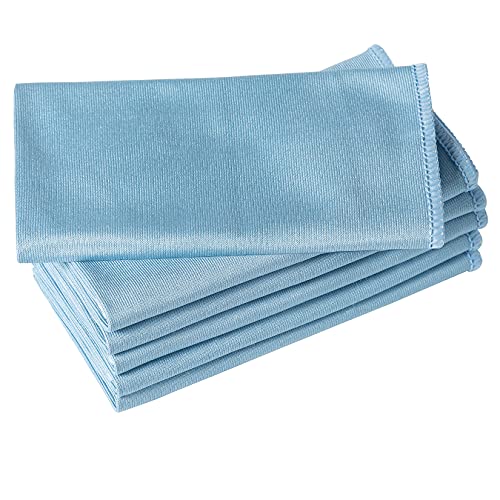
Puomue Microfiber Glass Cleaning Cloth, 6 Pack — Best Overall
The Puomue cloth is the straightforward answer to the question this article asks. It is a microfiber glass cleaning cloth, 16 inches square, sold as a 6-pack in blue, and its listing states the only promise that matters here: lint free, for quickly cleaning windows, glasses, windshields, mirrors, and stainless steel. Sixteen inches square is the classic glass-cloth size for a reason — folded in quarters it makes a pad that fits a palm, covers a tumbler in two passes, and wraps a wine glass bowl without bunching at the stem. Six cloths is the right starter bench: two in service on a normal evening, two drying, two in reserve, which is exactly how a glass cloth rotation should feel — unremarkable, because it never runs out at the moment guests arrive.
Strengths
- Purpose-built for glass: lint-free microfiber that polishes rather than smears.
- 16×16 in format folds to a controlled palm pad for tumblers and stemware alike.
- One cloth type serves glasses, mirrors, and stainless, simplifying the drawer.
Trade-offs
- Six cloths is a starter bench; a household drying a dozen glasses nightly will want the 10-pack below.
- Microfiber requires softener-free washing, or the lint-free finish degrades.
- Blue is the listed color; if your kitchen demands a different palette, check the listing for options rather than assuming.
Spec box: Material: microfiber (per listing) · Size: 16 x 16 in · Pack: 6 · Finish: lint free · Color of verified listing: Blue
Technique matters with a cloth this smooth: dry the outside of the glass first, then twist a corner gently into the interior rather than forcing a bunched cloth inside, which is how rims chip. For stemware, hold the base — never twist bowl and base in opposite directions, a caution that has nothing to do with the cloth and everything to do with stems snapping in confident hands. If your glassware routine is ordinary and your standards are high, this is the pack to buy first. Check the current price on Amazon.
Best for: everyday glassware and stemware in most homes / Not suited for: very high-volume entertaining as the only cloth supply
Check the current price on Amazon

HOMERHYME Microfiber Glass Cleaning Cloth, 10 Pack — Best for Entertainers
HOMERHYME sells its glass cloth as a polishing cloth, and the pack count tells you who it is for: ten cloths, 16×14 inches, streak free and lint free, listed for delicate surfaces including glasses and stainless steel. Entertaining changes the physics of glass drying. You are no longer drying two glasses at a sink; you are clearing a table of eight or twelve, the cloths load with water one after another, and the difference between a 6-pack and a 10-pack is whether the last four glasses get a fresh cloth or a damp one. A damp glass cloth is worse than a smaller dry one, because it redistributes a water film instead of removing it — the exact mechanism behind the mysterious spots that appear on glasses dried at the end of a party. The slightly rectangular 16×14 format drapes well over a hand for bowl polishing and folds neatly for storage in a bar drawer.
Strengths
- Ten cloths sustain a fresh-cloth rotation through a full dinner service.
- Positioned explicitly as polishing cloths for delicate surfaces.
- Streak-free, lint-free finish suits stemware and glass tabletops alike.
Trade-offs
- More cloth than a small household needs; the extras will live in a drawer.
- Same microfiber laundry discipline: no softener, separate from cotton loads.
- Rectangular format is slightly less classic for the quarter-fold pad than a true square.
Spec box: Material: microfiber (per listing) · Size: 16 x 14 in · Pack: 10 · Finish: streak free, lint free · Focus: polishing delicate surfaces
The entertainer’s workflow this pack enables is worth describing: stage three cloths at the bar or sideboard before guests arrive, rotate to a fresh one each time a cloth feels cool and damp against your palm, and send the used ones straight to a laundry pile rather than draping them to “dry and reuse” mid-party — a half-dried cloth carries the previous glasses’ mineral film into the next glass. Buy this pack if your glassware outnumbers your household. Check the current price on Amazon.
Best for: dinner parties, home bars, and stemware collections / Not suited for: a two-glass-a-day household that values minimal drawers
Check the current price on Amazon

Niveaya Microfiber Glass Cleaning Cloth, Fish Scale, 8 Pack — Best Texture for Polishing
The Niveaya cloth differs from the smooth cloths above in its weave: fish scale. The overlapping scale texture gives the surface thousands of tiny edges, and those edges are what let the cloth bite into a water film and break it up rather than skating over it — the reason fish-scale cloths have a following among people who polish glass, shower doors, and stainless steel for a living. Niveaya lists this 8-pack as streak free and lint free, quick drying, and suited to windows, kitchen, shower, and stainless steel. Quick drying is a real secondary virtue in a glass cloth: a cloth that dries fast between uses is a cloth that stays fresh-smelling in the drawer and is ready at full absorbency when the next rack of glasses comes out of the wash.
Strengths
- Fish-scale texture grips water film for a faster, more decisive polish.
- Quick-drying cloth stays fresher between uses and is ready sooner.
- 8-pack is a middle-depth bench that suits most households.
Trade-offs
- The textured face is a polisher, not a soaker; heavy standing water still wants an absorbent first pass.
- Texture preference is personal — some users simply prefer the glide of a smooth cloth.
- Microfiber care rules apply in full: softener will flatten exactly the performance you paid for.
Spec box: Material: microfiber (per listing) · Pack: 8 · Weave: fish scale · Finish: streak free, lint free, quick drying
Use the Niveaya as the second cloth in a two-cloth method: any absorbent cloth takes the bulk water, then the fish-scale cloth does the final polish in straight, overlapping strokes. It is also the pick of this list for the bathroom mirror and the glass shower door, where its bite on film is most visible. If you have ever finished drying a glass, held it to the light, and gone back in for one more pass, this is the cloth designed to make that second pass unnecessary. Check the current price on Amazon.
Best for: perfectionists, hard-water homes, and glass shower doors / Not suited for: buyers who want a single cloth to soak and polish in one step
Check the current price on Amazon

The Rag Company Standard Waffle Weave Towels, 3-Pack — Best Waffle Weave
The Rag Company comes from the auto-detailing world, where waffle weave is the established answer for glass and drying, and its Standard Waffle Weave Towels bring that format to the kitchen: microfiber, 16×16 inches, light blue, 3-pack, and — unusually for this category — a stated weight of 370gsm in the listing title, which we can therefore report as a listing fact rather than a guess. The waffle’s recessed pockets give water somewhere to go: instead of a flat film trapped between cloth and glass, the pockets collect it, which is why waffle towels feel like they keep absorbing after a flat cloth starts to smear. The same listing positions them for window and glass work, drying, and wax and polish removal, which tells you the weave is tuned for surface finish, not floor duty.
Strengths
- Waffle pockets hold water away from the surface for a longer effective polish.
- Stated 370gsm weight in the listing gives a concrete density to compare.
- Detailing-grade lint-free, streak-free finish.
Trade-offs
- Only 3 towels per pack — buy two packs if glasses are a daily volume job.
- Waffle texture can catch on rough or chipped rims; retire chipped glasses from hand-drying.
- A detailing towel wants gentle washing to keep its structure.
Spec box: Material: microfiber (per listing) · Size: 16 x 16 in · Pack: 3 · Weight: 370gsm (per listing) · Weave: waffle
For a small household with good glasses, two 3-packs of these may be the entire glass program: four in rotation, two resting. The waffle weave also makes this the best pick here for drying a glass cooktop or a window after the glasses are done, since the same pocket logic applies at larger scale. Check the current price on Amazon, and consider the two-pack math at checkout rather than discovering at the next dinner party that three towels was optimistic.
Best for: glass enthusiasts and small households that value weave quality over count / Not suited for: bulk rotation on a budget
Check the current price on Amazon

HIC Kitchen Jumbo Flour Sack Set, 4-Pack — Best Cotton
Before microfiber existed, the glass towel was the flour sack towel, and the HIC Kitchen Jumbo Flour Sack Set is that tradition at full size: heavyweight cotton, 32×38 inches, super absorbent and lint-free per the listing, machine washable, sold as a 4-pack. Flour sack cotton works on glass for the opposite reason microfiber does: its flat, tight weave has no loops to shed, so a well-worn, well-washed flour sack towel leaves essentially nothing behind while drinking a surprising amount of water into its sheer area. And area is the headline — at 32×38 inches, one towel draped over a shoulder or spread on a counter becomes a drying field for an entire rack of glasses, each set down on dry cloth and polished in turn. These are also the towels that double for every other kitchen job in this guide’s family, from proofing dough to straining, though for the sake of your glassware we recommend dedicating a set to glass and keeping it out of the greasy rotation.
Strengths
- Flat flour sack weave is naturally lint-free — the classic glass solution.
- Jumbo 32×38 in size creates a full drying station from a single towel.
- Cotton tolerates hot washes and needs no special laundry rules beyond sense.
Trade-offs
- New flour sack towels improve after several washes as sizing washes out; the first uses are not their best.
- The jumbo size is unwieldy inside a single small glass; fold discipline required.
- Cotton dries more slowly than microfiber when hung between uses.
Spec box: Material: cotton (per listing) · Size: 32 x 38 in · Pack: 4 · Weave: flour sack · Finish: lint-free per listing
If your household avoids synthetics, or your microfiber keeps dying in mixed laundry, this is your pick — a technology that has dried glasses for a century because it works. Wash the set three times before judging it, dedicate it to glass and produce, and it will repay you for years. Check the current price on Amazon.
Best for: cotton loyalists, big racks of glasses, and multi-use traditional kitchens / Not suited for: anyone who wants peak performance on the very first use
Check the current price on Amazon

Amazon Basics Microfiber Cleaning Cloths, Pack of 24 — Best Bulk Value
The Amazon Basics Microfiber Cleaning Cloths are the generalist’s route into glass drying: ultra absorbent, lint free, streak free, and non-abrasive per the listing, 16×12 inches, in a 24-pack of blue, white, and yellow. That color mix is a quiet feature — it lets you assign one color to glass permanently, so your glass cloths never moonlight on a greasy job and come back contaminated. The non-abrasive point matters for the modern kitchen’s glass-adjacent surfaces: glass cooktops, glossy cabinet fronts, and the plastic water window on a coffee maker all scratch under aggressive cloths and stay clear under these. Twenty-four cloths also means the laundry math disappears; even washing weekly, the glass station never empties.
Strengths
- 24-pack depth with three colors for permanent glass-duty assignment.
- Non-abrasive, lint-free, streak-free finish is safe on delicate surfaces.
- Ultra absorbent generalist cloth covers glasses and the whole kitchen.
Trade-offs
- A generalist cloth is a step behind a dedicated glass cloth on the final stemware polish.
- 16×12 in is slightly smaller than the classic 16×16 glass square.
- Bulk packs reward a storage system; a loose pile in a drawer tangles fast.
Spec box: Material: microfiber (per listing) · Size: 16 x 12 in · Pack: 24 · Colors: blue, white, yellow · Finish: lint free, streak free, non-abrasive
Buy this pack to solve the whole cloth drawer in one order, then promote your favorite color to glass duty and never let it leave. If stemware perfection is the goal, pair it with one dedicated polishing pick above and let the Amazon Basics cloths carry the daily tumblers. Check the current price on Amazon.
Best for: whole-drawer setups, color coders, and high-volume daily glasses / Not suited for: buyers seeking a single specialized stemware cloth only
Check the current price on Amazon
Comparison Table
| Pick | Badge | Key spec | Best for |
|---|---|---|---|
| Puomue Glass Cleaning Cloth (check price) | Best Overall | Microfiber, 16×16 in, 6-pack, lint free | Everyday glasses and stemware |
| HOMERHYME Glass Cleaning Cloth (check price) | Best for Entertainers | Microfiber, 16×14 in, 10-pack, polishing | Dinner parties and home bars |
| Niveaya Fish Scale Cloth (check price) | Best Texture for Polishing | Microfiber, fish scale, 8-pack, quick drying | Final polish, hard-water homes |
| The Rag Company Waffle Weave (check price) | Best Waffle Weave | Microfiber, 16×16 in, 370gsm, 3-pack | Weave quality over count |
| HIC Jumbo Flour Sack Set (check price) | Best Cotton | Cotton, 32×38 in, 4-pack, lint-free | Traditional kitchens, big racks |
| Amazon Basics Microfiber Cloths (check price) | Best Bulk Value | Microfiber, 16×12 in, 24-pack, 3 colors | Whole-drawer, color-coded systems |
Key Takeaways
- Glass drying rewards lint-free, streak-free surfaces — smooth microfiber, fish-scale microfiber, waffle weave, or flat flour sack cotton — not plush absorbency.
- A loaded, damp cloth creates spots; pack depth and fresh-cloth rotation matter as much as cloth quality.
- Technique is half the result: dry immediately, hold stemware by the base, and never twist bowl against stem.
- Microfiber performance dies by fabric softener and cotton-lint loads; wash glass cloths separately and softener-free.
- Every pick here was verified against its Amazon listing for material, size, and pack count before it earned a link.
How to Choose the Best Towels for Drying Glasses
Choose by your glassware, not by the cloth’s general reputation. If your daily reality is water tumblers and juice glasses, any lint-free microfiber here will feel like an upgrade, and the decision reduces to pack depth: a 6-pack for a couple, the 24-pack Amazon Basics for a family. If your reality includes stemware — wine glasses, coupes, delicate beer glasses — prioritize the polishing specialists (Puomue, HOMERHYME, Niveaya) and the two-cloth method described below, because stemware shows film that tumblers forgive. If your water is hard, weight your choice toward texture: fish scale and waffle weaves break up the mineral film that hard water leaves as it dries, while a smooth cloth on hard-water glass sometimes needs a second pass.
Material loyalty is the other honest axis. Cotton flour sack is the only pick here that asks nothing special of your laundry and improves with age, at the cost of a break-in period and slower drying between uses. Microfiber asks for a separate, softener-free wash and repays it with faster, more decisive polishing from the first use. Households that will not maintain a separate microfiber load should buy the flour sack set without a shred of guilt — the best towel is the one whose care rules your household actually follows. Finally, size: 16 inches square is the classic glass format because it folds to a palm pad; go jumbo only if you want the towel to double as a drying mat, and go smaller only for a bar kit where storage is tight.
How to Dry Glasses Without Streaks, Spots, or Lint
Technique, in order. First, start with a genuinely clean glass: a glass washed in greasy water will spot under any towel, so if spots persist across every cloth, fix the wash — hot water, fresh detergent solution, and a rinse — before blaming the drying. Second, dry immediately. Water that air-dries even partway leaves its minerals behind in rings, and no cloth fully erases a set ring without rewetting the glass. Shake the bulk water off over the sink, then take the cloth to the glass while it is still uniformly wet. Third, dry in a sequence: outside walls first, then the rim with a folded edge, then the interior with a twisted corner of cloth rather than a bunched fist, which stresses the rim. For stemware, cradle the bowl in the cloth in one hand and hold the base — never the stem alone — with the other, and rotate the glass, not the cloth, in small turns.
Fourth, manage the cloth, not just the glass. The moment a cloth feels cool and heavy — the tactile signal that it is loaded — fold to a dry quadrant or switch cloths entirely. A dry quadrant used with light pressure outperforms a fresh grip on a wet cloth used hard. Fifth, finish with inspection: hold the glass up to a window or under a cabinet light and look through it, not at it. Any remaining haze is film, and the cure is one pass with the driest cloth you own, ideally a fish-scale or waffle finisher. Sixth, store dried glasses rim-down only on a clean, dry surface or mat, or rim-up in the cupboard — the long-running rim debate matters less than the rule that a polished glass should not sit in a puddle of its own rinse water on a wet counter towel.
Glass Cloth Care: Keeping the Lint-Free Finish Alive
A glass cloth is a finished surface, and its lifespan is decided in the laundry room. The enemies are consistent: fabric softener and dryer sheets, which coat fibers with a waxy film that turns an absorbent cloth into a smearing one; cotton lint from mixed loads, which embeds in microfiber and then redeposits on your glasses as the very lint you bought the cloth to avoid; and excessive heat, which can damage microfiber’s split structure over time. The care routine that avoids all three is simple enough to tape inside a cabinet door: wash glass cloths together, warm, with a plain detergent and nothing else in the drum except other microfiber; dry on low or medium; fold immediately so the cloths are not gathering dust and counter grit while they wait.
Cotton flour sack towels live by kinder rules — hot washes are fine and even beneficial — but they share one rule with microfiber: a cloth must be fully dry and clean-smelling before it is stored, because a cloth stored damp develops the stale odor that transfers to glass as an off taste nobody can identify at the table. When does a glass cloth retire? When it stops polishing decisively — when a fresh-washed cloth still leaves film, the fibers are loaded with mineral or detergent buildup that normal washing no longer clears. Before retiring, one rescue attempt is legitimate: a hot wash with no detergent at all, which strips accumulated product. If that fails, demote the cloth to general cleaning, where its remaining life is still useful, and promote a fresh cloth to glass duty. Deep packs, again, are what make this discipline painless.
Setting Up a Glass Station That Makes Streaks Rare
Restaurants polish glass at a station, not at a sink, and the home version takes five minutes to arrange. Choose the spot where washed glasses naturally land — beside the dishwasher or along one stretch of counter — and give it three fixtures: a clean, dry landing surface (a dedicated flour sack towel spread flat, or a rack you actually empty), a small stack of folded glass cloths in a drawer or basket within one step, and a light source you can hold a glass against, even if that light is just the under-cabinet strip already there. The station changes behavior in the way that matters: glasses get dried immediately because the cloths are already there, cloths get rotated because the stack makes a fresh one the easiest one, and inspection becomes automatic because the light is part of the layout.
Two habits complete the station. First, separate the wash from the dry when you entertain: one person or one phase washes, the other dries and inspects, so no glass sits wet waiting for attention — sitting wet is where spots are born. Second, end the night by sending every used cloth to the laundry rather than draping them for tomorrow; a cloth’s second day is when yesterday’s mineral film becomes today’s mystery haze. The station costs nothing but a drawer and a decision, and it is worth more than any single cloth in this guide — which is exactly why this guide spends its length on cloths you can verify and a system you can copy, rather than on promises no towel can keep alone.
Hard Water, Detergent Film, and the Other Causes of Haze
When every cloth in this guide seems to “stop working,” the cloth is rarely the culprit. Haze on glass has three usual sources, and each has a different cure. Mineral haze comes from hard water: as droplets dry, they leave calcium and magnesium behind in a faint white film that a dry cloth mostly rearranges. The cures are upstream — dry the glass while it is still fully wet so minerals never deposit, use the textured cloths (fish scale, waffle) that physically break the film, and, if your home’s water is very hard, consider that a rinse aid in the dishwasher or a final rinse change will do more than any towel upgrade. Detergent film is the second source: too much detergent, or detergent that never fully rinsed, leaves a slick layer that feels clean and photographs as rainbow smear under light. The cure is less detergent and a hotter rinse, not a better cloth — and the diagnostic is simple: a glass rinsed in plain hot water and dried with your current cloth will tell you whether the film arrived before the drying started.
The third source is the cloth itself, loaded with the accumulated residue of its own laundry life: softener coatings, detergent buildup from overdosed loads, and lint from cotton companions. This is the one haze a purchase decision can influence, because deep packs let you rotate cloths before they are saturated in service and retire them before they are saturated in life. It is also why this guide insists on verification over adjectives: “lint free” in a manufacturer’s own listing title is a claim the maker stands behind in the one document attached to the product, while a reviewer’s adjective is weather. When haze persists after you have fixed the wash, the water timing, and the cloth rotation, the remaining suspect is the glassware itself — etched glass from years of harsh dishwasher cycles is permanently clouded, and no cloth on this page or any other will polish etching away. Knowing that saves real money: replace the etched everyday glasses, move the good ones to hand washing, and let the cloths in this guide do the job they can actually do.
Dishwasher Households Versus Hand-Wash Households
Your washing method changes what “best” means, and it is worth one section of honesty. If your glasses live in the dishwasher, the towel’s job narrows to rescue work: the glasses that emerge with pooled water in their bases, the good stemware you would never machine-wash, and the quick dry before guests arrive. In that life, a small bench of excellent cloths — Puomue or the Rag Company waffle — covers everything, and pack depth matters least. If your household hand-washes, the towel is a production tool used on every glass every day, and the economics invert: depth and durability dominate, the HOMERHYME and Amazon Basics packs earn their keep, and the flour sack set becomes a serious contender because its per-glass cost over years of daily service is hard to beat. Mixed households — most of us — should buy for the hand-wash load and let the dishwasher glasses borrow the system. One more dishwasher note: heated-dry cycles bake mineral spots onto glass that a towel then cannot remove without rewetting, so if spots are your complaint and you machine-wash, try towel-drying one load straight from a rinse-hold and compare — the experiment takes one evening and tells you whether your problem is the wash, the dry, or the cloth, in that order of likelihood.
A Short Note on Eyeglasses, Lenses, and Other Glass You Own
Readers inevitably ask whether these cloths should dry their eyeglasses too. The listings for several picks here do name glasses among their uses, and a clean, dedicated microfiber glass cloth is indeed gentle on lenses — with one discipline that matters more than the cloth: a cloth that has dried dishes, counters, or car glass carries grit, and grit is what scratches lenses. If you want a cloth from this guide to serve your eyewear, dedicate one, keep it in a case or drawer away from the kitchen rotation, and wash it on the same softener-free routine. Camera lenses and screens deserve the same dedication logic. The general principle travels well beyond this guide: in cloth systems, dedication beats quality — a mid-tier cloth used for one clean job outperforms a premium cloth used for everything.
How Many Cloths, in Practice: Three Households
Abstract pack advice lands better as arithmetic. A couple in an apartment, hand-washing a handful of glasses a day, runs happily on one Puomue 6-pack: two cloths in service, two resting, two spare, with a weekly softener-free wash resetting the bench. A family of five with a dishwasher still hand-dries the good glasses, the pots’ lids, and the daily water bottles, and discovers the Amazon Basics 24-pack’s color system is the real product: yellow for glass, blue for counters, white for the bathroom mirrors, and no arguments. The entertainer with a home bar dries in bursts of twenty and needs the HOMERHYME depth plus a finishing specialist — Niveaya or the Rag Company waffle — staged at the bar, because mid-party is no time to discover the bench is empty. Notice what changes across the three: not the cloth quality, but the rotation depth and the dedication system. That is the correct order of priorities for this entire category, and it is why this guide ranks packs, not just cloths.
One Last Distinction: Drying Versus Polishing
These are two jobs that share a cloth drawer and nothing else. Drying removes bulk water and rewards absorbency and area; polishing removes film and rewards texture and a dry surface. Most disappointment in this category comes from asking one cloth, in one pass, to do both in sequence — the drying pass loads the cloth, and the loaded cloth then polishes with its own moisture. The two-cloth method threaded through this guide — any absorbent pick first, a fish-scale or waffle finisher second — is not connoisseur theater; it is the mechanical recognition that the second job needs a dry tool. If you adopt only one idea from this article, adopt that separation, and your current cloths will immediately perform better than they did yesterday.
Common Buying Mistakes
The classic mistake is reaching for the plushest towel. Plush terry feels luxurious and is exactly wrong for glass: loops shed lint, hold detergent residue, and smear films. The second mistake is buying a single cloth or a token 2-pack; glass cloths load with water within a few glasses, so under-buying guarantees the damp-cloth spots buyers then blame on the cloth. The third is washing microfiber with fabric softener or in a cotton load, coating and lint-loading the fibers — the cloth did not fail, its care did. The fourth is using the same cloth for glasses and for wiping counters or hands; a glass cloth must be a protected specialist, because one greasy pass ends its polishing career until the next proper wash. The fifth is assuming price signals quality in this category: weave, lint behavior, and pack depth — all checkable in a listing — predict performance far better than a premium label.
Final Recommendation
Start with the Puomue 6-pack (check price on Amazon) if your glassware life is ordinary and your standards are not. Step up to the HOMERHYME 10-pack if you entertain, add the Niveaya fish-scale cloths as your finishing specialists if your water is hard or your eye is unforgiving, and choose the HIC flour sack set if cotton is your household’s religion. The Rag Company waffle towels are the connoisseur’s small-pack buy, and the Amazon Basics 24-pack is the pragmatic whole-drawer solution. For the rest of the towel system, see our companion guides to Best Towels For Cleaning Spills, Best Bar Towels For Drying Glassware, Best Bang For Buck Dish Towels, and Best 800 Gram Towels.
Frequently Asked Questions
Why do my glasses come out spotty even with a good towel?
Usually because the water film partially dried before the towel arrived, or because the cloth was already loaded and redistributed minerals instead of removing them. Dry glasses immediately after washing, rotate to a dry cloth sooner than feels necessary, and if spots persist, look at the wash itself — greasy wash water defeats every towel.
Is microfiber or cotton better for drying glasses?
Microfiber polishes faster and works from the first use, provided it is washed without softener. Cotton flour sack is lint-free by weave, tolerates any laundry routine, and improves after several washes, but needs that break-in. Both are legitimate; choose by your laundry habits.
How do I dry wine glasses without breaking the stem?
Never twist the bowl and base in opposite directions. Cradle the bowl in the cloth in one hand, support the base with the other hand, and rotate the glass gently within the cloth. Dry the interior with a twisted corner of cloth rather than forcing a bunched cloth inside.
How many glass cloths should I own?
Enough to always have a dry one: six is a workable minimum for a small household, ten or more if you entertain or run a home bar. The moment you catch yourself reusing a damp cloth because the rest are in the wash, your bench is too small.
Can I use the same microfiber cloths for glasses and for my car or windows?
The cloths themselves are listed for exactly those surfaces, and cross-use is fine at the category level — but dedicate specific cloths to glassware within your set. A cloth that has polished a car or wiped a sill carries grit and residues you do not want on a wine glass. Color assignment, like the three colors in the Amazon Basics pack, makes the dedication effortless.
How should glass cloths be washed?
Microfiber: warm wash, no fabric softener, no dryer sheets, ideally separate from cotton, and low-to-medium drying heat. Cotton flour sack: hot or warm wash with your regular towels, dried fully. In both cases, a cloth that comes out of storage smelling stale should be rewashed before it touches glass, because odor in the cloth becomes film on the glass.


