Disclosure: airfryerkitchensupply.com is reader-supported. When you buy through links on our site, we may earn an affiliate commission at no extra cost to you.
Where to buy
Each verified pick in this guide for best toddler slippers links to its Amazon listing, where you can check the current price on Amazon, confirm the size, colour or configuration, and read the full listing details before you decide. Listings change, so treat the listing page as the final word on anything this guide does not state.
If you are shopping for best toddler slippers, start with the Quick Picks below, then read the full review of the one or two options that match your space and habits. That order saves time and keeps the decision grounded in stated features rather than first impressions.
Toddler slippers need three things before cuteness: a sole that grips, a shape that stays on a small foot, and sizing you can verify. Every pick here is a toddler or little-kids slipper confirmed in its listing title, with the size or age wording printed only where the title states it. Toddlers wear slippers while awake and supervised, never for sleeping. This general toddler guide is separate from the girls-focused guide in the same batch, and the two share as few picks as possible.
In this guide
Quick Picks
- OWIF Toddler Slippers Boys Girls — Best Overall: Non-slip sole in title; warm; soft; indoor bedroom shoes. Check the current price on Amazon
- OWIF Toddler Slippers Boys Dinosaur — Best Dinosaur Design: Non slip in title; warm; soft; winter fuzzy; dinosaur. Check the current price on Amazon
- SITAILE Toddler Slippers Boys Girls — Best Grip Wording: With grips in title; non-slip sole; memory foam; plush lined. Check the current price on Amazon
- Fadezar Toddler Slipper, Pink Bunny — Best Stated Size: Size 8-9 toddler in title; non-slip rubber sole; half cover heel; bunny. Check the current price on Amazon
- Hstyle Baby Walking Sock Shoes — Best for 12-18 Months: 12-18 month in title; non-slip; soft rubber sole; lightweight. Check the current price on Amazon
- Dearfoams Lil Bear Slipper — Best Named Brand: 9-10 toddler US in title; unisex child; Lil Bear design. Check the current price on Amazon
How These Picks Were Chosen
Every product in this guide was checked against Amazon listing data. A product earned a link only when its listed title confirmed it as a complete product matching the intent of best toddler slippers. Variants of the same listing in different sizes or colours were not counted as separate picks, and accessories, covers, inserts and parts were excluded even when their titles shared the same keywords.
Features are described only as the titles state them. Where a title does not state a material, a dimension, a capacity or a certification, this guide says that plainly instead of filling the gap. That discipline matters most in categories where marketing language runs ahead of what a listing actually confirms.
Two toddler-specific gates shaped this shortlist beyond the general API check described above. First, a pick had to read as a shoe for a toddler or little kid in its own title, not as a baby bootie, an adult slipper in a small-looking photograph, or a sock with no sole claim at all. Second, wherever the guide repeats a size or an age, that number had to come from the title – which is why the Fadezar and Dearfoams entries can name a toddler size, the Hstyle entry can name an age in months, and the other three entries openly send you to a chart instead of borrowing a size from a neighbouring variant.
The six survivors also had to differ from one another in a way a parent can act on. Two OWIF pairs stayed because one is a plain everyday shoe and the other is a winter dinosaur design; keeping both is honest about how toddlers actually choose. The SITAILE pair earned its place on grip and cushioning language, the Fadezar pair on a stated size plus heel coverage, the Hstyle pair on being the only true early-walker format, and the Dearfoams pair on brand and a stated US size. If two listings had offered identical stated briefs, one would have been cut, because a guide that lists the same shoe twice helps nobody measure, compare or decide.
The 6 Best Options for Best Toddler Slippers

OWIF Toddler Slippers Boys Girls — Best Overall
This pick suits everyday indoor wear for a toddler. It is a weaker match for outdoor or playground use. Its confirmed positioning, taken from its listing title, is: non-slip sole in title; warm; soft; indoor bedroom shoes. Read that positioning literally, because this guide does not extend a title claim beyond the words the listing uses.
Strengths
- Non-slip sole is stated in the title
- Unisex boys and girls positioning suits hand-me-downs
- Soft indoor shape suits first walkers at home
Trade-offs
- No specific size is stated in this title, so check the chart
- Plush warmth is a cooler-weather choice
- Indoor positioning only
Key spec (as stated in the listing title): Non-slip sole in title; warm; soft; indoor bedroom shoes.
In daily use, the difference between a good and a disappointing choice in this category usually comes down to fit and habit rather than headline features. Match this pick against the measurements and routines described in the buying guide below. If its stated strengths line up with your first two needs and its trade-offs touch only things you rarely do, it is a sound choice. If a trade-off hits something you do every day, keep looking, even when the product photographs well.
Also consider how this option will age in your home. Surfaces that are easy to clean, shapes that stay comfortable after the novelty fades, and sizing you verified against a chart all matter more after a month than they do on delivery day. This pick earned its badge on stated features, and your own measurements are the final check before ordering.
Think of this OWIF pair as the plain, everyday baseline against which the rest of the list is judged. Its title makes no character claim and names no single size, which is precisely why it works as a first check: you are choosing it for a stated non-slip sole, warmth and softness in an indoor bedroom shoe, not for a costume effect. Put it on the shortlist if your morning actually looks like pyjamas, a cold hallway floor and a toddler who pads between bedroom and kitchen dozens of times before breakfast, because that repeated, unglamorous route is where a general indoor slipper earns its keep.
Because no size is printed in this title, the work here is measurement rather than guessing. Trace both feet while your child stands, note the longer one, and match that length to the size chart on the listing for the exact colour you intend to order. The unisex boys-and-girls positioning also changes the value calculation in a household with younger siblings: a neutral everyday pair is easier to hand down than a themed pair a second child may refuse. Its weakness is the mirror image of its strength – nothing in the title promises memory foam, a rubber sole compound, a heel cup or an age range, so if one of those specific features is your main problem, one of the narrower picks below answers it more directly.
On the floor, expect the practical question to be transitions. A toddler crosses from rug to wood to tile in a few steps at home, and a sole described only as non-slip should be tested on each of those surfaces during the first supervised wear, at walking pace, before you treat the pair as settled. If it holds on your smoothest floor and the upper does not fold under the toes when your child turns, the general brief is met. If your home is mostly carpet, warmth and softness will matter more than grip wording, and this pair’s stated warm, soft brief fits that house better than it fits a polished-tile kitchen.
Best for: everyday indoor wear for a toddler / Not suited for: outdoor or playground use
Check the current price on Amazon
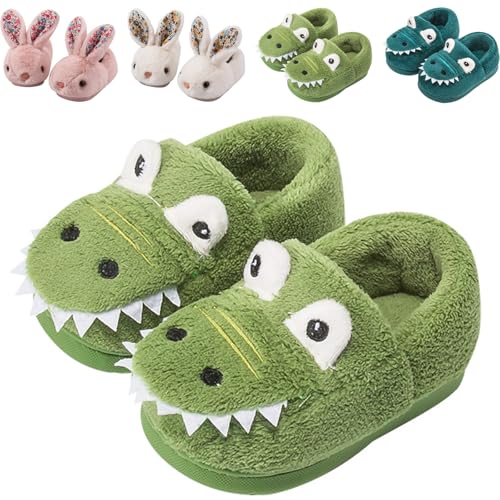
OWIF Toddler Slippers Boys Dinosaur — Best Dinosaur Design
This pick suits a toddler who loves dinosaurs and cold floors. It is a weaker match for summer wear. Its confirmed positioning, taken from its listing title, is: non slip in title; warm; soft; winter fuzzy; dinosaur. Read that positioning literally, because this guide does not extend a title claim beyond the words the listing uses.
Strengths
- Non slip wording is stated in the title
- Dinosaur design helps reluctant wearers
- Fuzzy winter build suits cold floors
Trade-offs
- Character design is a taste choice
- Winter weight is too warm for summer
- Green colourway confirmed in the title
Key spec (as stated in the listing title): Non slip in title; warm; soft; winter fuzzy; dinosaur.
The dinosaur version from OWIF shares the warm, soft, non-slip idea with the Best Overall pair, but the reason to choose it is different: cooperation. Its title confirms a green dinosaur design and a winter fuzzy build, so this is the pick for a child who resists putting anything on their feet yet will happily stomp around as a dinosaur. That behavioural difference is not trivial at toddler age. A slipper left by the door protects nobody, while a slightly theatrical pair that a child asks for by name gets worn through the coldest part of the day, which is when bare feet on winter floors are most uncomfortable.
Judge it as a seasonal purchase rather than a year-round one. The title says winter and fuzzy in plain words, so buying it for a heated flat in summer would fight its own brief; it belongs in a house with genuinely cold floors, draughty hallways or a playroom that never quite warms up. The green colourway is also confirmed in the title, so do not order expecting a choice of colours from this particular listing without checking the variant shown on the page. If the dinosaur appeal fades, the underlying warm indoor shoe still functions, but you will have paid the design premium in attention rather than in any extra stated sole technology.
Compared with the plain OWIF pair above, this one trades neutrality for motivation, and compared with the SITAILE truck pair below it offers character without the stated memory foam or plush lining language. That middle position suits a parent whose child is a confident indoor walker, does not need a cushioning claim, and mainly needs a reason to keep warm slippers on until lunchtime. Check the fit without thick socks first, then with the socks your child actually wears in winter, because a fuzzy winter upper plus a heavy sock can crowd toes that measured fine in bare feet during a summer try-on.
Best for: a toddler who loves dinosaurs and cold floors / Not suited for: summer wear
Check the current price on Amazon

SITAILE Toddler Slippers Boys Girls — Best Grip Wording
This pick suits a toddler on smooth indoor floors. It is a weaker match for outdoor wear. Its confirmed positioning, taken from its listing title, is: with grips in title; non-slip sole; memory foam; plush lined. Read that positioning literally, because this guide does not extend a title claim beyond the words the listing uses.
Strengths
- Grip and non-slip wording are both in the title
- Memory foam cushioning is stated in the title
- Plush lining suits winter floors
Trade-offs
- Truck design will not suit every child
- No size is stated in this title
- Indoor house shoe positioning
Key spec (as stated in the listing title): With grips in title; non-slip sole; memory foam; plush lined.
SITAILE makes the strongest grip case in this guide, and the wording deserves a slow read. Its title says both with grips and non-slip sole, then adds memory foam and a soft plush lining – four separate claims no other pick here combines. That makes it the natural first look for a home dominated by smooth floors, where a toddler is past the wobbly first-steps stage but still runs, stops suddenly and pivots around furniture. The truck design is part of the confirmed title too, so the child-facing appeal is a vehicle theme rather than an animal one, which matters if you are choosing between this and the dinosaur or bunny pairs for a particular child’s obsession.
Memory foam is the feature to interrogate hardest on the listing page. The title states it, but it does not state a thickness, a density or whether the foam forms the whole insole, so treat it as a stated cushioning direction rather than a measured specification. In practical terms, a cushioned, plush-lined winter house shoe suits long indoor play sessions on hard floors, where an unlined thin slipper can feel cold and flat after an hour. The trade-off is bulk and heat: the same plush lining that helps in January can make feet sweaty in a warm flat, and a thicker sole can feel clumsy to a very young walker who is still placing each foot deliberately.
Choose this pair when grip language is your top priority and you want the listing itself, not this guide, to carry that claim twice. Skip it, or at least look at the Fadezar or Hstyle options first, if your child is under the age where a shaped, lined house shoe stays on easily, because the title gives no age range and no heel-retention wording. Nothing here promises a half cover heel or a sock-like fit, so retention depends on getting the size right from the chart. Order for the foot you measured this week, not for growth, because an oversized cushioned slipper that slides forward at the heel undermines the very grip you bought it for.
Best for: a toddler on smooth indoor floors / Not suited for: outdoor wear
Check the current price on Amazon

Fadezar Toddler Slipper, Pink Bunny — Best Stated Size
This pick suits a toddler in the stated size who needs heel coverage. It is a weaker match for a buyer needing a different size in this exact listing. Its confirmed positioning, taken from its listing title, is: size 8-9 toddler in title; non-slip rubber sole; half cover heel; bunny. Read that positioning literally, because this guide does not extend a title claim beyond the words the listing uses.
Strengths
- A specific toddler size is stated in the title
- Non-slip rubber sole is stated in the title
- Half cover heel helps the slipper stay on
Trade-offs
- Pink bunny design is a specific taste
- Half cover heel is not a full closed back
- Autumn and winter positioning in the title
Key spec (as stated in the listing title): Size 8-9 toddler in title; non-slip rubber sole; half cover heel; bunny.
Fadezar is the most precisely described pick in the list, because its title does the thing buyers wish every toddler listing would do: it states a size, 8-9 toddler, in the title itself. That single fact changes who should buy it. If your child’s measured foot falls in that stated bracket, you can evaluate the rest of the brief – a non-slip rubber sole, a half cover heel and a warm bunny design for autumn and winter – without first wondering whether the listing even covers your size. If your child is outside that bracket, honesty is faster than hope: check the listing for other variants rather than assuming this exact title extends beyond the size it prints.
The half cover heel is this pick’s real distinguishing feature, and it sits between two extremes elsewhere in the guide. It is more retention than a fully open-backed slipper offers, yet it is not the full enclosure of the Hstyle sock shoe below. For a toddler who kicks slippers off mid-hallway or shuffles so the heel keeps escaping, that partial coverage is a meaningful, title-stated reason to prefer this pair over the plain OWIF options. The rubber wording on the sole is also specific to this listing among these picks, which gives parents who distrust vague grip language a material word to verify on the product page.
Pink bunny styling will either delight your child or end the conversation, and the title is candid that the design is a bunny and the colour in this listing title is pink, even though it also describes the slipper as unisex and for girls and boys. Treat the season wording seriously as well: autumn and winter positioning plus a warm, cozy plush description point to colder months, not to a breathable summer house shoe. This is therefore a narrow, confident buy – right size stated, heel help stated, rubber sole stated – rather than a flexible family spare, and narrow buys are best when the stated facts line up exactly with your child’s foot and habits.
Best for: a toddler in the stated size who needs heel coverage / Not suited for: a buyer needing a different size in this exact listing
Check the current price on Amazon

Hstyle Baby Walking Sock Shoes — Best for 12-18 Months
This pick suits a baby of the stated age learning to walk indoors. It is a weaker match for an older toddler who needs a structured slipper. Its confirmed positioning, taken from its listing title, is: 12-18 month in title; non-slip; soft rubber sole; lightweight. Read that positioning literally, because this guide does not extend a title claim beyond the words the listing uses.
Strengths
- Age range is stated in the title
- Soft rubber sole suits early walkers
- Sock shoe shape stays on small feet
Trade-offs
- Sock shoes are for the youngest toddlers only
- Soft sole gives less protection outdoors
- Grey colourway confirmed in the title
Key spec (as stated in the listing title): 12-18 month in title; non-slip; soft rubber sole; lightweight.
Hstyle is not really competing with the other five picks, because its title addresses a different child: a baby of 12-18 months, in grey, learning to walk. A sock shoe solves the earliest walker’s two problems in a way a shaped slipper cannot. It flexes with a foot that is still figuring out balance, and its sock-like body is far harder for small hands to pull off than a loose slip-on. The title states a soft rubber sole, non-slip wording and a lightweight build, which together describe protection and grip without the stiffness that can trip a child who still catches their toes when they turn.
That softness defines its limits just as clearly. A soft rubber sole is an indoor learning tool, not armour for gravel, playground surfaces or wet pavements, and the guide’s own trade-off line about outdoor protection should be read as a hard boundary rather than fine print. The stated age window is equally firm in spirit: a child well past 18 months, running and climbing, will usually need the structure of a proper slipper such as the SITAILE or Fadezar picks, while a younger baby in this bracket may find those same slippers too much shoe. The title even frames this pair as a first birthday gift, which fits its moment in a child’s life – the months when cruising furniture turns into independent crossing of the room.
Fit-checking a sock shoe is different from fit-checking the others. There is no heel cup to judge and no chart-driven size in the title beyond the stated months, so watch behaviour instead: the sock body should stay up without leaving deep marks, the toes should splay when your baby stands, and the sole should bend where the foot bends rather than staying flat as a board. If your baby is at the very top of the stated age range and already walking confidently outdoors, buy this for indoor use only and plan the next, more structured pair soon, because this design is deliberately a beginning rather than a long-term slipper.
Best for: a baby of the stated age learning to walk indoors / Not suited for: an older toddler who needs a structured slipper
Check the current price on Amazon

Dearfoams Lil Bear Slipper — Best Named Brand
This pick suits a toddler in the stated size range. It is a weaker match for a buyer who needs stated grip features above all. Its confirmed positioning, taken from its listing title, is: 9-10 toddler us in title; unisex child; lil bear design. Read that positioning literally, because this guide does not extend a title claim beyond the words the listing uses.
Strengths
- A specific toddler size is stated in the title
- Established slipper brand name in the title
- Unisex positioning suits siblings
Trade-offs
- No sole grip wording is claimed beyond the title
- Character styling is a taste choice
- Check current size availability on the listing
Key spec (as stated in the listing title): 9-10 toddler US in title; unisex child; Lil Bear design.
Dearfoams brings the only established slipper brand name in this guide, and for some buyers that familiarity is the deciding factor: they have bought adult Dearfoams before and prefer a known maker over an unfamiliar label. The title confirms a unisex child Lil Bear slipper in a buffalo plaid presentation, sized 9-10 toddler US. That stated US size is useful in a different way from the Fadezar size – it anchors this pick to a specific, slightly larger toddler foot, so it naturally suits a child who has outgrown the Hstyle age bracket and is walking confidently enough that a character slipper, rather than a sock shoe, is the right format.
Be clear-eyed about what the title does not say. Unlike the OWIF, SITAILE, Fadezar and Hstyle listings, this title carries no non-slip, grip or rubber sole wording at all, and this guide does not invent any on its behalf. If your floors are polished wood and grip is the reason you are shopping, the picks above state their case in words while this one asks you to check the listing page for sole details before ordering. That gap is the honest price of the brand-and-design choice, and naming it here is more useful than pretending every pick in a guide is strong on every axis.
Where this pair can win is the ordinary, non-technical side of toddler life. A bear design in buffalo plaid reads as a giftable, photograph-friendly slipper for grandparents to buy without navigating unfamiliar brands, and unisex child positioning keeps it passable between siblings. Buy it when the stated size matches, the design is the point, and you have confirmed any sole questions on the listing itself. Pass it by, without regret, when a stated grip feature is non-negotiable, because three other picks in this same guide put that promise in their titles where you can hold them to it.
Best for: a toddler in the stated size range / Not suited for: a buyer who needs stated grip features above all
Check the current price on Amazon
Comparison Table
| Pick | Badge | Key spec | Best for |
|---|---|---|---|
| OWIF Toddler Slippers Boys Girls | Best Overall | Non-slip sole in title; warm; soft; indoor bedroom shoes | everyday indoor wear for a toddler |
| OWIF Toddler Slippers Boys Dinosaur | Best Dinosaur Design | Non slip in title; warm; soft; winter fuzzy; dinosaur | a toddler who loves dinosaurs and cold floors |
| SITAILE Toddler Slippers Boys Girls | Best Grip Wording | With grips in title; non-slip sole; memory foam; plush lined | a toddler on smooth indoor floors |
| Fadezar Toddler Slipper, Pink Bunny | Best Stated Size | Size 8-9 toddler in title; non-slip rubber sole; half cover heel; bunny | a toddler in the stated size who needs heel coverage |
| Hstyle Baby Walking Sock Shoes | Best for 12-18 Months | 12-18 month in title; non-slip; soft rubber sole; lightweight | a baby of the stated age learning to walk indoors |
| Dearfoams Lil Bear Slipper | Best Named Brand | 9-10 toddler US in title; unisex child; Lil Bear design | a toddler in the stated size range |
How to Choose the Right Option for Best Toddler Slippers
Start with the constraint you cannot change: the size of the space, the size of the user, or the surface it will be used on. That single constraint removes more wrong options than any feature comparison. Then check the features the titles actually state, in the order you will feel them: fit first, comfort second, care and cleaning third, and appearance last, because appearance is the easiest thing to adapt to and the hardest thing to judge from a screen.
Budget tiers in this category are best thought of in relative terms. Budget options cover the stated basics, mid-range options usually add better materials or an extra stated function, and premium options add power, larger formats or more refined finishes. This guide does not print product prices, because they change; use the tiers to decide where to look, then check price on Amazon for the exact option.
Finally, read the listing for the exact size, colour or configuration you intend to order, not a neighbouring one. Titles in this category often span several variants, and the feature set can differ between them. Confirming the variant in front of you takes a minute and prevents the most common disappointment in this category.
Measure a toddler foot at the end of the day, standing, in the socks the slippers will be worn with, and measure both feet because one is usually slightly longer. Press the toes gently through the front of any pair you try: you want growing room, but a whole size of empty space at the front is not growing room, it is a tripping edge that catches on rug borders and stair noses. Toddlers fall forward onto their hands, so a slipper that folds off the foot during a stumble is worse than a plain grip sock, however charming its design looks in a listing photograph.
Then match the format to the walking stage, not to the birthday on the last card. A cruising baby who pulls up on furniture needs the flexible sock-shoe format and a soft sole that bends with the foot. A steady indoor walker can move to a shaped slipper with a stated non-slip sole. A runner who charges down hallways needs retention – a heel that stays covered or an upper that holds – as much as grip, because speed exposes a loose heel before it exposes a smooth sole. Revisit that staging every few months; the right answer at fourteen months is often the wrong answer at two and a half years.
Finally, walk your own floors in socks before you order and note where you slide. Kitchens and bathrooms concentrate smooth, sometimes damp surfaces in exactly the rooms toddlers follow adults into, while playrooms are often carpeted and forgiving. A house that is mostly carpet rewards warmth and softness, so the warm OWIF briefs compete well there. A house of wood and tile rewards the strongest stated grip language, which is the SITAILE brief, or a stated rubber sole, which is the Fadezar brief. Writing down your worst floor, rather than your average floor, is the quickest way to break a tie between picks that otherwise look equal.
How to Set Up and Care for Your Choice
When your choice arrives, set it up in daylight, check it against the listing description while the packaging is still at hand, and test the main function before you settle it into place. Keep small parts, tools and instructions together in one labelled bag or drawer so a later adjustment does not become a search.
For care, follow the listing instructions for the exact product. As a general rhythm, inspect moving parts, soles, straps or surfaces weekly, clean little and often rather than rarely and harshly, and let anything that gets damp dry fully before its next use. Stop using any product that becomes damaged in a way that affects safety, and replace it rather than improvising a repair.
Do the first fitting indoors, on a clean floor, while your toddler is rested and willing. Watch a full circuit of the room they play in most: straight walking, a turn around a chair, a stop, and a squat to pick something up, because squatting pushes the heel out of shallow slippers and reveals a fit problem that standing still hides. Check that toes can spread, that the upper does not crease hard across the top of the foot, and that your child is not curling their toes to keep the slipper on – toe-curling is the clearest early sign that a pair is too big, too loose at the heel, or too stiff in the sole.
Care for toddler slippers is mostly about grip preservation and damp. A sole that picks up dust, hair and kitchen crumbs loses the contact that its non-slip wording depends on, so wipe soles down as part of a weekly rhythm and sooner after any spill. Plush and fuzzy uppers, like the winter builds in this guide, should dry fully between wears; a pair put away damp will smell, feel clammy the next morning and tempt a toddler to refuse them. Keep a second cheap pair of grip socks in rotation for wash or drying days rather than sending a child onto smooth floors in smooth socks while the main pair dries.
Store the pair where the routine starts – by the bedroom door or the playroom entrance, toes pointing out, at a height your toddler can reach with you nearby. Toddlers cooperate with objects they can fetch themselves, and a slipper that lives in a cupboard is a slipper that gets forgotten until after the first cold-floor dash of the morning. Inspect the pair monthly for sole smoothing, loose decorative parts and seams opening at the toe, and retire any pair where a character feature, strap or trim has come partly away, because small detached pieces and tripping loops are not worth repairing on footwear this size.
Common Buying Mistakes
The most common mistake is buying from a photograph without checking a single stated feature. The second is assuming a feature the title does not state, such as a material, a size or a function, and discovering the gap after delivery. The third is ordering a size from habit instead of from a measurement and a chart. Each of these is avoidable in about two minutes, and the reviews above flag the exact gaps to check for every pick.
Another frequent mistake is solving the wrong problem: buying a warmer, larger or more powerful option when the real issue was fit, placement or surface. Re-read your original need before ordering, and let it, rather than the longest feature list, make the final call.
Measure the home before you measure anything else, because the best product on paper is the wrong product in a space it does not fit. Write the measurements down, keep them beside the listing while you compare, and re-check them before you order rather than relying on memory.
Think about who uses the home every day and who only visits, because a choice tuned to a daily user will serve the household better than one tuned to an occasional guest. Daily habits, not showroom impressions, decide whether a purchase still feels right after a month.
Light changes how colours and fabrics look, so a choice that seems perfect under shop lighting can read differently beside your own window. Where a title states a colour, treat it as a guide and expect some variation in your own light.
Keep the receipt, the listing details and a note of the size or colourway you ordered until you are sure the fit is right. That small habit makes any exchange simpler and stops guesswork later.
A good rule for this category is to rank your needs before you rank products. Put the one requirement you cannot compromise on first, let it cut the list, and only then compare the nicer extras among what remains.
Avoid buying two new things at once to solve one problem, because then you cannot tell which change actually helped. Change one thing, live with it for a week, and let that experience guide the next decision.
Where a listing title is silent about a feature, treat that feature as unconfirmed rather than absent or present. Titles in this guide are quoted honestly, and the listing page is the place to confirm anything the title does not state.
Consider the floor surface as part of the product. Hard floors, rugs and carpet all change how a chair base or a slipper sole behaves, and the right choice for one surface can be the wrong choice for another.
Set a simple maintenance rhythm when the product arrives rather than waiting for a problem. A quick weekly check and clean takes minutes and keeps small issues from becoming the reason a good purchase gets replaced early.
If two options look equal, choose the one whose stated features match your written measurements and needs most closely. Stated, verifiable details age better than impressions, and they are what this guide is built on.
Buying the character first and the fit second is the mistake this category invites most warmly. A dinosaur, truck, bunny or bear design can be a legitimate reason to choose between two pairs that both fit – this guide keeps themed picks for exactly that reason – but a beloved design in the wrong size still slides, trips and gets abandoned. Decide the size bracket and the format from a measurement and a walking stage first, then let the child’s favourite creature settle the choice among the pairs that survive, and you get the cooperation benefit without paying for it in falls.
Sizing up aggressively to get more wear is the second toddler-specific trap. Adult logic says a bigger shoe lasts longer; toddler biomechanics say a long, loose slipper catches, folds and teaches a child to shuffle to keep it on. Buy the size that fits the measured foot now, accept that toddler footwear is a short-lived purchase, and hand the outgrown pair down or pass it on while it still has life. The related error is keeping a much-loved pair in service after the toes reach the end, which cramps the foot and changes how a child walks just as surely as an oversized pair does.
A third mistake is blurring the indoor boundary the titles draw. Every pick in this guide is positioned for indoor, bedroom or house use, and several state soft or plush constructions that wet pavement, gravel and playground grit will ruin quickly while offering little protection outdoors. Using an indoor slipper as a garden shoe shortens its life, packs its sole with dirt that then tracks onto the floors it was bought to grip, and can leave a child under-protected on rough ground. Keep slippers for the house, shoes for outside, and teach the swap at the door as part of the routine.
Final Recommendation
For most buyers, start with the OWIF Toddler Slippers Boys Girls, our Best Overall pick, and check it against your measurements first. If its trade-offs clash with your daily routine, move to the pick whose badge names your situation most directly, because the badges in this guide were written to make that second choice easy. Related guides in this programme: Best Toddler Slippers Girls, Best Supporting Slippers For Kids, Best Summer Outdoor Slippers.
Read the badges as a decision tree rather than a ranking. If nothing about your situation stands out, the plain OWIF pair is the sensible start. If cold floors and a reluctant wearer stand out, go to the dinosaur pair; if smooth floors stand out, go to the SITAILE grip wording; if a stated size and a wandering heel stand out, go to the Fadezar pair; if the child is in the stated 12-18 month window, the Hstyle sock shoe is not a compromise but the correct format; and if a trusted brand name and a stated 9-10 toddler US size are what your household values, the Dearfoams pair is waiting at the end of the list for exactly that buyer.
Frequently Asked Questions
What size toddler slipper should I buy?
Measure your toddler’s foot and use the listing chart. Where a title states a size or age, this guide prints it; where it does not, the guide says so instead of guessing.
As a cross-check, compare the stated sizes in this guide with your measurement rather than with the size of the shoes your child is outgrowing. The Fadezar title states 8-9 toddler and the Dearfoams title states 9-10 toddler US, so a foot that measures between those conversations belongs to a chart check on the listing, not to a guess. When a chart gives a length range, choose by length, because age labels and shoe sizes drift between brands while a centimetre measurement of your child’s longer foot does not.
Why does grip matter so much for toddlers?
Toddlers walk on smooth kitchen and wood floors while still unsteady. A sole the title describes as non-slip or with grips is the first feature to look for.
Grip also matters at the moments adults forget: getting down from a sofa, stepping off a rug edge onto wood, and hurrying after a parent carrying something interesting. Those transitions change surface mid-step, which is why the strongest stated grip language in this guide belongs to a pick aimed at smooth floors, and why testing a new pair across every surface in your home, supervised, is worth ten minutes on the first day.
Should toddlers wear slippers to sleep?
No. Slippers are for awake, supervised time. Remove them for naps and overnight sleep.
The same rule covers naps in a pushchair, car journeys and overnight guests: slippers come off whenever a child sleeps, and feet can be kept warm in bed with appropriate sleep clothing instead. Keeping the boundary absolute, rather than negotiating it on tired evenings, also protects the routine – toddlers accept a rule that never bends far more easily than one that depends on how awake a parent feels at midnight.
Are sock shoes real slippers?
For the youngest toddlers, a sock shoe with a stated non-slip soft sole works as an indoor slipper and stays on well. Older toddlers usually do better in a shaped slipper.
Judge a sock shoe by its title the same way as any other pick here. The Hstyle listing states non-slip wording, a soft rubber sole and lightweight construction for a stated 12-18 month wearer, which is a complete indoor brief for that stage. A fashion sock with no sole wording in its title would not meet the same bar, whatever it looked like, and this guide would treat any unstated sole claim as unconfirmed rather than assumed.
How long will a pair last?
Toddler feet grow quickly, so check fit often and size up when toes reach the end. A slipper that is too small is worse than a plain sock with grip.
Expect the fit to expire before the shoe does. Most pairs in this guide will be outgrown while their soles and uppers still look respectable, which is why checking toe room every month matters more than inspecting for wear in the early weeks. When you pass a pair on, pass on the size you ordered and how it fitted as well, because the next parent faces exactly the chart-versus-foot question you have just answered.


