Uneven toast is a small, daily disappointment that most people quietly accept: one face golden, the other pale; the top edge scorched while the bottom corner is still white; the first slice perfect and the second, from the very same settings, a shade darker than anyone asked for. It does not have to be accepted. Browning evenness is not luck — it is the predictable result of how a toaster arranges its heating elements, how it centres the slice between them, how deep its slots are, and whether anything inside the machine is paying attention to how brown the bread already is. Toasters that get those four things right produce level colour as a matter of routine. Toasters that get them wrong produce leopard-spotted breakfasts no matter how carefully the dial is set.
This guide compares six slot toasters chosen for one quality above all others: even browning, across both faces of a slice and across consecutive batches on a busy morning. The six take genuinely different routes to that goal — a self-centring mainstream design with a rescue button for underdone toast, a hand-built manual machine with armoured elements, a premium model with a dedicated single-slice mode, a compact budget pick, a long-slot family machine that swallows artisan loaves whole, and a smart toaster whose heating system reaches full power almost instantly. One disclosure before the details: this site may earn an affiliate commission when readers buy through links on the page, and that is how guides like this stay free to read. It does not change which toasters made the list or what is said about their weaknesses.
Two boundaries are worth drawing at the start. This guide covers slot toasters only — the upright kind that takes sliced bread — not toaster ovens, which brown with a different geometry and get their own coverage elsewhere on this site. And within slot toasters, the ranking logic here is evenness first. A machine with a dozen clever modes that still browns in patches ranks below a plain machine that colours a slice the same way at the top as at the bottom, on the left as on the right, and on the fourth slice as on the first.
The short version runs like this. The Breville ‘A Bit More’ is the most complete answer for most kitchens, because it centres every slice automatically and can add a short burst of heat to an underdone piece without restarting the cycle. The Dualit NewGen is the connoisseur’s machine: fully manual, built to be repaired rather than replaced, with elements engineered to spread heat across the whole face of the bread. The Wolf Gourmet is the premium route, and its single-slice mode solves a specific evenness problem most people never realise they have. The Cuisinart CPT-122 proves that acceptable evenness does not require a premium budget. The KitchenAid long-slot model is the one for artisan loaves and four-slice households. And the Revolution InstaGLO is the fast, preset-driven option for people who want the machine to identify the bread and set itself. The rest of this guide explains the physics first, because once the causes of patchy toast are clear, the differences between these six machines explain themselves.
In this guide
Quick picks: best toasters for even toasting
| # | Product | Where to buy |
|---|---|---|
| 1 | Breville 'A Bit More' BTA720 | Check on Amazon |
| 2 | Dualit NewGen 2-Slice | Check on Amazon |
| 3 | Cuisinart CPT-122 Compact | Check on Amazon |
| 4 | KitchenAid KMT4116 | Check on Amazon |
| 5 | Revolution InstaGLO R180 | Check on Amazon |
Why toast browns unevenly in the first place
Bread browns through the Maillard reaction and surface caramelisation, both of which accelerate sharply once the surface of the slice dries out and climbs past a threshold temperature. A toaster’s job is to bring every square centimetre of both faces through that threshold at roughly the same moment. Anything that makes one region hotter, drier or closer to an element than another region shows up on the plate as a patch. The causes are mechanical, and there are five of them worth knowing.
The first is element layout. The cheapest toasters heat with a small number of widely spaced wire runs, and the bread sits close enough that each wire prints a faint stripe of extra browning opposite itself. Better machines use more runs, wound more closely, or flat mica-card elements that present a more continuous sheet of heat, so the slice receives something closer to a wall of warmth than a row of hot lines. The second cause is distance. Radiant heat falls off quickly with distance, so a slice leaning against one side of its slot browns hard on the near face and gently on the far one. That is why self-centring guides — spring-loaded racks that grip the slice and hold it midway between the elements — matter far more than their modest appearance suggests.
The third cause is slot depth. Many slots are shallower than a tall slice of sandwich bread, leaving the top inch of the loaf above the elements entirely; the result is the familiar two-tone slice, brown below and blond at the crown. The fourth cause is the empty-slot effect: when only one slice is toasted in a two-slot machine, the empty slot changes the heat balance, and the face of the bread pointing toward the empty chamber often browns faster than the outer face. The fifth cause is batch drift. Elements and the toaster’s interior heat up over consecutive cycles, so the second and third batches brown faster than the first at the same setting unless the machine compensates with a sensor or the user intervenes. Cheap timers know nothing about any of this; they simply count seconds in a machine that is getting hotter by the minute.
None of these causes is mysterious, and every pick below earns its place by answering at least one of them directly — with element design, with centring, with depth, with a single-slice mode, or with electronics that watch the toast rather than the clock. Keep the five causes in mind as a checklist while reading the reviews: the right toaster for a household is the one whose answers match the failures that household actually sees, whether that is striped white bread at weekday speed or a long sourdough slice that no standard slot can swallow whole.
What “even” actually means: three separate tests
Evenness sounds like one quality and is really three, and a toaster can pass one while failing another. The first test is across a single face: does the slice colour uniformly from top to bottom and edge to edge, or does it carry stripes, patches and a pale crown? This is the test set by element coverage and slot depth. The second test is between the two faces: do they match, or does one side belong to a darker setting than the other? This is the test set by centring, and by whether the machine was built to toast a lone slice without punishing it. The third test is across time: does the fourth slice of a family round match the first, at the same setting, or does the shade creep darker as the machine heats through? This is the test set by sensors, compensation and heating speed.
The distinctions matter because households fail different tests. A couple toasting two slices of the same loaf each morning lives or dies by the first two tests and barely meets the third. A family of five working through a loaf on a Saturday is governed by the third. A bakery-bread household fails a zeroth test that precedes all of these — whether the slice fits in the machine at all. The reviews below name, for each pick, which tests it passes by design and which it leaves to the cook’s habits, because a roundup that treated evenness as one number would recommend the same machine to all three households and be wrong for two of them.
What to look for in a toaster for even toasting
Heating elements: count, spacing and coverage
The element is where evenness is won or lost. Look for designs that put heat across the full height and width of the slot rather than concentrating it in a few glowing lines. Wound-wire elements on mica cards are the traditional quality answer, because the card spreads the heat into a more even field; armoured elements, sheathed in protective plating, go further and are the reason one pick below can be serviced for decades. Quartz and other fast-response elements heat and cool quickly, which gives electronics finer control over the dose of heat a slice receives. Whatever the technology, the practical question is coverage: a short element in a tall slot will always leave a pale band, and no amount of clever software can brown bread the elements never reach.
Power plays a supporting role. A higher-wattage toaster reaches working temperature faster and recovers between batches more decisively, which shortens the window in which the inside of the bread steams instead of toasting. Very low-powered compact models can still brown evenly, but they take longer about it, and long cycles dry the crumb out — the slice ends up crisp all the way through rather than crisp outside and soft within. For most kitchens, the sweet spot is a mainstream power figure in a well-sealed slot, not the largest number on the box.
Slot dimensions: width, depth and the artisan problem
Slots are measured in three directions and all three matter. Width decides whether thick-cut bread, bagels and crumpets fit without being squeezed — a squeezed slice touches an element and scorches along the contact line. Depth decides whether a tall slice browns to its top edge. Length, the dimension most often overlooked, decides whether a slice from a wide artisan loaf fits at all. Standard slots assume a standard supermarket loaf; anyone who buys bakery bread, bakes their own, or cuts thick slabs from a boule will eventually meet a slice that has to be cut in half, toasted in two passes, or folded — and every one of those workarounds ruins evenness, because the second pass always double-browns the overlap.
Long-slot designs answer the length problem directly by stretching one slot to take a full artisan slice, or two ordinary slices side by side. They cost counter depth rather than width, which suits some kitchens and not others. The honest way to shop is with a tape measure and the household’s actual bread: measure the tallest and longest slice the family really eats, then compare it against published slot dimensions rather than slice counts on the packaging, because a “four-slice” claim says nothing about the shape of the four slices it imagines.
Sensors and shade consistency across batches
A timer-based toaster applies the same seconds to a cold machine on Monday and a heat-soaked machine on the fourth consecutive batch, and the toast darkens accordingly. Better machines close the loop. Some use electronic controls that adjust for the toaster’s own temperature, shortening later cycles to deliver the same shade. Some add a mid-cycle inspection — a lever or button that lifts the toast for a look without cancelling the cycle — and a short top-up function that adds a measured burst of heat to a slice that came up pale, which is the civilised alternative to pushing the lever down again and cremating the already-brown face. A progress indicator, whether a dial of lights or a countdown, sounds like decoration but earns its keep here: it makes the machine’s state visible, and visible states get managed.
Shade dials themselves deserve suspicion. The numbers or gradations on any toaster are relative to that machine alone, and the useful question is not how many settings exist but how repeatable each setting is. A toaster with seven settings that delivers the same colour at setting four today, tomorrow and on the third batch is a better instrument than one with sixty-three combinations whose results wander. Preset-driven smart toasters approach the problem from the other side, asking what the food is — white bread, bagel, waffle, pastry — and setting time and intensity from a stored profile. That works well when the household’s bread matches the profiles, and less well for the unclassifiable loaf from a local bakery.
Bagel mode and one-sided browning
A bagel presents two different surfaces: a cut face that wants toasting and a rounded crust that wants only warming. A proper bagel mode answers by browning the cut side while merely warming the outside — typically by reducing or switching off the outer elements and keeping the centre elements at full work. It is the one place in toasting where deliberate unevenness is the goal, and it separates thoughtful designs from lazy ones, because a toaster without the mode forces a choice between a pale cut face and a scorched crust. The same one-sided logic flatters thick crumpets, English muffins and the cut face of a halved croissant. When comparing models, check whether the bagel setting is a true one-sided mode or simply a longer timer wearing a bagel label; the descriptions below call out which is which where the distinction is known.
Defrost, reheat and the forgotten-slice problem
Frozen bread is a different toasting problem: the interior is a block of ice that must thaw before the surface can brown, and a cycle that simply runs longer tends to brown the outside while the middle stays cold and damp. A genuine defrost function stages the cycle — a gentle warm-through first, then full browning power — and produces a slice that tastes fresh rather than scorched and soggy in layers. Reheat mode is the quiet hero of the category: it warms a slice that popped up and was forgotten, without adding colour. Households that toast in the middle of morning chaos use it more than any other secondary function. A keep-warm feature, which holds the toast in the warm slot for a few minutes after the cycle, solves the same forgotten-slice problem from the other direction and appears on one of the premium picks below.
Controls and feedback: how the interface changes the colour
The control layout is an evenness feature in disguise, because browning is a process the cook manages, and people manage what they can see. A lever that allows a mid-cycle lift without cancelling turns guessing into checking. A top-up function turns an underdone slice from a write-off into a ten-second correction. A progress indicator — a ring of lights, a countdown, a dial whose position means something — tells the household whether the machine is at the start of a cycle or the end, which is the difference between waiting and interfering. Even the humble shade dial has a design dimension: detents that click into place hold a setting against the knocks of a working counter, while a smooth, vague dial drifts a fraction every time the machine is moved for cleaning, and the family concludes the toaster is inconsistent when the dial has simply wandered. Fully manual machines take the opposite philosophy — no feedback electronics at all, but a timer whose behaviour never changes — and touchscreen machines take feedback furthest, naming the food and counting down the seconds. None of these philosophies is wrong; the question is whether the household wants to supervise, be supervised, or meet the machine halfway.
Crumb trays, cleaning and daily stability
Crumbs are an evenness issue in disguise. A slot floor heaped with fragments holds slices at slightly different heights, insulates patches of the lower element, and eventually smoulders. A slide-out crumb tray that is easy to reach — from the front rather than the back — gets emptied; a fiddly one does not, and the difference accumulates. Wide slots also need periodic clearing of the chunk of crust that inevitably breaks off a thick slice. Beyond crumbs, judge the machine’s manners: a high-lift lever or lift mechanism matters for small items like crumpet halves and mini slices, which otherwise invite fingertip fishing near hot slots; a stable, weighty body stays put when the lever is pressed; and a cord that stores underneath keeps the counter honest. None of this is glamorous, and all of it decides whether the toaster is still browning evenly, and being used daily, a year from now.
The six toasters, reviewed
Each pick below is judged on the same four questions: how level is the colour across one face, how closely the two faces match, how consistent the shade stays across consecutive batches, and how much attention the machine asks from the person making breakfast. The order runs from the most complete all-rounder toward the specialists, and every pick answers at least one of the five causes of patchy toast from the physics section in a way the others do not.

Breville ‘A Bit More’ BTA720 — the all-rounder that centres every slice
The Breville ‘A Bit More’ is a two-slice toaster built around the two mechanical answers to unevenness that matter most: extra-wide, self-centring slots and full-height element coverage. The centring guides grip each slice and hold it at an equal distance from the elements on both sides, which removes the lean that causes one face to scorch while the other stays pale. Around that core it layers the most useful set of corrections in this roundup. The Lift & Look lever raises the toast mid-cycle for inspection without cancelling anything, and the button the toaster is named for adds a short, measured burst of extra heat — around half a minute — to a slice that came up underdone, instead of forcing a whole second cycle that would over-brown the face that was already right.
Consistency across a morning is the other half of its case. An LED progress indicator counts the cycle down so the machine’s state is never a guess, and the electronic controls hold the chosen shade steady as batches accumulate, rather than letting the second round drift darker the way a simple timer allows. The bagel setting is a genuine one-sided mode, the frozen setting stages the warm-through before browning, and a high-lift position keeps crumpets and short slices within safe reach. The crumb tray slides out from the front, where it will actually be emptied. Taken together, this is the toaster that asks the least vigilance for the most even result: load, set, and rescue the occasional pale slice with a button designed exactly for that rescue.
On a multi-batch morning the design shows its depth. Because the centring guides treat a bagel half and a bread slice with the same grip, mixed rounds — toast for one person, a bagel for another, a frozen waffle for a third — come out at their intended shades without the operator re-learning the machine between items. The progress lights remove the other great batch error, pulling a slice early out of impatience and then over-correcting it with a second, full cycle. What the Breville cannot do is change the geometry of the loaf: a slice taller than the slot still wears a pale crown, and a slice longer than the slot still belongs in the KitchenAid below. Within standard bread geometry, though, it is the most forgiving machine here.
Strengths: self-centring slots hold every slice equidistant from the elements; the A Bit More function fixes underdone toast without a second full cycle; Lift & Look allows a mid-cycle check that does not cancel the browning; true one-sided bagel mode; staged defrost; front-access crumb tray; shade stays consistent across consecutive batches.
Trade-offs: it sits in the mid-range tier rather than the budget one; the slots are wide but standard length, so very long artisan slices still need a long-slot machine; the brushed finish shows fingerprints and asks for a wipe to stay handsome; there is no keep-warm function for slices that pop up into an empty kitchen.
Who it suits: the majority of households — anyone whose current toaster produces two-tone slices and who wants the problem solved by design rather than by standing over the machine. It is the default recommendation for mixed bread habits: sandwich loaves on weekdays, bagels at the weekend, frozen waffles whenever.
Households that want even toast handled quietly by the machine itself, with a civilised rescue button for the occasional pale slice, should start their search here and check price on Amazon.
Check price on Amazon: Breville 'A Bit More' BTA720

Dualit NewGen 2-Slice — the manual classic with armoured elements
The Dualit NewGen is the oldest idea in this roundup and, in one specific sense, still the most serious. It is hand-assembled in England around ProHeat elements — heating elements armoured in protective plating over a mica core — which spread heat broadly and evenly across the face of the bread and, crucially, are replaceable. Everything about the machine is mechanical and deliberate: a wind-up timer dial sets the browning, a selector chooses how many slots heat, and the toast does not leap out when the cycle ends. It stays down in the warm slots until the ejector lever is pressed, which means it also stays warm — a manual answer to the forgotten-slice problem that predates electronic keep-warm functions by decades.
The evenness case rests on the elements and on the honesty of manual control. The Peek & Pop lever lifts the toast for inspection at any point without disturbing the timer, so the cook, not a sensor, judges the colour — and because the timer is a simple dial, its behaviour is utterly predictable from the first batch to the fourth. There is a defrost setting worked into the dial’s range. What the NewGen asks in return is presence: there is no automatic pop-up, so a slice left down will keep darkening, and there is no dedicated one-sided bagel mode of the modern kind. Owners tend to describe this not as a flaw but as the terms of the relationship — a machine that does exactly what it is told, built so that when an element finally tires after years of service, it can be swapped rather than sending the whole toaster to landfill.
The selector switch deserves a word of its own, because it is an evenness control in disguise. It lets the cook heat one slot or both, and using it correctly matters: a lone slice toasted with both slots live receives a different heat balance from the same slice toasted in a slot whose neighbour is off, and experienced owners develop a feel for the dial position each configuration wants. This is the manual machine’s answer to the empty-slot effect — not a calibrated mode, but the tools to manage it, placed in the cook’s hands along with the responsibility. Households that want the machine to make that decision automatically should look at the Wolf Gourmet below; households that would rather make it themselves will find the arrangement honest.
Strengths: armoured ProHeat elements give broad, even coverage and are replaceable; fully mechanical controls behave identically on every batch; Peek & Pop inspection without cancelling; toast stays warm in the slot until ejected; exceptionally solid build intended for repair, not replacement; a defrost position on the timer.
Trade-offs: a premium-tier purchase by any measure; no automatic pop-up, so unattended toast over-browns; no true one-sided bagel mode; the timer demands a short learning period before its settings become second nature; two-slice capacity only in this configuration.
Who it suits: the deliberate cook who would rather judge browning personally than delegate it to electronics, and anyone buying a toaster as a decades-long appliance rather than a disposable gadget. It also suits households that value repairability as a feature in itself.
Cooks who enjoy judging the colour themselves and want elements built to be serviced rather than binned will find no substitute for this design, so check price on Amazon.
Check price on Amazon: Dualit NewGen 2-Slice
Wolf Gourmet WGTR102S — the premium pick with a single-slice answer
The Wolf Gourmet two-slice toaster is the premium entry in this roundup, and its headline contribution to evenness is a function most buyers have never heard of: a dedicated single-slice mode. The empty-slot effect described earlier — one slice browning faster on the face toward an empty chamber — is a real and daily source of lopsided toast in two-slot machines, and this mode recalibrates the heat for a lone slice so both faces finish together. Around it sits a full set of refinements: extra-wide, self-centring slots that take thick artisan slices without squeezing, a shade selector with seven settings, and a keep-warm function that holds finished toast warm for up to three minutes instead of letting it cool on the counter of a busy kitchen.
The remaining functions cover the rest of the morning’s cases — bagel, frozen and cancel — and the fit and finish are a clear step above the mainstream: a heavy, stable body, controls with a deliberate feel, and a slide-out crumb tray. The evenness story is consistency as much as colour: the machine is engineered so that the shade chosen is the shade delivered, on one slice or two, on the first batch or the third. The honest cost of all this is the tier it sits in. This is a premium appliance with a premium position in the market, and buyers are paying for build, warranty support and those calibrated modes rather than for any single dramatic feature.
Strengths: single-slice mode directly solves the empty-slot browning imbalance; self-centring extra-wide slots suit thick and artisan slices; keep-warm holds toast for up to three minutes; seven shade settings with steady repeatability; bagel and frozen modes included; heavy, stable, clearly premium construction.
Trade-offs: the highest tier in this roundup by a clear margin; standard slot length, so very long loaves still belong in a long-slot design; the feature set rewards households that toast daily and will notice calibration, and is wasted on occasional use; two slices at a time, like most of this list.
Who it suits: the frequent solo toaster — one slice, most mornings, expected to be perfect — and households willing to pay a premium tier price for calibration and build rather than capacity. It is also the gift-grade option: an appliance that feels like an heirloom object rather than a utility.
Anyone who toasts one slice at a time and is tired of one face finishing ahead of the other will understand exactly what this machine is for when they check price on Amazon.

Cuisinart CPT-122 Compact — the budget pick that respects the basics
The Cuisinart CPT-122 is the budget-tier answer, and its inclusion in an evenness roundup is deliberate: it demonstrates how far correct basics carry a design. The slots are a genuine inch and a half wide, so standard and moderately thick slices sit flat rather than wedged; the carriage lifts high enough for small items; and the control set covers the essentials — seven shade settings, bagel, defrost and reheat functions with indicator lights, and a slide-out crumb tray. The compact footprint is the other half of its appeal: this is a toaster for small counters, studio flats, dorm rooms and caravan kitchens, where a full-size machine crowds out the kettle.
Its evenness is respectable rather than remarkable, and the difference is worth stating plainly. The elements do their work honestly across a standard slice, but there is no self-centring mechanism, so a thin slice can lean and brown a touch harder on one face, and no electronic compensation, so consecutive batches drift slightly darker unless the dial is nudged down a notch after the first round. Both are manageable habits rather than hardships, and both are exactly the compromises the budget tier is expected to make. What the CPT-122 does not compromise is the shape of the thing: real slots, real functions, a real crumb tray, in a body small enough to live on the counter permanently instead of being fetched from a cupboard.
Strengths: genuinely compact footprint for small kitchens; wide slots for a machine this size; bagel, defrost and reheat functions all present; seven shade settings; high-lift carriage for crumpets and small slices; slide-out crumb tray; firmly in the budget tier.
Trade-offs: no self-centring guides, so thin slices can lean and brown unevenly; no batch compensation, so later rounds drift darker at the same setting; plastic housing lacks the heft and heat resistance of metal bodies; standard slot length and depth limit very tall or long slices.
Who it suits: small households, first flats, students and anyone whose kitchen counter is measured in centimetres — buyers who need honest, even-enough toast from a machine that earns its small patch of counter every single day.
Small kitchens that refuse to choose between counter space and decent toast will find this compact design covers the essentials with room to spare, so check price on Amazon.
Check price on Amazon: Cuisinart CPT-122 Compact
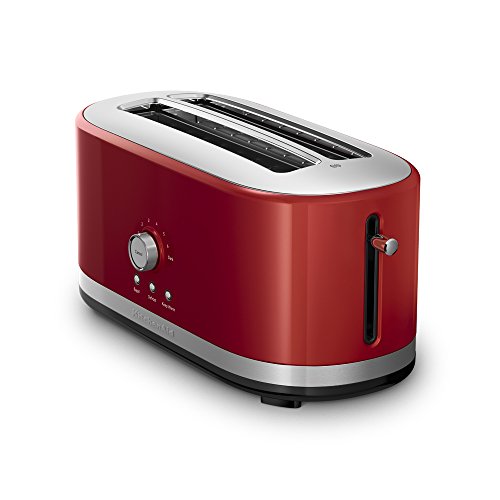
KitchenAid KMT4116 — the long-slot answer for artisan loaves
The KitchenAid KMT4116 reorganises the toaster around length. Instead of four short slots it offers two long ones, each wide and each able to take two standard slices side by side — or, the point of the design, one long slice of artisan bread laid in whole. Every workaround that ruins evenness for bakery bread disappears: no cutting the slice in half, no toasting in two passes with a double-browned band in the middle, no folding. A sourdough slice from a wide loaf goes in as one piece and comes out coloured as one piece, which is precisely the result this entire guide is about.
The supporting cast is complete: seven shade settings, bagel, defrost and frozen handling, a high-lift lever for retrieving small items, extra-wide slots that accept thick-cut bread without squeezing, and a removable crumb tray, with cord storage underneath to keep the counter tidy. The trade-offs are geometric. A long-slot toaster is a long appliance, and it claims a strip of counter that some kitchens will miss; and two long slots give a household less independence than four separate ones when two people want different shades at the same moment — the pair of slices in a slot share its setting. For households whose bread comes from a bakery or their own oven, neither point outweighs the central fact that their actual slices finally fit.
Strengths: long slots take full artisan slices in a single pass; four standard slices across two slots for family rounds; extra-wide slots handle thick cuts; bagel, defrost and frozen functions; high-lift lever; removable crumb tray and under-base cord storage.
Trade-offs: the long body claims a generous strip of counter; slices sharing a slot share a shade setting; a premium-leaning tier compared with ordinary four-slice machines; overkill for households that only ever toast standard sandwich bread.
Who it suits: bakery-loaf households, home bakers, and families whose toast comes in long slices and large rounds — anyone currently cutting slices in half to fit a standard slot and accepting the scorched overlap as normal.
Bakers and bakery-loaf households that are done cutting slices in half to fit the machine should measure their longest loaf and check price on Amazon.
Check price on Amazon: KitchenAid KMT4116
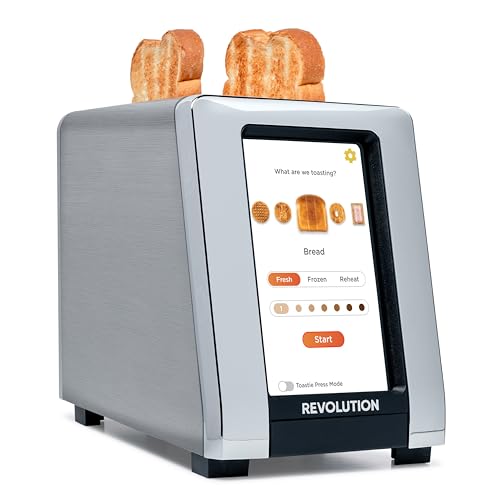
Revolution InstaGLO R180 — the smart, fast route to level colour
The Revolution InstaGLO R180 replaces the toaster’s oldest component — the slow-glowing element — with a heating system that reaches full power in about two seconds. That speed is its evenness argument. A conventional element ramps up gradually, and during the ramp the bread is drying and steaming more than toasting, which is one reason results vary with the machine’s starting temperature. A system that is at full, even heat almost immediately delivers a shorter, more controlled dose: the surface sears and colours while the interior keeps its softness, and the cycle depends far less on whether the toaster was cold or already warm from the previous batch.
Control is by touchscreen, and it is preset-driven: the machine offers dozens of combinations of food type and shade — breads, bagels, English muffins, waffles, pastries, with a gluten-free adjustment among them — plus an auto-lift that raises and lowers the carriage without a lever, and a countdown so the state of breakfast is always visible. The evenness is real when the food matches a profile, and the speed is startling the first week. The cautions are equally real. This is the most expensive technology in the roundup relative to its two-slice capacity; the experience stands or falls on the presets suiting the household’s actual bread, and an unclassifiable bakery loaf gets a best guess rather than a calibration; and a touchscreen is a great deal of interface for toast, which some cooks will love and others will regard as a solution touring the kitchen in search of a problem.
Strengths: near-instant full-power heat shortens cycles and reduces batch-to-batch drift; preset profiles for many bread types and shades; auto-lift carriage and a clear countdown display; crisp exterior with a softer interior thanks to the short, hot cycle; gluten-free adjustment included; sleek, compact two-slice body.
Trade-offs: premium-tier pricing for a two-slice machine; results depend on the food matching a stored profile; touchscreen controls divide opinion and add a surface that must stay clean to stay responsive; standard slot dimensions, so long artisan slices are not its game.
Who it suits: technology-friendly households that toast a varied rotation of breads, waffles and pastries and want the machine to identify the food and set itself — and anyone for whom the two-minute wait for toast genuinely registers as a cost.
Households that rotate through waffles, bagels and pastries and want the toaster to set itself for each one can see what the fast route costs and check price on Amazon.
Check price on Amazon: Revolution InstaGLO R180
The six compared at a glance
| Toaster | Evenness strategy | Capacity | Best at | Watch out for |
|---|---|---|---|---|
| Breville ‘A Bit More’ BTA720 | Self-centring slots plus a top-up button for pale slices | 2 slices, standard length | All-round evenness with the least vigilance | Standard slot length only |
| Dualit NewGen 2-Slice | Armoured elements and fully manual, predictable timing | 2 slices | Decades of service and cook-controlled colour | No auto pop-up or bagel mode |
| Wolf Gourmet WGTR102S | Self-centring slots plus a calibrated single-slice mode | 2 slices, extra wide | Perfect single slices and premium build | Highest tier in the roundup |
| Cuisinart CPT-122 | Honest basics: wide slots and a full function set | 2 slices, compact body | Small counters on a budget tier | No centring; later batches drift darker |
| KitchenAid KMT4116 | Long slots that take the whole slice in one pass | 4 standard slices or 2 long slots | Artisan loaves and family rounds | Long footprint; shared shade per slot |
| Revolution InstaGLO R180 | Near-instant full-power heat and stored food profiles | 2 slices | Speed and varied breads, waffles and pastries | Preset-dependent; premium tier |
Read the table by failure, not by feature. Stripes and patches point to element coverage and centring, which is Breville and Wolf Gourmet territory. Pale crowns point to slot depth. Scorched overlaps point to a loaf that does not fit, which only the KitchenAid’s length solves. One dark face on solo slices points to the empty-slot effect, which the Wolf’s single-slice mode exists to answer. A household that knows which failure it sees every morning already knows which row of this table is its shortlist.
Getting even toast from any toaster: the bread and the habits
Even the best machine can be defeated by the loaf and the routine around it, and a few habits close most of the remaining gap. Start with the bread itself. Moisture is the invisible variable: a slice from a fresh, soft loaf carries more water than one from a loaf on its third day, and water must be driven off before browning begins, so the same setting produces paler toast from fresh bread and darker toast from bread nearing stale. Frozen slices behave like very fresh ones until the defrost stage does its work. Households that freeze bread in slices and toast from frozen with a proper defrost cycle get some of the most consistent results of all, precisely because every slice starts from the same state.
Cut consistency matters as much as the machine. A wedge-shaped slice — thick at one end, thin at the other — cannot brown evenly in any toaster ever built, because the thin end is closer to done the moment the cycle starts. A bread knife used with a level hand, or a loaf sliced by the bakery’s machine, removes a whole category of patchiness before the toaster is even switched on. Sugar and fat content play their part too: enriched breads, brioche and anything with a sweet glaze brown faster and darker than lean white or wholemeal at the same setting, so a household that rotates bread types should expect to rotate the shade dial with them rather than treating one number as a permanent address.
Finally, manage the batches. The first cycle of the day runs in a cold machine and the third in a hot one; on timer-based toasters the honest fix is to drop the shade a fraction after the first round, and on any toaster the honest habit is to give the first slice to the person who likes it palest. Keep the slots crumb-free, empty the tray weekly rather than seasonally, and let thick slices sit flat in the slot rather than wedged at an angle. None of these habits costs anything, and together they are worth roughly one tier of toaster.
Five mistakes that quietly ruin a morning’s toast
The first mistake is the mid-cycle lever press: pushing the toast back down for “a bit more” after it pops, which double-browns the face that was already finished and is the single most common way good toast becomes uneven toast. The designed alternatives are a top-up function, a peek lever, or simply choosing a darker setting next time. The second mistake is toasting one slice in a two-slot machine on full two-slot assumptions and blaming the bread for the dark inner face — the empty slot did it, and a single-slice mode or accepting a notch less shade is the fix.
The third mistake is storing the toaster’s shade setting as a family heirloom, unchanged across fresh loaves, frozen loaves and brioche, then judging the machine inconsistent when the results wander. The fourth is neglecting the crumb tray until the slot floor is a mattress of fragments holding slices at uneven heights. The fifth is buying by slice count alone — a four-slice badge on slots too short for the household’s actual bread — when the tape measure and one real slice would have settled the question in the shop. Every one of these is a habit or a measurement, not a purchase, which is good news: they can all be corrected before tomorrow’s breakfast.
Frequently asked questions
Why is one side of my toast always darker than the other?
Three causes account for nearly every case. The slice is leaning in the slot, closer to one element than the other — the fix is a self-centring design or, on a plain toaster, slots wide enough that the slice stands upright. The toaster is running a single slice in a two-slot machine, and the face toward the empty slot browns faster — the fix is a single-slice mode or a slightly lower shade. Or one element is ageing faster than its partner, which on a repairable design like the Dualit is a service item rather than a death sentence.
Does a more expensive toaster actually toast more evenly?
Up to a point, yes, and the point is identifiable. The money that matters buys element coverage, self-centring hardware, deeper slots and electronics that hold a shade steady across batches — all genuine evenness mechanisms, all present in the mid-range and premium picks above. Beyond that point the money buys build, finish, brand and features like touchscreens and keep-warm timers, which are pleasures rather than evenness. The budget pick in this roundup toasts respectably; the premium picks toast respectably with less vigilance and for more years.
Is a long-slot toaster better than a four-slot toaster?
It is better at a different problem. Four separate slots give two people independent shades at the same moment and suit standard sandwich bread. Two long slots suit the shape of real bakery bread, taking a full artisan slice in one pass with no cutting and no double-browned overlap. Households should choose by the loaf they actually buy: the long slot is the only design that solves the artisan problem, and an unnecessary complication for a household that never brings one home.
How do I stop the second batch coming out darker than the first?
The toaster’s interior and elements hold heat between cycles, so a timer-based machine applies the same seconds to a hotter environment and the toast darkens. Three answers exist. Choose a toaster whose electronics compensate for its own temperature, or one whose heating system is so fast that the ramp barely matters. Or adopt the manual habit: drop the shade setting by a fraction after the first round and restore it the next morning. The drift is physics, not a fault, and any of the three approaches manages it.
What should I do about a tall slice that sticks out of the slot?
A slice taller than the slot will always wear a pale crown, because the top band sits above the elements. Turning the slice halfway through evens it partially but double-browns the middle band instead. The durable answers are a deeper-slot or long-slot design matched to the loaf, or cutting tall slices horizontally into two shorter ones that fit the slot fully. Measuring the household’s tallest slice against published slot dimensions before buying prevents the problem entirely.
Slot toaster or toaster oven: which browns more evenly?
Because this site also covers toaster ovens, the comparison deserves one honest paragraph. A toaster oven browns from elements above and below a rack, across a wide floor — a geometry that suits cheese on toast, reheated pizza and anything that needs heat from one side only, but asks sliced bread to travel through moving air and hot spots, and generally takes longer to reach the same colour. A slot toaster surrounds the slice closely on both faces at once, which is why, for plain toast, the upright machine remains the more even and much faster instrument: the bread is the filling in a heated sandwich rather than a tray under a grill. Households choosing between them should decide by the week’s actual cooking — toast every day points to the slot machine and a separate answer for melting jobs; toast occasionally, alongside baking and reheating, points to the oven and acceptance of slower, slightly less level browning. Many kitchens, given the counter, eventually keep both and stop asking either to do the other’s work.
The bottom line
Even toast is not a mystery and it is not a luxury; it is what happens when elements cover the bread, the slice is held straight between them, the slot is deep and long enough for the loaf, and something — a sensor, a dial with a predictable hand, or a heating system too fast to drift — keeps the shade honest across the morning. The Breville ‘A Bit More’ assembles the most of those answers for the most kitchens. The Dualit hands them to the cook personally and is built to keep doing so for decades. The Wolf Gourmet adds the single-slice calibration nobody knew they needed, the Cuisinart keeps small kitchens honest on a budget, the KitchenAid finally fits the bakery loaf, and the Revolution replaces patience with presets. Match the machine to the failure on your plate, and the patchwork slice becomes what it should always have been: a problem with a known cause, solved before the kettle boils.


