Disclosure: airfryerkitchensupply.com is reader-supported. When you buy through links on our site, we may earn an affiliate commission at no extra cost to you.
Where to buy
Shopping for the best tea towels for baking? Every linked pick below was cross-checked against Amazon listing data for this site before this guide was written, so the product name, size and configuration in each review match a real, current listing. Prices move constantly, so this guide never prints a fixed price: use the Amazon links to check the current price on the exact size, pack count or configuration you want. Where a pick could not be confirmed against the API, it is clearly marked as an unlinked slot instead of carrying a link we could not stand behind.
- Utopia Kitchen White Flour Sack Towels, 12-Pack, 28×28 in (Best Overall) — Check on Amazon
- Honest Weave Organic Cotton Flour Sack Towels, White, 12-Pack, 27×27 in (Best Organic All-Rounder) — Check on Amazon
- Bread Towels for Proofing Cover, 100% Organic Cotton, 27×27 in, 5-Pack (Natural) (Best for Bread Proofing Specifically) — Check on Amazon
- Organic Cotton Flour Sack Kitchen Towels, 10-Pack, Off-White, 27×27 in (Best Organic Value) — Check on Amazon
- COTTON CRAFT Waffle Terry Kitchen Towels, 12-Pack, 16×28 in (Best for Drying & Hot Work) — Check on Amazon
- LANE LINEN 100% Cotton Kitchen Towels, 6-Pack (Best Soft Everyday Set) — Check on Amazon
A tea towel in a baking kitchen is not a dish towel with better PR — it is a tool with specific jobs. The best tea towels for baking line proving baskets and cover rising dough without sticking or shedding lint into the surface, flour evenly for dusting worktops and rolling pins, catch hot tray edges, dry mixing bowls completely so meringue and chocolate behave, and survive being washed at temperatures that would embarrass a decorative towel. If you are choosing tea towels for baking rather than for general kitchen use, the weave matters more than the pattern: flat-weave flour sack cotton is the baker’s default for dough work because it releases flour and dough cleanly and leaves nothing behind, while terry and waffle weaves earn their place at the sink and the oven door.
This guide compares six verified cotton towel sets across those jobs, including two organic cotton flour sack options and one set sold specifically as bread proofing cloths. Every pick was cross-checked against its Amazon listing, so pack counts, sizes and materials below come from the listings themselves. Where a listing’s size or pack detail is worth pausing on — and in this category, sizes vary more than buyers expect — the review says so.
One expectation to set honestly: no towel is best at everything. The flour sack towel that proofs dough beautifully is a mediocre mop for a spilled litre of milk; the waffle terry that drinks up spills will shed and stick if you line a banneton with it. Serious bakers keep two types, and this guide is organised to help you choose the pair, not to pretend one set wins every job.
In this guide
Quick Picks
If you only have a minute, start here. These are the six tea towels for baking options this guide rates highest after checking each one against its verified listing details, grouped by the job each one does best rather than by marketing claims.
| Pick | Badge | Why it stands out | Link |
|---|---|---|---|
| Utopia Kitchen White Flour Sack Towels, 12-Pack, 28×28 in | Best Overall | The classic baker’s flour sack: big, flat-weave, 100% cotton, in a dozen-strong pack priced for real kitchen rotation. | Check on Amazon |
| Honest Weave Organic Cotton Flour Sack Towels, White, 12-Pack, 27×27 in | Best Organic All-Rounder | Organic cotton flour sacks with mitered corners, hemmed edges and hidden loops — the proofing towel, finished like a product. | Check on Amazon |
| Bread Towels for Proofing Cover, 100% Organic Cotton, 27×27 in, 5-Pack (Natural) | Best for Bread Proofing Specifically | Sold for one job — covering and lining dough as it rises — in unbleached organic cotton, and honest about it. | Check on Amazon |
| Organic Cotton Flour Sack Kitchen Towels, 10-Pack, Off-White, 27×27 in | Best Organic Value | Unbleached organic cotton flour sacks in an off-white that forgives stains — ten large towels for the organic-minded workhorse role. | Check on Amazon |
| COTTON CRAFT Waffle Terry Kitchen Towels, 12-Pack, 16×28 in | Best for Drying & Hot Work | Waffle-weave terry in a 16×28 hand-towel format — the absorbent partner every flour sack set needs. | Check on Amazon |
| LANE LINEN 100% Cotton Kitchen Towels, 6-Pack | Best Soft Everyday Set | A soft, quick-drying everyday cotton set — the gentle option for hands, glass and finished-bake presentation. | Check on Amazon |
How These Picks Were Chosen
Picks were verified against Amazon listing data: the listing had to state cotton construction (organic where claimed), a pack size and dimensions. Decorative printed towels with no stated material, microfiber sets — microfiber is a poor baking towel: it melts near oven heat, grips dough, and sheds fibres — and novelty towels sold as gifts rather than tools were excluded.
The six survivors cover the baker’s actual rotation: two all-purpose flour sack sets (one conventional, one organic), a dedicated organic proofing cloth set, an unbleached organic flour sack set, a waffle-terry set for drying and hot work, and a soft everyday cotton set for the bowl-drying and hand-towel end of the job. Sizes are quoted from the listings because this category hides real differences there — the sets below range from 16×28 to 28×28 inches, and the right size depends on the job.
No prices are printed: towel pricing moves with pack size and promotions, and cost-per-towel is the only honest comparison, which you can do on the listings in seconds. What this guide compares instead is weave, size, material integrity and fitness for each baking task — the things that decide whether a towel is still in your kitchen in three years.
The 6 Best Tea Towels for Baking

1. Utopia Kitchen White Flour Sack Towels, 12-Pack, 28×28 in — Best Overall
The flour sack towel is the baker’s towel, and this Utopia set is its standard form: 100% cotton, flat woven, a full 28×28 inches square, in a pack of twelve. That size is the point — a 28-inch square lines a proving basket with drape to spare, covers a tray of rising rolls completely, folds under a mixing bowl to stop it spinning while you whisk, and flours down into the classic baker’s couche substitute for baguettes. Flat weave means dough and flour release instead of gripping, and the towel itself dries fast and washes without holding odours the way looped towels can.
A dozen towels is also the right quantity for baking, which is a mess-generating hobby: proofing cloth, bench towel, hand towel, hot-pad backup and a clean one for the finished loaf’s photo is five towels in a single bake. The honest limits: white shows every turmeric and berry stain eventually, flat weave absorbs less per towel than terry for big spills, and these are work towels, not display pieces. For the dough jobs that define this search, nothing else in the guide is as purely fit for purpose.
Strengths
- True flour sack weave — dough and flour release cleanly, minimal lint
- 28×28 in square suits baskets, trays and couche-style proofing
- 12-pack matches a real baking session’s towel rotation
Trade-offs
- White stains visibly over time with heavy use
- Flat weave absorbs less than terry for large spills
- Plain utility look — working towels, not décor
| Material | 100% cotton (per listing) |
|---|---|
| Weave | Flour sack, flat weave |
| Size | 28 x 28 in |
| Pack | 12-pack |
| Colour reviewed | White |
Best for: Proofing, lining baskets, flouring and general dough work / Not suited for: Heavy spill cleanup or buyers wanting patterned display towels
Check on Amazon — check the current price on Amazon for the exact configuration reviewed here.

2. Honest Weave Organic Cotton Flour Sack Towels, White, 12-Pack, 27×27 in — Best Organic All-Rounder
Honest Weave takes the same flour sack formula and finishes it properly: organic cotton, 27×27 inches, with mitered corners, hemmed edges and hidden hanging loops, sold as a 12-pack in white. The listing itself names bread proofing among its uses, which is exactly right — this is the towel for the baker who wants the working virtues of flour sack cotton and cares that the cotton is organic and the edges will not fray into the dough after fifty washes. Hem quality is an unglamorous spec that decides a towel’s lifespan, and it is where cheap flour sacks fail first.
Against the Utopia benchmark you trade one inch of size and (typically) pay the organic premium; what you gain is the certified-material story and the finishing. As with the pillow guide elsewhere on this site, precision matters: the listing states organic cotton, and this review claims exactly that — organic cotton towels, with no further certification named because the listing title names none. For most home bakers choosing one organic set for everything, this is the set.
Strengths
- Organic cotton stated in the listing, in the classic flour sack weave
- Mitered corners and hemmed edges — built to survive wash cycles
- Hidden hanging loops for drying between uses
Trade-offs
- 27×27 in is an inch smaller than the Utopia benchmark
- Organic cotton carries a price premium over conventional sets
- White only in the verified listing
| Material | Organic cotton (per listing) |
|---|---|
| Weave | Flour sack, flat weave |
| Size | 27 x 27 in |
| Pack | 12-pack |
| Finishing | Mitered corners, hemmed edges, hidden loops (per listing) |
Best for: Bakers who want one organic set for proofing and everyday baking work / Not suited for: Buyers who need the absolute largest towel or the lowest cost per towel
Check on Amazon — check the current price on Amazon for the exact configuration reviewed here.

3. Bread Towels for Proofing Cover, 100% Organic Cotton, 27×27 in, 5-Pack (Natural) — Best for Bread Proofing Specifically
Most towels in this guide are all-rounders that proof well; this set is a specialist. The listing describes 100% organic cotton bread cloths for rising — breathable tea towels for bread making, unbleached, 27×27 inches, in a natural colour, pack of five. Unbleached is a considered choice for dough contact: no dye and no bleach residue against a food surface, and the natural colour hides the flour-and-dough patina that makes white proofing towels look permanently grubby.
The pack of five is sized to a home baker’s rhythm — two in use across a weekend’s loaves, two in the wash, one spare — rather than a bakery’s. What it is not: a general kitchen set. Five specialist cloths will not cover hand drying, spill duty and oven work for a busy kitchen, and the listing does not pretend otherwise. Buy it as the proofing layer of a two-type system, alongside a workhorse set like the Utopia or the waffle terry below, and it is the most purpose-true product in this guide.
Strengths
- Purpose-made for proofing: breathable organic cotton bread cloth
- Unbleached, natural colour — nothing against the dough but cotton
- Natural shade hides flour patina between washes
Trade-offs
- Only 5 towels — a specialist set, not a kitchen’s whole supply
- Flat specialist cloth is not the tool for spills or heavy drying
- Natural colour only; no white or patterned option in the listing
| Material | 100% organic cotton (per listing) |
|---|---|
| Use stated | Bread proofing cover / rising cloth (per listing) |
| Size | 27 x 27 in |
| Pack | 5-pack |
| Colour reviewed | Natural, unbleached |
Best for: Bread bakers who want a dedicated, dough-only proofing cloth set / Not suited for: Anyone needing one set to run the whole kitchen
Check on Amazon — check the current price on Amazon for the exact configuration reviewed here.

4. Organic Cotton Flour Sack Kitchen Towels, 10-Pack, Off-White, 27×27 in — Best Organic Value
This set answers the same brief as the Honest Weave with a different emphasis: organic cotton flour sack towels, extra large at 27×27 inches, lint-free and unbleached, in an off-white 10-pack. Off-white is the pragmatic baker’s colour — it reads clean without demanding the bleaching and boil-washing that keeping pure white presentable requires, and unbleached organic cotton is the shortest ingredient list in this entire guide: cotton, woven, hemmed, done.
Against the Honest Weave, the listing is lighter on finishing detail — no mitered corners or loops are claimed in the title, so none are claimed here — and the pack is ten rather than twelve. What you get is the core product, organic flour sack cotton at full size, in the colour that ages most gracefully. For a household converting its whole towel drawer to organic cotton, this is the economical way to do it without shrinking the towels.
Strengths
- Organic, unbleached cotton — minimal processing against food
- Full 27×27 in flour sack size in a 10-pack
- Off-white hides baking stains better than pure white
Trade-offs
- Finishing details (corners, loops) not stated in the listing
- Off-white will not match a bright-white kitchen scheme
- Flat weave shares flour sack’s lower spill absorbency
| Material | Organic cotton (per listing) |
|---|---|
| Weave | Flour sack, flat weave, lint-free (per listing) |
| Size | 27 x 27 in |
| Pack | 10-pack |
| Colour reviewed | Off-white, unbleached |
Best for: Organic households wanting full-size workhorse towels at sensible pack maths / Not suited for: Buyers who want stated premium finishing details
Check on Amazon — check the current price on Amazon for the exact configuration reviewed here.
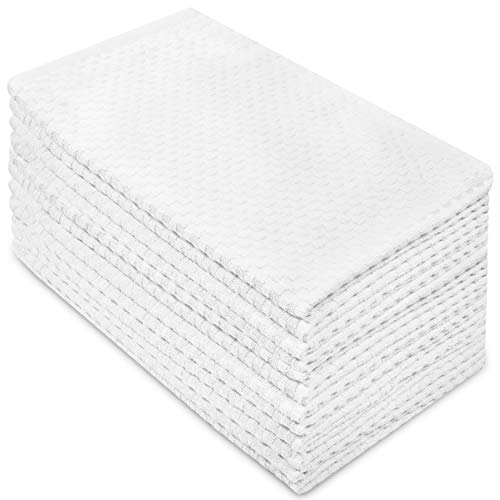
5. COTTON CRAFT Waffle Terry Kitchen Towels, 12-Pack, 16×28 in — Best for Drying & Hot Work
Every baking kitchen needs a second towel type, and this is it: COTTON CRAFT’s waffle terry towels, 100% cotton, 16×28 inches, in a 12-pack described as soft, absorbent, quick-drying and low-lint. The waffle-terry structure is the spill and drying specialist — the textured weave holds far more water than flat flour sack cotton, which is what you want for drying a mixing bowl bone-dry before whipping egg whites, mopping the bench after washing up, and grabbing a hot tray edge with a folded, substantial layer between hand and metal.
The size tells the same story: 16×28 is a hand-and-bowl towel, not a proofing cloth, and this review does not pretend it lines a banneton well — terry’s texture grips dough and can leave fibres, which is precisely why it is the partner pick and not the headline. Keep flour sacks on dough duty and these on water and heat duty, and the pair covers the whole of baking. Low-lint per the listing is a bonus for glassware and chocolate work, where a stray fibre shows.
Strengths
- Waffle terry absorbs far more water than flat-weave towels
- 16×28 in is the right format for hands, bowls and tray edges
- Quick-drying and low-lint per the listing; 12-pack rotation
Trade-offs
- Terry texture grips dough — not a proofing or lining towel
- Too small to cover a full tray of rising dough
- Loftier weave dries slower on the rail than flour sack
| Material | 100% cotton (per listing) |
|---|---|
| Weave | Waffle terry |
| Size | 16 x 28 in |
| Pack | 12-pack |
| Properties | Absorbent, quick dry, low lint (per listing) |
Best for: Drying bowls and hands, spill duty and folded hot-tray handling / Not suited for: Proofing, lining baskets or any direct dough contact
Check on Amazon — check the current price on Amazon for the exact configuration reviewed here.

6. LANE LINEN 100% Cotton Kitchen Towels, 6-Pack — Best Soft Everyday Set
The LANE LINEN set is the generalist of the guide: 100% cotton kitchen towels described as soft, absorbent and quick-drying, in a 6-pack positioned for drying dishes and hands. In a baking kitchen its niche is the gentle end of the work — drying washed glass and measuring tools, polishing a glaze, lining the basket that carries warm rolls to the table, and being the towel guests are handed without embarrassment. Softness is a real feature for those jobs; a beloved but scratchy work towel is the wrong thing against a finished loaf’s crust or a chocolate glaze.
The compromises are scale and specialisation: six towels is a household set, not a production rotation, the listing does not state dimensions in its title — check the product page for the exact size before assuming it matches the 27-inch flour sacks — and as a generalist weave it neither proofs like flour sack nor drinks like waffle terry. It earns its place as the third layer of a considered towel system, or as the only set for a light, occasional baker whose towel jobs are mostly drying and presenting.
Strengths
- Soft hand feel — right for finished bakes, glass and guests
- 100% cotton, absorbent and quick-drying per the listing
- Presentable enough for table and serving use
Trade-offs
- 6-pack is a small rotation for heavy baking days
- Dimensions not stated in the listing title — verify on the product page
- Generalist weave: neither the best proofer nor the best mop
| Material | 100% cotton (per listing) |
|---|---|
| Use stated | Drying dishes and hands; tea towels (per listing) |
| Size | Not stated in listing title — check product page |
| Pack | 6-pack |
| Properties | Soft, absorbent, quick drying (per listing) |
Best for: Light bakers and the gentle jobs: drying, presenting, serving / Not suited for: Heavy proofing schedules or as a kitchen’s only towel set
Check on Amazon — check the current price on Amazon for the exact configuration reviewed here.
Comparison Table
| Pick | Badge | Key spec | Best for | Link |
|---|---|---|---|---|
| Utopia Kitchen White Flour Sack Towels, 12-Pack, 28×28 in | Best Overall | 100% cotton flour sack, 28×28 in, 12-pack | Proofing, lining baskets, flouring and general dough work | Check on Amazon |
| Honest Weave Organic Cotton Flour Sack Towels, White, 12-Pack, 27×27 in | Best Organic All-Rounder | Organic cotton flour sack, 27×27 in, hemmed/mitered, 12-pack | Bakers who want one organic set for proofing and everyday baking work | Check on Amazon |
| Bread Towels for Proofing Cover, 100% Organic Cotton, 27×27 in, 5-Pack (Natural) | Best for Bread Proofing Specifically | Organic cotton proofing cloth, unbleached, 27×27 in, 5-pack | Bread bakers who want a dedicated, dough-only proofing cloth set | Check on Amazon |
| Organic Cotton Flour Sack Kitchen Towels, 10-Pack, Off-White, 27×27 in | Best Organic Value | Organic cotton flour sack, unbleached off-white, 27×27 in, 10-pack | Organic households wanting full-size workhorse towels at sensible pack maths | Check on Amazon |
| COTTON CRAFT Waffle Terry Kitchen Towels, 12-Pack, 16×28 in | Best for Drying & Hot Work | 100% cotton waffle terry, 16×28 in, 12-pack | Drying bowls and hands, spill duty and folded hot-tray handling | Check on Amazon |
| LANE LINEN 100% Cotton Kitchen Towels, 6-Pack | Best Soft Everyday Set | 100% cotton everyday towels, soft/quick-dry, 6-pack; size not in title | Light bakers and the gentle jobs: drying, presenting, serving | Check on Amazon |
How to Choose Tea Towels for Baking
Weave is destiny: flour sack, terry and waffle
Flat-weave flour sack cotton is a thin, smooth, lint-light fabric originally used for flour sacks, and bakers adopted it because dough releases from it and flour dusts off it evenly. Use it wherever the towel touches dough or dry ingredients: lining baskets, covering rising loaves, flouring benches, wrapping baked goods. Terry weave loops pile on one or both sides to trap water — superb for drying, wrong for dough, because loops grip, shed and hold yesterday’s flavours. Waffle weave splits the difference with a textured grid that absorbs well and dries fast, making it the sink-side and hot-work choice. A complete baking towel system is a flat weave plus a textured weave; everything else is refinement.
Threadbare honesty about absorbency claims: every towel listing says ‘highly absorbent’, and the phrase means different things per weave. A flour sack towel absorbs slowly and modestly but releases dough perfectly; a waffle terry absorbs fast and heavily but grips. Neither is lying — they are describing different physical behaviours with the same adjective. When a listing adds specifics — weave type, dimensions, pack count, finishing — it is giving you the data to place it in the system; when it offers only adjectives, it is asking to be judged as décor. The picks here were chosen from the first kind of listing, and the guide’s per-towel job assignments follow from their stated construction, not from their adjectives.
Cotton quality shows in the wash, not the shop. Long, even weaving and proper hems — the details the Honest Weave listing states outright — are what separate a towel that survives two hundred hot washes from one that twists into a rope by spring. Judge listings by stated finishing and material, not by how the towels photograph folded.
Size by job, not by habit
Proofing and covering want squares of 27 inches or more: enough to line a basket with drape, cover a tray without touching the dough’s crown, or flour into a couche. Hand, bowl and spill work wants a rectangle around 16×28 — big enough to fold into a hot pad, small enough to wring out one-handed. The sets in this guide map cleanly onto those two formats, and the most common buying mistake in the category is ordering one format for both jobs and blaming the towels. If you bake bread weekly, weight your drawer toward the big squares; if you bake cakes and cookies, the rectangles earn their keep daily and the squares come out for proving and presenting.
Organic, unbleached and other material claims
Organic cotton towels are a legitimate preference — the cotton is grown without synthetic pesticides — and two picks here plus the proofing specialist state organic cotton in their listings. Unbleached takes the logic one step further for dough contact: no dye, no bleach finish, a natural or off-white colour that also happens to hide a baker’s stains best. Neither claim makes a towel perform better at proofing; weave and size do that. Buy organic for the material values, buy unbleached for dough-contact purity and stain forgiveness, and do not pay either premium expecting a better rise — the yeast does not read labels.
The Baker’s Towel System: Rotation, Washing and Retirement
Professional bakers treat towels as a rotation, not a drawer of identical spares. A workable home system: dedicate towels by job and never cross the streams — proofing cloths that only ever touch dough and flour, washed separately and never with fabric softener, because softener coats cotton fibres and turns a release-friendly flour sack into a dough-gripping, water-repelling disappointment; sink and spill towels that take the detergents and the rough work; and one or two presentation towels kept genuinely nice. Mark the streams if your household needs it — a corner snip or a coloured hem thread has saved many a proofing cloth from mop duty.
Wash baking towels hot enough to deal with butter, egg and milk residues, and dry them fully before folding them away: a cotton towel stored faintly damp mildews in the drawer and perfumes the next loaf. Retire towels by demotion, not by bin — a proofing cloth that has gone thin becomes a bench towel, a bench towel becomes a floor-spill towel, and only the truly ragged leave the kitchen. That cascade is why pack sizes of ten and twelve make sense even for small households: the system consumes towels at the top and sheds them at the bottom, and a big pack restocks the top in one purchase.
Flouring, Couches and Other Flour Sack Techniques
The flour sack towel’s signature trick is the improvised couche: lay the towel on a tray, flour it generously — rice flour if you have it, which releases even more cleanly than wheat — and settle shaped loaves in its folds to proof, the cloth’s pleats holding each loaf’s shape and wicking a whisper of moisture from the surface for a better crust. The same flouring technique, lighter, turns a towel into the baker’s dusting sheet for benches and rolling pins: a floured flat towel shaken over the worktop lays a thinner, more even coat than fingers ever manage, which means less raw flour worked into the dough and fewer pale patches on the crust.
Two smaller techniques repay learning. A damp — not wet — flour sack under a mixing bowl locks the bowl to the bench while you whisk or knead in it, a trick every pastry kitchen uses and no product sells. And a dry towel folded around a just-baked loaf for its first minutes off the rack softens a crust that came out too hard, while the same towel draped, never wrapped tight, over cooling rolls keeps them from drying as they cool. None of this requires buying anything beyond the towels themselves — it is technique, and it is why the humble flat square outperforms decorative towels in a baker’s kitchen by a distance no pattern can close.
Tea Towels Beyond Bread: Cakes, Pastry and Chocolate Work
Bread dominates the tea towel conversation, but pastry and cake work make their own demands, and the same weave logic answers them. For pastry, the critical towel moment is butter temperature: a cool, dry flour sack draped over dough during its bench rests keeps the surface from skinning without warming the butter the way hands or a warm cloth would, and a floured flat towel under a rolling pin’s work catches the excess flour that would otherwise be rolled into the layers. For cakes, the waffle terry’s job is the mixing bowl dried to a polish — a bowl with a film of water in it is enough to break a meringue’s volume and to seize melted chocolate, and the low-lint claim in the COTTON CRAFT listing is aimed at exactly this kind of work, where one fibre in a ganache shows like a hair in soup.
Chocolate and sugar work add a safety footnote that belongs in any honest guide: towels near pulled sugar, caramel and hot trays must be dry, cotton and kept clear of the hob, because a synthetic-blend towel can melt onto skin and a dangling towel near a burner is a fire risk no recipe survives gracefully. Every pick in this guide is cotton for a reason that goes beyond dough release — cotton is the fibre that behaves predictably around heat, washes at real temperatures, and fails, when it fails, by wearing thin rather than by melting. Choose the weave per job, keep the streams separate, and the same six sets cover a bake sale, a sourdough habit and a birthday cake with equal competence.
How to Use Tea Towels Through a Bake, Start to Finish
One loaf of bread, five towel jobs. This is the sequence a working baker’s towels follow, and it doubles as a checklist for how many towels a baking session really needs. Read it before your next big bake and count your clean towels against it — the gap between the sequence and your drawer is the most useful shopping list this guide can give you, more useful than any ranking, because it is measured against your baking rather than a generic kitchen.
- Before mixing: dampen one flour sack and place it under the mixing bowl to stop it skating while you stir and knead.
- During mixing and shaping: keep a dry flour sack over your shoulder or at the bench edge for hands — dry hands shape dough; wet, doughy hands stick to everything.
- For the rise: line the basket or bowl with a flour sack dusted with flour, settle the dough in, and cover the top with the towel’s drape or a second towel. Specialist proofing cloths — the organic 5-pack in this guide — live exactly here.
- At the oven: fold a waffle terry towel into quarters for tray handling. Use it dry — a wet towel conducts heat and steam straight to your hand, which is the classic kitchen burn.
- While the bake finishes: use the soft everyday towel to dry washed tools and clear the bench, so the hot loaf lands in a clean, calm space.
- Cooling and serving: rest the loaf on a rack, drape a clean flour sack loosely nearby for carrying, and line the serving basket with your best towel if the loaf goes to the table warm.
Store the clean streams folded separately — dough towels in one pile, sink towels in another — because a system that requires detective work at 7 a.m. will collapse into a drawer of identical white squares within a month. The natural and off-white sets in this guide earn a quiet practical point here: their colour is the labelling. White for the sink stream, natural for dough, and nobody has to think about it twice.
After the bake, shake flour and crumbs from the dough towels outside before they go near the wash — flour paste in a washing machine is a gift to no one — and wash the dough stream separately from the spill stream, without fabric softener, as the system section above explains.
Common Buying Mistakes
Using terry towels on dough
Loops grip dough, shed fibres into the surface and hold old flavours. Dough contact is flat-weave work — flour sack or a dedicated proofing cloth — every time.
Grabbing a hot tray with a damp towel
Water in the towel flashes to steam and conducts heat faster than a dry towel. The oven towel must be dry and folded thick; if it gets wet mid-bake, swap it, do not risk it.
Washing proofing towels with fabric softener
Softener coats cotton and destroys the two properties a proofing cloth exists for: clean release and absorbency. Wash the dough stream plain, and keep softener for clothes.
Buying one small pack for the whole kitchen
A 6-pack across proofing, hands, spills and oven work runs out by the second bake of the weekend. Baking is a multi-towel activity; pack sizes of ten and twelve exist because the rotation is real.
Hanging a wet towel on the oven door and calling it stored
A towel that never fully dries between uses becomes the kitchen’s smell source and a hygiene question mark, and the oven door rail is where towels go to stay damp. Hang baking towels spread out — the hidden loops on the Honest Weave set exist for this — or over a rail with air on both sides, and rotate in a dry one rather than reusing yesterday’s damp hand towel for this morning’s dough work.
Judging towels by pattern
A printed decorative towel with no stated material is a gift item, not a tool. For baking, the listing should state cotton, weave and size — the picks here all do, and the one that omits its size in the title is flagged for it.
Final Recommendation
Build the system the guide describes: the Utopia flour sacks as the dough workhorse, or the Honest Weave if organic cotton and proper finishing matter to you; the organic proofing cloths if bread is your main bake; the COTTON CRAFT waffle terry as the water-and-heat partner; the off-white organic set as the value conversion for a whole drawer; and the LANE LINEN for the gentle jobs. Two types minimum, chosen by weave, will outperform any single ‘best’ towel a ranking could crown.
A note on what ‘best’ means at this end of the kitchen: these are consumable tools, and the right ambition is not a towel that lasts forever but a system that never leaves you mid-bake with the wrong weave in hand. Every set here is inexpensive enough to buy in its full pack size without deliberation paralysis, and the deliberation is better spent on the two decisions that actually change outcomes — flat weave for dough, texture for water, and enough towels that the right one is always clean. Get those right and the brand question, which the reviews above answer as honestly as the listings allow, becomes the smallest part of the purchase.
Check the current price per towel on each listing for the pack sizes reviewed — in this category, cost per towel across a full rotation is the honest maths, and the listings make it a ten-second calculation.
- Utopia Kitchen White Flour Sack Towels, 12-Pack, 28×28 in — Proofing, lining baskets, flouring and general dough work: Check on Amazon
- Honest Weave Organic Cotton Flour Sack Towels, White, 12-Pack, 27×27 in — Bakers who want one organic set for proofing and everyday baking work: Check on Amazon
- Bread Towels for Proofing Cover, 100% Organic Cotton, 27×27 in, 5-Pack (Natural) — Bread bakers who want a dedicated, dough-only proofing cloth set: Check on Amazon
- Organic Cotton Flour Sack Kitchen Towels, 10-Pack, Off-White, 27×27 in — Organic households wanting full-size workhorse towels at sensible pack maths: Check on Amazon
- COTTON CRAFT Waffle Terry Kitchen Towels, 12-Pack, 16×28 in — Drying bowls and hands, spill duty and folded hot-tray handling: Check on Amazon
- LANE LINEN 100% Cotton Kitchen Towels, 6-Pack — Light bakers and the gentle jobs: drying, presenting, serving: Check on Amazon
Related guides on this site: Tea Towels For Baking; Tea Towels For Bread Making; Flour Sack Dish Towels For Embroidery; Quality Flour Sack Dish Towels; Cotton Waffle Weave Kitchen Towels.
Frequently Asked Questions
Why do bakers prefer flour sack towels?
Centuries of bakery practice settled on it before marketing existed, and the reasons are physical: the flat, smooth weave releases dough and flour instead of gripping them, sheds very little lint onto dough surfaces, dries fast and washes clean without holding odours. Those four properties are exactly what proofing, lining and flouring require, which is why flour sack cotton — the Utopia, Honest Weave and organic sets in this guide — dominates the dough jobs.
Can I use the same towel for proofing and for drying dishes?
You can, but the system works better separated. A proofing cloth washed with softener or used for spills picks up residues and loses its clean release; a dedicated dough stream — washed plain, never softened — keeps proofing reliable. At minimum, keep one or two towels dough-only.
How many tea towels does a home baker need?
A working rotation is roughly ten to fifteen across the streams: four to six for dough work, four to six for sink and oven work, and a couple kept presentable. That is why the main picks here are 10- and 12-packs; a single 6-pack suits light, occasional baking only.
Are organic cotton towels better for baking?
They perform the same as conventional cotton of the same weave — the difference is how the cotton was grown, plus, in the unbleached sets here, the absence of dyes and bleach finishes against dough. Buy them for those material values; buy weave and size for performance.
What size tea towel is best for proofing bread?
A square of 27 inches or more lines a standard basket with drape to cover the dough, and works as a couche for shaped loaves. The proofing cloths and flour sack sets in this guide are 27×27 and 28×28 for exactly that reason; smaller hand towels cannot cover and line at once.
Can flour sack towels replace parchment or a baking mat?
For proofing, lining and covering — yes, that is their home ground. On the oven floor or under a baking loaf at full heat, no: a towel is not an oven liner, and cotton scorches. Towels work around the oven — handling, covering, proofing, drying — while parchment and mats work in it. The one borderline case is the damp-towel trick some bakers use around a cake tin for even baking, which uses a purpose-made or fully soaked strip, never a dry kitchen towel near an element.
How do I keep white baking towels white?
Honestly, you mostly do not — and the bakers who try spend more time on laundry than on bread, which is the wrong trade in a hobby measured in loaves — working white towels grey and stain over a baking life, which is why two picks here are natural or off-white. Rinse stains before washing, wash the dough stream hot and plain, and accept the patina as the mark of a used kitchen; keep one presentable set, like the LANE LINEN, for serving.


