Disclosure: airfryerkitchensupply.com is reader-supported. When you buy through links on our site, we may earn an affiliate commission at no extra cost to you.
Where to buy
The fastest way to buy any pick in this guide to the sustainable sheet sets is through Amazon, where sizing, color, and configuration options are shown on each listing. Start with the shortlist below, open the two or three listings that match your situation, and compare the exact variant — size, pack count, and finish — before ordering, because most returns in this category come from ordering the right product in the wrong variant.
- Bedsure PureWoven Rayon Derived from Bamboo Sheets, Queen (Best Overall) — check price on Amazon
- LANE LINEN 100% Organic Cotton Percale Sheets, Queen White (Best Organic Cotton) — check price on Amazon
- California Design Den 100% Organic Cotton Sheets, Queen (Best Value Organic) — check price on Amazon
- Sijo AiryWeight TENCEL Sheet Set, Queen Snow (Best Eucalyptus Lyocell) — check price on Amazon
- PURE BAMBOO Sheets, 100% Genuine Bamboo Viscose, Queen White (Best Pure Bamboo) — check price on Amazon
- Olive + Crate TENCEL Lyocell Sheets, Queen Moss (Best Deep Pocket Lyocell) — check price on Amazon
The best sustainable sheet sets are not a single material — they are three different answers to the same question. Organic cotton sheets reduce the chemical load of farming and carry GOTS certification when the claim is serious. Bamboo viscose sheets turn a fast-growing crop into a silky, cooling fabric through a chemical process whose honesty varies by maker. Eucalyptus lyocell — TENCEL — uses a closed-loop solvent system that is the most defensible process claim in bedding. This guide includes all three, verified, and labels each pick’s actual material and certification so sustainability here means specifics, not vibes.
It also means durability, because the most sustainable sheet is the one you do not replace. A set that pills in a year is landfill with good marketing. Every pick below was chosen for construction that lasts — long-staple cotton, genuine 100 percent viscose rather than blends where stated, deep pockets with real elastic — alongside its material credentials. Read the per-pick notes carefully: two picks are bamboo viscose, two are GOTS organic cotton, and two are eucalyptus lyocell, and they feel genuinely different in bed.
In this guide
Quick Picks
Bedsure PureWoven Rayon Derived from Bamboo Sheets, Queen — Best Overall. The mainstream bamboo answer done honestly: 100 percent rayon from bamboo, deep pockets, and a silky cooling hand feel. Check on Amazon
LANE LINEN 100% Organic Cotton Percale Sheets, Queen White — Best Organic Cotton. GOTS-certified organic cotton in a crisp percale weave — the classic hotel sheet feel with an audited supply chain. Check on Amazon
California Design Den 100% Organic Cotton Sheets, Queen — Best Value Organic. A second GOTS percale option with all-around elastic and a 15-inch pocket — the practical organic buy. Check on Amazon
Sijo AiryWeight TENCEL Sheet Set, Queen Snow — Best Eucalyptus Lyocell. 100 percent eucalyptus lyocell with a buttery hand — the closed-loop process pick and the smoothest sheet in this guide. Check on Amazon
PURE BAMBOO Sheets, 100% Genuine Bamboo Viscose, Queen White — Best Pure Bamboo. A bamboo specialist’s set: 100 percent viscose, OEKO-TEX certified, with corner straps and double stitching aimed squarely at longevity. Check on Amazon
Olive + Crate TENCEL Lyocell Sheets, Queen Moss — Best Deep Pocket Lyocell. Eucalyptus lyocell in a silky sateen with an 18-inch pocket and corner straps — built for deep modern mattresses. Check on Amazon
How These Picks Were Chosen
We verified candidates through the site Amazon listing data across three searches — organic cotton sheet sets, bamboo sheet sets, and eucalyptus TENCEL sheet sets — and confirmed each pick’s material claim from its verified listing title. Where a title says 100 percent, we repeat 100 percent; where a title says rayon derived from bamboo, we say that, because ‘bamboo sheets’ are viscose and honest labeling is the whole point of this category.
Certification was weighted heavily. GOTS certification on the organic cotton picks means the organic claim is audited through the supply chain, not self-declared. OEKO-TEX on the pure bamboo pick addresses finished-product safety. For lyocell, the TENCEL process itself — closed-loop solvent recovery — is the credential, and both eucalyptus picks here are 100 percent lyocell per their verified titles rather than lyocell-cotton blends.
We excluded microfiber entirely, however soft, because polyester microfiber is a petroleum product that sheds microfibers — including it in a sustainable guide would be greenwashing by assortment. We also excluded bamboo blends that bury a high polyester share under a bamboo headline; the bamboo picks here state 100 percent viscose derived from bamboo in their listings.
The 6 Best Sustainable Sheet Sets

1. Bedsure PureWoven Rayon Derived from Bamboo Sheets, Queen — Best Overall
Bedsure’s PureWoven set is the bamboo pick for shoppers who want the material’s genuine virtues — smoothness, moisture handling, cool touch — from a maker that labels it accurately as rayon derived from bamboo. The 16-inch deep pocket fits modern mattresses with toppers, which is where many sheet sets quietly fail.
Strengths
- 100% rayon derived from bamboo — no polyester blend hiding in the fine print
- 16-inch deep pocket handles mattresses plus toppers
- Silky, cooling surface that hot sleepers feel immediately
Trade-offs
- Viscose production is chemically intensive even from a renewable crop
- Softer and more fluid drape than crisp cotton — a preference, not a flaw
- Needs gentler washing than cotton to keep the surface smooth
| Key spec | Queen 4-piece, 16 in deep pocket |
|---|---|
| Format | 100% rayon derived from bamboo |
Bamboo viscose deserves an honest paragraph. The crop is genuinely low-input and fast-growing, and the fabric is genuinely lovely — but turning bamboo into viscose uses carbon disulfide chemistry, and makers differ in how responsibly they manage it. The sustainable case for this set rests on the renewable feedstock, the 100 percent composition (no petroleum fiber blended in), and longevity: a well-made viscose set kept for years beats a disposable set of any material. Bedsure’s accurate labeling — rayon derived from bamboo, right in the title — is itself a sustainability signal, because it shows a maker willing to describe the product truthfully.
Wash bamboo viscose cool and gentle, and dry it on low or line dry; heat and agitation are what roughen viscose over time. Treated that way the surface stays silky for years, and the set’s deep pockets and full elastic keep it on the bed instead of in a donation bin — durability is where its footprint is won back.
Best for: Hot sleepers who want bamboo’s feel with honest labeling / Not suited for: Shoppers who want a fully closed-loop certified process
Check on Amazon — check price on Amazon
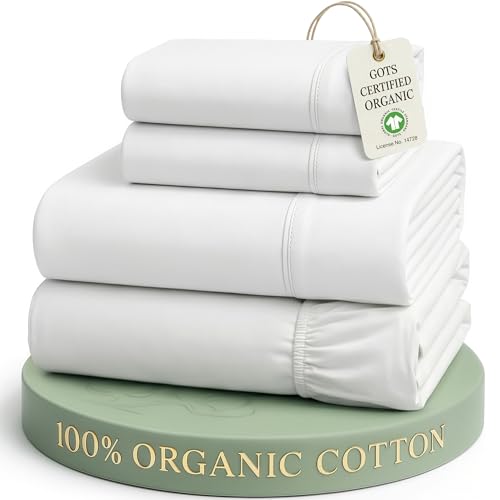
2. LANE LINEN 100% Organic Cotton Percale Sheets, Queen White — Best Organic Cotton
This is the pick for the shopper whose sustainability standard is certification, not adjectives. GOTS — the Global Organic Textile Standard — audits the fiber and the processing chain, and LANE LINEN states it in the verified title alongside the weave: percale, the crisp, matte, breathable weave that sleeps cool and wears like iron.
Strengths
- GOTS certified organic cotton, stated in the verified listing
- Percale weave is crisp, breathable, and exceptionally durable
- White colorway suits any bedding stack
Trade-offs
- Percale wrinkles more than sateen and has a crisper, less silky hand
- Organic cotton costs more than conventional — the audit is part of the price
- Crisp feel softens over washes, which not everyone wants accelerated
| Key spec | Queen 4-piece, GOTS certified |
|---|---|
| Format | 100% organic cotton percale |
Percale is the durability weave. Its simple one-over-one-under structure produces a sheet that resists pilling, breathes in summer, and historically outlasts fancier weaves — which is why hotels use it. Paired with organic cotton, the sustainability story is twofold: farming without synthetic pesticides and fertilizers, verified by GOTS, and a product lifespan measured in many years rather than seasons. If your definition of sustainable is ‘buy once, buy verified, keep it a decade,’ this set is the guide’s purest expression of it.
Percale rewards line drying or a prompt dryer removal — left crumpled it sets wrinkles that need ironing to fully release. It also improves for the first dozen washes, so judge it after a month, not after night one. Skip fabric softener; percale’s crispness is the point, and softener residue dulls its breathability.
Best for: Certification-first shoppers and crisp-sheet sleepers / Not suited for: Anyone who wants a silky sateen hand feel from day one
Check on Amazon — check price on Amazon

3. California Design Den 100% Organic Cotton Sheets, Queen — Best Value Organic
California Design Den’s set overlaps the LANE LINEN pick on paper — GOTS organic percale — and differs in the details that decide daily satisfaction: all-around elastic on the fitted sheet and a slightly shallower 15-inch pocket that hugs standard mattresses more snugly. It is the organic pick for normal-depth beds.
Strengths
- GOTS certified organic cotton percale
- All-around elastic keeps the fitted sheet seated
- Bright white, easy-care positioning for everyday use
Trade-offs
- 15-inch pocket is snug on very deep mattresses with thick toppers
- Percale crispness and wrinkling, as with any percale
- Two strong organic percale picks means choosing on fit details, not material
| Key spec | Queen 4-piece, 15 in deep pocket |
|---|---|
| Format | 100% organic cotton percale, all-around elastic |
Why include two organic percale sets? Because fitted-sheet fit is the top daily annoyance in bedding, and the right answer depends on your mattress. A 15-inch pocket on a 12-inch mattress pulls taut and stays smooth; the same pocket on an 18-inch mattress-plus-topper strains at the corners. This set is the tailored choice for standard beds, and its maker’s long track record in cotton bedding shows in the easy-care framing — organic should not mean fragile, and this set is built for weekly washing.
Measure your mattress depth including any topper before choosing between this and deeper-pocket picks. Wash with like colors in warm water, and expect the percale to reach peak softness around the tenth wash while keeping its structure for years.
Best for: Standard-depth mattresses wanting certified organic cotton / Not suited for: Very deep mattresses with thick toppers
Check on Amazon — check price on Amazon

4. Sijo AiryWeight TENCEL Sheet Set, Queen Snow — Best Eucalyptus Lyocell
Sijo’s AiryWeight set is for the shopper who has done the process reading: lyocell’s closed-loop production recovers and reuses its solvent, which is the strongest manufacturing claim available in sheets, and the fabric it produces is famously smooth, moisture-managing, and gentle on sensitive skin. The Snow colorway is a soft white that suits warm and cool rooms alike.
Strengths
- 100% lyocell derived from eucalyptus — no blends
- Closed-loop TENCEL process is the category’s best manufacturing story
- Exceptionally smooth surface, kind to skin and hair
Trade-offs
- Premium positioning — lyocell quality costs more than cotton
- Fluid drape feels different from structured cotton sheets
- Requires gentle-cycle care to protect the smooth finish
| Key spec | Queen 4-piece, 100% lyocell |
|---|---|
| Format | Eucalyptus TENCEL lyocell, Snow |
Lyocell manages moisture differently from both cotton and bamboo viscose: the fibers absorb and release moisture efficiently, which is why eucalyptus sheets feel dry and cool against the skin through the night rather than just at first touch. For hot sleepers with sustainability priorities, that makes this set the performance pick as well as the process pick. Sijo built its name on this single material, and single-material focus shows in details like the complete four-piece set with a proper flat sheet, which some lyocell brands quietly omit.
Wash lyocell cold on gentle with a mild detergent and keep it away from high dryer heat; the fibers are strong wet but the smooth surface is what you are protecting. Never use chlorine bleach on lyocell. Cared for this way, the buttery hand lasts — abused in hot washes, it dulls like any fine fabric.
Best for: Hot sleepers wanting the strongest process credentials / Not suited for: Crisp-sheet traditionalists or hot-wash laundry habits
Check on Amazon — check price on Amazon
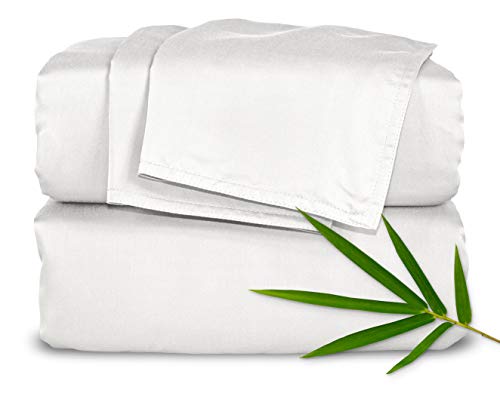
5. PURE BAMBOO Sheets, 100% Genuine Bamboo Viscose, Queen White — Best Pure Bamboo
PURE BAMBOO does one thing — bamboo viscose sheets — and the verified listing reads like a durability manifesto: corner straps to keep the fitted sheet anchored, double stitching at the seams, OEKO-TEX certification, and a stated guarantee. For a sustainability guide, that construction focus matters as much as the fiber.
Strengths
- 100% genuine bamboo viscose, OEKO-TEX certified
- Corner straps plus deep fit keep the sheet on the bed
- Double stitching targets the seams where sheets fail first
Trade-offs
- Bamboo viscose process caveats apply, as with all viscose
- White shows every mark — the laundry commitment is real
- Specialist brand sizing should be checked against your mattress depth
| Key spec | Queen, corner straps, double stitching |
|---|---|
| Format | 100% bamboo viscose, OEKO-TEX certified |
Sheets fail at seams and corners long before the fabric wears out, which is why this listing’s double stitching and corner straps are sustainability features, not conveniences. A sheet that pops off the corner nightly gets yanked, strained, and replaced sooner; a sheet that stays put gets kept. Combined with OEKO-TEX certification on the finished product, this is the bamboo pick for shoppers who weight product lifespan as heavily as fiber origin — a defensible and often underrated way to define sustainable.
Use the corner straps — they are the feature — especially on adjustable beds where flexing works fitted sheets loose. Wash cool and gentle, and the double-stitched seams will outlast the elastic, which is the correct order for a sheet to age in.
Best for: Longevity-focused bamboo shoppers and adjustable beds / Not suited for: Anyone unwilling to do gentle-cycle washing
Check on Amazon — check price on Amazon

6. Olive + Crate TENCEL Lyocell Sheets, Queen Moss — Best Deep Pocket Lyocell
Olive + Crate’s set solves the lyocell fit problem: most premium sheets top out at 16 inches, and this one reaches 18 with corner straps, so owners of deep mattresses and thick toppers can actually use eucalyptus sheets. The Moss colorway is a soft botanical neutral, and the sateen weave gives lyocell a subtle sheen.
Strengths
- 18-inch deep pocket — the deepest fit in this guide
- 100% TENCEL lyocell from eucalyptus
- Corner straps keep deep-pocket fit from turning sloppy
Trade-offs
- Moss is a color commitment — not a neutral white
- Deep pocket swims on shallow mattresses
- Sateen sheen shows more texture than matte percale
| Key spec | Queen, 18 in deep pocket, corner straps |
|---|---|
| Format | 100% TENCEL lyocell sateen, Moss |
Deep-pocket lyocell is rarer than it should be, because lyocell is positioned as a luxury fabric and luxury brands design for standard beds — while actual households keep adding toppers. This set closes that gap without compromising the material: 100 percent TENCEL lyocell, full four pieces, and straps that turn an 18-inch pocket from a loose sack into a tailored fit. If your mattress measures deep and your priorities run to closed-loop fiber, this is effectively the only pick in the guide that satisfies both, which earns it a place alongside the Sijo despite the shared material family.
Measure before ordering — on a shallow mattress the extra pocket depth bunches under the sheet and no strap fully fixes it. On the right mattress, wash cold and gentle like all lyocell, and the sateen surface keeps its sheen through years of weekly use.
Best for: Deep mattresses and toppers wanting eucalyptus lyocell / Not suited for: Shallow mattresses or white-only bedding schemes
Check on Amazon — check price on Amazon
Comparison Table
| Pick | Badge | Key spec | Best for |
|---|---|---|---|
| Bedsure PureWoven Rayon Derived from Bamboo Sheets, Queen | Best Overall | Queen 4-piece, 16 in deep pocket | Hot sleepers who want bamboo’s feel with honest labeling |
| LANE LINEN 100% Organic Cotton Percale Sheets, Queen White | Best Organic Cotton | Queen 4-piece, GOTS certified | Certification-first shoppers and crisp-sheet sleepers |
| California Design Den 100% Organic Cotton Sheets, Queen | Best Value Organic | Queen 4-piece, 15 in deep pocket | Standard-depth mattresses wanting certified organic cotton |
| Sijo AiryWeight TENCEL Sheet Set, Queen Snow | Best Eucalyptus Lyocell | Queen 4-piece, 100% lyocell | Hot sleepers wanting the strongest process credentials |
| PURE BAMBOO Sheets, 100% Genuine Bamboo Viscose, Queen White | Best Pure Bamboo | Queen, corner straps, double stitching | Longevity-focused bamboo shoppers and adjustable beds |
| Olive + Crate TENCEL Lyocell Sheets, Queen Moss | Best Deep Pocket Lyocell | Queen, 18 in deep pocket, corner straps | Deep mattresses and toppers wanting eucalyptus lyocell |
How to Choose Sustainable Sheet Sets
Sustainable sheets reward shoppers who read material labels the way they read contracts. The three fiber families below differ in farming, in factory chemistry, and in feel — and the right choice depends on which part of the footprint you care about most.
Three Fibers, Three Different Claims
Organic cotton’s claim is agricultural: grown without synthetic pesticides and fertilizers, and meaningful only when certified — GOTS audits the chain from farm to finished sheet, which is why both organic picks here carry it. Bamboo viscose’s claim is the feedstock: a fast, low-input crop. Its weakness is factory chemistry, which varies by producer and is rarely disclosed in detail; the honest mitigations are 100 percent composition, accurate ‘rayon derived from bamboo’ labeling, and product longevity. Eucalyptus lyocell’s claim is the process: a closed-loop solvent system that recovers nearly all of its chemistry, making it the most complete claim of the three.
None of the three is impact-free, and a guide that pretends otherwise is selling something. Rank them by your own priorities: audited farming, renewable feedstock, or cleanest manufacturing — then buy the best-made version of that fiber you can, because construction quality decides whether the sheet serves for two years or ten.
Durability Is a Sustainability Feature
The bedding industry’s footprint is driven by replacement as much as production. Sheets die at seams, at corners, and by pilling — all construction failures, not fiber failures. Double stitching, corner straps, full elastic, and long-staple cotton are therefore environmental specifications. When you compare two sets, ask which one you will still own in seven years; that answer usually outweighs small differences in fiber footprint.
Care is the other half of lifespan. Natural and regenerated fibers all prefer moderation: warm or cool water, gentle cycles for viscose and lyocell, no chlorine bleach, no scorching dryer heat. A household unwilling to wash gently should choose organic percale, the most forgiving fiber here, rather than buying delicate lyocell and shortening its life — matching the fiber to your laundry reality is a sustainability decision too.
Greenwashing Checks That Take Thirty Seconds
First, find the exact fiber percentage. ‘Bamboo sheets’ that are 40 percent bamboo viscose and 60 percent polyester are polyester sheets with a bamboo story. Every pick in this guide states 100 percent of its named fiber in the verified listing. Second, look for a named certification — GOTS, OEKO-TEX — rather than leaf logos and the word ‘eco,’ which certify nothing. Third, distrust thread-count theater: absurd thread counts are achieved by counting multi-ply yarns and say nothing about sustainability or even quality.
Finally, check what is in the set. Some ‘sheet sets’ quietly omit the flat sheet to cut cost and material while keeping the headline price. All six picks here are complete four-piece sets per their verified listings — sustainability includes not having to buy the missing piece separately.
How to Care for Sustainable Sheets So They Last for Years
A sustainable sheet set only delivers its promise if it lasts. This care routine is tuned to natural and regenerated fibers — organic cotton, bamboo viscose, and eucalyptus lyocell alike.
- Wash before the first night. New sheets carry finishing residues from manufacturing. A first wash in cool or warm water with a mild detergent removes them, opens the fibers, and gives you the fabric’s true hand feel to judge.
- Sort by fiber and color. Wash sheets separately from towels and anything with zippers or hooks, which abrade fine fibers. Keep whites with whites; natural fibers absorb dye transfer readily and permanently.
- Use mild detergent, measured modestly. Harsh detergents and overdosing strip natural fibers and coat regenerated ones. A modest measure of a gentle detergent cleans fully in a modern machine; extra soap mostly becomes residue you sleep on.
- Choose cool or warm, never hot, for viscose and lyocell. Bamboo viscose and eucalyptus lyocell keep their smooth surfaces in cool-to-warm gentle cycles. Organic percale tolerates warm water well. Reserve hot water for illness recovery washes, and accept it as an occasional exception, not the routine.
- Dry low, line, or a mix. Line drying is gentlest and free; a low dryer cycle is fine and softens cotton. Remove sheets slightly warm and smooth them onto the bed or fold immediately — most ‘ironing’ of percale is really just prompt folding.
- Rotate two sets. Two sets in rotation rest the fibers between uses and halve each set’s annual wash count. Rotation is the single easiest lifespan multiplier in bedding, and it makes the per-year cost of a premium sustainable set genuinely low.
Bought well and cared for this way, every set in this guide should serve for years — at which point its footprint per night of sleep undercuts any bargain set replaced annually. Longevity is not a side benefit of sustainable sheets; it is the mechanism.
Reading a Sheet Label Like an Auditor
A sheet listing is a small legal document, and sustainable sheets reward being read like one. Start with the fiber line and demand a percentage: ‘100% organic cotton’ is a claim with content, while ‘made with bamboo’ is a claim about seasoning. The picks in this guide were chosen because their verified titles state full percentages — 100 percent rayon derived from bamboo, 100 percent organic cotton, 100 percent lyocell — and that single habit, checking the percentage before the poetry, filters out most greenwashing in the category in under a minute.
Next, find the certification and know what it audits. GOTS certifies the organic chain from farm through processing; OEKO-TEX Standard 100 tests the finished textile for harmful substances; a brand’s own ‘eco-friendly’ badge certifies that the brand owns a printer. None of these marks guarantees comfort, and they do not claim to — they guarantee that a specific, checkable thing about the product is true, which is exactly the kind of guarantee worth paying for in a category built on unverifiable adjectives.
Finally, read what the set contains and how it is built. Four pieces should mean a fitted sheet, a flat sheet, and two pillowcases — some sets quietly substitute a second fitted sheet or omit the flat. Pocket depth should be a number, not the word ‘deep.’ Corner straps, full elastic, and double stitching should be named if they exist. A listing that specifies its construction is a listing from a maker who expects scrutiny, and in sustainable bedding, that expectation is the most reliable quality signal of all.
The First Month: How Sustainable Sheets Break In
Natural and regenerated fibers are not finished products on night one; they are materials at the start of a settling process, and knowing the timeline prevents most early returns. Organic percale arrives crisp — sometimes startlingly so — and softens progressively across the first eight to twelve washes as the fibers relax and residual finishing leaves. Shoppers who judge percale in week one are judging its stiffest state; the same set at month two is the one reviewers describe as the perfect hotel sheet. Bamboo viscose and lyocell run the timeline in reverse: they arrive at near-peak softness and the owner’s job is preservation, keeping hot water and harsh cycles from spending that softness early.
Fit settles too. A fitted sheet’s elastic relaxes slightly into your mattress’s exact corners over the first weeks, and natural-fiber fabrics ease into their true dimensions after the first washes — which is why the care guide insists on washing before the first night and judging size after, not before. A sheet that seems a whisper loose or snug on day one is frequently perfect by day ten, and a sheet judged and returned on day one never gets to prove it.
The practical advice is to commit to a fair trial: wash first, sleep a full week, wash again, and only then decide. Every fiber in this guide is at its most honest after that cycle. Sustainable purchasing includes not shipping products back and forth across the country on a first impression — the return truck is part of the footprint too, and a fair trial is both better shopping and better stewardship.
Blends, Hybrids, and When They Are the Honest Choice
This guide excluded blends from its picks, and it is worth explaining the line precisely, because blends are not automatically dishonest — hidden blends are. A sheet sold as 70 percent organic cotton and 30 percent lyocell, labeled exactly that way, is a legitimate engineering choice: lyocell can add moisture management and surface smoothness to cotton’s structure, and a maker who prints the ratio is respecting the buyer. A sheet sold as ‘bamboo sheets’ that turns out to be mostly polyester is a different act entirely — the headline fiber is doing marketing work the material is not doing.
The harder middle case is bamboo viscose itself, which is a manufactured fiber from a natural source, and which this guide includes with its process caveats stated in the open. The lesson generalizes: in sustainable textiles, the question is rarely ‘natural or not’ and almost always ‘is the claim specific, certified, and proportionate to the material.’ A specific claim you can check beats a pure claim you cannot, every time.
For shoppers, the working rule is simple. Pay sustainability premiums only where the listing gives you a percentage, a named certification, or a process you can verify — the three forms of evidence every pick here provides in at least one form. Where a listing offers only leaves, earth tones, and the word ‘pure,’ keep your money until it offers facts. The sustainable market improves exactly as fast as buyers reward evidence over atmosphere.
Sustainable Sheets and Sleep Quality: The Comfort Ledger
It is worth stating plainly that sustainability is not a comfort sacrifice in this category — for most sleepers it is a comfort upgrade purchased along a different axis. The fibers with the strongest environmental stories are also the fibers with the strongest sleep stories: lyocell’s moisture management is a process credential and the reason hot sleepers stop kicking off the sheet at 2 a.m.; percale’s breathability is a farming-neutral weave fact and the reason crisp-sheet people sleep cool; bamboo viscose’s surface is a feedstock story and the first thing your skin notices. The compromises in sustainable bedding are real but they are located in price and care, not in the bed.
Where comfort genuinely trades against credentials, this guide has tried to mark the spot: percale wrinkles, and a household that irons nothing will live with a relaxed look; lyocell asks for gentle washing, and a household that launders aggressively will spend its softness early; bamboo viscose’s process caveat is a values question no reviewer can settle for you. None of these is a sleep-quality failure. They are ownership textures, and matching them to your household’s actual habits — the recurring theme of this entire guide — is what converts a sustainable purchase from a statement into a decade of good nights.
The final comfort variable is fit, and it is fiber-independent: a sustainable sheet that pops off the corner is an unsustainable sheet, because it will be replaced. That is why this guide recorded pocket depths, elastic, and straps for every pick and included an 18-inch option for deep mattresses. Buy the fiber for your values, buy the fit for your mattress, and buy the construction for your decade. When all three point at the same set — as they do somewhere in the six picks above for nearly every household — the decision makes itself.
End of Life: What Happens When a Sheet Finally Wears Out
A sustainable purchase is not finished being sustainable when it wears out; the exit matters too, and sheets have better exits than most household goods. A cotton or lyocell sheet at the end of its bed life demotes gracefully — to a guest-room spare, a child’s bed, a pet’s bedding, a drop cloth, a garden frost cover — often serving years in second roles before it is truly done, and natural and regenerated fibers accept those demotions without the microfiber-shedding concerns that follow synthetics through every wash of every role. Households that plan demotions when they buy — this set will become the guest set when the next set arrives — extract the full material value of every fiber they paid a premium for, which is the quiet arithmetic underneath the entire sustainability claim.
When a sheet is genuinely finished, textile recycling is the correct last step where available, and even absent a program, natural-fiber sheets compost in a way polyester never will — a final, literal return that closes the loop the purchase opened. None of this requires heroics. It requires only that the household treat a sheet as a material with a lifecycle rather than a product with a lifespan, which is, in the end, the entire philosophy this guide’s picks were chosen under: buy a verified fiber, build it to last, care for it gently, demote it gracefully, and let it go honestly. A sheet that lives that full arc has earned its footprint many times over.
What to Do With the Sheets You Are Replacing
Upgrading to a sustainable set raises a fair question about the set leaving the bed, and the answer completes the purchase’s logic. A serviceable old set should not be discarded for being old: it demotes to the guest bed, the child’s room, the travel kit, or the emergency shelf, and a household that keeps one honest spare set avoids the panic purchases that produce the worst bedding decisions. Sheets too worn for beds still serve as drop cloths, pet bedding, moving blankets for furniture, and garden covers — cotton and other natural fibers accept every one of those demotions gracefully. The only set that should leave the house entirely is the one worn to transparency, and even that one exits better through textile recycling than through the trash where programs exist.
This demotion ladder is not thrift theater; it is the mechanism by which a premium set’s footprint argument completes itself. A sustainable sheet’s case rests on total service extracted per unit of material, and every demotion is service. Households that buy the sets in this guide and run the ladder — primary bed, guest bed, utility duty, recycling — will extract more nights and uses from their bedding than households buying three times the sheets at a third of the quality. Sustainability, practiced this way, stops being a label on a package and becomes a description of how a household runs. That is the standard the six picks here were chosen to support, and it is achievable by any household willing to think of a sheet as a material with a career.
One Last Check: The Smell and Sound Test
Two underrated diagnostics separate honest natural bedding from dressed-up synthetics the moment a package opens, and they cost nothing to run. The first is smell: genuine cotton, bamboo viscose, and lyocell arrive with a faint, neutral textile smell that one wash erases entirely, while heavily finished or blended fabrics often carry a sweet chemical odor that lingers through several washes and returns faintly when the bed warms at night. The second is sound: natural and regenerated fibers are quiet in the hand, while microfiber and high-polyester fabrics have a faint catch and rustle against skin that many sleepers never identify as the reason a bargain set felt subtly wrong. Run both tests on any set in this guide and they pass without drama — which is the point. A sustainable sheet should be as sensorially honest as its label claims, and a household that learns to check smell and sound at unboxing will rarely be fooled by this category again, whatever future listings promise.
Common Buying Mistakes
Believing the word ‘bamboo’ without the percentage
Blended bamboo-polyester sheets wear a green headline over a petroleum majority. Check the fiber content for 100 percent of the named fiber — the picks here state it in their listings — before paying a sustainability premium.
Treating all certifications as equal
A self-printed leaf logo certifies nothing. GOTS audits organic claims through the supply chain; OEKO-TEX tests the finished product for harmful substances. Know which claim each mark actually backs and match it to what you care about.
Washing delicate fibers like gym towels
Hot water, harsh detergent, and high dryer heat will halve the life of viscose and lyocell. If your household laundry style is aggressive, buy the forgiving organic percale instead of shortening a delicate set’s life.
Chasing thread count
Inflated thread counts come from multi-ply counting tricks and correlate with neither sustainability nor comfort. Fiber identity, staple length, weave, and construction — the things this guide specifies — are the real quality signals.
Buying one set with no rotation
A single set washed weekly wears out roughly twice as fast as two sets in rotation, and its cost per year ends up higher than the premium alternative. Rotation is the cheapest durability you can buy.
Final Recommendation
Start with the Bedsure PureWoven bamboo set if you want the best all-around balance of feel, honest labeling, and fit. Choose LANE LINEN or California Design Den if audited organic cotton is your standard — LANE LINEN for deeper pockets, California Design Den for standard beds and all-around elastic. Choose Sijo for the smoothest eucalyptus lyocell experience, Olive + Crate if your mattress is deep, and PURE BAMBOO if seam construction and corner straps are what will keep your set in service longest.
Whichever fiber you choose, buy two sets and rotate them. That single habit does more for the footprint of your bedding than any other decision in this guide.
Best Bamboo Sheet Sets Best Organic Cotton Sheets Best Cooling Sheet Sets Best Bamboo Memory Foam Pillows Best Cotton Quilts
Frequently Asked Questions
Which is more sustainable: bamboo, organic cotton, or eucalyptus sheets?
They lead on different measures. Organic cotton with GOTS certification has the most audited farming claim. Eucalyptus lyocell has the cleanest manufacturing process through its closed-loop solvent system. Bamboo viscose uses a renewable, low-input crop but a chemically intensive process. Durability can outweigh all three — the longest-lasting set usually wins overall.
Are bamboo sheets really made of bamboo?
The fabric is rayon or viscose produced from bamboo pulp — the bamboo is the source material, chemically transformed into a soft regenerated fiber. Honest listings say ‘rayon derived from bamboo,’ as the bamboo picks in this guide do. The fabric is not woven bamboo fiber in its natural form.
What does GOTS certified actually mean?
GOTS — the Global Organic Textile Standard — certifies that the fiber is organic and that processing through the supply chain meets environmental and social criteria, audited by third parties. It is the strongest organic claim available in bedding, and both organic cotton picks here carry it.
Do sustainable sheets sleep cooler?
Several do. Bamboo viscose and eucalyptus lyocell both manage moisture well and feel cool against the skin, and percale-weave organic cotton breathes freely. Sateen weaves and any synthetic blend sleep warmer. Four of the six picks here are specifically cooling-oriented per their verified listings.
How long should a good sustainable sheet set last?
Years, with rotation and gentle care — organic percale is famously long-lived, and well-kept lyocell and bamboo viscose serve for years as well. Lifespan depends more on construction and care than on fiber: seams, straps, and washing habits decide it.
Are sustainable sheets worth the higher price?
On a cost-per-year basis, usually yes: a certified, well-constructed set rotated with a second set commonly outlasts two or three bargain sets. The premium buys audited materials and construction — the two things that determine both footprint and lifespan.