Disclosure: airfryerkitchensupply.com is reader-supported. When you buy through links on our site, we may earn an affiliate commission at no extra cost to you.
Where to buy
Quilts are bulky, beloved and badly served by most storage: vacuum bags crush loft flat, airtight plastic traps moisture, and a bare closet shelf invites dust and moths. The picks below split honestly into vacuum compression for modern quilts and comforters where space is desperate, and breathable bags and structured containers for quilts that need gentler keeping. Every product was confirmed through the airfry site’s Amazon listing data before being linked — check the current price on Amazon from each link.
- Spacesaver Vacuum Storage Bags, Jumbo 10-Pack — Check on Amazon
- Amazon Basics Vacuum Storage Bags, Jumbo 6-Pack — Check on Amazon
- Lifewit 90L Large Storage Bags, 6-Pack — Check on Amazon
- ZOBER Under Bed Storage Bags, 90L 4-Pack — Check on Amazon
- StorageWorks Low Profile Under Bed Storage Containers — Check on Amazon
- Handy Laundry Comforter Storage Bag, 90L Clear — Check on Amazon
The best storage for quilts starts with a confession the storage industry avoids: the method that saves the most space — vacuum compression — is the method traditional quilters trust least. Sucking the air out of a quilt flattens batting, can stress hand stitching, and seals in whatever moisture was in the fabric. Yet for a modern machine-made comforter in a tiny apartment, vacuum storage is the difference between keeping it and giving it away. Good quilt storage is therefore not one product; it is matching the method to the quilt.
This guide ranks six verified options across that honest spectrum. Vacuum bags from Spacesaver and Amazon Basics handle the space emergencies and the modern bedding rotation. Breathable fabric bags from Lifewit and ZOBER store quilts the gentle way, with air circulation that batting appreciates. A structured under-bed container from StorageWorks keeps a quilt flat, visible and grabbable. And a clear zippered bag rounds out the set for the quilt that lives in the linen closet and comes out for guests.
Whichever method you choose, the preparation matters more than the product: a quilt must go into storage clean and completely dry, or no bag on earth will save it from mildew and stains setting in the dark. The how-to section walks through that prep properly.
In this guide
Quick Picks
Spacesaver Vacuum Storage Bags, Jumbo 10-Pack — Best Vacuum Storage. The vacuum benchmark: jumbo bags with a triple-seal turbo valve and double-zip closure that actually stay deflated, ten at a time. Check the current price on Amazon
Amazon Basics Vacuum Storage Bags, Jumbo 6-Pack — Best Budget Vacuum Set. The straightforward budget vacuum set: heavy-duty jumbo bags, a hand pump in the box, and stackable results for the seasonal swap. Check the current price on Amazon
Lifewit 90L Large Storage Bags, 6-Pack — Best Breathable Storage. The gentle method, done well: six 90-litre fabric bags with lids and reinforced handles, storing quilts with the air circulation batting prefers. Check the current price on Amazon
ZOBER Under Bed Storage Bags, 90L 4-Pack — Best Under-Bed Storage. Low-profile 90L bags that slide under the bed, with a clear top so you can see which quilt is which without unzipping anything. Check the current price on Amazon
StorageWorks Low Profile Under Bed Storage Containers — Best Structured Container. Structure where soft bags sag: a reinforced 6-inch under-bed container with a clear lid and a label holder, keeping one quilt flat, visible and instantly grabbable. Check the current price on Amazon
Handy Laundry Comforter Storage Bag, 90L Clear — Best Clear Linen-Closet Bag. The simple clear classic: a 90-litre zippered bag where the quilt is fully visible, for linen closets and guest bedding that rotates regularly. Check the current price on Amazon
How These Picks Were Chosen
We split candidates by method first — vacuum compression versus breathable storage — because recommending one without the other would mislead half our readers. Within each method we weighed seal and closure quality (a vacuum bag that reinflates in a month is a plastic sack with dreams), capacity honesty in litres and dimensions, fabric and window quality on soft bags, and handle reinforcement, because a bag full of quilts is heavier and more awkward than it looks.
Every product and ASIN was cross-checked against the airfry site’s Amazon listing data, matching listed titles to the products described; only confirmed products carry Amazon links. No prices or fixed ratings are printed — check price on Amazon and compare cost per bag or per litre inside each method class.
Heirloom honesty is a stated criterion in this guide: for hand-stitched, antique or sentimental quilts we recommend breathable storage and say so plainly in the reviews, even where a vacuum pick would be the easier sale. Modern quilts and comforters get the full menu.
The 6 Best Storage Options for Quilts
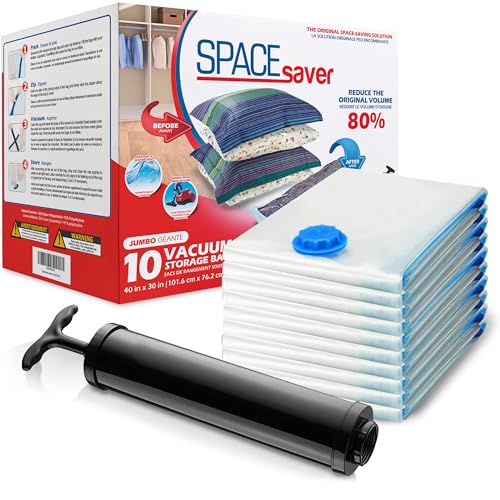
Spacesaver Vacuum Storage Bags, Jumbo 10-Pack — Best Vacuum Storage
Spacesaver is the name this category is judged against, and the jumbo 10-pack is its workhorse: big enough for a quilt or comforter per bag, sealed with a double zip and a triple-seal valve, with a hand pump in the box for homes without a suitable vacuum hose. Use it for the modern bedding rotation — the winter comforter in July, the spare quilts in the apartment with one closet — where compression is the entire point.
Strengths
- Sealing system with a proven stay-flat record
- Jumbo size takes a full quilt or comforter per bag
- Hand pump included; also works with a standard vacuum hose
Trade-offs
- Compression flattens loft — modern quilts recover on fluffing; delicate batting may not fully
- Airtight storage demands the quilt be perfectly dry first
- Not the method for heirloom or hand-stitched pieces
Key specs: Jumbo vacuum storage bags, pack of 10; triple-seal turbo valve; double-zip closure; hand pump included.
Vacuum bags fail at their seals, and Spacesaver’s valve-and-zip combination is why this brand leads: bags that stay flat for a season, not a week. Technique matters — fold the quilt to the bag’s shape, seal, vacuum slowly, and do not over-compress delicate fills; about a half to two-thirds reduction keeps modern quilts happy. Store the flattened bags flat, out of heat, and let quilts air and refluff for a day when they come back into service.
Best for: modern quilts and comforters in space-starved homes / Not suited for: heirloom or hand-stitched quilts (choose breathable storage)
Check the current price on Amazon

Amazon Basics Vacuum Storage Bags, Jumbo 6-Pack — Best Budget Vacuum Set
Amazon Basics’ jumbo set is the low-friction way to test vacuum storage: six heavy-duty bags, clear film so you can see what is inside, a hand pump included, and compressed bags that stack neatly on a closet shelf or under a bed. It suits the classic seasonal rotation — heavy quilts away for summer, light ones away for winter — without committing to a ten-bag system.
Strengths
- Heavy-duty film at a budget tier
- Clear bags make contents identifiable at a glance
- Hand pump included; stackable when compressed
Trade-offs
- Six bags is a starter quantity for quilt-heavy households
- Same vacuum caveats: dry quilts only, never heirlooms
- Valve quality is good, not class-leading, over many seasons
Key specs: Jumbo vacuum storage bags, pack of 6; heavy-duty clear film; hand pump included.
Buy this set to learn whether vacuum storage suits your household’s rhythm. If the seasonal swap works — and for modern quilts it usually does — you will know exactly how many more bags you need and can graduate to the Spacesaver ten-pack with data. If your quilts are precious, skip the experiment and go straight to the breathable picks below; this set’s honesty is that it never pretends to be for them.
Best for: first-time vacuum storage buyers and seasonal rotations / Not suited for: storing a whole household’s bedding at once
Check the current price on Amazon

Lifewit 90L Large Storage Bags, 6-Pack — Best Breathable Storage
For quilts you care about — good cotton batting, hand-finished edges, anything with sentimental weight — breathable fabric is the correct default, and Lifewit’s 90L bags are the category’s sensible standard. Ninety litres swallows a folded quilt or comforter with room to not be crushed, the lid keeps dust off, reinforced handles survive the lift into a high closet, and the bags fold flat when empty, which is more than any plastic bin can say.
Strengths
- Breathable fabric storage — the quilt-friendly method
- Generous 90L capacity per bag, six bags per pack
- Reinforced handles and lids; fold flat when empty
Trade-offs
- No compression — these take the space quilts take
- Fabric is not waterproof; store away from damp and leaks
- Soft sides mean stacking has natural limits
Key specs: 90L capacity each; fabric construction with lids; reinforced handles; foldable; pack of 6; gray.
This is the set we would hand a quilter without a single caveat about method: clean dry quilt in, lid on, shelf or closet, done — with a cedar block or lavender sachet alongside if pests are a local concern. The six-pack quantity matches how quilts actually accumulate, and the bags’ second life for clothing and linens means they never sit idle. If your problem is space rather than care, that is what the vacuum picks are for; if your problem is care, your shopping ends here.
Best for: quilts that need air circulation and closet-shelf storage / Not suited for: space emergencies where only compression will do
Check the current price on Amazon

ZOBER Under Bed Storage Bags, 90L 4-Pack — Best Under-Bed Storage
The space under a bed is the largest wasted storage zone in most homes, and these ZOBER bags are shaped exactly for it: low, long, 90 litres each, with dual zippers that open wide for loading a folded quilt and a clear top panel that ends the guess-which-bag game. Four bags take a household’s guest quilts and off-season bedding entirely out of the closet economy.
Strengths
- Purpose-shaped for under-bed space
- Clear top panel identifies contents instantly
- Dual zippers and reinforced handles; breathable non-woven fabric
Trade-offs
- Under-bed means dust discipline — vacuum under there occasionally
- Soft bags slide out full but go back fussier when overstuffed
- Measure your bed’s clearance before ordering
Key specs: 90L each; non-woven fabric; clear top; dual zippers; reinforced handles; pack of 4; gray.
Under-bed storage succeeds when retrieval is painless, and the clear top is the detail that delivers it: the guest quilt you want is visible from above, one zip away. Keep these for quilts in seasonal or guest rotation rather than weekly use, measure the frame clearance honestly — low-profile still has a height — and this set quietly adds a closet’s worth of storage to a room that thought it had none.
Best for: guest quilts and seasonal bedding stored under the bed / Not suited for: quilts in daily rotation (choose a structured container)
Check the current price on Amazon

StorageWorks Low Profile Under Bed Storage Containers — Best Structured Container
Some quilts are not stored so much as parked: the one that rotates onto the bed weekly, the guest-room quilt that must look crisp on demand. For those, structure beats capacity. StorageWorks’ reinforced container holds its shape empty or full, the clear lid shows the quilt at a glance, the label holder ends the mystery, and the whole thing slides under a bed with six inches of clearance — or stacks in a closet without the soft-bag slump.
Strengths
- Reinforced structure resists sagging and stacks cleanly
- Clear lid plus label holder — maximum identifiability
- Low 6-inch profile fits tight under-bed clearances
Trade-offs
- Structured means less capacity per container than a soft 90L bag
- One quilt per container is the realistic load
- Costs more per litre than fabric bags
Key specs: 6-inch low profile; reinforced structure; clear lid; handles and label holder; foldable and stackable.
Buy this for the quilt with a job, not the quilts in archive. The structure protects a folded quilt’s shape, the visibility removes friction from using it, and the container format survives years of sliding in and out that slowly worries soft bags at their seams. Households typically end up with a hybrid system — this container for the active quilt, Lifewit or ZOBER bags for the archive — and that hybrid is exactly what we recommend in the guide below.
Best for: the in-rotation quilt you grab weekly and want kept flat and visible / Not suited for: maximizing capacity per inch (soft bags hold more)
Check the current price on Amazon

Handy Laundry Comforter Storage Bag, 90L Clear — Best Clear Linen-Closet Bag
Sometimes the requirement is just: dust off, contents visible, zip it shut. The Handy Laundry 90L clear bag is the linen-closet staple for exactly that — a big see-through zippered organizer that takes a comforter or quilt and lets you inventory the whole shelf at a glance. It suits quilts in regular rotation, where months-long airtight archiving is not the mission and visibility is worth more than compression.
Strengths
- Fully clear — contents identified without opening
- Large 90L size takes a full quilt or comforter
- Simple, inexpensive, endlessly replaceable
Trade-offs
- Plastic film does not breathe — rotate contents and store only bone-dry quilts
- Not a compression bag; takes full shelf volume
- Basic construction versus the reinforced picks above
Key specs: 90L capacity; clear plastic; zippered closure.
Judge this bag as a closet organizer, not an archive vault, and it is perfect at its tier: the guest quilt stays clean, visible and grabbable, and the shelf stays honest. For anything stored longer than a season, or anything with heirloom value, step up to breathable fabric. Every storage system needs a simple clear bag or two; this is the one to have.
Best for: linen-closet quilts you want visible and dust-free / Not suited for: long-term heirloom archiving (choose breathable fabric)
Check the current price on Amazon
Comparison Table
| Pick | Badge | Key spec | Best for |
|---|---|---|---|
| Spacesaver Vacuum Storage Bags, Jumbo 10-Pack | Best Vacuum Storage | Jumbo vacuum bags x10, triple-seal valve, double-zip closure, hand pump included | modern quilts and comforters in space-starved homes |
| Amazon Basics Vacuum Storage Bags, Jumbo 6-Pack | Best Budget Vacuum Set | Jumbo vacuum bags x6, heavy-duty film, hand pump included, stackable | first-time vacuum storage buyers and seasonal rotations |
| Lifewit 90L Large Storage Bags, 6-Pack | Best Breathable Storage | 90L fabric bags x6, lids, reinforced handles, foldable | quilts that need air circulation and closet-shelf storage |
| ZOBER Under Bed Storage Bags, 90L 4-Pack | Best Under-Bed Storage | 90L low-profile bags x4, clear top, dual zippers, reinforced handles | guest quilts and seasonal bedding stored under the bed |
| StorageWorks Low Profile Under Bed Storage Containers | Best Structured Container | 6-inch low profile, reinforced structure, clear lid, label holder, handles | the in-rotation quilt you grab weekly and want kept flat and visible |
| Handy Laundry Comforter Storage Bag, 90L Clear | Best Clear Linen-Closet Bag | 90L clear zippered bag, see-through contents, simple construction | linen-closet quilts you want visible and dust-free |
How to Choose Storage for Quilts: Vacuum vs Breathable, Decided Honestly
The decision tree has one branching question: is this quilt replaceable, or is it precious? Modern machine-made quilts and comforters — replaceable, synthetic or sturdy cotton batting — can go either way, and space decides: vacuum if the closet demands it, breathable if it does not. Hand-stitched, antique, wool-batted or sentimental quilts go breathable, full stop: compression stresses their fibers and stitching, and airtight plastic risks trapping the moisture that grows mildew in the dark.
Capacity, translated to quilts
Litres mislead until you fold a quilt. A queen quilt folds to roughly a 60–90 litre footprint depending on loft, so a 90L bag is a one-quilt bag — plan quantities accordingly. Vacuum bags are sold by dimensions rather than litres; jumbo sizes take one quilt or comforter each. Whatever the method, a bag stuffed to bursting is a bag whose zipper fails in February: leave the last ten percent of capacity as insurance.
Where the quilt will live decides the container
Closet shelves suit structured containers and fabric bags; under-bed zones demand low profiles measured against your frame’s true clearance; attics and garages — with their temperature swings and damp — are the last resort for any quilt, and only in breathable bags with pest protection, checked seasonally. The best storage location is a cool, dry, interior one, and the best container is the one shaped for it.
A Simple System That Handles a Whole Household’s Quilts
Most households converge on three tiers. The active quilt — this week’s bedding — lives in a structured container or on the shelf, folded and visible. The seasonal rotation lives in breathable bags, or vacuum bags if the home is small and the quilts are modern. The archive — heirlooms and someday quilts — lives breathable, clean, refolded along different lines once or twice a year so creases do not set permanently, with a note in the bag saying what it is and whose it was. Label everything; future you is a stranger who will be grateful.
Batting, Fibers and Why Quilts Age in Storage
A quilt in storage is not inert — it is slowly reacting to its environment, and understanding the reactions explains every rule in this guide. Cotton batting absorbs moisture from humid air and releases it in dry air, which is healthy cycling in a breathable bag and a mildew risk in a sealed one that went in damp. Wool batting is resilient and naturally resistant to pests but dislikes compression and heat. Polyester batting tolerates almost everything, including vacuum storage, which is why modern comforters are the vacuum method’s natural citizens. The quilt’s fibers and batting, not your closet’s size, should cast the first vote on method.
Light and creasing are the slow enemies. Ultraviolet fades dyes unevenly, which is why storage belongs in the dark; permanent creases form where a fold is left under weight for years, which is why the annual refold along new lines — repeated throughout this guide — is the single most valuable habit in quilt keeping. Acidic materials are the third: cardboard boxes and ordinary tissue slowly yellow cotton, so long-term folds get acid-free tissue or a clean cotton sheet as their padding, never newspaper or a grocery bag.
None of this requires museum equipment. It requires a clean dry quilt, a breathable bag for anything precious, a dark interior space, and twenty minutes of attention a year. Quilts survive generations on exactly that regime — the heirlooms in museums were mostly kept by somebody’s grandmother following these rules without knowing their names.
Pests, Moths and the Clean-Quilt Rule
The pests that damage stored textiles — clothes moths and carpet beetles chief among them — are not hunting your quilt; they are hunting the soil in it: body oils, food traces, pet dander. A quilt washed before storage is a radically less attractive target, which is why the clean-first rule in this guide is stated without exceptions. Storage location matters secondarily: undisturbed, dark, seldom-checked places are where infestations grow unnoticed, another argument for the twice-yearly airing and inspection this guide prescribes.
Deterrents play a supporting role. Cedar blocks and rings lose potency as their oils evaporate — sanding or replacing them annually keeps them honest — and lavender sachets are a pleasant, mild adjunct. Sealed lids and zipped bags are the physical barrier that does the heavy lifting, and breathable fabric bags with proper closures balance that barrier against the airflow batting needs. Chemical mothballs are effective but leave quilts smelling of mothballs, which for most households settles the question against them.
If you discover damage, act quickly and completely: isolate the affected quilt, clean it thoroughly, inspect everything stored nearby, and vacuum the storage area itself. An early-caught infestation is an afternoon’s work; a season’s neglect is a collection’s loss.
Storing Quilts in Small Homes: The Vertical and Rotational Playbook
Small homes do not lack storage so much as they lack obvious storage, and quilts — bulky, light, forgiving — are the easiest large items to place well. Under-bed volume, as the ZOBER and StorageWorks picks exploit, is the biggest single win: a bed’s footprint hides a closet’s worth of flat storage. The tops of wardrobes and the dead space above closet shelves take fabric bags happily. Vacuum compression, reserved for the modern quilts that tolerate it, converts the seasonal rotation from a space crisis into a shelf.
Rotation is the small-home quilter’s real system: only this season’s quilts live in the accessible tier, everything else is stored by the method its fibers demand, and the swap happens on two fixed dates a year — which conveniently become the inspection and refolding dates this guide recommends anyway. Label every bag with its contents and its swap date, keep a one-line inventory on the closet door, and the whole collection stays findable, healthy and out of the way.
What small homes cannot afford is the guilt hoard: quilts kept in damaging conditions because there is nowhere proper for them. A quilt given to a relative who will use it beats a quilt mildewing in a damp garage. Storage done well is a form of respect for the work in the fabric — and sometimes respecting it means letting it live somewhere it can be used.
Climate, Light and Location: Placing Quilt Storage Where Quilts Survive
The ideal quilt storage climate is the climate of a lived-in interior room: moderate temperature, moderate humidity, darkness when the door closes. That description fits a bedroom closet, a linen press, a cedar chest in a spare room — and excludes, in descending order of suitability, the basement (damp and flood risk), the attic (heat that can exceed what fibers forgive, plus pests), and the garage (everything, plus fumes). Most households storing quilts badly are not careless; they simply never ranked their spaces. Rank yours by this paragraph and move the quilts accordingly — the relocation costs an afternoon and buys decades.
Humidity deserves its own sentence because it drives the worst storage outcomes. Sustained damp feeds mildew on cotton and weakens fibers invisibly until the damage announces itself all at once. If your only available space runs humid, a small dehumidifier or renewable desiccant in the closet, checked on the same twice-yearly rhythm as the quilts themselves, converts a bad location into an acceptable one. Conversely, forced-air heating vents blowing directly into a storage closet over-dry and overheat; keep bags out of the blast path.
Light discipline is simpler: quilts in storage should see darkness, and quilts on display — the other legitimate life — should rotate off sunlit walls seasonally. A quilt’s colors are its maker’s choices made permanent; fading is the one storage injury no cleaning can reverse.
Put together, the location rules cost nothing and matter more than any container in this guide. The best bag in a bad attic loses to a pillowcase in a good closet. Choose the room first, the container second, and the method third — in that order, every time.
The Seasonal Swap, Choreographed: A Twice-Yearly Ritual That Keeps Quilts Alive
Twice a year — when the heavy quilts come out and when they go away — run the same calm ritual and your collection will outlive its storage. Begin a week ahead: launder the quilts that will be stored, on their own care terms, and give them their full drying time plus the extra airing day this guide insists on. While they dry, empty and vacuum the storage spaces themselves, wipe shelves, renew cedar or desiccant, and inspect last season’s stored quilts as they emerge — airing them for a day before they go on beds, checking for any pest or damp surprise while it is still a small one.
Swap day itself is folding and labeling: incoming quilts folded along lines different from last time, precious ones with their padding in the folds, each into its method-appropriate bag with its label updated — what it is, when it was stored, anything its future self should know. Outgoing quilts get their day of air and light inspection before service. The whole ritual for a household collection takes an afternoon, and it replaces the alternative biography of stored textiles: forgotten, damp, discovered ruined.
Keep the ritual on fixed dates tied to something you never miss — the clock change weekends are the classic choice — because a maintenance habit attached to a calendar anchor survives busy years, and a floating intention does not. This, in the end, is the real product this guide is selling beneath the bags and containers: not storage, but a rhythm of care that a quilt collection can live inside indefinitely.
Quilt Storage for Collectors: When the Collection Outgrows the Closet
Serious quilters and collectors eventually face the arithmetic this guide has deferred: dozens of quilts, finite closets. The collector’s system extends the household one without changing its principles. Storage concentrates in one climate-suitable room or a rented interior unit chosen by the location rules — interior, dry, dark, visited — never by price alone. Quilts are catalogued as they are stored: a photograph, a line of provenance, the storage location and the date, in a notebook or a spreadsheet that lives with the household’s important papers. A collection without a catalogue is a rumor; with one, it is an inheritance that can actually be inherited.
Rotation becomes curatorship at this scale: pieces cycle between storage, display and use on the twice-yearly rhythm, display pieces rest from light in their dark seasons, and the refolding inspection doubles as a condition report. Any piece showing pest, damp or fold damage gets priority care and a note in the catalogue. Insurance enters the conversation too — documented collections with photographs can be scheduled or at least evidenced, a step casual storage never requires and serious collections should not skip.
And the endgame deserves the honesty this guide has practiced throughout: a collection’s final storage problem is solved by people, not products. Quilts given, with their stories written down, to the relatives and friends who will use and keep them are stored in the only medium that never mildews. The catalogue’s last column — where this quilt should go — is the most loving entry a collector ever types. Bags and containers, this guide’s whole subject, are how quilts wait well; that column is what they are waiting for.
Digitizing the Collection’s Memory: Photos, Notes and the Stories in the Stitching
A quilt is two artifacts: the fabric, and the knowledge of who made it, when, from what, and for whom. Storage protects the first; only you can protect the second, and it is the more fragile of the two — fabric survives a century in a good closet, while a maker’s name can be lost in a single generation’s silence. The remedy costs an afternoon: photograph each quilt spread flat in decent light, then photograph its label or signature block if it has one, and write the paragraph you would want read at its next century — maker, date, occasion, the source of its fabrics (a grandmother’s dresses, a wedding’s shirts), and its place in the family.
Store the record redundantly: a copy with the household documents, a copy in cloud storage, and — the analog touch that never fails — a printed note inside the quilt’s own storage bag, so the artifact and its story travel together even if every system fails. Update the record at the twice-yearly swaps this guide prescribes; the ritual takes minutes once the habit exists, and it converts your storage shelves from a pile of textiles into a documented collection.
This is the fitting place for the guide to end its technical advice: bags, containers, methods and climates all serve a single purpose — that the work in these fabrics, and the hands that did it, arrive intact at the people who will love them next. Store the quilts well. Write the stories down. The quilts will do the rest, as they have always done.
Emergency Storage: When Quilts Must Move Fast
Life occasionally stores quilts the way it does everything else — suddenly. A flood threat, a house sale, a relative’s estate arriving in boxes: the emergency version of this guide’s system compresses to four rules that preserve nearly all of the value. Clean beats perfect: a quilt that cannot be washed in time should at least be shaken, aired and inspected before it is bagged. Dry beats sealed: never close a bag on a damp quilt even for a week — leave it open, draped, in moving air instead. Breathable beats airtight at every timescale you cannot predict, because the emergency storage always lasts longer than the emergency. And a label beats a memory: thirty seconds with a marker on masking tape, saying what the quilt is and whose, has saved more family history than any container ever made.
When the emergency passes, promote the quilts into the full system at the next seasonal swap — wash, dry, refold, catalogue — and forgive the improvisation. Storage done hastily but dry, breathable and labeled loses almost nothing; storage done slowly but damp loses everything. If this guide’s hundreds of details must collapse into one sentence for the worst week of a quilt’s life, that sentence is it.
One more emergency deserves its own line: the quilt that arrives already damaged — mildewed, infested, torn. Isolate it from every other textile immediately, outdoors or in a sealed bag away from the collection, and deal with it as its own project with cleaning before any repair. Collections are lost by contagion more often than by catastrophe; quarantine is the collector’s first skill, and it costs nothing but decisiveness.
Passing It On: The Quilt’s Next Keeper
Somewhere in your collection is a quilt whose next keeper already exists — a niece who always reaches for it, a friend who quilts and will honor the stitching, a child who has claimed it by the simple method of sleeping under it at every visit. Notice those claims; they are the collection’s own succession plan announcing itself. When the time comes, hand the quilt over with its story written and its care made simple — wash gently, store breathable, refold yearly — and let it begin its second life in hands that chose it. A quilt passed on deliberately, with its history attached, is the best-stored quilt of all: kept not in a bag, but in a life. The containers in this guide are how quilts wait. This is what they are waiting for, and it is a good note to end on.
The Shelf, Revisited
Go and look at your quilt shelf once more before you order anything. Count the quilts, honestly assess their fibers and their meaning to you, measure the spaces they could live in — closet, under-bed, chest — and only then match each quilt to its method from this guide. The shelf will tell you the shopping list: how many breathable bags, whether a vacuum set earns its place, which quilt deserves the structured container. Storage bought from the shelf’s testimony fits the collection you have, rather than the collection in a catalog photograph. That is the last principle, and the first one worth keeping.
How to Prepare a Quilt for Storage (Clean, Dry, Fold Right)
Storage preserves whatever state the quilt goes in — including the dirt. Preparation is not optional.
- Wash or professionally clean the quilt first, following its care needs; body oils and food spots oxidize into permanent stains in storage and attract pests.
- Dry it completely — then dry it some more. A quilt that feels dry can hold moisture in its batting; an extra airing day is the cheapest mildew insurance there is.
- Fold with padding in the folds for long storage: acid-free tissue or a clean cotton sheet folded into the creases softens fold lines on precious quilts.
- For vacuum storage of modern quilts, compress gradually and stop short of maximum flatness; over-compression is what batting remembers.
- Add a label inside the bag: what the quilt is, when it was stored, and any care notes. Seal or zip, then store cool, dry and dark.
Check stored quilts once or twice a year: air them, refold along new lines, and confirm no damp or pests have moved in. Twenty minutes of attention annually is the entire maintenance cost of a quilt surviving decades in storage.
Common Buying Mistakes
Vacuum-sealing an heirloom quilt. Compression and trapped moisture are the twin enemies of hand stitching and natural batting. Precious quilts go in breathable fabric, always.
Storing a quilt unwashed. Invisible soil becomes visible stains and a pest buffet over a season in the dark. Clean first is the rule with no exceptions.
Storing even slightly damp. Mildew needs only a little moisture and a dark bag. When in doubt, air the quilt another day before sealing anything.
Overstuffing bags to their zippers. Strained zippers and seams fail mid-storage, quietly undoing all protection. Leave the last ten percent empty.
Forgetting what is where. Unlabeled bags get opened, rummaged and resealed badly. A label inside every bag takes ten seconds and saves the whole system.
Final Recommendation
Match the method to the quilt and the shopping is easy. Modern quilts in a space emergency: Spacesaver’s jumbo vacuum bags, with the Amazon Basics set as the budget starter. Quilts you care about: Lifewit’s breathable 90L bags for closets, ZOBER’s clear-top bags under the bed. The in-rotation quilt earns the structured StorageWorks container, and every linen closet deserves the simple clear Handy Laundry bag for visibility. Heirlooms: breathable only, prepared properly, checked yearly.
Clean, completely dry, correctly folded — do those three things and any pick here will keep your quilts well.
Shop the shortlist: Spacesaver Vacuum Storage Bags, Jumbo 10-Pack — Check on Amazon · Amazon Basics Vacuum Storage Bags, Jumbo 6-Pack — Check on Amazon · Lifewit 90L Large Storage Bags, 6-Pack — Check on Amazon
Best Vacuum Storage Bags For Bedding Best Under Bed Storage Best Storage Bags For Blankets Best Comforter Storage Best Linen Closet Organizers
Frequently Asked Questions
Is vacuum storage bad for quilts?
For modern quilts and comforters, gentle vacuum compression is generally fine and a huge space saver. For hand-stitched, antique, or wool-batted quilts, quilters recommend breathable storage instead — compression stresses fibers and stitching, and airtight bags can trap moisture.
How should I store an heirloom quilt?
Clean and fully dry, folded with padding in the folds, in a breathable fabric bag in a cool, dry, dark interior space. Refold along different lines once or twice a year and air it briefly. Never vacuum-seal it.
How many quilts fit in a 90L bag?
Realistically one queen quilt per 90L bag, folded — two thinner quilts at most. Plan one bag per quilt and treat any extra room as zipper insurance rather than capacity.
Can I store quilts in the attic or garage?
Only as a last resort: heat, cold swings and damp are all quilt enemies. If you must, use breathable bags, add pest protection, keep bags off the floor, and check them seasonally.
How do I keep moths and pests away from stored quilts?
Start clean — pests come for soil, not clean cotton. Store in sealed or lidded containers, consider cedar or lavender sachets as a deterrent, and inspect stored quilts a couple of times a year.
Should quilts be refolded in storage?
Yes, for long-term storage: refolding along different lines once or twice a year prevents permanent creases and lets you check condition and air the quilt. It is the single most valuable habit in quilt keeping.
Can I store a quilt in a cedar chest?
Yes — cedar chests are a traditional, good home for quilts, with the same rules: quilt clean and dry, folded with padding in the folds for precious pieces, refolded periodically. Let the quilt air before use, as cedar’s scent transfers pleasantly but noticeably.
Is it okay to store quilts in plastic bins?
For short-term, in-rotation storage in a dry interior, a lidded bin is workable. For long-term storage, breathable bags are kinder to fibers and batting, and airtight plastic over a damp quilt is the classic mildew setup — dryness and duration decide.


