The best steak cookers bring steakhouse heat into an ordinary kitchen, and that heat is the whole point. A steak needs a fast, hard sear to build a browned crust while the inside stays at the doneness you want, and most home stoves cannot deliver that kind of concentrated heat without smoking out the room. The six cookers below solve that problem in different ways: electric broilers that push heat down from above, infrared gas grills that reach searing temperatures in minutes, and indoor grill plates that hold steady, even heat across the whole cooking surface. Every pick here is a genuine steak-cooking appliance verified through the site catalog, chosen because it can sear a steak properly rather than merely warm it up.
Steak cookers matter most to cooks who eat steak at home more than a couple of times a month and are tired of the trade-offs. A cast iron pan can sear well, but it fills the kitchen with smoke and splatter. An outdoor grill works beautifully in summer and sits idle in winter. The appliances in this guide are built to close that gap: they reach searing temperatures fast, they manage smoke and grease instead of spreading them around, and they clean up without an hour of scrubbing. If that sounds like your kitchen, one of these six will fit. Readers comparing grill types may also want our guide to indoor grills for steaks and our roundup of electric grills for apartments.
In this guide
Quick picks: best steak cookers
| # | Product | Where to buy |
|---|---|---|
| 1 | BIG HORN Electric High Heat Indoor Grill | Check on Amazon |
| 2 | Ninja Sizzle Indoor Grill and Griddle GR101 | Check on Amazon |
| 3 | BIG HORN OUTDOORS Infrared Propane Gas Grill | Check on Amazon |
| 4 | Hamilton Beach Electric Indoor Searing Grill | Check on Amazon |
| 5 | George Foreman 4-Serving Indoor Grill | Check on Amazon |
| 6 | Ninja Foodi 5-in-1 XL Indoor Grill and Air Fryer AG301 | Check on Amazon |
How the picks were chosen
Each cooker below was checked against the same four tests. First, heat: it must reach a genuine searing temperature, not just a warm grilling temperature, because a steak that never gets hot enough steams instead of searing. Second, control: the heat has to be adjustable or at least predictable, so a thin sirloin and a thick ribeye can both come out right. Third, smoke and grease management: an indoor cooker that fills the house with smoke fails at its main job, so lids, drip trays and grease channels counted heavily. Fourth, cleanup: removable plates, dishwasher-safe parts and wipe-clean surfaces matter because a cooker that is hard to clean does not get used. Products that were accessories, replacement parts or a different appliance class entirely were left out, as were any listings that could not be verified as the exact model named.
Best steak cookers: what counts as one
A steak cooker is any countertop or portable appliance whose main job is cooking steak with direct, high heat. That definition covers more than one shape. Electric steak broilers use a heating element above the meat, the way a restaurant salamander does, so the heat hits the top of the steak first and fat drips away instead of pooling. Infrared gas grills use a burner that glows hot and radiates intense heat in a few minutes, which suits outdoor cooking and thick cuts. Indoor grill and griddle plates use a heated surface with raised ridges, which gives grill marks and even browning with less smoke than an open pan. All three shapes appear below, and the right one depends on whether you cook indoors or out, how thick your steaks run, and how much smoke your kitchen can tolerate.
Finally, every check was made against the verified catalog details rather than marketing claims. Wattage, temperature ceilings, capacities and included parts were taken from the listing data itself, and any product whose listing did not support the claim in its name was set aside. That matters for steak cookers more than for most appliances, because the difference between a grill that sears and one that merely warms is hidden in exactly those details. A cooker that lists a real searing temperature and a rack or dial to control it earned its place; one that only promises restaurant results without the numbers to back it up did not.
The picks at a glance
| Product | Type | Standout detail |
|---|---|---|
| BIG HORN Electric High Heat Indoor Grill | Electric broiler | 1500-degree top-down heat, 7-level rack |
| Ninja Sizzle Indoor Grill and Griddle GR101 | Indoor grill and griddle | 14-inch plates, 500-degree edge-to-edge heat |
| BIG HORN OUTDOORS Infrared Propane Gas Grill | Portable gas grill | 1500 degrees in 3 to 5 minutes, 19,000 BTU burner |
| Hamilton Beach Electric Indoor Searing Grill | Indoor searing grill | 450-degree sear, viewing window lid |
| George Foreman 4-Serving Indoor Grill | Contact indoor grill | Removable plates, 60-square-inch surface |
| Ninja Foodi 5-in-1 XL Indoor Grill and Air Fryer AG301 | Grill and air fryer | 500-degree cyclonic grilling, 5 functions |

BIG HORN Electric High Heat Indoor Grill
The BIG HORN electric broiler works like the salamander broilers used in steakhouse kitchens: the heat comes from above, it is intense, and it hits the surface of the steak fast enough to build a crust before the inside overcooks. That top-down design is the reason this cooker earns the first spot. When heat comes from below, fat renders into the fire or the pan and smoke follows. When heat comes from above, fat drips down and away from the element, which keeps smoke lower and keeps the crust dry and crisp. The verified details list a 1500-degree element, a reflective cooking chamber that concentrates heat onto the food, and a seven-level rack that moves the steak closer to or farther from the heat. Those three facts together describe a cooker that can handle a thin strip steak at a high rack setting and a thick ribeye lower down with more time. Cleanup is practical rather than an afterthought: the heating elements flip up and come out, the stainless steel interior wipes clean, and the drip tray, pan and rack supports go in the dishwasher. The same rack system also handles chicken, seafood and vegetables, so the cooker is not a single-trick appliance, but steak is clearly what it is built for. Cooks who buy it should expect a short learning period while they match rack height and minutes to their preferred doneness, and they should keep a reliable instant-read thermometer nearby, since the cooker rewards attention more than guesswork.
Key specs
- 1500-degree high-heat searing element
- 7-level adjustable rack system
- Diamond-shaped reflective cooking chamber
- Drip tray, pan and rack supports detach and are dishwasher-safe
- Heating elements flip up and remove for cleaning
Strengths
- Reaches a true steakhouse searing temperature indoors
- Top-down heat lets fat drip away instead of pooling under the steak
- Adjustable rack gives real control from searing to roasting
Trade-offs
- No temperature readout is listed in the verified details, so doneness relies on timing and rack height
- Countertop footprint is larger than a simple grill plate
- Best suited to steaks and similar cuts rather than as a general everyday grill
Who it fits: Cooks who want restaurant-style searing indoors and are willing to learn rack heights and timing for their favorite cuts.
Best for: steakhouse-style searing at home without firing up an outdoor grill
Not suited for: cooks who want a small, simple grill plate or a general-purpose outdoor grill
Check price on Amazon: BIG HORN Electric High Heat Indoor Grill

Ninja Sizzle Indoor Grill and Griddle GR101
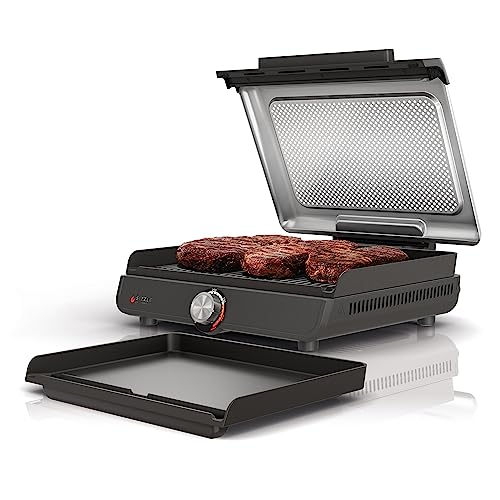
The Ninja Sizzle GR101 is the most versatile pick in this guide, and its strength is even, controlled heat across a large surface. The verified details describe interchangeable nonstick grill and griddle plates on a 14-inch footprint, a 500-degree maximum with edge-to-edge heating, and a perforated mesh lid that controls smoke while the high plate walls and grease catches keep splatter contained. For steak, the grill plate is the one that matters: the ridges give char-grilled marks, the even heat means the second steak cooks like the first, and the lid lets you finish with the hood down to hold heat and melt a topping. The griddle plate earns its keep on other days, handling vegetables, sandwiches and breakfast foods that would fall through grill ridges. Cleanup is straightforward because the plates are nonstick and removable, and the mesh lid detaches and goes in the dishwasher. The honest trade-off is ceiling temperature. At 500 degrees the Sizzle sears well, but it does not reach the extreme heat of a dedicated broiler, so very thick steaks benefit from a longer rest and a thermometer check rather than a rushed cook. For most home steak nights, though, the combination of size, control and low smoke is hard to beat, and the GR101 is the pick to buy when one appliance has to serve the whole household.
Key specs
- 14-inch grill and griddle plates, interchangeable
- 500-degree maximum heat with edge-to-edge coverage
- Perforated mesh lid controls smoke and splatter
- Nonstick plates with high walls and grease catches
- Plates fit about six burgers and feed four to six people
Strengths
- Interchangeable plates cover both grilling and flat-top cooking
- Edge-to-edge heat avoids the hot and cold spots that cause uneven steaks
- Mesh lid keeps smoke and splatter under control indoors
Trade-offs
- 500 degrees is strong for an indoor grill but below broiler-level searing heat
- The 14-inch plates need real counter and storage space
- The griddle plate adds versatility but is not needed for steak alone
Who it fits: Families and regular hosts who want one indoor appliance that grills steaks, cooks breakfast on the griddle, and feeds four to six people.
Best for: family steak nights and everyday indoor grilling with easy cleanup
Not suited for: cooks chasing the hardest possible restaurant sear on very thick steaks
Check price on Amazon: Ninja Sizzle Indoor Grill and Griddle GR101

BIG HORN OUTDOORS Infrared Propane Gas Grill
The BIG HORN OUTDOORS infrared grill is the outdoor counterpart to the electric broiler at the top of this guide, and it shares the same idea: intense heat from above, applied fast. The verified details list a 19,000 BTU infrared burner that reaches 1500 degrees in three to five minutes, a 13-inch wide cooking chamber with a seven-position rack, and a stainless steel body built for outdoor use. That heat-up speed changes how steak night works. There is no long preheat, no charcoal to manage, and no waiting for a grill to come up to temperature while the steak sits out. Pulse ignition starts it at the push of a button, and the top-down infrared heat sears the surface while the adjustable rack sets the distance for thicker or thinner cuts. The grill also includes a pizza stone, which adds a second use, and its parts detach for dishwasher cleaning. The limits are the ones that come with any portable gas appliance: the propane tank and the ignition battery are not included, the grill is for outdoor use, and the cooking chamber is sized for steaks and small batches rather than a crowd. For a household that grills outside often, camps, or tailgates, those are acceptable trade-offs, and the speed and sear quality make this the strongest outdoor pick here.
Key specs
- 19,000 BTU infrared burner, reaches 1500 degrees in 3 to 5 minutes
- 16-inch cooking chamber with 7-position adjustable rack
- Top-down infrared heat modeled on salamander broilers
- Windproof pulse ignition, battery not included
- Stainless steel body; parts detach and are dishwasher-safe
Strengths
- Fastest heat-up in this guide, ready to sear in minutes
- Portable tabletop design suits backyard, camping, tailgating and RV use
- Infrared top-down heat locks in moisture while building a hard sear
Trade-offs
- Runs on propane, so a tank and batteries must be bought separately
- Outdoor use only, which limits it in bad weather
- 16-inch chamber suits steaks and small batches, not large parties
Who it fits: Outdoor cooks and campers who want steakhouse searing away from the kitchen and do not mind handling a propane tank.
Best for: outdoor steak searing, camping and tailgating with fast, intense heat
Not suited for: apartment cooks who need an indoor-only appliance
Check price on Amazon: BIG HORN OUTDOORS Infrared Propane Gas Grill


Hamilton Beach Electric Indoor Searing Grill
The Hamilton Beach indoor searing grill is the straightforward pick in this guide: a compact electric grill that does one job well and stays out of the way the rest of the time. The verified details describe a 450-degree maximum temperature, an adjustable range from 200 to 450 degrees, a 118-square-inch PFAS-free nonstick surface, and a lid with a viewing window that lifts off and goes in the dishwasher. That combination suits the most common home steak situation, which is one or two steaks on a weeknight. The high sear setting browns the outside while the adjustable control lets the same grill handle shrimp, vegetables or pineapple at lower heat. The viewing window is a small detail that matters in practice, because lifting the lid to check a steak drops the temperature and dries the surface. The extra-large drip tray catches juices before they spill, and it slides out for the dishwasher. The trade-offs are size and ceiling heat. Two large ribeyes will fit, but four will not, and the 450-degree top end is a strong sear rather than an extreme one. Cooks who mostly grill for one or two people and want a grill that is easy to store, easy to clean and easy to use will find this one the least demanding pick in the guide.
Key specs
- Adjustable temperature control from 200 to 450 degrees
- 118-square-inch PFAS-free nonstick cooking surface
- Lid with viewing window, removable and dishwasher-safe
- Extra-large drip tray that slides out for cleaning
- Power and preheat indicator lights
Strengths
- 450-degree sear setting locks in juices on steaks, chops and fish
- Viewing window lets you watch the cook without lifting the lid
- Removable nonstick plate and slide-out drip tray make cleanup quick
Trade-offs
- 118 square inches is a modest surface for more than two steaks at once
- 450 degrees is a solid sear but not broiler-level heat
- The lid helps with smoke but the grill still needs ventilation for fatty cuts
Who it fits: Couples and small households who want a simple, affordable indoor grill for weeknight steaks without a big footprint.
Best for: weeknight steaks for one or two people with minimal smoke and fast cleanup
Not suited for: large families cooking four or more steaks at the same time
Check price on Amazon: Hamilton Beach Electric Indoor Searing Grill
George Foreman 4-Serving Indoor Grill
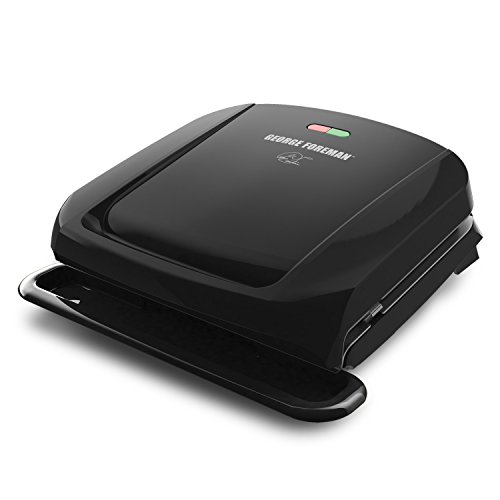
The George Foreman 4-serving grill is the longest-running design in this guide, and it stays here because its formula still works: two heated plates, a sloped surface that drains fat, and removable plates that go straight in the dishwasher. The verified details list a 60-square-inch surface that serves four, a nonstick coating the maker describes as three times more durable, and heating elements that preheat 35 percent faster than the previous design. For steak, the contact design has a clear character. Both sides cook at once, which is fast and forgiving for thinner steaks, burgers and chicken, and the slope keeps the cooking surface from sitting in rendered fat. The trade-off is control. A contact grill does not give the same crust-building freedom as an open broiler, because the top plate presses the steak and the cook cannot easily adjust one side at a time. There is also no temperature dial listed in the verified details, so doneness depends on timing and a thermometer. Those limits matter less for the audience this grill serves: cooks in small kitchens who want steak on the table quickly, with almost no cleanup and no learning curve. It is the simplest pick in the guide, and for many households that simplicity is the deciding factor.
Key specs
- 60-square-inch grilling surface, four servings
- Removable nonstick plates, dishwasher-safe
- Heating elements preheat 35 percent faster than the previous design
- Grease-reducing sloped design with drip channel
- Advanced nonstick coating, three times more durable by the maker claim
Strengths
- Removable plates make this the easiest grill here to clean
- Sloped surface drains fat away from the steak as it cooks
- Compact 60-square-inch size stores easily in a small kitchen
Trade-offs
- Contact grilling cooks both sides at once, which gives less control over crust development
- No temperature dial is listed in the verified details
- Four servings is the practical limit for a single batch
Who it fits: Small kitchens and first-time grill owners who want a simple, proven contact grill for everyday steaks and burgers.
Best for: everyday indoor grilling in small kitchens with fast cleanup
Not suited for: cooks who want precise temperature control or a hard open-flame style sear
Check price on Amazon: George Foreman 4-Serving Indoor Grill

Ninja Foodi 5-in-1 XL Indoor Grill and Air Fryer AG301
The Ninja Foodi AG301 closes this guide as the most capable all-rounder. The verified details list five functions in one base, a 500-degree cyclonic grilling system that circulates superhot air around the food while the grill grate brands char marks onto it, and a 10 by 10 inch grate with a 4-quart crisper basket and a 6-quart cooking pot. For steak, the cyclonic system is the feature that matters: heat reaches every side of the cut at once, which helps the crust develop evenly instead of only where the steak touches the grate. The maker states it can take a frozen steak to char-grilled in under 25 minutes, which solves the most common steak-night problem, a steak still frozen at dinner time. The air fryer function handles sides in the same session, and the roast and bake functions cover the rest of the meal. Cleanup is handled by ceramic-coated, dishwasher-safe parts. The trade-offs are footprint and focus. The AG301 is a substantial countertop appliance, and cooks who only ever grill steak may not need the air frying and dehydrating functions. But for a household that wants one machine to carry weeknight cooking, it is the most complete pick here, and its grill is strong enough to stand next to the dedicated broilers above.
Key specs
- 5 functions: grill, air fry, roast, bake and dehydrate
- 500-degree cyclonic grilling technology with surround searing
- 10 by 10 inch char-grill grate, 4-quart crisper basket, 6-quart cooking pot
- Cooks frozen steaks to char-grilled in under 25 minutes
- Ceramic-coated grate, basket and pot are nonstick and dishwasher-safe
Strengths
- Five appliances in one footprint, led by a strong indoor grill
- Cyclonic hot air sears all sides of the steak at once
- Handles frozen steaks without thawing, which suits unplanned dinners
Trade-offs
- The grill grate is 10 by 10 inches, so very large steaks need care with placement
- Multi-function design costs more counter space than a single-purpose grill
- Air frying and dehydrating add features some steak cooks will never use
Who it fits: Households that want one countertop appliance to grill steaks, air fry sides and roast, and that cook frozen steaks more often than they plan to.
Best for: all-in-one countertop cooking with a strong grill at the center
Not suited for: cooks who want a dedicated broiler or a purely outdoor grill
Check price on Amazon: Ninja Foodi 5-in-1 XL Indoor Grill and Air Fryer AG301
Buying guide: how to choose a steak cooker
Indoor or outdoor first
This is the decision that eliminates half the list. Indoor cookers suit apartments, winter cooking and anyone who grills more than twice a week without wanting to go outside. Outdoor cookers suit houses with patios, camping and tailgating, and they reach higher heat because they do not have to manage indoor smoke. Choose the location before the features, because a great outdoor grill is useless to a cook who will only ever use it in January.
Heat ceiling and heat control
Look for two numbers: the maximum temperature and how it is controlled. A broiler-style cooker that reaches 1500 degrees sears fast and hard, while a 450 to 500 degree grill sears well with more margin for error. Adjustable racks and temperature dials matter more than raw maximum heat for thick steaks, because the same cooker has to sear a thin sirloin quickly and bring a thick ribeye to temperature without burning the outside.
Size and batch cooking
Match the cooking surface to the number of steaks you cook at once. A 60-square-inch grill serves two people comfortably and four at a push. A 14-inch plate or a 10 by 10 inch grate handles a family batch. Cooking in two batches is not a failure, but the second batch always waits while the first rests, so size is worth getting right the first time.
Smoke, grease and cleanup
Smoke management decides whether an indoor cooker gets used or shelved. Lids with mesh or viewing windows, drip trays, grease channels and sloped plates all help. Removable, dishwasher-safe plates and trays matter just as much, because a grill that takes twenty minutes to clean after a ten-minute cook will not survive a busy week.
Warranty and build quality
Check what the body is made of and what is covered. Stainless steel bodies resist rust and wipe clean, while coated plates need care to avoid chips and scratches. Removable plates and dishwasher-safe parts are worth more than a longer feature list, because they decide whether the cooker survives daily use. A grill grate or plate that cannot be removed will accumulate grease in corners that no brush reaches, and a cooker with a short warranty and thin materials will show its age within a year.
How to use and care for your steak cooker
Start with a dry steak. Pat the surface dry with paper towels before it meets the heat, because moisture is the enemy of a crust. Season simply at first, let the cooker reach full temperature before the steak goes on, and use a thermometer rather than the clock to judge doneness, since thickness varies more than any timer accounts for. Rest the steak for a few minutes after cooking so the juices settle. For care, let the plates or grate cool enough to handle, then remove and wash the dishwasher-safe parts and wipe the body with a damp cloth. Empty the drip tray after every session rather than letting fat sit, and check the manual for whether the heating element can be wiped or only brushed. Stored clean and dry, any of these cookers will last far longer than one left greasy between uses.
Common mistakes to avoid
The most common mistake is cooking a wet, cold steak on a cooker that has not finished preheating, which produces a grey, steamed surface instead of a crust. The second is crowding the surface, which drops the temperature and turns searing into steaming. The third is skipping the thermometer and cutting into the steak to check, which loses juices and tells you less than a quick temperature reading. The fourth is choosing by maximum temperature alone: a cooker that hits extreme heat but has no rack adjustment or temperature control is harder to live with than a slightly cooler one that lets you manage the cook. Finally, do not ignore smoke. If an indoor cooker smokes heavily, the cause is usually excess fat on the surface or a dirty drip tray, and both are fixable before the next cook.
Getting the crust right
A good crust comes from three things: a dry surface, full heat and patience. Pat the steak dry with paper towels before it meets the heat, because water on the surface turns to steam and steaming is the opposite of searing. Let the cooker reach its full temperature before the steak goes on, and give the steak time on the first side before moving it. A steak that is moved too early tears and loses the crust that was forming, while one left alone builds a deep brown surface.
Oil the steak, not the cooker, and use only a thin layer of an oil that handles high heat. Too much oil smokes and splatters, and too little leaves the surface dry and patchy. Season simply at first: salt and pepper are enough to learn how a new cooker behaves, and marinades with sugar burn quickly at searing temperatures, so save them for lower-heat cooking. A thermometer is the tool that turns a good crust into a good steak, because it tells you the inside temperature without cutting the meat open and losing juices.
Thickness changes everything. A thin steak cooks in minutes and needs the highest heat and the least handling, while a thick steak benefits from a sear followed by a gentler finish, either by moving it to a lower rack or by closing the lid and letting the heat soak through. Let the steak come toward room temperature before cooking, keep the lid closed when the recipe calls for it, and rest the steak before slicing. Master those habits and any cooker in this guide will produce a better steak than a more expensive cooker handled carelessly.
Steak cuts: which cut suits which cooker
Not every steak wants the same cooker. A thin sirloin or a flank steak cooks in minutes and suits any of the indoor grills here, because the heat reaches the center quickly and the crust forms fast. A thick ribeye or a strip steak benefits from the broiler-style cookers, because the intense top-down heat builds a crust while the inside comes up slowly, and the adjustable rack lets the cook control the distance. A filet mignon is lean and tender, so it wants high heat and a short cook, with a thermometer to catch the exact moment it reaches doneness.
Tougher cuts such as chuck steak or skirt steak need a different approach. Skirt steak cooks fast and hot and should be sliced thinly against the grain, while chuck steak benefits from a longer, gentler cook that the grill-and-air-fryer combination handles well. Frozen steaks suit the Ninja Foodi best, since it is built to cook them without thawing, while the other cookers give better results with a thawed steak that has come toward room temperature.
Thickness is the number that matters most. Measure the steak before choosing the setting: a steak under an inch thick needs high heat and minutes, a steak over an inch thick needs a sear followed by a gentler finish, and a steak over two inches thick needs the most patience of all. Rest every steak after cooking, longer for thicker cuts, and slice against the grain for the tenderest bite. Match the cut to the cooker, and the cooker will reward the choice.
Fat content matters too. A well-marbled ribeye renders fat as it cooks, which adds flavor and helps the crust, but it also produces more smoke, so the lid and the drip tray matter. A lean filet produces less smoke but dries out faster, so it needs a shorter cook and a careful thermometer check. A strip steak sits between the two, with a fat cap that crisps beautifully when it meets high heat. Learn the cut, learn the cooker, and the results will follow.
Our recommendation
For most home cooks, the Ninja Sizzle GR101 is the pick to buy first: it is large enough for a family, controls smoke well, and handles far more than steak. Cooks who want the hardest sear possible indoors should choose the BIG HORN electric broiler, which is the closest thing to a steakhouse salamander in this guide. Outdoor cooks should take the BIG HORN OUTDOORS infrared grill for its speed and portability. The Hamilton Beach and George Foreman grills suit smaller households and tighter budgets of space, and the Ninja Foodi AG301 suits anyone who wants one appliance to carry the whole weeknight meal. Whichever you choose, dry the steak, preheat fully, and check doneness with a thermometer, and the cooker will do the rest.
Buy the cooker that matches the way you actually cook, not the one with the highest temperature on the box. A household that grills steak twice a week indoors will use the Ninja Sizzle more than a broiler that only comes out for special occasions, while a household that grills outside all summer will get more from the infrared grill. Size, smoke control and cleanup decide whether a cooker becomes a habit, and a habit is worth more than a specification.
Frequently asked questions
What temperature should a steak cooker reach?
For a hard sear, look for at least 450 degrees, and higher is better for thick cuts. Broiler-style cookers in this guide reach far higher, while indoor grill plates top out around 500 degrees and still sear well when fully preheated.
Can I cook a frozen steak in a steak cooker?
Yes, and the Ninja Foodi AG301 is built for exactly that, with the maker stating frozen steaks reach char-grilled in under 25 minutes. For other cookers, thawing first gives a more even result, and a thermometer matters more than the clock.
Do indoor steak cookers make a lot of smoke?
They make less than an open pan, but fatty cuts will always produce some smoke. Lids, drip trays and grease channels help, and patting the steak dry and keeping the drip tray clean reduce smoke further. Ventilation still helps on the fattiest cuts.
Is a steak cooker the same as an indoor grill?
They overlap. A steak cooker is any appliance built to cook steak with direct high heat, and many indoor grills qualify. The difference is emphasis: steak cookers prioritize searing heat and crust, while general indoor grills prioritize versatility across many foods.
How do I clean a steak cooker?
Let it cool, remove the plates, grate or drip tray, and wash the dishwasher-safe parts. Wipe the body and the heating area with a damp cloth once cool. Empty the drip tray after every session so old fat does not smoke into the next cook.
Should I rest a steak after cooking it?
Yes. Rest the steak for a few minutes before cutting, and longer for thicker cuts. Resting lets the juices redistribute instead of running out onto the board, and the internal temperature evens out. Cover the steak loosely with foil while it rests and use the time to finish the sides.
What is the best steak cut for a beginner?
A strip steak or a sirloin is the best place to start. Both are forgiving, widely available and easy to judge with a thermometer, and they reward a good sear without demanding perfect timing. Save the thick ribeye and the filet for once the cooker is familiar.


