Disclosure: airfryerkitchensupply.com is reader-supported. When you buy through links on our site, we may earn an affiliate commission at no extra cost to you.
Where to buy
All six towels below are sold on Amazon, and every link goes to the exact listing verified cache before writing. Two vocabulary points before you shop, because listings blur them on purpose: organic and GOTS describe how cotton was grown and certified as organic, while OEKO-TEX describes testing of the finished product for harmful substances — a towel can carry either, both, or neither, and this guide records each pick’s wording exactly as its listing states it.
- Burt’s Bees Baby Infant Hooded Towels, 2-Pack — Best Overall: check price on Amazon
- Natemia Organic Cotton Hooded Baby Bath Towel — Best for Long Use: check price on Amazon
- KeaBabies Hooded Baby Towel (Duck) — Best Silky Hand-Feel: check price on Amazon
- HIPHOP PANDA Ultra Soft Hooded Baby Towel — Best Thick Absorbency: check price on Amazon
- mushie Baby Hooded Towel (Tradewinds) — Best Minimalist Design: check price on Amazon
- SWEET DOLPHIN Muslin Hooded Baby Bath Towels, 2-Pack — Best Lightweight and Quick-Drying: check price on Amazon
Choosing the best soft hooded towels for baby sounds simple until the listings start stacking soft-sounding words — organic, bamboo, muslin, OEKO-TEX, GOTS — as if they were interchangeable. They are not, and the differences decide what you are actually buying. A hooded towel’s real job is modest and physical: wrap a wet baby completely, absorb water quickly so bath time ends warm instead of chilly, feel gentle against newborn skin, and survive very frequent washing without turning scratchy. Softness in that job comes from fiber and weave — long-staple cotton terry, bamboo-derived viscose blends, or airy muslin — not from certification logos, which speak to sourcing and safety testing rather than hand-feel.
Every pick below was matched by brand and model to its Amazon title before earning a link, and the spec boxes repeat only confirmed wording: sizes where the listing states them, GSM where the listing states it, fiber where the listing states it. Where a listing says organic cotton, this guide says organic cotton; where a different towel in the wider market claims OEKO-TEX testing, that is a different claim about a different thing, and the buying guide below explains how to keep the two straight when you compare beyond this shortlist.
One more framing note: a hooded towel is an ordinary bath product. This guide makes no medical or health claims for any pick — softness, absorbency, size and washability are the criteria, and they are enough to choose well. Size turns out to matter more than most first-time buyers expect: a towel that fits a newborn perfectly can be outgrown before the first birthday, so several picks below were chosen specifically because their confirmed sizes keep working into toddlerhood.
Key Takeaways
- Organic/GOTS and OEKO-TEX are different claims — sourcing certification versus finished-product substance testing — and this guide never swaps one for the other.
- Size decides lifespan: confirmed 35-inch-class towels keep wrapping a child long after small newborn squares are outgrown.
- Fiber drives softness: cotton terry for plush absorbency, bamboo-derived viscose for a silky hand-feel, muslin for lightweight, quick-drying softness.
- No health claims are made for any pick — these are bath towels, judged on softness, absorbency, size and washing.
In this guide
Quick Picks
Burt’s Bees Baby Infant Hooded Towels, 2-Pack — Best Overall. Confirmed 100% organic cotton knit terry in a practical 2-pack, sized for the newborn and infant months. Check the current price on Amazon.
Natemia Organic Cotton Hooded Baby Bath Towel — Best for Long Use. A 35-inch, 450 GSM organic cotton towel — the largest and most explicitly specified pick in the roundup. Check the current price on Amazon.
KeaBabies Hooded Baby Towel (Duck) — Best Silky Hand-Feel. A full-size 35-inch towel in bamboo-derived viscose, for parents who prefer silky-smooth over terry-plush. Check the current price on Amazon.
HIPHOP PANDA Ultra Soft Hooded Baby Towel — Best Thick Absorbency. The thickest confirmed towel here at 500 GSM and two layers, in rayon made from bamboo. Check the current price on Amazon.
mushie Baby Hooded Towel (Tradewinds) — Best Minimalist Design. Confirmed organic cotton in mushie’s calm, minimal Tradewinds design — the giftable, design-led pick. Check the current price on Amazon.
SWEET DOLPHIN Muslin Hooded Baby Bath Towels, 2-Pack — Best Lightweight and Quick-Drying. A 32-inch muslin 2-pack — lightweight, quick-drying softness for travel, warm climates and fast laundry turns. Check the current price on Amazon.
How These Picks Were Chosen
Candidates came from Amazon listing data cache for baby hooded towels, matched by brand and model to Amazon titles. Only complete towels were eligible — a bathtub bundle that merely includes a towel was excluded, as were oversized kids’ beach ponchos aimed at much older children. Duplicate variants of the same towel — the same product listed again in another color or pack shot — were counted once; the cache contained a second listing variant of the Burt’s Bees Baby towel, and only one appears here.
Certification wording was recorded verbatim. A pick described by its listing as organic cotton is presented as organic cotton; GOTS wording is used only where a listing states it; and no pick in this roundup is described as OEKO-TEX certified, because none of the six verified listings states that claim — the guide explains the term so you can evaluate other towels, without borrowing the label for these. GSM and dimensions are claimed only where the listing states them.
The 6 Best Soft Hooded Towels for Baby

Burt’s Bees Baby Infant Hooded Towels, 2-Pack — Best Overall
The Burt’s Bees Baby 2-pack leads this roundup because it states its case in confirmed facts: 100% organic cotton, a knit terry weave, a 29-by-29-inch size, and two towels in the pack. Knit terry is the softness most parents mean when they say soft — looped pile that feels plush against skin and pulls water off quickly, which is what ends bath time warmly. The organic claim is a sourcing claim, recorded here exactly as the listing makes it; this guide adds no GOTS or OEKO-TEX language to it, because the listing does not.
Strengths
- Listing confirms 100% organic cotton — a sourcing claim stated plainly, with no borrowed certifications added here.
- Knit terry is the plush, absorbent weave most parents picture for a first baby towel.
- A 2-pack matches real life: one in the wash, one at the tub.
Trade-offs
- 29-inch square is a newborn-and-infants size; tall toddlers will outgrow its wrap sooner than the 35-inch picks.
- Organic cotton terry is heavier to launder than muslin and dries slower.
- No GSM is stated in the listing, so this guide makes no weight claim for it.
| Pack | 2-pack (confirmed in listing) |
| Fiber | 100% organic cotton knit terry (confirmed in listing) |
| Size | 29 x 29 in (confirmed in listing) |
| Audience | Infant / unisex (confirmed in listing) |
The size is the honest trade-off. Twenty-nine inches wraps a newborn generously and an older infant adequately, but a long toddler will kick out of its coverage sooner than out of the 35-inch-class picks below. That is precisely why the 2-pack format matters: for the newborn months, when towels cycle through the wash constantly, two correctly sized towels beat one oversized one. Buy this as the newborn workhorse, and expect to add a larger towel later rather than pretending one size serves every year.
Best for: newborns and infants, and parents who want confirmed organic cotton in a practical 2-pack / Not suited for: buyers who want one towel to last well into the toddler years
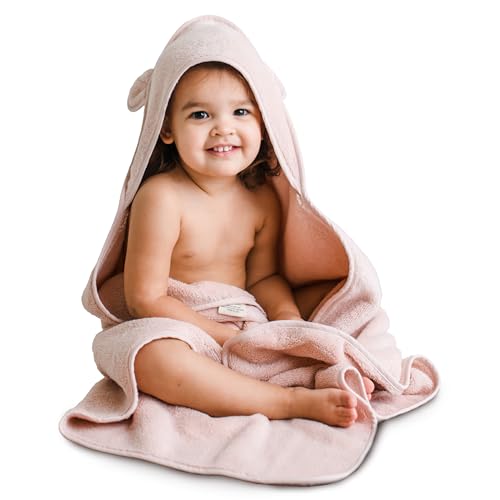
Natemia Organic Cotton Hooded Baby Bath Towel — Best for Long Use
The Natemia towel is the buy-it-once pick: 35 by 35 inches of 100% organic cotton at a confirmed 450 GSM, with a listing that names newborns and toddlers together. GSM — grams per square meter — is the rare towel spec that actually predicts feel, and 450 sits in the plush, absorbent band: enough pile to dry a baby in a couple of pats, without the bath-sheet heaviness that makes a towel awkward to handle one-handed while holding a wet infant. The size then does the longevity work, wrapping a toddler who would be escaping a 29-inch square.
Strengths
- The largest confirmed size here — 35 inches square keeps wrapping into toddlerhood.
- 450 GSM is confirmed, the only explicit fabric weight in this roundup, and it signals a plush, absorbent towel.
- Listing spans newborns and toddlers, matching the size story.
Trade-offs
- A heavier 450 GSM towel takes longer to dry between washes than muslin or lighter terry.
- Single-towel purchase — no pack value for wash rotation.
- Plush weight can feel bulky on the smallest newborns in the first weeks.
| Size | 35 x 35 in (confirmed in listing) |
| Fiber | 100% organic cotton (confirmed in listing) |
| Weight | 450 GSM fabric (confirmed in listing) |
| Audience | Newborns and toddlers (confirmed in listing) |
The costs are drying time and singularity. A 450 GSM cotton towel holds more water after the wash and dries slower on the rack — in a humid bathroom or a small laundry routine, that matters — and it is sold singly, so rotation means buying two or pairing it with a lighter backup. Its organic claim, like the Burt’s Bees pick, is recorded as the listing states it: organic cotton, full stop, with no additional certification language layered on top by this guide.
Best for: parents who want one confirmed-organic towel to serve from newborn through toddler / Not suited for: parents who prefer featherweight, fast-drying towels

KeaBabies Hooded Baby Towel (Duck) — Best Silky Hand-Feel
The KeaBabies Duck towel represents the second great softness route: viscose derived from bamboo, stated plainly in its listing, woven into a large 35-by-35-inch hooded towel. Bamboo-derived viscose feels different from cotton terry — smoother and silkier against skin, with strong absorbency — and many parents prefer exactly that glide for a newborn’s first baths. The duck hood is not a gimmick either: the hood is what keeps a wet baby’s head covered and warm during the carry from tub to changing mat, and a character hood is the part toddlers later ask for by name.
Strengths
- Bamboo-derived viscose is confirmed — the fiber behind this towel’s notably silky, smooth hand-feel.
- Full 35-inch size matches the Natemia for longevity.
- Large hooded format suits the post-bath wrap-and-carry routine for wriggly toddlers.
Trade-offs
- Viscose from bamboo is a processed fiber — this guide does not call it organic, and neither does the listing.
- Silky weaves can feel less plush-grippy than terry when a baby is very wet and slippery.
- Character hood designs date faster than plain towels if you are buying for a future sibling too.
| Size | 35 x 35 in (confirmed in listing) |
| Fiber | Viscose derived from bamboo (confirmed in listing) |
| Design | Duck hood (confirmed in listing) |
| Audience | Newborn through toddler (confirmed in listing) |
Precision matters with this fiber’s marketing. Viscose derived from bamboo is a manufactured fiber made from bamboo pulp; it is not the same claim as organic cotton, and this guide does not upgrade it into one. Judge this towel on its confirmed merits — fiber, size, absorbency positioning — and it stands up well: a full-size, silky-soft wrap for families whose softness preference runs smooth rather than plush.
Best for: parents who prioritize a smooth, silky softness and a full-size wrap / Not suited for: buyers specifically seeking certified organic cotton

HIPHOP PANDA Ultra Soft Hooded Baby Towel — Best Thick Absorbency
The HIPHOP PANDA towel is the thickness champion: a confirmed 500 GSM, two-layer construction in rayon made from bamboo, at 30 by 30 inches with a bear hood. If the Natemia’s 450 GSM is plush, 500 GSM is the next step into bath-sheet territory scaled for a baby — the kind of towel that dries a soaked toddler with pressing rather than rubbing, which is both faster and gentler-feeling. The two-layer wording matters because it explains the absorbency structurally instead of asking you to trust an adjective.
Strengths
- 500 GSM is the highest confirmed fabric weight here — a genuinely thick, absorbent towel.
- Two-layer construction is confirmed, backing the absorbency claim with structure.
- Rayon from bamboo gives the smooth hand-feel bamboo-route parents want.
Trade-offs
- At 30 inches, it is outgrown sooner than the 35-inch picks despite its premium thickness.
- The thickest towel here is also the slowest to dry after washing.
- Registry positioning aside, thickness this high suits bath use, not travel bags.
| Weight | 500 GSM, 2-layer thick (confirmed in listing) |
| Fiber | Rayon made from bamboo (confirmed in listing) |
| Size | 30 x 30 in (confirmed in listing) |
| Design | Bear hood (confirmed in listing) |
Its trade-offs are the mirror of its strengths. Five hundred GSM of fabric holds a lot of water — the baby’s, and then the wash’s — so it dries slowest in this roundup, and its 30-inch span gives it a shorter service life than the 35-inch picks. As with the KeaBabies, the fiber claim is recorded exactly: rayon made from bamboo, a processed fiber, not an organic claim. Buy it as the home bath-time specialist and pair it with something lighter for travel and laundry gaps.
Best for: parents who want maximum thickness and absorbency for home bath time / Not suited for: travelers and small-laundry households who need fast drying

mushie Baby Hooded Towel (Tradewinds) — Best Minimalist Design
The mushie hooded towel is the design pick: organic cotton, confirmed in its listing, in the brand’s Tradewinds colorway — the muted, modern palette that made mushie a nursery staple. For many parents the towel lives visible on a hook in a small bathroom, gets photographed in first-bath pictures, and is bought as a gift as often as for oneself; a towel that looks calm while doing its job has real value in that life, and mushie’s organic cotton construction means the design is not a compromise on the fiber story.
Strengths
- Organic cotton confirmed, in a design-led line known for muted, nursery-friendly colors.
- A calm, minimal look that photographs and gifts well without character branding.
- Straightforward single-towel purchase for parents building a small, quality rotation.
Trade-offs
- The cache record states no size or GSM, so this guide claims neither — check the listing if dimensions decide your purchase.
- Minimalist premium positioning rather than pack value.
- Less surface detail in the record means fewer confirmed extras to compare.
| Fiber | Organic cotton (confirmed in listing) |
| Brand | mushie (confirmed in listing) |
| Design | Tradewinds colorway (confirmed in listing) |
| Format | Baby hooded towel (confirmed in listing) |
The sourcing record for this listing is thinner than for its rivals: no size and no GSM are stated in the cached Amazon title, so this guide claims neither, and if dimensions are your deciding factor you should read them at the listing before buying — the same honesty rule applied to every pick here. What is confirmed is enough to place it: organic cotton, a baby hooded format, and a design language distinct from every character-hood rival in this roundup.
Best for: parents who want confirmed organic cotton in a calm, minimal design / Not suited for: spec-driven buyers who want a published GSM and dimensions before buying

SWEET DOLPHIN Muslin Hooded Baby Bath Towels, 2-Pack — Best Lightweight and Quick-Drying
The SWEET DOLPHIN 2-pack closes the roundup with the third fiber route: 100% cotton muslin at 32 by 32 inches. Muslin’s softness is a different sensation — light, breathable, slightly crinkled, and famously softer with every wash — and its absorbency-per-gram is why muslin has been a baby fabric for generations. For warm climates, small bathrooms where towels dry slowly, travel bags, and grandparents’ houses, a muslin hooded towel that dries fast and packs small is not the budget compromise; it is the correct tool.
Strengths
- Muslin is the lightweight, quick-drying route — the opposite pole from the 500 GSM pick, and the right one for travel and humid bathrooms.
- 32-inch size outlasts the 29-inch newborn squares while staying light.
- A 2-pack at a practical size covers the wash rotation in one purchase.
Trade-offs
- Muslin feels thinner by design — parents expecting terry plush should choose terry.
- Lightweight fabric is less insulating for a long, cool carry after the bath; wrap and move promptly.
- The listing says 100% cotton — no organic claim is made here, and this guide adds none.
| Pack | 2-pack (confirmed in listing) |
| Fiber | 100% cotton muslin (confirmed in listing) |
| Size | 32 x 32 in (confirmed in listing) |
| Audience | Babies, infants and toddlers (confirmed in listing) |
Judge it by its own standard. Held against the HIPHOP PANDA’s 500 GSM, muslin feels thin — because it is, deliberately — and a parent whose definition of soft is plush terry should buy terry. But a towel that is dry and fresh for the next bath beats a thicker towel still damp from the last one, and the confirmed 32-inch size plus 2-pack format give this pick the most practical ownership story in the guide. Its fiber claim is recorded plainly: 100% cotton, with no organic wording in the listing and none added here.
Best for: traveling families, warm climates, and anyone whose towels must dry fast / Not suited for: parents who define softness strictly as thick terry plush
Comparison Table
The honest comparison axes are fiber route, confirmed size, and confirmed weight where a listing states it. Certifications are listed only where a listing states them — absence here means the listing did not claim it, not that the towel failed a test.
| Pick | Badge | Key spec | Best for |
|---|---|---|---|
| Burt’s Bees Baby Infant Hooded Towels, 2-Pack | Best Overall | 2-pack (confirmed in listing) | newborns and infants, and parents who want confirmed organic cotton in a practical 2-pack |
| Natemia Organic Cotton Hooded Baby Bath Towel | Best for Long Use | 35 x 35 in (confirmed in listing) | parents who want one confirmed-organic towel to serve from newborn through toddler |
| KeaBabies Hooded Baby Towel (Duck) | Best Silky Hand-Feel | 35 x 35 in (confirmed in listing) | parents who prioritize a smooth, silky softness and a full-size wrap |
| HIPHOP PANDA Ultra Soft Hooded Baby Towel | Best Thick Absorbency | 500 GSM, 2-layer thick (confirmed in listing) | parents who want maximum thickness and absorbency for home bath time |
| mushie Baby Hooded Towel (Tradewinds) | Best Minimalist Design | Organic cotton (confirmed in listing) | parents who want confirmed organic cotton in a calm, minimal design |
| SWEET DOLPHIN Muslin Hooded Baby Bath Towels, 2-Pack | Best Lightweight and Quick-Drying | 2-pack (confirmed in listing) | traveling families, warm climates, and anyone whose towels must dry fast |
Organic, GOTS and OEKO-TEX: Three Claims That Are Not Interchangeable
Listings stack these terms because shoppers treat them as one softness badge, but they certify different things. Organic describes how the cotton was grown and handled, and a listing that says organic cotton — as the Burt’s Bees Baby, Natemia and mushie picks here do — is making that sourcing claim. GOTS is a specific, named certification scheme for organic textiles with chain-of-custody requirements; a product either states it or it does not, and this guide uses the term only where a listing states it. OEKO-TEX, by contrast, is about the finished product: it describes testing for harmful substances in the textile as sold. It says nothing about whether the cotton was grown organically.
Why does the distinction matter at the shelf? Because a towel can be OEKO-TEX tested without a gram of organic cotton in it, and an organic cotton towel may never have been submitted for OEKO-TEX testing — neither fact makes the other claim false or transferable. When you compare towels beyond this shortlist, read each label as its own sentence: what fiber, what sourcing claim, what testing claim. This guide applies that rule to its own picks strictly, which is why you will not find an OEKO-TEX claim attached to any of the six: none of their verified listings states one.
None of this is a health claim in either direction. Certifications describe sourcing and testing processes; softness, absorbency and durability — the things a towel does at bath time — come from fiber and weave, which is where this guide spends its attention.
Choosing Fiber and Size for Your Real Bath Routine
Fiber first. Cotton terry — the Burt’s Bees Baby and Natemia route — is plush, grippy and absorbent, and the default for a home tub. Bamboo-derived viscose and rayon — KeaBabies and HIPHOP PANDA — feel silkier and smoother, at similar absorbency, with a cooler hand-feel some babies prefer against the skin. Muslin — SWEET DOLPHIN — is the lightweight, breathable, fast-drying option that improves with washing and travels well. There is no universal winner; there is a winner per bathroom, climate and laundry setup.
Size second, because it decides how long the towel stays useful. A 29-inch square is a newborn towel; a 32-inch towel bridges into toddlerhood; the 35-inch picks here are the ones still wrapping a two-year-old. If you are buying before the birth, a rotation across sizes — a newborn 2-pack now, a 35-inch towel for later — matches how babies actually grow better than doubling down on one size. And whatever you choose, buy the rotation, not the single towel: bath towels for babies are washed constantly, and the second towel is the difference between a routine and a laundry emergency.
Budget Tiers Without the Marketing Fog
This guide prints no prices, but the tier structure is legible from construction. Muslin and standard terry 2-packs occupy the practical tier and compete on size and pack count. Organic cotton and high-GSM towels sit a tier up, charging for sourcing and fabric weight — both confirmed, checkable things. Design-led organic picks charge additionally for the design itself. What no tier legitimately charges for is a stack of certification words: read each claim as its own fact, as the guide above explains, and pay only for the ones a listing actually states.
How to Use and Care for a Hooded Baby Towel
The hood is a tool, not a decoration: used in the right order, it is what turns a wet, slippery lift out of the tub into a calm, warm wrap.
- Lay the towel out flat on the changing surface before the bath ends, hood at the top, so the wrap is ready the moment the baby comes out.
- Lift the baby out and lay them on the towel with their head in the hood first — covering the head first is what stops the post-bath chill and the crying that comes with it.
- Fold one side across the body, then the other, tucking gently; the wrap should be snug enough to stay, loose enough for a hand to slip in.
- Pat dry rather than rubbing — patting is faster with terry and muslin alike and feels gentler on newborn skin.
- Hang the towel fully open after use, hood spread, so air reaches the pile or muslin weave; a bunched towel dries slowly and smells stale fast.
- Wash on a regular rhythm with your baby laundry, skip fabric softener on absorbent towels — it coats fibers and reduces absorbency — and dry fully before folding away.
Inspect the hood seam and edges monthly. The hood takes the lifting strain of the whole wrap, and catching a loosening seam early is the difference between a towel that lasts through toddlerhood and one retired mid-year.
Common Buying Mistakes
Treating certification words as softness ratings. Organic, GOTS and OEKO-TEX describe sourcing and testing. Softness comes from fiber and weave — terry, bamboo-derived viscose, muslin — so choose the claim for what it says and the fiber for how it feels.
Buying only newborn size. A 29-inch towel is outgrown quickly. Mix sizes, or start with a 35-inch pick, unless you deliberately want the snug newborn fit for the first months only.
Using fabric softener on every wash. Softener coats towel fibers and steadily reduces absorbency — the towel feels slick and dries the baby worse. Plain washing keeps terry and muslin performing.
Owning exactly one towel. Babies generate laundry daily. A 2-pack or a two-towel rotation is not upselling; it is the minimum viable system for nightly baths.
Judging thickness as quality in all cases. A 500 GSM towel is a wonderful home tool and a poor travel one. Match weight to your drying space and routine instead of defaulting to the thickest option.
The First Year in Towels: A Rotation That Grows With the Baby
A workable towel system for the first year is smaller than marketing suggests and more size-aware. For the newborn months, the load is frequency: nightly baths, the occasional second bath after a major incident, and laundry that never quite catches up. Two towels in the newborn size — the Burt’s Bees Baby 2-pack is built exactly for this — cover the rhythm, with the second towel’s existence mattering more than any fiber debate. Add the household’s existing hand towels for the changing-mat layer and the system is complete for the first season.
Around the middle of the first year the constraint flips from frequency to coverage. The baby who was swaddled by a 29-inch square now kicks out of it, sits up dripping, and treats the wrap as a game. This is the moment the 32- and 35-inch picks earn their place — the SWEET DOLPHIN pair as the light, fast-drying bridge, the KeaBabies and Natemia as the full-size wraps that will serve through toddlerhood. Buying one large towel at this stage, rather than another newborn set, is the single most common upgrade this guide recommends to parents building their system in stages.
By toddlerhood the towel has a second job: it is part of the bath’s theater. Hoods with ears and characters — the bear on the HIPHOP PANDA, the duck on the KeaBabies — become the cue that bath time is ending happily, and a toddler who asks for their towel is a toddler leaving the tub voluntarily. The muslin and terry veterans of the rotation still do the weekday work. A system that began as two newborn squares ends as a mixed drawer — plush for home, muslin for travel, one beloved hooded character for morale — and every stage of it was a deliberate size and fiber choice rather than an accumulation.
Washing Baby Towels Without Wrecking Them
Baby towels live a harder laundry life than almost any household textile: daily or near-daily washing, constant damp storage temptation, and a performance requirement — absorbency — that common laundry habits actively destroy. The first rule is the softener rule, repeated in this guide’s mistakes because it is the most violated: fabric softener and dryer sheets coat fibers with a residue that repels water. A towel treated that way feels slick-soft in the hand and performs worse on the baby with every cycle. If a towel has already been softened into uselessness, a plain hot wash or two usually strips enough residue to restore it.
The second rule is dryness between uses. A hooded towel hung bunched on a hook dries at half speed and sours at the fold; hung open, hood spread, it dries fully and stays fresh. In humid bathrooms, the muslin picks have a structural advantage — thin fabric simply dries before mildew gets a vote — while the high-GSM terry picks reward a heated rail or a sunnier hanging spot. None of this is fastidiousness; a towel that smells stale gets replaced, and replacement is the expensive outcome that two hanging habits prevent.
Finally, wash temperature and company: baby towels wash happily with the household’s other towels and baby laundry at ordinary warm settings, and they do not need specialty detergents to perform — fiber and weave do the work, and the guide’s certification discussion exists precisely so that sourcing and testing claims are understood as their own facts rather than as laundry instructions. Keep the routine plain, keep the towels dry, keep softener away from them, and every pick in this roundup will outlast the size it was bought for.
Gifts, Registries and the Towel Nobody Regrets Giving
Hooded towels occupy a special place in baby gifting: they are useful from the first week, sized forgivingly, free of the sizing roulette that makes baby clothes a gamble, and — in the character-hood designs — genuinely delightful to unwrap. The registry logic follows from this guide’s rotation analysis. A single exquisite towel photographs beautifully and fails practically by the third bath; a system of two or three, across sizes or fibers, is the gift that gets used nightly for years. Givers who understand the system buy the 2-pack for the newborn stage or the 35-inch towel for longevity, and the mushie pick exists in this roundup partly because design-led gifting is a real and legitimate use.
For parents registering, the strategic move is to register across the timeline rather than within it: one newborn set for the high-frequency months, one full-size towel for the growth ahead, and — if the household travels or hosts grandparents — one muslin pair that can live in the travel bag or the grandparents’ bathroom. That spread costs little more than doubling down on a single stage and prevents the two classic regrets: a drawer of outgrown newborn towels, and a toddler still being wrapped in a square meant for a newborn.
A word on personalization and characters, since registries invite both: a name embroidered on a hood is lovely and permanent, and a character hood is a toddler’s joy and an infant’s irrelevance. Buy the character for the child who will ask for it by name at age two — the bear and the duck in this guide are placed with that future in mind — and buy plain, fiber-led quality for the newborn stage, where performance is the whole story. The towel nobody regrets is the one still in service when the baby it was bought for is running the bath-time negotiations.
A Note on Colors, Characters and Photographs
It may seem frivolous to end a specifications-led guide with aesthetics, but a baby towel is among the most photographed objects of the first year — first baths, monthly milestones, the hooded portrait every family takes — and its look is part of its service. The roundup spans the honest range: mushie’s muted Tradewinds minimalism, designed to sit calmly in a modern nursery and a photograph alike; the character hoods of the KeaBabies duck and the HIPHOP PANDA bear, which trade timelessness for a toddler’s delight; and the plain, fiber-first presentations of the Burt’s Bees Baby, Natemia and SWEET DOLPHIN picks, which let the baby be the picture’s subject. None of these is the correct taste; each is a correct answer for a different family’s album.
The practical advice is to buy the photograph you want at the stage you will take it. Newborn portraits favor the calm and the plain — the baby is small, the towel is half the frame, and a muted organic wrap flatters both. Toddler bath pictures favor the character hood, because by then the towel is a costume and the grin is the point. A rotation that contains one of each, as this guide’s system section describes, is not indecision; it is stage-matched buying, and it is why this roundup refused to crown a single aesthetic winner among six towels whose fibers it could compare but whose looks belong to you.
What Grandparents and Second Homes Should Stock
A towel system has a shadow system: the grandparents’ house, the family cabin, the second home where baths also happen. The shadow system’s rule is simplification — one or two towels, chosen for the broadest age span and the easiest laundry, because a towel that lives elsewhere will be washed by other hands on another rhythm. The 35-inch picks are the natural stock here: a Natemia or KeaBabies at the grandparents’ covers the grandchild from newborn visits through toddler stays without a size upgrade, and a muslin pair travels between houses without ever being missed at home. What the shadow system should not be is the cast-off — the thinnest, oldest towel retired from the main rotation — because the bath away from home is exactly the bath where everything else is already unfamiliar.
There is a sentimental dividend to stocking the second home properly, and this guide will permit itself one: the hooded towel a child associates with a grandparents’ bathroom becomes part of that house’s memory, requested by name years after it was strictly needed. Buy the shadow system once, buy it at full size, and let it serve the whole childhood of visits. It is the smallest line in the baby budget and, per bath, possibly the hardest-working.
Final Recommendation
For most newborns, start with the Burt’s Bees Baby 2-pack: confirmed organic cotton terry, the right newborn size, and a wash rotation in one purchase. If you would rather buy once for years, the Natemia’s confirmed 35-inch, 450 GSM organic build is the longevity pick. Silky-softness households should take the KeaBabies or the thick HIPHOP PANDA, design-led nurseries the mushie, and travel or fast-drying routines the SWEET DOLPHIN muslin pair.
Whichever route you take, read the labels the way this guide does — fiber for feel, size for lifespan, and each certification word as its own separate fact — and the towel you buy will be the towel you meant to buy.
If you are deciding today, the shortlist to check first is: Burt’s Bees Baby Infant Hooded Towels, 2-Pack, Natemia Organic Cotton Hooded Baby Bath Towel, KeaBabies Hooded Baby Towel (Duck). Each link goes to the verified listing discussed above, where you can confirm the current details before buying.
Keep exploring related guides: Best Baby Washcloths And Hooded Towels Best Hooded Towels For Babies Best Hooded Towels For Baby Best Kids Hooded Towels Best Bath Towels For Infants
Frequently Asked Questions
What size hooded towel does a newborn need?
A 29-inch square wraps a newborn generously. The trade-off is time: babies outgrow that wrap within the first year or so. Towels at 32 to 35 inches, like several picks here, start slightly roomy and keep working into toddlerhood, which is why size is the first spec this guide checks in a listing.
Is OEKO-TEX the same as organic?
No. Organic describes how the cotton was grown and sourced. OEKO-TEX describes testing of the finished product for harmful substances. A towel can carry either claim, both, or neither — read them as separate facts, and note that none of the six verified listings in this guide states an OEKO-TEX claim, so none is described that way here.
Which is softer: cotton terry, bamboo viscose or muslin?
They feel different rather than better. Terry is plush and grippy, bamboo-derived viscose is smooth and silky, and muslin is light and breathable and softens with washing. Babies show preferences; parents usually discover theirs within the first few baths, which is one reason mixed-fiber rotations are popular.
What does GSM mean on a baby towel?
Grams per square meter — the fabric’s weight, and a useful proxy for thickness and absorbency. In this roundup the confirmed figures are 450 GSM for the Natemia and 500 GSM for the HIPHOP PANDA. Higher GSM means a plusher, slower-drying towel; lower or unstated weights suit faster laundry turns.
How many hooded towels should I own?
Two is the working minimum — one in use, one in the wash — which is why 2-packs feature in this guide. Families bathing nightly or managing reflux-heavy months often run three or four. A size mix across the rotation extends the system’s useful life as the baby grows.
How do I keep baby towels absorbent?
Wash regularly, dry fully, and skip fabric softener, which coats fibers and reduces absorbency over time. Hang the towel fully open between uses — hood spread — so the weave dries completely; a towel stored damp loses freshness faster than any fiber choice can compensate for.


