Disclosure: airfryerkitchensupply.com is reader-supported. When you buy through links on our site, we may earn an affiliate commission at no extra cost to you.
Where to buy
Every pick below for the best small measuring spoons is a verified, live Amazon listing matched to the exact set described. Measuring spoon sets vary in which sizes they include — some reach down to 1/16 teaspoon, others stop at 1/4 — so check the size list on the listing before ordering. Prices are small in this category but still change, so each pick links to the live listing instead of quoting a figure.
- Spring Chef Magnetic Measuring Spoons Set of 8 — the dual-sided system — eight magnetic spoons, each with a narrow end for spice jars and a round end for liquids, plus a leveler.
- U-Taste 18/8 Stainless Steel Measuring Spoons Set of 9 — the fraction specialist — nine sizes including 1/16, 1/8, 1/3, and 3/4 teaspoon, the in-between measures most sets skip.
- YUNNKEEY Stainless Steel Measuring Spoons Set of 14 with Leveler — the slim rectangular system — fourteen pieces with a leveler, in a flat profile designed to fit inside spice jars.
- THLHKD Narrow Measuring Spoons Set, 6 Pieces — the budget narrow specialist — six long, narrow stainless spoons shaped specifically to fit inside spice jars.
- Hudson Essentials Stainless Steel Measuring Spoons Set of 7 — the classic slim seven — a traditional round-bowl set slimmed down to fit spice jars, for dry and liquid alike.
- King Arthur Baking Company Spice Measuring Spoons, 7-Piece — the baker’s spice set — seven precision 18/8 steel spoons from a baking company that measures for a living.
The best small measuring spoons solve a problem standard sets quietly fail at: the standard spoon is too wide for the spice jar, too coarse for the 1/8-teaspoon of cayenne a recipe actually wants, and too bulky for the precision work of baking, coffee, and seasoning. Small measuring spoons — slim, narrow-profile sets, many of them designed to slide straight into a spice jar — are the specialist tools of the measuring drawer. The six verified picks below are all genuinely small-format sets: narrow heads, slim handles, and size ranges that reach into the fractions where flavor is decided.
Why does narrow matter so much? A standard tablespoon spoon is wider than the mouth of most spice jars, which forces the daily ritual of pouring spice into a cap, onto a plate, or — worst — over the jar’s rim and onto the counter. A narrow spoon goes straight into the jar, levels against its rim, and comes out clean. The same slim profile makes these spoons better in small bowls, narrow extract bottles, and the tight geometry of an espresso basket or a baby food jar. Small is not a limitation here; it is the entire design brief.
Precision is the second brief. Baking chemistry lives in small numbers: 1/4 teaspoon of baking soda, 1/8 of salt, a 1/16 pinch-equivalent of a potent spice. Sets that include the in-between sizes — 1/8, 1/16, 3/4 teaspoon — measure those amounts honestly instead of asking you to eyeball half of a half. Every pick below was verified as a current listing with its size range checked, and the reviews are explicit about which sizes each set actually includes, because that list is the product.
In this guide
Quick Picks
Six verified slim and narrow sets — spice-jar-friendly profiles, fractional sizes down to 1/16 teaspoon, and levelers where they matter.
- Best Overall: Spring Chef Magnetic Measuring Spoons Set of 8 — two spoon shapes in every size and a leveler in the box — the most complete small-spoon system here.
- Best for Precision Sizes: U-Taste 18/8 Stainless Steel Measuring Spoons Set of 9 — the set for recipes that actually say 1/8 teaspoon — it measures what other sets make you guess.
- Best Slim Rectangular Set: YUNNKEEY Stainless Steel Measuring Spoons Set of 14 with Leveler — the most spoons in the roundup, in the slimmest profile — built for spice-jar work above all.
- Best Budget Narrow Set: THLHKD Narrow Measuring Spoons Set, 6 Pieces — the least expensive way to solve the spice-jar problem — six long narrow spoons that simply fit.
- Best Classic Slim Set: Hudson Essentials Stainless Steel Measuring Spoons Set of 7 — the familiar spoon shapes, on a spice-jar diet — the comfortable upgrade from a standard set.
- Best for Bakers: King Arthur Baking Company Spice Measuring Spoons, 7-Piece — from the people who test recipes professionally — precision measures sized for spice and baking work.
How These Picks Were Chosen
Every set here was cross-checked against Amazon’s live catalog: searched by brand and model, matched against the returned listing title, and recorded only on a certain match. In a category flooded with near-identical unbranded sets, that verification is what separates this guide’s picks from a pile of look-alikes — each set below is the specific product its listing describes, with the size range its title states. Catalog prices were used only for internal tier placement and never printed.
Picks had to be genuinely small-format: narrow or rectangular spoon heads that fit spice jars, slim handles, or a compact nesting design. Full-size standard sets were excluded even when excellent — they belong to a different guide. We also weighted engraved or stamped markings over printed ones, because printed sizes wash off within a year and an unmarked spoon set is a guessing set. Dual-ended designs and included levelers earned real credit: they double the size range or perfect the measurement without adding bulk.
Finally, material honesty: every pick here is stainless steel, because small spoons live hard lives in drawers and dishwashers, and steel is the material that keeps its shape and markings through them. The variation is in the sizes, the shapes, and the systems — which is exactly where a buyer in this category should be choosing.
Excluded from this roundup, by design: full-size standard spoon sets (a different tool for a different drawer problem), measuring cups (a different instrument entirely, however often they are bundled), plastic novelty sets whose markings and bowls would not survive a year of the life described above, and any set whose size list could not be verified from its own listing. That last exclusion removed more candidates than any other — this category’s listings are loose with their contents, and a set that will not say which sizes it contains is a set asking you to guess, which is the opposite of what measuring spoons are for. The six above state their sizes plainly and were verified against those statements.
The 6 Best Small Measuring Spoons

Spring Chef Magnetic Measuring Spoons Set of 8 — Best Overall
The Spring Chef set earns the top spot by refusing the category’s basic compromise. Every spoon is dual-sided: one end is a narrow oval shaped to slide into a spice jar, the other a round bowl that holds liquid without spilling it across a flat profile. That single design decision means one set does the work of two, and it is why this set, more than any other here, can be a household’s only measuring spoons. The included leveler — a straight edge for sweeping a spoon level in one motion — turns good-enough measuring into repeatable measuring, which bakers will feel in their results within a week.
The system details are equally considered. The spoons nest magnetically, arriving from the drawer as one flat, organized unit instead of a jangling bunch on a ring, and the stainless steel construction with clear size markings is built for the dishwasher life these tools actually live. The size range covers the everyday fractions a cook reaches for, and the dual ends effectively double the utility of every size in the set.
The costs are minor and real. Two working ends means both ends get dirty in a busy session, and the magnets that make storage tidy make separating a single spoon a two-handed moment. The black finish, while handsome, shows water spots that plain steel hides. None of it dents the verdict: this is the most complete, best-thought-out small measuring spoon set in the roundup, and the one to buy if you are buying once.
Strengths
- Dual-sided design solves both jobs — narrow ends enter spice jars, round ends hold liquids
- Magnetic nesting keeps the set together and flat in the drawer
- Leveler included for honest, repeatable dry measurements
Trade-offs
- Two ends per spoon means two ends to wash
- Magnetic nesting is strong — separating one spoon takes a deliberate tug
- Black finish shows water spots more than plain steel
| Set size | 8 dual-sided spoons |
| Design | Narrow end for jars, round end for liquids |
| Storage | Magnetic nesting |
| Extras | Leveler included |
| Care | Dishwasher safe |
Best for: most cooks — one set that handles jars, liquids, and leveling / Not suited for: minimalists who want single-purpose spoons only
Check the current price on Amazon
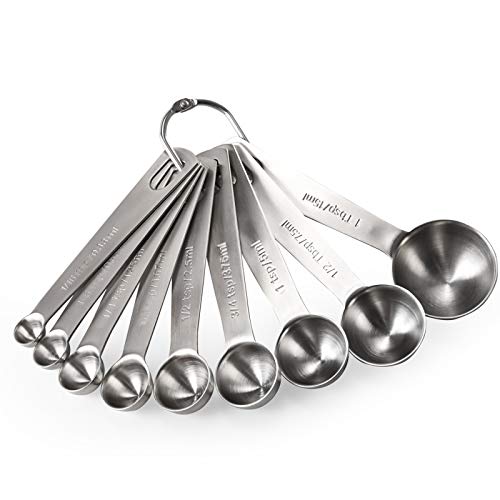
U-Taste 18/8 Stainless Steel Measuring Spoons Set of 9 — Best for Precision Sizes
Read the U-Taste size list slowly, because it is the product: 1/16, 1/8, 1/4, 1/3, 1/2, and 3/4 teaspoon, then 1 teaspoon, 1/2 tablespoon, and 1 tablespoon. Those in-between sizes — the 1/8 of cayenne, the 1/3 of baking powder an older recipe assumes, the 3/4 that saves you measuring twice — are where this set separates itself from every standard set in the drawer. Recipes written by careful bakers and older cookbooks call for these fractions constantly, and owning them converts a page of approximations into a page of measurements.
The construction matches the intent. The set is 18/8 stainless steel, the grade that resists rust and staining through years of dishwasher cycles, with the sizes marked to be read at a glance in the middle of a recipe. Nine spoons is a full system: nothing in the teaspoon-and-tablespoon universe is missing, and dry and liquid ingredients are both in its brief.
The trade-offs are footprint and accessories. Nine individual spoons on a ring take more drawer presence than the magnetic Spring Chef system, and there is no leveler in the box — a straight knife edge does the job, but the omission is felt by precision bakers. Buy this set if your cooking lives in the fractions: spice blending, baking chemistry, coffee ratios, and any recipe card written before measuring got dumbed down.
Strengths
- Includes 1/16, 1/8, 1/3, and 3/4 tsp — the sizes precision recipes actually call for
- 18/8 stainless steel is the food-grade standard for durability
- Engraved-style size coverage removes the half-of-a-half guessing game
Trade-offs
- Nine single-purpose spoons is the largest drawer commitment here
- No leveler included — level with a knife edge
- Ring storage rather than magnetic nesting
| Set size | 9 spoons |
| Sizes | 1/16, 1/8, 1/4, 1/3, 1/2, 3/4 tsp; 1 tsp; 1/2 and 1 tbsp |
| Material | 18/8 stainless steel |
| Use | Dry and liquid ingredients |
Best for: precision bakers, spice blenders, and anyone with older recipe collections / Not suited for: tiny drawers or leveler devotees
Check the current price on Amazon

YUNNKEEY Stainless Steel Measuring Spoons Set of 14 with Leveler — Best Slim Rectangular Set
Rectangular measuring spoons look like a gimmick until the first time you level one. A flat-sided spoon sweeps level against a straight edge — or a jar rim — in a way a round bowl never quite does, and the slim rectangular profile slides into spice jars that even narrow oval spoons cannot enter. The YUNNKEEY set commits fully to that logic: fourteen slim rectangular pieces covering the teaspoon and tablespoon range, with a leveler included to complete the precision system.
The count deserves a word. Fourteen pieces means the size ladder has no gaps worth mentioning — the set measures the fractions and the standards with the same confidence, which suits spice blending, baking, and supplement or coffee routines where the same small measures repeat daily. The whole system stores remarkably flat, the rectangular geometry stacking where round bowls would roll and clatter.
Shape is a preference as well as a function, and honesty requires saying so. Rectangular bowls pour liquids less gracefully than round ones and feel unfamiliar for the first week. Fourteen pieces also ask for a storage habit — a ring, a tray, a drawer corner of their own — or the set will scatter. For the spice-heavy, precision-led kitchen this set is designed for, those are small prices for the most jar-friendly, gap-free measuring system in this guide.
Strengths
- Rectangular heads are the best shape for leveling inside and against jars
- Fourteen pieces give the widest size coverage in this roundup
- Slim profile stores flatter than any round-bowl set
Trade-offs
- Rectangular bowls are less natural for liquids than round ones
- Fourteen pieces is a lot of small steel to keep together
- Less familiar feel for cooks raised on round spoons
| Set size | 14 pieces |
| Design | Rectangular, slim — fits in spice jars |
| Extras | Leveler included |
| Use | Dry and liquid ingredients |
Best for: spice-jar households, blenders of rubs and seasonings, precision measurers / Not suited for: liquid-heavy measuring or round-spoon traditionalists
Check the current price on Amazon

THLHKD Narrow Measuring Spoons Set, 6 Pieces — Best Budget Narrow Set
The THLHKD set is a single idea executed completely: spoons narrow enough, and handles long enough, for spice jars. Six stainless pieces with flat teaspoon and rectangular tablespoon profiles slide into the jars that defeat standard sets, reach down to the last of the paprika in a tall jar, and level against the rim on the way out. If the spice-jar problem is the whole reason you are reading this guide, this set is the direct, inexpensive answer.
There is an honesty to the set’s scope that this guide appreciates. It covers the essential sizes a seasoning cook uses daily and does not pad the count with novelties. The stainless construction is dishwasher-proof and drawer-proof, and at this tier the set can live in the spice cupboard itself — dedicated jar spoons, always where the jars are, which is a workflow the bigger systems cannot match.
The limits match the price. Six pieces will not measure a 1/16 teaspoon for you, flat profiles handle liquids adequately rather than elegantly, and the finish is workmanlike. Buyers building a complete precision system should take the U-Taste or YUNNKEEY sets. Buyers who simply want the jar problem gone — in the kitchen, the camper, or the second home — should take this one and spend the savings on better spices.
Strengths
- Purpose-built narrow shape enters spice jars standard spoons cannot
- Long handles reach the bottom of tall jars and canisters
- The friendliest price tier in this roundup
Trade-offs
- Six pieces cover the essentials, not the exotic fractions
- Flat profiles are less suited to liquids
- Basic finish and presentation — a tool, not a gift
| Set size | 6 spoons |
| Design | Long, narrow — made for spice jars |
| Material | Stainless steel |
| Shapes | Flat teaspoon and rectangular tablespoon profiles |
Best for: spice-jar sufferers on a budget, second kitchens, and campers / Not suited for: precision fraction work or liquid measuring
Check the current price on Amazon

Hudson Essentials Stainless Steel Measuring Spoons Set of 7 — Best Classic Slim Set
Hudson Essentials took the set most cooks already own and fixed its one flaw. The spoons keep the classic round-bowl shape — the shape that pours liquids properly and feels right in the hand — but the profile is slimmed so the set fits into spice jars, as its listing plainly promises. Seven stainless spoons cover the standard measuring range for dry and liquid ingredients, which is to say the range that ninety percent of recipes live in.
That positioning makes it the comfortable recommendation for a specific, common buyer: someone whose current set is fine except for the jar problem, who does not blend spices by the fraction or bake by the gram, and who wants one familiar set that simply works everywhere. The steel build takes the dishwasher and the drawer without complaint, and the sizes are the ones printed in ordinary cookbooks.
What it does not do is specialize. There are no fractional exotica for the precision baker, no leveler, no dual ends, no magnetic tricks. Shoppers who recognize themselves in those needs should buy the Spring Chef or U-Taste sets and be happier. Everyone else — the great middle of home cooking — will find this the set they reach for daily without ever thinking about it, which is what a classic is for.
Strengths
- Classic round bowls in a slimmed profile — familiar feel, jar-friendly size
- Seven sizes cover the standard range most recipes use
- Steel construction with the durability daily drawers demand
Trade-offs
- Standard size ladder — no 1/16 or 1/3 teaspoon exotica
- No leveler or dual-ended tricks; it is a classic set, plainly
- Ring storage, like most traditional sets
| Set size | 7 spoons |
| Design | Slim profile — fits in spice jars |
| Material | Stainless steel |
| Use | Dry and liquid ingredients |
Best for: everyday cooks upgrading from a standard set / Not suited for: fraction specialists or feature seekers
Check the current price on Amazon

King Arthur Baking Company Spice Measuring Spoons, 7-Piece — Best for Bakers
King Arthur Baking Company sells measuring spoons the way a piano maker might sell tuning forks: measurement is the family business. This seven-piece spice set is built in 18/8 stainless steel to precision measures, sized for the small end of baking where the consequential numbers live — the salt, soda, powder, and spice fractions that decide whether a bake rises, balances, or falls flat. A set designed by people who develop and test recipes for a living carries a different kind of authority than a generic set with a longer size list.
In the kitchen that authority shows as trust. When a King Arthur recipe says a quarter teaspoon, this is the quarter teaspoon it was tested with, and bakers who follow serious recipes will feel the difference in repeatability — the same loaf, the same crumb, batch after batch. The slim spice-set format fits the jars those ingredients live in, and the steel shrugs off the daily dishwasher cycle.
The scope is deliberately narrow, and buyers should honor it. This is a spice and precision set, not the household’s only measuring system — the tablespoon end of life is better served by the fuller sets above. It also sits at a premium tier for seven pieces; you are paying for the standard it is made to. For bakers, that is the correct trade. For general cooks, the Hudson Essentials or Spring Chef sets cover more ground for the money.
Strengths
- Designed by a baking company — the sizes serve real recipes, not marketing
- 18/8 stainless steel with precision as the stated brief
- A set sized for spice work, where baking’s smallest numbers live
Trade-offs
- Spice-focused range — not a full tablespoon-system replacement
- Premium tier for a seven-piece set
- Baking-led design may be narrower than general cooks need
| Set size | 7 pieces |
| Material | 18/8 stainless steel |
| Design brief | Precision spice measures for baking and cooking |
| Brand | King Arthur Baking Company |
Best for: serious bakers and followers of tested recipes / Not suited for: buyers wanting one set to cover every measuring job
Check the current price on Amazon
Comparison Table
| Pick | Badge | Key spec | Best for |
|---|---|---|---|
| Spring Chef Magnetic Measuring Spoons Set of 8 | Best Overall | Set of 8, dual-sided, magnetic nesting, leveler included | most cooks — one set that handles jars, liquids, and leveling |
| U-Taste 18/8 Stainless Steel Measuring Spoons Set of 9 | Best for Precision Sizes | 9 sizes from 1/16 tsp to 1 tbsp, 18/8 stainless steel | precision bakers, spice blenders, and anyone with older recipe collections |
| YUNNKEEY Stainless Steel Measuring Spoons Set of 14 with Leveler | Best Slim Rectangular Set | Set of 14, rectangular slim design, leveler included | spice-jar households, blenders of rubs and seasonings, precision measurers |
| THLHKD Narrow Measuring Spoons Set, 6 Pieces | Best Budget Narrow Set | Set of 6, long narrow profile, spice-jar fit | spice-jar sufferers on a budget, second kitchens, and campers |
| Hudson Essentials Stainless Steel Measuring Spoons Set of 7 | Best Classic Slim Set | Set of 7, slim profile fits spice jars | everyday cooks upgrading from a standard set |
| King Arthur Baking Company Spice Measuring Spoons, 7-Piece | Best for Bakers | 7-piece, 18/8 stainless steel, precision measures | serious bakers and followers of tested recipes |
How to Choose the Best Small Measuring Spoons
Start with the size list, because in this category the size list is the product. A complete small set should cover the standard ladder — 1/4, 1/2, and 1 teaspoon, 1/2 and 1 tablespoon — and the question is what it adds below and between. The fractions that earn their drawer space are 1/8 teaspoon (spice heat and salt adjustments), 3/4 teaspoon (one-motion measuring), 1/3 teaspoon (older and European recipes), and 1/16 teaspoon (potent spices, curing salts, and supplements). If your cooking uses them, buy a set that has them — the U-Taste and YUNNKEEY sets here are built on exactly that logic. If it does not, a classic seven-piece like the Hudson Essentials covers real life completely.
Next, judge the profile against your jars. Measure the mouth of your most-used spice jar if you can; narrow oval, rectangular, and slim round profiles all fit different jars, and the dual-sided Spring Chef design hedges the bet by putting a narrow end on every spoon. Handles matter at the bottom of tall jars — the long-handled THLHKD set exists precisely for that reach. Then judge the markings: engraved or deeply stamped sizes survive a decade of dishwashing, while printed markings are a countdown to a drawer full of anonymous spoons.
Finally, consider the system around the spoons. A leveler turns scooping into measuring — if the set lacks one, a straight knife edge works, but the included levelers on the Spring Chef and YUNNKEEY sets are genuinely useful. Storage decides whether the set survives as a set: magnetic nesting keeps pieces together best, rings are traditional and adequate, and loose sets in a busy drawer become partial sets within a year. Small spoons are a small purchase that touches cooking daily; the right set disappears into the routine and quietly makes every recipe more repeatable.
Why Small Spoons Measure Better: The Physics of a Level Spoon
A measuring spoon is a volume instrument, and its accuracy depends on one act: leveling. A heaped teaspoon of flour can hold half again the volume of a level one, and with potent ingredients — salt, baking soda, cayenne, curing salt — that swing is the difference between seasoned and spoiled. Small, narrow spoons level more honestly than wide ones because their geometry helps you: a slim spoon swept against a jar rim or a leveler loses its heap in one motion, while a wide round spoon holds a dome that invites guessing.
Narrow spoons also measure where the ingredient lives. Scooping from the jar, rather than pouring the jar over a bowl, keeps the spice uncontaminated, the counter clean, and the amount controlled — and it prevents the steam-from-the-pot mistake, where a cook measures over a simmering dish and the rising moisture cakes the jar’s contents over time. The small-spoon habit — into the jar, level at the rim, into the dish — is a tiny discipline that professional kitchens treat as basic hygiene of measurement.
There is also the matter of the smallest sizes themselves. Below a quarter teaspoon, no standard spoon exists in most drawers, so cooks pinch — and a pinch varies by hand, by day, and by ingredient. A 1/8 or 1/16 spoon converts the most flavor-critical quantities in cooking from folklore into measurement. That is the real promise of the sets in this guide: not smaller versions of what you own, but the missing bottom of the measuring scale, in profiles that fit the jars those ingredients actually come in.
The Missing Fractions: A Field Guide to Small Measures
Cooking’s small numbers have names and jobs, and a cook who owns the spoons for them cooks differently. The 1/2 teaspoon is the workhorse adjustment — half a recipe’s salt, a sauce corrected. The 1/4 teaspoon is where leavening and potent seasoning live: baking soda, cream of tartar, cayenne, ground cloves, the ingredients where a doubling is a disaster and a halving is a disappearance. The 1/8 teaspoon — the traditional ‘half of a quarter’ that old cookbooks assumed you could estimate — is the fine adjustment: the extra heat in a rub, the salt on a small batch, the spice in a single cup of chai. The 1/16 teaspoon, sometimes called a smidgen’s honest cousin, serves curing salts, potent extracts in baking, supplements, and any chemistry where the dose is genuinely small and genuinely matters.
Between the standards sit the two great conveniences. The 3/4 teaspoon turns a two-measure job (1/2 + 1/4) into one motion, and in a fast recipe that saved motion is saved accuracy — every additional scoop is an additional chance to lose count. The 1/3 teaspoon serves the older and European recipe literature, where thirds appear without apology, and any cook with a grandmother’s recipe box will meet it within a month. The sets in this roundup were chosen partly on their coverage of exactly this map: the U-Taste set owns the whole territory, the YUNNKEEY and Spring Chef systems cover the working majority, and the classic sets cover the standards in jar-friendly form.
There is a confidence dividend to owning the fractions that no one advertises. A cook who can measure 1/8 teaspoon stops fearing the recipes that call for it, starts adjusting seasoning in deliberate increments instead of pinches and prayers, and produces the same dish the same way twice — which is, in the end, the entire difference between cooking and repeating. Small spoons are a small purchase that buys that difference, and they buy it for the price of a bag of good spice.
Materials and Markings: What Survives a Decade in the Drawer
A measuring spoon leads a hard life: rattling in a drawer against knives and peelers, cycling through dishwashers, prying at jar lids it was never designed to pry. The material verdict of this category is settled — stainless steel, in the 18/8 grade the better sets here specify, is the only common material that takes all of it indefinitely. Steel does not rust in normal service, does not stain from turmeric or tomato, does not soften in hot water, and holds its bowl shape against the drawer. Plastic sets warp and stain; plated sets chip at the rim, which is the measuring edge itself; ceramic sets are beautiful and belong to the gift-and-display branch of the family rather than the daily drawer.
Markings are the second survival question, and the more subtle one. A spoon’s size marking is its identity — lose it, and the spoon becomes a rumor. Printed and inked markings sit on the surface and are removed by exactly the dishwasher cycles the spoon will see hundreds of; within a year or two a printed set is anonymous. Engraved, etched, or deeply stamped markings are cut into the steel and survive as long as the spoon does. Every serious set in this roundup marks its sizes durably, and any set you consider beyond this list should be held to that standard before its price is even discussed.
The third survival factor is the system that keeps the set a set. Magnetic nesting, as on the Spring Chef set, is the modern answer — the spoons arrive together, store flat, and return together. Rings are the traditional answer and work until the ring opens in the drawer. Loose storage is not an answer; it is how complete sets become the three orphaned spoons every kitchen drawer already holds. Buy the set whose survival system matches your drawer’s chaos level, and in ten years you will still own all of it — which cannot be said of most small kitchen purchases.
How to Measure Small Quantities Accurately
Technique turns a good spoon set into accurate measurement. These habits apply to every pick in this roundup and matter most exactly where these spoons specialize — the small end of the scale.
- Dip, do not scoop-and-pack. Push the spoon into the ingredient and lift it out heaped, without pressing it against the jar wall. Packing compresses dry ingredients and inflates the measure — the classic cause of over-salted, over-leavened results.
- Level in one straight sweep. Draw a leveler, a knife’s straight edge, or the jar’s rim across the spoon once. Sawing back and forth settles and packs the ingredient; one clean pass leaves a true level measure.
- Measure over the jar or a small plate, never over the pot. Spills return to the jar instead of the dish, and steam from the pot never reaches the jar’s contents to cake them.
- For liquids, fill to the brim at eye level and pour steadily. Round-bowl and dual-sided sets (the round end of the Spring Chef) hold liquids best; rectangular spoons want a slower, more deliberate pour.
- Use the in-between sizes instead of estimating them. Half of a half-teaspoon guessed by eye is routinely off by a third. If the recipe says 1/8, use the 1/8 — that is the entire reason these sets exist.
- Wash and dry the set together, and store it as a set. Markings stay readable longer with gentle washing, and a set stored as one unit is a set that survives — partial sets are how measuring drawers fill with orphans.
One last habit separates careful cooks: measure the potent things first and the bulky things last. Salt, leavening, and spices measured into a small dish before you begin — the mise en place of the small numbers — means no mid-recipe fumbling with a jar over a hot pan, and no second-guessing whether the soda went in. Small spoons reward small rituals.
A final technique note concerns temperature and the spoon itself. A spoon fresh from a hot dishwasher, or stored above the stove, expands the imagination more than the metal — but a chilled spoon does genuinely help with one real task: measuring sticky ingredients. A spoon rinsed in cold water, or dusted with the recipe’s flour or sugar first, releases honey, molasses, and syrups cleanly instead of donating a film of the measure to the bowl’s wall. For the stickiest work, a whisper of neutral oil on the spoon does the same. Small spoons measure small, clingy, consequential things; giving them a fair release is part of measuring them honestly.
Common Buying Mistakes
Buying a standard set and calling it small. Standard spoons do not fit spice jars and rarely include sizes below 1/4 teaspoon. If jars and fractions are the problem, only a genuinely narrow, fraction-rich set — like the picks here — solves it.
Estimating the small fractions. Half of a 1/4 teaspoon eyeballed is not 1/8 of anything reliable. With salt, soda, and potent spices, the error is the flavor. Own the small sizes or accept the variance knowingly.
Measuring over the cooking pot. Steam cakes the jar, spills season the dish at random, and a dropped spoon is a rescue operation. Measure over the jar or a side plate, every time.
Trusting printed size markings. Printed sizes fade in the dishwasher within a year or two, leaving anonymous spoons. Engraved or stamped markings are a buy-once feature — check for them before ordering.
Letting the set scatter. A measuring set’s value is its completeness. Loose spoons in a busy drawer become a partial set quickly; magnetic nesting or a ring is not a gimmick, it is the survival mechanism.
Final Recommendation
For most buyers, the Spring Chef set of 8 is the best small measuring spoon purchase: the dual-sided design covers jars and liquids in one system, the magnets keep it together, and the leveler makes it honest. Precision cooks should take the U-Taste 9-piece for its unmatched fraction range or the YUNNKEEY 14-piece for its slim rectangular system, bakers the King Arthur spice set, classicists the Hudson Essentials seven, and anyone who simply wants the spice-jar problem gone at the friendliest tier the THLHKD narrow six.
Check the size list on the listing before ordering — in this category the sizes included are the product, and they vary more between sets than any other feature — and check the current price on Amazon rather than trusting a quoted figure. Then adopt the two habits that make any set accurate: level in one sweep, and measure the small numbers with small spoons. Your baking, seasoning, and coffee will quietly become more repeatable within the week.
One last piece of advice before you order: read the size list one final time and picture your three most-cooked recipes against it. The set that covers those recipes’ smallest numbers — in a profile that fits your jars, with markings that will survive your dishwasher — is your set, whatever its badge says. Measuring is a habit, and the right spoons are the ones the habit forms around.
Then put the set where the spices live, not where sets are supposed to live, and let proximity do what discipline promises and so often fails to deliver.
And if the set you choose becomes, as the best of them do, invisible in your cooking — reached for without thought, trusted without checking, present in every recipe without ever being the subject of one — that invisibility is the highest praise measuring tools can earn. Accuracy that calls attention to itself is a chore; accuracy that disappears into the routine is a craft. Buy the spoons that disappear.
Keep exploring the cluster: Best Ceramic Measuring Spoons, Best Copper Measuring Spoons, Best Camping Measuring Spoons, Best Cylinder Measuring Spoons.
Frequently Asked Questions
What makes measuring spoons ‘small’?
Profile and purpose. Small measuring spoons have narrow or slim heads designed to fit inside spice jars, and size ranges that reach the small fractions — 1/8 and even 1/16 teaspoon — that standard sets omit. Every pick in this guide is a genuinely small-format set, not a standard set with ‘small’ in the title.
Which sizes should a small measuring spoon set include?
The standard ladder (1/4, 1/2, 1 tsp; 1/2 and 1 tbsp) plus as many in-between fractions as your cooking uses: 1/8 and 3/4 tsp are the most useful additions, then 1/3 and 1/16 tsp for precision work. The U-Taste set here includes all of them; the classic sets cover the standard ladder in slimmer profiles.
Are rectangular measuring spoons better than round ones?
For dry ingredients and spice jars, often yes — flat sides level cleanly against a rim or leveler and the slim profile enters narrow jars. For liquids, round bowls pour more naturally. Dual-sided sets like the Spring Chef hedge the question by providing both shapes in every size.
How do I keep the size markings from wearing off?
Choose engraved or stamped markings over printed ones, and wash gently — the dishwasher is fine for the steel itself, but markings last longest with hand washing. All the sets in this guide are stainless steel; check the listing’s marking style if longevity of the labels matters to you.
Can small measuring spoons replace my standard set?
The fuller systems here — the Spring Chef 8, U-Taste 9, and YUNNKEEY 14 — can serve as a household’s only sets, since they include the tablespoon sizes too. The spice-focused sets (King Arthur, THLHKD) are best as companions to a standard set, covering the small end it misses.
What is a leveler and do I need one?
A leveler is a straight edge used to sweep a heaped spoon level in one motion — the difference between a repeatable measure and an estimate. Two sets here include one; otherwise a straight knife edge or the jar’s rim does the same job. If you bake, it is worth having.

