Disclosure: airfryerkitchensupply.com is reader-supported. When you buy through links on our site, we may earn an affiliate commission at no extra cost to you.
Where to buy
Every slipper linked below was confirmed against its live Amazon listing, so the materials and constructions quoted — linen, cotton, open toes, perforations — come from the listings themselves. This category attracts vague ‘breathable’ claims, so each pick had to show its cooling mechanism in the listing: an open toe, a woven natural-fibre upper, a perforated design, or a sweat-absorbing cloth sole. Use the links in this box to check the current price on Amazon; prices are not printed here because they change too often to stay accurate.
- Japanese Style Linen House Slippers, Open Toe, Breathable and Lightweight — check price on Amazon
- COCOMUSE Ultralight Open Toe Cotton Linen Women’s Slippers with Cloth Bottom — check price on Amazon
- EitCaton Unisex Linen House Slippers, Open-Toe, Memory Foam, Navy (Women 9-10 / Men 7-8) — check price on Amazon
- Japanese Style Cotton Linen Slippers, Woven Breathable Indoor House Shoes — check price on Amazon
- Dearfoams Men’s Brendan Breathable Memory Foam Clog, Black Perforated, Large — check price on Amazon
- VeraCosy Men’s Open-Toe Slippers, Ultimate Gray, 9-10 US — check price on Amazon
The best slippers that don’t make your feet sweat solve a simple physics problem: a foot sealed inside fleece, foam and synthetic lining produces heat and moisture faster than that construction can release them, and the result is the clammy, overheated feeling that makes people kick their slippers off by nine in the evening. The fix is not a miracle material. It is openness — toes that can breathe, uppers woven from linen and cotton instead of piled synthetics, and soles that absorb moisture rather than trapping it against the skin.
That is why this guide looks so different from a winter slipper roundup. There is no shearling here, no faux fur, no sealed memory foam bootie. Instead you will find Japanese-style linen house slippers, open-toe cotton designs, a perforated breathable clog, and terry cloth — the fabrics and shapes that warm-climate households and warm-footed people have quietly relied on for years. Every one is a genuine house slipper, not a sandal or a slide dressed up for the category.
If your feet run hot, if you live somewhere warm, or if your home is simply well heated, these six verified picks cover the realistic options: unisex linen pairs for the whole household, a women’s open-toe cotton set, a men’s breathable clog for those who still want structure, and guest-ready styles that keep feet cool without looking like beachwear. The buying guide below also explains the less obvious half of the problem — socks, rotation and washing — because the coolest slipper still fails in a bad system, and the freshest system cannot rescue a sealed fleece bootie in July.
In this guide
Quick Picks
Best Overall — Japanese Style Linen House Slippers, Open Toe, Breathable and Lightweight. The benchmark design: an open-toe linen slipper for women and men with an anti-skid sole — minimal, airy, and made for warm rooms and guest use alike. Check price on Amazon
Best Sweat-Absorbing Sole — COCOMUSE Ultralight Open Toe Cotton Linen Women’s Slippers with Cloth Bottom. A cotton-linen open-toe slipper whose cloth bottom is designed to absorb sweat — the pick for bare feet that leave ordinary soles feeling damp. Check price on Amazon
Best Cushioned Breathable — EitCaton Unisex Linen House Slippers, Open-Toe, Memory Foam, Navy (Women 9-10 / Men 7-8). The compromise pick: a breathable linen open-toe upper over a memory foam layer, machine washable, in unisex sizing — cooling without giving up cushion. Check price on Amazon
Best Woven Construction — Japanese Style Cotton Linen Slippers, Woven Breathable Indoor House Shoes. A woven cotton-linen construction where the weave itself is the ventilation — air passes through the upper, not just around the toes. Check price on Amazon
Best for Men — Dearfoams Men’s Brendan Breathable Memory Foam Clog, Black Perforated, Large. A perforated men’s clog from a major slipper brand — ventilation holes plus memory foam and wide widths, for men who want structure without the sweat. Check price on Amazon
Best Open-Toe for Men — VeraCosy Men’s Open-Toe Slippers, Ultimate Gray, 9-10 US. A men’s open-toe summer slipper in a neutral grey — maximum toe ventilation in a simple slip-on that works from bedroom to bathroom. Check price on Amazon
How These Picks Were Chosen
Picks were verified on this site’s own Amazon connection, and each listing had to demonstrate its cooling mechanism in its own title: open toe, linen, cotton, woven breathable construction, perforations, or sweat-absorbing cloth. Listings that merely used the word ‘breathable’ about a sealed fleece slipper were not accepted at face value. Sandals, slides and flip-flops were excluded by rule — this guide is about house slippers — as were slippers whose main pitch was medical, since this guide makes comfort claims only, never health claims.
The six were then spread across real use cases. Two are Japanese-style linen slippers, the category’s benchmark, in different constructions. One is a women’s open-toe cotton-linen design with a sweat-absorbing cloth bottom. One is a unisex linen pair with a memory foam layer for those who refuse to give up cushioning entirely. One is a perforated men’s clog for buyers who want a structured shoe feel. One is an open-toe summer scuff from an established slipper brand. Duplicate listings of the same product under variant ASINs were deduplicated.
No prices and no fixed ratings appear in this guide; check the current price on Amazon through each pick’s link. Where a listing does not state a material or feature, this guide says so rather than assuming it — in a category built on vague claims, that restraint is the point.
The 6 Best Slippers That Don’t Make Your Feet Sweat

1. Japanese Style Linen House Slippers, Open Toe, Breathable and Lightweight — Best Overall
Start here if you want the classic answer. Japanese-style house slippers are built around airflow: an open toe that lets heat escape where feet produce most of it, a linen upper that breathes instead of insulating, and a light, low sole that adds nothing to the warmth. This listing covers women and men, describes itself as breathable and lightweight, and includes an anti-skid sole — the practical detail that separates a house slipper from a sock with ambitions. It suits warm homes, warm feet, and households that keep a basket of slippers for guests.
Strengths
- Open toe plus linen upper attacks heat at both ends
- Unisex design suits whole-household and guest buying
- Anti-skid sole, as listed, for hard indoor floors
Trade-offs
- Minimal cushioning — this is an airflow slipper, not a comfort foam shoe
- Linen creases and softens with wear; it will not keep a crisp new look
- Open toe gives no protection against stubbing or dropped objects
| Spec | Detail (as listed) |
|---|---|
| Upper | Linen (as listed) |
| Toe | Open toe (as listed) |
| Sole | Anti-skid (as listed) |
| Fit | Women and men (as listed) |
Linen is the right fibre for this job and the listing leads with it. Flax fibres are hollow, move moisture along their length, and feel cool against skin even before any airflow — the same reasons linen shirts dominate hot climates. Woven into an open slipper upper, linen gives structure without sealing the foot, and it tolerates frequent washing better than most natural fibres, which matters because cool slippers still need regular washing to stay fresh.
The open toe is doing more work than the material, though. Feet vent a large share of their heat through the toes and forefoot, and even a breathable closed toe traps a pocket of warm air exactly there. Opening the front of the slipper turns every step into a small bellows, pumping that warm air out. If you have only ever tried ‘breathable’ closed slippers and found them disappointing, the open toe is most likely the difference you were missing.
Expect honest limits. There is little between your foot and the floor here, so on cold tile in an unheated house these will feel brisk rather than cozy — they are warm-room footwear, and the guide’s winter counterpart category exists for the opposite problem. Within their season and setting, though, this is the design the rest of the category imitates.
Best for: warm homes, warm feet, and guest-ready household buying / Not suited for: anyone wanting deep cushioning or cold-floor insulation

2. COCOMUSE Ultralight Open Toe Cotton Linen Women’s Slippers with Cloth Bottom — Best Sweat-Absorbing Sole
Most anti-sweat thinking focuses on the upper and forgets the sole, yet the sole is where moisture pools. This COCOMUSE design pairs a cotton-linen open-toe upper with a cloth bottom that the listing explicitly describes as absorbing sweat, so the surface under your foot behaves like a towel rather than a plastic tray. It is ultralight and soft by design. Choose it if you go barefoot in slippers, if rubber soles always feel clammy to you, and if your floors are the forgiving kind — wood, laminate, carpet — rather than wet-prone tile.
Strengths
- Cloth bottom absorbs sweat, as listed — rare and directly on-brief
- Cotton-linen open-toe upper breathes from above
- Ultralight build you can wear all day without noticing
Trade-offs
- Cloth bottoms wear faster than rubber soles and dislike wet floors
- Women’s sizing only in this listing
- Minimal structure or cushioning for long standing
| Spec | Detail (as listed) |
|---|---|
| Upper | Cotton linen (as listed) |
| Sole | Cloth bottom, sweat-absorbing (as listed) |
| Toe | Open toe (as listed) |
| Fit | Women (as listed) |
The cloth bottom deserves a closer look because it reverses the usual design. A rubber or foam sole is waterproof by nature, which outdoors is a virtue and indoors is a trap: sweat has nowhere to go, so it stays on the footbed and on your skin. A cloth bottom wicks that moisture away from the contact surface and lets it evaporate through the sole’s edges. The sensation difference is immediate — the slipper feels dry at the end of the evening, not just at the start.
The trade is durability and terrain. Cloth soles are consumable in a way rubber is not; they thin with months of daily wear, and they should stay away from wet bathroom floors and doorsteps, where they will soak through and wear faster. Treat this pair as indoor-only footwear for dry rooms and it will do the one job it was built for better than any rubber-soled rival in this guide.
Ultralight construction completes the brief. Heat is not only about fabric — a heavy slipper makes feet work harder and warm up faster. A slipper you barely feel is a slipper your feet stay calm in, which is why the lightest designs in this category consistently outperform padded ‘breathable’ ones for genuinely hot feet.
Best for: barefoot wearers whose main complaint is damp soles / Not suited for: wet floors, doorsteps, or anyone needing a durable outdoor-capable sole

3. EitCaton Unisex Linen House Slippers, Open-Toe, Memory Foam, Navy (Women 9-10 / Men 7-8) — Best Cushioned Breathable
Some people love the idea of a linen slipper and hate the reality of a thin sole. This EitCaton design is the negotiated settlement: a cotton-fabric linen-style upper, open at the toe for airflow, over a memory foam footbed that restores the cushioning the pure designs sacrifice. The listing adds non-slip grip and machine washability, and the sizing is unisex with dual size labelling. Choose it if you stand a lot at home, if hard floors punish your heels, or if you are buying one style for two people.
Strengths
- Memory foam cushioning inside a genuinely breathable open-toe design
- Machine washable, as listed — vital for a warm-weather slipper
- Unisex sizing with clear dual labelling
Trade-offs
- Memory foam holds more warmth than a plain cloth sole — cooler than fleece, warmer than the pure linen picks
- Foam footbeds compress over time and will need replacing sooner than cloth soles
- Soft bottom is best kept indoors despite the listing’s casual outdoor mention
| Spec | Detail (as listed) |
|---|---|
| Upper | Cotton fabric, linen style (as listed) |
| Footbed | Memory foam (as listed) |
| Toe | Open toe (as listed) |
| Care | Machine washable (as listed) |
Every category has a tension at its centre, and here it is cushion versus cooling. Foam insulates; that is what foam is. The EitCaton’s answer is to spend its insulation budget only under the foot, where pressure demands it, and keep the upper and toe completely open so heat escapes from above. The result is not the coolest slipper in this guide — the pure linen designs beat it — but it is the coolest slipper that still feels like a cushioned shoe, and for many buyers that is the actual requirement.
Machine washability is the quiet headline. Warm-weather slippers absorb sweat daily, and a slipper that cannot be washed becomes unpleasant on a schedule set by biology, not by wear. A washable pair can be kept genuinely fresh through a whole summer, and two pairs in rotation — one washing, one wearing — is the system this guide recommends in the care section below. This listing makes that system easy.
Sizing deserves care: the listing labels sizes for both women and men on the same product, so confirm which scale you are ordering against before checkout. Unisex designs simplify household buying, but only if each wearer checks the dual label rather than assuming their usual number.
Best for: buyers who want cooling and cushioning in one washable pair / Not suited for: the hottest feet, which should choose the pure cloth-sole designs

4. Japanese Style Cotton Linen Slippers, Woven Breathable Indoor House Shoes — Best Woven Construction
This pick cools by a different mechanism: the upper is woven cotton linen, and a weave — unlike a solid fabric panel — has thousands of tiny gaps that air moves through with every step. The listing describes the slippers as woven and breathable indoor house shoes in the Japanese style. Choose this design if you prefer a closed, tidy look but refuse a sealed upper, or if open-toe styles let your feet slip too far forward. It is the discreet option: a normal-looking house slipper that behaves like a ventilated one.
Strengths
- Woven upper ventilates across the whole foot, not only at the toes
- Tidy, closed appearance for those who dislike open-toe styles
- Cotton-linen fibres feel cool and tolerate washing
Trade-offs
- Listing is brief — sole material and cushioning are not stated, so check the product page
- A woven upper still traps more warmth than a fully open toe
- No stated anti-skid detail in the listing title
| Spec | Detail (as listed) |
|---|---|
| Upper | Woven cotton linen (as listed) |
| Style | Japanese style house shoe (as listed) |
| Use | Indoor (as listed) |
| Sole/cushion | Not stated in listing title |
Weave density is the hidden specification of breathable footwear. A tight weave in a natural fibre breathes modestly; an open weave breathes like a screen. Woven cotton-linen slippers sit at the airy end of that scale while still looking like proper shoes, and the natural fibres add a second mechanism — they absorb a little moisture into the fibre itself, buffering the damp feeling between steps in a way synthetics cannot.
Honesty about the listing matters here: it is a short title, and this guide does not invent the missing details. The sole material, the cushioning and the grip pattern are not stated, so treat those as questions to confirm on the product page if they matter to you. What is stated — woven cotton linen, breathable, indoor house shoe — is exactly the core of the brief, and it is enough to earn the pick its place for buyers whose priority is the upper’s airflow.
Pair this style with the rotation habit described below and it shines: woven uppers dry quickly after washing because air passes through them, so a two-pair rotation stays genuinely fresh rather than merely alternating dampness.
Best for: buyers wanting a closed, tidy slipper that still ventilates / Not suited for: shoppers who need confirmed sole and cushioning specs before buying
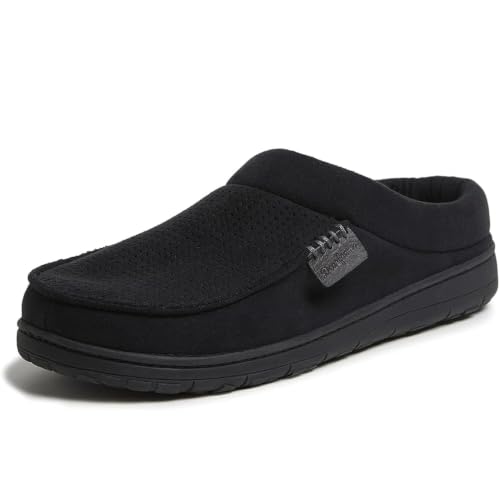
5. Dearfoams Men’s Brendan Breathable Memory Foam Clog, Black Perforated, Large — Best for Men
Men’s breathable house slippers are scarcer than women’s, and most ‘cool’ men’s options are really sandals. The Brendan is a proper clog house shoe whose listing leads with breathable and specifies a perforated design in this black version — holes punched through the upper so air reaches the foot directly — with memory foam underfoot and wide widths offered. Choose it if you want a substantial, shoe-like slipper for indoor and outdoor wear, if your feet are wide, or if open-toe styles feel too exposed for workshop and doorstep trips.
Strengths
- Perforated upper vents the foot directly, as listed
- Memory foam footbed keeps real cushioning in a breathable design
- Wide widths offered, as listed; indoor/outdoor clog build
Trade-offs
- A closed clog still runs warmer than the open-toe linen picks
- Perforations let in dust and pet hair more than a solid upper
- Men’s sizing only in this listing
| Spec | Detail (as listed) |
|---|---|
| Style | Clog house shoe (as listed) |
| Upper | Perforated, breathable (as listed) |
| Footbed | Memory foam (as listed) |
| Widths | Wide widths offered (as listed) |
Perforation is the oldest ventilation technology in footwear — leather shoes were brogued for country wet long before ‘breathable’ became a marketing word — and it works for the unglamorous reason that holes let air through. In a clog, which otherwise seals the forefoot completely, a perforated upper converts the hottest zone of the shoe into the vented zone. It will not match an open toe for raw airflow, but it keeps the clog’s protection and structure, which for many men is the actual trade they want.
The wide-width option matters more in warm weather than in cold. Feet swell slightly in heat, and a slipper that fits in the shop can bind by evening; width is the pressure release. Combined with memory foam that moulds rather than squeezes, the Brendan is the pick in this guide most likely to be forgotten on the foot — which, for a house shoe, is the highest praise available.
Dearfoams’ long history in slippers shows in the brief done properly: indoor/outdoor intent, a real size range, and comfort features that are structural rather than slogans. If the linen aesthetic is not for you, this is your pick.
Best for: men wanting a structured, wide-friendly clog that still breathes / Not suited for: the very hottest feet, which need an open toe instead

6. VeraCosy Men’s Open-Toe Slippers, Ultimate Gray, 9-10 US — Best Open-Toe for Men
If the clog still sounds like too much shoe, this is the men’s open-toe answer. The VeraCosy listing describes a slip-on open-toe house slipper for summer and bedroom wear, breathable by design, in a sober Ultimate Gray that goes with everything and shows household dust less than white. Choose it for hot climates, post-shower wear (the listing names bathroom use), and any man whose feet overheat in every closed slipper he has tried. It is the simplest design in this guide, and for the hottest feet, simple wins.
Strengths
- Open toe gives men the maximum-ventilation option
- Neutral grey colourway suits any household
- Listing covers summer, bedroom and bathroom wear
Trade-offs
- Open toe means no protection for toes around furniture
- Listing does not state sole or cushioning materials — check the product page
- Lightweight summer build offers little support for all-day standing
| Spec | Detail (as listed) |
|---|---|
| Toe | Open toe (as listed) |
| Style | Slip-on house slipper (as listed) |
| Colour | Ultimate Gray (as listed) |
| Materials | Not stated in listing title |
There is a reason the open-toe design keeps reappearing in this guide: for genuinely hot feet it outperforms every fabric technology. No fibre, however breathable, moves as much air as an opening. This VeraCosy pair applies that principle to a men’s slipper without turning it into a sandal — the upper still covers and holds the foot like a house shoe, while the front simply ends where the heat begins.
The bathroom mention in the listing is worth taking seriously. Post-shower is when feet are warmest and dampest, and a closed slipper put on damp feet stays damp. An open-toe pair worn for the first half hour after a shower lets feet finish drying in comfort, and the slipper itself dries quickly too. Households that keep a dedicated pair by the bathroom often find their main slippers last longer and smell fresher as a side effect.
As with the woven pick, the listing is brief about materials, and this guide will not fill the gap with guesses. Judge it on what is stated — open toe, breathable, summer house slipper — and confirm sole details on the product page if you need a specific grip or cushion.
Best for: men with the hottest feet and hot-climate households / Not suited for: anyone needing toe protection or standing support
Comparison Table
| Pick | Badge | Key spec | Best for |
|---|---|---|---|
| Japanese Style Linen House Slippers, Open Toe, Breathable and Lightweight | Best Overall | Linen upper, open toe, anti-skid sole | warm homes, warm feet, and guest-ready household buying |
| COCOMUSE Ultralight Open Toe Cotton Linen Women’s Slippers with Cloth Bottom | Best Sweat-Absorbing Sole | Cotton-linen, cloth sweat-absorbing bottom | barefoot wearers whose main complaint is damp soles |
| EitCaton Unisex Linen House Slippers, Open-Toe, Memory Foam, Navy (Women 9-10 / Men 7-8) | Best Cushioned Breathable | Linen-style open toe + memory foam, washable | buyers who want cooling and cushioning in one washable pair |
| Japanese Style Cotton Linen Slippers, Woven Breathable Indoor House Shoes | Best Woven Construction | Woven cotton-linen upper, breathable weave | buyers wanting a closed, tidy slipper that still ventilates |
| Dearfoams Men’s Brendan Breathable Memory Foam Clog, Black Perforated, Large | Best for Men | Perforated clog, memory foam, wide widths | men wanting a structured, wide-friendly clog that still breathes |
| VeraCosy Men’s Open-Toe Slippers, Ultimate Gray, 9-10 US | Best Open-Toe for Men | Men’s open-toe summer slipper, grey | men with the hottest feet and hot-climate households |
Key Takeaways
- Openings beat fabrics: an open toe vents more heat than any ‘breathable’ sealed upper. Start with shape, then material.
- Linen and cotton uppers breathe and wash well; a cloth sole (COCOMUSE) absorbs the sweat that rubber soles trap.
- Cushioning costs coolness. The EitCaton’s memory foam compromise suits standing; the pure linen designs suit the hottest feet.
- Washability is a cooling feature. A slipper you can wash weekly stays fresher — and feels cooler — than one you cannot, because clean fibres absorb moisture instead of sitting saturated and clammy against your skin all evening long.
How to Choose Slippers That Keep Feet Cool
Work through three decisions in order: opening, fibre, sole. The opening decides most of your result. Open-toe designs vent the forefoot, where heat concentrates, and nothing else in this category comes close. If you dislike open toes, a woven upper is the second-best mechanism, and perforations in a closed shoe are the third. A sealed upper with a breathable claim stitched on it is not a mechanism at all.
Fibre comes second. Linen is the standout — cool to the touch, moisture-moving, hard-wearing, and washable. Cotton is close behind and softer from new. Cotton-linen blends, used by several picks here, split the difference sensibly. What you are avoiding is the sealed synthetic stack: fleece lining plus foam plus synthetic upper, which is a insulation system whatever the label says. Terry cloth deserves an honourable mention as a footbed or upper for post-shower wear because it absorbs moisture on contact.
The sole decides where the sweat goes. Rubber and foam soles are waterproof, so moisture stays on the footbed. Cloth soles absorb and evaporate it, at the cost of durability and any tolerance for wet floors. Foam footbeds add comfort and a little warmth; cloth footbeds add coolness and a shorter life. Neither is wrong — but choose consciously, because the sole is the half of the slipper most buyers never think about and most feet notice.
Finally, weight. A light slipper makes the foot work less, and working feet are warming feet. The ultralight designs in this guide feel insubstantial in the hand and wonderful at hour six. Judge them at the end of an evening, not the start.
Temperature is only half of indoor comfort; the other half is how a slipper treats the floor’s sound and your downstairs neighbours. Lightweight linen and cloth-soled designs are the quietest footwear in this entire series — no heel strike, no sole slap — which makes them the considerate choice for flats, thin floors and early risers. A household that keeps different hours under one roof will feel the benefit of quiet slippers as keenly as the benefit of cool ones, and it costs nothing extra to have both in the same pair.
Why Feet Sweat in Slippers: The Three Traps
The first trap is insulation symmetry. A winter slipper is designed to keep heat in, and it cannot tell the difference between January and July. Wearing a fleece-lined foam bootie in a heated home is wearing a coat indoors; the sweat is the design working as intended, in the wrong season. Most ‘my feet sweat in slippers’ complaints are really season-mismatch complaints, solved by owning a summer pair rather than by any product feature.
The second trap is the sealed footbed. Even in a breathable upper, a waterproof foam sole creates a closed system at the exact surface where sweat glands are densest. Moisture condenses, the footbed stays damp, and dampness itself feels like sweatiness long after the feet have cooled. Cloth soles, terry footbeds and regular washing all attack this trap from different sides.
The third trap is the single pair. Any slipper worn sixteen hours a day, every day, accumulates moisture faster than it can dry overnight, and by the end of the week even a linen slipper feels less fresh than it should. Two pairs in rotation rest each pair for a full day between wears, and rested slippers feel dramatically cooler than their materials alone explain. If you buy one thing after reading this guide, make it a second pair of whatever you already like.
How to Set Up a Cool-Feet Slipper Routine
Own two pairs and alternate days. Resting a pair for 24 hours lets uppers and footbeds dry completely, which keeps both pairs feeling cool and doubles their service life. This single habit outperforms most product upgrades.
Wash on a rhythm, not on a crisis. Linen and cotton slippers tolerate regular machine or hand washing — check the listing, as several picks here state washable outright. Weekly in summer, fortnightly in winter, keeps the fibres absorbing instead of repelling.
Air them where air moves. A hallway or near an open window dries slippers; a closed shoe cupboard marinates them. Give summer slippers the breeziest storage spot in the house.
Reconsider socks before blaming slippers. A thin cotton or linen sock inside a breathable slipper absorbs sweat before the slipper does and washes more easily. Many hot-footed people find the sock-plus-open-slipper combination cooler than bare feet in a closed slipper.
Keep a bathroom pair. Feet are warmest and dampest after a shower. A dedicated open-toe pair for that half hour keeps your main slippers drier and fresher across the whole week.
Breathable Slippers for Guests, Hotels and Shared Homes
Shared footwear has its own logic, and the Japanese-style picks in this guide were practically designed for it. Linen house slippers are inexpensive in multi-pair buying, wash completely between guests, dry fast, and suit almost any foot in a couple of sizes. A basket of them by the door is standard practice in much of Asia and increasingly common anywhere with a shoes-off household rule — and unlike foam guest slippers, they do not make visitors’ feet sweat through dinner.
For guest use, prioritise washability and a non-slip sole over cushioning. Guests are unfamiliar with your floors, and a guest slipping on polished wood is a worse outcome than a guest in a thin slipper. The anti-skid sole on this guide’s top pick is exactly the feature to look for. Choose neutral colours, buy the middle sizes generously, and wash the whole basket after any gathering — linen makes that a ten-minute job rather than a project.
The same logic serves holiday rentals, hospital bags and dorm rooms: anywhere feet are warm, floors are shared, and laundry access matters more than luxury. Pack the lightest pair you own; ultralight linen slippers weigh almost nothing and flatten into a bag’s corner.
A Short Glossary of Cool Slipper Materials
Linen (flax): the benchmark cooling fibre. Hollow fibres move moisture, the cloth feels cool on contact, and it strengthens when wet — which is why it survives the frequent washing this category demands. It creases, softens with age, and looks better slightly rumpled than ironed flat. If a listing leads with linen, it is usually serious about airflow.
Cotton: softer and cheaper than linen, nearly as breathable, and the fibre in most cloth soles and terry footbeds. Its weakness is that it holds moisture longer than linen once saturated, so cotton designs benefit most from the two-pair rotation. Cotton-linen blends split the virtues and appear across this guide for good reason.
Terry cloth: looped cotton that absorbs moisture on contact, ideal for the minutes after a shower. The loops that make it absorbent also make it warmer than flat weave, so terry belongs on footbeds and post-bath pairs rather than as an all-day summer upper.
Bamboo-derived fabrics: often marketed hard in this category. They can feel soft and cool initially, but performance varies enormously with construction, and a sealed bamboo-fleece slipper traps heat like any other sealed slipper. Judge by shape and openness first; the fibre name is the least reliable part of any listing.
Synthetic fleece and faux fur: excellent insulators, which is precisely the problem here. They belong to the winter guides in this series. If a summer listing’s upper is fleece, the word ‘breathable’ elsewhere in the title is decoration, not description.
When Cool Slippers Are Not the Answer
Sometimes the slipper is innocent. If your feet sweat heavily in every shoe and even barefoot on cool floors, the cause sits with the wearer, not the wardrobe, and no purchase in this guide will change it — that pattern is worth a conversation with a clinician rather than another pair of slippers. This guide deliberately makes comfort claims only; nothing here treats, prevents or diagnoses anything.
Environment is the other honest limit. A breathable slipper in a humid, unventilated room still works, but modestly; the same slipper with a window open works dramatically. And in a genuinely cold house, cool slippers solve a problem you do not have — your feet will simply be cold, and the thick-slipper guide in this series is the right read instead.
Knowing which problem you have is most of the solution. Hot feet in a warm home: this guide. Cold feet on hard floors: thickness and insulation. Feet that are somehow both, at different hours: one pair from each guide and a rotation between them, which is what most households end up owning anyway.
Common Buying Mistakes
Buying a fleece slipper labelled ‘breathable’. A sealed synthetic stack cannot vent, whatever the tag says. Demand a mechanism — open toe, woven upper, perforations, cloth sole — visible in the listing.
Choosing sandals and calling them slippers. Slides and flip-flops vent well but give no hold, no warmth at all, and poor footing on stairs. House slippers exist as a category for good reasons; buy within it.
Wearing one pair every day. Moisture accumulates faster than a single pair can dry. Rotation is the cheapest cooling upgrade in this entire guide.
Never washing summer slippers. Sweat-loaded fibres stop absorbing and start smelling. Washable designs exist precisely for this category — use the feature.
Blaming the slipper for a hot room. Ventilation, socks and a second pair solve most cases. If feet sweat in all footwear and none, that is a question for a clinician, not a checkout.
Final Recommendation
For most buyers the Japanese-style linen open-toe slipper is the answer: it is the benchmark design, unisex, guest-friendly and honest about its minimalism. If damp soles are your specific complaint, the COCOMUSE cloth-bottom pair attacks exactly that. If you refuse to surrender cushioning, the EitCaton memory foam compromise is the coolest cushioned option here. Men are served by the perforated Dearfoams clog for structure or the VeraCosy open-toe for maximum venting, and the woven cotton-linen pick keeps a closed, tidy look without sealing the foot.
Pair any of them with the two-pair rotation and a weekly wash, and the clammy nine-o’clock kick-off becomes a memory. Start with one pair if you are sceptical, wear it for a week of warm evenings, and let your own feet deliver the verdict — in this category, personal testing settles arguments that no specification sheet can. The related slipper guides below cover the neighbouring cases — thick winter warmth, platform styles, and clog slippers for feet that sweat — for readers balancing a whole household’s drawer.
- Japanese Style Linen House Slippers, Open Toe, Breathable and Lightweight (Best Overall) — check price on Amazon
- COCOMUSE Ultralight Open Toe Cotton Linen Women’s Slippers with Cloth Bottom (Best Sweat-Absorbing Sole) — check price on Amazon
- EitCaton Unisex Linen House Slippers, Open-Toe, Memory Foam, Navy (Women 9-10 / Men 7-8) (Best Cushioned Breathable) — check price on Amazon
- Japanese Style Cotton Linen Slippers, Woven Breathable Indoor House Shoes (Best Woven Construction) — check price on Amazon
- Dearfoams Men’s Brendan Breathable Memory Foam Clog, Black Perforated, Large (Best for Men) — check price on Amazon
- VeraCosy Men’s Open-Toe Slippers, Ultimate Gray, 9-10 US (Best Open-Toe for Men) — check price on Amazon
Best Breathable Slippers Women Best Clog Slippers That Dont Make Feet Sweat Best Cool Indoor Slippers For Men Best Mens Slippers Keep Feet Cool And Dry Best No Sweat Memory Foam Slippers Best Indoor Slippers For Summer
Related guides
Frequently Asked Questions
What makes a slipper not make your feet sweat?
Three things, in order of importance: an opening or weave that lets air move, natural fibres like linen and cotton that absorb and release moisture, and a sole that does not trap sweat against the foot. An open-toe linen slipper combines all three, which is why that design tops this guide. A sealed fleece slipper with a ‘breathable’ label has none of them.
Are open-toe slippers better than breathable closed slippers?
For cooling, yes — an opening moves more air than any fabric. Closed breathable designs (woven uppers, perforated clogs) are the better choice when you want toe protection, a tidier look, or a more secure fit. Many households end up with one of each: open for high summer, woven or perforated for the shoulder seasons.
Is linen or cotton better for hot feet?
Linen, by a nose. It feels cooler on contact, moves moisture efficiently, and is very hard-wearing through washes. Cotton is softer initially and cheaper. Cotton-linen blends, used by several picks in this guide, are a sensible middle. Either is dramatically better than fleece or synthetic pile for warm feet.
Do memory foam slippers make feet sweat?
They run warmer than cloth soles because foam insulates and its surface does not absorb moisture. A memory foam footbed inside an open-toe, breathable upper — the EitCaton compromise in this guide — is workable for most people. A memory foam footbed inside a sealed fleece bootie is the warmest combination sold and should be avoided by hot-footed buyers.
How often should summer slippers be washed?
Weekly during heavy summer use is a good rhythm for linen and cotton designs; they are built for it, and several picks here state machine washable in their listings. Washing restores absorbency as much as cleanliness — sweat-loaded fibres stop wicking long before they look dirty.
Can socks help with sweaty feet in slippers?
Yes. A thin cotton or linen sock absorbs sweat before the slipper does, washes more easily than any slipper, and can make an open slipper comfortable even in cooler rooms. It sounds backwards — adding a layer to cool down — but the sock becomes the replaceable moisture layer, and the system works.


