Disclosure: airfryerkitchensupply.com is reader-supported. When you buy through links on our site, we may earn an affiliate commission at no extra cost to you.
Where to buy
Every pick in this guide to the best slippers for mens wide feet is a genuine men’s house slipper sold in a wide fit — not a standard-width shoe stretched by wishful thinking. Each one was verified against Amazon’s catalog before it earned a link here. Start with Dearfoams Men’s Brendan Breathable Memory Foam Clog, ARIAT Lasso Men’s Suede Slippers in Wide and FitVille Extra Wide Men Slippers. Check the current price on Amazon from any pick’s link, and check the size chart on the listing itself, because wide sizing is not standardized between brands.
Finding the best slippers for mens wide feet sounds simple until you actually shop for them. Most “wide” slippers are regular slippers with a wider label, most size charts quietly stop before the sizes wide-footed men actually wear, and the pairs that do fit often trade away the sole, the lining or the structure that makes a slipper worth wearing all evening. A wide foot is not just a longer foot scaled up: the forefoot spreads, the instep sits higher, and toes that are cramped in a standard toe box will push against seams that a narrower foot never touches. This guide only includes slippers that address that reality directly — sold in stated wide widths, built with room in the toe box, or fitted with adjustable uppers that open up for a high instep instead of fighting it.
We also held the line on what counts as a house slipper. Everything here is a closed house slipper, clog, moccasin or boot-style slipper meant for indoor wear with light outdoor use. Sandals, slides, flip-flops and novelty footwear were excluded, as were baby and toddler shoes that surface in slipper searches. If your feet swell over the course of a day, if you wear a wide or extra-wide in your regular shoes, or if standard slippers leave red marks across the top of your foot, the six picks below were chosen with you in mind.
Key Takeaways
- “Wide” is not a standard: one brand’s wide is another brand’s regular. The picks here are sold in explicitly stated wide widths, extra-wide fits or adjustable uppers — verify your size against the listing’s own chart before ordering.
- An adjustable strap or a hands-free slip-on opening matters as much as width for high insteps and feet that swell during the day.
- Memory foam feels generous for the first hour and packs down over weeks; a structured footbed or a removable insole keeps a wide slipper comfortable for longer.
- Closed-back and clog styles stay on wide feet better than scuffs and open-back mules, which wide heels tend to walk out of.
- Every linked pick was verified; the model names and widths below are the ones on the live listings.
In this guide
Quick Picks
Best Overall — Dearfoams Men’s Brendan Breathable Memory Foam Clog. A perforated, breathable clog offered in wide widths, with a memory foam footbed and an indoor/outdoor sole. The safest first pair for most wide-footed men.
Best Moccasin Style — Alpine Swiss Wide Men’s Steve Moccasin Slipper. A corduroy slip-on moccasin with a terry lining, memory foam and a non-slip rubber sole, cut wide from the start rather than adapted from a regular last.
Best for Indoor/Outdoor Wear — ARIAT Lasso Men’s Suede Slippers, Wide. A suede, closed-back slipper with a western boot look, faux shearling warmth, a cushioned footbed and an EVA sole that handles trips to the mailbox and the garage.
Best Extra-Wide Fit — FitVille Extra Wide Men Slippers. A slip-on winter house slipper built on an extra-wide fit with a non-slip sole — the roomiest toe box in this guide.
Best Adjustable Fit — XIHALOOK Men’s Wide Toe House Slippers. An adjustable strap over a wide toe box, with soft memory foam and a water-resistant, cozy build you can loosen or snug down as your feet change through the day.
Best for Very Wide Sizes — Ravelier Men’s Adaptive Wide Width Slipper Shoe. An adaptive, adjustable slipper shoe in sizes up to 15W, with memory foam, a machine-washable build and an indoor/outdoor sole.
How These Picks Were Chosen
We started from the full men’s slipper catalog and filtered hard. A pick had to be a men’s house slipper — clog, moccasin, closed-back or boot style — and it had to solve the wide-fit problem in a verifiable way: a stated wide width in the listing, an extra-wide fit in the product name, or an adjustable upper that opens the fit up. Standard-width slippers with roomy reputations were left out, because reputation is not a size. We excluded sandals, slides, flip-flops, massage shoes and children’s footwear, and we excluded listings whose main pitch is medical treatment rather than comfortable fit — this is a comfort guide, not a medical one.
Every surviving candidate was then checked: the brand and model were searched, the returned title was matched against the product we intended to recommend, and only listing-confirmed listings received Amazon links. Where a listing’s title carried sizing information — a stated wide width, a 15W size, a 12 Wide — we used exactly that and nothing more. Width claims that appear only in marketing copy and not in the product’s own listing were treated as unverified and did not earn a pick a place here.
The 6 Best Slippers for Mens Wide Feet
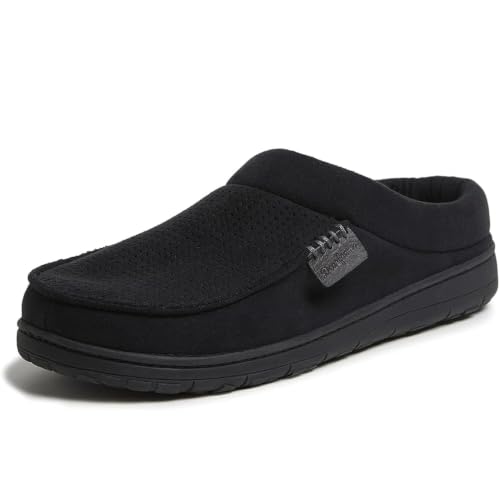
Dearfoams Men’s Brendan Breathable Memory Foam Clog — Best Overall
The Brendan is the pair we would hand to most men first. It is a clog, which is the friendliest shape for a wide foot: the open back removes heel squeeze entirely, the toe box is broad, and the perforated upper breathes instead of trapping heat — a real issue for wide feet, which generate more friction and more warmth inside a closed shoe. Dearfoams sells this model in wide widths, which is stated in the listing itself, and the memory foam footbed gives wide forefeet a forgiving surface to spread into.
Strengths
- Sold in stated wide widths, so the fit claim is in the listing, not in a review comment.
- Perforated, breathable upper keeps wide feet cooler than fleece-lined winter slippers.
- Clog shape with an indoor/outdoor sole — easy on, easy off, fine for hard floors and short trips outside.
Trade-offs
- Memory foam compresses over time, so the first-month plushness is not the year-two feel.
- The open back can slip on stairs if you rush; it is a clog, not a walking shoe.
- Perforation that helps in summer lets in cold air in winter — this is a warm-weather-leaning pick.
Spec box
- Style: clog house slipper
- Fit: wide widths (as listed)
- Footbed: memory foam
- Upper: perforated, breathable
- Sole: indoor/outdoor
What makes the Brendan work for wide feet is the combination rather than any single feature. Width alone does not fix a high instep, and the clog opening handles that by removing the top-of-foot pressure point entirely. Men who have given up on slippers because the strap or the vamp always digs in will find the open design a relief. The perforated upper also matters more than it sounds: wide feet in closed slippers get hot, hot feet sweat, and sweat makes linings break down faster. A breathable clog sidesteps that cycle for most of the year. Order your usual wide size; the memory foam needs a few wears to mold, and a clog that feels merely fine on day one usually feels right by day four. Check the current price on Amazon and confirm the wide option is selected before checkout, because this model is also sold in regular widths. Check the current price on Amazon.
Best for: men who want one dependable, breathable wide clog for year-round indoor wear. / Not suited for: men who need a closed heel for stairs, ladders or uneven ground.

Alpine Swiss Wide Men’s Steve Moccasin Slipper — Best Moccasin Style
Some men want a slipper that looks like a shoe they would not be embarrassed to answer the door in. The Alpine Swiss Steve is a corduroy slip-on moccasin with a terry lining, a memory foam footbed and a non-slip rubber sole, and — the point of its inclusion — it is a wide men’s slipper by design, in a wide fit with a roomy toe. Moccasin construction suits wide feet better than most styles, because the upper wraps under the foot rather than being lasted tightly over it, so the sides can give without a seam pressing into the widest part of the forefoot.
Strengths
- True moccasin wrap construction gives at the sides instead of squeezing the forefoot.
- Terry lining manages moisture better than synthetic fleece in mild weather.
- Rubber sole with grip for tile, wood and quick outdoor steps.
Trade-offs
- Corduroy upper is a casual look that will not pass for a dress shoe, whatever the photos suggest.
- Slip-on moccasin fit depends on instep height; very high insteps may find the vamp snug at first.
- Lighter lining means less insulation for cold floors in winter.
Spec box
- Style: moccasin slip-on
- Fit: wide (as listed)
- Lining: terry
- Footbed: memory foam
- Sole: non-slip rubber, indoor/outdoor
The Steve earns its place as the style pick that does not sacrifice the brief. Plenty of moccasin slippers are handsome and hopeless for wide feet; this one starts wide. The terry lining is a thoughtful choice for men whose feet run warm — it absorbs moisture instead of sealing it in — and the rubber sole makes it a genuine house-and-driveway slipper rather than a bedroom-only one. Fit note: moccasins relax with wear, and the wrap construction stretches across the width, so a first-day fit that is snug across the top usually settles. If you are between sizes and your feet swell in the evening, take the larger size. Check the current price on Amazon.
Best for: men who want a presentable, shoe-like wide slipper for all-day house wear. / Not suited for: men who need maximum insulation for unheated floors in winter.

ARIAT Lasso Men’s Suede Slippers, Wide — Best for Indoor/Outdoor Wear
The Lasso is the most substantial slipper in this guide: a suede closed-back slipper with a wide square toe, a western boot look, faux shearling warmth, a cushioned footbed, an EVA sole and a heel pull tab. The wide square toe is the detail that matters — square-toe geometry gives toes lateral room that a tapered toe never will, and ARIAT sells this model in a wide fit, in the listing, in sizes that run to a men’s 13 in the verified listing. The closed back and structured sole make it the pick for men who are in and out of the house all day.
Strengths
- Wide square toe gives toes genuine side-to-side room.
- Closed back and EVA sole handle garages, patios and driveways without complaint.
- Suede upper and faux shearling lining make it the warmest structured pick here.
Trade-offs
- The boot styling is a look you either like or you do not; there is no neutral version of it.
- Suede needs more care than washable synthetics and should not be soaked.
- Warmer and heavier than the clogs — overkill for summer evenings.
Spec box
- Style: closed-back suede slipper, square toe
- Fit: wide (as listed)
- Lining: faux shearling
- Footbed: cushioned
- Sole: EVA, indoor/outdoor
Think of the Lasso as the slipper for men who treat slippers as footwear rather than loungewear. The heel pull tab sounds minor until you are pulling a structured slipper onto a wide foot with one hand while holding coffee in the other. The cushioned footbed is firmer than memory foam, which many wide-footed men actually prefer over a long day: foam that bottoms out leaves a wide forefoot pressing on the sole, while a firmer bed keeps its shape. If your wide feet come with a lot of daily steps — workshop, yard, dog — this is the pair built for that life. Check the current price on Amazon.
Best for: wide-footed men who wear slippers as all-day indoor/outdoor footwear. / Not suited for: men who want a soft, packable travel slipper.

FitVille Extra Wide Men Slippers — Best Extra-Wide Fit
When “wide” is not wide enough, this is the pick. FitVille builds this slip-on house slipper on an extra-wide fit, and the difference shows up where it matters: the toe box. Men with genuinely broad forefeet — the ones who measure their feet and get letters beyond W — will find room here that the wide-width versions of regular slippers do not offer. It is a winter-weight slip-on with a non-slip sole, made for indoor and outdoor use.
Strengths
- Extra-wide fit with the roomiest toe box in this guide.
- Slip-on design with no laces or straps to fight a high instep.
- Non-slip sole suited to hard floors and cold-morning kitchen runs.
Trade-offs
- Winter weight and warmth make it a poor summer choice.
- The generous fit can feel loose on feet that are only slightly wide — this is for truly wide feet.
- Slip-on security depends on heel fit; men with narrow heels should check the listing’s guidance.
Spec box
- Style: slip-on house slipper
- Fit: extra wide (as listed)
- Season: winter weight
- Sole: non-slip, indoor/outdoor
FitVille’s whole brand is built around wide footwear, and that focus shows in the proportions: the extra width is in the last, not added by sizing up, which matters because sizing up a regular slipper adds length your toes do not need and leaves the heel sloppy. If you have been buying a size up in standard slippers and still feeling the squeeze, a true extra-wide in your actual length is the correction. Wear them with the socks you actually wear at home when judging the fit — winter slippers plus winter socks eat room fast. Check the current price on Amazon.
Best for: men whose feet are extra wide, not just wide, especially in winter. / Not suited for: men with average-width feet looking for a snug fit.

XIHALOOK Men’s Wide Toe House Slippers — Best Adjustable Fit
Feet are not the same size at 8 a.m. and 8 p.m., and wide feet that swell are the hardest fit problem in this category. The XIHALOOK answers it with an adjustable strap over a wide toe box: open it up in the evening, snug it down in the morning. The verified listing is a 12 Wide with soft memory foam, a water-resistant upper and a cozy warm lining, on a non-slip sole. Adjustability also makes this the most forgiving pick for men between sizes or with one foot noticeably wider than the other.
Strengths
- Adjustable strap adapts the fit through the day and between two different feet.
- Wide toe box plus soft memory foam for a forgiving, pressure-free fit.
- Water-resistant upper shrugs off kitchen splashes and damp bathroom floors.
Trade-offs
- Hook-and-loop straps lose grip over time if they collect lint — keep them clean.
- The cozy lining runs warm; hot sleepers may prefer the breathable clog.
- Strap styling is functional rather than handsome.
Spec box
- Style: adjustable-strap slip-on
- Fit: wide toe, 12 Wide in the verified listing
- Footbed: soft memory foam
- Upper: water-resistant, cozy lining
- Sole: non-slip
The honest way to frame this pick: it trades elegance for control. If your width problem is stable — your feet are wide and stay wide — a fixed wide last like the Brendan or the Lasso is simpler. If your width problem changes by the hour, or if you are buying for a man recovering from a foot issue who needs the opening wide one week and normal the next, an adjustable upper is the only design that keeps up. Set the strap so two fingers of ease remain across the top; a strap cranked tight defeats the entire point of a wide slipper. Check the current price on Amazon.
Best for: men whose feet swell, or whose two feet differ in width. / Not suited for: men who want a clean, strap-free moccasin look.

Ravelier Men’s Adaptive Wide Width Slipper Shoe — Best for Very Wide Sizes
Most wide slippers quietly give up above a size 13. The Ravelier adaptive slipper shoe is verified in a 15W — a size that wide-footed men usually have to hunt for — with an adjustable closure, memory foam, a breathable lightweight build and a machine-washable design on an indoor/outdoor non-slip sole. The “slipper shoe” shape, with a closed back and a structured upper, also makes it the most secure fit here for men who find clogs and mules walking off their heels.
Strengths
- Verified in 15W — real availability at the big end of the size range.
- Adjustable closure plus a closed back keeps the slipper on wide heels.
- Machine washable, which matters for a pair worn every day.
Trade-offs
- Adaptive styling reads more functional than fashionable.
- Lightweight build is less plush than the fleece-heavy winter picks.
- Big sizes sell through; check the listing for your exact size before planning around it.
Spec box
- Style: adaptive slipper shoe, closed back
- Fit: wide width, 15W in the verified listing
- Footbed: memory foam
- Care: machine washable
- Sole: non-slip, indoor/outdoor
There is a specific frustration this pick solves: the man who wears a 14 or 15 wide in shoes and finds every slipper guide written as if he does not exist. An adjustable, adaptive design in a genuine 15W, from a listing verified through the API, is worth more to him than any amount of plushness in a size that stops at 13. The washable build is the quiet second win — daily-wear slippers at this size are hard to replace, so a pair you can wash and keep fresh lasts longer in service. Check the current price on Amazon.
Best for: men in large wide sizes (up to 15W) who need a secure, washable daily slipper. / Not suited for: men who prioritize a fashionable look over fit range.
Comparison Table
| Pick | Badge | Key spec | Best for |
|---|---|---|---|
| Dearfoams Men’s Brendan Clog | Best Overall | Wide widths, perforated upper, memory foam | Year-round breathable wide fit |
| Alpine Swiss Steve Moccasin | Best Moccasin Style | Wide fit, terry lining, rubber sole | Shoe-like looks, mild weather |
| ARIAT Lasso Wide | Best Indoor/Outdoor | Wide square toe, suede, EVA sole | All-day wear, garage and patio |
| FitVille Extra Wide | Best Extra-Wide Fit | Extra-wide last, winter weight | Truly broad forefeet |
| XIHALOOK Wide Toe | Best Adjustable Fit | Adjustable strap, wide toe box | Feet that swell during the day |
| Ravelier Adaptive Wide | Best for Very Wide Sizes | 15W verified, adjustable, washable | Large wide sizes, secure fit |
How to Choose Slippers for Wide Feet
Start with the honest question: how wide are your feet, really? If you do not know, measure. Stand on a sheet of paper in the evening — feet are at their widest then — trace both feet, and measure the width across the ball of the foot. Compare that against the size chart on the listing, not against the size you wear in a different brand. Wide-fit labeling is unregulated in slippers: a W from one maker can equal a regular from another, which is why this guide only used listings that state the width in the product itself.
Next, decide where your width problem lives. Forefoot width calls for a wide or square toe box — the Lasso’s square toe or FitVille’s extra-wide last. A high instep calls for an open clog shape or an adjustable strap, because the pressure point is the top of the foot, not the sides. Heel slip calls for a closed back, because wide feet often pair a broad forefoot with an average heel, and open-back styles let that heel wander. Many men have two of the three, which is why adjustable closed-back designs like the Ravelier exist.
Then match the slipper to your floors and your climate. Hard floors reward a real sole with grip and a footbed that keeps its structure; carpet forgives almost anything. Cold floors reward insulation — suede and shearling-style linings — while warm houses reward breathability, like the Brendan’s perforated upper. Finally, think about socks. A wide slipper fitted barefoot in July will be tight over wool socks in January. If you are a year-round sock wearer, fit for the sock.
Wide, Extra Wide and Adjustable: What the Labels Actually Mean
A “wide widths” listing means the maker cut the pattern on a wider last — more volume everywhere, in proportion. “Extra wide” means a second step beyond that, and it is the right answer when standard wides still pinch the forefoot. An adjustable slipper is a different solution to the same problem: the last may be only moderately wide, but the upper opens, so the effective volume adapts. Adjustable designs are the most forgiving for asymmetry and swelling; fixed extra-wide lasts are the most comfortable for feet that are simply built broad. Neither is better in the abstract — they solve different versions of wide.
It is also worth knowing that width letters and width words do not map neatly onto each other between brands. One maker’s “wide” may be built for a foot that another maker calls regular-plus, and a numeric width in a shoe brand does not transfer to a slipper brand at all. That is not a reason to give up on labels — it is a reason to treat the listing’s own size chart, with measurements, as the only trustworthy translation, and to prefer brands whose entire business is wide footwear when your measurements sit at the extremes.
One warning that applies to every label: never solve width by buying length. A size up in a regular slipper puts the widest part of the shoe past the widest part of your foot, adds a flapping toe, and leaves the heel loose. If a brand does not offer your width, the correct move is a different brand from this list, not a longer size in the wrong one.
How to Measure Your Feet and Check the Fit at Home
Measure both feet in the evening, standing, wearing the socks you will wear with the slippers. Trace each foot on paper, measure length and ball width, and use the larger foot’s numbers against the listing’s chart. When the slippers arrive, do the fit check on hard floor, not carpet — carpet hides pressure. You should be able to spread your toes without the upper pulling, the ball of your foot should sit inside the footbed without spilling over the edge, and the top of your foot should show no strap or vamp marks after ten minutes of wear. Walk stairs if you will use them in the slippers; clogs that feel fine on the flat can shift on steps. Keep the packaging until you have done an evening test, because a slipper that fits at noon can fail at eight o’clock on swollen feet.
Materials and Footbeds: What Lasts on a Wide Foot
Wide feet are harder on slippers than narrow ones. More width means more lateral force on seams, more friction on linings, and more weight spread across the footbed. Memory foam is the most common footbed in this category and it is genuinely comfortable, but it is a consumable: it molds, then it thins. A firmer cushioned bed, like the Lasso’s, trades initial plushness for shape retention. Removable or structured insoles extend a slipper’s life because the part that wears out can be the part you replace. On uppers, suede and leather tolerate lateral stretch better than thin synthetics; terry and knit linings handle moisture better than dense fleece. Whatever you choose, rotate two pairs if you wear slippers all day — foam recovers between wears, and a rotated pair easily outlasts two pairs worn back to back.
Slipper Styles Compared for Wide Feet
Clogs are the most forgiving style for width because they remove two pressure points at once: the heel cup and, in open designs, much of the top-of-foot squeeze. A clog’s weakness is security — on stairs, carrying laundry, or stepping off a curb, an open back can shift. For flat, single-level living, the clog is the easiest wide fit to get right, which is why the Brendan leads this guide.
Moccasins wrap the upper under the foot, so the material that surrounds your forefoot is continuous rather than seamed, and continuous material gives. A moccasin in a true wide, like the Alpine Swiss Steve, suits men whose width is moderate and whose priority is an all-day, shoe-like feel. The fit depends on instep height more than any other style, so high-instep men should expect a break-in period or choose another shape.
Closed-back and boot-style slippers are the secure end of the spectrum. The Lasso’s closed back and structured sole behave almost like a shoe, and for wide men who move around the house and yard all day, that security is worth the extra warmth and weight. The trade-off is that a closed back has nowhere to hide a fit problem: if the width is wrong, you feel it everywhere, all day.
Adjustable and adaptive slippers — the XIHALOOK and the Ravelier — trade a clean look for control over volume. They are the right answer when width is a moving target: swelling, asymmetry between feet, bandages or braces, or a household where one pair must fit a man whose feet are changing. They are also the easiest styles to put on with limited mobility, because the upper opens wide instead of asking the foot to push through a fixed opening.
Scuffs and open-back mules are the style we deliberately did not pick. They are easy to step into, but a wide heel tends to walk out of them, the toes grip to keep them on, and that gripping is exactly the fatigue wide-footed men complain about by evening. Every style above holds a wide foot better than a scuff does.
What Wide-Footed Men Actually Complain About (and the Fix)
Read enough fit feedback from wide-footed men and the same four complaints repeat. The first is the strap or vamp digging across the top of the foot — an instep problem, fixed by clog openings and adjustable straps, not by more width. The second is toes pressing the front of the toe box even in the correct length — a toe-box shape problem, fixed by square or extra-wide lasts like the Lasso’s and FitVille’s. The third is the foot spilling over the side of the footbed, visible as the upper bulging outward — a last-width problem, fixed only by a genuinely wider pattern, never by sizing up. The fourth is heel slip in open styles — a style problem, fixed by a closed back. Naming which complaint is yours is the fastest route through this guide: match the complaint to the fix, then pick the model that embodies it.
Wide Slippers by Season: One Pair Rarely Does It All
The wide-fit problem changes with the weather, and so should the slipper. In summer, the enemy is heat: a wide foot in a closed, fleece-lined slipper sweats, and a sweaty lining both feels worse and wears out faster. That is the Brendan’s season — perforation and an open clog shape move air across the foot, and the memory foam stays comfortable without insulation you do not need. Warm-house households can wear it most of the year, but if your floors are tile over a cold slab, you will feel January through any breathable upper.
Winter reverses the brief. Cold floors punish thin soles first, so insulation in the sole matters as much as insulation in the upper. The Lasso’s suede and faux shearling and the FitVille’s winter weight earn their place here, and both pair naturally with socks — remember to size for the sock, because a wide foot plus a wool sock is a different fit problem than a wide foot alone. The shoulder seasons are where adjustable designs quietly win: the XIHALOOK strap snug over bare feet in September can open up over socks in November without changing pairs. If your budget stretches to two pairs, make them a breathable clog and an insulated closed-back; that combination covers more of the year, more comfortably, than any single compromise pair we verified.
Care and Cleaning: Making a Wide Pair Last
Wide slippers die at the seams and in the footbed, and both deaths can be slowed. Seams fail because lateral force is constant, so the single best habit is rotation: foam and stitching both recover when a pair rests a day between wears, and two rotated pairs will outlast the same two pairs worn consecutively. Between wears, stand slippers somewhere air moves rather than in a closed closet — linings that dry fully between uses smell better and break down slower.
For cleaning, follow the listing for your specific pair. The Ravelier is machine washable, which is one of its genuine advantages for a daily-wear pair; wash cold, air dry, and never put any foam footbed through a hot dryer cycle, because heat is what permanently collapses memory foam. Suede like the Lasso’s should be brushed, spot-cleaned and kept out of soaking water entirely. Terry and knit linings tolerate gentle washing better than fleece. Adjustable straps need one specific chore: press the hook-and-loop closed before washing and pick lint out of the hooks monthly, because a strap clogged with fluff is a strap that lets go on the stairs. Finally, check soles twice a year. A wide man’s weight spread over a worn-smooth sole on a wet kitchen floor is the one genuinely dangerous failure mode in this category, and it is entirely visible in advance if you look.
Who Should Skip Wide Slippers Entirely
Honesty about fit cuts both ways. If your feet are a standard width and you simply like a roomy toe, a wide slipper will feel sloppy at the heel and the upper will crease and wear oddly — buy a standard-width slipper with a generous toe box instead. If your width comes with significant foot pain, numbness or a diagnosed condition, a shopping guide is the wrong tool: the picks here are comfort footwear chosen for fit, and nothing in this article is a medical recommendation. And if you need a slipper for standing work on concrete all day, even the sturdiest pick here is out of its depth — that is a work shoe’s job, and a supportive shoe in a true wide width will serve you better than any house slipper.
Common Buying Mistakes
The first mistake is trusting the word “wide” without checking where it is stated. If the width is not in the listing’s title, options or size chart, it is marketing, not sizing. The second is sizing up for width, covered above — it creates three fit problems to solve one. The third is buying a scuff or mule for a wide heel and then shuffling to keep it on; wide feet deserve a back. The fourth is ignoring the sole: a wide man on a thin fabric sole feels every tile edge, and a no-grip sole on polished wood is a fall waiting for a wet kitchen floor. The fifth is forgetting the evening test — feet swell, and a morning fit check is how wide-footed men end up with slippers they only wear before noon. The sixth is treating all wide slippers as winter slippers; a breathable clog for summer and an insulated pair for winter beats one compromised pair for both.
What You Get at Each Tier
Wide slippers sort into three honest tiers, and knowing them keeps you from paying for the wrong thing. At the budget tier you get a correctly wide last in synthetic materials with a foam footbed — the fit problem is solved, and what you give up is longevity: linings thin, foam packs down, and a daily-worn pair is a yearly purchase. That is a fair trade for a first wide pair while you learn what your feet actually need. The mid tier adds better materials and construction — real suede, stitched moccasin wraps, firmer cushioned beds, soles that grip — and the payoff is a pair that holds its fit through a second and third season. The premium and specialty tier is where adaptive closures, very large wide sizes and washable constructions live; you are paying for range and adjustability rather than luxury, and for men in a 14 or 15 wide, or with feet that change size through the day, that tier is not an indulgence — it is the only tier that fits at all. Across all three, the rule is the same: pay for width that is built into the last, and treat every other feature as secondary.
Final Recommendation
For most men, start with the Dearfoams Brendan: it is breathable, honestly wide, and easy to live with. If your feet are extra wide rather than wide, go straight to the FitVille Extra Wide. If your width changes through the day, the adjustable XIHALOOK or the Ravelier in sizes up to 15W will fit when fixed lasts will not. For all-day indoor/outdoor wear, the ARIAT Lasso Wide is the sturdiest pair here, and for a slipper that looks like a shoe, the Alpine Swiss Steve moccasin is the pick. Shopping for the rest of the household too? See our guides to Best House Slippers Wide Width, Best Big And Tall Slippers, Best Slippers For Wide Feet Womens and Best Women’s Slippers For Extra Wide Feet, plus Best Soft And Wide Open Summer Slippers when the weather turns warm.
Related guides
Frequently Asked Questions
How do I know if I need wide or extra wide slippers?
If standard slippers pinch the sides of your forefoot or leave marks across the ball of your foot, start with wide. If wide widths in your regular shoes still feel tight, or your measured ball width sits at the top of a brand’s wide range, go extra wide. When in doubt, an adjustable upper covers the gap between the two.
Should wide slippers feel loose at first?
They should feel roomy across the toes, not loose at the heel. A wide fit adds width, not length, so your heel should still sit securely — especially in closed-back styles. Slipping at the heel usually means the size is too long, not too wide.
Are memory foam slippers good for wide feet?
Yes for comfort, with a caveat: foam molds to a wide forefoot nicely but compresses over months of daily wear. If you wear slippers all day, a firmer cushioned footbed or a rotation of two pairs keeps the support consistent for longer.
Can I wear wide house slippers outside?
The picks here with rubber or EVA indoor/outdoor soles — the Brendan, the Steve, the Lasso, the FitVille and the Ravelier — handle dry patios, garages and driveways fine. They are not rain shoes, and suede uppers in particular should stay out of wet weather.
What if one foot is wider than the other?
Fit the larger foot and choose an adjustable design, like the XIHALOOK strap or the Ravelier closure, so the smaller foot can be snugged down independently. Fixed lasts force you to choose which foot to disappoint.
Do wide slippers stretch over time?
Uppers do, footbeds do the opposite. Suede, leather and moccasin wraps relax across the width during the first weeks, which is why a slightly snug top fit can settle in. Synthetic uppers stretch less and recover more. Memory foam, meanwhile, only ever compresses — so judge a new pair by its upper fit, knowing the material will give a little, and never buy a pair that is tight hoping the foam will make room, because the foam’s only direction is thinner.
How often should wide slippers be replaced?
When the footbed stays compressed, the upper stretches enough that your foot spills over the footbed edge, or the sole’s grip is worn smooth. For daily wearers that is commonly somewhere in the one-to-two-year range; rotating two pairs stretches it considerably.


