Disclosure: airfryerkitchensupply.com is reader-supported. When you buy through links on our site, we may earn an affiliate commission at no extra cost to you.
Where to Buy
All six picks are on Amazon:
- Dearfoams Leslie Clog
- Dearfoams Rebecca Slipper
- Dearfoams Darcy Clog
- Acorn Chinchilla Bootie
- RockDove Birdseye Knit Slipper
- ULTRAIDEAS Women’s Hard Bottom Slipper
Shopping for the best slippers for diabetics for women should start with one honest note, because it matters more than any product here: slippers are comfort footwear, not medical devices. Nothing in this guide treats, prevents or protects against any medical condition, and any woman managing diabetes who has foot concerns — sores, swelling changes, numbness, circulation problems or a history of foot ulcers — should follow her own doctor’s or podiatrist’s guidance on footwear first and treat this list as shopping help only. With that said plainly, the best slippers for diabetics for women are chosen on practical comfort criteria that anyone can judge: soft interiors, easy slip-on shapes, roomy fits that do not squeeze, and construction without harsh features rubbing at the foot.
Those criteria shaped every pick below. The six are women’s house slippers whose verified titles support the comfort brief — memory foam cushioning, wide-width options, washable builds, plush soft linings and non-slip soles. Listings whose main pitch is medical — products sold primarily on health claims rather than comfort — were deliberately excluded from this guide, and the wording used here stays with what the titles actually describe: materials, fit and feel. Check the current price on Amazon for the pair that suits your feet and your home.
Important: The slippers in this guide are comfort footwear chosen for softness, fit and ease of wear. They are not medical devices, and they do not treat, prevent or protect against diabetes or any foot condition. If you have diabetes and any concern about your feet, follow the guidance of your doctor or podiatrist on footwear and foot care.
Key Takeaways
- Slippers are comfort footwear, not medical devices — your clinician’s guidance comes first.
- Judged on physical features only: soft interiors, roomy wide-width fits, easy slip-on shapes.
- Listings that lead with medical claims were excluded from these picks on purpose.
- Memory foam, non-slip soles and washable builds are the daily-comfort basics here.
In this guide
Quick Picks
Best Overall Comfort — Dearfoams Women’s Leslie Washable Memory Foam Terry Clog (Wide Widths): Women who want a soft, roomy, washable everyday clog with an easy slip-on shape. Check price on Amazon
Best Closed Back — Dearfoams Women’s Rebecca Closed Back Slipper (Wide Widths): Women who dislike open-back slippers slipping at the heel and want a held, secure fit. Check price on Amazon
Best Easy Slip-On — Dearfoams Women’s Darcy Velour Clog (Wide Widths): Women who want the softest-feeling upper and a roomy clog that can step onto the porch. Check price on Amazon
Best for Cold Floors — Acorn Women’s Chinchilla Bootie Slipper: Women in cold homes who want warmth, ankle coverage and a sole with real grip. Check price on Amazon
Best Breathable — RockDove Women’s Birdseye Knit Memory Foam Slipper: Women whose feet run warm and who want a light, washable, breathable daily pair. Check price on Amazon
Best Hard Bottom — ULTRAIDEAS Women’s Memory Foam House Slippers (Hard Bottom): Women who want one sturdy pair for the whole house-and-garden routine. Check price on Amazon
How These Picks Were Chosen
Picks were verified through Amazon listing held for this site, then screened on comfort criteria only: a soft, cushioned footbed; an easy-on shape (clog, scuff or bootie) that does not require bending and forcing; availability of wide widths where the title states them; and interiors without aggressive seams or hard trims described in the listing. Products whose titles lead with medical or therapeutic claims were excluded on principle — this guide recommends slippers for comfort, and leaves medical footwear decisions to clinicians who know the individual foot.
The final six cover the main comfort preferences: two washable wide-width clogs and closed-back slippers from Dearfoams, a velour clog in wide widths, a plush bootie with a multi-layer memory foam footbed for cold floors, a breathable knit for warm feet, and a hard-bottomed pair for women who step outside often. Sizing and width information comes only from the verified titles; where a title gives a size range, the spec box shows it, and where width options are not stated, the guide does not invent them.
The screening also applied a language rule worth explaining: product titles were read for physical facts — materials, widths, footbed construction, soles, care — and those facts, quoted plainly, are all this guide claims. Where a well-known comfort product’s title happened to include medical wording, that wording is recorded in this article’s source file for transparency but is not repeated in the article, because the recommendation stands on the product’s comfort features alone. Readers comparing listings elsewhere can apply the same rule in seconds: features you can touch are information; promises about conditions are marketing.
The 6 Best Slippers for Diabetics for Women

Dearfoams Women’s Leslie Washable Memory Foam Terry Clog (Wide Widths) — Best Overall Comfort
The Leslie leads on the combination daily comfort actually needs: a wide-width option in its title, memory foam cushioning and a washable terry clog shape that slips on without bending or forcing.
Strengths
- Wide widths stated in the title — room for feet that should not be squeezed
- Washable terry build keeps a daily-worn pair fresh with minimal effort
- Memory foam footbed cushions hard floors for standing and pottering
Trade-offs
- Open clog heel is easy-on but less secure on stairs — take care and size honestly
- Terry fabric is soft and absorbent but slower to dry after washing
- Foam cushioning compresses gradually with daily wear, like all foam footbeds
| Specification | Detail (from verified listing title) |
|---|---|
| Style | Terry clog, slip-on |
| Footbed | Memory foam |
| Fit (per title) | Wide widths available |
| Care (per title) | Washable |
Comfort, judged practically, is mostly about absence — no squeezing, no rubbing, no wrestling the shoe on. The Leslie’s title covers the three absences that matter most. Wide widths mean the clog can be chosen to fit the foot’s actual width rather than compressing it, which is the single most valuable fit feature in this entire guide. The terry upper is soft against the top of the foot, the memory foam footbed takes the edge off hard kitchen and bathroom floors, and the clog shape asks nothing of the wearer — step in and go, which matters on stiff mornings and after long days. Washability completes the daily-use case, because a pair worn every day should be easy to keep fresh. The honest limits are the clog’s own: an open heel is less secure on stairs, terry dries slowly after its wash, and no slipper — this one included — is a medical device. As a comfort-first everyday pair, it is the strongest all-round answer here.
Best for: Women who want a soft, roomy, washable everyday clog with an easy slip-on shape / Not suited for: Anyone needing a closed heel for security, or whose clinician has specified particular footwear
Check the current price on Amazon

Dearfoams Women’s Rebecca Closed Back Slipper (Wide Widths) — Best Closed Back
The Rebecca is the held-fit option: a lightweight closed-back slipper with memory foam and wide widths in its title, for women who want the slipper to stay put.
Strengths
- Closed back keeps the slipper on the foot — the secure-feeling option in this guide
- Wide widths in the title, so the secure fit does not have to mean a tight one
- Lightweight build is easy on tired legs across a full day at home
Trade-offs
- Closed back takes a moment more to put on than a clog — no step-in-and-go
- Title does not state washability — check care on the listing
- A snugger style overall; measure and use the width options rather than sizing up blindly
| Specification | Detail (from verified listing title) |
|---|---|
| Style | Closed back slipper |
| Footbed | Memory foam |
| Fit (per title) | Wide widths available |
| Weight (per title) | Lightweight |
Open-back slippers have one persistent annoyance — they slip at the heel, shift on stairs and occasionally slide off entirely. The Rebecca answers with a closed back, and pairs it with the two features that keep a closed style comfortable rather than confining: memory foam underfoot and wide-width options in the title, so the security comes from shape, not squeeze. Dearfoams describes it as lightweight and cozy, and light weight is an underrated comfort feature in a slipper worn from morning to night — heavy footwear is its own fatigue by evening. The trade-offs are small and practical: a closed back takes a second longer to put on, and the title does not claim washability, so check the care instructions on the listing before buying if easy washing is essential to you. For women whose first complaint about slippers is that they will not stay on, this is the pick.
Best for: Women who dislike open-back slippers slipping at the heel and want a held, secure fit / Not suited for: Anyone who needs the absolute easiest step-in shape, or a clinician-specified shoe
Check the current price on Amazon
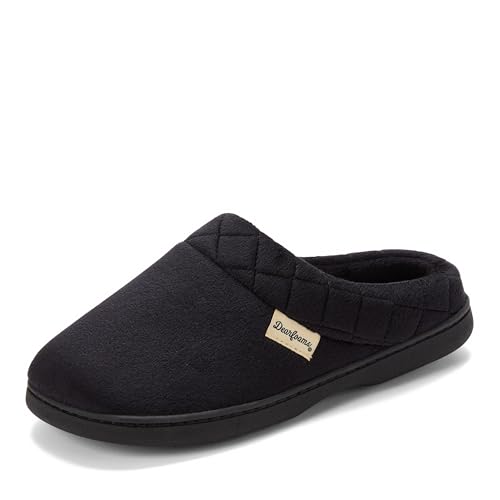
Dearfoams Women’s Darcy Velour Clog (Wide Widths) — Best Easy Slip-On
The Darcy wraps the wide-width memory foam formula in a microfiber velour upper — the softest-feeling clog in this guide — with an indoor/outdoor sole.
Strengths
- Velour microfiber upper is soft against the foot with a smoother finish than terry
- Wide widths stated in the title — roomy fit without sizing up and slipping
- Indoor/outdoor positioning means a sole made for quick steps outside
Trade-offs
- Clog heel is open — the stairs caveat applies as with the Leslie
- Velour shows marks more readily than knit uppers; brush or spot-clean promptly
- Title does not claim washability, unlike the terry Leslie
| Specification | Detail (from verified listing title) |
|---|---|
| Style | Microfiber velour clog |
| Footbed | Memory foam |
| Fit (per title) | Wide widths available |
| Use (per title) | Indoor/outdoor |
If the Leslie is the practical pick, the Darcy is the tactile one. Microfiber velour has a smoother, softer hand than terry or knit, and against feet that are dressed and undressed many times a day, that surface kindness is a real, daily pleasure rather than a luxury. The fundamentals match the guide’s comfort brief: memory foam cushioning, wide widths in the title so the fit can be roomy without being sloppy, and an indoor/outdoor rating that means the sole tolerates the porch, the bins and the garden path without a shoe change. The compromises are care and security: velour marks more visibly than a heathered knit and wants prompt spot-cleaning, the title does not claim machine washability, and the open clog heel shares the usual stairs caution. Choose the Darcy when the feel of the upper is your deciding factor and the Leslie when washability is.
Best for: Women who want the softest-feeling upper and a roomy clog that can step onto the porch / Not suited for: Anyone who prioritises machine washability above upper softness
Check the current price on Amazon

Acorn Women’s Chinchilla Bootie Slipper — Best for Cold Floors
Acorn’s Chinchilla bootie is the cold-floor answer: plush faux fur, a multi-layer memory foam footbed and a rubber sole, in a shape that wraps the ankle and stays on.
Strengths
- Bootie shape wraps the ankle — warmth and a slipper that cannot slide off the heel
- Multi-layer memory foam footbed stated in the title, a step beyond a single foam pad
- Rubber sole gives real grip and structure for hard, cold floors
Trade-offs
- The warmest pick here — too warm for heated floors and summer wear
- Bootie fit is closer than a clog; wide feet should check sizing carefully, as widths are not stated in the title
- Plush faux fur needs gentle care and slower drying
| Specification | Detail (from verified listing title) |
|---|---|
| Style | Bootie slipper |
| Upper (per title) | Plush faux fur |
| Footbed (per title) | Multi-layer memory foam footbed |
| Sole (per title) | Rubber sole |
Cold is a comfort problem with a simple shape of solution — coverage. The bootie covers the ankle that clogs and scuffs leave bare, the plush faux fur lining holds warmth around the whole foot, and the result is the pair women in cold houses reach for from October to April. Acorn’s footbed deserves its title billing: ‘multi-layer memory foam’ describes a constructed footbed rather than a single pad, and under a full day of standing and moving around a cold home, that construction is the difference between cushioning that lasts the day and cushioning that gives up by lunch. The rubber sole completes the winter brief with grip on the smooth floors where cold homes need it most. Honesty notes: widths are not stated in this title, so wider feet should study the listing’s sizing; the bootie is genuinely warm, which is a flaw in summer; and like every pick here, it is a comfort slipper, not a medical device. For cold floors, it is the guide’s warmest recommendation.
Best for: Women in cold homes who want warmth, ankle coverage and a sole with real grip / Not suited for: Warm-footed wearers, or anyone who needs a stated wide-width option
Check the current price on Amazon

RockDove Women’s Birdseye Knit Memory Foam Slipper — Best Breathable
RockDove’s Birdseye knit slipper is the breathable option: a light, machine-washable open-back with memory foam and a non-slip sole, for feet that run warm.
Strengths
- Breathable knit upper — the pick for feet that overheat in lined slippers
- Machine washable per the title, with a non-slip sole for hard floors
- Lightweight, easy slip-on shape for constant on-and-off wear
Trade-offs
- Open back is the least secure shape here for stairs
- Knit gives less structure than the clogs — a relaxed fit, not a held one
- Warmth is modest; cold-floor households should take the bootie instead
| Specification | Detail (from verified listing title) |
|---|---|
| Style | Open back slip-on |
| Upper (per title) | Birdseye knit, breathable |
| Footbed | Memory foam |
| Care (per title) | Machine washable; non-slip sole |
Warmth is not everyone’s comfort problem — for many women, the daily slipper failure is heat: lined, enclosed pairs become stifling by mid-morning and get kicked off, which helps nobody. The Birdseye knit answers with airflow. The knitted upper breathes, the open back vents, and the whole slipper stays light on the foot, while memory foam and a non-slip sole keep the practical basics covered. Machine washability, stated in the title, suits a pair designed to be worn barefoot and often. The shape’s limits are the open back’s usual ones — less security on stairs, a relaxed rather than held fit — and knit uppers offer less structure than the Dearfoams clogs, with no wide-width claim in the title. Judge it as the warm-weather and warm-foot specialist of this guide and it is exactly right: the pair that stays on your feet because your feet stay comfortable in it.
Best for: Women whose feet run warm and who want a light, washable, breathable daily pair / Not suited for: Anyone wanting ankle warmth, a closed heel, or a stated wide-width fit
Check the current price on Amazon

ULTRAIDEAS Women’s Memory Foam House Slippers (Hard Bottom) — Best Hard Bottom
ULTRAIDEAS’ women’s slipper is the sturdy option: memory foam and a fur lining over a hard, non-slip bottom built for indoor and outdoor wear.
Strengths
- Hard bottom stated in the title — a structured sole for women who step outside often
- Fur lining adds warmth around a memory foam footbed
- Non-slip sole for the kitchen, bathroom and porch circuit of daily life
Trade-offs
- A hard bottom feels firmer and less slipper-like for curling up on the sofa
- Fur lining runs warm — not the breathable pick
- Widths are not stated in the title; check the listing’s sizing if width is your deciding factor
| Specification | Detail (from verified listing title) |
|---|---|
| Style | House slipper, fur lined |
| Footbed | Memory foam |
| Sole (per title) | Hard bottom, non-slip sole |
| Use (per title) | Indoor outdoor |
Some households ask more of a slipper than the house. Dogs need letting out, gardens need checking, bins need taking — and a soft-bottomed slipper fails that routine at the first wet step. This ULTRAIDEAS pair is built for it: a hard bottom, stated in the title, that behaves like a light shoe sole; a non-slip tread for the smooth floors inside; and a fur lining with memory foam so the sturdiness does not cost the foot its comfort indoors. It is, deliberately, the most shoe-like pick in this guide, and that is its virtue and its limitation in one — the hard bottom that shrugs off the garden path feels firmer when you curl up in the evening, and the warm lining is not the choice for hot feet. Widths are not stated in the title, so let the listing’s size information guide you. For women whose slippers live an indoor-outdoor life, this is the durable answer.
Best for: Women who want one sturdy pair for the whole house-and-garden routine / Not suited for: Anyone wanting the softest, most flexible slipper feel, or a stated wide width
Check the current price on Amazon
Comparison Table
| Pick | Badge | Key spec | Best for | Amazon |
|---|---|---|---|---|
| Dearfoams Women’s Leslie Washable Memory Foam Terry Clog (Wide Widths) | Best Overall Comfort | Style: Terry clog, slip-on | Women who want a soft, roomy, washable everyday clog with an easy slip-on shape | Check price |
| Dearfoams Women’s Rebecca Closed Back Slipper (Wide Widths) | Best Closed Back | Style: Closed back slipper | Women who dislike open-back slippers slipping at the heel and want a held, secure fit | Check price |
| Dearfoams Women’s Darcy Velour Clog (Wide Widths) | Best Easy Slip-On | Style: Microfiber velour clog | Women who want the softest-feeling upper and a roomy clog that can step onto the porch | Check price |
| Acorn Women’s Chinchilla Bootie Slipper | Best for Cold Floors | Style: Bootie slipper | Women in cold homes who want warmth, ankle coverage and a sole with real grip | Check price |
| RockDove Women’s Birdseye Knit Memory Foam Slipper | Best Breathable | Style: Open back slip-on | Women whose feet run warm and who want a light, washable, breathable daily pair | Check price |
| ULTRAIDEAS Women’s Memory Foam House Slippers (Hard Bottom) | Best Hard Bottom | Style: House slipper, fur lined | Women who want one sturdy pair for the whole house-and-garden routine | Check price |
How to Choose Comfortable Slippers: A Practical Checklist
This checklist is about comfort and fit only — for anything medical, your clinician’s advice comes first and this list does not compete with it. One: fit without squeeze. Feet should have room to lie naturally; wide-width options, where a title states them, are the honest way to get that room, rather than sizing up into a slipper that then slips at the heel. Two: a soft interior. Look for plush, terry, velour or knit uppers whose surfaces are kind to skin, and check product photos for bulky interior seams or hard trims across the toes — if a seam would annoy any foot, it does not belong in a daily slipper. Three: easy on and off. Clogs, scuffs and step-in booties ask nothing of stiff fingers or sore backs; lace-ups and stiff shoes belong to a different routine.
Four: cushioning that matches your floors. Memory foam — in every pick here — takes the edge off tile, wood and laminate, and a constructed multi-layer footbed like the Acorn’s will outlast a thin pad. Five: a sole you can trust. Non-slip soles, stated in several titles here, matter on kitchen and bathroom floors, and a hard or rubber bottom is the right choice if your routine includes the garden or the porch. Six: care you will actually do. A washable pair stays pleasant; a pair that needs delicate hand care will quietly stop being worn. Judge every slipper — in this guide and beyond it — against those six practical points and the marketing falls away.
Fit, Socks and Daily Habits That Keep Feet Comfortable
Try slippers on at the end of the day, when feet are at their largest, and with the socks you actually wear at home — or barefoot, if that is your habit. A pair that fits a morning foot in a shop can squeeze an evening foot at home. Walk in them on a hard floor, not carpet: the footbed and sole you are judging only show themselves on the surfaces you live on. If a slipper needs a breaking-in period to stop rubbing, it is the wrong slipper; daily comfort footwear should feel right on day one.
Habits matter as much as products. Rotate two pairs if you can, so each dries and recovers between wears. Keep a pair by the bed and a sturdier pair by the door rather than asking one pair to do everything. Wash or air pairs regularly, and replace a pair when its sole smooths or its footbed flattens — worn-out slippers stop cushioning long before they stop looking acceptable. And repeat the guide’s opening note in daily life: new foot pain, sores that do not heal, or changes in swelling and sensation are reasons to see a doctor promptly, not reasons to buy different slippers.
Matching Comfort Features to Everyday Situations
Cold homes and cold floors call for coverage and insulation: the Acorn bootie in this guide wraps the ankle, and the fur-lined ULTRAIDEAS adds a hard bottom for floors that stay cold through the slippers’ soles. Warm homes and warm feet call for the opposite — the RockDove’s breathable knit exists because a slipper that overheats its wearer gets kicked off, and a kicked-off slipper provides no comfort at all. Neither preference is a compromise; they are different households, and the honest move is to buy for the thermometer you actually live with.
Busy, upright days — cooking, cleaning, grandchildren, dogs — reward structure: the Dearfoams clogs’ easy step-in shape, a sole with stated grip, and a fit that does not need adjusting every ten steps. Slow, seated days reward softness and warmth above structure, and make the closed-back Rebecca’s held fit and the bootie’s wrap feel like the luxury they are. Stairs deserve their own sentence: any open-back style asks for a hand on the rail and unhurried steps, and households where stairs are constant should weight closed backs and secure fits accordingly.
Travel and hospital-bag practicality is the last situation worth planning for. A washable, packable pair — the Leslie or the RockDove here — goes into a bag clean, comes out familiar, and returns home to the washing machine. Familiar footwear in an unfamiliar place is a small comfort with an outsized effect, and it costs nothing but forethought. As ever in this guide, these are comfort and practicality judgements only; anything about a specific foot’s medical needs belongs to the clinician who knows that foot.
A Two-Pair System: House Pair and Door Pair
One practical system suits almost every household in this guide’s audience: a soft house pair that lives indoors, and a sturdier door pair that handles everything beyond the threshold. The house pair is chosen purely for interior comfort — the Dearfoams clogs or the Rebecca’s closed back, soft inside, easy on and off, never worn outside where soles pick up grit and damp. The door pair is the hard-bottomed ULTRAIDEAS model in this guide’s picks: a structured, non-slip sole for the porch, the garden path and the bins, kept by the door it serves. Two pairs, two jobs, no compromises asked of either.
The system pays for itself in cleanliness and lifespan. A house pair that never goes outside stays cleaner, needs washing less often and keeps its interior pleasant for far longer; a door pair that is built for outside work does not have its sole ground down by a role it was not designed for — or rather, it is designed for exactly that role, and wears accordingly. Rotation between the two also rests each pair’s footbed on alternate days, the same foam-recovery logic this guide recommends for daily slippers generally.
Setting the system up takes one decision: where each pair lives. House pair by the bedroom or bathroom door, door pair on a mat by the exit, and the habit forms itself within a week. Add a third, washable travel pair — the Leslie or the RockDove knit — only if trips and overnight stays are a regular part of life. Keep the system simple, keep both pairs in good repair, and the daily question of what to put on your feet answers itself.
Comfort Language vs Medical Claims: How to Read Slipper Listings
Slipper listings speak two languages. Comfort language describes what a product is: memory foam, wide widths, plush lining, non-slip sole, washable. Medical language promises what a product will do for a condition. This guide was built entirely from the first language — every feature in every spec box is a physical fact stated in a verified title — and listings that led with the second language were excluded from the picks, because a slipper’s job is to be soft, roomy and kind, and promising more than that would be dishonest.
That distinction is a useful shopping tool beyond this guide. When a listing’s headline is a diagnosis, ask what physical features sit underneath the claim; when the answer is the same memory foam and wide fit described in plain comfort terms elsewhere, buy on the features and the fit, at the comfort price. And when a foot genuinely needs therapeutic footwear, that is a conversation for a podiatrist who can examine the foot — no product page, including this one, can have it for you.
Why ‘Soft, Roomy, Easy’ Is the Whole Philosophy
Strip the marketing from every category of comfort footwear and three physical properties remain: the surface against the skin should be soft, the space around the foot should be generous, and getting the shoe on and off should ask nothing of the wearer. Those three properties are judgeable by anyone, from a listing, without expertise — which is precisely why this guide is built on them. A shopper armed with ‘soft, roomy, easy’ plus a sole she trusts can evaluate any slipper in any shop, and no headline, however medical its vocabulary, adds information beyond those facts.
The philosophy has a second half: know what a product cannot do. Slippers cannot monitor, medicate or mend. Treating them as comfort equipment — excellent at comfort, silent on everything else — keeps expectations honest and attention where it belongs: on the daily habits of foot care that clinicians actually recommend, and on seeking help promptly when something changes. A guide that sold slippers as more than slippers would be doing its readers a disservice, and this one declines to.
There is a dignity point in ending here. Women shopping with this search are usually shopping for themselves or for a mother or friend, and what they want is a good pair of slippers and straight information. The straight information is that the best pairs are soft inside, roomy in fit, easy to wear and honestly described — six of which are reviewed above — and that the rest of foot care is a conversation with a professional. Buy the slippers for comfort, keep the medicine with the clinicians, and both will do their jobs properly.
Reading Reviews and Listings With a Clear Eye
Finish with a skill that outlasts any single purchase: reading a slipper listing like an editor. Start with the title and list only its physical facts — material, width, footbed, sole, care. That list, and nothing else, is what the manufacturer is verifiably telling you. Then read the description for sizing honesty: a brand that publishes its size ranges and width options plainly, as the titles in this guide do, is a brand communicating like a maker rather than a marketer. Photographs of the interior, where provided, are worth more than lifestyle images of the exterior.
Reviews need the same discipline. Look for comments about fit over time — whether the pair stayed soft, whether the sole kept its grip, whether the wide width was genuinely wide — and discount any review, positive or negative, that promises or blames medical outcomes; a slipper cannot earn either. The pattern of many ordinary reviews mentioning the same physical fact is real information. A single dramatic claim, in either direction, is an anecdote wearing a megaphone.
Armed with that reading method, the six picks in this guide become a starting point rather than a boundary — which is what a good guide should be. The comfort criteria travel: soft interior, roomy honest fit, easy shape, trustworthy sole, care you will actually do. Any slipper, anywhere, that meets them is a reasonable purchase; any that fails them is not, whatever its headline says. And the standing rule of this whole article travels too: comfort from the slippers, medicine from the clinicians, and a clear eye for the difference.
Keeping the Receipt: Returns, Exchanges and Fit Guarantees
Comfort footwear is a fit purchase, and fit purchases should be made where exchanges are easy. Buy from listings with clear returns, keep the packaging until the pair has been worn around the house for a few days — on clean floors, so the pair stays returnable — and judge the fit by evening feet, not morning ones. If the size is wrong, exchange it rather than enduring it: a comfort slipper that does not fit is not a comfort slipper, and no amount of breaking-in changes a wrong width into a right one. The wide-width options in several picks here exist so that the exchange, when it happens, has somewhere better to go.
Keep a simple note of what worked — brand, size, width, and what your feet liked about it. Comfort shopping gets easier every time it is informed by the last purchase, and a mother, sister or friend shopping with the same questions will thank you for the specifics. That, in the end, is all this guide has tried to model: decisions made on physical facts, recorded honestly, with comfort as the goal and medicine left to the professionals.
How to Fit and Care for Everyday Comfort Slippers
A few minutes of fitting care at the start, and simple habits afterwards, keep a comfort pair comfortable for its whole life.
- Fit in the evening: try the pair on late in the day, with your usual at-home socks or barefoot, and walk on a hard floor. Toes should lie flat with room to move; nothing should squeeze or rub from the first step.
- Check the heel: walk and turn. A clog or scuff should follow the foot without slapping or sliding; a closed back should hold without gripping. If the fit needs breaking in to stop rubbing, exchange the size instead.
- Inspect the interior: run a hand inside before first wear. Feel for bulky seams, hard trims or rough joins across the toes and heel — the features your feet will meet ten thousand times.
- Wash or air on schedule: washable pairs (the Leslie and the RockDove here) go in the wash regularly and air-dry; all pairs air somewhere ventilated overnight rather than in a closed cupboard.
- Watch the sole and footbed: when the tread smooths or the foam stops springing back, the pair’s comfortable life is over even if it looks fine. Replace for function, not appearance.
- Keep a door pair and a house pair: a hard-bottomed pair by the door for outside steps keeps the soft house pair cleaner and extends both pairs’ lives.
And the standing reminder: slippers manage comfort, not health. Any new or worsening foot problem deserves a clinician’s eyes — promptly, and before any shopping decision.
Common Buying Mistakes
Treating slippers as medical treatment
The most important mistake to avoid. Slippers can be soft, roomy and kind — they cannot treat, prevent or protect against complications of diabetes or any other condition. Foot problems need medical care; footwear choices for a medical foot need a clinician’s input, not a product page.
Buying on a medical-sounding headline
Listings that lead with health claims are marketing, not evidence. Judge the physical features instead — fit, width, interior softness, cushioning, sole — the way this guide does, and let clinicians handle the medicine.
Squeezing into a standard width
A tight slipper worn all day is a daily discomfort and a daily friction source. Where wide widths are offered, use them; a roomy fit that stays on beats a snug fit that rubs, every time.
Ignoring the interior finish
Uppers get the photographs, but interiors touch the foot. Bulky seams and hard trims are the features that make a pair unwearable by week two. Check inside before committing — your hand will find what your eyes miss.
Wearing a worn-out pair too long
Foam flattens and soles smooth gradually enough that you adapt without noticing. The pair that no longer cushions or grips is no longer doing the job you bought it for; replacement is maintenance, not extravagance.
Final Recommendation
Start with the Dearfoams Leslie for the fullest comfort checklist in one pair — wide widths, memory foam, washable terry — and check price on Amazon first. Women who want a held fit should take the closed-back Rebecca, those who prize a soft upper the velour Darcy, cold-floor homes the Acorn bootie, warm feet the breathable RockDove knit, and indoor-outdoor routines the hard-bottomed ULTRAIDEAS.
Hold every pair to the same plain standard: soft inside, roomy without slipping, easy to put on, honest grip underneath — and remember that comfort is the whole promise. Anything beyond comfort belongs to your care team, whose guidance outranks this guide, always.
Shortlist: Dearfoams Women’s Leslie Washable Memory Foam Terry Clog (Wide Widths), Dearfoams Women’s Rebecca Closed Back Slipper (Wide Widths), Dearfoams Women’s Darcy Velour Clog (Wide Widths) — check price on Amazon for each before you decide.
Related guides on this site: Best Slippers For Women With Sore Feet Best Affordable House Slippers For Women Best Slippers For Daily Use Best Arch Support Womens Slippers Best Slippers For Women For Warmth
Frequently Asked Questions
Are these slippers medical footwear?
No. Every pick here is a comfort house slipper, chosen for soft interiors, roomy fits, easy slip-on shapes and cushioning. Slippers are not medical devices and cannot treat or prevent foot complications. If you have diabetes-related foot concerns, ask your doctor or podiatrist what footwear is appropriate for you.
What features should I look for in a comfortable everyday slipper?
A soft interior without bulky seams over the toes, a fit with room to spare — wide widths where offered — memory foam or similarly cushioned footbeds for hard floors, an easy slip-on shape, and a non-slip sole. Those physical features, all stated in the verified titles here, are what comfort is actually made of.
Why were some ‘diabetic’ labelled slippers excluded from this guide?
Because their listings lead with medical claims as the main selling pitch. This guide recommends on comfort features that can be verified from a title — materials, fit, cushioning, sole — and deliberately excludes products sold primarily on health promises. Footwear decisions with a medical dimension belong with your clinician.
Wide width or size up — which is better?
Wide width, where it is offered. Sizing up adds length you do not need and makes the heel slip, while a true wide width adds room where the foot actually needs it. Several picks here state wide widths in their titles — the Dearfoams Leslie, Rebecca and Darcy among them.
Closed back or clog — which is more comfortable for daily wear?
It depends on your priority. Clogs are the easiest to step into and out of, all day long. A closed back, like the Rebecca here, stays on the foot more securely, which many women prefer for stairs and busy routines. Both can be equally soft inside; choose on how you move around your home.
When should I see a doctor about my feet instead of buying slippers?
Promptly, if you notice a sore or cut that is not healing, new or worsening swelling, changes in sensation, or new pain. Those are medical matters, not shopping matters, and they deserve a clinician’s assessment first. Comfortable slippers are a good everyday choice — they are never a substitute for care.


