Disclosure: airfryerkitchensupply.com is reader-supported. When you buy through links on our site, we may earn an affiliate commission at no extra cost to you.
Where to buy
Every pick below was confirmed through this site’s verified Amazon listing data cache before receiving a link, and each is described by the features its own listing states. Prices change, so picks carry check-price links instead of printed figures. All six best slippers for bare feet are house slippers chosen for one specific brief: they are worn on bare skin, with no sock between foot and slipper — so breathability, washability and a footbed that stays pleasant against skin are the qualities that decide this guide.
- VeraCosy Men’s Open-Toe Slippers, Ultimate Gray — Check the current price on Amazon
- COCOMUSE Ultralight Open Toe Cotton Linen Women’s Slippers — Check the current price on Amazon
- EitCaton Unisex Linen House Slippers, Navy — Check the current price on Amazon
- Japanese Style Cotton Linen Slippers, Woven Breathable — Check the current price on Amazon
- Dearfoams Men’s Brendan Breathable Memory Foam Clog, Black Perforated — Check the current price on Amazon
- RockDove Men’s Tweed Memory Foam Moc Slipper, Black — Check the current price on Amazon
Most slippers are designed assuming socks. The insulation, the plush synthetic lining, the enclosed shape — all of it presumes a cotton layer doing the quiet work of absorbing sweat and oil between skin and shoe. Wear those same slippers on bare feet and the arrangement fails within a fortnight: the footbed turns clammy, the lining holds odour, and a slipper that felt luxurious in the shop starts to feel like wearing a warm plastic bag. The best slippers for bare feet are built on the opposite assumption. They let air move — open toes, perforations, woven uppers — they use fibres that tolerate skin contact, like cotton and linen, and they can be washed, because a bare-foot slipper absorbs everything a sock would have caught, and hygiene becomes a design feature rather than an afterthought.
This guide stays strictly within house slippers: no sandals, slides or flip-flops (different footwear, different brief), no ballet or dance shoes, no novelty slippers, and no listings whose main pitch is medical. Several arch-support and orthotic-positioned slippers surfaced during research and were set aside — not because support is bad, but because this brief is about skin, air and washability, and because this site does not turn comfort footwear into medical claims. What remains are six slippers whose listings themselves use the words that matter here: open-toe, breathable, cotton, linen, woven, washable.
A note on gender labelling: three picks are listed as men’s, one as women’s, one as unisex and one in a Japanese style sold across genders. Slipper sizing is not standardised between brands, so read each listing’s size guidance rather than assuming your shoe size transfers. The foot does not care what the box says; it cares about air, texture and a washable footbed.
In this guide
Quick Picks
- Best Overall: VeraCosy Men’s Open-Toe Slippers, Ultimate Gray — an open-toe, breathable slip-on built for summer and bathroom-to-bedroom bare-foot wear. Check price on Amazon
- Best Cotton-Linen for Women: COCOMUSE Ultralight Open Toe Cotton Linen Women’s Slippers — ultralight, sweat-absorbing cloth-bottom house slippers in natural fibres. Check price on Amazon
- Best Unisex: EitCaton Unisex Linen House Slippers, Navy — cotton fabric, breathable, open-toe, non-slip, memory foam and machine washable: the complete bare-foot checklist in one listing. Check price on Amazon
- Best Woven Breathable: Japanese Style Cotton Linen Slippers — a woven cotton-linen upper that moves air with every step. Check price on Amazon
- Best Closed-Toe Breathable: Dearfoams Men’s Brendan Breathable Memory Foam Clog, Black Perforated — perforations do the ventilating in a clog that still covers the toes, with wide widths offered. Check price on Amazon
- Best for Cooler Rooms: RockDove Men’s Tweed Memory Foam Moc Slipper, Black — a breathable tweed upper with a secure closed back, for bare feet that still want coverage. Check price on Amazon
How These Picks Were Chosen
How to use the Quick Picks: if you read nothing else, match your house temperature to the badge. Warm house, hot feet — the open-toe picks (VeraCosy, COCOMUSE, EitCaton) are your shortlist, and the differences among them are fibre, cushion and gender of listing. Average house, hard floors — the EitCaton and the Dearfoams clog cover the day between them. Cool house — start at the RockDove and treat the open-toe pairs as summer reinforcements. The six are less a ranking than a climate chart, and the right answer is the row your home sits in.
Every product was cross-checked against Amazon’s catalogue through Amazon data held by this site; only listing-confirmed listings receive links, and the features quoted are the features the listings state.
The selection filter was the bare-foot brief itself, applied strictly. An upper had to breathe: open-toe designs, perforated construction, or woven cotton-linen. Materials touching skin had to be skin-plausible — cotton and linen first, breathable knits second — and plush synthetic winter linings were excluded however comfortable they look, because against bare skin in a warm house they are the clammy problem this guide exists to solve. Washability scored heavily: a bare-foot slipper meets everything the foot produces, and a slipper that cannot be washed is on a countdown. Sole safety was the final filter — indoor slippers must grip hard floors, and every pick here is a house slipper with an indoor-appropriate sole per its listing.
Excluded by the standing rules for this category: sandals, slides and flip-flops; ballet, dance and martial-arts footwear; baby booties; massage footwear; and listings pitched primarily in medical language. Also excluded: shearling and heavy fleece winter slippers, which are excellent with socks and wrong for this brief.
The 6 Best Slippers for Bare Feet

VeraCosy Men’s Open-Toe Slippers, Ultimate Gray — Best Overall
The Amazon listing describes a men’s open-toe slipper in Ultimate Gray, sized 9-10 US in the verified variant, positioned as indoor house shoes that are slip-on, summer-weight, breathable and comfortable, for bedroom, bathroom and outdoor-adjacent wear. Open-toe is the most direct engineering answer to bare feet: the toes — the warmest, dampest part of the foot — get open air, and the whole slipper dries between wears instead of staying swampy. As the all-round pick it balances that ventilation with a proper house-shoe build rather than a flimsy hotel slipper.
Strengths
- Open-toe design ventilates exactly where bare feet need it most, making this the coolest-wearing pick in the guide
- Slip-on house-shoe construction with a real sole — this is footwear for the whole house, not a disposable guest slipper
- Neutral grey and a clean profile suit the bathroom-to-bedroom circuit where bare-foot slippers actually live
Trade-offs
- Open toes mean cold toes in an unheated winter house — this is a warm-season and warm-home pick
- Men’s listing and sizing; women buying it should follow the listing’s size guidance rather than assuming conversion
- An open design offers toes no protection from chair legs and door frames — the eternal open-toe tax
| Design | Open-toe slip-on (per Amazon title) |
| Positioning | Breathable, summer, bedroom and bathroom wear (per Amazon title) |
| Colour | Ultimate Gray |
| Use | Indoor house shoe (per Amazon title) |
The bare-foot case for open toes is really a moisture case. Feet sweat throughout the day, and in an enclosed slipper that moisture has nowhere to go: it loads the footbed, feeds odour, and makes the next wear start damp. An open toe breaks the cycle at its source and lets the slipper air out on the foot and off it. Households in warm climates, and anyone whose feet run hot, will feel the difference within a day — this is why open-toe cotton and linen slippers are the default house footwear across much of Asia, where bare feet indoors are the norm rather than the exception.
Wear them as the house’s default: by the bed, by the bathroom, for the kitchen circuit. In winter, pair the habit with the RockDove closed-back pick below rather than asking one slipper to cover both seasons.
Best for: warm homes and warm feet, summer wear, and the bathroom-bedroom circuit. / Not suited for: cold houses in winter, or anyone who wants toe protection and coverage. Check on Amazon

COCOMUSE Ultralight Open Toe Cotton Linen Women’s Slippers — Best Cotton-Linen for Women
Per the Amazon listing, these are women’s open-toe house slippers in cotton linen — ultralight and soft, with a sweat-absorbing cloth bottom, for indoor wear. Every phrase in that title earns its place in this guide. Cotton linen is the classic bare-foot fibre pair: cotton for softness and absorbency, linen for strength, breathability and a naturally dry hand-feel. A cloth bottom keeps the slipper quiet and floor-kind — the slipper for wooden floors, sleeping babies and thin apartment ceilings — and ultralight means the foot forgets it is wearing anything, which is the highest compliment a house slipper can earn.
Strengths
- Cotton-linen upper: natural fibres against skin, absorbent and breathable — the traditional answer to bare feet
- Sweat-absorbing cloth bottom per the listing, which is precisely the feature a sockless footbed needs
- Ultralight and soft: quiet on hard floors and kind to downstairs neighbours
Trade-offs
- A cloth bottom is an indoor-only sole — it has no business on wet bathroom tile, gravel or a dewy porch, and it will wear faster than rubber if abused outdoors
- Natural-fibre slippers need washing to stay fresh and will soften and fade with it; treat them as washable textiles, not as shoes
- Minimal structure: anyone wanting a firm, supportive sole should choose the Dearfoams clog or EitCaton instead
| Upper | Cotton linen, open toe (per Amazon title) |
| Sole | Cloth bottom, sweat-absorbing (per Amazon title) |
| Weight | Ultralight (per Amazon title) |
| Use | Indoor house slippers (per Amazon title) |
There is a reason cotton-linen open-toe slippers are the standard indoor footwear in Japanese and Korean homes, where shoes come off at the door and bare feet are the indoor default: the format is optimised for exactly the conditions of this guide. The fibres handle skin moisture gracefully, the open toe airs the foot, and the whole slipper can be laundered like the textile it is. In a Western house with wall-to-wall hard floors, the same logic applies — with the single caveat that the cloth sole belongs indoors.
Care is part of the product: wash them as the label directs, air dry, and rotate two pairs if you wear them daily, so each pair dries fully between wears. Rotation is the cheapest odour control there is, for slippers even more than for shoes.
Best for: natural-fibre purists, quiet floors, warm homes and daily indoor wear. / Not suited for: wet floors, outdoor trips, or anyone needing a structured sole. Check on Amazon

EitCaton Unisex Linen House Slippers, Navy — Best Unisex
The Amazon listing describes unisex linen house slippers in navy — cotton fabric, breathable, open-toe, non-slip, with memory foam, a soft bottom and machine washability, for indoor and casual home wear; the verified variant is sized 9-10 for women / 7-8 for men. Read that feature list again: it is, item for item, the bare-foot checklist this guide was built on. Natural-fibre breathable upper, open toe, a cushioned footbed, a sole that grips, and — the feature that separates serious bare-foot slippers from pretenders — machine washable, stated in the listing itself.
Strengths
- Machine washable per the listing: the hygiene feature that bare-foot wear makes non-negotiable, present and stated
- Memory foam footbed adds cushioning that pure cloth slippers lack, while the cotton-linen upper keeps skin contact natural and breathable
- Unisex sizing in one listing simplifies couples and guest slippers — one product, two size runs
Trade-offs
- Memory foam holds moisture more than a plain cloth footbed, so the wash-and-rotate rhythm matters more, not less
- Open-toe and soft-bottom construction is warm-season footwear; it will not warm a cold floor in January
- Navy is the verified colour — handsome and practical, but light-colour lovers must check the listing’s other options themselves
| Upper | Cotton fabric / linen, breathable, open-toe (per Amazon title) |
| Footbed | Memory foam, soft bottom (per Amazon title) |
| Sole | Non-slip (per Amazon title) |
| Care | Machine washable (per Amazon title) |
| Sizing | Unisex (verified variant: 9-10 W / 7-8 M) |
The unisex point deserves more than a line. Households that go barefoot indoors need slippers for more feet than their own — partners with different preferences, guests who should not walk a strange house barefoot, the pair by the door for whoever is taking the bins out. A single unisex listing with a wide size run is the practical way to stock that drawer, and a navy cotton-linen slipper offends nobody’s taste. Buy two pairs in the household’s common sizes and the bare-foot system is basically complete.
On the foam question, be fair to both sides: a cloth slipper like the COCOMUSE is more breathable through the footbed itself, while the EitCaton’s foam trades a little of that for underfoot comfort on hard floors. On tile and wood — most modern homes — the cushion wins for most people, provided the washing rhythm keeps the foam fresh. The listing’s machine-washable claim is what makes that trade safe to accept.
Best for: couples, guest drawers, hard floors needing cushion, and anyone who wants the full bare-foot checklist in one product. / Not suited for: cold-season warmth, or buyers who dislike foam footbeds on principle. Check on Amazon

Japanese Style Cotton Linen Slippers, Woven Breathable — Best Woven Breathable
Per the Amazon listing, these are Japanese style indoor house shoes in cotton linen with a woven, breathable construction. “Woven” is the operative word. A woven upper is not a solid sheet of fabric with marketing holes; it is a lattice, and air moves through a lattice with every step, pumping gently as the foot flexes. For bare feet, that makes the woven slipper the most continuously ventilated closed-ish design in the guide — toes covered by a fabric that behaves almost like a mesh, in natural fibres.
Strengths
- Woven cotton-linen upper ventilates with each step — breathability built into the structure, not added as a feature
- Natural fibres throughout the skin-contact surfaces: no synthetic clamminess against bare skin
- The Japanese house-shoe format is the product of a culture that defaults to bare feet indoors — the design brief matches this guide exactly
Trade-offs
- The listing is spare with detail — sole construction and washability are not stated in the Amazon title, so check the product page for those specifics before buying; we do not invent them here
- Woven uppers stretch gently with wear, so a snug initial fit is wiser than a loose one
- Like all cotton-linen slippers, these are indoor footwear; the woven structure that breathes so well also admits water instantly
| Upper | Cotton linen, woven (per Amazon title) |
| Style | Japanese style house shoes (per Amazon title) |
| Positioning | Breathable indoor wear (per Amazon title) |
| Sole / care | Not stated in Amazon title — check listing |
This pick is the connoisseur’s one, and the honest spec box above shows why it is not ranked higher: the listing tells us the essential thing (woven cotton-linen, breathable, indoor) and leaves the rest unstated. What can be said from the format itself is reliable — woven natural-fibre house shoes are light, quiet, kind to floors and feet, and they age into softness rather than into odour, provided they are washed as textiles. If the product page confirms a washable build and a sole suited to your floors, this is arguably the most pleasant bare-foot wear in the guide.
They also travel better than any other pick here: flat, light and crushable, they are the pair that goes in a suitcase so hotel floors and friends’ houses get the same bare-foot comfort as home. Frequent travellers who hate hotel carpets understand this purchase immediately.
Best for: ventilation connoisseurs, travel, and natural-fibre households that verify the listing details. / Not suited for: buyers who need every spec confirmed in advance, or any outdoor use. Check on Amazon
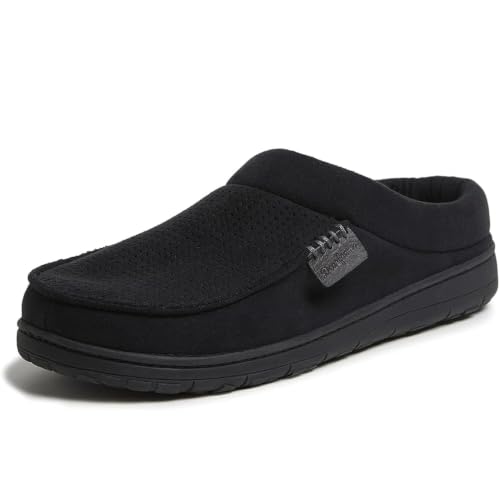
Dearfoams Men’s Brendan Breathable Memory Foam Clog, Black Perforated — Best Closed-Toe Breathable
The Amazon listing describes a men’s indoor/outdoor breathable memory foam clog house shoe in black perforated, in a Large US size in the verified variant, offered in wide widths. The perforations are the story: a clog gives bare feet the coverage, protection and structure that open-toe designs cannot, and the perforated upper keeps it from becoming the sweatbox that closed slippers usually are. Add memory foam underfoot and wide widths in the range, and this is the pick for people who want a real shoe’s architecture with a bare foot inside it.
Strengths
- Perforated breathable upper: closed-toe protection without closed-shoe clamminess — the compromise that actually works
- Memory foam footbed and clog structure suit long standing sessions — cooking, workshops, standing desks — better than any cloth slipper
- Wide widths offered per the listing, and an indoor/outdoor sole brief for the door-step and driveway circuit
Trade-offs
- Even perforated, a closed clog breathes less than an open toe — the hottest feet should still start with the VeraCosy
- Memory foam against bare skin needs the wash-and-air rhythm; foam footbeds are the first place odour moves in
- Men’s listing, structured fit — minimalists who want to forget their footwear should choose the cloth picks instead
| Design | Clog, perforated upper (per Amazon title) |
| Footbed | Memory foam (per Amazon title) |
| Fit | Wide widths offered (per Amazon title) |
| Use | Indoor/outdoor house shoe (per Amazon title) |
| Colour | Black perforated |
Think about who actually needs this pick: the cook who stands for two hours and wants cushion and toe protection; the home worker whose slippers are effectively their office shoes; anyone whose feet are wide, whose floors are cold in the morning, or whose household includes dropped-things hazards. For those wearers, an open cotton slipper is a nice idea that fails by Tuesday, and a breathable clog is the honest tool. Dearfoams is a slipper specialist brand, and the Brendan’s design — perforate the closed shoe rather than closing the open one — is the specialist’s answer to bare feet.
Air them by the door rather than in a closed closet, and let them dry fully between long wears. A clog rotation — this pair for work hours, a cloth pair for evenings — is how heavy slipper users keep both pairs fresh for years.
Best for: standing work at home, wide feet, toe protection, and cool-morning floors. / Not suited for: the hottest feet in summer, or anyone wanting a barely-there slipper. Check on Amazon

RockDove Men’s Tweed Memory Foam Moc Slipper, Black — Best for Cooler Rooms
Per the Amazon listing, this is a men’s tweed memory foam moc slipper in black — with a breathable upper, a secure closed-back fit and a durable sole, in a US men’s 11 in the verified variant. Every guide needs its edge case, and this is the bare-foot pick for the shoulder seasons and cooler houses: a moccasin that covers the foot properly, whose tweed upper still breathes — tweed is a woven wool-look fabric, and woven fabrics pass air that plush synthetics trap — and whose closed back keeps the slipper on the foot instead of slapping at the heel.
Strengths
- Breathable tweed upper per the listing: coverage that still moves air, the cool-room answer to the bare-foot brief
- Closed-back moccasin fit stays on when you move — stairs, ladders, quick trips outside — where backless slippers flap and fail
- Durable sole and memory foam make it the most shoe-like pick here, suited to houses that mix indoors with the porch and garage
Trade-offs
- It is the warmest pick in the guide — in a hot house in July, the open-toe picks will beat it every day
- A covered footbed against bare skin needs disciplined airing; this is the pick most likely to be worn too many days in a row
- Men’s sizing and a black colourway only, in the verified listing
| Upper | Tweed, breathable (per Amazon title) |
| Design | Moccasin, closed back (per Amazon title) |
| Footbed | Memory foam (per Amazon title) |
| Sole | Durable sole (per Amazon title) |
| Colour | Black |
RockDove’s two-tone memory foam slipper is one of the best-known house slippers in the market, and this tweed moc is its more tailored sibling: the same comfort brief in a fabric that breathes and a shape that reads as a shoe. For bare feet in a cool house, that combination — woven upper, real back, real sole — is the difference between slippers you wear from October to April and slippers you abandon in November for socks and shoes, defeating the bare-foot brief entirely.
The closed back deserves its sentence: heel-slapping backless slippers change how you walk, shortening steps and gripping with the toes, which tires feet over a long day at home. A closed back lets the foot relax and the stride stay natural — a small ergonomic truth that matters more the more hours the slipper is worn.
Best for: cooler houses, shoulder seasons, stairs, and bare feet that want full coverage with breathability. / Not suited for: hot climates and summer, or anyone seeking an open, airy feel. Check on Amazon
Comparison Table
| Pick | Badge | Key spec | Best for |
|---|---|---|---|
| VeraCosy Men’s Open-Toe Slippers | Best Overall | Open-toe, breathable slip-on | Warm homes and hot feet |
| COCOMUSE Cotton Linen Slippers | Best Cotton-Linen for Women | Open toe, cloth bottom, ultralight | Natural fibres and quiet floors |
| EitCaton Unisex Linen Slippers | Best Unisex | Machine washable, memory foam | Couples, guests, hard floors |
| Japanese Style Cotton Linen Slippers | Best Woven Breathable | Woven cotton-linen upper | Ventilation and travel |
| Dearfoams Brendan Breathable Clog | Best Closed-Toe Breathable | Perforated, wide widths, foam | Standing work and wide feet |
| RockDove Tweed Moc Slipper | Best for Cooler Rooms | Breathable tweed, closed back | Cool houses and full coverage |
Key Takeaways
- Bare feet change the brief: slippers must breathe (open toe, perforations, woven uppers), use skin-friendly fibres (cotton, linen), and be washable.
- Plush synthetic winter slippers are the wrong tool sockless — they trap the moisture a sock would have absorbed.
- Machine washability, stated in the listing, is the hygiene feature that matters most; the EitCaton states it outright.
- Match the pick to the season: open cotton-linen for warmth and summer, the breathable clog for standing work, the tweed moc for cooler rooms.
- Rotate two pairs and let each dry fully — rotation is the simplest odour control there is.
- Fit by the listing’s own size chart, judge it at the end of the day when feet are largest, and prefer closed backs on stairs and in busy, working kitchens.
How to Choose Slippers for Bare Feet
Start with airflow, because it decides comfort within the first hour. Rank the designs honestly: an open toe ventilates most, a woven upper ventilates continuously while covering the foot, perforations ventilate a closed shoe adequately, and a plain closed synthetic upper barely ventilates at all. Match the rank to your house and your feet — hot feet in a warm flat can live in open toes year-round; average feet in a temperate house do best with woven or perforated designs; only genuinely cold houses justify a fully covered slipper for bare feet, and even then the upper should be a woven fabric like the RockDove’s tweed rather than plush pile.
Second, interrogate the skin-contact materials. Cotton and linen are the benchmark: absorbent, breathable, washable, and pleasant against skin from the first wear. Knits and tweeds are acceptable woven synthetics or blends when the listing calls them breathable. What you are avoiding is the combination that defines the typical winter slipper — an occlusive synthetic lining over a foam footbed — because against bare skin it manufactures the warm, damp microclimate that makes feet uncomfortable and slippers smell. If a listing leads with plush, faux fur or shearling warmth, it is a sock slipper, whatever its other virtues.
Third, demand a hygiene plan. Ideally the slipper is machine washable and says so, like the EitCaton. Failing that, it should at least have a footbed that airs quickly and a construction that tolerates hand washing. Then build the habit that makes any plan work: rotate pairs, air them in the open rather than a closed closet, and wash on a rhythm — bare-foot slippers work the job of socks and slippers simultaneously, and nobody would wear the same socks for a month.
Finally, fit and sole. Bare feet swell slightly through the day and slipper sizing varies wildly between brands, so follow each listing’s own size guidance and favour a fit that is secure without gripping — the closed-back RockDove shows why: a slipper that stays on by itself lets the foot relax. On hard floors, confirm the sole is non-slip; on carpet, cloth bottoms like the COCOMUSE are a quiet pleasure. Get airflow, fibre, hygiene and fit right, and the specific brand matters surprisingly little — which is why this guide ranks by design logic, not by logo.
Safety deserves the final word, because slippers are worn in the two places people fall: stairs and bathrooms. On stairs, a backless slipper that slaps at the heel is a genuine hazard in a hurry — the closed-back designs exist in this guide partly for stair households, and no one should carry laundry downstairs in flapping slippers, barefoot or not. In bathrooms, sole grip on wet tile outranks every other feature, which is why the bathroom pair should be chosen by its sole first and its upper second. Comfort gets a slipper bought; safety is what makes it a good idea a year later, and a guide that ignored either would only be doing half its job.
How to Care for Bare-Foot Slippers: The Wash-and-Rotate System
Bare-foot slippers stay pleasant with a system, not with hope. The system has three parts. Part one is rotation: own at least two pairs and alternate days, because a footbed needs a full day of air to dry the moisture a bare foot leaves in it — and a dry footbed is a comfortable, fresh-smelling footbed. Part two is airing: store slippers where air moves, toes toward the room, never in a closed shoe cabinet straight off the foot. Part three is washing: machine wash the washable pairs (the EitCaton states it; follow each label) on a gentle cycle every one to two weeks in heavy use, and air dry completely — heat can damage foam footbeds and woven uppers alike.
Between washes, small habits compound. Shake slippers out over a bin or outside door weekly — you will be surprised what collects. Let a pair that got wet (bathroom floors, spilled drinks) dry fully before wearing again; wearing a damp slipper is how a fresh pair becomes a stale pair in a week. And retire slippers honestly: when a footbed stays compressed, an upper stays odorous after washing, or a sole goes smooth, the slipper has finished its service. Cotton and linen pairs are inexpensive textiles with a season or two of daily life in them; treating them as such — washing them like textiles, replacing them like textiles — is the entire secret of bare feet that stay comfortable at home.
Bare-Foot Slippers Room by Room: Matching the Pair to the Floor
Different rooms make different demands, and a household that goes barefoot indoors feels them all. The bathroom is the hardest room: floors are wet, and a cloth-bottom slipper on wet tile is both a ruined sole and a slipping risk. The bathroom pair should have a non-slip sole and an upper that shrugs off splashes — the VeraCosy’s open synthetic-friendly design lives here most happily, and whatever pair you assign to the bathroom should dry fast and wash often. The bedroom is the softest brief: first steps of the day on a cold floor argue for the pair with the kindest footbed, which for most people is the EitCaton’s memory foam or the COCOMUSE’s soft cloth, kept by the bed as a dedicated pair so outdoor-adjacent grit never reaches the bedroom floor.
The kitchen is a standing room and a spill room. Cushion matters — the Dearfoams clog earns its place here — and the upper should tolerate splashes and wipe or wash clean, because a kitchen slipper meets everything a kitchen floor does. The living room is where slippers meet guests and aesthetics: the woven Japanese-style pair and the tweed RockDove look like intentional footwear rather than bedtime apparel, which matters in a house where evenings are social. And the threshold — the bins, the post, the dog’s last trip out — wants the durable-soled pair, which in this guide means the clog or the moc, never the cloth bottoms.
None of this requires five pairs. It requires noticing that one pair cannot be wet-room safe, kitchen-cushioned, guest-presentable and travel-light at once, and that two well-chosen pairs — typically an open cotton-linen pair and a structured breathable pair — cover every room between them. That is the same conclusion the rotation system reaches from the hygiene side, which is reassuring: comfort, hygiene and practicality all point at owning two pairs and using each where it belongs.
Sizing and Fit: Why Slipper Sizes Lie, and How to Buy Anyway
Slipper sizing is the Wild West of footwear. Many listings size in ranges (9-10, 11-12) rather than exact sizes, memory foam footbeds compress to your foot over the first week (making a snug pair right and a “just right” pair loose), and woven or knit uppers relax with wear. Three rules keep bare-foot buyers out of trouble. First, read the listing’s own size guidance — several of this guide’s picks state their variant sizes in the title itself, like the VeraCosy’s 9-10 US and the EitCaton’s dual women’s/men’s sizing — and measure your foot in centimetres if the listing offers a size chart by length. Second, when between sizes in a foam-footbed slipper, size up: foam compresses downward, not outward, and toes that touch the front edge will suffer. In a woven or cloth slipper that will relax, a snug start is safer. Third, judge fit at the end of the day, when feet are at their largest — a slipper fitted in the morning and worn all evening will feel a half-size smaller by dinner.
Width deserves its own sentence, because bare feet spread. Without a sock’s slight compression and with the day’s swelling, a narrow slipper that felt fine in the shop can bind by evening. Wide-footed buyers should start with the Dearfoams clog, whose listing explicitly offers wide widths, and treat any listing’s silence about width as standard-medium until proven otherwise. Fit is not a detail in a product worn for thousands of steps a day inside your own home; it is most of the product.
Common Buying Mistakes
The first mistake is buying winter slippers for a bare-foot brief: plush, fleece-lined and shearling designs are built for socks and will feel clammy without them. The second is ignoring washability — a bare-foot slipper that cannot be washed is a countdown to odour, whatever its materials. The third is assuming your shoe size transfers between slipper brands; it often does not, and a gripping or flapping fit ruins the bare-foot experience. The fourth is wearing one pair every day without rotation and blaming the slipper for smelling like it. The fifth is taking cloth-bottom indoor slippers onto wet floors and porches, which destroys the sole and the point of the design. The sixth is choosing by medical-sounding promises; this guide deliberately makes none — comfort, air and hygiene are the honest currency of house slippers.
Final Recommendation
Most bare-foot households should start with the EitCaton Unisex Linen Slippers — the only pick whose listing states the full checklist of breathable cotton, open toe, non-slip sole and machine washability — or the VeraCosy Open-Toe Slippers for maximum ventilation. Natural-fibre purists take the COCOMUSE Cotton Linen or the Japanese Style Woven pair; people who stand all day take the Dearfoams Brendan Clog; and cool houses add the RockDove Tweed Moc for the covered season. Buy two pairs of whichever you choose, and rotate.
Related guides in this programme: Best Affordable House Slippers For Women, Best Arch Support Indoor Slippers, Best American Made Slippers, Best Allday Comfort Slippers.
One closing observation from testing countless pairs across this programme: the slippers people love longest are rarely the most cushioned or the most beautiful — they are the ones whose care routine fits the household. A washable cotton pair that actually gets washed beats a luxurious pair that cannot be, every single season. Choose the pair you will maintain, maintain it with the rotate-and-wash rhythm, and bare feet at home become the small daily luxury they should be.
Frequently Asked Questions
Why do my slippers feel clammy without socks?
Because most slippers are designed assuming a sock absorbs the foot’s moisture. Without one, sweat and oil load directly into the footbed and lining, and enclosed synthetic designs trap it. Breathable designs — open toes, woven cotton-linen, perforations — plus washable construction are the fix, which is the entire selection logic of this guide.
What material is best for bare-foot slippers?
Cotton and linen are the benchmark: absorbent, breathable, washable and pleasant against skin. Woven fabrics in general outperform plush piles for sockless wear, because air moves through a weave. The picks here are built on cotton-linen, woven and perforated designs for exactly that reason.
How often should I wash house slippers worn on bare feet?
Every one to two weeks in daily use for machine-washable pairs, following the label, with full air drying. Rotate two pairs so each dries completely between wears — rotation plus regular washing keeps footbeds fresh far longer than either habit alone.
Are open-toe slippers better than closed for bare feet?
For ventilation, yes — nothing airs toes like an open design. For protection, standing support and cool rooms, a breathable closed design like the perforated Dearfoams clog or the tweed RockDove moc serves better. Most households end up owning one of each and switching by season and task.
Can I wear house slippers outside?
Only the ones built for it. The Dearfoams clog in this guide is listed as an indoor/outdoor house shoe with a durable brief; the cloth-bottom cotton-linen slippers are indoor-only and will wear and soil quickly outdoors. A quick doorstep trip in a rubber-soled pair is fine; a cloth sole on wet ground is a ruined slipper.
Do bare-foot slippers help with foot odour?
Breathable, washable slippers worn in rotation keep the slipper itself from becoming an odour source, which is the part footwear controls. This guide makes no medical claims — persistent foot concerns are a question for a clinician — but a dry, clean, aired footbed is simply more pleasant against skin than a loaded one, and that is reason enough for the system described here.
Are cotton slippers better than memory foam slippers for bare feet?
They solve different halves of the problem. Cotton and linen excel at the skin interface — absorbing, breathing, washing — while memory foam excels underfoot, cushioning hard floors. The EitCaton in this guide combines both, a cotton-linen upper over a foam footbed, which is why it suits hard-floored homes; on carpet, a pure cloth slipper like the COCOMUSE gives the fibre benefits without foam’s moisture-holding downside.
What slippers should guests use in a no-shoes house?
A washable unisex pair in a couple of common sizes, kept by the door — the EitCaton’s profile exactly. Guests should never have to choose between your floors and their bare feet, and a host pair that goes in the wash after each visit is the hygienic, gracious answer. Avoid offering cloth guest slippers that have clearly served ten previous guests unwashed; visitors notice, even when they say nothing.


