Disclosure: airfryerkitchensupply.com is reader-supported. When you buy through links on our site, we may earn an affiliate commission at no extra cost to you.
Where to buy
Every slipper in this guide to the best slippers for aged feet is sold on Amazon, and every link below goes to a listing confirmed before writing. For women, start with the adjustable Orthofeet Charlotte; for men, the adjustable Orthofeet Asheville. Structured support points to the Vionic Gemma Mule, wide feet to the Dearfoams Leslie Clog or the Dearfoams Brendan Clog, and cold floors to the Acorn Chinchilla Bootie. Prices change constantly, so check the current price on Amazon rather than trusting any number printed in a guide.
The best slippers for aged feet are not simply softer slippers. Feet change across a lifetime: arches settle, padding thins, circulation slows so feet run cold, skin grows delicate, and — the detail that decides everything in this category — feet swell and change size across a single day. Add the practical realities of later life, like not wanting to bend double to wrestle a shoe on, or needing a sole that grips a kitchen floor with total reliability, and the right slipper stops looking like a smaller shoe and starts looking like a piece of thoughtful equipment: easy to enter, adjustable across the day, stable underfoot, warm without bulk, and washable when life happens.
This guide was built to that brief, and it uses comfort language only. Several listings in this category carry medical-style wording in their titles; we record those titles faithfully in the _SOURCES file and make no medical claims in the article itself. A slipper can offer arch support, cushioning, an adjustable fit, and a non-slip sole — all real, checkable product features — and that is exactly how the picks below are described. If you are shopping for someone with a diagnosed foot condition, diabetes-related foot care needs, or a clinician’s footwear instructions, those instructions outrank any buying guide, including this one: bring this shortlist to the conversation rather than treating it as the conclusion. And if you are shopping for yourself with none of those flags, the same discipline still applies in miniature — let the fit, the sole, and the entry decide, and let the marketing come last.
The six picks divide by the problem they solve first. Two are adjustable-strap specialists — the Orthofeet Charlotte for women and Asheville for men — whose fit can change as the foot changes through the day, and which can be put on hands-free. One, the Vionic Gemma, builds its support into a structured insole inside an easy mule. Two are wide-width clogs from Dearfoams — the Leslie for women, the Brendan for men — because width is the most common unmet need in this category. And one, the Acorn Chinchilla Bootie, wraps the ankle in warmth for the coldest floors and the coldest feet. Every one is a true house slipper — no sandals, no slides, no novelty footwear — with a real sole meant for real floors, chosen for the person who will live in them from the first coffee to the last lock-up of the night.
In this guide
Quick Picks
- Best Adjustable for Women: Orthofeet Charlotte Slippers — adjustable strap, hands-free slip-on entry, faux fur lining.
- Best Adjustable for Men: Orthofeet Asheville Slippers — adjustable, hands-free slip-on, supportive house shoe design.
- Best Structured Support: Vionic Gemma Mule Slipper — built-in arch-support insole in an easy-on mule.
- Best Wide Fit for Women: Dearfoams Leslie Terry Clog — offered in wide widths, washable memory foam comfort.
- Best Wide Fit for Men: Dearfoams Brendan Clog — wide widths, breathable perforated design, indoor/outdoor sole.
- Best Warm Bootie: Acorn Chinchilla Bootie Slipper — ankle coverage, plush faux fur, multi-layer memory foam footbed, rubber sole.
How These Picks Were Chosen
We searched the program’s Amazon listing data cache for house slippers and applied this search’s filters strictly. Every pick had to be a genuine house slipper — the standing rule for this category excludes ballet and dance slippers, sandals, slides and flip-flops, massage shoes, and baby footwear, and none appears here. Every pick needed a real sole with grip, because a sock-like slipper on a hard floor is a fall waiting for a moment. Every pick needed an easy entry — slip-on, adjustable, or wide — because a slipper that requires bending, pulling, and a shoehorn fails the brief before comfort is even discussed. And every pick needed a fit story for changing feet: an adjustable strap, a wide-width offering, or a forgiving enclosed shape.
We also handled the category’s medical marketing with care. Listings whose main pitch is medical language rather than footwear were passed over; the picks that remain are footwear first — supportive, adjustable, well-soled house slippers from established comfort brands — and where their titles contain medical-style terms, those terms are documented in _SOURCES and not repeated as promises in the article. What the article claims is only what a shoe can claim: fit, support structure, cushioning, warmth, grip, and washability.
Specifications come only from each listing as recorded through the API — strap and entry style, widths offered, sole type, lining, washability. Where a record does not state a detail, the spec box omits it rather than inventing it. And per standing rules, we print no fixed prices and no star ratings or review counts; check the current price on Amazon for today’s figure.
The 6 Best Slippers for Aged Feet

Orthofeet Charlotte — Best Adjustable for Women
The Charlotte leads this guide because adjustability is the single most valuable feature for feet that change across the day, and its listing confirms the full package: an adjustable strap design, hands-free slip-on entry — step in without bending or using your hands — and a faux fur lined, supportive house shoe build in taupe. Morning feet and evening feet are effectively two sizes; this is the slipper that fits both, and it fits them without asking the wearer to sit down, reach down, and negotiate with a heel cup first thing in the morning.
Strengths
- Adjustable fit accommodates daily swelling and thicker socks in winter.
- Hands-free slip-on entry — no bending, no pulling, no shoehorn.
- Enclosed, supportive house-shoe shape stays on the foot securely.
Trade-offs
- Premium tier relative to basic memory-foam slippers.
- Faux fur lining runs warm — hot sleepers of the foot world may prefer the breathable Brendan style.
- The structured fit feels firmer than plush scuffs at first wear.
| Specifications (as confirmed by the listing) | |
|---|---|
| Style | Women’s house slipper, taupe |
| Fit | Adjustable strap; hands-free slip-on |
| Lining | Faux fur |
| Support | Supportive build with arch support (per listing) |
Who is this for? The woman whose feet are a half-size larger by evening, who wears compression socks some days and none on others, or who simply refuses to start the morning wrestling footwear. The strap is not a decoration — it is the mechanism that lets one slipper serve a changing foot, loosened after a long day on your feet, snugged for a secure fit on the stairs. The hands-free entry deserves equal emphasis: step-in shoes were once a niche convenience and are, for anyone with a stiff back or a balance concern, the difference between slippers that get worn every single day and slippers that live by the door untouched, however good their specifications looked on the product page.
Best for: women whose feet swell across the day and anyone who cannot bend easily to put shoes on. / Not suited for: buyers wanting the cheapest plush scuff, or feet that run very hot.
Check the current price on Amazon

Orthofeet Asheville — Best Adjustable for Men
The Asheville is the men’s counterpart to the Charlotte’s logic: an adjustable, hands-free slip-on house slipper with a supportive build and faux fur lining, in brown. Men’s feet in later life run into the same swelling and the same morning stiffness, and the same answer applies — a slipper that adapts to the foot and asks nothing of the back or the balance to put on.
Strengths
- Adjustable strap fit for swelling and sock changes.
- Hands-free step-in entry.
- Enclosed supportive shape with warm faux fur lining.
Trade-offs
- Premium tier for a house slipper.
- Warm lining is a winter virtue and a summer excess.
- Structured support feels different from the soft moccasins many men default to — allow a few days to adjust.
| Specifications (as confirmed by the listing) | |
|---|---|
| Style | Men’s house slipper, brown |
| Fit | Adjustable; hands-free slip-on |
| Lining | Faux fur |
| Support | Supportive build with arch support (per listing) |
The Asheville’s buyer is often a gift buyer — a son or daughter watching a father pad around in flattened decade-old moccasins or, worse, in socks on hardwood. The upgrade case writes itself: same step-in ease he already has, plus a sole that grips, a fit that adjusts, and warmth that does not come from a space heater. For the wearer himself, the selling point is dignity of design: this reads as a shoe, not as medical equipment, and it will be worn daily precisely because it does not announce itself. Size it by the evening foot, not the morning one, and let the strap handle the difference. There is a fitting detail worth stealing from shoe stores: have him stand, not sit, for the test — a foot under full weight is longer and wider than a foot dangling from a chair, and slippers live their whole lives under load. A pair that fits the standing, evening foot will not surprise anyone at the top of the stairs.
Best for: men with swelling or changing feet, and gift buyers upgrading a father’s house shoes. / Not suited for: hot climates without air conditioning, or strict budgets.
Check the current price on Amazon

Vionic Gemma Mule Slipper — Best Structured Support
The Gemma takes the opposite route to support: instead of an adjustable exterior, it builds the support into the insole — its listing describes a three-zone comfort design with an arch-support insole — inside a soft mule that slips on without hands, straps, or thought. For the wearer who wants structure under the arch and the simplest possible entry, this is the guide’s answer.
Strengths
- Built-in arch-support insole with a three-zone comfort design, per the listing.
- Mule entry is effortless — the easiest on-and-off in this guide.
- Spa-slipper styling looks at home beyond the bedroom.
Trade-offs
- A backless mule is less secure on stairs than the enclosed Orthofeet designs — know your wearer.
- No adjustability: the fit is the fit, so sizing accuracy matters.
- Structured insoles are a preference, not a universal — flat-footbed loyalists may not convert.
| Specifications (as confirmed by the listing) | |
|---|---|
| Style | Women’s mule slipper |
| Insole | Arch-support insole; three-zone comfort design (per listing) |
| Entry | Slip-on mule |
The honest trade in this pick is security versus ease, and the guide will not blur it: a mule is the easiest slipper to step into and the easiest to step out of, including accidentally. For a steady walker on one-level living, that ease is a daily pleasure and the structured insole does quiet, constant work. For anyone unsteady, or for a house where the stairs are part of every day, choose the enclosed Charlotte instead and accept the strap as the price of security. Bought for the right wearer, the Gemma is the slipper most likely to be described as “the first slippers that feel like real shoes” — supportive in a way plush cannot imitate. It also travels well between rooms and roles: bedroom in the morning, kitchen through the day, and presentable enough that an unexpected doorbell does not send the wearer hunting for shoes.
Best for: steady walkers wanting built-in arch support and effortless entry. / Not suited for: unsteady walkers or stair-heavy homes, where an enclosed heel is safer.
Check the current price on Amazon

Dearfoams Leslie Terry Clog — Best Wide Fit for Women
Width is the unglamorous specification that decides whether a slipper is worn or abandoned, and the Leslie addresses it head-on: a washable memory foam terry clog offered in wide widths. The clog shape gives toes room to spread — valuable for feet that have spent decades in narrow shoes — and the whole slipper goes in the wash, a hygiene feature this category undervalues.
Strengths
- Offered in wide widths — the fit feature aged feet most often need.
- Machine washable, memory foam comfort.
- Clog shape is easy to enter and roomy across the toes.
Trade-offs
- Backless clog: less heel security than enclosed designs, like the Gemma’s caveat.
- Terry cloth is absorbent and cozy but slower to dry after washing.
- Memory foam softness is comfort-first; it offers less structure than the Vionic or Orthofeet.
| Specifications (as confirmed by the listing) | |
|---|---|
| Style | Women’s terry clog slipper |
| Widths | Wide widths offered |
| Footbed | Memory foam |
| Care | Washable |
Dearfoams has made slippers for generations, and the Leslie shows the virtue of that focus: it solves the two complaints heard most from older women about slippers — “they pinch” and “they get grubby” — with width options and a washing machine. The terry upper is gentle against delicate skin in a way synthetic fleece sometimes is not, and the clog’s open back makes it a true step-in shoe for the bathroom-to-kitchen circuit. Pair it with the safety note that applies to all backless picks: wonderful on one level, thoughtful about stairs. The washability deserves one more practical word — a slipper that can be washed can also be kept in rotation through the minor illnesses and spills of a real household, coming back from the machine genuinely fresh rather than merely aired, and for footwear worn barefoot against skin for most of the day, that difference is the whole argument.
Best for: women with wide feet who want a washable, gentle, easy clog. / Not suited for: anyone needing maximum heel security or structured support.
Check the current price on Amazon
Dearfoams Brendan Clog — Best Wide Fit for Men
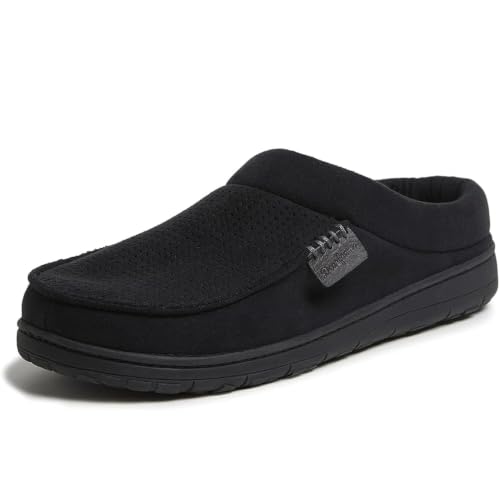
The Brendan is the men’s wide-width answer with a twist the other picks lack: breathability. Its listing describes an indoor/outdoor breathable memory foam clog in a perforated design, offered in wide widths — a slipper for the man whose feet run hot, whose house runs warm, or whose “house slipper” duty includes the porch, the mailbox, and the garage.
Strengths
- Wide widths offered — room where men’s slippers usually pinch.
- Breathable perforated upper suits warm feet and warm houses.
- Indoor/outdoor sole handles porches and quick trips outside.
Trade-offs
- Backless clog security caveat applies, as with all mules and clogs here.
- Breathability is the opposite of insulation — cold-floor households should take the Acorn or Orthofeet.
- Memory foam comfort prioritizes cushion over structure.
| Specifications (as confirmed by the listing) | |
|---|---|
| Style | Men’s clog house shoe, black perforated |
| Widths | Wide widths offered |
| Upper | Breathable, perforated |
| Sole | Indoor/outdoor |
Every category has a pick that understands a specific life, and the Brendan understands the man who wears his slippers sixteen hours a day, indoors and out, and whose feet are warm by ten in the morning. The perforations are not styling; they are ventilation, and in a heated house they are the difference between slippers that stay on and slippers that get kicked off under the table. The indoor/outdoor sole completes the thought — this is a house shoe built for how houses are actually lived in, thresholds and all. Just do not buy it for a cold stone floor in January and blame the breeze. It is also, quietly, the easiest of these picks to keep by the door for the household’s busiest threshold — the man who steps out to the porch, the bins, and the garage twenty times a day is the man this clog was drawn for, and its sole is the only one here that treats that circuit as its home turf.
Best for: men with wide, warm feet and indoor-outdoor slipper habits. / Not suited for: cold floors, cold feet, or anyone needing an enclosed heel.
Check the current price on Amazon

Acorn Chinchilla Bootie Slipper — Best Warm Bootie
Some feet are simply cold — thin padding, slow circulation, stone floors — and for them the answer is coverage. The Acorn Chinchilla is a women’s bootie slipper: plush faux fur wrapping the ankle, a multi-layer memory foam footbed per its listing, and a rubber sole. The bootie shape also earns a safety point the backless picks cannot claim: it stays on the foot, heel and all.
Strengths
- Bootie coverage warms the ankle, not just the foot — the warmest pick here.
- Enclosed heel stays on securely, including on stairs.
- Multi-layer memory foam footbed and a real rubber sole.
Trade-offs
- The warmest pick is the wrong pick for warm houses and hot feet.
- A bootie takes a moment more to put on than a mule — no hands-free claim here.
- Plush faux fur needs gentle care to keep its loft.
| Specifications (as confirmed by the listing) | |
|---|---|
| Style | Women’s bootie slipper |
| Upper | Plush faux fur |
| Footbed | Multi-layer memory foam |
| Sole | Rubber |
Acorn is one of the heritage names in slippers, and the Chinchilla is its cold-weather argument in full: fur inside the ankle cuff, layered cushioning underfoot, and a sole with genuine grip. For the woman who keeps a blanket over her feet on the couch, this bootie is the blanket, worn. It is also the pick we would hand to a daughter shopping for a mother in a drafty house — warmth, security, and a little luxury in one object, none of which reads as “equipment.” Size with your winter socks on, and expect the fur to settle into the foot’s shape over the first week. In the coldest houses the bootie pairs well with the guide’s other quiet theme — rotation: a second, lighter pair for the milder months keeps the Chinchilla from being worn into the ground year-round, and gives its fur the rest days that keep plush lofty instead of matted.
Best for: cold feet, cold floors, and anyone wanting maximum warmth with a secure heel. / Not suited for: warm climates, hot feet, or hands-free entry needs.
Check the current price on Amazon
Slipper Styles, Decoded for This Brief
The slipper aisle uses style words loosely, so here is what each shape in this guide actually does. A mule is backless with a closed toe — the Vionic Gemma — offering the fastest entry and a tidy look, at the cost of heel security. A clog is a roomier backless shape, often with a slightly raised, structured sole — both Dearfoams picks — which adds toe room and a little platform stability while keeping the step-in ease. A scuff, the classic hotel-style slipper, is the lightest backless form; it is also the least secure and the least supportive, which is why no pure scuff made this guide’s cut. A moccasin encloses the foot with a stitched upper and usually a closed heel — secure and traditional, but it must be pulled on, which is why the adjustable Orthofeets, with their step-in design, outrank classic moccasins for this search. A bootie extends coverage up the ankle — the Acorn Chinchilla — trading a slower entry for warmth and the most secure fit of any style here. Read the styles as a spectrum from ease to security, with warmth rising toward the bootie end, and the right point on that spectrum is a fact about the wearer, not about the slipper’s quality.
One more style note with practical weight: the difference between a slipper and a house shoe is mostly sole and structure, and this guide deliberately buys from the house-shoe end. Pure slippers are soft goods — fabric, foam, a token sole — made for bedroom-to-bathroom distances. House shoes are footwear that happens to be soft inside, made for all-day, whole-house wear. Aged feet live in their slippers for most of their waking hours and walk real distances in them across real floors; they deserve the house-shoe end of the spectrum, and every pick here was chosen from it.
Buying for Someone Else: A Gift Buyer’s Protocol
Most slippers in this category are bought by adult children for parents, so here is the protocol that makes those gifts succeed. First, get the real size — current, not remembered: ask, check a shoe they wear now, or accept that an exchange may be part of the gift and choose a design whose fit forgives error, which means adjustable first (Orthofeet), wide second (Dearfoams), fixed last. Second, interrogate the house, not the taste: stairs argue for enclosed heels, stone floors for warmth and cushion, a warm apartment for the breathable Brendan. Third, respect the wearer’s vanity — slippers that read as shoes get worn, slippers that read as equipment get thanked and shelved; every pick here was chosen partly because it looks like something a person would choose for themselves. Fourth, present them as an upgrade, not a correction: “these are the good ones” lands better than any sentence containing the word “safe,” even when safety is exactly what you bought. Fifth, do the follow-up fitting yourself — visit, watch them walk the kitchen in the new pair, check the heel lift and the strap marks, and arrange the exchange while the return window is generous. A gift slipper fitted with that much care stops being a present and becomes what it should be: the thing they wear every day without thinking about it, which is the highest praise footwear can earn.
Comparison Table
| Pick | Badge | Key spec | Best for |
|---|---|---|---|
| Orthofeet Charlotte | Best Adjustable for Women | Adjustable strap, hands-free entry | Swelling feet, limited bending |
| Orthofeet Asheville | Best Adjustable for Men | Adjustable, hands-free slip-on | Men’s changing feet, gifts |
| Vionic Gemma Mule | Best Structured Support | Arch-support insole, mule entry | Steady walkers wanting support |
| Dearfoams Leslie Clog | Best Wide Fit for Women | Wide widths, washable memory foam | Wide feet, easy care |
| Dearfoams Brendan Clog | Best Wide Fit for Men | Wide widths, breathable, indoor/outdoor sole | Warm feet, porch duty |
| Acorn Chinchilla Bootie | Best Warm Bootie | Faux fur ankle coverage, rubber sole | Cold feet and floors |
What Aged Feet Actually Need From a Slipper
Start with the changes themselves, because each one maps to a feature in this guide. Thinning padding: the fat pads under the ball and heel thin with age, so hard floors feel harder and cushioning stops being a luxury — every pick here has a real footbed, from memory foam to layered constructions. Settling arches and spreading feet: feet commonly grow longer and wider across a lifetime, which is why last decade’s size pinches and why wide widths (both Dearfoams picks) and adjustable straps (both Orthofeet picks) matter more than brand names. Swelling: feet are smallest in the morning and largest by evening, and a fixed slipper fits only one of those feet; adjustability is the engineering answer. Cold: slower circulation means feet that chill on floors other people find fine — hence linings, faux fur, and the Acorn’s ankle coverage. Delicate skin: soft, non-abrasive interiors and the absence of internal seams and tags stop being details. Balance and bending: a slipper that requires a seated wrestle will be skipped, and skipped slippers mean socks on hard floors — the worst grip scenario in the house. Hands-free and clog entries exist in this guide because adherence is a safety feature.
The sole deserves its own paragraph because it is where slippers quietly succeed or fail as safety equipment. A house slipper for an older adult should have a rubber or rubber-like outsole with tread, full contact with the floor, and enough structure that it does not fold under the foot on a turn. Fabric-soled and sock-style slippers fail that description entirely, which is why none appears here despite their popularity as gifts. Every pick in this guide is a soled house shoe in slipper’s clothing — that is the category’s whole point, and it is worth saying to gift buyers plainly: the cute pair with the cloth sole is the wrong present for the person you are worried about.
How to Choose Slippers for Aged Feet
Fit the evening foot. Shop and size late in the day, when feet are at their largest, and if you are between sizes in a fixed-fit slipper, take the larger and manage the morning looseness with socks. In an adjustable design like the Orthofeets, size to the evening foot and let the strap earn its keep across the day. When buying for someone else, ask for their current shoe size and their width honestly — many older adults have worn the wrong width for years because slippers never offered the right one.
Choose the entry before the cushion. Decide how the slipper gets on: hands-free step-in (Orthofeet), open mule or clog (Vionic, Dearfoams), or enclosed bootie (Acorn). The right answer depends on the wearer’s back, balance, and patience, and it outranks every other feature, because the best-cushioned slipper in the world does nothing in the closet. When in doubt for a gift, step-in and clog entries are the safest generosity.
Enclosed heel or open back — decide by the stairs. This guide is deliberately split: three picks enclose the heel (both Orthofeets, the Acorn) and three are backless (Vionic, both Dearfoams). Backless is easier; enclosed is more secure. In a one-level home with a steady walker, either serves. In a home with stairs used daily, or for any wearer whose balance is a family conversation, buy the enclosed heel and do not negotiate with yourself about it.
Match warmth to the house, not the season’s worst day. Faux fur linings and bootie coverage are for cold floors and cold feet; in a warm house they become the reason slippers get kicked off, and kicked-off slippers are socks again. The Brendan’s breathable perforations exist for the opposite household. Be honest about the thermostat’s real setting and the floors’ real material — stone and tile argue for warmth and cushion; carpet argues for breathability and a lighter build.
Washability is a health feature. Slippers live against skin, absorb the house’s dust, and are worn barefoot more than any other footwear. A washable pair like the Leslie can be kept genuinely clean; for non-washable designs, plan on airing, rotating two pairs if the budget allows, and replacing on a schedule rather than on a collapse. However you manage it, manage it deliberately — the slipper is the most-worn shoe in an older adult’s life and deserves a hygiene plan like one.
How to Fit and Care for House Slippers
Fitting: try new slippers at day’s end, in the socks you will actually wear, and walk the house’s real surfaces — hard floor, carpet, and the bathroom tile — before deciding. The heel should not lift out of an enclosed design with each step; toes should spread without pressing the front; an adjustable strap should hold the midfoot snugly without marks on the skin after ten minutes. Expect memory foam and fur linings to settle over the first week — a fit that is merely snug on day one is usually right by day seven, while a fit that is loose on day one becomes a shuffle by day thirty.
Care: air slippers out of direct heat when they come off — not on a radiator, which cooks linings and glues — and rotate a second pair if you own one, because foam recovers loft on rest days. Wash the washable (the Leslie) on a gentle cycle and dry fully before wearing; spot-clean the structured designs and let them dry naturally. Inspect soles seasonally: tread worn smooth is a retirement signal, not a cosmetic one, and so is a footbed that has compressed into a hard pancake. Replace on condition, and the condition that matters most is grip — the day a sole stops biting the kitchen floor, the slipper’s service is over whatever its upper looks like.
Troubleshooting the Fit After They Arrive
Problem: the heel slips out with every step. → In an adjustable design, snug the strap one notch and re-test on hard floor, not carpet — carpet hides heel lift. In a fixed design, the size is likely a half-step large for the morning foot; try the wearer’s regular socks before exchanging, and exchange down only if the evening foot still fits without toe pressure.
Problem: toes press the front by evening but the morning fit is perfect. → That is textbook swelling meeting a fixed fit. The lasting answers are an adjustable strap or a wide width, not a longer size — length adds trip risk at the front. If the pair is new, this is the exchange to make without guilt.
Problem: the structured insole feels strange, even annoying, for the first days. → Built support is a change of posture for the foot, and feet notice change before they approve it. Wear the pair for short indoor stretches across three or four days. If discomfort sharpens rather than fading, the shape is wrong for that foot — exchange toward a flat memory-foam design like the Dearfoams rather than enduring it.
Problem: the slippers feel secure on carpet but slide on the kitchen floor. → Test every new pair on the hardest, smoothest floor in the house before trusting it — that surface is the audit. Wipe new soles with a damp cloth to remove any factory finish, and if the sole still skates, return the pair; no break-in period fixes a sole that does not grip.
Problem: one foot fits and the other does not. → Most people have one foot measurably larger, and aging can widen the difference. Fit the larger foot, manage the smaller with the strap or a thicker sock, and never size to the smaller foot and let the larger one suffer quietly — it will not stay quiet.
Common Buying Mistakes
- Buying the cute cloth-soled pair as a gift. Fabric soles on hard floors are a fall hazard dressed as a present. Every pick here has a real sole for a reason.
- Sizing by the morning foot or an old shoe size. Feet swell daily and spread across years. Fit the evening foot, and re-measure rather than assuming a size from a decade ago.
- Choosing backless for a stair-heavy home. Mules and clogs are wonderfully easy and genuinely less secure. Stairs and unsteady walkers call for the enclosed heel.
- Ignoring width. Length is only half of fit. If slippers pinch across the toes, the answer is a wide width — both Dearfoams picks offer them — not a longer size that trips.
- Treating warmth as always good. In a warm house, the fur-lined bootie gets kicked off and the wearer is back in socks. Match insulation to the actual floors and thermostat.
- Keeping slippers past their sole’s life. Uppers outlive tread. A smooth sole on a kitchen floor is the end of a slipper’s safe service, however beloved it is.
Final Recommendation
For most buyers in this category, start with adjustability: the Orthofeet Charlotte for women and the Orthofeet Asheville for men solve the changing-foot problem and the bending problem in one purchase. If width is the known issue, go straight to the Dearfoams Leslie or the breathable Dearfoams Brendan. The Vionic Gemma serves the steady walker who wants structured support with zero-effort entry, and the Acorn Chinchilla Bootie is the answer when cold is the complaint. Whichever you choose, fit it in the evening, test it on the bathroom tile, walk it across the kitchen’s smoothest stretch, and retire it when the sole goes smooth — those habits do more for an older adult’s footing than any single product can.
Shopping the wider slipper drawer with the same fit-first logic? See Best Arch Support Slippers Mens, Best Arch Support Womens Slippers, Best Bedroom Slippers For Grandma, Best Bootie Slippers Womens, and Best Affordable House Slippers For Women.
Frequently Asked Questions
What makes a slipper good for older feet, specifically?
Four things, all present in this guide’s picks and worth checking on any pair you consider anywhere: an easy entry that does not require bending or pulling; a fit that adapts — an adjustable strap or a wide width — because older feet swell across the day and spread across the years; a real rubber-style sole with grip, since cloth soles on hard floors are a fall risk; and cushioning that compensates for thinning natural padding. Warmth and washability complete the picture for most households, and neither should be traded away for a novelty shape.
Are backless slippers safe for elderly wearers?
It depends on the wearer and the house, and on how honestly both are assessed. For a steady walker in a one-level home, a mule or clog like the Vionic Gemma or the Dearfoams clogs is a reasonable, easy choice. For anyone unsteady, or where stairs are part of daily life, an enclosed heel — the Orthofeet designs or the Acorn bootie — is the safer purchase, because the slipper cannot be stepped out of accidentally. When in doubt, choose the enclosed heel and sleep better for it.
How should slippers fit when feet swell during the day?
Fit them at their largest — in the evening, with the day’s socks, standing up — and prefer designs that can adapt: the adjustable straps on the Orthofeet Charlotte and Asheville exist precisely for this daily rhythm, loosening as the day swells the foot and snugging when it does not. In a fixed-fit slipper, take the size that fits the evening foot without pressure points, and let morning looseness be managed with a thicker sock rather than buying small.
Why not just wear socks around the house?
Grip. Socks on hardwood, tile, or laminate are one of the most common contributors to household slips, because fabric on a smooth floor has almost no friction at all — less, on polished tile, than a bare foot manages. A soled house slipper keeps the comfort and warmth of a sock and adds the tread of a shoe — which is why every pick in this guide, whatever its style, is built on a real sole with real grip.
How often should house slippers be replaced?
Replace on condition rather than calendar: when the sole’s tread has worn smooth, when the footbed has compressed flat and stays flat, when an adjustable strap no longer holds, or when the lining cannot be brought back to clean. For a pair worn all day every day, expect that moment to arrive well before the upper looks worn — check the soles every few months, because grip is the feature with a retirement date, and it does not announce itself.
Should slippers for older adults have arch support?
For many wearers, a supportive insole is more comfortable across a full day of standing and walking at home — which is why the Vionic’s built-in arch-support insole and the Orthofeet pair’s supportive build headline their designs. But support is a preference shaped by the individual foot, not a rule: some feet are happiest on the flat memory foam of the Dearfoams picks. The practical approach is to match the slipper to the shoes the wearer already finds comfortable — a lifetime in supportive shoes predicts success with structured slippers, and a lifetime in flat, soft footwear predicts the reverse. And where a clinician has given specific footwear guidance, that guidance decides, full stop.
Can these slippers be worn outside?
Briefly, some of them can: the Dearfoams Brendan is explicitly an indoor/outdoor design, and rubber-soled picks like the Acorn bootie will handle a dry porch or a quick trip to the mailbox. But house slippers are built first and foremost for indoor floors — their soles pick up outdoor grit that then scratches indoor floors, and their uppers are not weatherproof in any meaningful sense. Keep them as house shoes, and keep a real shoe by the door for anything further than the porch.

