Disclosure: airfryerkitchensupply.com is reader-supported. When you buy through links on our site, we may earn an affiliate commission at no extra cost to you.
Where to buy
Every tub in this guide was verified against Amazon’s own catalog data before it earned a link, and the specifications quoted — length, slipper configuration, faucet drillings, feet and drain finishes — are taken from those listings. Cast iron tubs are freight-class purchases whose delivered cost depends on options and destination, so no price is printed here; check the current price on Amazon for the exact configuration, and confirm the drilling and finish options on the listing before ordering, because the same model is often sold in several configurations under one name.
- Vintage Tub & Bath Randolph Morris Charlotte 60 Inch Cast Iron Slipper Clawfoot Tub (Brushed Nickel Feet) — Check the current price on Amazon
- Vintage Tub & Bath Randolph Morris Mila 58 Inch Cast Iron Slipper Clawfoot Tub — Check the current price on Amazon
- Vintage Tub & Bath Charlotte 67 Inch Cast Iron Slipper Clawfoot Tub — Check the current price on Amazon
- Signature Hardware Arabella 61 Inch Cast Iron Double-Slipper Clawfoot Tub — Check the current price on Amazon
- Vintage Tub & Bath Randolph Morris Grace 72 Inch Cast Iron Double Slipper Tub — Check the current price on Amazon
- Kingston Brass 67 Inch Cast Iron Single Slipper Pedestal Tub — Check the current price on Amazon
The best slipper tubs cast iron can offer share a silhouette that has barely changed in a century: one end of the tub rises into a high, sloped backrest — the slipper — so you recline against cast iron that holds the water’s heat, in a tub that will outlast the bathroom around it. This guide verified the current cast iron slipper market against Amazon’s catalog data and found it concentrated in the hands of a few specialist makers: Vintage Tub & Bath’s Randolph Morris line, Signature Hardware, and Kingston Brass. Six tubs made the cut — three single slippers at 58 to 67 inches, two double slippers for reclining from either end, and one pedestal design — and each review states plainly what the listing confirms about drillings, feet and drains, because with tubs at this level, configuration mistakes are expensive ones.
Two vocabulary points will save you money, so they belong at the top. ‘No faucet drillings’ means the rim has no holes: your faucet must be freestanding (floor-mounted) or wall-mounted, which is a plumbing decision to make before the tub arrives, not after. ‘Rim drillings’ — often listed as 7-inch centers — means faucet holes are drilled in the rim for a deck-mounted tub filler. Neither is better; they are different bathrooms. Every review below states which configuration its listing describes.
And a weight warning that is also a compliment: cast iron is heavy in a way acrylic shoppers do not expect. These tubs can weigh several hundred pounds empty, they arrive by freight, and they ask real questions of your floor structure and your doorway widths. That mass is the point — it is why the tub holds heat, feels immovable in use, and survives generations — but plan the route from curb to bathroom before you fall for a silhouette.
In this guide
Quick Picks
The Charlotte 60 is the balanced default: classic single slipper, mid-size, no drillings for a clean rim. The Mila 58 suits smaller bathrooms with vintage detailing, the Charlotte 67 is the spacious soaker, the Arabella and Grace cover double-slipper duty at 61 and 72 inches, and the Kingston pedestal removes the clawfoot cleaning gap entirely.
| Pick | Badge | Why it stands out | Check |
|---|---|---|---|
| Vintage Tub & Bath Randolph Morris Charlotte 60 Inch Cast Iron Slipper Clawfoot Tub (Brushed Nickel Feet) | Best Overall | The classic 60-inch single slipper on claw feet, with an undrilled rim and brushed nickel feet. | Check on Amazon |
| Vintage Tub & Bath Randolph Morris Mila 58 Inch Cast Iron Slipper Clawfoot Tub | Best for Smaller Bathrooms | A 58-inch vintage-styled single slipper with no drillings and an oil rubbed bronze drain detail. | Check on Amazon |
| Vintage Tub & Bath Charlotte 67 Inch Cast Iron Slipper Clawfoot Tub | Best Spacious Single Slipper | The Charlotte stretched to 67 inches — a full-length single slipper for serious soaking. | Check on Amazon |
| Signature Hardware Arabella 61 Inch Cast Iron Double-Slipper Clawfoot Tub | Best Double Slipper on Claw Feet | A 61-inch double slipper with 7-inch rim holes and feet and drain included in the configuration. | Check on Amazon |
| Vintage Tub & Bath Randolph Morris Grace 72 Inch Cast Iron Double Slipper Tub | Best Grand Statement Tub | Seventy-two inches of double slipper on lion paw feet, with rim drillings and an oil rubbed bronze foot finish. | Check on Amazon |
| Kingston Brass 67 Inch Cast Iron Single Slipper Pedestal Tub | Best Pedestal Design | A 67-inch single slipper on a pedestal base — no claw feet, no gap underneath to clean. | Check on Amazon |
How These Picks Were Chosen
Candidates were checked individually against Amazon’s catalog. The tub had to be a complete cast iron slipper bathtub — single or double slipper — from its listing title. That filter removed the inevitable noise: a clawfoot tub faucet that surfaced in the data is an accessory, not a tub, and copper and acrylic lookalikes were set aside because this search asks for cast iron specifically. Dimensions, drilling configuration and feet or pedestal format all had to be readable from the listing.
Duplicate discipline mattered here more than in any other guide in this batch: the Charlotte 57-inch, for example, appears in the catalog under three different ASINs with identical titles. It is one tub, and it is counted once in this guide’s research notes. Picks were then spread across the real decision axes: length (58 to 72 inches), single versus double slipper, clawfoot versus pedestal, and drilled versus undrilled rims.
What the verification could not confirm, the reviews do not claim. Where a listing does not state a water capacity, soaking depth or interior finish detail, this guide says the listing does not state it rather than borrowing numbers from a sibling model. On a purchase of this size, ‘not stated’ is useful information — it tells you exactly what to ask the seller before the freight truck is booked.
The 6 Best Cast Iron Slipper Tubs

Vintage Tub & Bath Randolph Morris Charlotte 60 Inch Cast Iron Slipper Clawfoot Tub (Brushed Nickel Feet) — Best Overall
The Charlotte 60 is the slipper tub in its most balanced form. Sixty inches is the length at which a single slipper gives an average adult a genuine recline — the raised end supports your back and shoulders while your legs extend — without demanding the floor plan of a estate bathroom. The single raised end is the defining slipper gesture, and the Charlotte’s profile is the traditional one: a graceful rise at the head of the tub, a level rim elsewhere, and claw feet that lift the body of the tub clear of the floor.
This configuration has no faucet drillings, so the rim is one clean unbroken line and your faucet choice is freestanding or wall-mounted. Buyers who love the silhouette in the photographs of freestanding fillers standing beside the tub are looking at exactly this arrangement. The brushed nickel feet are the listing’s stated finish — a softer, more contemporary metal than chrome, and one that pairs well with the brushed fixtures common in current bathroom remodels. Confirm the drain arrangement on the listing for this configuration before ordering; on undrilled tubs the drain and overflow are the details that vary.
Strengths
- 60-inch length balances reclining room against bathroom footprint
- Undrilled rim gives the classic clean silhouette and faucet freedom
- Brushed nickel feet suit modern brushed-fixture bathrooms
Trade-offs
- Freestanding or wall-mount faucet is an additional purchase and plumbing decision
- Single slipper means one reclining direction only
- Cast iron weight demands freight delivery and floor planning
| Length (listing-verified) | 60 inches |
| Type | Cast iron single slipper clawfoot |
| Rim | No faucet drillings |
| Feet finish in listing | Brushed nickel |
If a reader buys one tub from this guide without a strong pre-existing constraint, it should be this one — not because it is the largest or the most ornate, but because every choice in its configuration is the mainstream one: the size most bathrooms can take, the drilling style most slipper-tub photography shows, the finish that matches the most hardware. Its compromises are the category’s compromises, honestly shared by all six picks: weight, freight, and a faucet decision that cannot be postponed.
Best for: Period-style remodels wanting the classic single-slipper centerpiece / Not suited for: Bathers who recline from both ends or want a rim-mounted faucet
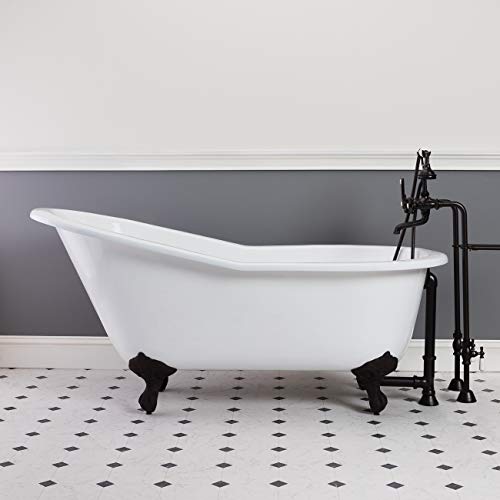
Vintage Tub & Bath Randolph Morris Mila 58 Inch Cast Iron Slipper Clawfoot Tub — Best for Smaller Bathrooms
The Mila answers the most common slipper-tub heartbreak: the bathroom is two inches too small for the tub in the photograph. At 58 inches it brings the full cast iron slipper format — raised reclining end, claw feet, undrilled rim — into bathrooms that cannot take a 60 or 67. Two inches sounds trivial on paper and is decisive in a real room, where it is the difference between a tub that fits with clearance to clean around it and a tub that technically fits and practically bullies the space.
The listing leans into the vintage brief: the Mila is presented as a vintage cast iron slipper, and the stated oil rubbed bronze drain gives the warm, dark-metal accent that period bathrooms are usually built around. Like the Charlotte 60, it has no faucet drillings, so plan on a freestanding or wall-mounted filler. Shorter tubs ask an honest question of taller bathers — at 58 inches, a six-footer reclines with knees bent, which many bathers happily accept and some do not; the Charlotte 67 below exists for those who will not compromise on stretch.
Strengths
- 58-inch footprint opens cast iron slipper bathing to smaller rooms
- Oil rubbed bronze drain suits period and vintage schemes
- Same undrilled-rim flexibility as the larger Charlottes
Trade-offs
- Tall bathers will recline with knees bent
- Faucet is a separate freestanding or wall-mount decision
- Smaller water volume than the 67-inch picks
| Length (listing-verified) | 58 inches |
| Type | Vintage cast iron single slipper clawfoot |
| Rim | No faucet drillings |
| Drain finish in listing | Oil rubbed bronze |
The Mila is the pick that respects the room. Too many small-bathroom remodels force a 60-inch tub into a 58-inch life and spend years stepping around the consequence. If your tape measure says 58, believe it, and take the tub that was designed for your bathroom rather than the one designed for your mood board — the bathing experience loses far less than the daily circulation space gains.
Best for: Smaller period bathrooms and guest baths with vintage styling / Not suited for: Tall bathers who prioritize a full-length stretch

Vintage Tub & Bath Charlotte 67 Inch Cast Iron Slipper Clawfoot Tub — Best Spacious Single Slipper
The 67-inch Charlotte is the same classic design as the Best Overall pick, given the one thing dedicated soakers ask for: length. Seven extra inches transform the recline — legs extend fully, the waterline covers more of the body, and the raised slipper end meets a back that is lying back rather than sitting up. For tall bathers, this is not the luxury version of the 60; it is the version that fits, and fit in a bathtub is not a preference, it is the product.
Everything else about the configuration stays classic: cast iron single slipper, claw feet, no faucet drillings. The listing for this size does not specify a feet finish in its title, so treat the finish as a detail to confirm on the listing page for the configuration you choose — feet and drain finishes are options on this line, and the photograph may show a different combination than the default. The extra length also adds cast iron, which adds weight: the floor and delivery planning in this guide’s how-to section applies with emphasis at this size.
Strengths
- 67-inch length gives tall bathers a true full-length recline
- Proven Charlotte design scaled up, not redesigned
- Undrilled rim keeps faucet choice open
Trade-offs
- Needs a bathroom that can take 67 inches plus cleaning clearance
- Heaviest class of single slipper here — plan floor and freight carefully
- Feet finish not stated in the listing title; confirm before ordering
| Length (listing-verified) | 67 inches |
| Type | Cast iron single slipper clawfoot |
| Rim | No faucet drillings |
Buy this Charlotte if the 60-inch version’s only flaw, for you, is arithmetic. Soakers over about five-foot-ten, and anyone who treats the bath as a daily half-hour ritual rather than an occasional event, will feel the extra length every single use — which is the correct test for an upgrade on a product you cannot return casually and will own for decades.
Best for: Tall bathers and dedicated soakers with the room to fit it / Not suited for: Compact bathrooms or buyers who want finishes confirmed in the title

Signature Hardware Arabella 61 Inch Cast Iron Double-Slipper Clawfoot Tub — Best Double Slipper on Claw Feet
A double slipper raises both ends of the tub, and the Arabella is the guide’s clawfoot expression of that idea at a manageable 61 inches. Recline facing either direction, share the tub with a partner sitting at the other raised end, or simply enjoy the symmetry — a double slipper centered in a room is one of the great bathroom silhouettes, and it asks to be placed away from the wall where both sculpted ends can be seen.
Its configuration differs from the Charlottes in one decision-shaping way: the rim carries 7-inch holes for a deck-mounted faucet, so the filler mounts on the tub itself rather than standing on the floor or the wall. Buyers who prefer that traditional arrangement — and the simpler plumbing run it can allow — should weight this heavily. The listing also states that feet and drain are part of this configuration, which removes two of the option-matching headaches that accompany undrilled tubs sold bare.
Strengths
- Recline from either end; symmetrical centerpiece silhouette
- Rim holes suit a deck-mounted faucet on the tub itself
- Feet and drain included in the stated configuration
Trade-offs
- Double slipper shortens the flat floor of the tub between the rises
- Rim-mounted faucet style is a commitment — no freestanding filler look
- Best displayed away from walls, which needs floor space
| Length (listing-verified) | 61 inches |
| Type | Cast iron double-slipper clawfoot |
| Rim | 7-inch rim holes (deck-mount faucet) |
| Included in listing | Feet and drain |
Choose the Arabella when the double-slipper idea itself is the attraction and you want it at a size ordinary bathrooms can host. Its rim-drilled configuration also makes it the most ‘complete recipe’ in this guide: tub, feet, drain and faucet mounting all decided in one listing. If your heart is set on a freestanding filler photograph instead, the Charlottes’ undrilled rims are your route and this tub’s holes are its honest deal-breaker.
Best for: Bathers who want double-slipper symmetry with a rim-mounted faucet / Not suited for: Fans of the freestanding floor-filler look

Vintage Tub & Bath Randolph Morris Grace 72 Inch Cast Iron Double Slipper Tub — Best Grand Statement Tub
The Grace is the maximalist’s tub: 72 inches long, double-slippered, carried on lion paw feet with an oil rubbed bronze finish, and drilled at the rim for its faucet. Every element is the traditional choice made at full scale. Lion paw feet are the ornate classic of the clawfoot world — larger, more sculptural than standard feet — and at 72 inches the tub has the proportions to carry that ornament without looking dressed up beyond its size.
Practically, 72 inches of cast iron double slipper is a two-person-capable, whole-evening bathtub and a serious building project in one object. The room must fit it with grace — literally: this tub wants clearance on all sides and a doorway route that can take it. The rim drillings place the faucet on the tub, in keeping with its period presentation. Buyers should confirm the full configuration details on the listing, because at this end of the market the options list is long and the freight is unforgiving of mistakes.
Strengths
- The largest, most traditional statement in this guide
- Lion paw feet and bronze finish deliver full period drama
- Double slipper at 72 inches suits shared, unhurried bathing
Trade-offs
- Demands a large bathroom and a verified delivery route
- The heaviest commitment here — floor structure must be assessed
- Ornate styling will fight a minimalist room rather than join it
| Length (listing-verified) | 72 inches |
| Type | Cast iron double slipper |
| Feet in listing | Lion paw, oil rubbed bronze finish |
| Rim | Faucet drillings |
The Grace is not the sensible pick and does not pretend to be; it is the pick for the renovation that is being built around the tub. If your project is a primary suite with a freestanding tub as its centerpiece and a period heart, this is the one the other five are measured against. If your project is a hardworking family bathroom, its scale and ornament will be daily friction — the Charlotte 60 is your tub, and choosing it is not settling.
Best for: Large period-style primary suites built around the tub / Not suited for: Small bathrooms, minimalist schemes or casual remodels

Kingston Brass 67 Inch Cast Iron Single Slipper Pedestal Tub — Best Pedestal Design
The Kingston takes the slipper silhouette and sets it on a pedestal instead of feet, and that single change alters the tub’s whole character. The line runs unbroken to the floor: no claw feet, no shadowed gap underneath collecting dust and the occasional dropped earring, and a slightly more architectural, less Victorian presence that sits comfortably in transitional bathrooms that find full clawfoot ornament too much costume.
At 67 inches it matches the largest Charlotte for bathing length, so the pedestal choice costs the soaker nothing. The listing presents it in white and under Kingston’s Aqua Eden family naming — note the brand field in the catalog data reads Kingston Brass, and the model code VCT7D673128 is the identifier to match if you cross-check configurations or speak to the seller. As with every tub here, confirm drilling and drain configuration on the listing for the exact unit, since pedestal tubs route their plumbing through the base and the details matter to your plumber.
Strengths
- Pedestal base eliminates the under-tub cleaning gap
- Full 67-inch soaking length with a cleaner, transitional look
- Model code stated for exact configuration matching
Trade-offs
- Loses the classic clawfoot character many slipper buyers want
- Plumbing routes through the pedestal — installer must plan for it
- White-only in this listing; finishes story is on the Charlottes instead
| Length (listing-verified) | 67 inches |
| Type | Cast iron single slipper pedestal tub |
| Base | Pedestal (no feet) |
| Color in listing | White |
This is the slipper tub for the buyer who loves the recline and the cast iron but not the costume. It is also the pragmatic cleaner’s pick: anyone who has fished a hair tie from under a clawfoot tub with a flashlight understands the pedestal’s appeal instantly. Choose it for transitional and modern-traditional rooms; choose the Charlottes when the feet themselves are part of the point.
Best for: Transitional bathrooms wanting slipper comfort without clawfoot ornament / Not suited for: Period purists for whom the feet are non-negotiable
Comparison Table
Sort the table by length and slipper type first — those decide whether the tub fits your bathroom and your bathing style. Drilling configuration second, because it chooses your faucet. Finish and feet are the pleasant decisions you get to make last.
| Pick | Badge | Key spec | Best for | Check |
|---|---|---|---|---|
| Vintage Tub & Bath Randolph Morris Charlotte 60 Inch Cast Iron Slipper Clawfoot Tub (Brushed Nickel Feet) | Best Overall | 60 in cast iron single slipper clawfoot; no faucet drillings; brushed nickel feet | Period-style remodels wanting the classic single-slipper centerpiece | Check on Amazon |
| Vintage Tub & Bath Randolph Morris Mila 58 Inch Cast Iron Slipper Clawfoot Tub | Best for Smaller Bathrooms | 58 in cast iron single slipper clawfoot; no faucet drillings; oil rubbed bronze drain | Smaller period bathrooms and guest baths with vintage styling | Check on Amazon |
| Vintage Tub & Bath Charlotte 67 Inch Cast Iron Slipper Clawfoot Tub | Best Spacious Single Slipper | 67 in cast iron single slipper clawfoot; no faucet drillings | Tall bathers and dedicated soakers with the room to fit it | Check on Amazon |
| Signature Hardware Arabella 61 Inch Cast Iron Double-Slipper Clawfoot Tub | Best Double Slipper on Claw Feet | 61 in cast iron double slipper clawfoot; 7 in rim holes; feet and drain included | Bathers who want double-slipper symmetry with a rim-mounted faucet | Check on Amazon |
| Vintage Tub & Bath Randolph Morris Grace 72 Inch Cast Iron Double Slipper Tub | Best Grand Statement Tub | 72 in cast iron double slipper; rim faucet drillings; lion paw feet, oil rubbed bronze finish | Large period-style primary suites built around the tub | Check on Amazon |
| Kingston Brass 67 Inch Cast Iron Single Slipper Pedestal Tub | Best Pedestal Design | 67 in cast iron single slipper on pedestal base, white | Transitional bathrooms wanting slipper comfort without clawfoot ornament | Check on Amazon |
How to Choose the Best Slipper Tubs Cast Iron Offers
Choose in this order: length, slipper configuration, base, drillings, finish. Length is governed by two tape measures — the bather and the bathroom. Bathers over average height should start at 67 inches; everyone else fits the 58–61 range, which returns floor space to the room. The bathroom measurement must include clearance: a freestanding tub needs room to walk and clean around it, and a tub that fits wall-to-wall on paper fails in a real room with baseboards, door swings and a plumber who needs access.
Slipper configuration is about how you bathe. A single slipper gives one perfected reclining end and a longer flat floor — better for stretching, for bathing children, and for anyone who also showers-standing in the tub’s footprint. A double slipper gives symmetry and two reclining ends at the cost of that flat middle. Neither is the upgrade of the other; they are different baths, and the honest question is which one your evenings actually look like.
Cast iron versus the alternatives, plainly
Cast iron’s case is heat retention, solidity and lifespan: the tub holds bathwater temperature noticeably longer than thin-walled alternatives, feels immovable, and its enamel surface is the benchmark the category is judged by, with a service life measured in decades. Its costs are weight, freight and price of entry. Acrylic is light and warm to the touch but flexes and scratches more readily; stone resin is beautiful and heavy in a different way. If you are reading a cast iron guide, you have probably already decided the material’s trade suits you — this section exists so the decision is informed rather than romantic.
Drillings: the decision that chooses your faucet
No drillings (the Charlottes and the Mila) means a freestanding floor filler or a wall-mounted faucet — the clean-rim look, at the cost of a separate fixture purchase and, for floor fillers, plumbing that must be roughed in at the tub’s location. Rim drillings (the Arabella at 7-inch centers, the Grace) mount the faucet on the tub: traditional, compact, and often simpler to plumb. Decide this before ordering anything, because the tub, the faucet and the rough plumbing are one system, and changing your mind after the freight delivery is the most expensive sentence in bathroom remodeling.
Feet, pedestals and finishes
Claw feet lift the tub, show the floor beneath and carry the period look; finishes — brushed nickel on the Charlotte 60, oil rubbed bronze on the Grace’s lion paws — should be matched to your faucet and drain metals for a composed room, or deliberately contrasted if you know what you are doing. A pedestal, as on the Kingston, trades the ornament for a clean base and easier floor cleaning. None of these affect the bath itself; all of them affect how the room feels and how Saturday cleaning goes.
How to Plan Installation of a Cast Iron Slipper Tub
A cast iron tub installation is a logistics project with a bathtub at the end of it. These planning steps, in order, prevent the standard disasters.
- Verify the floor: cast iron tubs are several hundred pounds before water and a bather are added. Have the floor structure assessed — joist condition and span — especially in older homes and upper-floor bathrooms, and reinforce if your contractor advises it.
- Walk the delivery route with a tape measure: doorways, hallway turns, stair widths. Freight delivery is typically to the curb or threshold; moving the tub to the bathroom is your crew’s job, and it takes several strong people and a plan.
- Decide the faucet system before the tub ships — freestanding, wall-mounted or rim-mounted per the tub’s drillings — and rough in plumbing to match while walls and floors are open.
- Dry-fit the tub’s position, mark the drain location precisely, and confirm the drain and overflow configuration you ordered matches the tub that arrived before it is set.
- Level the tub on its feet or pedestal per the manufacturer’s instructions; cast iron does not flex to forgive an uneven set, and a rocking tub is a leak with a schedule.
- Fill and drain-test before final sealing and before the room is closed up — the cheapest leak is the one found on day one.
Living with Cast Iron: Care That Keeps Enamel Beautiful
Cast iron’s enamel is famously durable and famously mistreated by the wrong cleaners. Use non-abrasive cleansers and soft cloths; abrasive powders and pads dull the gloss microscopically with every use, and the damage is cumulative and permanent. Rinse the tub after baths with bath oils or salts, which can film the surface, and dry the area around the drain where water stands. Chips — rare, and usually from a dropped metal object — should be touched up promptly with an enamel repair kit, because a chip exposes iron to water and rust works quietly.
The feet and exterior deserve a sentence too: the painted exterior can be wiped down like any painted surface, and the gap beneath a clawfoot tub should be part of the cleaning routine rather than a discovery years later. Treat the tub this way and the honest expectation is that it outlasts the rest of the bathroom’s fixtures — cast iron slipper tubs are among the few household objects still bought with the word ‘heirloom’ used non-ironically, and the care that earns it is measured in minutes a month.
What a Slipper Tub Costs to Own Beyond the Tub
Budget honestly for the system, not the centerpiece. Beyond the tub itself, a slipper installation typically involves the faucet system your drilling choice requires — freestanding fillers are a significant fixture purchase in their own right — drain and overflow hardware where not included, possible floor reinforcement, freight and in-home moving labor, and the plumber’s time for rough-in and set. None of this is hidden by the sellers so much as distributed across trades, and the remodels that go smoothly are the ones that priced the whole system before the tub was ordered.
Against that, set the ownership math: a cast iron tub is a multi-decade fixture with no mechanism to wear out, no finish that peels in sheets, and a strong claim to being the last tub a house needs. Per year of service, even the grandest pick in this guide is inexpensive. The tubs that are expensive are the wrong ones — the mis-measured, the wrongly drilled, the ones whose style fights the room — which is why this guide spends so many of its words on configuration and so few on adjectives.
Questions to Ask the Seller Before the Freight Truck Rolls
A cast iron tub purchase has a point of no easy return — roughly, the moment a several-hundred-pound crate is in your hallway — so the verification questions belong before it. Ask for the exact configuration in writing: drilling pattern, drain side and finish, feet finish, and whether drain and overflow hardware are included or sold separately, because listings in this category bundle differently across near-identical model names. The reviews in this guide state what each listing’s title confirms; the seller’s answer covers the rest, and a seller who answers precisely is also telling you something about the delivery to come.
Ask about the delivery itself: freight class, whether the service is curbside or threshold, crate dimensions, and what happens on a damage claim — enamel chips in transit are the category’s known heartbreak, and the time to learn the inspection-and-refusal procedure is before the truck arrives, not on the driveway with a driver waiting. Photograph the crate before opening it and the tub before signing anything the carrier asks you to sign.
Finally, ask your plumber — not the internet — the rough-in question for your chosen faucet system, with the tub’s specification sheet in hand. The tubs in this guide are mainstream configurations from established makers, and a plumber who has set a clawfoot before will find no surprises; the surprises in this category are almost never in the tub. They are in the assumptions nobody checked, which is a fixable problem, and this section is the fix.
A Note on Second-Hand Cast Iron
Because cast iron lasts generations, a used market exists, and some readers will wonder. A vintage tub can be a wonderful buy — the iron does not wear out — but the enamel is the product: chips, rust at the drain, and worn gloss are refinishing projects with real costs, and a refinished surface never quite equals original enamel. The new tubs in this guide carry warranties and known configurations; a used tub carries a story you must inspect in person, out of its crate, with the drain area examined closely. Buy vintage with eyes and hands, or buy new with paperwork — both are rational, and confusing the two is where the money leaks.
Common Buying Mistakes
Mistake 1: Ordering before deciding the faucet
Drillings choose your faucet system. A buyer who falls for an undrilled tub while dreaming of a rim-mounted filler — or the reverse — discovers the conflict at installation, when the fix involves a different tub, a different faucet or a plumber’s improvisation. Read the drilling line of the listing first; this guide states it in every review for exactly this reason.
Mistake 2: Measuring the tub, not the room or the route
A 67-inch tub in a bathroom with 67 inches of wall is a failure wearing a success’s paperwork. Freestanding tubs need clearance to enter, to clean around and to bathe beside — and before any of that, they need a route from the street through your doors. Measure the room’s usable footprint and every doorway on the path, in that order, before choosing a length.
Mistake 3: Assuming the floor will hold it
Cast iron, water and a bather together are a serious point load, and older floors with tired joists are common in exactly the period homes that suit these tubs. A structural once-over is cheap insurance; discovering deflection after the tile is laid is not. This is a contractor conversation, held before the order.
Mistake 4: Mixing metals by accident
Brushed nickel feet, a chrome faucet and an oil-rubbed-bronze drain in one small room looks like three bathrooms colliding. The listings state their finishes — brushed nickel, oil rubbed bronze — so compose deliberately: match the tub’s metals to your faucet and drain, or make one intentional contrast and keep everything else quiet.
Mistake 5: Cleaning enamel like it is indestructible
Cast iron is tough; its gloss is not. Abrasive powders and scouring pads cloud enamel permanently, one cleaning at a time. Soft cloths and non-abrasive cleaners keep the surface at its day-one shine for decades — the care instructions in this guide are short because the rules genuinely are simple.
Final Recommendation
For most bathrooms and most bathers, the Charlotte 60 remains the recommendation: the classic single slipper at the size that fits both bodies and rooms, in brushed nickel. Step down to the Mila 58 when the room demands it, up to the Charlotte 67 when the bather does. The Arabella is the double-slipper choice with the complete rim-mounted recipe, the Grace is the grand period statement, and the Kingston pedestal is the refined answer for rooms that want the recline without the costume.
Whichever you choose, do the unglamorous work first — floor, route, faucet system, configuration check — because a cast iron slipper tub rewards planning like few purchases can: get those four things right and you are buying a half-century of good baths.
- Best Overall: Vintage Tub & Bath Randolph Morris Charlotte 60 Inch Cast Iron Slipper Clawfoot Tub (Brushed Nickel Feet) — Check the current price on Amazon
- Best for Smaller Bathrooms: Vintage Tub & Bath Randolph Morris Mila 58 Inch Cast Iron Slipper Clawfoot Tub — Check the current price on Amazon
- Best Spacious Single Slipper: Vintage Tub & Bath Charlotte 67 Inch Cast Iron Slipper Clawfoot Tub — Check the current price on Amazon
- Best Double Slipper on Claw Feet: Signature Hardware Arabella 61 Inch Cast Iron Double-Slipper Clawfoot Tub — Check the current price on Amazon
- Best Grand Statement Tub: Vintage Tub & Bath Randolph Morris Grace 72 Inch Cast Iron Double Slipper Tub — Check the current price on Amazon
- Best Pedestal Design: Kingston Brass 67 Inch Cast Iron Single Slipper Pedestal Tub — Check the current price on Amazon
Best Undermount Bath Tubs Best Walkin Bath Tubs Best Vintage Mirrors Above Claw Tubs Best Whirlpool Freestanding Tubs 72 Best 72×48 Whirlpool Tubs
Frequently Asked Questions
What is a slipper tub?
A slipper tub is a freestanding bathtub with one end (single slipper) or both ends (double slipper) raised and sloped into a high backrest, so the bather reclines against the raised end. The name comes from the silhouette’s resemblance to a slipper. In cast iron, the raised end holds the water’s heat against your back, which is the design’s original and still-valid point.
Is cast iron better than acrylic for a slipper tub?
For heat retention, solidity and lifespan, yes — cast iron holds bath heat longer, feels immovable and its enamel can serve for decades. Acrylic wins on weight, price and ease of installation. The honest summary: cast iron is the better bathtub and the bigger project. This guide exists for buyers who have weighed that trade and chosen the project.
What does ‘no faucet drillings’ mean?
The tub’s rim has no holes for a faucet. You must use a freestanding floor-mounted filler or a wall-mounted faucet. Tubs with rim drillings — like the Arabella’s 7-inch centers in this guide — accept a faucet mounted on the tub itself. Neither is superior; they produce different looks and different plumbing, and the choice must be made before ordering.
How heavy is a cast iron slipper tub, and can my floor hold it?
Weights vary by size and maker, but expect several hundred pounds for the empty tub, plus water and bather. Many floors hold that without drama; older or upper floors deserve a structural check by a contractor before ordering. This guide deliberately does not print a single weight figure for all tubs — check the specific listing and your specific floor.
Can two people use a double slipper tub?
A double slipper raises both ends so two bathers can recline facing each other, and at 72 inches — the Grace in this guide — that is a realistic shared bath. At 61 inches, the Arabella’s double slipper is better understood as one bather reclining from either end. Length, not the slipper count, decides whether two is company or a crowd.
How do I clean under a clawfoot tub?
Regularly and briefly: a flat dust mop or a vacuum crevice tool reaches most of the gap, and a handheld light helps you see what you are doing. It is a two-minute monthly task. If the thought of it genuinely bothers you, that is a legitimate reason to choose the pedestal design — the Kingston in this guide — which has no under-tub gap at all.


