Disclosure: airfryerkitchensupply.com is reader-supported. When you buy through links on our site, we may earn an affiliate commission at no extra cost to you.
Where to buy
Short freestanding tubs live and die by their true length, so every model below was matched to a listing that states its size plainly — 59 inches or under, with one honest 55-inch option for genuinely tight rooms. If you are comparing the best short freestanding bathtubs, measure your floor space first, then use this list.
- WOODBRIDGE 59 Inch Acrylic Freestanding Bathtub B0014-MB, Matte Black Drain — check price on Amazon
- Empava 59 Inch Freestanding Bathtub, Acrylic Deep Soaking — check price on Amazon
- DeerValley 55 Inch Acrylic Freestanding Bathtub DV-1T0582 — check price on Amazon
- Signature Hardware Paxton 59 Inch Copper Soaking Freestanding Tub — check price on Amazon
- GAOMON 59 Inch Freestanding Acrylic Soaking Tub — check price on Amazon
- SereneLife 59 Inch Portable Foldable Bathtub for Adults — check price on Amazon
The best short freestanding bathtubs solve a specific heartbreak: you want the sculptural, spa-like presence of a freestanding tub, but your bathroom offers five feet of floor, not six. Standard freestanding tubs run 67 to 72 inches, and forcing one into a small bathroom leaves you squeezing past the rim to reach the faucet. A short freestanding tub — 59 inches and under — keeps the standalone look while leaving room to walk, clean, and actually use the bathroom around it.
The fear buyers bring to this category is that short means shallow, cramped, and disappointing. It does not have to. Length and comfort are related but not identical: a well-shaped 59-inch tub with a reclined backrest and a deep basin can soak a tall adult more comfortably than a long, upright, shallow one. What you give up is stretched-out legroom; what the good designs give back is depth, back angle, and a waterline that still reaches your chest.
This roundup covers the realistic spectrum of short: four 59-inch acrylic soakers from established tub brands, a genuinely compact 55-inch DeerValley for the smallest footprints, a 59-inch copper Signature Hardware piece for buyers who want the tub to be the room’s artwork, and a foldable portable option for renters and anyone whose “bathroom remodel” budget is zero. Every one is a real, verified listing.
Key Takeaways
- At 59 inches and under, depth and backrest shape matter more than the lost length.
- Run the painter’s-tape test: a short tub must leave cleaning access and door clearance, not just fit.
- Center-drain models (DeerValley 55) are the most forgiving in tight retrofits.
- If renovation is impossible, the foldable SereneLife is a real seated soak — not a toy.
In this guide
Quick Picks
WOODBRIDGE 59 Inch Acrylic Freestanding Bathtub B0014-MB, Matte Black Drain — Best Overall. The default answer in this category: a true 59-inch WOODBRIDGE soaker with contemporary lines and matte black hardware, from the brand that effectively built the Amazon freestanding market.
Check the current price on Amazon
Empava 59 Inch Freestanding Bathtub, Acrylic Deep Soaking — Best Deep Soak in a Short Tub. Empava states the number short-tub buyers actually care about — a 15-inch deep soak — plus ergonomic back support, an anti-slip bottom, and cUPC certification, drain included.
Check the current price on Amazon
DeerValley 55 Inch Acrylic Freestanding Bathtub DV-1T0582 — Best for the Smallest Bathrooms. When 59 inches is still too much: a true 55-inch freestanding soaker with center drain and integrated overflow — the shortest plumbed option in this roundup.
Check the current price on Amazon
Signature Hardware Paxton 59 Inch Copper Soaking Freestanding Tub — Best Statement Piece. A 59-inch copper soaker that turns the small-bathroom constraint into the design: warm metal, handcrafted presence, and a footprint that fits where statement tubs usually cannot go.
Check the current price on Amazon
GAOMON 59 Inch Freestanding Acrylic Soaking Tub — Best Value 59. A budget-route 59-inch acrylic soaker with non-slip surface and the drain and overflow included — the geometry of the top picks at an entry tier, with the usual value-brand homework required.
Check the current price on Amazon
SereneLife 59 Inch Portable Foldable Bathtub for Adults — Best No-Renovation Option. Not a fixture at all — a 59-inch foldable soaking tub that sets up for a hot soak or cold plunge and folds away afterward. The renter’s answer to everything above.
Check the current price on Amazon
How These Picks Were Chosen
Length was the hard filter: only tubs listed at 59 inches or shorter qualified, verified model by model so no 67-inch tub could sneak in under a “compact” marketing label. Within that filter we prioritized soaking depth and backrest shape, because in a short tub those two traits — not length — decide whether the bath feels generous or compromised.
We also weighed the practicalities that small bathrooms magnify. A freestanding tub needs cleaning access around it, so models whose footprint leaves a workable gap in a typical small room scored better. Drain placement mattered too: center-drain designs sit more flexibly in tight layouts, while end-drain models need their plumbing planned. Included drain and overflow hardware counted in a pick’s favor, since short-tub buyers are often doing compact remodels on compact budgets.
Finally, we kept one non-traditional seat at the table. A foldable portable tub is not a renovation fixture, but for renters, small-space dwellers, and cold-plunge fans it solves the same problem — a real soak in a room that cannot take a plumbed tub — and pretending otherwise would make this list less honest.
The 6 Best Short Freestanding Bathtubs

WOODBRIDGE 59 Inch Acrylic Freestanding Bathtub B0014-MB, Matte Black Drain — Best Overall
If you want one name to trust in short freestanding tubs, WOODBRIDGE is it — the brand’s 59-inch B0014 is its standard-length soaker trimmed down, keeping the oval contemporary silhouette and double-walled acrylic construction its larger tubs are known for. The matte black overflow and drain suit the black-hardware bathrooms most remodels are building now.
Strengths
- True 59-inch length from the most established freestanding brand on Amazon
- Contemporary oval shape reads as a design piece, not a compromise
- Matte black drain and overflow included and matched
Trade-offs
- Very tall bathers will sit with knees bent; that is physics at 59 inches
- Freestanding install needs a floor drain position planned, unlike an alcove swap
- White acrylic with black trim locks you into a two-tone scheme
| Length | 59 in |
| Configuration | Freestanding, center-style drain |
| Trim | Matte black overflow and drain |
| Material | Acrylic |
What makes the B0014-MB the top pick is balance. The basin is shaped for soaking rather than sitting — a reclined end to lean against and enough depth that the water does its job — while the footprint stays honest to a small room. In a 5-by-8 bathroom, this tub leaves a believable walkway and cleaning gap, which is where longer “almost fits” tubs quietly fail their owners every single day.
WOODBRIDGE’s scale also means replacement drains, flex hoses, and support are easy to find years later. For a fixture that is plumbed into your floor, that aftermarket depth is worth real money, and it is why this model anchors the list instead of a cheaper unknown with a similar silhouette.
Best for: small primary bathrooms that want a real soaking tub without a renovation of the floor plan / Not suited for: bathers well over six feet who prioritize stretching out flat

Empava 59 Inch Freestanding Bathtub, Acrylic Deep Soaking — Best Deep Soak in a Short Tub
Empava’s 59-inch entry is aimed squarely at the depth question. The listing states a 15-inch deep soak, an ergonomic back, and an anti-slip bottom, and the tub is cUPC certified with the drain and overflow in the box. For a buyer whose last tub was a shallow builder-grade alcove model, those specifics promise a categorically better bath in the same five feet.
Strengths
- Stated 15-inch soaking depth is strong for a 59-inch tub
- cUPC certification matters for permitted remodels and resale
- Anti-slip bottom and ergonomic back support are stated design features, not afterthoughts
Trade-offs
- Deep-for-its-size still means knees-up soaking for tall bathers
- Empava’s tub support network is thinner than WOODBRIDGE’s
- Gloss acrylic shows water spots; expect a wipe-down habit in hard-water homes
| Length | 59 in |
| Stated soaking depth | 15 in |
| Certification | cUPC |
| Included | Drain and overflow |
Depth is the correct obsession in this category, because it is the dimension that survives the length cut. Your legs adapt to 59 inches by bending; your shoulders cannot adapt to a shallow waterline. Empava clearly designed around that logic, and the certification gives permitted projects a paperwork-friendly path that no-name tubs cannot offer.
The anti-slip bottom deserves more credit than it gets in listings. Short tubs are often bought for smaller bathrooms used by kids and older relatives, and a textured floor in a deep, high-sided tub is a genuine safety feature at entry and exit, not a marketing garnish.
Best for: soakers who rank depth and certification above brand size / Not suited for: buyers who want the widest possible aftermarket parts network
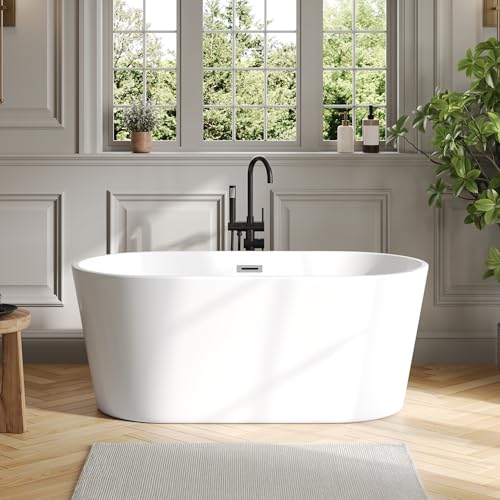
DeerValley 55 Inch Acrylic Freestanding Bathtub DV-1T0582 — Best for the Smallest Bathrooms
Some bathrooms simply cannot take 59 inches with any dignity: a door swing, a vanity, or a toilet clearance eats the difference. The DeerValley DV-1T0582 at 55 inches is built for those rooms. Its center drain and integrated overflow simplify the install, and the ergonomic shaping works to make a compact basin feel intentional rather than apologetic.
Strengths
- Shortest plumbed tub here, opening up genuinely tiny bathrooms
- Center drain gives flexible placement against walls and in corners
- Integrated overflow keeps the exterior lines clean
Trade-offs
- At 55 inches, most adults soak seated with knees well up
- Value brand; inspect finish and drain hardware carefully on arrival
- Too small to share, and tight as a kids’ bath for siblings together
| Length | 55 in |
| Configuration | Freestanding, center drain |
| Overflow | Integrated |
| Model | DV-1T0582 |
Judge this tub against the alternative, which is no tub at all. In a small ensuite or a converted powder room, 55 inches of soaking tub transforms the space from shower-only to a room with a ritual in it. Seated soaking — knees up, back supported, water high — is how much of the world bathes, and a deep, well-shaped 55 does it properly.
The center drain also helps in retrofits, because the tub can sit in either orientation while the rough-in is planned beneath it. For landlords converting small units and owners of older homes with genuinely small bathrooms, this is frequently the only freestanding geometry that works.
Best for: tiny ensuites, powder-room conversions, and small rental units / Not suited for: anyone who equates a bath with stretching out full-length

Signature Hardware Paxton 59 Inch Copper Soaking Freestanding Tub — Best Statement Piece
Every category has a pick for the buyer who wants the object itself to be beautiful, and in short freestanding tubs it is this copper Paxton from Signature Hardware. Copper holds a living finish that deepens with use, conducts warmth from the water, and makes a small bathroom feel designed rather than compromised. The external drain and overflow suit the exposed-plumbing aesthetic the material invites.
Strengths
- Copper construction is a genuine material upgrade, not a finish imitation
- 59-inch footprint brings a statement tub into small rooms
- Signature Hardware is a specialist fixtures brand with real support
Trade-offs
- Copper is a premium material at a premium tier; budget accordingly
- Living finish changes over time and needs the care routine copper asks for
- Heavier and more delicate to install than acrylic; plan the placement carefully
| Length | 59 in |
| Material | Copper |
| Configuration | Freestanding soaking, external drain and overflow |
| Model | 928206-59 Paxton |
Copper’s case is partly sensory: it warms quickly, feels substantial, and pairs with both rustic and modern schemes in a way white acrylic cannot. In a small bathroom, where the tub is unavoidably the largest object in the room, choosing one that earns that visual dominance is sound design logic, not indulgence.
Be honest with yourself about maintenance before buying. Copper owners either love the evolving patina or commit to polishing; there is no third option. If either of those sounds like you, this is the short tub you will still be pleased with in fifteen years.
Best for: design-led remodels where the tub is the room’s centerpiece / Not suited for: set-and-forget buyers who want a finish that never changes
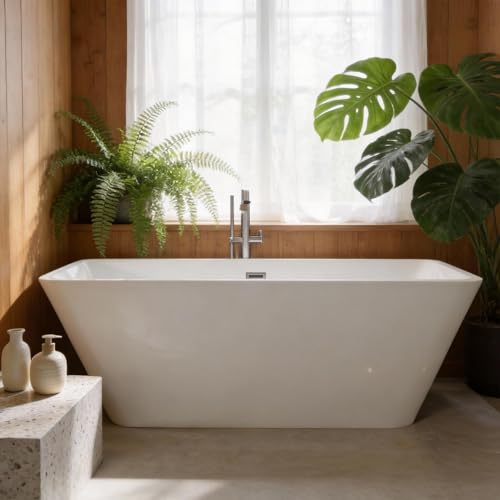
GAOMON 59 Inch Freestanding Acrylic Soaking Tub — Best Value 59
GAOMON’s 59-inch tub targets the buyer who has priced the big brands, winced, and still wants the freestanding look in a small room. The listing promises the right fundamentals — contemporary stand-alone shape, non-slip surface, overflow and drain included — at the value end of the category.
Strengths
- Full 59-inch freestanding geometry at a value tier
- Drain and overflow included, reducing add-on costs
- Non-slip surface is a practical touch for family bathrooms
Trade-offs
- Lesser-known brand; verify every dimension and the drain spec before the plumber arrives
- Finish and acrylic thickness may not match premium brands over the long term
- Support and replacement parts are Amazon-mediated rather than dealer-based
| Length | 59 in |
| Configuration | Freestanding soaking |
| Included | Overflow and drain |
| Material | Acrylic |
Value tubs live or die on inspection discipline. Order early, unbox immediately, check the rim, skirt, and drain threads, and dry-fit the tub in place before any plumbing is cut. Done that way, a tub like this can deliver the same daily soak as models costing far more; skipped, the savings evaporate into a return freight headache.
This is also a sensible pick for a secondary bathroom — a guest ensuite or a rental — where the tub will be used weekly rather than daily and the budget is better spent on the primary bath.
Best for: value-focused remodels and secondary bathrooms / Not suited for: primary-bathroom buyers who want maximum long-term brand support
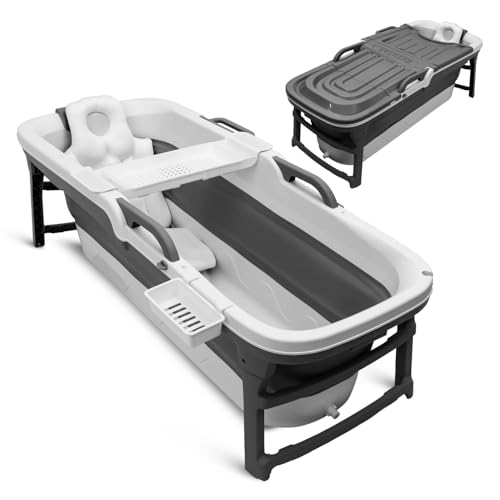
SereneLife 59 Inch Portable Foldable Bathtub for Adults — Best No-Renovation Option
Include it honestly: for renters, dorm-adjacent living, small apartments, and anyone whose landlord or lease forbids renovation, the SereneLife foldable is the only “short freestanding tub” that is actually available to them. At 59 inches unfolded it offers a genuine seated soak, fills from a shower head or faucet, drains by hose, and stores flat when the bathroom needs to be a bathroom again.
Strengths
- Zero renovation, zero plumbing — works in rentals and apartments
- Folds flat for storage in small homes
- Doubles as a cold-plunge tub, a second life most fixtures never get
Trade-offs
- It is a portable tub, not a plumbed fixture; filling and draining are manual chores
- Materials will not age like acrylic or copper; treat it as a multi-year appliance, not a fixture
- Aesthetics are functional — it will not anchor a designed bathroom
| Length | 59 in unfolded |
| Configuration | Portable, foldable, freestanding |
| Plumbing | None — manual fill and drain |
| Use | Hot soak and cold plunge |
The right comparison for this pick is not the WOODBRIDGE; it is the shower-only life its buyers currently have. Against that baseline, a foldable soaker that delivers a real, deep, seated bath on demand is a large quality-of-life upgrade, and its cold-plunge second career gives it a use case even after a future move into a home with a real tub.
Set expectations on routine: you will fill it from the shower, soak, then drain it to the shower or tub drain. Owners who build that rhythm — soak evenings, fold away on Sundays — report the friction fading fast. Owners who expected a plumbed tub’s convenience should buy a plumbed tub.
Best for: renters, apartment dwellers, and cold-plunge users / Not suited for: homeowners doing a permanent bathroom remodel
Comparison Table
Length is the entry ticket here — all six are 59 inches or under. The real differences are material, depth, drain position, and whether the tub is a plumbed fixture or a portable.
| Pick | Badge | Key spec | Best for |
|---|---|---|---|
| WOODBRIDGE 59 Inch Acrylic Freestanding Bathtub B0014-MB, Matte Black Drain | Best Overall | 59 in, acrylic, matte black overflow and drain | small primary bathrooms that want a real soaking tub without a renovation of the floor plan |
| Empava 59 Inch Freestanding Bathtub, Acrylic Deep Soaking | Best Deep Soak in a Short Tub | 59 in, 15 in deep soak, cUPC certified | soakers who rank depth and certification above brand size |
| DeerValley 55 Inch Acrylic Freestanding Bathtub DV-1T0582 | Best for the Smallest Bathrooms | 55 in, center drain, integrated overflow | tiny ensuites, powder-room conversions, and small rental units |
| Signature Hardware Paxton 59 Inch Copper Soaking Freestanding Tub | Best Statement Piece | 59 in, copper, external drain and overflow | design-led remodels where the tub is the room’s centerpiece |
| GAOMON 59 Inch Freestanding Acrylic Soaking Tub | Best Value 59 | 59 in, non-slip surface, drain included | value-focused remodels and secondary bathrooms |
| SereneLife 59 Inch Portable Foldable Bathtub for Adults | Best No-Renovation Option | 59 in, foldable, no plumbing | renters, apartment dwellers, and cold-plunge users |
How to Choose a Short Freestanding Bathtub
Measure the room, not just the tub footprint
A freestanding tub needs more than its own length. You need a cleaning gap you can actually reach around — a few inches on every side at minimum — plus door swing clearance and a path to carry the tub into the room in the first place. Map the tub’s outline on the floor with painter’s tape and live with it for a day: walk past it, mimic cleaning behind it, open every door and drawer. A 59 that passes the tape test beats a 67 that technically fits and practically bullies the room.
Depth and backrest shape replace lost length
In a short tub you soak seated, so the design details that matter are soaking depth, the recline of the backrest end, and whether the rim gives your arms a natural rest. A deep basin with a laid-back end feels luxurious at 59 inches; a shallow, upright one feels like a bucket at any length. Prioritize listings that state a soaking depth, and be skeptical of short tubs that publish only exterior dimensions.
Plan the drain before you fall in love
Freestanding tubs drain through the floor, and in a small bathroom the joists, existing drain line, and tub position must agree. Center-drain models offer the most placement flexibility; end-drain models need the rough-in on their schedule. A flexible drain hose buys a few inches of forgiveness, not a foot. Bring your plumber a dimension diagram before the tub ships, not after.
Short Tub, Tall Bather: An Honest Word
If you are over six feet tall, a short tub means soaking with your knees bent and your back reclined — a posture many tall bathers genuinely enjoy, closer to a hot tub seat than a stretched-out bath. What you cannot do is lie flat. If lying flat is the entire point of bathing for you, the honest options are a longer tub with a room rethink, a deep alcove tub that uses wall-to-wall length efficiently, or a walk-in shower with a bench and a great shower head. This guide will not pretend a 55-inch tub stretches; it will insist, correctly, that a deep seated soak is a real bath and not a consolation prize.
The Geometry of a Comfortable Short Soak
A short tub asks your body to do one thing: sit with bent knees and a reclined back. Whether that posture feels like a spa or a punishment is decided by three measurements most listings bury. The first is the backrest angle — the reclined end should lean you back far enough that your head and shoulders rest without effort, roughly the angle of a good lounge chair. The second is the basin’s floor length, the flat area your hips and folded legs actually occupy; a tub can be 59 inches at the rim and far less at the floor if the ends slope steeply, which is why the shaped, soaking-oriented models here outperform merely shortened standard tubs.
The third is rim width. In a short tub your arms live on the rim, and a rim wide enough to rest a forearm — or a book, or a cup — changes the soak from a sit to a session. None of these numbers appear in headlines, which is why this guide favored models whose listings and shapes are explicitly soaking-oriented, and why the tape test in the how-to section should be paired with a showroom sit whenever one is available.
There is also a genuine upside to shortness nobody markets: less water. A 59-inch tub filled deep uses notably less hot water than a 72-inch one, fills faster, and reheats the room less. For a nightly soaker, that efficiency compounds into lower bills and a routine that is easier to keep — a short tub is not just a small bathroom’s compromise, it is a frequent bather’s optimization.
Floors, Fillers, and the Small-Room Install Budget
Budget a short freestanding install as three purchases, not one. The tub is the first. The filler is the second: in small rooms a wall-mount filler usually wins because a floor-mount filler consumes the same scarce floor the short tub was bought to save, but a wall-mount demands the tub sit within spout reach of the wall, which slightly reduces the freestanding drama. Price both before the plumber arrives, because the choice changes the rough-in. The third purchase is the drain work itself — a freestanding tub drains through the floor, and in a retrofit that can mean opening the ceiling below, a cost that has nothing to do with the tub’s price tag.
Floors deserve a check as well. A filled short tub concentrates its weight on four small feet or a compact base ring. Sound subfloor handles it easily; a floor with existing bounce or water damage should be reinforced while it is open for the drain anyway. Doing both jobs in one opening is the cheapest structural insurance a remodel can buy.
Against those costs, set the alcove alternative honestly: a deep 60 alcove tub reuses existing plumbing positions and often installs for less in total. The freestanding earns its premium in rooms where its look is the point. In a small bathroom being remodeled for resale, that look frequently returns the premium — a photogenic freestanding tub, even a short one, is the image that sells the listing.
Short Tubs for Two, for Kids, and for Aging in Place
Three audiences ask about short tubs with specific hopes, and each deserves a straight answer. For couples: a 59-inch tub is a one-person soak with rare exceptions. Two adults in 59 inches is a squeeze that belongs to novelty, not routine; if bathing together matters, the answer is a wider or longer tub and a different room plan, and no amount of shopping changes that geometry. Buy the short tub as a superb solo ritual and enjoy it as such.
For children, the verdict reverses: a short, deep tub is arguably better than a long one. Less water to supervise, a basin a child cannot stretch out and submarine in, and a height that makes lifting a toddler in and out kinder on a parent’s back than a long tub’s reach. Families converting a small bathroom often find the short soaker becomes the kids’ bath by acclaim. For aging in place, judge carefully: the high wall of a deep short tub is a real step-over, and the seated posture is comfortable once inside, but entry and exit are the risk. A grab bar, a transfer bench, or a walk-in design may serve better — comfort features only count if you can get to them safely.
The common thread is honesty about who will actually use the tub, how often, and how. A short freestanding tub bought for a real ritual gets used weekly for years; one bought for a photograph gets used monthly and resented at cleaning time. Choose for the ritual.
Caring for a Short Freestanding Tub So It Ages Well
A freestanding tub’s beauty is exposed on every side, which makes its care routine slightly different from an alcove tub’s. The exterior is a visible surface: dust it, wipe splashes before they dry into mineral marks, and treat the outside with the same non-abrasive discipline as the inside. In hard-water homes, a weekly wipe of the exterior prevents the slow dulling that makes a statement tub look tired by year two — fifteen minutes a month preserves the object you bought the room around.
The floor gap is the second care frontier. Hair, dust, and the occasional dropped earring migrate under and behind a freestanding tub, and in a small bathroom that hidden strip is a meaningful fraction of the floor. A slim crevice tool monthly, as the how-to section advised, keeps it honest. Once a year, check the drain connection and the filler’s flexible lines while you are down there; small weeps announce themselves as mineral traces long before they become damage, and catching one is a washer replacement rather than a floor replacement.
Acrylic care is gentle by rule: mild cleaner, soft cloth, no abrasive powders, no scouring pads, and care with bath products that dye — bath bombs and colored oils can tint acrylic left soaking in them, so rinse the basin after use. Copper, like the Paxton in this list, follows its own covenant: embrace the patina or polish on a rhythm, and never let harsh cleaners strip it unevenly. Either material rewards the same underlying habit — little and often, never heroic and rare.
Finally, protect the rim in daily life. It is where cups, books, razors, and phones land, and where chips and stains begin. A simple bath caddy or a small stool beside the tub gives those objects a home that is not the rim, and keeps the silhouette you paid for unmarked. Small bathrooms forgive nothing, but they also need very little — a few consistent habits, and a short tub looks new for a very long time.
Short Freestanding vs. Deep Alcove: The Final Decision Framework
If you have read both this guide and the deep-60 alcove guide in this cluster and still cannot decide, reduce the choice to three questions. First: does the bathroom need a shower over the tub? If yes, the alcove wins outright — showering in a freestanding tub is a curtain-wrapped compromise that satisfies no one for long. Second: is the tub the room’s design centerpiece, or a participant in a working bathroom? Centerpiece ambitions justify the freestanding premium; working bathrooms spend that money better on depth and fixtures. Third: who soaks, and how often? A nightly solo soaker in a small ensuite is the short freestanding tub’s perfect owner; a family bathroom bathing kids and adults in rotation belongs to the alcove.
Score your household honestly and the answer is rarely close. Most standard bathrooms resolve to the deep alcove; most small ensuites and design-led remodels resolve to the short freestanding. The mistake is choosing against your own answers for the sake of a photograph — a tub is a twenty-year roommate, and it should be the one your actual life would pick.
Whichever way you land, the short freestanding category has matured past compromise: the picks here are real soaking instruments at 59 inches and under, from brands that will answer for them. The small bathroom no longer has to apologize for its bath.
Accessories That Complete a Short Tub Setup
A short tub reaches its potential with three companions, none expensive. The first is a bath caddy sized to the tub’s width — at 55 to 59 inches, standard caddies fit, but measure the inner width rather than assuming, because a caddy that spans the rim of a long tub may sit awkwardly on a short one’s curved ends. The caddy holds the book, the cup, and the phone at a safe distance from the water, and it gives the soak its session quality. The second is a simple bath pillow for the reclined end: even the best-shaped backrest benefits from a cushion at the neck, and in a short tub, where your posture is more upright than in a long one, the pillow is the difference between twenty minutes and forty.
The third companion is lighting. A small bathroom with a statement tub deserves light that flatters the ritual — a dimmable fixture or a warm bulb turns a functional room into the spa the tub promised, at the cost of a bulb. Owners consistently underestimate how much of the “freestanding experience” is actually the room’s mood, and mood is the cheapest layer of the whole project. Buy the tub for its geometry, then spend the small money on caddy, pillow, and light, and the short tub stops being the small option and becomes simply your bath.
How to Plan a Small-Bathroom Freestanding Tub Install
Short freestanding installs fail on logistics more than plumbing. Work through these steps in order and the tub that arrives will be the tub the room can actually take.
- Tape the tub’s full outline on the bathroom floor, including a hand’s width of cleaning clearance on all sides. Live with the tape for a day and test door swings, drawer pulls, and the path you walk at night.
- Trace the delivery route: front door, hallway turns, bathroom door width. A one-piece 59-inch tub is light but bulky, and discovering a too-narrow doorway with the crate open is a classic small-remodel disaster.
- Confirm the drain position against the floor structure with your plumber. Mark where the drain will land, check it against joists, and decide on a flexible connector if the alignment is close but not exact.
- Choose the filler position while the floor is open in your mind: a floor-mount filler needs its own floor space beside the tub, while a wall-mount filler needs the tub close enough to the wall for the spout to reach. In small rooms, wall-mount usually preserves the walkway.
- Before the final set, fill the tub in place and check for level, drain seal, and overflow function. A freestanding tub that rocks or weeps is far easier to correct before the filler is connected and the room is finished.
After install, keep the area behind the tub on a monthly cleaning rhythm — dust and hair collect in the gap, and a slim crevice tool on a vacuum handles it in a minute. Small bathrooms forgive nothing, but they also reward this small discipline with a room that always looks intentional.
Common Buying Mistakes
Buying length by the product title
Listings round, and “59 inch” in a headline can describe a tub whose rim overhang or skirt changes the real footprint. Trust the dimension diagram, and verify the exact model — every pick here was matched to a listing that states its size.
Forgetting cleaning access
A freestanding tub wedged wall-to-wall is a dirt trap with a faucet. If you cannot reach behind it, you cannot clean behind it, and in a small bathroom that grime is always visible.
Assuming short means shallow is fine
Length is the compromise you chose; depth should not be the second one. A short and shallow tub satisfies nobody — insist on a stated soaking depth.
Ignoring the filler footprint
Floor-mount fillers are furniture too. In a tight room their footprint competes with the tub’s, and many small-bathroom plans only work with a wall-mount filler.
Skipping the delivery-route check
More than one beautiful tub has spent a night in a hallway because a bathroom door was two inches too narrow. Measure the route, not just the room.
Final Recommendation
Start with the WOODBRIDGE B0014-MB if your room takes 59 inches — it is the category’s reference point for a reason. Choose the Empava when depth and certification top your list, the DeerValley 55 when the room itself makes the decision, and the copper Paxton when the tub is meant to be the most beautiful object you own. The GAOMON covers the value route with proper inspection discipline, and the SereneLife foldable remains the honest answer when renovation is off the table entirely.
Whatever the pick, run the tape test first. In small bathrooms, the tape never lies.
Start your shortlist here: WOODBRIDGE 59 Inch Acrylic Freestanding Bathtub B0014-MB, Matte Black Drain · Empava 59 Inch Freestanding Bathtub, Acrylic Deep Soaking · DeerValley 55 Inch Acrylic Freestanding Bathtub DV-1T0582
Keep exploring the same cluster: Best Deep 60 Tubs Best Freestanding Bathtubs Best Soaking Tubs For Small Bathrooms Best Alcove Bathtubs Best Bathtub Faucets
Frequently Asked Questions
Can a tall person use a 59-inch freestanding tub?
Yes, seated — with knees bent and back reclined against the shaped end. Many tall bathers find a deep 59 more comfortable than a shallow 67. What a short tub cannot offer is lying fully flat; if that is essential, look at deep alcove models instead.
How much space should I leave around a short freestanding tub?
Enough to clean: a few inches on every side at minimum, more on the side you will reach from. Tape the outline and test your own movement before committing.
Is a 55-inch tub worth it, or too small?
For a small ensuite or converted space, it converts a shower-only room into a bathing room, which is a genuine upgrade. Judge it as a seated soaking tub and it succeeds; judge it as a stretched-out bath and nothing under 67 inches will satisfy you.
Do short freestanding tubs need special plumbing?
They need floor drainage like any freestanding tub, plus attention to filler reach. Center-drain models are the most forgiving in tight retrofits. A flexible drain connector helps alignment but does not replace planning.
Are portable foldable tubs a real alternative?
For renters and no-renovation situations, yes — a foldable 59-inch soaker delivers a real seated bath and stores away. It is an appliance, not a fixture, and filling and draining are manual, but against a shower-only baseline it is a major upgrade.
Which material is best for a short freestanding tub?
Acrylic is the practical default: light, warm, repairable, and available in every short size. Copper is the premium statement material with a living finish to maintain. The portable foldable is its own category for no-renovation homes.
Can two people fit in a 59-inch freestanding tub?
Not comfortably as a routine. A 59-inch tub is a solo soaker; two adults can squeeze in briefly, but if bathing together is a real priority, you need a wider or longer model and the room to match.
How do I fill a freestanding tub in a small bathroom?
Most small-room installs use a wall-mount filler with the tub placed within spout reach of the wall, which preserves floor space and walkway. A floor-mount filler is the alternative when the tub sits away from walls, but budget its footprint as furniture.
How do I clean behind a freestanding tub in a small bathroom?
Monthly, with a slim crevice tool on a vacuum or a flat microfiber mop made for gaps. This is why the tape test in this guide insists on a hand’s width of clearance — if you planned the gap, cleaning it takes a minute; if you did not, no tool fully solves it.
Do short freestanding tubs hold heat as well as longer ones?
Better than their size suggests. A deep short tub holds less total water, but the bather displaces and covers more of its surface, and double-walled acrylic models insulate well. In practice, a 30-minute soak in a deep 59 stays comfortably hot, especially with the fill started slightly warm.
Is a short freestanding tub hard to resell a home with?
Quite the opposite in most cases: a photogenic freestanding tub — even a short one — is the image that anchors a bathroom listing, and buyers read it as a spa upgrade. The only caution is in family homes marketed on a kids’ bath, where a standard alcove may photograph as more practical; even there, the short soaker’s deep, attractive basin rarely counts against the home.


