Disclosure: airfryerkitchensupply.com is reader-supported. When you buy through links on our site, we may earn an affiliate commission at no extra cost to you.
Where to buy
The six sheet sets below were verified against Amazon catalog data on 2026-11-22 by brand and model. All six are sets that live in the under-$50 tier this guide is about — but sheet prices drift with sales and seasons, so treat the tier as a positioning, not a promise: check the current price on Amazon through the links before you buy, and if a set has wandered above the line in your size, its neighbours here will not have.
- Mellanni Iconic 4-Piece Bed Sheet Set (Queen) — Best Overall. Check the current price on Amazon.
- Bedsure Queen Sheet Set (4 Pieces) — Best Cooling Feel. Check the current price on Amazon.
- California Design Den 400TC Cotton Sateen Sheet Set (Queen) — Best Cotton. Check the current price on Amazon.
- Amazon Basics Brushed Microfiber Sheet Set — Best Budget. Check the current price on Amazon.
- Bedsure Deep Pocket Queen Sheets Set — Best for Thick Mattresses. Check the current price on Amazon.
- Mellanni Cotton Flannel Sheet Set (Queen) — Best for Winter. Check the current price on Amazon.
The market for the best sheet sets under 50 dollars is the most honest corner of bedding, because at this level nobody is selling you a story about thread counts in the thousands or fibres harvested by moonlight. What fifty dollars buys — when it is spent well — is a soft, properly fitting, easy-washing set of sheets that survives a year of weekly laundry without pilling into sandpaper or popping off the mattress corners at 3 a.m. What it buys when spent badly is exactly those failures, which is why this category rewards choosing known constructions from known makers over anonymous sets with inflated specifications.
This guide picks six sets that each win a different version of the under-$50 brief. Two are brushed microfiber, the tier’s workhorse fabric: one the all-round benchmark, one the rock-bottom budget buy that still behaves. One is a cooling-feel set for hot sleepers. One proves that real cotton — 400 thread count sateen — can still be had inside this budget if you buy from the right brand. One solves the deep-mattress fit problem that defeats most cheap sets. And one is flannel, because winter is the season when a budget set can feel like a luxury one. Every pick is a four-piece set in queen unless stated, every one machine-washes like a normal household item, and every claim below traces to a verified listing rather than a marketing page.
One piece of tier honesty before the reviews: “under $50” describes where these sets are positioned, and queen sizes sit at the top of each range. Twin sets cost less, king sets sometimes nudge the line, and holiday sales move everything. The right way to use this guide is to choose by fabric and fit first — the differences that will still matter in month six — and confirm the price of your size at checkout.
In this guide
Quick Picks
- Best Overall: Mellanni Iconic 4-Piece Bed Sheet Set — double-brushed microfiber with a 16-inch deep pocket; the set this tier is measured against.
- Best Cooling Feel: Bedsure Queen Sheet Set — a light, breathable-feeling four-piece set for sleepers who run warm.
- Best Cotton: California Design Den 400TC Cotton Sateen Sheets — genuine cotton sateen with a smooth, hotel-style hand, inside a budget tier usually owned by synthetics.
- Best Budget: Amazon Basics Brushed Microfiber Sheet Set — the lowest-cost route to soft, wrinkle-resistant sheets that simply work.
- Best for Thick Mattresses: Bedsure Deep Pocket Queen Sheets Set — fits mattresses up to 21 inches thick, the fix for corner pop-off on modern deep beds.
- Best for Winter: Mellanni Cotton Flannel Sheet Set — double-brushed flannel that makes a cold bed feel welcoming in January.
How These Picks Were Chosen
Every set was verified against Amazon’s catalog on 2026-11-22 — searched by brand and model, matched to the returned listing title, ASIN taken from the listing response. Construction details quoted here (pocket depths, piece counts, the California Design Den’s 400 thread count, the Bedsure deep-pocket set’s 21-inch mattress capacity) come from those verified listings, not from roundups of other roundups.
The filter for this tier was durability of experience. Under-$50 sheets fail in predictable ways — pilling, thinning, elastic that gives up, corners that will not stay on — so we favoured established bedding brands with long-running product lines over one-season listings, and constructions with a track record: double-brushed microfiber done properly, sateen cotton at an honest thread count, flannel brushed on both sides. Fit got its own criterion, because a cheap set that fits a 21-inch mattress is worth more than a finer set that pops off it. And every pick had to wash and dry in a normal home laundry cycle without special handling, because sheets at this price are bought to be used hard and replaced without grief when their years are done.
What we excluded: sets advertising implausible thread counts (a four-figure thread count at this price is a fiction printed on a band), microfiber so thin it is translucent out of the packet, and any set whose fitted sheet depth was unstated — an unquoted pocket depth at this tier is a shallow one.
The 6 Best Sheet Sets Under $50

Mellanni Iconic 4-Piece Bed Sheet Set (Queen) — Best Overall
This is the set that built the modern budget-sheet category, and it remains the one to beat. The Iconic is a double-brushed microfiber four-piece set — flat sheet, fitted sheet with a 16-inch deep pocket, and two pillowcases — with a soft, peachy hand that feels closer to a worn-in cotton than to anything synthetic. It suits first apartments, family beds, guest rooms and anyone buying two sets to rotate; in other words, almost everybody. It is less suited to sleepers who strongly prefer the crisp, cool feel of real cotton — that preference is legitimate, and the California Design Den below serves it.
Strengths
- Double-brushed microfiber is soft from the first wash and resists the pilling that ruins cheap microfiber.
- 16-inch pocket fits most modern mattresses, including many with toppers, without a wrestling match.
- Enormous colour range, so matching an existing room or duvet is rarely a problem.
Trade-offs
- Microfiber sleeps warmer than cotton; hot sleepers should look at the Bedsure cooling pick or the cotton sateen.
- The soft, smooth finish can feel slippery to sleepers who like a crisp sheet’s grip.
- Light colours show wear and staining sooner than mid-tones over a long life.
| Mini spec — Mellanni Iconic Sheet Set | |
|---|---|
| Pieces | 4 (flat, fitted, 2 pillowcases) |
| Fabric | Double-brushed microfiber |
| Pocket depth | 16 inches |
| Size shown | Queen |
The reason this set endures while a thousand imitators cycle through the marketplace is consistency: the brushing is even, the elastic runs the full perimeter rather than just the corners, and the fabric weight is honest for the tier. In practical terms it washes without drama, dries fast, comes out of the dryer nearly wrinkle-free, and goes back on the bed without the corner-hunt that shallow sets demand. Buy two sets in the same colour and rotate them weekly; that rotation alone doubles the life of budget bedding, because sheets die from wash cycles concentrated on one set.
Best for: almost everyone — the default under-$50 set for main beds and guest beds alike. / Not suited for: committed cotton-only sleepers and the very hottest sleepers.
Check on Amazon — check the current price on Amazon.

Bedsure Queen Sheet Set (4 Pieces) — Best Cooling Feel
Hot sleepers on a budget are usually told to save up for bamboo or linen. This Bedsure set is the more realistic answer: a light four-piece set with a breathable, cooling feel that has made it a fixture of dorm rooms, first flats and warm-climate bedrooms. The fabric is a smooth, lightweight weave that does not cling the way heavier microfiber can, and it suits summer sleepers, warm bedrooms and anyone whose partner runs the duvet like a furnace. It is not a winter set — pair it with a blanket strategy when the season turns — and sleepers who love a heavy, tucked-in sheet feel should choose the Mellanni instead.
Strengths
- Light, smooth hand that feels cool on entry and does not trap heat through the night.
- Wrinkle-resistant and quick to wash and dry — a low-effort set for busy households.
- Hotel-plain styling in a wide colour range suits any bedroom without visual fuss.
Trade-offs
- Lightweight fabric is not the choice for cold bedrooms or winter without layers.
- The smooth finish is slippery compared with cotton percale’s crisp grip.
- Very light colours can be slightly sheer against dark mattresses.
Judge this set by the standard of its job: it exists to make warm nights cheaper to sleep through. It does that job by staying light and smooth rather than by any exotic fibre claim, and its easy-care character means the second set for rotation costs little and stores small. For students and renters especially, it hits the exact point where price, comfort and laundry-day simplicity intersect — which is why it keeps appearing in this tier year after year.
Best for: hot sleepers, warm climates, dorms and rentals in summer. / Not suited for: cold bedrooms or sleepers who want a heavy, crisp sheet.
Check on Amazon — check the current price on Amazon.

California Design Den 400TC Cotton Sateen Sheet Set (Queen) — Best Cotton
Real cotton inside fifty dollars is this tier’s pleasant surprise. California Design Den’s set is a genuine 400 thread count cotton sateen — a weave that gives cotton a smooth, slightly lustrous, hotel-style surface while keeping cotton’s breathability and moisture handling that microfiber cannot imitate. It suits cotton loyalists, sleepers with skin that dislikes synthetics, and anyone who associates good sheets with that cool, smooth first slide into bed. It asks a little more care than microfiber — cotton wrinkles more readily and dries slower — and its price sits at the top of this guide’s tier, occasionally testing the line in larger sizes.
Strengths
- Genuine cotton: breathable, moisture-absorbent, and free of microfiber’s static and cling.
- Sateen weave delivers the smooth, hotel-style hand people associate with far pricier sets.
- An honest 400 thread count — a real number for real cotton, not a marketing fiction.
Trade-offs
- Wrinkles more than microfiber; looks best taken from the dryer promptly.
- Dries slower and can feel cool-damp on entry in winter — a pro in July, a con in January.
- Top of the tier’s pricing, especially in king.
The cotton-versus-microfiber debate has no universal winner, but it has a clear test: if you have ever kicked off microfiber sheets at 2 a.m. feeling clammy, you are a cotton sleeper, and this is your under-$50 set. Cotton also ages differently — where microfiber eventually pills, cotton softens, wash after wash, so this set’s best months may be its second year rather than its first. For a main bed used nightly by a cotton person, it is the most satisfying purchase in this guide.
Best for: cotton loyalists and sleepers who find microfiber clammy. / Not suited for: anyone who hates wrinkles or needs the fastest-drying laundry.
Check on Amazon — check the current price on Amazon.

Amazon Basics Brushed Microfiber Sheet Set — Best Budget
Every tier needs its floor, and this is a good one: Amazon’s own brushed microfiber set, soft and wrinkle-resistant, at the lowest price point of any pick here. It suits spare beds, kids’ rooms, rental properties, holiday homes and the “we need sheets tonight” purchase — all the places where sheets are consumables rather than heirlooms. It will not out-soften the Mellanni or out-breathe the cotton set, and heavy nightly use will show its budget construction sooner; buy it for the jobs where that trade is obviously correct.
Strengths
- The lowest-cost route in this guide to sheets that are genuinely soft and presentable.
- Wrinkle-resistant finish keeps spare beds and rentals looking made with minimal effort.
- Easy-care microfiber: washes cold, dries fast, no ironing under any circumstances.
Trade-offs
- Thinner hand than the Mellanni Iconic; heavy nightly use ages it faster.
- Standard pocket depth can struggle on very deep mattresses with toppers — measure first.
- Basic colour palette compared with the fashion-led brands.
There is no shame in the budget pick when it is chosen deliberately. A holiday home that hosts six weekends a year does not need the guide’s best sheets; it needs these, twice over, so one set is always clean in the cupboard. Likewise a teenager’s room, where sheets meet snacks, homework and the floor. Spend the savings where nightly sleep actually happens, and let the Amazon Basics set carry every other bed in the house without a twinge of guilt.
Best for: spare beds, rentals, kids’ rooms and bulk buying. / Not suited for: a main bed expected to serve nightly for years.
Check on Amazon — check the current price on Amazon.

Bedsure Deep Pocket Queen Sheets Set — Best for Thick Mattresses
Modern mattresses have quietly become a fit problem: pillow-tops, hybrid builds and add-on toppers push many beds past the depth a standard fitted sheet can hold, and the result is the 3 a.m. corner pop that ruins sleep and tempers alike. This Bedsure set is built for exactly that bed — its fitted sheet accommodates mattresses up to 21 inches thick, with the elastic and corner construction to stay put once it is on. It suits anyone whose current sheets will not stay on, owners of deep hybrid mattresses, and households stacking a topper on an already tall bed. If your mattress is a slim 10-inch foam model, the extra depth is unnecessary — the standard Mellanni will fit you more snugly.
Strengths
- Fits mattresses up to 21 inches — the deepest capacity in this guide by a wide margin.
- Stays on through the night instead of creeping off the corners.
- Bedsure’s GentleSoft hand keeps it comfortable, not merely capacious.
Trade-offs
- Excess fabric can bunch on shallow mattresses; match the pocket to your bed.
- Deep fitted sheets are slightly more work to fold and store neatly.
- Colour range is narrower than the flagship Mellanni line.
| Mini spec — Bedsure Deep Pocket Set | |
|---|---|
| Pieces | 4 |
| Mattress capacity | Up to 21 inches thick |
| Line | GentleSoft |
| Size shown | Queen |
Fit is the unglamorous specification that decides whether sheets are a pleasure or a nightly annoyance, and it is the one most buyers never measure. Take thirty seconds with a tape measure — mattress depth plus topper — before ordering anything in this category. If the number is anywhere near the high teens, this is your set, and the premium over a standard set buys back every future night of uninterrupted corners. Few upgrades in bedding pay off as immediately as a fitted sheet that simply stays fitted.
Best for: deep mattresses, pillow-tops and topper stacks up to 21 inches. / Not suited for: slim mattresses under about 12 inches, where standard pockets fit better.
Check on Amazon — check the current price on Amazon.
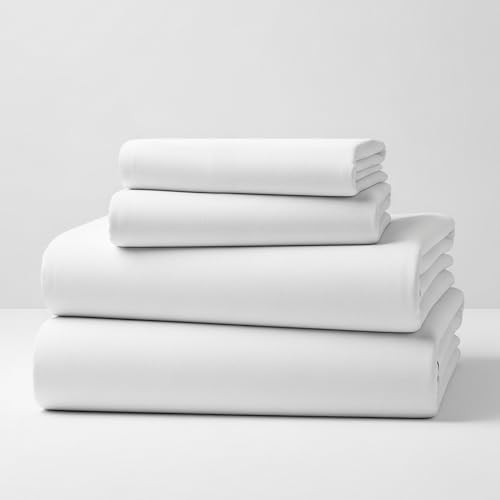
Mellanni Cotton Flannel Sheet Set (Queen) — Best for Winter
Flannel is the one fabric that can make a budget bed feel luxurious, because its luxury is thermal: brushed cotton that traps a layer of warmth and, crucially, never feels cold on first contact. Mellanni’s set is double-brushed cotton flannel with a deep pocket, made for the months when getting into bed is an act of courage. It suits cold bedrooms, draughty houses, winter cabins and anyone whose feet stay cold for the first hour of the night. It is a seasonal set — in summer it will be far too warm — and it rewards a household that rotates bedding with the calendar.
Strengths
- Double-brushed flannel feels warm instantly; no cold-sheet shock on entry.
- Real cotton flannel breathes better than synthetic fleece alternatives.
- Deep pocket fit keeps it on the mattress under a heavy winter duvet’s shifting.
Trade-offs
- A winter-only set for most climates; it needs a warm-season partner set.
- Flannel sheds some lint in its first washes — wash separately at first.
- Can pill over years if washed harshly; gentle cycles extend its life.
The seasonal rotation is the grown-up bedding strategy this pick enables: flannel from the first cold snap to the last, the Bedsure cooling set or the cotton sateen through the warm months, each stored clean and ready. The cost of the second set is repaid in sleep quality at both ends of the year, because sleeping temperature is the variable your body notices most and your bedding controls cheapest. If your home has one cold bedroom that everyone avoids in January, flannel sheets are the smallest purchase that gives the room back.
Best for: winter bedrooms, cold sleepers and seasonal rotation. / Not suited for: warm climates or year-round single-set households.
Check on Amazon — check the current price on Amazon.
Comparison Table
| Pick | Badge | Key spec | Best for |
|---|---|---|---|
| Mellanni Iconic Sheet Set | Best Overall | Double-brushed microfiber, 16″ pocket | The default main-bed set |
| Bedsure Queen Sheet Set | Best Cooling Feel | Lightweight breathable-feel weave | Hot sleepers, summer |
| California Design Den Sateen Set | Best Cotton | 400TC cotton sateen | Cotton loyalists |
| Amazon Basics Microfiber Set | Best Budget | Brushed microfiber, wrinkle-resistant | Spare beds and rentals |
| Bedsure Deep Pocket Set | Best for Thick Mattresses | Fits mattresses up to 21″ | Deep beds and toppers |
| Mellanni Flannel Sheet Set | Best for Winter | Double-brushed cotton flannel | Cold bedrooms, winter |
How to Choose the Best Sheet Sets Under $50
At this tier, three decisions matter and the rest is decoration: fabric, fit and rotation. Get those right and a modest set outperforms an expensive mistake.
Fabric: microfiber, cotton, or flannel
Microfiber — finely woven polyester, brushed for softness — is the tier’s default for good reasons: it is soft immediately, washes without shrinking, dries fast, resists wrinkles and costs least per unit of comfort. Its honest costs are warmth (it sleeps hotter than cotton) and a smooth, sometimes slippery feel. Cotton breathes, absorbs moisture and feels cool and crisp or smooth depending on weave — percale is the crisp one, sateen the smooth one — at the price of wrinkles and slower drying. Flannel is cotton brushed into a thermal nap: a winter specialist, not a year-rounder. Choose by your sleeping temperature first and your laundry patience second; both are knowable before you spend anything.
Thread count, translated
For cotton, thread count means threads per square inch, and the honest working range is roughly 200 to 500. Within it, weave and fibre quality matter more than the last hundred of count. Beyond it, numbers at this price are achieved by counting multi-ply yarns creatively and mean nothing you can feel. For microfiber, thread count does not apply at all — judge it by brushing, weight and the maker’s track record instead. Any under-$50 set leading with a four-figure thread count is telling you how it markets, not how it sleeps.
Fit: measure the mattress, then the pocket
Measure your mattress depth including any topper, in the middle of the bed where it is tallest. Then match: a standard pocket around 14–16 inches covers most beds up to the mid-teens in depth; deeper beds need a deep-pocket set like the Bedsure above, rated to 21 inches. A fitted sheet should need a firm pull to seat the last corner — if it drops on loosely, it will walk off by morning; if it needs two people and strong language, the elastic will fail early from the strain. While you are measuring, confirm the set’s pillowcase style suits your pillows; envelope closures keep pillows in, open ends are faster on laundry day.
The two-set rotation rule
The cheapest way to make budget sheets last is to own two sets and alternate weekly. Each set then rests a week between washes, elastic recovers, and wear spreads across twice the fabric. It also ends the laundry-day scramble of washing, drying and remaking one bed in a single evening. Two mid-tier sets rotated will outlast — and out-comfort — one premium set washed to death, which is the closest thing this category has to a free lunch.
How to Wash and Store Budget Sheets So They Last
Sheets at this price die in the laundry more often than in bed. A gentle routine doubles their useful life.
- Wash sheets alone. Towels, jeans and anything with zips or hooks abrade sheet fabric and wrap it into a twisted rope. A sheets-only load is the single kindest habit.
- Use warm, not hot, water and a moderate detergent dose. Excess detergent does not rinse out of microfiber and leaves it feeling coated and less absorbent; hot water ages elastic. Half the cartoon amount on the bottle is usually plenty for a sheet load.
- Untangle before drying. Shake each piece out and load loosely. A fitted sheet balled around pillowcases dries unevenly and comes out wrinkled in the shape of its ball.
- Dry on medium and remove promptly. Overdrying cooks elastic and microfiber alike. Taking sheets out while very slightly damp and smoothing them onto the bed gives a near-ironed finish for free.
- Treat stains before the wash, not after. Body oils at the pillow and head area respond to a pre-wash rub of detergent; once heat-set in the dryer, they are permanent residents.
- Store sets inside their own pillowcase. Fold the set, slip it into one of its pillowcases, and stack. Rotation becomes grab-and-go, and no set ever loses its fitted sheet to the back of the linen cupboard.
- Retire honestly. When the fitted sheet’s elastic no longer grips, when microfiber pills despite gentle washing, or when cotton thins to translucency at the centre, the set has done its service. At this tier, replacement is the plan, not a failure.
Common Buying Mistakes
- Believing giant thread counts. At this price, a huge number signals creative counting, not luxury. Buy construction and brand track record instead.
- Guessing the pocket depth. Corner pop-off is a measurement error, not bad luck. Measure the mattress and topper, then buy the pocket that fits the number.
- Buying one set. A single set gets washed to death and leaves you remaking the bed at midnight on laundry day. The two-set rotation is this tier’s core strategy.
- Choosing fabric by the packet feel. New sheets are finished with softeners that wash out in a month. Judge by fabric type and construction, which are what remain after the finish is gone.
- Ignoring the hot-sleeper question. The softest microfiber is the wrong buy for someone who overheats nightly. Temperature honesty at purchase beats thread-count pride.
- Forgetting the guest bed audit. Guests remember bad sheets. The budget pick in this guide exists precisely so the spare bed costs little and still sleeps respectably.
Final Recommendation
Buy the Mellanni Iconic if you want one answer: two sets, rotated, will carry a main bed comfortably for years inside this tier. Cotton sleepers should go straight to the California Design Den sateen set, hot sleepers to the Bedsure cooling-feel set, and deep-mattress owners to the Bedsure Deep Pocket set before anything else, because fit outranks fabric. Cover the spare beds with the Amazon Basics set and add the Mellanni flannel when the cold arrives — that combination outfits a whole house sensibly without leaving the under-$50 tier anywhere it matters.
Related guides in this series: Best Affordable High Quality Sheet Sets, Best Sheet Sets Percale, Best Sheet Sets For Teen Beds and Bed Sheet Set Buying Guide.
Sheets for Specific Sleepers
Couples at different temperatures are the hardest brief in bedding, and under $50 the honest answer is compromise by layer, not by sheet: choose the cotton sateen or the Bedsure cooling set as the shared base — neither partner overheats against cotton the way both can against brushed microfiber — then let the colder partner add their own throw on their own side. One set cannot be two temperatures, and any listing claiming otherwise is selling fiction. Sensitive skin points to cotton too, washed before first use and kept away from heavily fragranced detergents; the California Design Den set is the gentlest starting point in this guide, and its smoothness improves with washing rather than degrading. Children and teenagers are microfiber’s natural constituency: the Mellanni and Amazon Basics sets shrug off the snack incidents, art projects and laundry neglect of a teen bedroom, cost little to replace at growth-spurt sheet-size changes, and come in colours that survive being chosen by a fourteen-year-old.
Guest beds deserve a sentence of strategy: guests judge a bed by its first five seconds — the look of the made bed and the first touch of the sheet. A mid-tone Mellanni set, washed and stored as a complete set in its pillowcase, delivers those five seconds reliably for years. And allergy-conscious households should note the habit that matters more than any fabric claim: hot-enough washes on a regular rhythm, which every set in this guide tolerates, and full drying before storage. The set is the vehicle; the laundry routine is the policy.
Weaves, Translated: Percale, Sateen, Jersey and Microfiber
Four words on sheet listings explain most of what a sleeper feels, and none of them require a textile degree. Percale is a plain one-over-one-under weave: matte, crisp and cool, the hotel-shirt of fabrics, loved by hot sleepers and people who iron nothing but appreciate a sheet with posture. Sateen weaves more threads across the surface, giving cotton a smooth, faintly lustrous hand that feels warmer and drapes closer — the California Design Den set’s weave, and the right choice for sleepers who find percale austere. Jersey is knitted, not woven: it is a T-shirt for the bed, stretchy, cosy and forgiving of odd mattress shapes, at the cost of a casual look and a warmer sleep. Microfiber is a fibre rather than a weave — finely split polyester, usually brushed — and its character comes from that brushing: soft, smooth, warm and easy-care, with the slippery hand its fans and critics describe in identical words and opposite tones.
The practical translation: choose percale or the cooling-feel sets if you sleep hot, sateen if you sleep neutral and like smooth, jersey if you sleep cold and casual, microfiber if laundry ease and softness-per-dollar rule the decision. Every pick in this guide maps to one of those temperaments, which is a more useful way to shop than any thread count ever printed.
The True Cost of a Sheet Set, Per Night
Budget sheets invite a sneer they do not deserve, and the arithmetic shows why. A set in this tier, rotated with a partner set and washed sensibly, serves a main bed for roughly two to three years — call it several hundred nights of sleep. Divided honestly, the cost per night lands in the territory of a few cents: less than the electricity that runs the bedside lamp, for the surface your body spends a third of its life against. The expensive sheet mistake is not buying at this tier; it is buying badly at any tier — the set that pills in a month, fits no mattress you own, or sleeps at a temperature your body hates, and gets replaced at full price while the good budget sets in this guide are still on their first rotation.
That is also why this guide keeps returning to fit and fabric over specifications. A $45 set that fits your 18-inch mattress and matches your sleeping temperature will be remembered fondly in year three. A set bought for a four-figure thread count that pops off the corners nightly will be remembered every single night, for the wrong reason, until it is replaced. Spend the tier’s money on the things the tier can genuinely deliver — honest construction, correct fit, the right fabric for your body — and the under-$50 shelf stops looking like a compromise and starts looking like what it is: the sensible end of the bedding aisle.
Setting Up a Whole House Inside the Tier
The under-$50 tier is one of the few in bedding where an entire house can be outfitted on a single sensible plan, and the plan writes itself from this guide’s picks. The main bed gets two sets of the best match for its sleepers — Mellanni Iconic for most, California Design Den for cotton loyalists — rotated weekly. The guest bed gets the Amazon Basics set plus one spare, stored as complete sets in their pillowcases so a surprise visitor is a five-minute make-ready rather than a laundry event. Children’s and teenagers’ beds get microfiber in their chosen colours, two sets each, because their laundry reality is not the main bed’s laundry reality and their sheets should be priced for the life they will actually live.
Seasonal insurance completes the plan: one flannel set for the coldest bedroom, bought before the first cold snap rather than during it, and one cooling-feel Bedsure set for the hottest sleeper in the house. Deep-pocket households standardise on the Bedsure deep-pocket fit for every bed with a topper, ending the mixed-drawer confusion of which fitted sheet belongs to which mattress. Bought this way — by role, in pairs, inside one tier — a household ends up with perhaps ten sets total, every one of them known, fitted and accounted for, at a total outlay that a single premium bedding shopping trip can exceed without covering half the beds. That is the tier’s real promise, and it is why this guide treats “under $50” not as a limitation to apologise for but as a system to exploit.
Sleeping Cooler or Warmer Without Changing the Thermostat
Sheets are the cheapest climate control in the house, and a few habits multiply what the picks in this guide can do. To sleep cooler: choose the cotton or cooling-feel set, skip the flat sheet’s tuck so feet can escape, wash bedding in fragrance-free detergent whose residue will not coat the fibres’ breathability, and store the day’s duvet folded back so the bed airs rather than stews. A set that comes out of the wash and goes straight onto the bed, still holding the line’s freshness, sleeps measurably cooler than one pulled from a warm cupboard — a small thing, noticed nightly.
To sleep warmer: flannel is the headline, but the supporting habits matter — pre-warm the bed with the duvet pulled up an hour before sleep so the sheets hold the room’s warmth rather than its chill, keep a spare brushed set for the coldest fortnight so laundry never forces a cool set onto a January bed, and pair the sheets with socks without embarrassment, since cold feet under warm sheets are the most common false verdict on a good winter set. None of this costs anything beyond the sets themselves. It is simply the difference between owning the right sheets and operating them — and at this tier, operating them well is what closes the gap that premium marketing claims only money can close.
A Note on Sizes: From Twin to King Inside the Tier
This guide shows queen sets because queen is the size most readers sleep on, but every pick’s line spans the standard sizes, and the tier behaves differently at the extremes. Twin and twin XL sets sit comfortably inside the budget in every pick here — dorm and teen shopping is this tier’s home ground, and the twin XL’s extra length is the one specification worth double-checking on a listing before a student leaves for college. Full sets track close to queen pricing and fit. King and California king are where the tier frays: the same set costs most in its largest size, pillowcases grow to king dimensions, and some lines occasionally step over the guide’s line in king even when queen sits inside it. King sleepers should choose by fabric and fit first — as this guide advises everyone to do — and verify their size’s price at checkout with clear eyes.
Two size habits protect any buyer. First, measure the mattress, not the label on the old sheets: mattresses swell with toppers and shrink with age, and the fitted sheet must fit the bed that exists now. Second, buy the spare set in the same size and colour at the same time when a line is being cleared or recoloured — sheet lines change shades between seasons, and a rotation pair bought a year apart can arrive as near-twins rather than twins. Neither habit is glamorous. Both are the difference between a linen cupboard that works and one that merely contains fabric.
A Final Word on Buying With Confidence
If this guide leaves you with one habit, let it be this: decide your fabric by how you sleep, measure your mattress before you measure your budget, and buy in rotating pairs. Those three decisions — all free — determine more of your next three years of sleep than any specification printed on a packet. The six sets above were chosen so that any reader who follows the habit lands on a good set: the Mellanni for most, the cotton for the loyalists, the cooling set for the warm, the deep pocket for the tall-mattressed, the flannel for the cold, and the Amazon Basics for every other bed in the house. Under fifty dollars, spent this way, is not a compromise. It is simply where the value lives.
And when the first sets arrive, do the unglamorous thing that makes all of it real: wash them before the first night, make the bed completely, and sleep. The verdict on a sheet set is never delivered by a listing, a label or even a guide like this one — it is delivered at 2 a.m. by a sleeper who is not thinking about their sheets at all, which is the highest praise bedding can earn at any price.
Frequently Asked Questions
Are sheet sets under $50 actually worth buying?
Yes — this is the tier where bedding value lives. A well-chosen set from an established maker gives soft, properly fitting sheets that last years with sensible washing. What the tier cannot give you is luxury fibre or decade-long life, and it does not pretend to once you strip away inflated thread counts.
Is microfiber or cotton better at this price?
Microfiber wins on softness per dollar, easy care and wrinkle resistance. Cotton wins on breathability, moisture handling and how it ages — softening rather than pilling. Hot sleepers and cotton loyalists should buy cotton; everyone else is usually happiest with good microfiber like the Mellanni.
What thread count should I look for in cotton sheets under $50?
Roughly 300–400 in a sateen or percale from a reputable maker is the sweet spot, as with the California Design Den set here. Treat counts far above 500 at this price as marketing arithmetic rather than a quality signal.
How deep are the pockets on budget sheet sets?
Standard sets run about 14–16 inches, which covers most mattresses without toppers. Deep-pocket sets go further — the Bedsure in this guide fits mattresses up to 21 inches. Measure your mattress plus topper and buy for the number you get.
How many sheet sets should one bed own?
Two in rotation is the practical minimum — one on the bed, one clean or in the wash — and it noticeably extends the life of both. Add a seasonal specialist like the flannel set if your bedroom swings between hot summers and cold winters.
Why do my cheap sheets pill, and how do I stop it?
Pilling is short fibres working loose and tangling, accelerated by hot water, harsh agitation and washing with abrasive items like towels. Wash sheets alone, warm rather than hot, with moderate detergent, and dry on medium. Brushed microfiber from established lines, like the picks here, is manufactured to resist it far better than anonymous sets.