Disclosure: airfryerkitchensupply.com is reader-supported. When you buy through links on our site, we may earn an affiliate commission at no extra cost to you.
Where to buy
Every pick was verified against Amazon listing data, with sizes, pile claims and backing claims taken from the listings themselves. The default buy is the Lahome Moroccan 8×10; small kitchen tables take the JONATHAN Y 5×8 or the ultra-thin Lahome Abstract, and big rooms scale to the GarveeHome 9×12 or the SERISSA 10×14. Check the current price on Amazon from any pick’s link. Whichever you choose, add a thin rug pad if your floor is very smooth — it is the universal insurance this guide recommends alongside every pick.
Key Takeaways
- Bunching has three causes — sliding, chair-leg drag, and undersizing — and the cure is a formula: non-slip backing, low pile, and a rug big enough that every pulled-out chair leg stays on it.
- Washability is secretly an anti-bunch feature: a rug that can be washed returns flat and supple, while an unwashable kitchen rug stiffens, curls and starts bunching.
- Printed numbers beat adjectives: the JONATHAN Y states 0.4-inch thickness; the ultra-thin Lahome removes the material bunching acts on entirely.
- Size up honestly. Most bunching complaints are a rug one size too small wearing the blame that belongs to the tape measure.
Introduction: Why Rugs Bunch Under Kitchen Tables
The best rugs for under kitchen table that won’t bunch up solve a mechanical problem, not a decorating one. A kitchen or dining table is the most mechanically violent place a rug can live: four to eight chair legs dragging across it several times a day, each drag a small shear force; people shifting weight, scooting chairs, standing mid-meal. A rug answers those forces in one of three bad ways. It slides across a smooth floor because nothing grips it. It wrinkles because chair legs catch its pile and plow it forward. Or it folds at the edge because a chair sits half on and half off, levering the border up at every single sit-down. Most ‘my rug bunches’ stories are one of those three, and most are all three at once.
This guide therefore shops by mechanism, not by pattern. Every pick combines a non-slip backing (against sliding), a low or ultra-thin pile (against chair-leg drag), and a size range that lets you satisfy the all-legs-on rule (against edge levering) — and every pick is washable, because the spill zone under a kitchen table destroys unwashable rugs slowly and curls them as it goes. Six verified rugs cover kitchen tables from a small 5×7 footprint to a 10×14 great-room field, each with its size logic stated plainly.
One accessory note before the picks: a thin rug pad is cheap insurance under any of them, especially on polished tile, laminate or hardwood. The picks’ non-slip backings do most of the work, but a pad adds the final registration on glassy floors and a whisper of cushion that low pile deliberately omits. Think of the pad as the foundation and the rug as the floor’s working surface; this guide’s job is to get the working surface right.
In this guide
Quick Picks: The Best Rugs for Under a Kitchen Table That Won’t Bunch Up at a Glance
- Best Overall Anti-Bunch Pick: Lahome Moroccan Washable Rug, 8×10 — check price on Amazon
- Best True Low-Pile Construction: JONATHAN Y Haze Solid Low-Pile Rug, 5×8 — check price on Amazon
- Best Ultra-Thin for Chair Glide: Lahome Abstract Washable Rug, 5×7, Ultra-Thin — check price on Amazon
- Best Large Size That Still Washes: GarveeHome Large Washable Rug, 9×12 — check price on Amazon
- Best Soft Modern 8×10: Area Rug 8×10, Washable Modern Abstract — check price on Amazon
- Best Extra-Large Statement: SERISSA Washable Non-Slip Boho Rug, 10×14 — check price on Amazon
How These Picks Were Chosen
Eligibility required the anti-bunch formula in the product’s own listing: a non-slip claim, a low-pile or ultra-thin construction, and washability, verified in Amazon listing data. High-pile, shag and backing-free decorative rugs were excluded regardless of beauty, because they fail this specific keyword’s promise mechanically. Sizes were then mapped to table sizes so the guide can make honest sizing recommendations instead of listing rugs in a vacuum. Pattern and feel were treated as tiebreakers among mechanically sound options — which is why two 8x10s with different looks both appear, and why the comparison table names the room each suits.
Stated numbers are quoted where listings print them — most usefully the JONATHAN Y’s 0.4-inch thickness — and pile is described in the listing’s own terms elsewhere. No rug here is claimed to be bunch-proof in the absolute; the claim, made carefully in each review, is that the formula removes the three causes, and that correct sizing by the buyer removes the rest.
The 6 Best Rugs for Under a Kitchen Table That Won’t Bunch Up

1. Lahome Moroccan Washable Rug, 8×10 — Best Overall Anti-Bunch Pick
The Lahome Moroccan is the complete answer to this search in one listing: an 8×10 washable rug, non-slip, low pile, distressed vintage styling, and listed as stain resistant for homes with kids, pets and high traffic. Every element of that description fights bunching. Low pile gives chair legs nothing to grab and drag. A non-slip backing keeps the rug registered to the floor instead of migrating a centimeter per meal. Washability matters because a kitchen-table rug lives under food, and a rug you can wash is a rug you will keep flat and clean rather than curling and neglected. The 8×10 size is the workhorse dining dimension, big enough that all four chair legs stay on the rug when chairs are pulled out — the sizing rule that prevents most bunching.
Strengths
- Non-slip backing plus low pile is the exact two-part formula against bunching and chair-leg dragging.
- Machine washable per the listing — under a kitchen table, that is not a luxury, it is the maintenance plan.
- Stain resistant and high-traffic positioning suits the spill zone it will actually live in.
Trade-offs
- Distressed vintage styling is a specific look; minimalists wanting a flat solid color should take the JONATHAN Y below.
- Low pile means minimal cushion underfoot — comfort here is about flatness, not plushness.
- An 8×10 needs a large-capacity washer or a tub wash; check your laundry reality before choosing the big sizes.
| Spec | Detail (from the listing) |
|---|---|
| Size | 8×10 |
| Pile | Low pile (per listing) |
| Backing | Non-slip (per listing) |
| Care | Machine washable (per listing) |
Bunching has three causes, and this rug addresses all of them, which is why it leads. Cause one: the rug slides because nothing grips the floor — answered by the non-slip backing. Cause two: chair legs catch pile and drag the rug into wrinkles — answered by the low pile, which chair legs glide over instead of digging into. Cause three: the rug is too small, so chairs sit half on and half off, levering the edge up at every sit-down — answered by the 8×10 footprint, provided your room takes it and you follow the sizing rule in the buying guide below: every chair leg on the rug, even with chairs pulled out.
The washability deserves emphasis because it is the anti-bunch feature nobody lists. A kitchen rug that cannot be washed gets spot-cleaned, gets stiff and grubby at the edges, and starts curling — and a curled rug bunches. A rug that goes through the wash comes back flat, supple and re-gripped to the floor. In the spill zone, washable is not a convenience feature; it is the long-term flatness strategy.
Best for: most kitchen and dining tables: the balanced formula of grip, glide and washability in the standard big size / Not suited for: anyone wanting plush cushion underfoot or a crisp, non-distressed modern look
Check the current price on Amazon

2. JONATHAN Y Haze Solid Low-Pile Rug, 5×8 — Best True Low-Pile Construction
The JONATHAN Y Haze is the construction purist’s pick: a solid low-pile rug, power loomed from polypropylene, with a stated thickness of 0.4 inches, listed as pet-friendly, easy-cleaning and durable. Power-loomed polypropylene is the material story — it is woven tight and flat by machine, so there is no lofty pile to compress, catch or wander, and the synthetic fiber shrugs off the kitchen’s water and food assaults that would stain natural fibers. At 5×8 it suits kitchen tables and smaller dining spaces where an 8×10 would flood the room, and the solid ivory color keeps a small space feeling open.
Strengths
- Stated 0.4-inch thickness — a printed, honest number in a category that usually hides behind the words low pile.
- Power-loomed polypropylene is tight, flat and inherently easy to clean; spills sit on it rather than soaking a natural fiber.
- Solid, simple styling works under any table and in small rooms where pattern would crowd.
Trade-offs
- Ivory under a kitchen table is a commitment — it will show every spill until washed, however easy-clean the fiber.
- A solid low-pile rug shows chair-leg traffic patterns more than a distressed pattern does.
- 5×8 is right for kitchen tables and small dining rooms; a six-person dining table will outgrow it and break the all-legs-on rule.
| Spec | Detail (from the listing) |
|---|---|
| Size | 5×8 |
| Thickness | 0.4 in (per listing) |
| Material | Polypropylene, power loomed (per listing) |
Why does power-loomed construction resist bunching? Because bunching begins with differential stretch — a rug whose surface can creep relative to its base wrinkles under shear, and chair legs apply shear all day. A tight machine weave has almost no creep to give. The rug behaves like a mat with ambitions: it lies where it is put, chairs glide over its low, dense surface, and the edges stay down because the whole structure is too disciplined to curl casually. Add polypropylene’s indifference to water and most food chemistry, and you have the engineer’s answer to the kitchen-table problem.
The trade is sensory. This is not a rug you sink toes into, and its solid color is honest about every crumb between cleanings. Buy it where function rules — the working kitchen table, the small dining nook — and let pattern-loving rooms take the Lahome or the SERISSA. In return you get the pick most likely to be lying perfectly flat, unremarked, five years from now.
Best for: smaller kitchen tables, function-first buyers, and anyone who wants a printed pile height instead of an adjective / Not suited for: large dining tables, plush-seekers, or anyone who cannot face an ivory rug under a food zone
Check the current price on Amazon

3. Lahome Abstract Washable Rug, 5×7, Ultra-Thin — Best Ultra-Thin for Chair Glide
If low pile is good for chairs, ultra-thin is the logical extreme, and the Lahome Abstract is listed exactly that way: an ultra-thin, non-slip, washable 5×7 rug with a soft surface, pitched for dining rooms among other spaces. An ultra-thin rug is closer to a floor cloth than a carpet — chair legs meet almost no resistance, the rug cannot bunch because there is barely any material to bunch, and it slides into a standard washing machine like a blanket. For renters, small kitchens and anyone whose chairs have casters or glides that catch on everything, this profile is the path of least resistance in every sense.
Strengths
- Ultra-thin profile per the listing — the least bunchable construction in this guide, because there is almost nothing to wrinkle.
- Non-slip and washable, and the thin build washes and dries in a normal home machine without a struggle.
- Soft surface despite the thinness, so bare feet at breakfast are not punished for the chair glide.
Trade-offs
- Ultra-thin means ultra-little cushion and sound absorption; a noisy, echoing kitchen stays noisy.
- On very smooth floors, even non-slip thin rugs can creep at the corners without a rug pad beneath — the one accessory this guide recommends universally.
- 5×7 serves kitchen tables and four-person dining; bigger tables break the sizing rule.
| Spec | Detail (from the listing) |
|---|---|
| Size | 5×7 |
| Profile | Ultra-thin (per listing) |
| Backing | Non-slip (per listing) |
| Care | Washable (per listing) |
The ultra-thin rug reframes the problem: instead of engineering a carpet to resist forces, it removes the material the forces act on. A chair leg crossing a two-millimeter rug has nothing to plow; a spilled drink meets a surface that goes straight into the wash; a robot vacuum, if your kitchen has one, climbs it without drama. Households that have fought a thicker rug into submission for years often find the thin rug’s surrender is actually victory — the floor covering stops being an opponent.
Set expectations on feel and acoustics honestly. You are buying a washable, grippy floor cloth with a designed surface, not a carpet experience. In a kitchen — a room of hard surfaces, hard chairs and hard floors — that trade usually reads as practical rather than cheap, especially in the abstract pattern, which hides the crumb-level evidence of kitchen life between washes better than any solid.
Best for: renters, small kitchens, caster chairs, and anyone who prioritizes washability and glide over cushion / Not suited for: anyone wanting warmth, cushion or noise dampening from their kitchen rug
Check the current price on Amazon
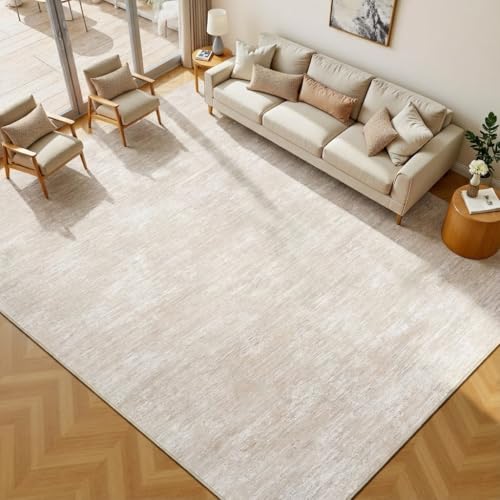
4. GarveeHome Large Washable Rug, 9×12 — Best Large Size That Still Washes
Big dining rooms break small rugs, and the GarveeHome answers with scale: a 9×12 washable rug with a non-slip backing, stain resistant low pile, listed for dining rooms among its uses. The 9×12 footprint is the six-to-eight-person table’s correct size — every chair, pulled out with a person in it, still stands on the rug, which is the geometric precondition for a bunch-free life. The achievement is that it stays washable and low pile at that size; many rugs this large are heavy, high-pile area pieces that could never enter a machine or survive a chair leg.
Strengths
- 9×12 size satisfies the all-chair-legs-on rule for large dining tables, the single most effective anti-bunch decision.
- Non-slip backing and low pile keep the big footprint registered and glide-friendly.
- Stain resistant and washable per the listing — the spill-zone features, at a size that usually forfeits them.
Trade-offs
- A 9×12 washable rug still needs a plan for washing — the largest home machines or a laundromat trip are part of ownership.
- The modern solid styling is calm to the point of plain; pattern lovers should scale up the SERISSA instead.
- Measure honestly: a 9×12 that reaches wall to wall leaves no floor border and can fight door swings at the edges.
| Spec | Detail (from the listing) |
|---|---|
| Size | 9×12 |
| Pile | Low pile (per listing) |
| Backing | Non-slip (per listing) |
| Care | Washable, stain resistant (per listing) |
Size is the under-discussed anti-bunch technology. Most bunching complaints trace to a rug one size too small: the back chair legs stand on the floor, the front legs on the rug, and every sit-down levers the rug’s edge like a hinge until it folds. The fix is not a grippier small rug; it is a rug whose border clears every pulled-out chair by a comfortable margin. For a large table, that arithmetic lands at 9×12, and the GarveeHome is the verified option that reaches it without surrendering the washable, low-pile, non-slip formula the rest of this guide is built on.
Living with the big rug is mostly about the wash plan and the install. Two people, a patient unroll, furniture placed to anchor the field, and a day for the edges to relax flat. After that, its size becomes its stability: a large, low, gripped rug has enormous inertia against the daily shear of chairs. It is the least likely rug in this guide to move at all.
Best for: large dining tables and open-plan kitchen-diners where smaller rugs break the sizing rule / Not suited for: small rooms, or anyone without a credible plan for washing a 9×12 rug
Check the current price on Amazon

5. Area Rug 8×10, Washable Modern Abstract — Best Soft Modern 8×10
This 8×10 entry competes directly with the Lahome Moroccan on size and formula — washable, soft, non-slip, stain resistant, listed for dining room tables among its rooms — and differs in feel and look: a modern abstract design and a softness the listing emphasizes. That softness is the reason to choose it. Some households reject low-pile rugs as hard-hearted; this one keeps the anti-bunch essentials (low profile, non-slip, washable) while giving bare feet a friendlier surface at the breakfast table. The abstract pattern is also a working feature in a kitchen, breaking up the visual evidence of crumbs and small spills between washes.
Strengths
- Soft surface with the full anti-bunch formula — non-slip, washable, stain resistant — for households that found basic low pile too austere.
- Modern abstract pattern hides kitchen evidence between washes better than solids or pale rugs.
- 8×10 dining size satisfies the chair-leg rule for the standard six-person table.
Trade-offs
- Softness in a low rug is relative — it is kinder than a flatweave, not a plush carpet, and should be bought with that calibration.
- Abstract modern styling will fight traditional dining furniture; the Moroccan and the boho SERISSA dress those rooms better.
- Like the other 8x10s, it wants a large washer for its wash days.
| Spec | Detail (from the listing) |
|---|---|
| Size | 8×10 |
| Backing | Non-slip (per listing) |
| Care | Washable, stain resistant (per listing) |
Consider this the comfort-tuned version of the guide’s core formula. The anti-bunch engineering is unchanged — grip below, glide above, size around — but the top surface is chosen for the human moments of a kitchen table: bare feet on a cold morning, a toddler’s knees during a long family lunch, the general sense that the room’s one soft surface should feel like one. Modern abstract is also the most forgiving pattern family in a food zone; its visual noise swallows the real noise of crumbs, drips and chair scuffs, so the rug looks composed on day six, not just on wash day.
Between this and the Lahome Moroccan, the decision is honestly aesthetic and textural: distressed vintage versus modern abstract, standard low-pile feel versus emphasized softness. Both are verified, both follow the formula, and either will lie flatter than whatever high-pile or backing-free rug it replaces. Let the room’s furniture cast the deciding vote.
Best for: households that want the anti-bunch formula with a softer feel and a modern pattern / Not suited for: traditional dining rooms, or anyone expecting genuine plush from a washable low rug
Check the current price on Amazon

6. SERISSA Washable Non-Slip Boho Rug, 10×14 — Best Extra-Large Statement
Some kitchen-diners are really great rooms, and a great room swallows ordinary rugs. The SERISSA is the biggest verified option here: a 10×14 washable, non-slip boho rug with a low-pile, distressed tribal character, listed for dining rooms. At this size the rug stops being an accessory under the table and becomes the floor plan — table zone, traffic lane and all — and its sheer footprint is an anti-bunch argument in itself, since a rug this large, gripped and low, has no edge anywhere near a chair leg’s levering range. The vintage boho styling carries the large field with pattern that hides a working kitchen’s evidence.
Strengths
- 10×14 footprint defines a whole dining zone and removes every chair leg from any edge — bunching has nowhere to start.
- Washable, non-slip, low pile per the listing: the guide’s formula, at statement scale.
- Distressed boho pattern is the hardest-working disguise for crumbs and spills in this roundup.
Trade-offs
- A 10×14 rug is a commitment of money, floor and laundry logistics — washing it is an event, not a chore.
- Boho tribal styling is a strong point of view; it will not sit quietly under minimalist furniture.
- Rooms must genuinely fit it with a floor border to spare, or door swings and edges will create the very lifting you bought it to avoid.
| Spec | Detail (from the listing) |
|---|---|
| Size | 10×14 |
| Pile | Low pile (per listing) |
| Backing | Non-slip (per listing) |
| Care | Washable (per listing) |
The SERISSA is the pick for the household whose dining table seats eight, whose kitchen opens into the living space, and whose previous rugs all looked like postage stamps. Scale solves their problems in sequence: chairs never reach an edge, traffic lanes fall on the rug rather than straddling it, and the pattern field makes the whole zone read as designed rather than floored-by-committee. Its inertia is its stability — this is a rug that stays because moving it would be a project.
Ownership honesty: you will wash this rug rarely and deliberately, spot-cleaning between, and you should confirm the laundromat plan before purchase, not after the first gravy incident. Households at peace with that rhythm get the most dramatic transformation in this guide. Households that want a weekly-wash rug should stay at 8×10 or below, where the GarveeHome and the two Lahome-formula picks live.
Best for: great-room kitchen-diners and eight-person tables that need zone-defining scale / Not suited for: small or medium rooms, weekly washers, or minimalist interiors
Check the current price on Amazon
The one-line version of this entire guide: grip below, glide above, and size for the chairs pulled out — everything else is pattern.
Comparison Table
| Pick | Badge | Key spec | Best for |
|---|---|---|---|
| Lahome Moroccan 8×10 | Best Overall Anti-Bunch Pick | Non-slip, low pile, washable | Standard dining tables |
| JONATHAN Y Haze 5×8 | Best True Low-Pile Construction | Stated 0.4 in, power-loomed polypropylene | Small kitchen tables |
| Lahome Abstract Ultra-Thin 5×7 | Best Ultra-Thin for Chair Glide | Ultra-thin, non-slip, washable | Renters, casters, small kitchens |
| GarveeHome 9×12 | Best Large Size That Still Washes | Non-slip, low pile, stain resistant | Six-to-eight-person tables |
| Modern Abstract 8×10 | Best Soft Modern 8×10 | Soft, non-slip, washable | Modern rooms wanting softness |
| SERISSA Boho 10×14 | Best Extra-Large Statement | Low pile, non-slip, washable | Great-room kitchen-diners |
How to Choose a Rug That Stays Flat: The Sizing Rule and the Formula
The sizing rule, stated once and forever: with every chair pulled out as if someone were sitting down, every chair leg must still be on the rug, with a few inches to spare. Measure your table, add the pull-out distance on all sides (roughly two feet per side is the working figure), and buy the rug that covers the result. This single rule prevents the edge-levering that causes most bunching, and it is why this guide’s sizes run large: under a kitchen table, a rug that looks slightly too big in the product photo is usually exactly right in the room.
The formula, in order: non-slip backing first, because a rug that migrates will eventually bunch wherever it migrates to. Low pile second, because chair legs must glide, not plow. Washability third, because the flat rug of month twelve is the one that survived twelve washes flat. Pattern last, chosen for evidence-hiding: distressed, abstract and boho patterns forgive a kitchen; solids confess everything and should be chosen knowingly, as the JONATHAN Y’s review states.
Then check your floor. Polished tile and laminate are the slippery extreme — plan the rug pad. Matte hardwood is cooperative. Existing carpet under a dining table is the hardest case: rugs creep on carpet by nature, and the ultra-thin pick plus a pad made for rug-on-carpet is the least-bad answer, with expectations set accordingly.
How to Install a Kitchen Rug So It Never Starts Bunching
Unroll the rug and give it time — a day under the table’s weight, or a reverse roll overnight, relaxes shipping curl, which is the one bunch that is not your fault. Lay the pad first if you are using one, trimmed an inch smaller than the rug on each side so it never peeks. Position the rug by the sizing rule, then place the table, then the chairs, and walk the perimeter pressing edges down. For the first week, resist the urge to drag chairs; lift-and-place teaches the household the habit that keeps any rug flat, and after a week the rug’s grip makes the habit easy to keep.
Maintenance is the second install. Vacuum with a suction-only or beater-off setting where your machine allows, because aggressive beaters worry edges and backing over time. Wash on the rhythm the kitchen imposes — monthly in busy homes — and dry flat or fully before relaying, since a damp-backed rug grips poorly and can mark floors. Rotate the rug 180 degrees seasonally if your table allows it, evening the chair-drag wear. Flatness is not a purchase; it is a small, kept routine, and these rugs are the ones built to reward it.
Common Buying Mistakes
Buying the pretty high-pile rug. Shag under a dining table is a month of compliments followed by a year of plowed wrinkles and trapped crumbs. Pile height is the first spec in this category, not the last.
Sizing to the tabletop. A rug the size of the table guarantees half-on chair legs and levered edges. Size to the pulled-out chairs, as the rule above states.
Skipping the backing question. A rug without a non-slip claim is a rug planning to travel. On smooth floors, add the pad; on any floor, buy the backing.
Choosing an unwashable rug for a food zone. Spot-cleaning has a limit, and beyond it the rug stiffens, curls and bunches. Washable is a structural feature here.
Blaming the rug for chair habits. Dragging chairs sideways will move almost anything eventually. The formula buys you a wide margin; the lift-and-place habit keeps you inside it.
Cost framing, briefly: the anti-bunch formula is not a premium formula. Non-slip backings, low piles and washable constructions dominate the sensible middle of the rug market, and the picks here sit in that territory — the money in this category should go to size, because size is the spec that cannot be faked later. A household deciding between a fancier small rug and a plainer correct-size rug should take the plain big one every time; the pattern will be admired for a week, while the sizing will be felt, one way or the other, at every meal for years. If budget forces a choice, drop the pattern, keep the formula, keep the size.
And the second-rug strategy deserves a mention for the wash-heavy homes: two modest washable rugs in rotation — one down, one clean and ready — beat one premium rug out of service on wash day, and rotation halves each rug’s mechanical wear. The 5×7 and 8×10 picks make that rotation affordable in a way the statement sizes cannot, which is a legitimate reason for a big-table household to run two 8x10s in sequence rather than one 10×14, if the room’s shape allows the swap.
Measure twice, order once — the rug cannot stretch, but the right size never needs to.
Final Recommendation
Buy the Lahome Moroccan 8×10 for the standard dining table, the JONATHAN Y or the ultra-thin Lahome for small kitchen tables, the modern abstract 8×10 if softness and a contemporary pattern matter, and scale to the GarveeHome 9×12 or SERISSA 10×14 when the table and room demand it. In every case: size by the pulled-out chairs, and check the current price on Amazon once the tape measure has had its say.
More rug guidance from the same program: Best Area Rugs For Under Kitchen Table, Best Area Rugs For Homes With Dogs, Best Cat Friendly Rugs, Best Blue Kitchen Rugs, and Best Affordable Moroccan Rugs.
Chair Legs, Casters and Glides: The Other Half of the System
A rug does not bunch alone; the chairs are co-authors. Bare wood or metal chair legs concentrate the drag force on four small points, which is why they plow pile and shove rugs. Felt glides spread that force and add a slippery interface — the cheapest anti-bunch upgrade in this entire guide is a set of felt pads on every dining chair leg, replaced when they wear. Casters are the opposite extreme: they roll beautifully over low pile and ultra-thin rugs, which is why the ultra-thin Lahome is the caster household’s pick, but a caster dropped off a rug edge will lever and chew that edge, which is why the sizing rule matters even more in caster homes. Sled-base chairs, with their continuous rails, are secretly the gentlest on rugs — they spread load along a line instead of four points. Whatever your chairs, the system view wins: grip below, glide above, and nothing sharp or pointy in between.
Round Tables, Benches and Other Honest Complications
Round tables want round or square rugs, and the sizing rule survives translation: chairs pulled out in every direction, legs on the rug. A square rug under a round table is the pragmatic shape — the round washable rugs in most lines run small — and its corners give the pulled-out chairs their margin. Benches change the physics for the better: a bench slides as one unit with a long contact line, gentler than four legs, though its greater weight makes the initial placement worth doing carefully. Extendable tables are the trap: size the rug for the extended table, not the everyday one, or the holiday dinner will lever every edge at once. And in eat-in kitchens where the table doubles as a prep surface and homework station, traffic doubles too — weight the washable, stain-resistant claims higher and the pattern’s evidence-hiding higher still. The formula does not change; the dosage does.
What Flat Looks Like After a Year: Wear Patterns to Expect
A year in, a good kitchen rug tells the truth about the household. The chair-drag lanes will show slightly more wear than the field — normal, and the reason distressed and abstract patterns age gracefully while solids show their traffic like a map. Backing grip fades slowly with wash count; if year two brings the first creep, the rug pad that was optional becomes the fix, and it is a cheap one. Edges that lift after a year usually trace to a chair leg that lives half-off the rug — a sizing confession, correctable by rotating the rug or, honestly, by the bigger rug that should have been bought first. None of these are product failures; they are the maintenance horizon of a textile doing heavy mechanical work, and the picks in this guide were chosen because their construction — tight weaves, low piles, grippy backings — pushes that horizon further out than the decorative alternatives.
Kids, Pets and the Under-Table Ecosystem
The under-table zone has residents. Toddlers treat it as a fort and a snack graveyard; dogs patrol it on a schedule synchronized to dropped food; cats regard a new rug as a personal gift. Each argues for this guide’s formula from a new angle. For toddlers, low pile means no fibers to pick at and a surface that wipes and washes — and a rug that lies flat is one less trip edge at toddler head height’s floor level. For dogs, washable and stain resistant are the whole conversation, and the pattern’s crumb camouflage works on paw prints too. For cats, a low, tight weave offers no satisfying scratch purchase, unlike the loop piles cats dismantle with joy. Households without any of these residents can relax the wash frequency; households with all three should buy the pattern that hides the most and the size that washes in their machine — which, in this guide, points squarely at the Lahome Moroccan and the modern abstract.
One safety note that belongs in any flatness discussion: a bunching rug is not merely ugly, it is a trip hazard at the exact spot where people carry hot dishes with both hands. That is the real stake behind this search, and it is why the guide treats grip, glide and sizing as a system rather than a style preference. A flat rug under a kitchen table is a small, daily safety device that also happens to look good.
Frequently Asked Questions
Why does my current rug bunch up under the table?
Almost certainly one of three causes: it slides because the backing does not grip, chair legs catch its pile and drag it into wrinkles, or it is too small so chairs sit half on and half off and lever the edge up. The picks in this guide are built against all three — non-slip backing, low pile, and sizes that satisfy the all-chair-legs-on rule.
What pile height is best under a kitchen table?
Low — and lower than most people guess. The JONATHAN Y in this guide states 0.4 inches and that is a good benchmark; the ultra-thin option goes further and removes chair resistance almost entirely. Anything you would describe as plush or shag belongs in a bedroom, not under chairs that move ten times a day.
Do I still need a rug pad with a non-slip rug?
On most floors the listed non-slip backings do the job. On polished tile, laminate or glossy hardwood, a thin pad adds the final grip and a touch of cushion, and it protects the floor finish. Think of it as cheap insurance rather than a requirement — except on glassy floors, where it becomes close to a requirement.
How big should a rug be under a 6-person dining table?
Big enough that every chair, pulled out for sitting, keeps all four legs on the rug with inches to spare. For most six-person tables that arithmetic lands at 8×10, which is why that size anchors this guide; larger tables and chairs land at 9×12. Measure your own pull-out distance rather than trusting the table’s nominal size.
Can a washable rug really survive kitchen life?
Yes — washability is what lets it survive. The under-table zone accumulates food oils and grit that spot-cleaning cannot fully remove; a rug that goes through a real wash comes back flat, clean and gripping. Follow the maker’s wash guidance, dry fully, and the rug’s flatness actually renews with each wash.
Will these rugs work on top of carpet?
Rug-on-carpet is the hardest case, because rugs creep on carpet pile by nature. The ultra-thin pick with a rug-on-carpet pad is the least-bad combination, and expectations should be modest: better than a thick rug, not perfect. On hard floors, which is the assumed case in this guide, the formula works as described.
How do I stop the corners from curling up?
Corner curl is usually a memory problem: the rug was stored rolled and the edges remember it. Reverse-roll the rug overnight, weigh the corners under furniture for the first days, and let a wash relax the fibers. If curl returns persistently, a thin rug pad beneath — extending nearly to the edges — holds them down mechanically. Persistent curl on an old rug often means the backing has stiffened with age and spills, which is the rug announcing its retirement.
Are flatweave rugs a good alternative?
Yes — flatweaves are cousins of this guide’s formula: no pile to plow, naturally flat. The picks here were favored because their listings combine the flat profile with non-slip backings and washability in dining sizes, but a true flatweave with a pad under it follows the same physics and can serve the same table well.
Should the rug go under a kitchen island’s stools too?
Stools are the worst bunching offenders in any kitchen — they are dragged, twisted and tipped constantly. If stools are in play, the ultra-thin profile plus a pad is the strongest combination in this guide, and the rug should extend well past the stool’s full swing and slide radius. Many households sensibly keep the stool zone bare-floored and rug only the table; that is a legitimate design answer, not a failure.
What about rug tape or corner grippers instead of a new rug?
They are a reasonable first aid for a rug you otherwise love: tape and grippers can stop sliding, which is one of the three causes. They cannot fix pile drag or undersizing, and tape on finished wood deserves a compatibility check before commitment. If your rug bunches from one cause only, treat the cause; if it bunches from all three, the formula in this guide is the cheaper long-term answer.


