Disclosure: airfryerkitchensupply.com is reader-supported. When you buy through links on our site, we may earn an affiliate commission at no extra cost to you.
Where to Buy
This guide to the best rugs for a deck starts, as every guide in this program does, with where to buy safely. Every rug below is outdoor-positioned in its Amazon listing data-verified listing title, and the claims are repeated at exactly the level each title states them: where a title says waterproof, we say waterproof and name it as the seller’s wording; where it does not, the spec box says Not stated and we never upgrade a claim. Sizes are printed only when the title states them. Prices are never printed — check the current price on Amazon.
- Fab Habitat Outdoor Rug — Vintage Boho Kilim (Recycled Plastic) — Best Overall. Check the current price on Amazon.
- MontVoo Outdoor Rug Carpet — Waterproof, 5×8, Reversible — Best Stated Size. Check the current price on Amazon.
- Pauwer Waterproof Outdoor Rug — 9×12, Leaf Brown — Best Large Coverage. Check the current price on Amazon.
- BalajeesUSA Outdoor Rug — 5×7 Black, Reversible Recycled Plastic Straw — Best Budget Classic. Check the current price on Amazon.
- GENIMO Indoor Outdoor Rug — Washable, for Patio and Deck, 5×8 Cream Beige — Best Soft-Feel Deck Rug. Check the current price on Amazon.
- Loom&Crate Washable Indoor Outdoor Area Rug — 12×15, Navy — Best Extra-Large. Check the current price on Amazon.
Choosing the best rugs for a deck is a weather decision disguised as a decorating one. A deck is outdoors: full sun, real rain, pollen, and boards that need to dry. So this roundup only includes rugs whose verified listing titles position them for outdoor use — plastic straw mats that shed water, a washable chenille with a quick-dry backing, a woven polypropylene at architectural scale — and it grades their claims strictly by what each title is willing to state.
Read the spec boxes as the guide’s honesty ledger. Waterproof appears only where a title says waterproof. UV resistant appears only where a title says UV resistant. Two picks state neither waterproof nor UV wording, and their boxes say Not stated — they earn their places on other documented strengths (washability, hose-off cleaning, scale), with placement advice that respects the missing claims. That discipline is what lets you match a rug to your deck’s actual exposure instead of to a marketing mood.
Key Takeaways
- Only outdoor-positioned rugs are included; indoor rugs were excluded however attractive.
- Claims are quoted at title level: waterproof and UV resistant appear only where the title states them.
- Plastic straw (Fab Habitat, MontVoo, Pauwer, BalajeesUSA) is the open-deck, wet-climate answer; textiles (GENIMO, Loom&Crate) suit covered decks.
- Stated sizes run 5×7 to 12×15 — measure the furniture footprint, not just the deck.
- Every deck rug needs an underneath routine: lift it and let the boards dry regularly.
In this guide
Quick Picks
Six outdoor rugs across two material families and five stated sizes. Badges repeat in the full reviews, and each spec box is a verbatim-level summary of its own title.
Fab Habitat Outdoor Rug — Vintage Boho Kilim (Recycled Plastic) — Best Overall. Waterproof, fade resistant, crease-free and reversible are all stated in the verified title, with deck named among its surfaces — the most completely documented deck rug here. Check price on Amazon.
MontVoo Outdoor Rug Carpet — Waterproof, 5×8, Reversible — Best Stated Size. The verified title states the size (5×8), waterproof and reversible in one line, with deck in its surface list — the easiest deck rug here to buy correctly. Check price on Amazon.
Pauwer Waterproof Outdoor Rug — 9×12, Leaf Brown — Best Large Coverage. A stated 9×12 footprint with waterproof and UV resistant wording in the verified title — the big-deck pick, sized for full seating groups. Check price on Amazon.
BalajeesUSA Outdoor Rug — 5×7 Black, Reversible Recycled Plastic Straw — Best Budget Classic. The long-running 5×7 format in recycled plastic straw, waterproof and reversible per the verified title — the proven, value-tier deck mat. Check price on Amazon.
GENIMO Indoor Outdoor Rug — Washable, for Patio and Deck, 5×8 Cream Beige — Best Soft-Feel Deck Rug. A different construction: a washable chenille rug with fade resistant wording and a quick-dry non-slip backing, sized 5×8 and named for patio and deck in the verified title. Check price on Amazon.
Loom&Crate Washable Indoor Outdoor Area Rug — 12×15, Navy — Best Extra-Large. A stated 12×15 polypropylene flat weave with hose-off cleaning and pet friendly wording in the verified title — the oversized-deck statement piece. Check price on Amazon.
How These Picks Were Chosen
The filter ran through this program’s verified Amazon listing data cache of rug listings. A rug qualified only if its title positioned it for outdoor use — outdoor, patio, deck, porch or indoor-outdoor in its own words — and we then recorded its claims at face value: waterproof, UV resistant, fade resistant, washable, hose-off, reversible, exactly as stated, and Not stated where absent. Several beautiful indoor rugs were excluded at this gate; a deck is not a living room with weather, and the guide refuses to pretend otherwise.
Within the qualifying set we spread the real decision axes: material (plastic straw versus textile), exposure (full sun versus covered), and scale (5×7 utility to 12×15 architecture). The two textile picks are placed deliberately with their limits stated in their trade-offs — they are covered-deck recommendations, and the guide says so in their own sections rather than in a footnote.
A note on language discipline, because this category abuses it: water resistant and waterproof are different claims, and fade resistant and UV resistant are cousins, not twins. Where titles use the weaker or the different word, we print that word. Your deck will experience the difference even if a headline would prefer you not to.
The 6 Best Rugs for a Deck

Fab Habitat Outdoor Rug — Vintage Boho Kilim (Recycled Plastic) — Best Overall
Start with the Fab Habitat if you want the deck brief answered in one title: waterproof, fade resistant, reversible and crease-free, in recycled plastic, with deck listed explicitly among its intended surfaces.
Strengths
- Waterproof and Fade Resistant both stated in the verified title
- Deck named outright among patio, porch and balcony
- Reversible — two looks and a second chance for the worn side
Trade-offs
- Exact dimensions are not in the portion of the title we rely on — confirm size on the listing before ordering
- Recycled plastic straw feel is firmer underfoot than woven textile rugs
- Boho kilim pattern is a strong look; minimalist decks may prefer the MontVoo
| Specification | From the verified listing title |
|---|---|
| Water resistance (title wording) | Waterproof (stated in title) |
| Fade | Fade Resistant (stated in title) |
| Material | Premium Recycled Plastic (stated in title) |
| Size | Not stated |
Deck rugs fail in predictable ways: they hold water against the boards, they fade in stripes where the furniture shadow falls, and they crease when folded for winter. This title answers the first two failures in writing and the third as well — crease-free is an unusual claim to find in a title, and it matters for anyone who stores the rug rolled or folded. Reversibility then doubles the design life: when the sunny side tires, flip it.
One discipline note: waterproof here is the seller’s stated wording for a plastic-straw rug, and plastic straw is the right material logic for a deck — it does not absorb water into fibres the way an indoor rug does. Still, lift any deck rug periodically and let the boards beneath dry; a rug that sheds water can still trap ambient moisture under itself, and deck boards prefer airflow. The rug protects the deck best when you treat underneath as part of the routine.
Best for: deck owners who want waterproof and fade claims in writing / Not suited for: buyers who need a stated size before they can commit Check on Amazon.

MontVoo Outdoor Rug Carpet — Waterproof, 5×8, Reversible — Best Stated Size
Choose the MontVoo if size certainty matters: its verified title states 5×8 outright, alongside waterproof, reversible plastic-straw construction and deck among its named uses, so the two biggest deck-rug mistakes — wrong size, wrong material — are answered before checkout.
Strengths
- Size stated in the title: 5×8
- Waterproof stated — the seller’s wording, for a plastic straw rug
- Reversible design doubles pattern life
Trade-offs
- 5×8 suits seating groups, not whole large decks — measure your zone
- Plastic straw texture is practical, not plush
- Boho pattern direction is fixed; check the listing photos for the exact colourway
| Specification | From the verified listing title |
|---|---|
| Size | 5×8 (stated in title) |
| Water resistance (title wording) | Waterproof (stated in title) |
| Material | Plastic Straw (stated in title) |
| Reversible | Reversible (stated in title) |
A stated size sounds like a small virtue until you have unrolled a rug that is a foot short of the table legs. Deck rugs should sit under the front legs of every seat in the group, which makes the footprint a furniture question, not a floor question. The 5×8 format is the classic small-group answer — a bistro set, two loungers and a side table — and having it in the title means the rug in this review is the rug that arrives.
The plastic-straw construction is the deck-correct choice and also the honest trade: it will never feel like wool, and it is not trying to. It feels like a firm, woven mat that hoses clean, dries fast and shrugs at spilled drinks. On a deck — where the alternatives are bare boards or a ruined indoor rug — that trade is the entire point of the category.
Best for: small-to-mid decks and balconies needing a stated 5×8 / Not suited for: large decks needing full coverage from one rug Check on Amazon.

Pauwer Waterproof Outdoor Rug — 9×12, Leaf Brown — Best Large Coverage
Go to the Pauwer when the deck is the room: its verified title states a 9×12 size, waterproof construction and UV resistance, in a reversible plastic-straw design that names deck among its surfaces.
Strengths
- Size stated in the title: 9×12 — full-group coverage
- UV Resistant stated, the exact claim full-sun decks need
- Waterproof stated for a plastic straw rug
Trade-offs
- 9×12 is a lot of rug to store in winter — plan the storage before the summer
- Leaf pattern in brown is a specific look; confirm it suits your boards
- Large rugs trap more moisture beneath; lift and dry the deck regularly
| Specification | From the verified listing title |
|---|---|
| Size | 9×12 (stated in title) |
| UV | UV Resistant (stated in title) |
| Water resistance (title wording) | Waterproof (stated in title) |
| Material | Plastic Straw (stated in title) |
UV resistance is the claim that separates deck rugs from patio tourists. A covered porch forgives almost anything; an open deck in full sun bleaches an unprotected rug in a single season, in the exact shape of the furniture shadow. This title states UV resistance in words, which is the strongest thing a listing can do short of a warranty — and it pairs the claim with the size that makes it matter, because big rugs are the expensive ones to replace when they fade.
Manage the moisture honestly at this scale. A 9×12 plastic rug sheds rain, but the deck beneath it still gets damp from humidity and splash, and dries slower under cover. The routine that keeps both healthy is boring and effective: lift a corner after storms, roll the rug back on a dry windy day each month, and let the boards breathe. Five minutes of airflow is the maintenance price of a rug this size.
Best for: large open decks in full sun with full seating groups / Not suited for: small decks, and anyone without storage for a 9×12 roll Check on Amazon.
BalajeesUSA Outdoor Rug — 5×7 Black, Reversible Recycled Plastic Straw — Best Budget Classic
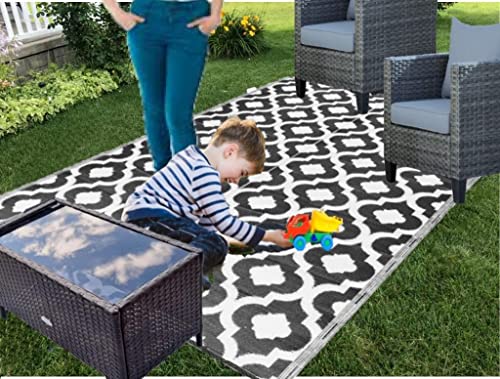
The BalajeesUSA is the category’s old reliable: its verified title states a 5×7 size, reversible recycled plastic straw construction and waterproof wording, in the black colourway that hides deck dirt best.
Strengths
- Size stated in the title: 5×7
- Waterproof and reversible both stated
- Recycled plastic straw — the deck-correct material at a value tier
Trade-offs
- The title does not state UV or fade resistance — in harsh full sun, the Fab Habitat documents more
- Black shows dust and pollen more than mid-tones, despite hiding stains
- Value-tier finishing; edges benefit from furniture anchoring them
| Specification | From the verified listing title |
|---|---|
| Size | 5×7 (stated in title) |
| Material | Reversible Recycled Plastic Straw (stated in title) |
| Water resistance (title wording) | Waterproof (stated in title) |
| UV / fade | Not stated |
Notice the discipline in this spec box: UV resistance is Not stated, because this title does not claim it, while the Pauwer and Fab Habitat titles do. That difference should steer placement, not just preference — this rug is the right buy for a shaded or partially covered deck, an RV mat, a rental, a first deck season. In punishing full sun, its undocumented fade behaviour is a gamble the other titles let you avoid.
The 5×7 footprint is the deck’s utility size: under a four-person table, inside an RV awning’s shade, at the foot of loungers. Black as the verified colourway is the pragmatic choice for ground-adjacent textiles — soil disappears into it — with the single caveat that pale pollen and dust show on black in spring. A hose answers that in a minute, which is rather the point of plastic straw.
Best for: shaded decks, RV users and value buyers / Not suited for: full-sun decks that need a stated UV claim Check on Amazon.
GENIMO Indoor Outdoor Rug — Washable, for Patio and Deck, 5×8 Cream Beige — Best Soft-Feel Deck Rug
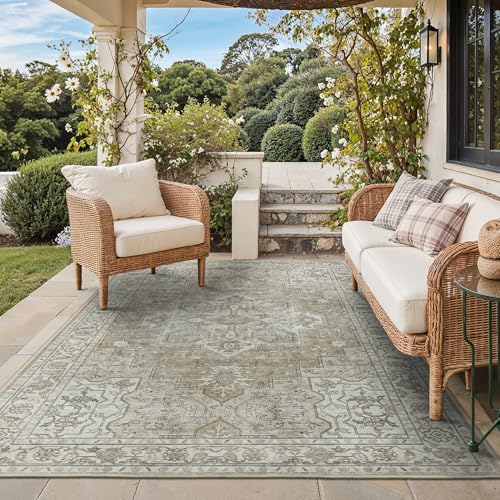
Choose the GENIMO if plastic straw’s feel is your objection: its verified title documents a washable indoor-outdoor chenille rug, fade resistant, with a quick-dry non-slip backing, in a stated 5×8, named for patio and deck.
Strengths
- Fade Resistant stated in the verified title
- Washable — a textile rug you can actually launder, unlike plastic mats
- Quick-dry non-slip backing named in the title
Trade-offs
- Textile construction drinks more weather than plastic straw — best on covered or part-covered decks
- The title says indoor outdoor and washable, not waterproof — we do not upgrade its claim
- Cream beige shows deck dirt fastest of any colourway here
| Specification | From the verified listing title |
|---|---|
| Size | 5×8 (stated in title) |
| Fade | Fade resistant (stated in title) |
| Backing | Quick-dry non-slip backing (stated in title) |
| Waterproof | Not stated — washable indoor-outdoor, per title) |
This is the feel pick, and its spec box is a small lesson in label honesty: the title claims fade resistance and washability, and pointedly does not claim waterproof. We repeat it at exactly that level. A washable chenille on a covered deck — where rain is occasional and mostly blown — gives barefoot softness plastic cannot, and when it dulls, the washing machine answers. On an open deck in a wet climate, that same textile logic becomes a liability, and the plastic picks above are the honest recommendation.
The quick-dry non-slip backing is the feature that makes the textile gamble reasonable: water that gets under a rug is the enemy of both the rug and the deck, and a backing designed to dry quickly and grip boards addresses both halves. Still lift it after storms. No backing repeals weather; good ones just shorten the wet hours, and shortened wet hours are what deck boards actually need.
Best for: covered decks and barefoot households who want a washable soft rug / Not suited for: open, rain-exposed decks in wet climates Check on Amazon.

Loom&Crate Washable Indoor Outdoor Area Rug — 12×15, Navy — Best Extra-Large
The Loom&Crate is for decks that swallow ordinary rugs: its verified title states a 12×15 size, a polypropylene flat weave, low pile, hose-off cleaning and pet friendly positioning — a woven textile at a scale plastic mats rarely reach.
Strengths
- Size stated in the title: 12×15 — the largest here
- Hose-Off Cleaning stated — deck-practical maintenance
- Polypropylene flat weave, low pile, non-shedding per title
Trade-offs
- Woven polypropylene is not plastic straw: it handles weather, but it is not sold with a waterproof claim in this title, and we do not add one
- 12×15 needs two people and real storage
- Navy shows sun-fade contrast more visibly than neutrals if it fades
| Specification | From the verified listing title |
|---|---|
| Size | 12×15 (stated in title) |
| Material | Polypropylene Flat Weave, Low Pile (stated in title) |
| Cleaning | Hose-Off Cleaning (stated in title) |
| Waterproof | Not stated |
Scale changes the product. At 12×15 a rug stops being an accessory and becomes the deck’s floor plan: dining zone, lounging zone and traffic path all live on one surface, which is why flat weave and low pile matter — chair legs glide, doors clear, and the whole thing reads as intentional architecture rather than a mat that grew. Hose-off cleaning at this size is not a convenience; it is the only realistic maintenance, and the title states it.
Hold the weather claim at the title’s level: polypropylene is a sensible outdoor fibre and flat weaves dry faster than pile, but this listing does not say waterproof, so plan for a covered or well-drained deck and a drying routine after storms. What you get in exchange for that discipline is the one thing plastic straw never gives: a woven textile hand at a genuinely architectural size.
Best for: very large decks wanting one woven surface, and pet households / Not suited for: small decks and buyers needing a stated waterproof claim Check on Amazon.
Comparison Table
| Pick | Badge | Key spec | Best for |
|---|---|---|---|
| Fab Habitat Outdoor Rug — Vintage Boho Kilim (Recycled Plastic) | Best Overall | Waterproof, fade resistant, reversible — deck named | deck owners who want waterproof and fade claims in writing |
| MontVoo Outdoor Rug Carpet — Waterproof, 5×8, Reversible | Best Stated Size | 5×8 stated, waterproof, reversible | small-to-mid decks and balconies needing a stated 5×8 |
| Pauwer Waterproof Outdoor Rug — 9×12, Leaf Brown | Best Large Coverage | 9×12 stated, UV resistant, waterproof stated | large open decks in full sun with full seating groups |
| BalajeesUSA Outdoor Rug — 5×7 Black, Reversible Recycled Plastic Straw | Best Budget Classic | 5×7 stated, waterproof, reversible, value tier | shaded decks, RV users and value buyers |
| GENIMO Indoor Outdoor Rug — Washable, for Patio and Deck, 5×8 Cream Beige | Best Soft-Feel Deck Rug | 5×8, fade resistant, washable chenille, quick-dry backing | covered decks and barefoot households who want a washable soft rug |
| Loom&Crate Washable Indoor Outdoor Area Rug — 12×15, Navy | Best Extra-Large | 12×15 stated, hose-off cleaning, flat weave | very large decks wanting one woven surface, and pet households |
Compare the Key spec column against your deck’s exposure before comparing patterns: a full-sun, rain-open deck needs the stated waterproof and UV claims in the top rows; a covered deck can trade those claims for the textile feel of the bottom rows. The table is ordered by badge logic, not by weather hardness — your climate does the ranking.
How to Choose a Rug for a Deck: Exposure First
Classify your deck before you look at a single pattern. Open and unsheltered: you need the plastic-straw family and stated waterproof wording, plus a stated UV or fade claim if the sun is direct — that is the Fab Habitat, MontVoo and Pauwer profile. Covered or screened: textiles become viable, and washability (GENIMO) or hose-off cleaning (Loom&Crate) can outrank waterproof wording you will rarely test. Partially covered decks should be judged by their wettest corner, not their driest — the rug lives everywhere it reaches.
Size by furniture, not by deck dimensions. The rug should catch the front legs of every seat in the group it serves, with a border of board showing around it; a rug that exactly matches the deck looks like carpet and traps the most moisture. Stated sizes in this guide run from 5×7 (a four-person table, an RV awning) through 5×8 and 9×12 (full seating groups) to 12×15 (zoned, architectural coverage). Measure the group, add the border, then shop the number.
Finally, interrogate the claim words as this guide does. Waterproof in a title is a commitment; water resistant is a lesser one; silence is information. UV resistant and fade resistant are both sun claims but not identical promises. The sellers who state specifics in titles are the sellers you can hold to specifics after delivery — prefer them, and verify the wording is still there when you check the current price on Amazon.
Plastic Straw vs Woven Textile on a Deck
Plastic straw rugs are woven from hollow plastic strands: they do not absorb water into a fibre, they dry fast, they hose clean, and they feel like a firm mat. That is the complete, honest profile — superb weather logic, modest barefoot luxury. Woven textiles (chenille, polypropylene flat weave) reverse the trade: real textile softness, slower drying, and a maintenance story built on washing or hosing rather than shedding. Polypropylene sits between the families — a textile hand with an outdoor-grade fibre — which is why the Loom&Crate can work at 12×15 on a well-drained deck.
Neither family is ‘better’; they answer different decks. The mistake is cross-applying them: a textile rug on an open deck in a wet climate becomes a mildew project, and a plastic mat under a covered deck’s barefoot loungers can feel like a compromise you notice daily. Match material to exposure first and to feet second, in that order.
Keeping Deck Boards Healthy Under a Rug
A rug changes the deck’s microclimate: shade, trapped humidity and slower drying underneath. Manage it with a rhythm, not anxiety. After storms, lift a corner and check; on a dry, breezy day each month, roll the rug back and let the boards dry fully; at season’s end, clean the rug, dry it completely, and store it rolled rather than folded if you can (the Fab Habitat’s crease-free claim is the exception that proves the rule). Boards that get regular air under a rug outlast boards under a rug that is never lifted — the rug is not the risk, the neglect is.
How to Lay, Anchor and Maintain a Deck Rug
A deck rug needs no installation, but it rewards ten minutes of placement discipline and a light seasonal routine.
- Sweep and dry the boards first; grit trapped under a rug is sandpaper with every footstep.
- Position the rug under the front legs of the seating group, leaving a border of deck visible on all sides.
- Let furniture do the anchoring: table and chair legs pin the edges better than tape, which decks and rug backings both dislike.
- After rain, lift a corner; if the boards are wet, roll the rug back on the next dry day and let everything air before relaying.
- Clean by construction: hose plastic straw and the Loom&Crate, launder the GENIMO as its label directs, and always dry fully before relaying or storing.
- Store rolled, dry and indoors for winter where your climate demands it; a dry rug in spring is a five-minute job, a damp-stored one is a replacement.
Walk the rug barefoot once a season and check the boards beneath at the same time — the pairing of those two checks is the whole maintenance philosophy of outdoor rugs in one habit.
Deck Materials: Wood, Composite and Stone Behave Differently
Natural wood decks are the most rug-sensitive surface in this guide: they need the drying rhythm the how-to section prescribes, because trapped moisture is their one real enemy, and they reward plastic-straw rugs that shed water off the surface rather than holding it. Check under the rug monthly in the wet season and you will never have a problem worth the name; skip a year of checks and the rug gets blamed for the calendar’s work.
Composite decking is the forgiving middle: it does not rot, but it can stain and it grows slippery algae films in shade, which argues for rugs with grip and for lifting them so the surface can be washed. Some composites also run hot in full sun — a rug there is shade for the boards as much as decoration, and the UV-stated picks (Pauwer, Fab Habitat) protect their own colours while they do it. Stone, tile and concrete patios are the easiest hosts of all: drainage and heat are their variables, textiles like the Loom&Crate and GENIMO behave best here, and the main discipline is letting everything dry after storms so efflorescence and mustiness never start.
Whatever the material, one rule survives: a rug is a guest on the surface, not a seal over it. The sellers in this guide who state their claims plainly make that guest easy to host; the maintenance rhythm in this guide — lift, dry, clean, store dry — is the rent it pays.
Seasonal Rotation: Getting Two Looks and Twice the Life
Reversible rugs — four of the six picks here state reversibility — invite a habit worth adopting deliberately: flip the rug at midsummer. The second side is a fresh pattern for the season’s second half, the sun’s damage is shared between two faces instead of carved into one, and the act of flipping forces the underneath check that deck boards need anyway. Rotation is maintenance disguised as decorating, which is the only kind of maintenance that happens reliably.
Pair the flip with a calendar: spring, lay the rug and inspect the boards; midsummer, flip and wash; autumn, decide honestly whether your climate stores the rug or winters it in place; winter, if stored, clean and dry before rolling, because a rug stored damp is a rug replaced. Each touch is fifteen minutes; together they are the entire difference between a rug that lasts one season and one that lasts five.
Households with two decks or a deck and a patio can extend the logic by swapping rugs between a harsh and a sheltered site each year, evening out their exposure. It sounds like effort and is actually just carrying — but it is the kind of quiet system that makes outdoor textiles, like the six documented here, pay back their price several times over.
Colour, Pattern and How a Deck Rug Ages Visually
Outdoor colour choice is a negotiation with sunlight and dirt, and the titles in this guide quietly encode the options. Dark rugs (the BalajeesUSA’s black) hide soil and show pollen; pale rugs (the GENIMO’s cream beige) show soil and hide fading; mid-tone patterns hide both at the cost of visual calm. There is no universally right answer — there is your deck’s pollen load, your sun hours and your tolerance for the hose, in that order.
Patterns earn their keep outdoors even more than indoors, because an outdoor rug’s life includes bird visits, leaf tannins and tracked grit that no household fully prevents. A vintage or boho pattern — the Fab Habitat’s kilim, the GENIMO’s medallion — distributes that evidence across a design that already contains variation, while a flat solid narrates every incident. Choose the narration level your household can live with between cleans.
And expect honest ageing even from the UV-stated picks: resistance slows fading, it does not repeal the sun. The reversible designs in this guide exist partly as the answer — two faces, shared exposure, double the presentable life — and the midsummer flip from the rotation section is what converts that design feature into actual years.
Underfoot: Warmth, Bare Feet and Evening Use
A deck rug changes the deck’s hours. Boards that are punishingly hot at noon or chilly after sunset become walkable under a rug, and plastic straw — for all its firmness — is noticeably kinder than sun-baked timber at both extremes. Households that live on their decks barefoot will feel this benefit daily, and it is a legitimate reason the textile picks exist: the GENIMO’s chenille at dusk, on a covered deck, is a genuinely luxurious surface that no mat reproduces.
Evening dew is the counterweight: open decks collect moisture after dark, and a rug that was dry at dinner can be damp by the nightcap. Plastic straw shrugs this off by breakfast; textiles hold it longer, which is the same covered-versus-open logic this guide has applied throughout, now measured in hours of the day rather than seasons of the year. Know your deck’s dew habit before choosing its rug’s material.
Children and dogs vote in this category too, with their feet: both prefer a rug to splintered boards, both track the outdoors back across it, and both are reasons the hose-cleanable and washable claims in these titles are practical features rather than marketing garnish.
When a Deck Rug Is the Wrong Purchase
Honesty requires the negative case. A deck in deep, permanent shade that never dries is a poor rug host: the underneath stays wet, the boards suffer, and the rug becomes a mildew project — solve the drainage and light first, or enjoy the bare boards. A deck whose boards are already soft or failing needs its repair budget spent on timber, not textiles; a rug over rot hides the evidence while the problem compounds, which is the one truly expensive outcome in this category.
Renters with short tenures should weight the smaller, stated sizes (5×7, 5×8) and the value tier: a rug that moves house easily and costs little to leave behind beats an architectural 12×15 fitted to a deck you will wave goodbye to. And households that hose the deck weekly for a pool or a kennel will find any rug an obstacle in their routine — the right purchase there is a mat by the door, not a rug under the furniture.
None of this dims the six picks for the decks they suit. It defines their borders, and a guide that tells you when not to buy is the only kind worth trusting when it tells you to.
Rugs for Decks With Pools, Hot Tubs and Outdoor Kitchens
Water features rewrite deck life around their edges: a pool or hot tub guarantees daily splashing in its radius, and the rug inside that radius lives wet. Plastic straw is the only family in this guide built for that postcode — it does not absorb, it dries between uses, and its stated waterproof wording is doing real work there. Place it to catch the exit path from water to house, where bare wet feet need grip and the boards need protection from constant soaking, and accept that this rug is infrastructure first and decoration second.
Outdoor kitchens add grease to the weather, and grease changes the cleaning hierarchy: a rug that hoses clean (the Loom&Crate states it; the plastic picks tolerate it) survives a cooking season, while a textile that needs laundering will spend that season either dirty or in the wash. If the rug must sit under a grill zone, choose by cleanability, keep it clear of direct heat and sparks by a sensible margin, and treat its service life as seasonal — the honest price of cooking outdoors on a decorated floor.
Fire features demand the plainest safety sentence in this guide: rugs and open flame are neighbours to manage, not friends — keep every rug at the distance the fire feature’s own instructions require, never let any rug in this guide contact embers or a heat source, and when in doubt, the boards alone are the right floor for the fire circle. No pattern is worth a scorch, and no claim in any title here suggests otherwise.
Handled with that zoning — plastic by the water, cleanable by the kitchen, nothing by the fire — a hard-working deck can absolutely carry rugs, and the households that zone honestly are the ones whose summer photographs show the same rug, unbothered, in September as in May.
Common Buying Mistakes
Mistake one: putting an indoor rug on a deck because the pattern matched. Indoor fibres absorb water, hold it against the boards and fade without any stated UV claim — the most expensive rug mistake in this category. Mistake two: upgrading claim words in your head, reading water resistant as waterproof or assuming UV protection a title never states; this guide’s Not stated boxes exist to break that habit.
Mistake three: sizing to the deck instead of the furniture, ending with a rug that either wallpapers the whole deck or maroons the table. Mistake four: never lifting the rug — the boards beneath need scheduled air, and five minutes monthly is the entire cost. Mistake five: storing a damp rug in autumn and meeting the result in spring.
Final Recommendation
For most open decks, the Fab Habitat is the complete documented package: waterproof, fade resistant, reversible, crease-free, deck named in the title. If you want your size guaranteed in writing, the MontVoo states its 5×8; if the deck is large and sun-blasted, the Pauwer’s stated 9×12 and UV resistance answer it. The BalajeesUSA remains the value classic for shade and RV life. Covered-deck households who prioritise feel should take the GENIMO’s washable chenille, and the biggest decks can graduate to the Loom&Crate’s stated 12×15 of hose-cleanable woven polypropylene.
Close the purchase the way this guide was built: open the listing, confirm the exact claim words your deck needs are still stated in the title, measure the furniture group once more, and check the current price on Amazon.
Keep researching with these related guides from the same program: Best Durable Outdoor Rugs Best Outdoor Rugs For All Weather Best Outdoor Rugs For Balcony Best Outdoor Rugs That Can Get Wet Best Rugs For A House With Cats Best Area Rugs For A Beach House
Frequently Asked Questions
Can I leave a deck rug out all year?
Plastic straw rugs with stated waterproof wording tolerate year-round exposure best, but every rug and every deck benefits from winter storage in harsh climates — and the boards benefit most of all. Textile picks here should be stored dry for winter without exception.
Is waterproof the same as water resistant?
No, and this guide never treats them as the same. Waterproof is the stronger claim and appears here only where a title states it. Two picks state neither waterproof claim and are recommended for covered decks on other documented strengths.
What size rug for a deck seating group?
Big enough to sit under the front legs of every seat, with deck border showing. Stated sizes here run 5×7 for a small table group, 5×8 and 9×12 for full groups, and 12×15 for zoned coverage of very large decks.
Will a rug damage my deck boards?
A neglected rug can hold moisture against boards; a maintained one will not. Lift it after storms, give the boards a dry day monthly, and store the rug dry — that routine, not the rug, decides the outcome.
Plastic straw or textile — which feels better?
Textile, honestly, and plastic straw wins on weather. That is the category’s central trade, and this guide places each pick on its correct side of it rather than pretending one material does both jobs.
Do deck rugs need a pad underneath?
Generally no — pads trap moisture outdoors and fight the drying this guide keeps prescribing. Let furniture anchor the rug, choose a backing with grip where a title offers one (the GENIMO’s non-slip backing), and keep the underneath dry.
Can I put a deck rug over a stained or weathered deck?
Yes — and it is one of the best cosmetic moves in outdoor living, covering silvered boards and old stain lines under a surface you chose. Two disciplines apply: clean and fully dry the deck first, because a rug laid over a damp, dirty deck seals the problem in rather than covering it up; and keep the underneath rhythm from this guide, since a weathered deck is exactly the one that most needs its scheduled air. Cosmetically the rug buys you seasons; structurally it buys nothing, and soft or failing boards should still be repaired on their own merits, rug or no rug.


