A good rotisserie cooker turns an ordinary chicken, roast, or kebab into a meal with crisp skin, juicy meat, and even browning on every side. The spit keeps turning, so heat reaches the food from all directions and the meat bastes itself in its own juices as it rotates. The best rotisserie cookers do this work on a countertop, without a full-size oven, and they do it with simple controls that anyone can learn in one cooking session.
This guide covers the best rotisserie cookers for home kitchens, from compact countertop ovens that fit a 12-pound bird to tall vertical units built for shawarma and kebabs. Every pick below is a real rotisserie cooker sold on Amazon, chosen for its capacity, its build, and the way it handles everyday roasting. If you want a dedicated rotisserie oven rather than a grill attachment, start here.
In this guide
Quick picks: best rotisserie cookers
| # | Product | Where to buy |
|---|---|---|
| 1 | Ronco 5500 Series Countertop Rotisserie Oven | Check on Amazon |
| 2 | Ronco 6000 Platinum Digital Countertop Rotisserie Oven | Check on Amazon |
| 3 | NutriChef Multi-Function Rotisserie Countertop Oven | Check on Amazon |
| 4 | Nutrichef Vertical Countertop Oven with Rotisserie | Check on Amazon |
| 5 | NutriChef Vertical Countertop Rotisserie Oven Roaster | Check on Amazon |
| 6 | RareDot Ultra Rotisserie Oven 35Qt | Check on Amazon |
How the picks were chosen
Each cooker in this guide was checked against the same list. First, it had to be a rotisserie cooker by design, not an oven that merely offers a rotisserie setting as an afterthought. The spit, the rotation, and the heating layout had to be central to how the machine cooks. Second, it had to state a usable capacity, so you can tell before buying whether it fits a whole chicken, a roast, or a holiday turkey. Third, it had to be a countertop model suited to a home kitchen, with a footprint that fits a standard counter and a build that handles regular use.
Capacity mattered more than extra functions. A rotisserie cooker earns its place by roasting well, so models with clear capacity ratings and sturdy spit assemblies ranked ahead of models that list many modes but say little about roasting. Stainless steel housings and glass doors earned credit because they are easy to wipe down after a greasy roast, and a visible cooking chamber helps you judge browning without opening the door and losing heat. Models that bundle kebab racks, skewers, or baskets earned credit too, because those accessories extend the same machine to kebabs, vegetables, and smaller cuts.
Finally, each pick had to be verifiable on the site store: a matching brand and model name, a working product image, and a link that takes you to that exact model. No substitute models and no accessories standing in for the cooker itself. Six cookers met every part of that test, and they cover the main ways people roast at home: whole birds, large roasts, kebabs, and vertical shawarma-style cooking.
One more check shaped the list: the difference between a rotisserie cooker and a grill or oven that happens to include a spit. Several countertop ovens and gas grills list rotisserie as one function among many, and they can roast well, but they are not rotisserie cookers first. This guide keeps the focus on machines where rotation is the main cooking method, because that is what a buyer searching for a rotisserie cooker actually wants. Combination machines still have a place, and they are linked in the buying guide below, but the six picks here are dedicated rotisserie cookers. That focus also keeps the comparison honest: every model below is judged on how well it rotates, browns, and holds a roast, not on how many unrelated modes it lists.
The best rotisserie cookers in detail


Top pick
1. Ronco 5500 Series Countertop Rotisserie Oven
The Ronco 5500 Series is a countertop rotisserie oven with a 12-pound capacity and a stainless steel body. It is built around one job: rotating a whole chicken or roast on a spit until the outside is crisp and the inside stays juicy. The 12-pound capacity covers most whole chickens and many roasts, which makes it a practical size for family dinners without taking over the counter.
The countertop format is the main appeal. It sits beside the stove, heats up without warming the whole kitchen, and frees the main oven for side dishes. The stainless steel housing wipes clean after roasting, and the enclosed chamber keeps heat and splatter inside while the bird turns. Three cooking functions give you options beyond a basic roast, so the same machine can handle different cuts and preparations.
Strengths:
- 12-pound capacity fits a whole chicken or a family-size roast
- Countertop size keeps the main oven free for side dishes
- Stainless steel housing is easy to wipe down after a greasy roast
Trade-offs:
- Countertop footprint still needs a clear stretch of counter space
- A 12-pound limit rules out the largest holiday turkeys
- The enclosed chamber needs a wipe-down after every roast to stay clean
Who it fits: households that roast whole chickens or roasts once or twice a week and want a dedicated machine that does the job without heating the full oven.
Best for: weeknight roast chicken with crisp skin. Not suited for: very large turkeys or cooks who need a machine that also air fries and bakes.
Check price on Amazon: Ronco 5500 Series Countertop Rotisserie Oven

2. Ronco 6000 Platinum Digital Countertop Rotisserie Oven
The Ronco 6000 Platinum is the digital version of the countertop rotisserie oven, with the same 12-pound capacity in a stainless steel body and digital controls in place of dials. The digital panel makes it easier to set time and temperature precisely and to repeat a good result, which matters when you are learning how long your favorite roast needs.
Like the 5500, it is sized for whole chickens and family roasts, and it keeps the main oven free. The digital controls are the difference: they suit cooks who prefer exact settings and a clear display over turning a dial and guessing. The stainless body and enclosed chamber follow the same pattern as the rest of the line, with easy wipe-down surfaces and heat kept inside while the spit turns.
Strengths:
- Digital controls make time and temperature easy to set and repeat
- 12-pound capacity covers whole chickens and family roasts
- Stainless steel body and enclosed chamber keep heat and splatter inside
Trade-offs:
- Digital controls add complexity for cooks who prefer simple dials
- Same 12-pound ceiling as the 5500, so the largest birds still do not fit
- Countertop placement needs clearance above the unit for heat
Who it fits: cooks who roast often and want repeatable settings, and anyone who prefers a digital display to manual dials.
Best for: repeatable roasts with exact settings. Not suited for: very large turkeys or buyers who want the simplest possible controls.
Check price on Amazon: Ronco 6000 Platinum Digital Countertop Rotisserie Oven


3. NutriChef Multi-Function Rotisserie Countertop Oven
The NutriChef Multi-Function Rotisserie Countertop Oven is a 24-quart vertical unit with a glass door, built for rotisserie roasting as well as other countertop cooking. The 24-quart chamber is roomy for a countertop machine, and the vertical layout with a glass door lets you watch the roast brown without opening the door.
The glass door is a practical feature, not a decoration. Judging browning through glass keeps the heat in, and the vertical shape fits a tall roast or a skewer of kebabs without a wide footprint. As a multi-function oven it covers more than rotisserie work, which suits kitchens where one machine has to earn its counter space in several ways.
Strengths:
- 24-quart chamber fits larger roasts and tall skewers
- Glass door lets you check browning without losing heat
- Vertical shape saves counter width while holding a tall load
Trade-offs:
- The tall shape needs vertical clearance on the counter
- A glass door needs regular cleaning to stay clear
- Multi-function controls take a session or two to learn
Who it fits: households that want one countertop oven for rotisserie roasting, kebabs, and everyday baking, and cooks who like to watch food brown.
Best for: tall roasts and kebab skewers in a compact footprint. Not suited for: low cabinets with no clearance above the counter, or cooks who want a single-purpose rotisserie only.
Check price on Amazon: NutriChef Multi-Function Rotisserie Countertop Oven

4. Nutrichef Vertical Countertop Oven with Rotisserie
The Nutrichef Vertical Countertop Oven is a vertical unit that combines rotisserie cooking with bake, broil, and kebab rack functions, with adjustable settings and two shelves. The vertical layout holds a roast or a set of kebab skewers upright, so the footprint stays small while the cooking space stays tall. Adjustable settings let you match the heat to the cut, whether you are roasting a chicken or crisping kebabs.
The kebab rack is the feature that sets this one apart for mixed cooking. It turns the same vertical chamber into a kebab machine, so one appliance covers roast nights and skewer nights alike. Two shelves add room for vegetables or smaller items alongside the main roast, which helps when you want the whole meal to cook in one place.
Strengths:
- Rotisserie plus bake, broil, and kebab rack functions in one unit
- Vertical layout saves counter width while holding tall loads
- Two shelves give room for vegetables beside the main roast
Trade-offs:
- Vertical cooking needs practice to load and balance the spit
- Two shelves share one chamber, so flavors can mix
- The tall body needs clearance above the counter
Who it fits: cooks who want one vertical machine for roasts and kebabs, and kitchens where counter width is tight but vertical space is free.
Best for: roast nights that double as kebab nights. Not suited for: cooks who only roast whole birds and want the simplest single-purpose machine.
Check price on Amazon: Nutrichef Vertical Countertop Oven with Rotisserie
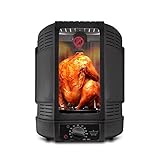
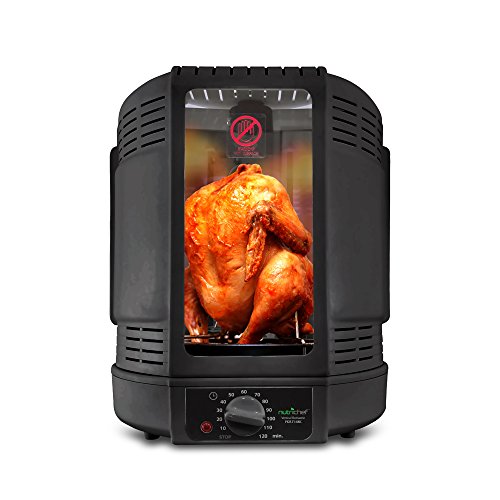
5. NutriChef Vertical Countertop Rotisserie Oven Roaster
The NutriChef Vertical Countertop Rotisserie Oven Roaster is a rotating vertical oven built for rotisserie roasting, shawarma, and kebabs, with a skewer, a rack, and a basket included. It roasts upright, so juices run down over the meat as the spit turns, and the rotating action keeps the outside browning evenly. The included skewer and basket make it ready for kebabs and smaller items from the first use.
This is the pick for cooks who like variety on the spit. One night it roasts a chicken, the next it turns a stack of shawarma meat or a skewer of kebabs. The vertical design keeps the footprint small, and the basket handles foods that do not suit a spit, such as vegetables or small cuts that need to tumble rather than rotate on a skewer.
Strengths:
- Skewer, rack, and basket included for roasts, kebabs, and small items
- Upright rotation bastes the meat as it turns
- Vertical shape fits a tall cook in a small counter footprint
Trade-offs:
- Loading a vertical spit takes care to balance the meat
- The basket and skewer need hand washing after greasy cooks
- Tall shape needs vertical clearance and a stable counter spot
Who it fits: cooks who rotate between roasts, shawarma, and kebabs, and anyone who wants the skewer and basket included rather than bought separately.
Best for: shawarma and kebab nights as well as roast chicken. Not suited for: very large roasts that need a wide horizontal chamber.
Check price on Amazon: NutriChef Vertical Countertop Rotisserie Oven Roaster


6. RareDot Ultra Rotisserie Oven 35Qt
The RareDot Ultra Rotisserie Oven is a 35-quart countertop unit that fits two whole chickens, with a stainless steel body. The large chamber is the selling point: it handles two birds at once, which suits big family dinners, meal prep, or gatherings where one chicken is never enough. The stainless steel body stands up to regular use and wipes clean after roasting.
Two chickens at once changes how you plan a roast. You can cook the main bird and a second one for leftovers, or two different preparations side by side. The 35-quart size is generous for a countertop machine, so measure your counter before buying, but for large households the extra room is the reason to choose it.
Strengths:
- 35-quart chamber fits two whole chickens at once
- Stainless steel body handles regular roasting and wipes clean
- Large capacity suits big families and meal prep
Trade-offs:
- The large chamber needs a wide stretch of counter
- A big roast takes longer to heat through than a small one
- Heavier to move and store than a compact countertop oven
Who it fits: large households, meal preppers, and anyone who regularly roasts for a crowd and wants two birds in one cook.
Best for: cooking two whole chickens at once. Not suited for: small kitchens, single-person households, or counters with limited space.
Check price on Amazon: RareDot Ultra Rotisserie Oven 35Qt
Best rotisserie cookers compared
| Cooker | Capacity | Key feature | Best for |
|---|---|---|---|
| Ronco 5500 Series | 12 lb | Countertop rotisserie oven, stainless steel | Weeknight roast chicken |
| Ronco 6000 Platinum | 12 lb | Digital controls, stainless steel | Repeatable roasts with exact settings |
| NutriChef Multi-Function | 24 quart | Glass door, vertical layout | Tall roasts and kebab skewers |
| Nutrichef Vertical Oven | Vertical chamber | Rotisserie, bake, broil, kebab rack | Roast and kebab nights in one machine |
| NutriChef Vertical Roaster | Vertical chamber | Skewer, rack, and basket included | Shawarma, kebabs, and roast chicken |
| RareDot Ultra | 35 quart | Fits two whole chickens | Big families and meal prep |
How to choose a rotisserie cooker
Start with capacity, because it decides what you can cook. A 12-pound rotisserie handles a whole chicken and most family roasts, and it fits kitchens where counter space is limited. A 24-quart or 35-quart chamber handles larger birds, two chickens, or a tall skewer of kebabs. Measure the largest roast you cook regularly, then choose a chamber that fits it with room for the spit to turn freely. A roast that touches the walls will brown unevenly and drip onto the heating parts.
Next, decide between a horizontal oven and a vertical one. Horizontal countertop ovens work like a small oven with a spit, and they suit whole birds and roasts laid along the spit. Vertical ovens hold the meat upright, which suits shawarma, kebabs, and tall loads, and they take less counter width. If you mostly roast chickens, a horizontal oven is the simpler choice. If you cook kebabs and shawarma often, a vertical unit earns its place. For a closer look at dedicated oven-style models, see our guide to the best rotisserie ovens.
Controls matter more than they seem. Simple dials are fast to learn and hard to break, while digital controls make it easier to repeat an exact time and temperature. If you roast the same chicken every week, digital settings save fiddling. If you prefer to set and forget with a single dial, a manual model is fine and often cheaper to maintain. Either way, look for a timer you can hear from another room, because a roast that runs long dries out fast.
Build and cleaning decide whether you keep using the machine. Stainless steel housings wipe clean and resist stains from roasting fat. A glass door lets you judge browning without opening the chamber and losing heat. Removable drip trays, spit rods, and baskets that come out for washing will save you time after every cook. Check that the parts you will wash most often are easy to remove and fit in your sink.
Think about what else the machine should do. Some rotisserie cookers also bake, broil, or air fry, which can replace a second appliance. Others focus on rotisserie alone and do it well. A multi-function machine suits a small kitchen where one appliance must cover several jobs. A dedicated rotisserie suits a cook who already owns an air fryer or a toaster oven and wants the best possible roast. If your cooking leans toward grilling as well, the best rotisserie gas grills cover outdoor options, and the best BBQ grills with rotisserie cover grill-and-spit combinations.
Finally, check the counter. Measure the width, depth, and height of the spot where the cooker will live, and leave clearance above and behind it for heat. A rotisserie cooker that lives in a cupboard gets used far less than one that sits ready on the counter, so plan a permanent home for it before you buy.
Budget is the last factor, and it is simpler than it looks. A basic countertop rotisserie costs less than a multi-function oven, and the difference buys you a dedicated machine that does one job well. Digital controls and larger chambers cost more, and they are worth it only if you will use them: a cook who roasts weekly will notice the digital panel, while a cook who roasts monthly will not. Spend on capacity first, then on controls, and treat extra functions as a bonus rather than a reason to buy.
Using and caring for your rotisserie cooker
Truss the bird before it goes on the spit. Tie the legs and wings close to the body so nothing flops, catches, or cooks unevenly. A loose wing can drag against the heating element, and an unbalanced load makes the spit wobble, which wears the motor and browns the meat unevenly. Balance matters: center the roast on the spit and tighten the forks so the load does not shift as it turns.
Season simply and let the rotation do the work. Salt, pepper, oil, and herbs are enough for a good roast chicken, because the turning spit bastes the meat in its own juices. Avoid thick sauces or sugary glazes at the start of the cook, since they burn before the inside is done. Add a glaze only in the last stretch, when the meat is nearly cooked through.
Use a drip tray every time. The tray catches fat, keeps the bottom of the chamber clean, and gives you pan juices for gravy. Line it with foil for an easier cleanup, and empty it while it is still warm, before the fat sets. Never pour hot fat down the sink; let it cool and discard it with household waste.
Let the roast rest after the spit stops. Ten to fifteen minutes on a cutting board lets the juices settle back into the meat, so the first slice is moist rather than dry. Tent the roast loosely with foil while it rests, and use the time to finish side dishes or make gravy from the pan juices.
Clean after every cook, while the chamber is still warm but safe to touch. Wipe the interior with a damp cloth, wash the spit, forks, drip tray, and any baskets in hot soapy water, and dry everything before storing. Grease left in the chamber smokes on the next cook and leaves a stale smell. A quick wipe after each use keeps the machine ready and avoids a deep clean later.
Common mistakes to avoid
The most common mistake is overloading the spit. A roast that is too heavy for the motor turns slowly or stalls, and the meat cooks unevenly. Respect the stated capacity, and when in doubt, cook a smaller bird. A 12-pound limit means 12 pounds of meat, not 12 pounds plus stuffing and trussing.
The second mistake is skipping the truss. An untrussed bird cooks with wings and legs sticking out, which means burnt tips and pale spots where the meat folded. Two minutes with kitchen twine fixes it, and the result is a bird that browns evenly all over.
The third mistake is opening the door to check too often. Every opening drops the temperature and adds minutes to the cook. Use the glass door or the timer, and check once near the end rather than every ten minutes. A meat thermometer gives a better answer than a visual check anyway.
The fourth mistake is forgetting the drip tray. Without it, fat pools in the bottom of the chamber, smokes, and bakes onto the heating parts. The tray is part of the machine, not an optional extra, and it should go in before the spit does.
The fifth mistake is storing the cooker dirty. Grease left on the spit and forks turns rancid and sticky, and a dirty chamber smokes on the next cook. Wash the removable parts, wipe the chamber, and let everything dry before the machine goes back on the shelf.
Final recommendation
For most home kitchens, the Ronco 5500 Series is the best starting point: a 12-pound countertop rotisserie that roasts a whole chicken well, fits a standard counter, and keeps the main oven free. If you prefer exact digital settings, step up to the Ronco 6000 Platinum, which adds a digital panel to the same capacity. Large households should look at the RareDot Ultra 35Qt, which fits two whole chickens at once and makes meal prep and gatherings far easier.
Cooks who want kebabs and shawarma as well as roasts should choose a vertical model. The NutriChef Vertical Countertop Rotisserie Oven Roaster covers roasts, shawarma, and kebabs with its skewer, rack, and basket, while the Nutrichef Vertical Countertop Oven adds bake and broil functions for kitchens that need one machine to do more. Whichever you choose, measure your counter, respect the capacity, and truss the bird. If you already own an air fryer and want rotisserie as an added function, our guide to the best air fryers with rotisserie covers combination machines.
One last note: buy the cooker for the meals you cook most often, not the meals you imagine cooking someday. A household that roasts chicken every Sunday needs a reliable 12-pound countertop oven, not a commercial machine built for a restaurant. A household that cooks kebabs every week needs a vertical rotisserie with a skewer and a basket. Match the machine to your table, and it will earn its counter space for years.
What to cook on a rotisserie cooker
Whole chicken is the classic rotisserie cook, and it is the best way to learn the machine. A 3 to 5 pound bird fits every cooker in this guide, and the turning spit gives you crisp skin and juicy meat with very little effort. Season the bird, truss it, slide it onto the spit, and let the rotation do the work. Once you are comfortable, the same method works for a pork loin, a beef roast, or a leg of lamb, all of which benefit from steady rotation and self-basting.
Kebabs and shawarma are the second family of rotisserie cooking, and they suit the vertical models best. Stacks of seasoned meat turn slowly against the heat, and you slice off the crisp outer layer as it browns. Skewers of chicken, beef, or vegetables work in the same way, and the basket included with some models handles smaller items that would fall through a spit. If your household eats kebabs weekly, a vertical cooker with a skewer and a basket will earn its counter space quickly.
Vegetables deserve a place on the spit too. Potatoes, carrots, and whole onions roast well in the basket or on skewers, and they pick up flavor from the drippings when cooked below the meat. A drip tray full of vegetables under a roasting chicken is one of the simplest one-machine meals: the meat bastes the vegetables as it turns, and everything finishes at the same time.
Holiday cooking is where capacity matters most. A 12-pound rotisserie handles a large chicken or a modest turkey, while a 35-quart chamber handles two chickens or a bigger bird with room to spare. If you host holiday dinners, plan the bird first and choose the chamber second. A roast that fits with clearance browns evenly; a roast squeezed against the walls does not. For very large turkeys, the main oven is still the safer choice, and the rotisserie can handle a second bird or a ham alongside it.
Rotisserie cooker vs. roasting in a regular oven
A regular oven roasts with still air and heat from above and below, which means the side facing the heat browns first and the cook has to turn the pan. A rotisserie cooker rotates the food through the heat, so every side gets equal time near the heating element. The result is more even browning and meat that bastes itself as it turns, without the cook opening the door to turn anything.
The second difference is heat and time. A countertop rotisserie heats a small chamber, so it reaches temperature fast and uses less energy than a full oven for a single roast. It also keeps the kitchen cooler in summer, since the heat stays inside a small enclosed box instead of warming the whole room. For a single chicken or roast, the rotisserie is the more efficient tool.
The third difference is what the cook can do at the same time. While the rotisserie handles the main roast, the main oven is free for side dishes, bread, or dessert. That split is the real reason many households buy a rotisserie cooker: it adds a second oven for the price of a countertop appliance, and it takes the most demanding dish off the main oven schedule.
An oven still wins for some jobs. Large trays of roasted vegetables, several dishes at once, baking, and very large turkeys all belong in the main oven. A rotisserie cooker is a specialist, and specialists beat generalists at their own job. Use the rotisserie for the roast, and let the oven do everything else.
Placement and safety
Place the cooker on a flat, stable, heat-resistant surface with clearance on all sides. The chamber gets hot during a roast, and the housing needs air around it to stay at a safe temperature. Keep it away from the edge of the counter, where a cord could be pulled, and away from curtains, paper, and other flammable items. A rotisserie cooker is a heating appliance, and it deserves the same respect as a stove.
Handle the spit and forks with care while they are hot. Use oven mitts to remove the spit after cooking, and set it on a heat-resistant surface rather than directly on the counter. The forks are sharp, so wash them with attention and store them where they will not catch a hand reaching into a drawer. Let the chamber cool before wiping it down, and never pour water into a hot chamber to speed cooling, since the steam can burn and the sudden temperature change can damage the interior.
Keep the cord in good shape. Do not let it hang over the edge of the counter where it can be pulled, and do not run it across a hot surface. If the cord or plug shows damage, stop using the machine and have it checked rather than cooking with a damaged lead. A rotisserie cooker runs for an hour or more at a time, and a sound cord is part of safe cooking.
Frequently asked questions
What size rotisserie cooker do I need for a whole chicken?
A 12-pound capacity handles most whole chickens sold in grocery stores, which usually weigh between 3 and 6 pounds. A 24-quart or 35-quart chamber gives extra room for larger birds, two chickens, or a roast with vegetables. Measure your usual bird and choose a chamber that leaves clearance for the spit to turn freely.
Can a rotisserie cooker replace my oven?
For roasting, yes, and it often does the job better, because the turning spit bastes the meat and browns it evenly. It does not replace an oven for baking bread, roasting large trays of vegetables, or cooking several dishes at different temperatures at once. Most cooks keep both and use the rotisserie for roasts.
Do I need to truss the chicken before rotisserie cooking?
Yes. Trussing ties the legs and wings close to the body, which keeps the load balanced on the spit, prevents parts from catching on the heating element, and helps the bird brown evenly. It takes about two minutes with kitchen twine and makes a clear difference in the result.
How do I clean a rotisserie cooker?
Remove the spit, forks, drip tray, and any baskets, and wash them in hot soapy water after every cook. Wipe the interior chamber with a damp cloth while it is still warm, and dry all parts before storing. Lining the drip tray with foil makes cleanup faster, and regular wiping prevents grease from baking onto the chamber walls.
Can I cook foods other than chicken in a rotisserie cooker?
Yes. Rotisserie cookers handle roasts, pork loin, kebabs, and shawarma-style meat, and models with baskets can cook vegetables and smaller cuts. The spit suits foods that hold together while turning, while the basket suits foods that would fall apart on a skewer. Check the manual for the weight limit before loading a heavy roast.
Is a vertical or horizontal rotisserie cooker better?
It depends on what you cook. Horizontal countertop ovens suit whole birds and roasts laid along the spit, and they work like a small oven with rotation. Vertical ovens suit shawarma, kebabs, and tall loads, and they take less counter width. If you mostly roast chickens, a horizontal model is simpler. If you cook kebabs and shawarma often, a vertical model is the better fit.
How much counter space does a rotisserie cooker need?
Plan for the footprint of the machine plus clearance above and behind it for heat. Compact 12-pound models fit a standard stretch of counter, while 35-quart models need a wider spot. Measure the space before buying, and give the cooker a permanent home on the counter, since a machine stored in a cupboard gets used far less often.


