Gas stoves put more heat, moisture and combustion byproducts into the air than most electric cooktops, so the hood above them matters. A good one captures rising steam and smoke at the source and exhausts it outdoors. Airflow strength, hood width and a short, straight duct run are the factors that count most.
The six hoods below are mostly wall-mounted or pro-style models with strong fans, from established and value brands. We have not used these products ourselves, so treat every detail as general guidance and confirm it on the current listing before you buy. Airflow ratings, noise levels and duct sizes change between versions.
As an Amazon Associate we earn from qualifying purchases. Links below are affiliate links, and they do not change the product information we give.
What to Look For
| Feature | Why it matters |
|---|---|
| Airflow | Higher airflow suits powerful gas burners and wok cooking |
| Width | Choose a hood at least as wide as the cooktop |
| Ducting | Venting outdoors beats recirculating for gas cooking |
| Filters | Baffle or mesh filters are easier to clean than basic types |
| Noise | Stronger fans are louder, so check the sone rating |
| Lighting | Bright LEDs let you see the flame and the food clearly |
In this guide
Specs at a Glance
| Hood | Mount | Width class | Notes |
|---|---|---|---|
| Cosmo | Wall mount | 36 inch class | Stainless chimney |
| Hauslane | Wall mount | 36 inch class | Baffle filters on many |
| ZLINE | Wall mount | 30 to 36 inch class | Professional look |
| Vent-A-Hood | Wall mount | Several sizes | Built around a blower system |
| Proline | Wall mount | Several sizes | Custom-style options |
| Thor Kitchen | Wall mount | 30 to 36 inch class | Pairs with Thor ranges |
The 6 Best Range Hoods for Gas Stoves
Top pickBest for wide gas cooktops
1. Cosmo Wall Mount Range Hood
A stainless chimney hood with a modern look and several fan speeds. It is a common choice for people who want solid ventilation above a wide gas cooktop without paying for a premium brand. Check the listing for the exact airflow rating and the duct size it expects.
Suits: wide gas cooktops. Strengths: a strong look for its class. Weaknesses: check duct size needs. Skip it if you have low cabinets above.
View Cosmo Wall Mount Range Hood on Amazon
Best for frequent cooks
2. Hauslane Chef Series Wall Mount Hood
A heavy-duty stainless hood aimed at serious home cooks. Many listings mention baffle filters and multiple fan speeds, which suits regular high-heat cooking. Fan speeds and lighting differ by version, so read the details of the one you choose.
Suits: frequent cooks. Strengths: features aimed at heavy use. Weaknesses: sizes vary by line. Skip it if you want a plain hood.
View Hauslane Chef Series Wall Mount Hood on Amazon

Best for pro-style kitchens
3. ZLINE Wall Mount Range Hood
A well-known stainless wall hood with a professional finish. It is meant for kitchens that want the ventilation to be a visible part of the design. Finish choices and chimney heights vary, so confirm them before ordering.
Suits: pro-style kitchens. Strengths: a sturdy, polished look. Weaknesses: finish options differ. Skip it if you want a minimalist hood.

Best for heavy cooking
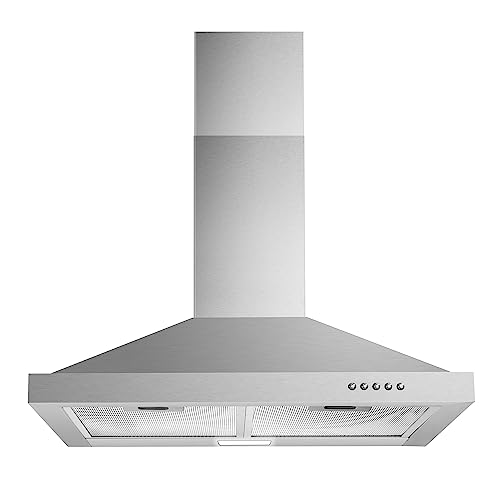
4. Vent-A-Hood Range Hood
A ventilation specialist whose hoods are known for a different blower design. It targets homeowners who care about grease capture and long service life. It is built around a distinctive blower approach, so read the maker’s notes on installation.
Suits: heavy cooking. Strengths: a ventilation-focused brand. Weaknesses: installation planning is needed. Skip it if you want the simplest option.

Best for larger ranges
5. Proline Wall Mount Range Hood
A brand known for pro-style hoods in a range of sizes and finishes. It can be a good match when you want a larger hood for a wide gas range. Size and finish choices are a strength, though lead times can differ.
Suits: larger ranges. Strengths: size and finish choices. Weaknesses: check lead times. Skip it if you want an off-the-shelf look.
View Proline Wall Mount Range Hood on Amazon

Best for matching sets
6. Thor Kitchen Wall Mount Range Hood
A stainless hood from a brand that also sells pro-style ranges. It is a natural pairing when you want a matching look above a Thor stove. Check which models are offered in the width you need.
Suits: matching sets. Strengths: a coordinated appearance. Weaknesses: check airflow figures. Skip it if you use another stove brand.

Care and Setup
- Wash grease filters on a regular schedule.
- Wipe the hood body with a cleaner made for stainless steel.
- Check the damper in the duct for sticking.
- Run the fan before you start cooking and a few minutes after.
- Keep the area around the hood free of stored items.
Mistakes to Avoid
- Choosing a hood narrower than the cooktop.
- Using a long duct with many bends.
- Relying on recirculating filters for heavy frying.
- Ignoring makeup air needs for very strong fans.
Matching Airflow to Your Burners
Hood airflow is usually listed in cubic feet per minute, or CFM, and the right number depends on what is underneath it. A common rule of thumb is to add up the heat output of all burners, expressed in BTU, and divide by a set figure to get a starting CFM target. Different guides use different divisors, and some local codes set their own thresholds, so treat any rule as a starting point and check your local requirements and the stove’s manual.
Think about how you cook as well. A household that mostly simmers and boils needs less capture than one that sears, stir-fries in a wok or fries often. A wide range with powerful front and rear burners throws more heat and fumes into the room than a basic four-burner stove, and a hood sized for the basic stove may fall short.
- List your burner outputs from the stove’s manual or rating label.
- Decide whether you cook with high heat and lots of oil, or mostly gentle methods.
- Compare the hood’s listed maximum airflow, but remember that real-world performance drops with long duct runs and bends.
- Check the sone rating, since a fan that is too loud on its top speed often goes unused.
More airflow is not automatically better. Very strong hoods can pull more air out of the house than the home can easily replace, which leads to the makeup air question covered below. Aim for a hood that comfortably handles your heaviest cooking rather than the biggest number on the page.
Duct Size and Routing Checks
A powerful fan cannot make up for a restricted duct. Every hood expects a specific duct diameter, which is listed on the product page or in the installation manual, and a smaller duct can choke the fan and raises the noise. Round ducts are typical, though some hoods use rectangular transitions, so confirm what the model needs.
The shorter and straighter the run to the outside, the better the hood performs. Each elbow adds resistance, and a long run with several bends can noticeably reduce the airflow you actually get. Smooth metal duct is generally preferred over flexible, ribbed duct because ribbed material creates turbulence and collects grease. Check the manual for the maximum equivalent duct length the maker allows.
- Decide early whether the hood will vent up through the ceiling, through the roof or out the back wall.
- Look at what is behind the wall: studs, wiring and plumbing can all limit the route.
- Confirm that the exterior cap has a damper and a screen suited to your climate.
- Seal the joints as the manual directs.
If a clear route to the outside is not possible, some hoods can be set up to recirculate, but recirculating filters do not remove combustion byproducts or moisture in the same way, so check the product listing carefully before relying on it for gas cooking.
Mounting Height and Clearances
The distance between the cooktop and the bottom of the hood affects both safety and performance. Too low and the hood can get uncomfortably hot, block your view or conflict with fire safety clearances. Too high and the hood loses its ability to capture smoke and steam before it spreads. Makers publish a recommended height range for each model, and gas stoves and combustible materials may call for a greater minimum clearance than electric ones, so read the manual and your stove’s installation instructions.
Chimney-style wall hoods also need clear wall space for the chimney cover and enough ceiling height for the duct to rise. Measure the finished ceiling height, not just the wall, and check the length of the chimney sections the hood includes. Some models offer extensions, which are worth considering for tall ceilings.
- Measure from the cooktop surface up, not from the countertop.
- Check that nothing, such as an upper cabinet or a window, interferes with the hood body.
- Make sure there is enough room to lift the hood into place and to reach the duct collar.
- Consider headroom for tall cooks standing at the stove.
Always follow the clearances in the hood and stove manuals over general rules, and ask a qualified installer or your local building office if the numbers conflict.
Makeup Air and Whole-Home Considerations
When a hood exhausts air to the outside, the same volume of air must come back in from somewhere. In older, leaky houses this often happens without anyone noticing. In newer, tightly sealed homes, a strong hood can create negative pressure, which may make doors harder to open, pull drafts through gaps and in some cases interfere with other combustion appliances such as a gas water heater or furnace if they are not sealed-combustion types.
Many building codes require a makeup air system once a hood passes a certain airflow threshold, and thresholds vary by location. That does not mean you should avoid a strong hood, only that you should ask about the rules in your area before buying. A makeup air damper or a dedicated intake duct is usually a job for a qualified contractor.
- Check local code for the airflow level that triggers makeup air.
- Ask whether the hood has a variable-speed fan, so you can run it lower for light cooking.
- If you notice backdrafting or odors from other appliances while the hood is running, stop and have the system checked.
- Crack a window when running a strong hood on high if the manual suggests it.
It is also sensible to install a carbon monoxide alarm near sleeping areas in any home with gas appliances, and to keep it maintained.
Filters, Lighting and Controls
Day-to-day experience with a hood comes down to how easy it is to clean and operate. Baffle filters are usually made of stainless steel or aluminum and are designed to be washed, often in the dishwasher if the maker allows it. Mesh filters also wash clean but can clog faster under heavy frying. Charcoal filters only apply to recirculating setups and are replaced rather than washed.
Look at how the filters release. Tool-free latches make cleaning a quick task, while hard-to-reach filters tend to be neglected. Grease buildup reduces airflow and can become a fire hazard, so a hood that is easy to maintain is a safer one.
- Lighting: LED lights use little power and last a long time, but check whether the bulbs are replaceable or integrated.
- Controls: push buttons are simple and durable, while touch panels look neat but can be harder to use with greasy hands.
- Speed range: a low speed that is quiet enough to run during meals is more useful than a very high top speed.
- Delay-off or timer: useful for clearing the last of the steam after cooking.
Check the listing for what is included, since some models leave out the duct, the damper or the exterior cap, and plan to purchase those separately if needed.
Why Gas Cooking Calls for Good Airflow
Gas stoves produce heat, moisture and combustion byproducts in addition to cooking smoke and steam. A range hood that is properly chosen and used helps carry cooking fumes away from your kitchen. Airflow strength is measured in CFM, or cubic feet per minute, and the right figure depends on your stove size and cooking habits. Larger and more powerful burners, as well as frequent high-heat cooking, call for stronger airflow.
| Cooking habit | What to look for |
|---|---|
| Light everyday cooking | Moderate airflow and quiet operation |
| Frequent frying and searing | Higher airflow and a deep hood |
| High-output gas range | Strong airflow matched to burner output |
| Open-plan kitchen | Strong airflow with sound control |
Ducted or Recirculating
A ducted hood sends air outside through a duct, which removes moisture, heat and fumes from your home. A recirculating hood filters the air and returns it to the kitchen, which can help with grease and odors but does not take out moisture or heat. Many gas range owners and building guidance prefer ducted systems where possible. Ask a qualified contractor or your local building authority about requirements for ventilation and makeup air.
- Check the duct size and the route to the outside.
- Look at whether the hood includes a damper to stop backdraft.
- Consider noise ratings, listed in sones.
- Confirm the width is at least as wide as the stove, as the maker recommends.
More on Mounting Height and Clearances
The distance between the stove and the hood affects both performance and safety. Follow the manufacturer’s instructions about the minimum and maximum mounting height, and local codes. A hood that is too far from the burners captures less smoke, while one that is too close may be a hazard. Installation involves electrical wiring and ducting, so hire a licensed professional if you are unsure.
Filters, Lights and Controls
Baffle and mesh filters trap grease and can usually be washed according to the manual. Clean filters regularly, since grease buildup reduces airflow and creates a fire risk. Lights illuminate the cooktop, and LED options use less energy. Fan speeds, timers and delay-off features add convenience.
Use Habits That Help
Turn the hood on before you begin cooking and leave it running for a few minutes afterward. Use the back burners when possible, since hoods capture them well, and keep a window slightly open if the maker or code suggests makeup air.
Pre-Purchase Checklist for a Gas Stove Hood
A range hood is tied to your kitchen layout, so a few measurements and questions up front prevent returns and delays.
- Measure the width of your cooktop and compare it with the hood width the maker recommends.
- Note the ceiling height and the space between the cooktop and the underside of the hood.
- Find where the duct would leave the wall or roof, and how long and bendy the run would be.
- Check that the wall can support the weight of the unit, with studs or backing in the right place.
- Look at the controls and decide whether you want buttons, a dial or a touch panel.
- Think about noise at the speeds you will use most.
When to Call a Professional
Hoods that sit above gas appliances touch several regulated areas. The table below shows a sensible split between do-it-yourself and expert help.
| Task | Suggested approach |
|---|---|
| Wiping filters and surfaces | You, following the care notes |
| Replacing light bulbs | You, with power off and the bulb type from the manual |
| Mounting a heavy hood on the wall | An experienced installer, for safe fixing |
| Cutting a duct hole or running ducting | A qualified contractor, who knows local rules |
| Wiring the hood or changing gas connections | A licensed electrician or gas fitter |
Follow the maker’s instructions and your local building rules for clearances above a gas cooktop, since these can differ by region.
Daily Habits for Cleaner Air
- Switch the hood on before you begin cooking and leave it running a few minutes after.
- Use the back burners when possible, since the hood captures them more easily.
- Keep a window or door slightly open if the maker or a ventilation professional advises it for makeup air.
- Clean grease from filters on the schedule the manual gives.
Reading the Picks With Fresh Eyes: What Separates One Hood From Another
The hoods in this guide all promise cleaner air, yet they earn that promise in different ways, and the differences only appear when you match the hood to your cooking rather than to a headline number. Start with how you actually cook. A household that mostly simmers, reheats and bakes needs far less extraction than one that sears meat, fries fish or uses a wok several nights a week. Be honest about that pattern, because a hood chosen for imaginary cooking will be either wastefully oversized or quietly inadequate.
Next, look at capture, which is about geometry as much as power. A hood that covers the front burners, sits at the height the maker specifies and gives steam a shaped path upward will clear a kitchen better than a stronger fan mounted too high or too far back. Steam rises and spreads as it climbs, so width, depth and mounting position decide how much of it the hood can collect before it escapes into the room. This is why the measuring guidance earlier in this guide matters more than any single figure on a listing.
Finally, judge the hood by the features you will touch daily. Controls you can find by feel, lights that actually illuminate the pans rather than the wall, and filters you can remove without a struggle decide whether the hood gets used at full strength or left off because it is a nuisance. A hood that is slightly less powerful but pleasant to use will keep a kitchen cleaner than a stronger model that everyone avoids switching on.
A Week of Cooking Under the Hood: Where the Design Shows Itself
On a weeknight, the pattern is simple: the hood should start before the pan gets hot, not after the kitchen has filled with steam. Running it for a short while after cooking finishes clears the moisture and smells that linger in the air and settle on cabinets. Households that build this small habit notice that walls stay cleaner, window condensation drops, and the smell of last night’s dinner stops greeting them at breakfast.
Frying and searing are the real test. Fat leaves a hot pan as a fine mist that coats everything it touches, and once it lands on cabinet tops and light fittings it turns sticky and holds dust. A hood running at a suitable speed from the start captures most of that mist at source. If your kitchen still feels greasy after cooking, the cause is usually late starts, a clogged filter or a hood mounted outside the maker’s recommended height, rather than a simple lack of fan power.
At the weekend, long cooking sessions reveal the comfort side of the design. Simmering stock, reducing sauces and batch cooking fill a home with moisture for hours. Steady, moderate extraction over a long period works better than short blasts at maximum, and it is kinder to conversation and concentration. If your kitchen opens into a living space, this is where a quieter mid-range speed earns its keep far more than a dramatic top speed you rarely use.
Filters, Grease and the Cleaning Rhythm That Keeps a Hood Honest
Every hood slowly loses performance as its filters load with grease, and the change is gradual enough that most people never notice until cooking smells start lingering again. Set a rhythm instead of relying on memory: wipe the outer surfaces while they are still slightly warm after cooking, check the filters on a regular schedule that matches how often you fry, and clean or replace them exactly as the maker directs. A clean filter restores airflow more cheaply than any other fix.
Different filter types ask for different care, and the guide above explains the main ones. What matters most is consistency. A filter washed and fully dried before it goes back will behave as intended; a damp filter refitted in a hurry will not. While the filters are out, wipe the visible interior surfaces and the fan housing area you can safely reach, following the manual’s instructions and with the power off. Grease left inside the body is both a hygiene problem and, over time, a fire risk.
Keep a simple log if your household cooks a lot: the date the filters were cleaned, the date any charcoal filter was replaced, and a note of any new noises. That short record makes troubleshooting far easier, because a hood that suddenly sounds strained after months of heavy frying is usually telling you about buildup, not about a failing motor.
Matching Range Hoods for Gas Stoves to Your Situation
The right choice looks different depending on the household in front of it, and this guide was written for a gas cooktop that produces strong heat, steam and cooking fumes every day. Use the situations below to find the one closest to your own life, then read the picks again through that lens. The differences between models that look minor in a list become obvious once they are measured against a real routine.
For the keen fryer and searing cook
Frequent frying fills a kitchen with grease mist, so prioritise capture coverage, a suitable top speed and filters you can clean without a struggle. Start the hood before the oil heats, and judge each pick by how pleasant it is to run at the speed your cooking actually needs.
For the open-plan household
Where the kitchen shares air with the living space, noise at normal speeds matters as much as power. Compare how each pick is described at its working speeds, plan to run it steadily rather than in blasts, and remember that a hood you can talk over is a hood that stays on.
For the simmer-and-batch cook
Long, gentle cooking produces hours of steam rather than dramatic smoke. Steady moderate extraction, good lighting for monitoring pots, and controls that are easy to adjust with wet hands matter most. Moisture left to linger condenses on windows and cabinets, so duration of use beats peak power here.
For the small or awkward kitchen
Tight kitchens punish oversized choices. Measure the mounting space, the duct route and the headroom before comparing features, and favour a pick whose size and style fit the room you have. A correctly fitted modest hood outperforms a powerful one mounted in the wrong place.
How the Picks in This Guide Compare, Using Only What This Guide Already Tells You
Rather than adding new claims, the fairest comparison is to lay the descriptions above side by side and read them against your own priorities. Each pick in this guide was summarised with the household it suits, its strengths and its weaknesses. Those three lines, taken together, tell you more than any headline, because they show where the maker and this guide think the compromises sit.
Cosmo Wall Mount Range Hood. As described above, this one suits wide gas cooktops. Its noted strengths are a strong look for its class. Its noted weakness is check duct size needs, so weigh that honestly against your own situation rather than treating it as a footnote. If that weakness touches something you do every day, another pick will serve you better; if it touches something you rarely do, it may not matter at all.
Hauslane Chef Series Wall Mount Hood. As described above, this one suits frequent cooks. Its noted strengths are features aimed at heavy use. Its noted weakness is sizes vary by line, so weigh that honestly against your own situation rather than treating it as a footnote. If that weakness touches something you do every day, another pick will serve you better; if it touches something you rarely do, it may not matter at all.
ZLINE Wall Mount Range Hood. As described above, this one suits pro-style kitchens. Its noted strengths are a sturdy, polished look. Its noted weakness is finish options differ, so weigh that honestly against your own situation rather than treating it as a footnote. If that weakness touches something you do every day, another pick will serve you better; if it touches something you rarely do, it may not matter at all.
Vent-A-Hood Range Hood. As described above, this one suits heavy cooking. Its noted strengths are a ventilation-focused brand. Its noted weakness is installation planning is needed, so weigh that honestly against your own situation rather than treating it as a footnote. If that weakness touches something you do every day, another pick will serve you better; if it touches something you rarely do, it may not matter at all.
Proline Wall Mount Range Hood. As described above, this one suits larger ranges. Its noted strengths are size and finish choices. Its noted weakness is check lead times, so weigh that honestly against your own situation rather than treating it as a footnote. If that weakness touches something you do every day, another pick will serve you better; if it touches something you rarely do, it may not matter at all.
Thor Kitchen Wall Mount Range Hood. As described above, this one suits matching sets. Its noted strengths are a coordinated appearance. Its noted weakness is check airflow figures, so weigh that honestly against your own situation rather than treating it as a footnote. If that weakness touches something you do every day, another pick will serve you better; if it touches something you rarely do, it may not matter at all.
Read across the six in this way and a pattern emerges: there is rarely a single best option, only a best match. Two households can read the same six summaries and correctly choose different products, because their cooking, space, budget habits and patience for maintenance differ. Use the summaries as the makers’ and this guide’s honest positioning, then let your own routine cast the deciding vote.
More Questions Buyers Ask About Range Hoods for Gas Stoves
How do I know if my hood is actually working well?
Cook something steamy and watch the vapour: most of it should bend toward the hood rather than drifting across the ceiling. Check that cooking smells fade reasonably soon after cooking instead of lingering into the next morning, and look at the tops of your cabinets over a few weeks; a growing greasy film suggests capture or filter problems worth investigating before blaming the fan.
Is a more powerful hood always the right answer?
No. Power helps only when the hood can capture the air in the first place, which depends on coverage, mounting height and how the duct run is built. An oversized fan on a poor installation can be noisy, can pull conditioned air out of the home wastefully and may even need makeup air arrangements. Match the hood to your cooking and your ducting, using the maker’s guidance, rather than chasing the largest figure.
What is the most common reason a good hood disappoints?
Late starts and loaded filters. A hood switched on after the kitchen has filled with steam is chasing a problem instead of preventing one, and a grease-laden filter strangles airflow on any model. Start the hood before cooking, let it run briefly afterwards, and keep the filters on a cleaning rhythm matched to how much you fry.
Can I install a hood myself?
It depends on the model, your walls and whether ducting and electrics are already in place. Some straightforward replacements are within a competent homeowner’s ability when the manual is followed exactly, but new duct runs, structural fixings, electrical work and anything involving a gas appliance’s clearances are sensible points to use a professional. When in doubt, the cost of help is small next to a poorly mounted or poorly vented hood.
How should I choose between speeds when cooking?
Use the lowest speed that visibly captures the steam and smoke your cooking is producing. Gentle simmering needs little; frying and searing need more. Running an unnecessarily high speed wastes energy and makes conversation harder, while running too low lets grease escape into the room. Adjust as the cooking changes rather than setting one speed and forgetting it.
When should a hood be replaced rather than repaired?
Consider replacement when the body or fan housing is corroded or grease-damaged beyond cleaning, when the motor fails on an older unit with no available parts, or when a remodel changes the cooking appliance beneath it. If the issue is noise, weak airflow or smells, check filters, duct blockages and mounting first, because those causes are common and far cheaper to fix.
Extra Notes Before You Decide on Range Hoods for Gas Stoves
Think about makeup air before choosing a very powerful hood, especially in a modern, tightly sealed home. A strong fan removes a large volume of air, and that air has to come from somewhere; without a path in, the hood can underperform and can affect other appliances that vent outdoors. Local rules and the maker’s guidance govern what is needed, so raise the question with your installer early rather than after the fan is fitted and disappointing you.
Consider the duct run as part of the product you are buying. Every bend, every metre of length and every rough interior surface steals performance from the fan, so the same hood can behave like two different appliances in two different kitchens. If your duct route is long or awkward, that fact should shape your shortlist more than a small difference in headline airflow between two picks.
Lighting deserves more respect than buyers usually give it. You cook by the light under the hood, judging colour on meat, sauce and vegetables, and poor light makes good cooking harder and cleaning easier to postpone. Compare how each pick lights the cooking surface, whether the light is even across all burners, and how simple it is to maintain when a bulb or module eventually needs attention.
Think about who cleans the kitchen before choosing finishes and shapes. Smooth surfaces with few ledges wipe down quickly, while elaborate shapes collect grease in their details and demand patience. In a household that fries often, the most beautiful hood is the one that still looks clean on an ordinary Tuesday, not the one that photographed best on the day it was installed.
Plan the hood and the cooking appliance as a pair, even if you are only replacing one of them. A change of cooktop, especially to a more powerful gas model, can outgrow an existing hood, and a new hood over an old, weak cooktop may be more capacity than you need. Whenever one half of the pair changes, re-check the other half against your real cooking rather than assuming the old match still holds.
Noise behaves differently in real kitchens from showrooms. Hard floors, bare walls and open-plan layouts amplify sound, while soft furnishings absorb it. Judge any noise description against your own room, and remember that the speed you will use for most cooking matters far more than the loudest setting, which most households use only in short bursts.
Keep a simple ownership record from the day the hood is installed: the model details, the filter type, cleaning dates and any professional work done. That single page turns future troubleshooting from guesswork into comparison, and it is the first thing a technician will wish you had when something changes years later.
A Practical Decision Worksheet Before You Commit
Before you order, work through this short worksheet with a pen. First, write down the width of your cooktop, the height from the cooktop to the cabinet or ceiling, the depth of the space above the stove, and the size and direction of any existing duct, all measured in your kitchen rather than remembered. Second, list the three cooking jobs that fill your kitchen with the most steam, smoke or grease in a normal week. Third, note who will clean the filters and how often they will honestly do it. Those three short lists will eliminate more wrong choices than any amount of browsing, because they describe your kitchen and your habits instead of an imagined household.
Next, score each pick in this guide against the worksheet. Does its style fit the structure you actually have, cabinet or open wall? Does its capture area cover the burners you use most, including the front ones? Does its duct arrangement match your existing route, or will it need work you have not planned for? Are its controls and lights easy to use at the height it will hang? A pick that passes all four questions is your answer, even if another pick looks sleeker in photographs. A pick that fails one question needs a deliberate reason to survive, written down, so the compromise is chosen rather than discovered.
Finally, plan the whole job, not just the purchase. The hood itself is only part of the commitment: duct parts, fixings, possible electrical work and professional help where the installation needs it all belong in the same honest total, and so does the time to do the work without rushing. A hood mounted level, sealed properly and tested at every speed on the day it goes in will quietly do its job for years, while a hurried installation announces itself in rattles, leaks of greasy air and disappointing performance from the very first meal.
Small Frustrations in the First Season, and What They Usually Mean
New hoods teach their owners a few lessons, and most early frustrations have simple causes. If suction seems weaker than expected, check the filters first, then the damper at the wall or roof cap, which can stick or be blocked, and only then question the fan. If a new rattle appears, it is often a loose filter, a duct joint that needs sealing or a fixing that has settled, rather than a failing motor. If cooking smells linger despite good suction, look at when the hood is being started; a fan switched on after the pan is already smoking is chasing steam that has already escaped into the room.
Grease appearing on nearby cabinets usually tells a story about capture rather than power: the hood may be mounted higher than the maker intends, the front burners may be doing work the hood cannot reach, or the filters may be loaded enough to bend the airflow. Work through those causes in order before shopping for a stronger model. And if the lights feel dim or harsh, remember that you will judge food by them every evening, so a lighting arrangement that suits your eyes is worth weighing as seriously as any airflow figure when you compare the picks.
Keep a simple note of the installation date, the filter type and the dates you clean or replace filters. Hoods rarely fail without warning; they fade, gradually, as grease builds and parts tire, and a dated record turns that fade into something you can see and correct. Most owners who keep the note find their hood performs like new for far longer, simply because the small jobs happen on schedule instead of after the symptoms arrive.
One last habit separates kitchens that stay clean from kitchens that slowly film over: treat the hood as part of cooking, not as an emergency device for smoke. Switch it on when the first pan goes on the heat, choose the speed that matches the job in front of you, and let it run while you eat if the meal was a greasy one, so the last of the mist is captured rather than settled. Wipe the underside while it is still warm enough for grease to move easily, and glance at the filters whenever you wipe, because that glance is the reminder that keeps the cleaning rhythm honest. A hood used this way disappears into the routine of the kitchen, and that is exactly what good ventilation should do: work so steadily that nobody in the house ever has to think about it.
Gas Stove Range Hood FAQ
How much airflow do I need?
Gas burners with high output call for stronger fans. Check the listing’s airflow rating and match it to your burners and duct size.
Should I vent outdoors?
Yes where possible. Ducting outside removes moisture, heat and combustion byproducts that recirculating filters cannot.
Are wall-mounted hoods better?
They give a taller capture area and a chimney look, but they need open wall space above the stove.
Can I install it myself?
Hoods are heavy and need secure mounting and proper ducting, so consider a qualified installer.
What does CFM mean on a range hood?
CFM stands for cubic feet per minute and describes how much air the fan can move. Real performance is lower when the duct is long, narrow or full of bends, so the listed number is a maximum rather than a promise.
Do gas stoves need a stronger hood than electric ones?
Gas burners produce combustion byproducts and often higher heat output, so many cooks choose a stronger hood and outdoor venting. Check your burner outputs and local code, and follow the stove and hood manuals.
How high should the hood be above the cooktop?
Each hood publishes a recommended height range, and gas stoves may need more clearance than electric ones. Follow the hood and stove manuals, and ask a qualified installer if they differ.
Can I use a recirculating hood with a gas stove?
Some hoods can be set up that way, but recirculating filters do not move moisture or combustion byproducts outdoors. Venting outside is generally the better choice for gas cooking where possible.
Do I need makeup air?
Many codes require it above a certain airflow level, and the threshold depends on your location. Ask your local building office or a contractor, especially if your home is tightly sealed.
How often should I clean the filters?
It depends on how often you cook and how much you fry. Many makers suggest checking them monthly and washing them when they look greasy, so follow the manual for your model.
Why is my hood loud even on a low setting?
Common causes include a duct that is too small, a loose connection, a clogged filter or a damper that is stuck. Check the sone rating on the listing and confirm that the duct matches the size the hood expects.
Is a wider hood better than a narrower one?
A hood at least as wide as the cooktop captures more, and extra width at each side helps with wide pans and wok cooking. Check your wall space and cabinet layout before choosing a size.
The Short Version
For a modern chimney, the Cosmo. For heavy cooks, the Hauslane. For a pro finish, the ZLINE. For a ventilation specialist, the Vent-A-Hood. For custom sizing, the Proline. For a matched set, the Thor Kitchen. Match the hood to your burners, your duct and your wall space. Then compare noise and lighting.

