A camper van kitchen has almost no space, no real ventilation and a limited electrical system. Portable induction cooktops suit that setup because they heat the pan directly, stay cool around the edges and can be stored in a cabinet when you are driving.
The six cooktops below are widely sold plug-in models, from compact single burners to a double unit for two pots. We have not used these products ourselves, so confirm the exact power draw, size and cord details on the current listing before you buy, since a van’s inverter and battery bank set a hard limit on what you can run.
As an Amazon Associate we earn from qualifying purchases. Links below are affiliate links, and they do not change the product information we give.
What to Look For
| Feature | Why it matters |
|---|---|
| Power range | Lower power settings matter in a van, where the inverter may not handle a full-power burner |
| Footprint | A slim body slides into a drawer or under a seat |
| Controls | Simple buttons are easier to use on a moving or uneven surface |
| Pan fit | Only magnetic cookware works, so check your pans before the trip |
| Cooling fan | The fan adds noise, so test it in a small space |
In this guide
Specs at a Glance
| Cooktop | Burners | Best for | Notes |
|---|---|---|---|
| Duxtop 9600LS | One | Daily cooking | Glass top; check the power rating |
| NUWAVE Flex | One | Precise cooking | Fine control; check the listing for details |
| Max Burton 6400 | One | RV and van use | Digital panel; check weight |
| Cuisinart ICT-60 | Two | Larger rigs | Shared power across burners; check ratings |
| Amazon Basics Induction Cooktop | One | Weekend trips | Simple panel; check cord length |
| Secura 9100MC | One | Classic use | Preset levels; check listing for details |
The 6 Best Portable Induction Cooktops for Camper Vans
Top pickBest for everyday van cooking
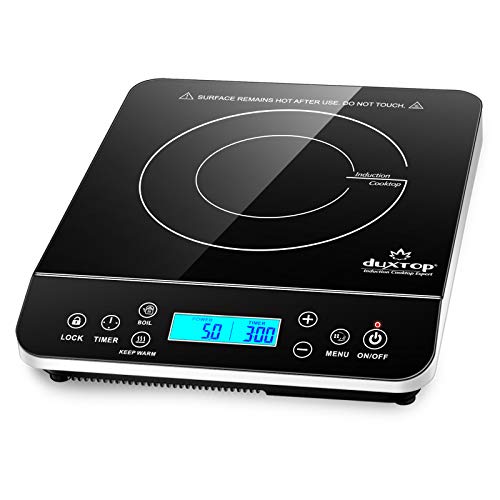
1. Duxtop 9600LS Portable Induction Cooktop
A very popular single-burner countertop unit with a glass top and a digital panel. It offers a range of temperature and power levels, which helps when you cook off a limited supply of power.
Suits: everyday van cooking. Strengths: a wide range of settings and a large following. Weaknesses: it is fairly tall for a tight drawer. Skip it if you need two burners.

Best for careful simmering
2. NUWAVE Flex Precision Induction Cooktop
A single-burner cooktop known for fine temperature control and a flat glass surface with an easy-to-clean look. It is a familiar choice for people who want precise heat.
Suits: careful simmering. Strengths: fine control of heat. Weaknesses: a fan that you can hear in a small space. Skip it if you want a thin mechanical dial.

Best for rV or van cooking
3. Max Burton 6400 Digital Induction Cooktop
A long-sold digital single-burner unit with a stainless-finish edge and a set of heat presets. It is a common pick for RV owners who like a sturdy feel.
Suits: RV or van cooking. Strengths: a sturdy build and preset heat levels. Weaknesses: a heavier body than slimmer units. Skip it if you travel very light.
View Max Burton 6400 on Amazon
Best for bigger vans with strong power
4. Cuisinart ICT-60 Double Induction Cooktop
A two-burner countertop cooktop from a familiar kitchen brand. It lets you boil water on one side while you cook on the other, but it asks more of the power source.
Suits: bigger vans with strong power. Strengths: two burners from a known brand. Weaknesses: a larger body and a greater power need. Skip it if your inverter is small.
View Cuisinart ICT-60 on Amazon

Best for weekend trips
5. Amazon Basics Portable Induction Cooktop
A straightforward single-burner induction plate with a glass surface and plain controls. It is a no-fuss pick when you want a simple, budget-friendly burner for occasional trips.
Suits: weekend trips. Strengths: plain controls and a simple look. Weaknesses: fewer finer features than premium units. Skip it if you want deep temperature control.
Best for boil-and-simmer cooking
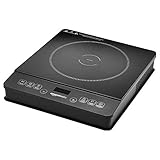
6. Secura 9100MC Portable Induction Cooktop
A long-standing single-burner induction cooktop with a glass top and quick preset levels. It was a go-to model for years and is still widely recognized.
Suits: boil-and-simmer cooking. Strengths: a proven design. Weaknesses: an older style panel. Skip it if you want a modern touch screen.
Care and Setup
- Use the lowest setting that works so you do not overload a van inverter.
- Wipe the glass only after it cools and with a soft cloth.
- Store the cooktop in a padded spot so the glass is not hit on rough roads.
- Keep the vents clear of crumbs and cloth.
Mistakes to Avoid
- Plugging a high-power burner into an undersized inverter.
- Bringing pots that are not magnetic.
- Placing the cooktop on a surface that is not level.
- Leaving the unit exposed to spills or steam in storage.
Doing the Power Math for Your Van
Induction is efficient, but it is not low power. A single burner can ask for a large share of what a typical van electrical system can deliver, so the first job is to work out what your system can actually supply. Start with the inverter, which converts battery power to household-style current. Its continuous rating is the limit that matters, not the short peak figure. Then look at the battery bank, which has to supply that power for the length of your cooking session.
The basic relationship is simple: power in watts equals volts times amps. A cooktop that draws a certain wattage from the inverter draws a much larger current from the battery side, because battery voltage is lower. That heavy current needs properly sized cables, fuses and connections. If your wiring was designed for lights and chargers, check with a qualified installer before running a high-draw appliance.
Look at the cooktop listing for its maximum wattage and the lower power levels. Many cooktops offer settings that draw less, and these are your friend. Cooking at a medium or low level for a longer time can fit within a smaller inverter. Two burners may share a total power limit, so using both at once may reduce each burner’s output. Check the listing and the manual.
Consider the battery’s capacity and your usual cooking time. Boiling a pot of water for coffee uses less than a long simmer. If you have solar or driving charge, plan cooking when the system is topped up. If your system is small, use the cooktop for short tasks and combine it with other methods, such as a kettle or a thermal cooker for slow dishes. Always follow your electrical system’s ratings and consult a qualified person when in doubt.
Cookware That Works and Cookware That Does Not
Induction heats the pan itself using a magnetic field, so the cookware must be magnetic. Cast iron and many stainless steel pans work. Aluminum, copper and glass do not unless they have a magnetic layer built into the base. The simple test is to hold a magnet to the bottom of the pan. If it sticks firmly, the pan will probably heat. Many induction-ready pans are labeled with a coil symbol.
Size and shape matter. A pan that is much smaller than the cooking zone may not be detected, and one that is much larger will heat unevenly. Flat, smooth bases make better contact with the glass, which improves heating and sensing. Warped pans rock and heat poorly. In a moving van, a pan with a stable base is also safer.
Think about weight and storage. Cast iron is heavy and takes space, while thin stainless pans are lighter but may heat unevenly. A pan with a thick base spreads heat better and is less likely to scorch food. Nesting sets save space but check that they are induction-compatible.
Consider the cooktop’s safety features. Most induction units will not heat without a suitable pan, which is a plus in a small space. Some have a minimum pan detection that shuts off after a short time without cookware. Be mindful of the pan’s handle, which can get hot from the pan itself. Use potholders. Do not place metal utensils, foil or cutlery on the hot surface, as they can heat up. Keep cards, phones and other magnetic items away from the glass.
Securing the Cooktop and Managing Vibration
A van moves, so anything loose can become a hazard. Decide where the cooktop will be used and where it will live while you drive. For use, you want a firm, level, heat-tolerant surface with a few inches of space around the unit so the fan can breathe. A fold-down table, a slide-out board or a counter section works. Avoid soft surfaces and anything that traps heat underneath.
Never cook with the vehicle in motion. Even a small shift can spill hot liquid. Park on level ground and use stabilizing measures if needed. A non-slip mat under the cooktop helps prevent sliding, and a pan with a lid reduces the risk of spills. Keep the cord short and routed so it does not catch on hands or hang over the edge.
For travel, store the cooktop where it will not bang around. Glass surfaces can crack if hit, so wrap or pad the unit and secure it with straps or a fitted compartment. A drawer with foam lining or a bag with padded walls works. Keep it away from moisture, and dry the unit and cord before putting them away.
Check how the cooktop handles cords and plugs. A tight bend can damage the cord, so coil it loosely. Make sure the plug fits your outlet and that the connection is secure. If you use a power strip, check its rating, because high-draw appliances may overload a cheap one.
Ventilation, Condensation and Fan Noise
Induction cooks without a flame, so there are no combustion gases, which is a major advantage in a small sealed space. It still produces steam, grease and cooking smells, and a van has little air to absorb them. Moisture condenses on cold windows and walls, which leads to damp surfaces and eventually mold if ignored. Open a vent, crack a window or use a roof fan when cooking, and wipe condensation afterward.
Use lids to keep steam in the pan and reduce condensation. Choose cooking methods that produce less steam and grease, such as simmering with a lid or using a pressure cooker or a thermal pot where it suits your system. Frying produces smoke and odors, so ventilate well. A fan above the cooking area helps pull steam out, but check that it is rated for the use.
The cooktop has a cooling fan that runs while it is on and often for a while after. In a small van, that sound can be noticeable. If noise matters, ask about the fan on the listing, and consider running the unit at lower power. Make sure the vents are not blocked by cloth, paper or a tight enclosure, because poor airflow can trigger overheating protection.
Keep the cooktop clean. Spills on the glass can burn on, and crumbs can enter the vents. Let the glass cool before wiping it with a soft cloth and a cleaner suitable for glass-ceramic surfaces. Never spray liquid directly into vents.
Maintenance, Troubleshooting and Replacement
Treat the cooktop like any electronic device that lives in a harsh environment. Vans see vibration, temperature swings and humidity. Wipe the glass after each use, check the vents for dust and crumbs, and inspect the cord and plug for wear. Do not let liquids seep into the unit. If something spills, switch it off, unplug it and let it dry fully.
If the cooktop beeps, shows an error or shuts off, check the basics first. Is the pan induction compatible and centered? Is the pan too small, too hot or empty? Is the unit overheating because the vents are blocked? Is the inverter shutting down because of overload or low battery voltage? Many apparent faults trace back to the power supply rather than the cooktop. A voltage drop under load can cause erratic behavior, so check battery state and cable condition.
Keep the manual and note the error codes. If you see sparks, smell burning, notice a damaged cord or see cracks in the glass, stop using it. Cracked glass can allow liquid into the electronics.
Signs that you should replace the cooktop include a cracked or chipped glass surface, a fan that no longer runs or is noisy, recurring error codes after the power system has been checked, a damaged cord, and inconsistent heating. Check the warranty terms before discarding it. If your needs change, for example, you add more battery capacity or travel with more people, you may want a different cooktop. Match the next one to the system you have, not the one you plan to build.
Power Planning Before You Buy an Induction Cooktop
Induction is attractive in a camper van because it heats cookware directly and keeps the cabin cooler, but it asks a lot of your electrical system. Many portable units draw significant power, so the first question is what your van can supply. Check your inverter capacity, battery bank, shore power connection and wiring against the wattage on the cooktop label. Lower power settings or a model with adjustable wattage may suit smaller systems. If your setup is not clearly sized for the load, speak with a qualified installer before you plug anything in.
- Read the wattage on the label, not only the listing headline.
- Compare it with your inverter and battery limits.
- Look for adjustable power levels for a smaller system.
- Follow the manual for cords and extension guidance.
Cookware, Fit and Storage in a Small Space
Induction only works with cookware that responds to magnets, so test your pans with a simple magnet before relying on them. Thin pots may heat unevenly, and tiny pans can fail to register. Consider the flat surface you have available, since a hot glass top needs a stable spot with clearance. Slim units are easy to store in a drawer or beside the bed platform.
| Van situation | What to prefer |
|---|---|
| Limited battery | Lower wattage with adjustable levels |
| Occasional shore power | Higher wattage for quick cooking |
| Tiny counter | Slim single burner |
| Rough roads | Easy-to-secure unit with a stable base |
Using It Safely on the Road
Never run a cooktop while driving, keep fabrics and paper away from the surface, and let it cool before packing. Follow the manufacturer instructions for ventilation, cord care and cleaning. For anything involving your van wiring or fixed installation, a licensed electrician is the right person to ask.
Quick Checklist for Van Cooking Gear
Before settling on an induction cooktop, write down the practical limits of your van. Note where the unit will sit, how you will secure it, and where the cord will run. Think about the cookware you already carry, and whether you would need new pans. Consider how many people you cook for and whether one burner is enough or two would help.
- Check the wattage against your power supply.
- Confirm that your pans work with induction.
- Decide where the cooktop will be stored while driving.
- Look for child lock, timer and overheat protection features.
- Read cleaning instructions for the glass surface.
- Keep the manual with your van paperwork.
Pack a heat-safe mat to protect the counter surface, and carry a small fire blanket or extinguisher as your local guidance suggests. Both take little space and make cooking in tight quarters more comfortable.
A little planning prevents the frustration of arriving at a campsite with a unit that your electrical system cannot run.
Matching a Portable Induction Cooktop to Your Pans and Your Cooking
The least glamorous compatibility check decides whether a portable cooktop delights or disappoints: your pans. Induction models need magnetic cookware, so the fridge-magnet test on the base of every pan you actually use is worth five minutes before ordering — a magnet that sticks firmly means the pan will work; one that slides or will not grip means it will not, whatever the listing implies. Single burners also impose a size logic: a very wide pan on a small burner heats unevenly and can overhang onto controls, while tiny pans on some induction units are not detected at all. Match the burner to the pans you reach for daily, not the pans you own in theory.
Think in meals rather than in burners. One burner cooks a full meal happily if the meal is sequenced — grains or pasta first and held, sauce or protein second, vegetables in the same pan while the protein rests. Two burners change the style of cooking more than the volume: sauce and pasta finishing together, a full breakfast without relays. Households upgrading from one burner to two usually say the second burner bought them timing, not capacity, and timing is what makes weeknight cooking feel calm.
Controls You Can Use With Wet Hands
Cooktop controls are operated mid-cooking, with wet, greasy, hurried hands, so their design matters more than their looks. Touch panels are sleek and wipe clean but can ignore damp fingers or respond to a splash; dials are positive and glove-friendly but trap grime. What matters most is resolution at the low end: the difference between a bare simmer and a rolling boil is where sauces live, and cheap controls that jump from off to fierce make delicate cooking a negotiation. If you simmer often — oats, sauces, melting, reheating — judge a cooktop by its lowest settings first.
Daily Care for Glass, Coil and Cast-Iron Surfaces
Wipe the cooktop after every use, once it is safe to touch, because today’s splatter is tomorrow’s baked-on varnish. Glass surfaces want a soft cloth and non-abrasive cleaner; sugar spills deserve immediate attention once the surface cools, since molten sugar bonds to glass as it sets. Coil and cast-iron burners tolerate more abuse but rust if put away damp, so dry them properly and store the unit somewhere air moves. Never immerse a portable cooktop, never hose it down, and keep water away from vents and control panels — the appliance is a kitchen tool, not a boat.
The cable and plug are part of care too. Coils of cable stored tightly kinked, plugs yanked by the cord, and units carried by their lead all fail eventually at the same stressed point. Store the cable loosely, unplug by the plug, and check the cord occasionally for nicks, especially if the cooktop travels. Underneath, keep the fan vents and intake slots free of crumbs and dust; a portable burner that cannot breathe runs hot, cycles oddly and ages fast, and a vacuum and soft brush once a month prevent most of it.
Storage and Travel Habits
Store the cooktop flat, with nothing heavy stacked on a glass surface, and ideally in the bag or box it came in if it moves between locations. In a vehicle or a cupboard it should be wedged against sliding rather than left to surf every corner. If the unit lives on a counter permanently, give it a defined home with the cable managed, because a portable appliance without a home becomes a portable obstacle — moved for every task, resented at every meal, and eventually exiled to a cupboard from which it rarely returns.
Cooking Well on One Burner: Sequencing and Technique
One-burner cooking is a discipline that improves all your cooking. The principles: cook in order of what holds best, use the pan’s residual heat, and let resting time do work. Grains and boiled potatoes hold happily in their lidded pot; sauces improve for resting; proteins want to rest anyway. So the sequence writes itself — starch first, sauce second, protein last and rested while vegetables flash in the same pan — and a complete dinner emerges from one burner in under an hour with one pan washed. Add a kettle for boiling water and a microwave if you have one, and the single burner stops feeling like a limitation at all.
Pan choice amplifies a small burner. A heavy-based pan spreads a small hot spot into even cooking; a lidded pan turns the burner into a small oven for finishing chicken or steaming vegetables over a sauce; a wide pan gives evaporation for reducing and browning, while a deep one contains the splatter of frying in a small room. The portable cooktop rewards the same advice as any serious stove: fewer, better pans, matched to the burner, used in a planned order.
Using a Portable Induction Cooktop in Real Life
Life in a camper van turns a cooktop into infrastructure. Every meal is cooked within arm’s reach of where you sleep, so the virtues that matter are the domestic ones: a surface that wipes clean in seconds, controls that behave at a simmer for morning porridge, and heat that does not fill the van with steam and smell. Induction suits van life particularly well where the electrical system supports it, because the surface itself stays relatively cool, there is no open flame in a fabric-lined space, and the unit stores flat in a drawer or under a seat.
The honest constraint is power, and van cooks plan around it the way sailors plan around weather. Cooking happens when the batteries are full or the hookup is connected; big boils are timed for when the engine has just run or the sun is on the panels; and the menu leans on quick, one-pan food that asks little of the system. None of this is hardship — it is simply the van version of mise en place, and cooks who embrace it eat remarkably well in very small spaces.
Troubleshooting the Everyday Cooktop Frustrations
A short list of complaints accounts for nearly every unhappy portable-cooktop experience, and most have household fixes. The burner cycles on and off at medium settings: that is how many units regulate temperature, and a heavier pan smooths the swings. Water takes ages to boil: check the pan is centred, lidded and matched to the zone, and that the unit is not sharing its circuit with another heavy appliance. The surface marks easily: sugars and boil-overs bake on if left, so wipe spills once the surface is safe, and lift pans rather than sliding them. Controls respond oddly: dry your fingers and the panel, because touch controls and wet hands are natural enemies.
What remains after those fixes is usually a mismatch of expectations — a single portable burner asked to behave like a range cooker. Judged as what it is, a portable cooktop is a precision instrument for one or two pans, and the cooks who love theirs have arranged their habits around that truth: sequenced meals, lids on pans, and a kettle as the silent second burner. The frustration cases are almost always a cooktop being asked, nightly, to be a different appliance than the one that was bought.
When Guests or Big Meals Arrive
A portable cooktop scales socially better than it scales technically. For a crowd, choose food that holds — braises, curries, big salads with one hot element — and let the burner produce a steady centrepiece rather than a dozen à-la-minute items. Cook starches ahead and keep them warm wrapped; grill or fry the protein in batches and rest it; and put cold starters on the table so nobody watches the burner. The cooktop’s limit is real, but a menu designed around it feeds eight people without a single stressful moment, which is more than many full kitchens manage.
Power, Heat and the Physics of a Small Burner
In a van, the cooktop’s draw sits on top of everything else the electrical system is doing — fridge, lights, chargers — and the inverter and battery bank set a hard ceiling that no burner can negotiate with. Portable burners share the power available to them, and a unit plugged into a circuit that is already feeding a kettle or a microwave will make its displeasure known. Learn which sockets in your space are on which circuit if you can, and give the cooktop first claim on its outlet while it works. Heat-up speed is only half the story anyway: a burner that boils fast but cycles coarsely will scorch milk and catch rice, while a slightly slower burner with fine, steady control cooks better food across a whole week of meals.
Residual heat is the other half of burner physics. Glass-ceramic and cast-iron surfaces hold heat after switch-off, which is free cooking for a sauce that needs two more minutes and a burn risk for the hand that forgets. Build the habit of treating a recently used burner as hot until proven otherwise, and teach everyone in the household the same rule. Induction surfaces themselves stay comparatively cool — the pan does the heating — but the pan transfers heat back to the glass, so ‘induction means cold’ is a myth that burns exactly one person per household, once.
Ventilation and Steam in Small Spaces
A portable cooktop in a small room produces the same steam and cooking smells as a full hob, with less extraction to clear them. Crack a window or run whatever fan you have when boiling pasta or searing, both for comfort and because sustained steam is unkind to walls, soft furnishings and the cooktop’s own electronics over time. In rented rooms and dorms, this is also courtesy: cooking smells travel, and a window opened during the boil is a small price for being the neighbour whose dinner nobody else has to smell.
How the Picks Above Compare, Side by Side
Portable cooktops divide by burner type, control style and how they share power, and the reviews above assign each pick a clear role. The comparison below restates those roles — who each model suits, its stated strength and its flagged limitation — so you can match a pick to your pans, your circuit and your cooking style rather than to a feature list.
Duxtop 9600LS Portable Induction Cooktop. In the review above, this pick is matched to everyday van cooking. Its stated strength is a wide range of settings and a large following. The honest limitation flagged there is it is fairly tall for a tight drawer. And the skip condition still applies: skip it if you need two burners. Read in isolation, a strength can sound like a reason to buy; read against the other five picks, it is really a statement about fit. If the situation described matches your own, this is the pick to shortlist first. If the limitation touches something you deal with every day, one of the other picks will serve you better, even if its headline strength sounds less exciting.
NUWAVE Flex Precision Induction Cooktop. In the review above, this pick is matched to careful simmering. Its stated strength is fine control of heat. The honest limitation flagged there is a fan that you can hear in a small space. And the skip condition still applies: skip it if you want a thin mechanical dial. Read in isolation, a strength can sound like a reason to buy; read against the other five picks, it is really a statement about fit. If the situation described matches your own, this is the pick to shortlist first. If the limitation touches something you deal with every day, one of the other picks will serve you better, even if its headline strength sounds less exciting.
Max Burton 6400 Digital Induction Cooktop. In the review above, this pick is matched to RV or van cooking. Its stated strength is a sturdy build and preset heat levels. The honest limitation flagged there is a heavier body than slimmer units. And the skip condition still applies: skip it if you travel very light. Read in isolation, a strength can sound like a reason to buy; read against the other five picks, it is really a statement about fit. If the situation described matches your own, this is the pick to shortlist first. If the limitation touches something you deal with every day, one of the other picks will serve you better, even if its headline strength sounds less exciting.
Cuisinart ICT-60 Double Induction Cooktop. In the review above, this pick is matched to bigger vans with strong power. Its stated strength is two burners from a known brand. The honest limitation flagged there is a larger body and a greater power need. And the skip condition still applies: skip it if your inverter is small. Read in isolation, a strength can sound like a reason to buy; read against the other five picks, it is really a statement about fit. If the situation described matches your own, this is the pick to shortlist first. If the limitation touches something you deal with every day, one of the other picks will serve you better, even if its headline strength sounds less exciting.
Amazon Basics Portable Induction Cooktop. In the review above, this pick is matched to weekend trips. Its stated strength is plain controls and a simple look. The honest limitation flagged there is fewer finer features than premium units. And the skip condition still applies: skip it if you want deep temperature control. Read in isolation, a strength can sound like a reason to buy; read against the other five picks, it is really a statement about fit. If the situation described matches your own, this is the pick to shortlist first. If the limitation touches something you deal with every day, one of the other picks will serve you better, even if its headline strength sounds less exciting.
Secura 9100MC Portable Induction Cooktop. In the review above, this pick is matched to boil-and-simmer cooking. Its stated strength is a proven design. The honest limitation flagged there is an older style panel. And the skip condition still applies: skip it if you want a modern touch screen. Read in isolation, a strength can sound like a reason to buy; read against the other five picks, it is really a statement about fit. If the situation described matches your own, this is the pick to shortlist first. If the limitation touches something you deal with every day, one of the other picks will serve you better, even if its headline strength sounds less exciting.
Keep a folded heat-resistant mat or a wooden board beside the cooktop as a landing zone. Portable burners live on counters that are also prep space, storage and desk, and a defined spot for a hot pan prevents the daily shuffle of moving papers, packets and post out of harm’s way. Small kitchens run on landing zones; the cooktop simply makes the need impossible to ignore.
Camper Van Induction Cooktop FAQ
Do induction cooktops work with a van’s battery system?
Only if the inverter and battery bank can handle the load. Check each cooktop’s power rating against your system, and use low settings to reduce the draw.
Which pans work on an induction cooktop?
Pans with a magnetic base, such as cast iron and many stainless steel pieces. If a magnet sticks to the bottom, the pan should work.
Is a single burner enough for van life?
For most vans, yes. A single burner takes less power and less space, and you can cook in stages.
Can I run an induction cooktop from a small inverter?
Only if the inverter's continuous rating covers the cooktop's power draw, including at the setting you use. Check both ratings and use lower settings, or ask a qualified installer for advice.
What happens if my pan is not induction compatible?
The cooktop will usually not heat or will show an error. Test pans with a magnet, or buy cookware labeled for induction.
Is induction safer than gas in a van?
It has no flame or combustion gases, which removes some risks, but it still gets hot and draws a lot of power. Ventilation and safe handling still matter.
Can I use a portable induction cooktop while driving?
No. Cook only when parked on level ground. Secure the cooktop for travel.
Why does the cooktop shut off while I am cooking?
Common causes include overheating from blocked vents, an unsuitable pan, a voltage drop or an overloaded inverter. Check the pan, the vents and your power supply.
How can I reduce the load on my battery?
Use a lid, preheat with water already warm, choose lower power levels and cook smaller portions. A kettle or a thermal cooker can handle some tasks.
How do I clean a glass cooktop without scratching it?
Let it cool, then wipe with a soft cloth and a mild cleaner made for glass surfaces. Avoid abrasive pads and heavy scraping.
Do I need a special extension cord?
Avoid extension cords when you can. If you must use one, choose a heavy-duty cord rated for the load, keep it short and check that it does not overheat.
Can I cook on induction while driving or with the engine off?
Cook only when parked, level and settled — a pan of hot food in a moving vehicle is a scald waiting for a corner. With the engine off, whether you can cook depends entirely on your leisure battery and inverter capacity, which is a calculation to make with your system’s figures and the cooktop’s stated draw before you rely on it. Many van owners cook mainly on hookup or after a drive has topped the batteries up, and keep a small gas backup for off-grid stretches.
How do I stop pans sliding on a glass cooktop in a van?
Cook when parked and as level as you can get — levelling blocks or a careful pitch choice do most of the work. A thin silicone mat rated for induction use between pan and glass adds grip and protects the surface in transit-adjacent rattling, though you should check it does not interfere with pan detection on your model. In practice, van cooks also favour wide, heavy pans with low centres of gravity, which sit calmly where thin pans wander.
Why does my induction cooktop hum or click?
A gentle hum or buzz from the pan is normal induction behaviour — the magnetic field makes the pan itself vibrate minutely, and lightweight or layered pans sing more than heavy solid ones. Clicking is usually the power cycling at low settings, where the burner pulses to hold a simmer. Both sounds are louder in a quiet small space than in a busy kitchen. If a pan is noisy, a heavier pan often quietens it; if the unit itself rattles or the fan sounds strained, that is worth a service conversation.
Can I use a portable cooktop as my only cooking source?
Plenty of people do, especially in studios, dorms, annexes and vans, and the secret is menu design rather than endurance: one-pot meals, sequenced multi-part dinners, and a supporting cast of kettle, microwave or air fryer where available. What a single burner cannot do is a roast dinner with four pans finishing at once — plan celebrations accordingly, with dishes that hold, and the everyday reality is entirely workable.
What should I do if the cooktop keeps shutting off?
Work through the boring causes first: the pan is not detected or is too small for the burner, the unit has overheated because its vents are blocked or it is cooking in a very hot, still room, or the timer or auto-off has been set unknowingly. Let it cool, check the manual’s error guidance, and try a known-compatible pan on a clear surface. Repeated unexplained shutdowns on a cool, correctly used unit are a warranty conversation, not a personality trait to live with.
How do I stop food catching on the bottom of the pan?
Catching is usually a control problem: portable burners can run fierce at settings that look modest, and thin pans concentrate that heat in one spot. Use a heavier pan, start lower than instinct suggests, stir sauces as they thicken, and remember that sugar, milk and starches catch fastest. Once food has caught, soak the pan rather than scouring — and lower the setting next time before the same dish teaches the same lesson.
The Short Version
For everyday van cooking, the Duxtop 9600LS. For fine heat control, the NUWAVE Flex. For a sturdy build, the Max Burton 6400. For two burners, the Cuisinart ICT-60. For a simple budget-friendly pick, the Amazon Basics. For a proven classic, the Secura 9100MC.
Related Guides
- 6 Best Home Induction Cooktops: Portable and Built-In (2026)
- 6 Best Induction Cooktops for Apartments: Portable (2026)
- 6 Best Portable Cooktops: Induction, Butane and Camp Stoves
- 6 Best Portable Induction Cooktops: Single and Double (2026)
- 6 Best Commercial Induction Cooktops: Portable and Foodservice (2026)