Disclosure: airfryerkitchensupply.com is reader-supported. When you buy through links on our site, we may earn an affiliate commission at no extra cost to you.
Where to buy
Four picks below were verified against Amazon’s catalog data, with their pima or Supima cotton content confirmed from their own listings: the SUTERA Quick Dry Bath Towel, which states 100% pima cotton in a silver-thread waffle weave; the Lands’ End Supima Cotton Towel Set (6 Piece) for a complete matched bathroom; the Lands’ End Supima Cotton Bath Towel (1 Piece) for buying exactly the workhorse towel on its own; and the Lands’ End Supima Cotton Bath Sheet (1 Piece) for the oversized wrap. Two further verified picks widen the guide beyond one maker: the Oversized Waffle Bath Sheet Set (3 Piece, Supima), a quick-dry waffle set from another maker, and the SUTERA Waffle Hand Towels, which state 100% U.S. pima cotton for the small pieces themselves. Check the current price on Amazon for every pick — and read the short Supima explainer in the introduction first, because it decides whether half the towels in this category are even eligible for your shortlist.
Introduction: Pima, Supima, and Why the Label Matters
Shopping for the best pima towels runs into a naming puzzle immediately, so let us solve it before the picks. Pima is a cotton species — Gossypium barbadense — grown for extra-long staple fibers. Longer fibers spin into smoother, stronger yarn, and smoother yarn weaves into towels that feel silkier, shed less lint, resist pilling, and keep absorbing after years of washing instead of going scratchy and thin. That is the entire pima value proposition, and it is real. Supima is not a different cotton: it is the trademarked, licensed name for pima cotton grown in the United States, traceable through a licensed supply chain. Every Supima towel is a pima towel; not every pima towel is Supima, because pima is also grown in Peru, Israel and elsewhere. A buyer who wants American-grown, chain-verified pima should shop the Supima label; a buyer who wants the fiber’s properties at the best value can shop pima wherever it is grown — provided the listing actually commits to a pima percentage.
That proviso shapes this guide. Towel listings love the phrase “pima blend,” which can mean almost any proportion of pima fiber, and love thread-count and GSM numbers borrowed from sheet marketing, which predict far less about a towel than fiber length and weave do. So our verified picks are listings that state their cotton plainly: one that says 100% pima outright, and three from the Lands’ End Supima line, whose listings state 100% cotton terry from the Supima program. Three of the four picks coming from one maker’s line is not favoritism — it is what the verified market looks like when you require the fiber claim in writing — and the field is broadened below by two further verified picks from outside that line. What you get from any of the verified picks is the thing pima does better than ordinary cotton: a towel that still feels like the towel you bought, fifty washes from now.
In this guide
Quick Picks
| Pick | Badge | Why it is here | Link |
|---|---|---|---|
| SUTERA Quick Dry Bath Towel | Best Quick-Dry Pima | 100% pima cotton per its listing; waffle weave with silver threads; oversized format | Check on Amazon |
| Lands’ End Supima Towel Set, 6 Piece | Best Complete Set | Supima (US-grown pima) cotton terry; bath towel, hand towel and washcloth pieces in one set | Check on Amazon |
| Lands’ End Supima Bath Towel, 1 Piece | Best Single Workhorse | The line’s core bath towel sold singly — restock and replacements without buying sets | Check on Amazon |
| Lands’ End Supima Bath Sheet, 1 Piece | Best Oversized Wrap | Supima cotton bath sheet format for full wrap coverage | Check on Amazon |
| Oversized Waffle Bath Sheet Set, 3 Piece, Supima | Best Alternative Set | 100% US-grown Supima cotton stated in its listing; waffle bath sheet plus hand and face towel | Check on Amazon |
| SUTERA Waffle Hand Towels, Silver-Ion Pima Cotton | Best for Guest Baths | 100% U.S. pima cotton stated in its listing; waffle weave, silver-ion threads | Check on Amazon |
Short on time? Buy the Lands’ End set if you are furnishing a bathroom, the SUTERA if your towels never quite dry between uses, and the bath sheet if you are tall or simply like a towel that wraps twice.
How These Picks Were Chosen
The first filter was the fiber claim, in writing. A pick’s listing had to state pima or Supima cotton — ideally with a percentage, as the SUTERA’s “100% Pima Cotton” does — because a towel whose listing will not commit to its fiber is asking you to pay pima prices for an unknown blend. “Pima blend” listings without a stated proportion were excluded from the linked picks. The second filter was format coverage: a set, a single bath towel, a bath sheet, and a quick-dry waffle cover the four ways people actually buy towels, so the guide teaches the category rather than ranking six near-identical terry rectangles. The third filter was maker accountability: the Lands’ End line is a long-running towel program with consistent sizing and piece-by-piece availability, which matters for towels because you will reorder singles over the years and want them to match. The final two picks passed the same written-fiber test from other directions: an alternative maker’s set whose listing states 100% US-grown Supima cotton for every piece, and a hand-towel listing that states 100% U.S. pima cotton for the small pieces themselves — the two claims rival listings most often leave vague.
One more note on the three Lands’ End picks: they are three different products — a six-piece set, a single bath towel, and a single bath sheet — not one product in three colors. Each answers a different buying situation, and each was verified as its own listing. Where a brand’s color variants of the same set appeared in the catalog data, we used one and ignored the rest.
The 6 Best Pima Towels

SUTERA Quick Dry Bath Towel — Best Quick-Dry Pima
The SUTERA attacks the most common towel complaint — the towel that never dries and starts to smell like it — with construction rather than fragrance. Its listing states 100% pima cotton in a waffle weave with silver threads woven in (the listing’s “Silverthread” name), in an oversized bath-sheet format of 60×30 inches per the listing details. Waffle weave is the quick-dry geometry: the recessed grid creates air channels and a huge surface area, so the towel dries between morning and evening uses in a way dense terry loops cannot match, and it packs flat for gym and travel. The silver threads are the maker’s odor-management approach — silver is included in textiles for its antimicrobial properties, and the listing presents the benefit as freshness between washes; we present it the same way, as the maker’s stated design intent rather than a guaranteed outcome, because how fresh a towel stays depends as much on your bathroom’s ventilation as on its threads. It suits small or windowless bathrooms, gym bags, humid climates, and anyone whose towels live on a hook rather than a heated rail. It does not suit the plush-terry traditionalist: waffle feels textured and efficient, not spa-thick, and that trade is the entire point of the design.
Strengths
- 100% pima cotton stated in the listing — the fiber claim in full, not a blend
- Waffle weave dries fast between uses; the quickest-drying pick here
- Oversized 60×30 in format per the listing — bath-sheet coverage that packs flat
Trade-offs
- Waffle texture is not plush terry; spa-thickness seekers should choose the Lands’ End picks
- Silver-thread benefit is the maker’s stated design intent, not a tested guarantee
- Sold as a single towel — furnishing a bathroom means buying multiples
Spec box
- Fiber: 100% pima cotton (as listed)
- Weave: waffle, with silver threads (as listed)
- Size: 60 x 30 in oversized (per listing details)
- Color verified: grey (as listed)
The honest way to think about this towel is as the engineer’s answer to a ventilation problem. If your bathroom dries towels well, terry’s plushness is free; if it does not, terry stays damp, and a damp towel is a towel you wash twice as often and replace twice as soon. The waffle SUTERA breaks that cycle with geometry, and its pima fiber means the quick-drying towel is also the long-lived one — waffle weaves in cheap short-staple cotton go limp and thin, while long-staple pima yarn holds the grid. Wash it without fabric softener, which coats fibers and defeats both absorbency and the weave’s drying speed, and it will be the hardest-working towel you own.
Best for: humid bathrooms, gym and travel, and anyone fighting musty towels / Not suited for: plush terry traditionalists
Check on Amazon — check the current price on Amazon.
Lands’ End Supima Cotton Towel Set, 6 Piece — Best Complete Set
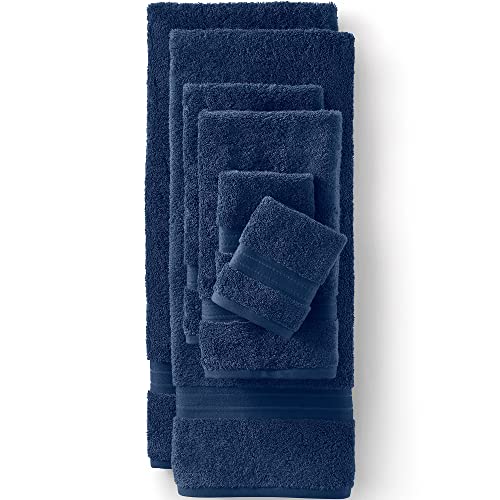
A bathroom refresh usually fails on matching: the bath towels are new, the hand towels are tired, the washcloths are a different white entirely. The set exists to solve that in one purchase, and this one’s listing states the full package — a six-piece set in Supima cotton terry, combed, with a dobby weave detail, spanning bath towel, hand towel and washcloth pieces. Supima is the licensed US-grown pima program, so the fiber story is the strongest documented in this guide: extra-long staple American pima, chain-licensed from grower to finished towel. Combed cotton matters too — combing removes short fibers before spinning, which is why combed towels shed less lint in the first washes and pill less in the fiftieth. The verified set is Deep Sea Navy, a color with a practical virtue: it hides the gradual graying that white towels show and the fading that black towels advertise. It suits anyone furnishing a primary or guest bathroom in one decision. It does not suit buyers who need only bath towels — the single below exists for them — or anyone whose bathroom scheme demands white, though the line sells other colors as separate listings.
Strengths
- Supima cotton: licensed US-grown pima with a documented supply chain
- Six pieces cover bath, hand and face in one matched purchase
- Combed terry with dobby detail per the listing — less lint, less pilling
Trade-offs
- A set commits you to one color and one line for the whole bathroom
- Terry dries slower than the SUTERA’s waffle in a damp bathroom
- Piece counts in sets vary by listing configuration — confirm the six pieces match your needs before ordering
Spec box
- Fiber: Supima cotton (US-grown pima), 100% cotton terry (as listed)
- Set: 6 pieces — bath towel, hand towel, washcloth pieces (as listed)
- Weave: combed terry, dobby detail (as listed)
- Color verified: Deep Sea Navy (as listed)
The set is also the economically literate way to buy pima. Towels are a system: they rotate through the wash together, age together, and get replaced together, and a matched set bought once ages more gracefully than a decade of singles in almost-matching whites. The Supima premium buys the two things that decide whether a set survives that decade — fiber length (absorbency and softness that persist) and combing (a surface that stays smooth). Buy the set, wash everything before first use to clear the factory finish that repels water, and skip the fabric softener from day one; a pima set cared for that way is the closest thing towels have to a ten-year purchase.
Best for: furnishing a bathroom in one matched, long-lived purchase / Not suited for: single-towel restocks or white-only schemes in this listing
Check on Amazon — check the current price on Amazon.

Lands’ End Supima Cotton Bath Towel, 1 Piece — Best Single Workhorse
Not every towel purchase is a renovation. Sometimes the bath towels are fine except for the one that met bleach, the one that went to college, and the one that has been a dog towel since 2021. The single bath towel from the same Supima line — its listing states a one-piece bath towel in 100% cotton terry, combed, with the line’s dobby weave — is the restock pick: the core towel, sold alone, in the verified listing’s white. Its value is boring in the best way: same fiber, same construction and same sizing as the set, so a single bought this year disappears into a rotation bought three years ago. It suits owners of the set who need replacements or extras, and minimalists who buy towels strictly one at a time. It does not suit the buyer furnishing from zero, for whom the set is better value per piece, or the tall wrapper, who should take the bath sheet below.
Strengths
- Supima cotton terry, combed — the set’s fiber and build, sold singly
- Exact restocks: replacements match the rotation you already own
- White, per the verified listing — the bleach-tolerant, always-available classic
Trade-offs
- Per-piece price of singles exceeds the set’s per-piece price, as singles always do
- Standard bath towel size will not satisfy bath-sheet people
- White shows every year of its age honestly — there is no hiding a tired white towel
Spec box
- Fiber: Supima cotton, 100% cotton terry (as listed)
- Piece: bath towel, 1 piece (as listed)
- Weave: combed terry, dobby detail (as listed)
- Color verified: white (as listed)
There is a small philosophy in this pick: towels are consumables with a long fuse, and the cheapest towel strategy is a consistent line you can replenish forever. Every household that has ever owned five brands of bath towel knows the alternative — a linen closet of singles that match nothing, stack badly, and get replaced in panicked sets anyway. Pick a documented pima line, buy the singles as life happens, and the problem never compounds. That is the entire argument, and it is enough.
Best for: restocking and building a consistent towel rotation one piece at a time / Not suited for: furnishing a whole bathroom at once
Check on Amazon — check the current price on Amazon.

Lands’ End Supima Cotton Bath Sheet, 1 Piece — Best Oversized Wrap
The bath sheet is the towel for people who have always suspected bath towels are slightly too small — because for anyone tall, broad, or simply fond of a full wrap, they are. This listing states a one-piece bath sheet in the line’s Supima cotton, in Bering Sea Blue as verified. The format difference is pure geometry: a bath sheet’s extra inches in both dimensions mean the towel overlaps itself around the body, stays up without being clutched, and covers from shoulder to knee in one wrap. In pima terry, that geometry comes with the fiber’s absorbency, so the sheet dries as it wraps rather than merely covering. It suits tall bathers, anyone who uses a towel as a post-shower robe substitute, and households where one luxurious towel per person beats a stack of ordinary ones. It does not suit small bathrooms with limited drying space — a bath sheet is a lot of wet terry for one hook — children, for whom it is a blanket with ambitions, or gym bags.
Strengths
- Bath sheet format in Supima cotton: full wrap coverage with pima absorbency
- One-piece purchase — buy the luxury format without a set commitment
- Same line as the set and single: consistent fiber, weave and care
Trade-offs
- Needs real drying space; a crowded hook rail will keep it damp
- Heavier wash loads — a sheet is roughly a towel and a half of laundry
- Oversized for children and for travel
Spec box
- Fiber: Supima cotton (as listed)
- Piece: bath sheet, 1 piece (as listed)
- Color verified: Bering Sea Blue (as listed)
The bath sheet is where pima’s virtues become physical. A short-staple bath sheet is a burden — heavy when wet, slow to dry, quick to go rough. A long-staple pima sheet absorbs more per square inch, so the format’s size becomes comfort rather than chore, and the fiber’s smoothness is what you feel across the largest contact area any towel offers. If you have never owned one, this is the pick in the guide most likely to change a daily habit permanently; if you have, you already know, and you are only here to check that it is pima. It is — Supima, documented in the listing.
Best for: tall bathers and full-wrap devotees / Not suited for: small bathrooms, children, or travel
Check on Amazon — check the current price on Amazon.

Oversized Waffle Bath Sheet Set, 3 Piece, Supima — Best Alternative Set
The rival set this guide needed, and its listing makes the claim the right way: 100% US-grown Supima cotton — the licensed, traceable form of pima — across a three-piece waffle set built around an oversized 38 x 67 inch bath sheet, with a hand towel and a face towel in the same fiber. That last point is the one to underline: the known set trick is pima bath towels over ordinary-cotton small pieces, and this listing states the Supima content for the set as a whole, small pieces included. The waffle weave is the second differentiator: against the Lands’ End set’s plush terry, this is the quick-drying, lighter-handling alternative for humid bathrooms and smaller linen closets.
Strengths
- 100% US-grown Supima cotton stated in the listing, covering the set’s pieces
- Oversized 38 x 67 inch bath sheet — true wrap format, with matching hand and face towels
- Waffle weave dries faster and stores slimmer than terry of the same coverage
Trade-offs
- Waffle’s hand feel is textured, not plush — terry devotees should stay with the Lands’ End set
- Three pieces furnish one bather, not a whole bathroom — furnishing a family bath means multiples
- An unbranded listing: long-term restock consistency is less assured than an established line’s
- Fiber: 100% US-grown Supima cotton (as listed)
- Pieces: bath sheet 38 x 67 in, hand towel, face towel (as listed)
- Weave: waffle, quick-dry positioning (as listed)
- Color verified: Cinder Grey (as listed)
Shop it against the Lands’ End set on the honest axes: weave (waffle versus terry), format (one bather’s oversized set versus a six-piece bathroom set), and restock (an established line’s singles versus a listing you should screenshot for its specs). On fiber documentation — the test this entire guide is built on — it passes outright, which is more than most rival ‘pima’ sets can say: our catalog searches for this guide surfaced page after page of Turkish and generic cotton sets that never claim pima at all.
Best for: buyers who want a documented second option, and quick-dry waffle devotees / Not suited for: furnishing a whole family bathroom in one purchase
Check on Amazon — check the current price on Amazon.

SUTERA Waffle Hand Towels, Silver-Ion Pima Cotton — Best for Guest Baths
The small-pieces pick, from the same maker as this guide’s quick-dry bath towel — and the listing states the fiber for the small pieces themselves, which is exactly the claim this slot exists to test: 100% U.S. pima cotton, in a quick-drying waffle weave, with silver-ion threads woven in (the same silver-thread approach as the SUTERA bath towel at pick 1, presented here as the maker’s stated design, not as a verified hygiene outcome). Hand towels live the hardest life in the bathroom — washed more often than any other textile in the house, hung damp between uses — and long-staple pima’s resistance to pilling and fraying is worth the most exactly here, while the waffle weave answers the damp-hang problem by drying between uses instead of staying wet.
Strengths
- 100% U.S. pima cotton stated for the hand towels themselves — not inherited from a sibling bath towel
- Waffle weave dries fast between uses, the hand towel’s defining practical problem
- Coordinates with the SUTERA bath towel at pick 1 for a matched quick-dry bathroom
Trade-offs
- Hand towels only in this listing — washcloth buyers should take the small pieces of the sets above
- Waffle texture, again, is not terry plush
- The maker’s freshness framing for the silver threads is a design claim, not a measured outcome
- Fiber: 100% U.S. pima cotton (as listed)
- Weave: waffle, quick-dry (as listed)
- Threads: silver-ion (as listed)
- Color verified: Grey (as listed)
For guest baths specifically, this is the practical summit of the category: a hand towel that documents its fiber, dries before the next guest, and survives the wash frequency that destroys short-staple hand towels within a couple of years. Pair it with the bath sheet set above or the Lands’ End set for the full guest-bath arrangement, and keep one plain truth in view — washcloths in any fiber are semi-consumable and rotate out first; it is the hand towel where pima’s longevity actually compounds.
Best for: guest bathrooms and hand-towel-heavy households / Not suited for: buyers who need washcloths in the same purchase — take a set’s small pieces instead
Check on Amazon — check the current price on Amazon.
Comparison Table
| Pick | Badge | Key spec (as listed) | Best for |
|---|---|---|---|
| SUTERA Quick Dry Bath Towel | Best Quick-Dry Pima | 100% pima, waffle weave, silver threads, 60×30 | Humid bathrooms, gym, travel |
| Lands’ End Supima Set, 6 Piece | Best Complete Set | Supima cotton terry, combed, dobby | Whole-bathroom furnishing |
| Lands’ End Supima Bath Towel | Best Single Workhorse | Supima terry, 1 piece, white | Restocks, minimalists |
| Lands’ End Supima Bath Sheet | Best Oversized Wrap | Supima cotton, bath sheet format | Tall bathers, full wrap |
| Oversized Waffle Bath Sheet Set, 3 Piece | Best Alternative Set | 100% US-grown Supima, waffle, 38×67 bath sheet + hand + face | Comparison shoppers |
| SUTERA Waffle Hand Towels, Pima | Best for Guest Baths | 100% U.S. pima, waffle weave, silver-ion threads | Guest baths |
How to Choose Pima Towels
Verify the fiber before anything else. Look for a stated percentage — “100% pima” or a named program like Supima — in the listing itself. “Pima blend,” “pima-rich” and “with pima cotton” without a figure are marketing grades of honesty, and the towel will perform like its majority fiber, whatever that is. This single check eliminates most of the category’s disappointment.
Understand what Supima adds. Supima is pima cotton grown in the United States under a licensing program that tracks the fiber through the supply chain. The cotton species is the same; what you are paying for is origin and traceability, plus the consistency of the mills that work under the license. If those matter to you, the Lands’ End picks are your verified route. If only the fiber’s performance matters, a documented 100% pima from any origin — like the SUTERA — delivers the same long-staple physics.
Choose the weave for your bathroom, not your fantasy bathroom. Terry loops maximize absorbency and plushness and dry slowest. Waffle maximizes drying speed and packability and feels textured rather than plush. A steamy, windowless bathroom makes waffle the rational choice even for terry lovers; a bright, ventilated bathroom lets terry be itself. The towel that dries is the towel that stays fresh, and freshness is most of what people are actually buying.
Ignore thread count; respect weight and combing. Thread count is a sheet metric that towel marketing borrowed; it predicts almost nothing about a looped fabric. What predicts substance is the towel’s weight for its size (heavier terry generally means more cotton per towel) and whether the cotton is combed — combing strips short fibers, cutting lint and pilling. Both verified lines in this guide state combed construction or long-staple fiber; when a listing gives you neither a weight nor a fiber length, it is asking to be judged on adjectives.
Buy the system, not the towel. Towels rotate, age and retire as a set. A documented line with sets, singles and sheets — replenishable for years — beats a spectacular one-off towel you can never match again. Decide your line once, then let restocking be a non-event.
Wash before you judge. New towels carry mill finishes that repel water; a towel’s first three washes are not its character. Wash pima before first use, without softener, and judge absorbency from the fourth use onward — that is the towel you actually bought.
The Anatomy of a Towel: Loops, Weight and Edges
A towel is a simple machine, and its three working parts explain most of the price spread in this category. The first part is the loop pile. Terry towels are woven with loops standing off a ground fabric; longer, denser loops mean more cotton surface to hold water, which is why a substantial terry towel feels heavy in the hand and a flimsy one feels like a suggestion. Loop quality is where fiber length earns its money: long-staple pima yarn can be twisted into loops that stay upright and intact for years, while short-staple loops break, mat and pill — the scratchy gray roughness of an old cheap towel is literally its loops dying. The second part is weight, usually expressed as GSM (grams per square meter) when sellers state it at all. Higher GSM terry is plusher and more absorbent per towel and slower to dry; lower GSM is lighter, faster and thinner-feeling. Neither is better in the abstract — the right GSM is the one your bathroom’s drying conditions and your washing machine’s capacity can support, which is why this guide values the waffle alternative as highly as the terry picks: it steps outside the GSM trade entirely. The third part is the edge. Dobby borders and double-stitched hems are not decoration; the hem is where towels fail, and a line that finishes its edges properly — as the verified Lands’ End listings describe with their dobby detailing — is a line whose towels retire from thinning, not from unraveling. When you compare two pima towels, compare them in that order: loops, weight, edges. Fiber first, because it decides how long the other two survive.
Where Pima Grows, and Why Origin Programs Exist
Pima’s home is the Americas — the species was developed from Sea Island and Egyptian-type cottons and named for the Pima people of Arizona, whose agricultural work helped establish it in the American Southwest. Today the premium crop grows in the irrigated valleys of California, Arizona, New Mexico and west Texas, and in coastal Peru, where some of the world’s most prized pima is hand-picked. Origin programs like Supima exist because extra-long staple cotton is a small fraction of world cotton production and commands a price that invites substitution: without a licensed chain of custody, a bale of ordinary cotton can acquire a pima label somewhere between the gin and the loom, and no finished towel can be tested by eye for the difference. The license is the audit trail. For the buyer, the practical meaning is modest but real: a Supima towel’s fiber claim is backed by a program with something to lose, while an unlicensed “100% pima” claim rests on the seller alone — which is why this guide required the claim in the listing’s own words, and why a documented seller like SUTERA, stating 100% pima plainly, can stand in the same guide as the licensed line. Buy the audit trail if it matters to you; buy the stated percentage if it does not; buy neither adjective without one of those two behind it.
How to Wash and Care for Pima Towels
1. Wash new towels separately in warm water before first use to remove mill finishes and loose lint; expect the first two washes to shed — that is short surface fiber leaving, and combed long-staple towels shed least. 2. Never use fabric softener or dryer sheets on towels: the coating that makes them feel slick is the coating that stops them absorbing, and on pima it wastes the fiber you paid for. If towels feel stiff, a cup of white vinegar in the rinse cycle strips residue instead. 3. Wash towels as their own load — zippers, hooks and rough fabrics abrade terry loops. 4. Dry on medium heat or line-dry; chronic high heat cooks cotton fibers brittle over years, and pima’s whole point is years. 5. If a loop snags, snip it flush; never pull, which unzips the weave’s neighbors. 6. Wash bath sheets and bath towels at the same cadence — roughly weekly for bath pieces, twice weekly for hand towels in busy bathrooms — and rotate two sets so no towel is washed to death while its twin rests. 7. Store fully dry, always: a pima towel folded damp will mildew as obediently as any other cotton, and no fiber quality survives storage mildew gracefully.
Setting Up a Towel Rotation That Lasts
The difference between towels that last three years and towels that last eight is rarely the purchase — it is the rotation. A single set of towels washed every three days accumulates washes at a punishing rate, and washing, not use, is what wears cotton out. Two sets in rotation halve the wash frequency per towel and give each towel a rest day to fully dry and recover its loft, which matters more than any detergent choice. The practical household math: per full bathroom, two bath towels per person (one in use, one in wash or reserve), two hand towels per sink per week, and washcloths in a small stack, since they are washed most often and retire first. That is the system the verified picks are shaped for — the six-piece set as the foundation, singles as the replenishment mechanism, the bath sheet as the one deliberate luxury that does not need a twin. Guests change the math temporarily, not structurally: a guest set in a second color of the same line keeps the system coherent and the linen closet honest. Retire towels as a cohort when the signs arrive — thinning folds, fraying hems, absorbency that no vinegar rinse restores — and demote them to the garage and the dog before they leave the house; a pima towel’s second life as a utility cloth is longer than most towels’ first lives.
Common Buying Mistakes
Paying pima prices for an unstated blend. If the percentage is not printed, assume the pima is a garnish. The verified picks here state their fiber in full; hold every other listing to the same standard.
Confusing Supima with a different, better species. Supima is US-grown pima under license — origin and traceability, not a different plant. Buy it for those reasons, which are good ones, rather than for an imagined fiber upgrade over other pima.
Using fabric softener from day one. The fastest way to make a premium towel perform like a cheap one. Softener coats absorbent fibers; skip it permanently, not occasionally.
Judging a towel in the first wash. Mill finish repels water on day one. Three washes in, the towel shows its real absorbency; review it then, return it then if it fails — not before.
Buying terry for a bathroom that cannot dry it. A damp towel is a musty towel, whatever its fiber. Windowless and humid means waffle, and the SUTERA exists in this guide for exactly that room.
Mixing lines and hoping they match. Whites differ, navies differ, terry heights differ. A linen closet of near-matches is the tax on unplanned towel buying; a single documented line avoids it forever.
Overdrying on high heat for years. Cotton’s enemy is not water but heat: a dryer run hot enough to make towels crackle is cooking the fibers a little every week, and even pima’s long staples surrender eventually. Medium heat, removed while just dry, is the setting that lets a premium towel live its full premium lifespan.
Storing towels folded while still damp. It takes one mildewed fold to teach this lesson permanently. A towel that smells musty out of the closet was stored wet, not washed wrong — dry fully, store loosely, and let the linen closet breathe.
Buying by the photograph instead of the dimensions. Towel listings photograph bath sheets and bath towels identically, and “oversized” means nothing across brands. The picks in this guide were chosen with their formats stated — set, single, sheet, waffle — and your shortlist should be too: read the inches, picture the towel against your own height, and only then look at the color.
Final Recommendation
For a whole bathroom, the Lands’ End Supima six-piece set is the anchor purchase — documented US-grown pima, combed terry, every piece matched. Maintain it with the single bath towel as life happens, and graduate to the bath sheet if you are tall or wrap-minded. If your bathroom’s real problem is drying, the SUTERA — 100% pima in a quick-dry waffle — is the smarter towel for your actual room. For a documented alternative to the anchor set, the Supima waffle bath sheet set states 100% US-grown Supima across its pieces, and for the small pieces that live hardest, the SUTERA pima hand towels state their fiber outright. Whatever else you shop beyond this guide, let any listing that will not state its pima percentage excuse itself from your bathroom.
Related guides in this series: Best 800 Gram Towels, Best Anti Odor Bath Towels, Best Bath Towels For Small Bathrooms, Best Bath Towels Hydrocotton, Best Absorbent Gym Towels.
Frequently Asked Questions
What is the difference between pima and Supima cotton?
Species versus source. Pima is the extra-long staple cotton species; Supima is the licensed trademark for pima grown in the United States, tracked through a licensed supply chain. All Supima is pima; pima from Peru or elsewhere is not Supima. The fiber physics — length, smoothness, durability — come from the species; Supima adds origin and traceability.
Are pima towels really more absorbent than regular cotton towels?
Yes, and they stay that way longer. Extra-long staple fibers make smoother, stronger yarn with more absorbent surface and less lint and pilling, so a pima towel absorbs well when new and — unlike short-staple towels that thin and go scratchy — keeps absorbing after years of washing. The advantage is as much about the fiftieth wash as the first.
Why do my new towels barely absorb water?
Mill finishes. New towels are often treated with softeners or finishes that repel water until they are washed out. Wash new towels two or three times — warm water, no fabric softener — before judging them. If a towel still repels water after that, the problem is the towel, not the finish, and the return window is the right tool.
Terry or waffle: which pima towel should I buy?
Terry for plush absorbency in a bathroom that dries towels well; waffle for speed in a bathroom that does not. Waffle’s grid dries between uses, packs flat and suits gym and travel; terry is the spa feel. The SUTERA in this guide is the waffle representative and the Lands’ End picks are terry — choose by your room’s ventilation first and your texture preference second.
How long should pima towels last?
With sane care — no softener, medium drying heat, rotation between sets — a quality pima towel should give several years of daily service before its absorbency or edges retire it, noticeably longer than a short-staple equivalent. The retirement signs are thinning at the fold lines, frayed hems and a surface that stays rough after washing; when one towel in a set goes, its siblings are usually close behind, which is why consistent lines sell singles.
How many towels does one person actually need?
Two bath towels in rotation, minimum — one in use while the other is in the wash or drying fully — plus a hand towel per sink changed twice a week and a small stack of washcloths for face and hands. That rotation is what lets a good towel last: washing is the wear, and halving the wash frequency per towel roughly doubles its useful life in the rotation. Bath sheets follow the same rule if they are your daily towel; as an occasional luxury, one per person is more than enough for most homes.
Do pima towels need special detergent?
No — ordinary detergent, used at normal doses, is right, and the special products are the ones to avoid. Dose honestly, too: doubling detergent does not double cleaning, it doubles the residue your rinse has to remove, and residue is the quiet thief of absorbency in every towel fiber, pima included. Fabric softener and dryer sheets coat the fibers and destroy absorbency; scent boosters leave residue with the same effect. If towels gradually lose absorbency, the cause is almost always product buildup, and a hot wash with a cup of white vinegar in the rinse, followed by one detergent-free hot wash, usually restores them. The fiber does not need protecting from detergent; it needs protecting from coatings.
Can I bleach white pima towels?
Occasionally and gently, yes — whites tolerate an oxygen-based bleach far better than chlorine, which weakens cotton fibers over time and can yellow them. The verified white single in this guide is the bleach-tolerant classic format, but even it will last longer with oxygen bleach used sparingly. Colors, including the set’s navy, should never meet chlorine bleach at all.


