Disclosure: airfryerkitchensupply.com is reader-supported. When you buy through links on our site, we may earn an affiliate commission at no extra cost to you.
Where to buy
Shopping for the paper towel holder where your towels are elevated up? The fastest way to buy any pick in this guide is through Amazon, where stock, delivery and returns are handled in one place. Start with our top recommendation, the STWWO Paper Towel Holder Countertop — Stainless Steel with Anti-Slip Weighted Base (Black) (see its review below), then compare it against the other five picks before you decide. One pick — the raised-base drip-guard type — is presented as unlinked guidance, because we could not confirm a matching live listing for it with the same confidence. Prices move with stock and season, so we never print a fixed price in the article itself — use the check-price links to see the current figure on Amazon.
- STWWO Paper Towel Holder Countertop — Stainless Steel with Anti-Slip Weighted Base (Black) — check price on Amazon
- SMARTAKE Paper Towel Holder Countertop — Spring Arm for Easy Tear, Weighted Base (Silver) — check price on Amazon
- NESAPTO Wooden Paper Towel Holder Countertop — Rustic Farmhouse (Brown) — check price on Amazon
- Raised-Base Stand with Drip Guard — Maximum Elevation Type — check price on Amazon (listed by type; see the review below)
- simplehuman Paper Towel Holder with Spray — 6 oz Refillable Pump, Weighted Base — check price on Amazon
- Koville Carrara Marble Paper Towel Holder Countertop — Genuine Stone — check price on Amazon
The best paper towel holder where your towels are elevated up solves a problem you have probably been tolerating without naming it: a roll that lives flat on the counter drinks the counter. Every splash from the sink, every wiped spill pushed a centimetre too far, every damp cloth set down beside it wicks into the roll’s bottom edge, and the first sheet of the morning tears off sodden and goes in the bin. An elevated holder — a freestanding stand that holds the roll upright on a raised base, clear of the work surface — ends that quiet waste, keeps the roll’s foot dry, and puts a sheet at grabbing height instead of in the puddle zone. That is the whole meaning of this search, and every pick below is a variation on it: the differences are base weight, tearing mechanism, material and what else the stand does while it is up there.
A note on this guide’s links, stated plainly at the start: five of the six picks are verified Amazon listings with buy links, each cross-checked against the catalog before it earned its place. The exception is the raised-base drip-guard type: verification searches for a roll holder with a genuine drip tray returned flat guest-towel trays instead — a different product — so that one pick is published unlinked by type, under this programme’s standing rule that an unverified product receives no purchase link and no invented ASIN. Its review still gives you the exact measurements and listing details that let you vet any holder yourself.
What decides between the six types is your counter’s reality. A dry counter needs only weight. A wet counter needs elevation and a lip. A cook needs an arm that tears one-handed. A styled kitchen needs wood or stone; a cleaning station needs a caddy. Read your kitchen honestly — where the roll will stand, how wet that spot gets, how the towels are actually torn in your house — and the table below narrows to one row very quickly.
In this guide
Quick Picks: The Best Paper Towel Holder Where Your Towels Are Elevated Up at a Glance
Six elevated holders, five of them verified listings with buy links; the raised-base drip-guard pick is presented by type, because no matching listing could be confirmed and this guide does not invent products. The badges divide by the problem each pick solves: weight, tearing, style, wet counters, organisation and stability.
| Pick | Badge | Why it stands out | Link |
|---|---|---|---|
| STWWO Paper Towel Holder Countertop — Stainless Steel with Anti-Slip Weighted Base (Black) | Best Overall Type | The default elevated holder: a heavy base keeps the roll upright, raised and one-hand stable. | Check on Amazon |
| SMARTAKE Paper Towel Holder Countertop — Spring Arm for Easy Tear, Weighted Base (Silver) | Best for One-Handed Tearing | A stand with a spring or ratchet arm that holds the roll while you tear with one hand. | Check on Amazon |
| NESAPTO Wooden Paper Towel Holder Countertop — Rustic Farmhouse (Brown) | Best Style Type | A turned-wood or rustic wood stand that makes the holder a piece of kitchen décor. | Check on Amazon |
| Raised-Base Stand with Drip Guard — Maximum Elevation Type | Best for Wet Counters | A stand whose base lifts the roll highest off the counter, with a raised lip or tray to catch drips. | Listed by type — see review |
| simplehuman Paper Towel Holder with Spray — 6 oz Refillable Pump, Weighted Base | Best for Cleaning Stations | A holder that pairs the elevated roll with storage for a spray bottle — the cleaning caddy format. | Check on Amazon |
| Koville Carrara Marble Paper Towel Holder Countertop — Genuine Stone | Best Stability | A marble or stone base under a metal post: the heaviest, most immovable elevated holder type. | Check on Amazon |
Best Overall — STWWO Paper Towel Holder Countertop — Stainless Steel with Anti-Slip Weighted Base (Black): The standard done right — a vertical stainless stand on a genuinely weighted, anti-slip base, the configuration most kitchens should start from. Check on Amazon
Best for One-Handed Tearing — SMARTAKE Paper Towel Holder Countertop — Spring Arm for Easy Tear, Weighted Base (Silver): The cook’s favourite upgrade: a spring arm that rests against the roll, so a sheet tears one-handed while your other hand holds the pan. Check on Amazon
Best Style Pick — NESAPTO Wooden Paper Towel Holder Countertop — Rustic Farmhouse (Brown): The look-led option: wooden construction, farmhouse character, and the care honesty that wood in a wet zone requires. Check on Amazon
Best for Wet Counters — Raised-Base Stand with Drip Guard — Maximum Elevation Type: Unlinked guidance for the wettest kitchens: maximum elevation — the roll held well clear of the counter on a lipped base that intercepts drips before they reach the bottom sheet. No roll holder with a genuine drip tray could be confirmed at verification time, so this pick is presented by type.
Best for Cleaning Stations — simplehuman Paper Towel Holder with Spray — 6 oz Refillable Pump, Weighted Base: The tidy-minded pick: roll and cleaning spray in one footprint — a built-in refillable spray pump beside the elevated roll, the grab-both cleaning station for counters and bathrooms. Check on Amazon
Best Stability — Koville Carrara Marble Paper Towel Holder Countertop — Genuine Stone: The end of the stability argument: a genuine Carrara marble stone base whose sheer mass makes the holder a fixture — nothing slides, nothing tips, ever. Check on Amazon
How These Picks Were Chosen
Candidates were sought cache-first in the verified catalog data held for this site, then confirmed with fresh verification searches through the site’s catalog connection. Five of the six slots matched real listings that state their construction plainly — weighted stainless, spring-arm, wooden farmhouse, spray-integrated and genuine marble stone. The raised-base drip-guard slot did not: searches aimed at drip trays returned flat guest-towel trays, which hold folded towels rather than a roll, and a multi-pack of reusable cloth paper-towel alternatives in the cache is likewise a different product that was excluded on sight rather than presented as a holder. For that one slot the brief’s rule applies in full: it is not linked, and no ASIN, brand claim or product specification has been invented to fill the space.
The six types were chosen to map the real design space of elevated holders rather than to imitate a product ranking. The axes are the ones that decide ownership: base mass (weighted metal, natural wood weight, stone), tearing assistance (plain post versus tension arm), elevation engineering (standard base versus raised lipped base), material and style (stainless, wood, stone), and added function (the spray caddy). Each review specifies its type by the measurable details a buyer can verify on any listing — stated base weight and diameter, total height against cabinet clearance, stated maximum roll diameter, underside material — because the checklist is the product advice — above all for the one unlinked pick — and a reader armed with it can buy well from any retailer.
One interpretation was fixed before writing and held throughout: ‘elevated up’ in this search means the roll held upright and raised off the counter surface on a freestanding stand. Wall-mounted and under-cabinet holders — which lift a roll horizontally — are a different product family answering a different search, and they are not smuggled into this guide to fill it; the how-to section notes them only as the alternative to consider if counter space, not elevation, turns out to be your real constraint.
The 6 Best Paper Towel Holders That Keep Your Towels Elevated Up, Reviewed in Detail
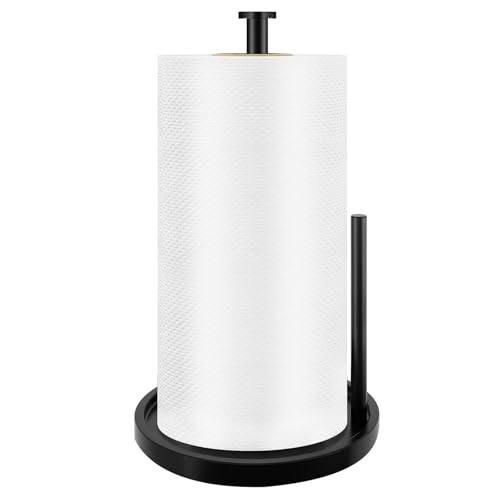
STWWO Paper Towel Holder Countertop — Stainless Steel with Anti-Slip Weighted Base (Black) — Best Overall
This is the type the search describes in its plainest form: a vertical post on a weighted base, standing on the counter, holding the roll upright and elevated off the work surface. The elevation is not a gimmick — the bottom of a roll that sits directly on a kitchen counter wicks up every splash and spill it meets, and a raised base ends that. The weighted base is the specification that separates the good versions from the annoying ones: enough mass in the foot that a one-handed tear pulls a sheet, not the whole holder across the counter.
Strengths
- Weighted base = one-handed tearing without the holder travelling
- Stainless finish wipes clean and shrugs off kitchen splashes
- Roll sits elevated on the base, clear of counter spills and puddles
Trade-offs
- Cheap versions cheat the weight: a light base is the single most common failure of this type — judge by stated weight
- A plain post with no arm means two-handed tearing for perforated sheets that resist
- Footprint is real counter space; tiny kitchens should measure the base diameter
Shop this type by the base. A heavy, wide, flat base — ideally with a non-slip underside — is the product; the post is a stick. Listings that state the holder’s weight are doing you a favour: mass is tear-stability, and a holder that weighs noticeably more than the roll it carries is a holder that stays put. Stainless grades and finishes vary, but at this product’s scale the practical questions are simpler: does it fit under your wall cabinets with a full roll on (measure — a standard roll on a stand is taller than the roll alone), and does the post’s top knob unscrew or lift for roll changes, which you will do monthly for years.
As the guide’s default recommendation, this type earns it by having no agenda beyond doing the job: upright, elevated, stable, cleanable. Every other pick below adds something — an arm, a material, a second function — and charges for it in money or footprint. If your kitchen simply needs the roll off the counter and under control, this is the configuration to buy — and the STWWO stand above is the verified version of it, its weighted anti-slip base and stainless build stated on its listing.
Best for: most kitchens wanting the simple, stable standard / Not suited for: anyone needing one-handed tear assistance — take the arm pick
STWWO Paper Towel Holder Countertop: Check on Amazon — check the current price on Amazon.

SMARTAKE Paper Towel Holder Countertop — Spring Arm for Easy Tear, Weighted Base (Silver) — Best for One-Handed Tearing
Ask a cook what they actually want from a paper towel holder and the answer is rarely storage — it is a sheet, now, with one hand, while the other hand is holding a hot pan, a raw chicken or a child. The tension-arm stand is engineered for exactly that second: a spring-loaded or ratcheting arm rests against the roll and stops it spinning freely, so a sharp one-handed pull meets resistance at the perforation and tears there instead of unravelling three sheets onto the floor. It is the same elevated, weighted format as the standard pick, plus the one mechanism that changes daily life.
Strengths
- True one-handed tearing — the feature cooks actually ask for
- Arm stops free-spinning, so no more unravelling or runaway sheets
- Same elevated base protection as the standard type, with the mechanism added
Trade-offs
- Moving parts are a lifespan and cleaning question: springs and ratchets must survive grease and years
- Arm pressure must suit your roll size — oversized mega rolls can bind in some designs; check the stated roll capacity
- Costs and weighs more than the plain stand; overkill for a bathroom or utility room
Vet this type by two listing details. First, the stated maximum roll diameter: the arm’s geometry is designed around a roll size, and the modern mega roll is exactly the case that breaks the assumption, so match the holder to the rolls you actually buy. Second, the arm’s action — a spring arm adjusts continuously as the roll shrinks, while a ratchet or friction design holds a setting; the spring type is the more forgiving across a roll’s life. Either way, the base still matters as much as in the standard pick: an arm cannot tear against a holder that slides.
This is the pick for the working kitchen — the one where towels are grabbed mid-recipe with wet or occupied hands. Its whole value is measured in seconds and tempers saved at the stove, and cooks who have lived with one rarely return to a plain post. If your towel use is occasional and two-handed, the standard weighted stand is the same money spent on mass instead of mechanism, and it will serve you just as well.
Best for: busy cooks and anyone who tears towels one-handed / Not suited for: occasional users or mega-roll buyers whose rolls exceed the stated capacity
SMARTAKE Paper Towel Holder Countertop: Check on Amazon — check the current price on Amazon.

NESAPTO Wooden Paper Towel Holder Countertop — Rustic Farmhouse (Brown) — Best Style Pick
Some kitchens are styled, and in them a stainless post looks like equipment where a wooden stand looks like furniture. The farmhouse type — turned, stained or natural wood, often with a finial top and a round wooden base — holds the roll in the same elevated, upright way while matching the wood tones of a country or traditional kitchen. It is the pick where appearance is a legitimate specification, and this review treats it as one, without pretending wood is the practical champion of a wet zone.
Strengths
- The décor pick: wood warmth that metal cannot imitate in a farmhouse kitchen
- Solid wood versions have natural base weight — stability from material, not added ballast
- A freestanding object you can move for cleaning, photos or a cleared counter
Trade-offs
- Wood and water are a managed relationship: a base that sits in spills will mark and eventually split if the finish fails
- Lighter wooden bases on cheap versions can be too light for one-handed tearing
- Finish quality varies enormously at this tier; the listing’s wood and finish description is the product
Buy wood by its finish and its foot. A sealed, water-resistant finish is the difference between a stand that shrugs off its splash zone and one that rings and swells; and the base should be wide, flat and preferably felt- or rubber-footed so the wood never sits directly in a puddle — elevation protecting the roll should also protect the holder. Solid wood beats hollow or composite at this job in both weight and longevity, and a listing that names its wood is behaving better than one that says only ‘rustic brown’.
Placed on the dry side of the sink zone and wiped with the counters, a good wooden stand gives years of service and the best-looking towel storage in this guide. Placed in the splash zone and ignored, it will show it. That is the honest bargain of the style pick, and kitchens that are styled usually accept it gladly — the stand earns its place as décor that happens to hold the towels, elevated and ready.
Best for: farmhouse and traditional kitchens; style-led buyers / Not suited for: the splash zone of a hard-working sink, or anyone who will not wipe a base dry
NESAPTO Wooden Paper Towel Holder Countertop: Check on Amazon — check the current price on Amazon.
Raised-Base Stand with Drip Guard — Maximum Elevation Type — Best for Wet Counters
This type takes the search’s ‘elevated up’ most literally, and it exists for a specific enemy: the chronically wet counter. In kitchens where the sink zone is always damp — big households, constant cooking, a drying rack that overflows its brief — even a standard base can sit in a film of water, and the roll’s bottom edge finds it by capillary action. The raised-base design answers with height and a lip: the roll platform sits visibly above the counter on a tray-like base whose raised edge catches drips and keeps the roll’s foot dry.
Strengths
- Maximum clearance: the roll’s bottom edge stays dry on counters that never are
- Lipped tray base catches drips instead of letting them reach the roll
- The most literal answer to this search’s ‘elevated up’ requirement
Trade-offs
- Taller and visually busier than a plain stand — it looks engineered, because it is
- The tray that catches drips must itself be emptied and wiped, or it becomes the problem it solves
- Check total height with a full roll against your wall-cabinet clearance twice over
The detail to vet is the base’s drainage story: a lipped tray that holds water against the roll’s platform has solved nothing, so look for a design where the roll sits on a raised centre with the lip outside it — drips land in the moat, the roll stays on its island. Height is the second check, and it cuts both ways: elevation is the point, but every extra centimetre is a centimetre closer to the underside of your wall cabinets, and a holder that only fits with a three-quarter roll is a holder that fails monthly.
For the dry-counter kitchen this type is engineering beyond the brief, and the standard weighted stand is the cleaner buy. For the kitchen whose counter is a shallow sea by 7 p.m., it is the only type in this guide designed around your actual conditions, and the bottom-sheet-wasting problem — the sodden first sheet torn off and binned every morning — simply stops happening.
Best for: wet counters, big households and sink-side placement / Not suited for: dry counters or low wall cabinets
Check price on Amazon by searching the product type and configuration described above; this pick is presented without a direct link because no elevated roll holder with a genuine drip tray could be confirmed at research time.

simplehuman Paper Towel Holder with Spray — 6 oz Refillable Pump, Weighted Base — Best for Cleaning Stations
Paper towels rarely travel alone; they travel with a spray bottle. The two-in-one type builds that partnership into the holder: an elevated stand for the roll with the spray built in beside it. The simplehuman pick above integrates a refillable spray pump into the holder itself, so the cleaning pair lives in one footprint and moves around the house as a unit — counter to bathroom to garage — without a free hand being needed to carry both. It is the organisational pick, and in utility rooms and bathrooms it is often the most-used format in this guide.
Strengths
- Roll and spray stored together: one grab for any cleaning job
- A single footprint replaces two loose objects on the counter
- Portable cleaning station for bathrooms, utility rooms and workshops
Trade-offs
- The built-in pump holds 6 oz of cleaner: enough for daily duty, but heavy cleaning days will mean a refill rather than a full-size bottle
- A bigger footprint than a plain stand; small counters pay for the organisation
- You are committed to the integrated pump: if you prefer a specific trigger bottle, a plain stand plus your own bottle is the freer arrangement
Vet the spray half against your cleaning habits before anything else: the pump is refillable and holds 6 oz, which suits a single all-purpose cleaner kept at the station; households that rotate several different sprays will still keep bottles elsewhere. The stand half should be judged by the same rules as the standard pick: base weight first — and this pick’s weighted base and one-handed tear design are stated on its listing, which is what a cleaning station that gets tugged at all day requires.
This type’s natural homes are the places cleaning actually starts: beside the kitchen sink as the spill station, in the family bathroom where towels and spray handle the daily mirror-and-sink situation, and in utility rooms where both are reached for together. If your spray lives under the sink and your towels live alone, the two-in-one solves a problem you do not have; if they are always fetched as a pair, it removes a small friction from every single day.
Best for: cleaning stations in kitchens, bathrooms and utility rooms / Not suited for: minimalists and small counters
simplehuman Paper Towel Holder with Spray: Check on Amazon — check the current price on Amazon.

Koville Carrara Marble Paper Towel Holder Countertop — Genuine Stone — Best Stability
Every type in this guide fights the same physics — a tear pulls sideways, a light holder follows — and the stone-base stand ends the argument with geology. A marble or stone disc under a metal post weighs several times what a roll does, sits with a low centre of gravity, and converts one-handed tearing from a technique into a certainty. It is also, not coincidentally, the type that looks most like a deliberate object: stone reads as quality in a kitchen in a way that ballasted plastic never will.
Strengths
- Heaviest base type: effectively immovable in daily use — tear as hard as you like
- Stone’s low centre of gravity makes tipping a non-event
- Premium appearance: the holder becomes part of the kitchen’s material palette
Trade-offs
- Genuinely heavy to move for cleaning underneath — you will slide it, not lift it, one-handed
- Stone can chip if it meets tile or granite badly, and can mark delicate worktops without a felt underside
- Top of the type’s price range; the stability is real but so is the premium
Two listing details decide a stone stand. The underside: it must be felted or rubber-ringed, both to protect the worktop and to add the grip that completes the stability story — bare stone on polished granite can skate in a way that surprises buyers of a ‘heavy’ product. And the post’s attachment: on a base this permanent, the post should be firmly fixed or threaded, because a wobbling post on an immovable base concentrates all the annoyance the base removed. Stated base weight and diameter, again, are the honest numbers to shop by.
Buy this type when the holder’s place is permanent — the designated towel station beside the hob or sink that will not move for years — and when the household tears towels hard and often. It is wasted in a rental you will leave in spring and excessive in a bathroom. In its place, it is the last paper towel holder most kitchens buy: the one that simply never becomes a topic again, which is the highest praise a countertop object can earn.
Best for: permanent towel stations and hard, frequent use / Not suited for: rentals, frequent movers or delicate worktops without a protected underside
Koville Carrara Marble Paper Towel Holder: Check on Amazon — check the current price on Amazon.
Comparison Table
| Pick | Badge | Key spec | Best for | Link |
|---|---|---|---|---|
| STWWO Paper Towel Holder Countertop — Stainless Steel with Anti-Slip Weighted Base (Black) | Best Overall Type | Weighted anti-slip base · stainless | most kitchens wanting the simple, stable standard | Check on Amazon |
| SMARTAKE Paper Towel Holder Countertop — Spring Arm for Easy Tear, Weighted Base (Silver) | Best for One-Handed Tearing | Spring arm · weighted base · suction cups | busy cooks and anyone who tears towels one-handed | Check on Amazon |
| NESAPTO Wooden Paper Towel Holder Countertop — Rustic Farmhouse (Brown) | Best Style Type | Wood construction · farmhouse finish | farmhouse and traditional kitchens; style-led buyers | Check on Amazon |
| Raised-Base Stand with Drip Guard — Maximum Elevation Type | Best for Wet Counters | Raised lipped base · max elevation · unlinked | wet counters, big households and sink-side placement | Listed by type — see review |
| simplehuman Paper Towel Holder with Spray — 6 oz Refillable Pump, Weighted Base | Best for Cleaning Stations | Roll + built-in 6 oz spray pump · weighted base | cleaning stations in kitchens, bathrooms and utility rooms | Check on Amazon |
| Koville Carrara Marble Paper Towel Holder Countertop — Genuine Stone | Best Stability | Carrara marble stone base · standard rolls | permanent towel stations and hard, frequent use | Check on Amazon |
Five rows are linked products and one — the raised-base drip-guard — is a type to shop by its checklist; compare them all by the problem they solve. Base mass rises as you go down the table toward stone; tearing help exists only in the arm row; wet-counter protection peaks in the raised-base row. The measurement that governs all six is identical: total height with a full roll, against the underside of your wall cabinets. Measure it before you shop any of them.
How to Choose an Elevated Paper Towel Holder: Weight, Height and the Wet Zone
Three measurements decide this purchase, and all three are yours to take before you look at a single listing. First, height: a standard paper towel roll is about eleven inches tall, and on a stand with its base and top knob the whole assembly stands taller — measure from your counter to the underside of your wall cabinets and keep that number in front of you, because the most common elevated-holder return in the world is the holder that fits the counter and not the cabinet above it. Second, the wet zone: stand at your sink and look at where water actually reaches on a normal cooking day. If the holder’s spot is inside that zone, elevation and a lip move from features to requirements, and the raised-base type in this guide exists for you; if the spot is dry, a standard weighted base is all the engineering you need.
Third, base physics, which no photograph conveys: tearing a sheet pulls the holder sideways with real force, and the holder resists with its weight and its footprint. A heavy, wide base with a gripping underside does not move; a light, narrow one walks across the counter a centimetre per tear until it meets the wall. When a listing states the holder’s weight, believe it and compare it; when it does not, treat the omission as your answer. Roll size is the quiet fourth check — standard and mega rolls differ in diameter, and any holder with an arm or a caddy has a designed maximum; match it to the rolls your household actually buys, not the ones in the listing’s photograph.
Elevated Stands vs Wall-Mounted and Under-Cabinet Holders
This search chooses the freestanding elevated stand, but a buyer should know what they are not choosing, and why they might choose it anyway. Wall-mounted and under-cabinet holders carry the roll horizontally, fixed to a surface: they free the counter entirely, they tear predictably because the holder cannot move, and they cost you a permanent installation, a reach up or across, and — under a cabinet — a roll that hangs exactly where steam and splashes rise. They are the right answer when counter space is the scarcest thing in the kitchen. The elevated stand is the right answer when the counter has room but the roll needs rescuing from it: no drilling, movable for cleaning and rearranging, and the roll presented upright at hand height.
The failure modes mirror the formats. A stand’s enemy is instability, solved by base mass — hence this guide’s obsession with weight. A mounted holder’s enemy is commitment: it is where it is, at the height it is, and a household that rearranges its kitchen or moves house inherits the holes. Renters, rearrangers and the commitment-averse belong with stands; tiny kitchens with no spare counter belong with mounts. What neither format excuses is the roll living loose on the counter, wicking spills — the one arrangement worse than both, and the one this entire keyword exists to retire.
Materials and Care: Stainless, Wood and Stone on a Real Counter
An elevated holder lives in the kitchen’s splash zone, so its material is a care decision before it is a style one. Stainless steel is the default for a reason: it wipes clean in the same pass as the counter, does not absorb anything, and its weight in the base does the stability work — its only enemies are water spots, which a microfibre cloth settles, and the cheapest thin grades, which feel tinny in the hand in a way listings cannot photograph. Wood is the style choice with a maintenance clause: a sealed finish makes it a citizen of the dry zone indefinitely, while an unsealed or worn finish in the wet zone will mark, swell and split in that order — place it dry, wipe it with the counters, and it will out-serve its warranty.
Stone is the connoisseur’s base: unmatched mass, a cool premium feel, and two vulnerabilities — it chips when it meets harder stone badly, and its underside must be felted or ringed, both to protect the worktop and to give the grip that bare stone on polished granite oddly lacks. Across all three materials the care rhythm is identical and tiny: wipe the base when you wipe the counter, empty any drip lip before it becomes a pond, and lift the holder weekly to clean the ring of kitchen film that gathers under any permanent counter resident. Thirty seconds a week is the whole maintenance budget of this product category, and it buys a dry roll forever.
How to Set Up an Elevated Paper Towel Holder for One-Handed Use
Step 1 — choose the spot by water and reach. The holder belongs within arm’s reach of the sink and the hob — the two places towels are grabbed — but at the dry edge of the splash zone if your chosen type allows it; the raised-base type can live closer in. Test the spot with the cabinet measurement before committing: counter to cabinet underside, against the holder’s total height with a full roll. Step 2 — seat it properly. Base flat, underside clean and dry (a gritty underside both slides and scratches), and if the base has a felt or rubber ring, confirm it is intact — that ring is half the stability system.
Step 3 — load and orient the roll. Load the roll so the loose sheet hangs toward you and slightly toward your dominant hand; on a plain post, the tear works best pulling down and across the perforation in one motion rather than straight out, which is what unrolls extra sheets. With a tension-arm type, set or check the arm so it rests on the roll with light pressure — enough to stop free spin, not enough to crush the tube. Step 4 — rehearse the one-handed tear. Pull the sheet out to the perforation, then snap it down-and-away sharply; on any elevated stand, speed at the perforation is what tears, not force against the holder. If the holder moves, the base is too light for your tear or the underside is wet — dry it, and if it still walks, that holder belongs in a lower-duty room. Step 5 — keep the zone dry. Wipe the base with the counters, empty the drip lip if your type has one, and replace the roll before the last sheets, when a nearly empty roll’s lightness makes every design tear worse. Set up this way, an elevated holder disappears into the kitchen’s reflexes within a week — which is the entire point of the product.
Common Buying Mistakes
Mistake 1: not measuring the cabinet clearance. The holder plus a full roll is taller than the roll alone, and the space under wall cabinets is the dimension nobody checks until the parcel arrives. Measure first; it is the category’s number-one return. Mistake 2: buying a light base to save money. The base is the product. A holder that travels with every tear will be hated daily and replaced within the year, at which point the cheap one cost double. Judge by stated weight. Mistake 3: placing any holder in the wet zone without elevation. A roll’s bottom edge in a puddle wicks the puddle; that sodden first sheet every morning is a placement failure, not a towel failure.
Mistake 4: ignoring your roll size. Mega rolls defeat arms, caddies and narrow posts designed for standard rolls. Match the holder’s stated maximum diameter to the rolls you actually buy. Mistake 5: substituting a different product for the holder. A pack of reusable cloth towels is not a holder, a wall mount is not an elevated stand, and a guide (or a shopper) that blurs those lines ends up with the wrong object — this guide excluded the cloth-towel listing from its own data on exactly that principle. Mistake 6: never cleaning underneath. Any permanent counter object grows a ring of kitchen film beneath it; lift and wipe weekly, or the elevated holder becomes the least hygienic thing on the counter it was bought to rise above.
Final Recommendation
Read your counter and choose once. Dry counter, ordinary use: the weighted-base stainless stand, vetted by its stated weight. Cooking in earnest, hands never free: the tension-arm type, checked against your roll size. A kitchen that is styled as much as used: the wooden farmhouse stand on the dry side, or the stone-base stand as the permanent station. A counter that is never dry: the raised-base drip-guard type — the fullest answer to ‘elevated up’ in this guide. Towels and spray fetched as a pair: the simplehuman two-in-one. Readers organising the rest of the towel drawer will also find Best Bath Towels For Small Bathrooms, Best Bang For Buck Dish Towels and Best Absorbent Gym Towels useful, along with Best Bar Towels For Drying Glassware for the cloth side of the same cupboard. Measure the cabinet gap, weigh the base on paper before it ships — and retire the sodden bottom sheet for good.
Frequently Asked Questions
What does ‘elevated up’ mean for a paper towel holder?
It describes a freestanding countertop stand that holds the roll upright on a raised base, so the roll stands clear of the counter surface instead of sitting in it. The point is practical: a roll resting directly on a kitchen counter wicks up splashes and spills into its bottom sheets, while an elevated roll stays dry, tears at hand height, and can be moved anywhere. It is a different family from wall-mounted and under-cabinet holders, which carry the roll horizontally and fixed.
Why is one pick in this guide shown without a buy link?
Because the raised-base drip-guard pick could not be matched to a confirmed listing: verification searches for an elevated roll holder with a drip tray returned flat guest-towel trays — which hold folded towels, not a roll — and the one paper-towel-adjacent entry in this site’s verified data is a pack of reusable cloth towels, which is not a holder and was excluded. This programme’s rule is that unverified products get no link and no invented product code — so that one pick is published as type guidance with the measurements you need to vet any listing yourself, while the other five picks carry verified links.
What is the most important thing to check before buying an elevated holder?
Height. A roll on a stand stands taller than the roll alone, and the space between your counter and your wall cabinets is fixed. Measure that gap and compare it with the holder’s total height with a full roll fitted. The second check is base weight — it decides whether the holder stays put when you tear — and the third is maximum roll diameter if you buy mega rolls or choose a type with an arm or caddy.
Can I tear a sheet one-handed from a plain stand?
Usually, with technique: pull the sheet to the perforation and snap it down and across sharply, letting speed at the perforation do the work. A heavy base makes this reliable; a light base makes it a chase across the counter. If one-handed tearing is a daily need — and for cooks it genuinely is — the tension-arm type in this guide exists precisely to guarantee it, by holding the roll against the tear.
Where should an elevated holder stand in the kitchen?
Within arm’s reach of the sink and hob, at the driest edge of the splash zone your type allows. Standard and wooden stands belong just outside the wet zone; the raised-base drip-guard type is designed to live closer in. Keep it off the draining board’s territory, out from under any cabinet that fails the height check, and where a torn sheet’s natural swing does not cross the hob.
How do I stop the bottom of the roll getting soggy?
That is the exact problem elevation solves: keep the roll raised on its base, keep the base wiped and its drip lip (if fitted) emptied, and do not let the holder stand in the sink’s splash path if a drier spot serves as well. If your counter is chronically wet, choose the raised-base type — its lipped tray is designed to intercept drips before they reach the roll’s foot.


