Panasonic is best known in microwaves for its Inverter technology, which delivers steady power instead of cycling on and off. That tends to heat food more evenly and helps with delicate tasks like melting or defrosting. The brand also sells simpler models for ordinary reheating.
The six microwaves below span compact units, family-size ovens and a convection model. We have not used these microwaves ourselves, and sizes and finishes change over time, so confirm capacity, wattage and dimensions on the current listing before you buy.
As an Amazon Associate we earn from qualifying purchases. Links below are affiliate links, and they do not change the product information we give.
What to Look For
| Feature | Why it matters |
|---|---|
| Inverter or standard | Inverter models give steady power; standard ones cycle on and off |
| Capacity | Pick a size class that fits your plates and counter space |
| Wattage | Higher wattage generally cooks faster; check the listing |
| Presets | Sensor and preset menus make everyday cooking easier |
| Footprint | Measure counter space and ventilation clearance |
| Door and controls | Check which way the door opens and whether the keypad is easy to read |
In this guide
Specs at a Glance
| Model | Type | Standout feature | Notes |
|---|---|---|---|
| Panasonic NN-SN966S | Countertop Inverter | Large family-size class | Stainless finish; sensor cooking |
| Panasonic NN-SD372S | Countertop | Compact class | Simple controls; stainless look |
| Panasonic NN-SU696S | Countertop Inverter | Mid-size class | Sensor and Inverter features |
| Panasonic NN-CD87KS | Convection combo | Microwave plus convection | Check the listing for rack details |
| Panasonic NN-SN686S | Countertop Inverter | Mid-size class | Popular everyday choice |
| Panasonic NN-SD975S | Countertop Inverter | Large class | Check the listing for capacity |
The 6 Best Panasonic Microwaves
Top pickBest for a big household
1. Panasonic NN-SN966S Countertop Microwave
A large-class Panasonic with Inverter technology and sensor cooking, designed for families that reheat plates and cook full meals.
Suits: a big household. Strengths: steady Inverter power and sensors. Weaknesses: takes more counter space. Skip it if you have a small kitchen.
View Panasonic NN-SN966S Countertop Microwave on Amazon
Best for a small kitchen or office
2. Panasonic NN-SD372S Countertop Microwave
A compact Panasonic with a stainless look and simple controls, suited to dorm rooms, small kitchens and basic reheating.
Suits: a small kitchen or office. Strengths: a compact size and easy use. Weaknesses: fewer advanced features. Skip it if you want Inverter cooking.
View Panasonic NN-SD372S Countertop Microwave on Amazon
Best for everyday home cooking
3. Panasonic NN-SU696S Countertop Microwave
A mid-size Panasonic that blends Inverter cooking with sensor features, making it a balanced choice for everyday use.
Suits: everyday home cooking. Strengths: a good mix of size and features. Weaknesses: fewer extras than larger models. Skip it if you need a very large cavity.
View Panasonic NN-SU696S Countertop Microwave on Amazon
Best for cooks who want browning
4. Panasonic NN-CD87KS Convection Microwave
A combination oven that adds convection and a rack to microwave cooking, so it can brown food as well as heat it.
Suits: cooks who want browning. Strengths: microwave plus convection in one box. Weaknesses: more to learn and clean. Skip it if you only reheat food.
View Panasonic NN-CD87KS Convection Microwave on Amazon

Best for a balanced home setup
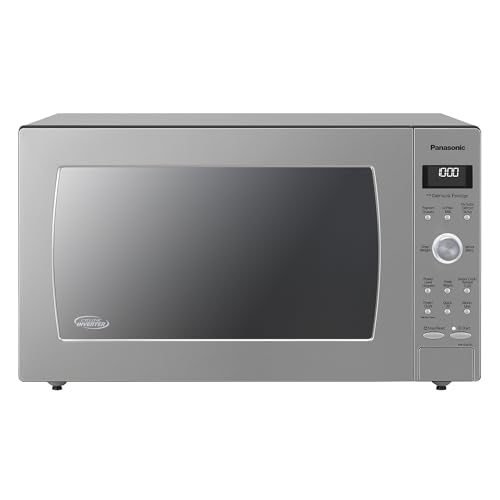
5. Panasonic NN-SN686S Countertop Microwave
A mid-size Inverter microwave that is a popular everyday Panasonic pick, with sensor features and a stainless-style finish.
Suits: a balanced home setup. Strengths: steady Inverter heating. Weaknesses: check the listing for exact size. Skip it if you want convection.

Best for bigger plates and dishes
6. Panasonic NN-SD975S Countertop Microwave
A large-class Panasonic Inverter model with a roomy cavity for bigger plates and dishes, aimed at busy kitchens.
Suits: bigger plates and dishes. Strengths: a roomy cavity and steady power. Weaknesses: a larger footprint. Skip it if counter space is tight.
Care and Setup
- Wipe the cavity after spills so splatter does not bake on.
- Clean the turntable and roller ring regularly.
- Never run the oven empty.
- Use microwave-safe dishes and covers only.
- Leave ventilation space around the unit.
Mistakes to Avoid
- Buying by wattage alone and ignoring cavity size.
- Overlooking the counter space the unit needs.
- Using metal containers or foil.
- Skipping the manual’s cooking tips for Inverter models.
- Expecting a standard model to defrost as gently as an Inverter one.
Understanding Inverter Technology in Practice
Panasonic is widely associated with Inverter microwaves, so it helps to understand what that feature does and when it matters. Many conventional microwaves control lower power levels by cycling the magnetron on and off. At a setting of half power, for example, the unit alternates between full power and nothing. Inverter models instead supply a more continuous stream of lower power. The aim is gentler, steadier heating.
In daily use, this shows up in a few ways. Defrosting is more even, so the edges are less likely to start cooking while the center is still frozen. Delicate foods such as sauces, melted chocolate or leftover rice can be warmed with less risk of hot spots and splatter. Some owners also find that foods stay moister.
It will not transform every task. Boiling water, reheating a mug and cooking a frozen meal at full power work in much the same way on any microwave. If these are your main uses, an Inverter model may not offer a noticeable gain. If you often defrost meat, simmer, melt or cook at medium power, it can be worth having.
- Choose Inverter for frequent defrosting or low-power cooking.
- A non-Inverter model is fine for basic reheating.
- Check the product page to see which models use Inverter.
- Read the manual for power-level tips, as the feature can change cooking times.
Cooking times from older recipes may need adjusting, so check the food as it cooks and stir or rotate where advised.
Sensor Presets, Menu Programs and Defrost Options
Within the Panasonic line, models differ in the cooking programs they offer. Simpler units provide a few one-touch keys, such as popcorn, beverage or potato. Mid-level units add sensor programs that measure steam and adjust the time, and Inverter models add defrost and reheat settings that suit different foods. Higher models add more auto programs and menu choices. Check the listing for the exact set on each model, since the available programs vary.
It helps to think about your real routine. If you mainly reheat leftovers and make tea, a couple of presets are enough. If you cook vegetables, rice and fish in the microwave, look at the menu for those. Test any preset the first time with a small amount of food, because results depend on quantity, shape and container.
Defrost options deserve attention. Some defrost by weight, others by food type. Remove packaging and use a microwave-safe dish, and stop to turn or separate pieces as the manual advises. Defrosted meat and poultry should be cooked soon after, following food safety guidance.
- List the presets you would use, then compare with the listing.
- Learn the manual power levels as a backup.
- Use a microwave-safe cover to avoid splatter.
- Check food temperature before serving, especially for reheated meals.
Presets are convenient but not magic. Be ready to adjust time up or down according to your results.
Cavity Shape, Turntable and Dish Compatibility
Choosing among Panasonic models is largely about the inside of the cavity. Compact models have smaller turntables that suit mugs, bowls and small plates. Larger cavities carry full dinner plates and casserole dishes. Some models offer a flat floor design, which gives a larger usable area for rectangular containers. Check the listing for the interior dimensions and the turntable diameter, not only the capacity figure.
Measure the dishes you use. The largest plate, the tallest cup and your biggest bowl are good tests. A turntable that bumps the wall will not rotate properly, which leads to uneven heating and noise. If you use rectangular dishes for lasagna or leftovers, a flat floor may suit them better.
The outside size matters as well. Check height, width and depth against your counter space, and leave the clearance the manual specifies for ventilation. If you want to put the microwave in a cabinet or shelf, check whether the manual and listing say it is allowed. Panasonic models listed as countertop are not generally meant to be built in without approval.
- Match turntable diameter to your largest plate.
- Consider a flat floor for rectangular dishes.
- Check exterior size and clearance.
- Do not enclose the unit unless the maker allows it.
Weight and door design also count. Look at which way the door opens and whether a handle or button releases it.
Convection and Combination Models: Who They Suit
The Panasonic range includes convection microwaves that add a heating element and fan so the unit can bake and brown as well as microwave. These can be useful if you want to make a small baked dish, crisp a pizza slice, roast vegetables or brown a casserole top without turning on a full oven. They can be a good choice in small kitchens or in the summer when you want to avoid heating the room.
They come with trade-offs. A convection microwave is larger and heavier, and it runs hot on the outside during convection use, so it needs more clearance. Cleaning is more involved, since baked-on food can build up. Accessories such as racks and trays are made for specific modes. Never use metal in microwave mode unless the manual explicitly allows it for that accessory.
Think about what you would cook. Small batches of cookies, a single pizza, reheated pastries and roasted vegetables fit well. Large roasts, multiple trays or big batches of baking do not. Cooking times and results differ from a full oven, so expect to test recipes and adjust.
- Choose convection if you want to bake and brown in small amounts.
- Choose a standard model if you only reheat and cook.
- Read the mode rules for metal and cookware in the manual.
- Allow cooling time before cleaning after convection use.
If you already have a good oven and rarely use small-batch cooking, the extra features may not be worth the added cost.
Warranty, Support and Keeping a Panasonic Microwave Running
Whichever model you choose, check warranty details on the listing and the maker’s support information. Warranty length and what is covered vary, and you should read the exclusions, such as commercial use or damage from misuse. Keep your receipt and note the model number somewhere easy to find, since service and replacement parts depend on it.
Maintenance is simple. Wipe the cavity after splatters, wash the turntable and roller ring and keep the door seal clean. Use only microwave-safe containers, avoid metal and do not run the unit empty. Keep the vents clear and the cord out of the way of heat and walkways. If you hear unusual noises, check that the ring and turntable are seated correctly before assuming a fault.
Signs of trouble include sparks, a door that does not seal, burning smells, a display that fails, uneven heating that gets worse, or a turntable motor that stops. Do not open the casing or attempt internal repairs, because microwave components can hold dangerous charge even when unplugged. Contact the maker’s service or a qualified technician, or replace the unit.
- Record the model number and purchase date.
- Keep the manual or a digital copy.
- Clean the interior regularly.
- Replace a cracked turntable or ring promptly.
When it is time to buy again, repeat the checks on size, features and fit. Staying with a familiar brand can be convenient, but compare the features that matter most to you.
A Quick Checklist for Choosing a Microwave
Microwaves look alike on the outside, yet small differences affect daily use. Work through these points before you buy.
- Measure the counter space, including the clearance the manual asks for around the sides, back and top.
- Check the interior capacity against the biggest plate or dish you use.
- Decide on a wattage range that suits your cooking, with higher output heating faster.
- Look at the control panel style: dials, buttons or a touch pad.
- Note whether you want convection or grill functions or only simple reheating.
- Think about the door release, turntable and ease of wiping the interior.
Most households use a microwave for reheating, defrosting and quick vegetables, so a clear interface often matters more than a long preset list.
Panasonic Models Compared by Use
The six models in this guide serve different kitchens. The table groups them by general features.
| Need | Feature to look for | Why it helps |
|---|---|---|
| Even reheating | Inverter power control | Provides steady output instead of cycling on and off |
| Large family dishes | Higher capacity | Fits bigger plates and covered bowls |
| Small kitchen | Compact exterior | Saves counter space |
| Baking and crisping | Convection mode | Adds oven-style heat |
| Easy cleaning | Smooth interior and flat floor | Faster wipe-down |
Match these features to your habits instead of choosing on wattage alone.
Mistakes to Avoid at Home
A few common errors reduce performance or shorten the life of an appliance.
- Running the microwave empty, which the manual warns against.
- Using metal containers or foil unless the maker explicitly allows it.
- Blocking the vents or crowding the unit between cabinets.
- Letting spills dry on the interior and around the door seal.
- Using containers that are not labeled as microwave safe.
Keep the manual handy and refer to it when you try a new function, especially convection or combination modes.
Electrical Setup and Safe Use
Plug the microwave into a suitable outlet as the manual describes, and avoid sharing a circuit with other high-draw appliances if the maker advises against it. Avoid extension cords unless the manual allows them. If the cord or plug looks damaged, stop using the unit and contact the maker or a qualified technician. Do not try to open the casing, because it contains parts that can hold a charge even when unplugged. For food reheating times and temperatures, follow official food guidance and the instructions on packaged food.
Cleaning and Everyday Care
Wipe the interior regularly with a damp cloth and mild cleaner, using the manual as your guide for what is safe. A bowl of water heated for a short time can loosen stuck-on splatter, which makes wiping easier. Clean the door seal and edges where food collects. Remove the turntable and wash it according to the maker’s notes, then dry it before putting it back. Keep the outside clean and avoid harsh abrasives on the control panel.
Making Sense of Wattage and Capacity
Two numbers dominate most microwave listings, and they are easy to misread. Wattage describes cooking power, and capacity describes the interior volume. A higher wattage generally means quicker heating, while a larger capacity makes room for wide plates and tall containers. Neither number tells you how evenly food heats, so look at the plate size, the turntable diameter and any inverter notes from the maker.
- Small households: a compact unit with modest capacity is usually enough.
- Families: look for a roomy cavity that fits a large dinner plate.
- Frequent cooks: consider extra functions, but make sure you will actually use them.
Recipe and package times often assume a certain wattage, so check the label on your appliance and adjust as the instructions advise. If a time guide for packaged food differs from your wattage, follow the package directions for the closest match and consult official food guidance.
Where the Microwave Should Sit
Placement affects both safety and convenience. Choose a stable counter at a comfortable height, ideally with a free outlet nearby. Leave the clearances the manual lists for ventilation, and do not tuck the unit into a closed cabinet unless the maker has designed it for that. Keep it away from sinks and the stove burners, and keep the cord out of walking paths. A shelf at roughly chest height lets you see into the cavity and lift hot dishes out without straining, which matters in a busy household.
Before You Decide: The Ownership View
A countertop microwave is the appliance most households use several times a day without thinking, which is exactly why the small decisions around it matter: where it sits, what goes into it, and how its features match the food you actually heat. The sections below build on the picks above with that everyday view.
How the Picks Above Compare When You Line Them Up
With six options on the table, the fastest way to a good decision is to compare the picks above in pairs rather than as a crowd. Start with the two that caught your eye and read their reviews back to back, asking the same three questions of each: what is it best at, what is its honest limitation, and whose home does it suit? The reviews above answer those questions in the same pattern for every pick, which makes the comparison fair. Cross off the one that loses on the question you care about most, then bring the next pick into the ring against the survivor.
The opening pair sets the tone for the list. The Panasonic NN-SN966S Countertop Microwave and the Panasonic NN-SD372S Countertop Microwave represent two of the clearest approaches in this category, and the difference between them — in style, in priorities and in the kind of owner they suit — is the difference that matters for most buyers. If one of them feels immediately right, that instinct is worth noting, because it usually reflects your real habits rather than the headline features. If neither appeals, the middle of the list is where your answer probably lives.
The Panasonic NN-SU696S Countertop Microwave and the Panasonic NN-CD87KS Convection Microwave occupy that middle ground, and they reward close reading. Picks in the middle of a list like this tend to balance competing virtues rather than maximise one, which makes them the safest choice for households whose needs are mixed: two cooks with different priorities, a space that must serve several jobs, or a buyer who simply wants no drama. Compare their stated strengths against your own week and see which set of compromises you would rather live with daily.
At the end of the list, the Panasonic NN-SN686S Countertop Microwave and the Panasonic NN-SD975S Countertop Microwave are the specialists and the reminders that there is more than one way to solve the same problem. A specialist pick is the wrong choice for most people and the perfect choice for a few, and only an honest account of your own situation tells you which group you are in. Do not dismiss them for being different, and do not choose them for being interesting; choose them if their particular strength is the exact thing your current setup lacks.
Finish the comparison with a short written exercise. On paper, list your three non-negotiables — the size limit, the job it must do brilliantly, the habit you refuse to change — and score each surviving pick against them in a sentence each. The exercise takes ten minutes and it converts a fog of impressions into a decision you can explain. Owners who choose this way rarely look back, because the choice was made against their own criteria rather than against a stranger’s enthusiasm.
Matching the Microwave to Your Actual Dishes
Capacity figures describe the cavity, but your dishes describe your life. The dinner plates, the big mixing bowl, the tall baby bottle or the rectangular dish you use for every family bake — those are the measurements that matter. Take the largest dish you use weekly and check it against the cavity and turntable information in the picks above, remembering that a dish must not only fit but rotate, or sit sensibly if the model works differently. Height catches people out most often: a cavity wide enough for the plate may still be too low for the jug you heat every morning.
Also be honest about batch habits. A household that reheats single portions lives happily in a compact model and gains counter space; a household that reheats family-sized dishes or cooks whole meals in the microwave will fight a small cavity daily. Neither answer is wrong, but buying the compact model for its price and then resenting it at every family meal is the expensive route in the long run.
Power Levels: The Setting Most People Never Touch
Full power is the microwave equivalent of shouting. Many foods heat more evenly and taste better at a medium setting given a little more time: sauces that would split, cheese that would turn rubbery, and dense dishes that heat at the edges while the centre stays cold. Defrosting in particular rewards patience and the dedicated settings the makers build in, with rests between bursts so the temperature can even out through the food.
Experiment during ordinary meals rather than important ones. Reheat tonight’s leftovers at a lower power for longer and compare the texture with your usual blast; most people are converted by a single plate. Standing time matters as much as cooking time, because the heat continues to spread after the beep. Build the rest into your timing and you will stop serving meals that are scalding at the rim and cold in the middle, which is the single most common complaint about microwave cooking and the easiest to fix.
Containers, Covers and What Stays Out
The container shapes the result. Round dishes heat more evenly than square ones, shallow food heats faster than a deep mound, and a cover that traps some steam while venting a little gives moist, even reheating. Use only containers labelled for microwave use, and retire any plastic that has warped, cracked or picked up permanent staining, since damaged containers do not belong in contact with hot food. Glass and ceramic are the calm defaults for most reheating, provided they have no metallic trim.
Keep the obvious hazards out: metal and foil unless the manual specifically allows a described use, sealed containers that can build pressure, and anything that might melt or scorch. Eggs in shells, whole chillies and similar sealed natural packages can burst impressively. When you try a container for the first time, stay nearby; a container that is merely warm to the touch after heating is behaving, while one that becomes hotter than the food is absorbing energy it should be passing through.
Cleaning Little and Often
A microwave cleaned weekly takes minutes; a microwave cleaned rarely takes an afternoon and a strong stomach. Wipe the cavity after messy meals once it has cooled, wash the turntable and its support as you would a plate, and pay attention to the door seal and the area around the latch, where splashes collect and where a clean seal matters for proper closing. Dried splashes can be softened by heating a bowl of water until it steams, where the manual allows, then wiping once the steam has done its work.
Odours are usually a cleaning issue rather than a fault: last week’s fish, reheated in an unwiped cavity, will season this week’s porridge. A thorough wipe, a spell with the door open to air the cavity, and attention to the underside of any removable parts usually clears it. If the microwave still smells of electrical heat or shows sparking, stop using it and follow the manual’s guidance; those are faults, not housekeeping.
Placement: The Metre of Counter That Decides Everything
Where a countertop microwave lives decides how it is used. It needs a stable, level surface, the ventilation clearance the maker specifies on the sides, top and back, and a position where the door opens fully without swinging into a walkway or a person carrying something hot. Think about the journey of a hot dish: out of the microwave, turned around, and set down. If that journey crosses the kitchen or ends with nowhere to land, the placement is wrong even if the microwave fits the gap.
Power matters too. The outlet should be reachable without the cord trailing across a sink or a hob, and the circuit should not already be carrying several other hungry appliances that all run at breakfast. If the microwave shares a crowded counter, give it the spot nearest the outlet and the clearest door swing, and move the lesser-used gadgets instead. A microwave placed thoughtfully disappears into the routine; a badly placed one is cursed several times a day for years.
Repair or Replace: Judging the End of a Product’s Run
Every Panasonic microwave eventually reaches the point where money spent keeping it going would be better spent on its replacement, and the honest signals are usually clear if you look for them. Performance that no longer recovers after a proper clean and the maker’s own troubleshooting steps is one signal. Repeated faults in the same system, parts that the maker no longer lists, and damage to the main body, frame or cooking or cooling chamber are others. Cosmetic wear, by contrast, is a poor reason to replace a product that still does its job safely and well; a faded finish or a scuffed handle costs nothing to live with.
When you do judge a product finished, use what it taught you. Your notes about what annoyed you, what you cleaned most and which feature you never touched are a better buying guide than any advertisement, because they describe your household rather than an average one. Carry those lessons back to the picks above: the right replacement is usually the one that fixes your old product’s specific weakness, not the one with the longest feature list. Dispose of the old product through the route your area provides for appliances or metal goods, remove anything the maker says to remove first, and keep the manual until the replacement is settled in, since measurements and habits often transfer.
Getting More Years Out of What You Buy
Longevity with a Panasonic microwave is mostly decided by small, unglamorous choices. Protect the product from the conditions it was not built for: standing water, relentless weather, corrosive cleaners, knocks during moves and long neglect between seasons. Where the maker offers a cover, a storage position or a winter routine, use it; those recommendations are written from warranty claims, not from theory. Handle the parts that move, seal or bear weight with a little care, because those are the parts that wear first and are often the hardest to replace once a model is discontinued.
Keep a small kit for the product: the cleaner the maker approves, any specialist tool it shipped with, and the spare consumables you know you will need, stored together rather than scattered around the house. When you move house or rearrange the space, treat the product like the appliance it is: empty it, secure moving parts, lift with help and re-check it sits level in the new spot. Owners who think of a Panasonic microwave as equipment to be kept, rather than a purchase to be consumed, routinely get years more service from the same product, and they spend the money they save on better ingredients, better gatherings and better weekends.
Measuring and Planning the Space Before Anything Arrives
Most disappointment with a Panasonic microwave is really a measuring problem that showed up late. Measure the space where the product will live, then measure the path it travels to get there: doorways, gates, stairs, tight corners and the lift or hallway if you have one. A product that fits its final spot but cannot get through the door is a return waiting to happen. Allow room around the product for the way you actually work, not just the footprint on the page. You need space to open doors and lids fully, to stand comfortably while you use it, and to reach the back for cleaning without dragging the whole thing out of place.
Think about the surface underneath as part of the measurement. It should be level, stable and suited to the heat, weight or moisture the product brings with it. Then think about what sits nearby: curtains, fences, stored fuel, cleaning supplies and the things a busy household piles into corners. Planning the neighbourhood of a Panasonic microwave, not only its footprint, is what separates a setup that feels easy every day from one you fight with every weekend. Sketch the layout on paper if it helps; five quiet minutes with a tape measure prevents most of the expensive mistakes.
A Cleaning and Maintenance Rhythm That Actually Sticks
A Panasonic microwave rarely fails all at once; it drifts. Small deposits build up, moving parts get stiff, seals and surfaces pick up grime, and one day the performance you paid for is quietly gone. The fix is a rhythm rather than a heroic annual clean. Wipe down the surfaces you touch after use, while spills and splashes are still easy to move. On a regular cycle, do the deeper job the manual describes: the removable parts out, the hidden corners reached, the filters, trays, racks or drip paths dealt with, whichever your product has. Use the cleaners the maker allows for that surface, because the wrong chemical can mark a finish or damage a coating faster than the dirt would have.
Build the habit around an anchor you already keep, such as the end of a cookout, the weekly shop or the change of a season, so the job happens without willpower. While you clean, look at the product the way an inspector would: loose fixings, worn edges, cracked or perished flexible parts, and anything that has started to smell, stain or behave differently. Catching wear early usually means a small part or a good clean sorts it. Ignoring it usually means the same issue returns on the day you have guests, a full load or no spare time. A clean product is also simply nicer to use, and people look after things they enjoy using.
More Questions Before You Buy
When should a countertop microwave be replaced?
When it stops heating reliably, sparks, has a door that no longer closes and latches properly, or shows damage to the cavity or cord. Door and latch condition is a safety matter, not a cosmetic one, so do not nurse a microwave with a faulty door.
What size microwave does a typical household need?
The size that fits your largest weekly dish with room to rotate, and matches how much you reheat at once. Compact models suit single portions and small kitchens; family reheating and microwave cooking of whole dishes justify a larger cavity. Measure your dishes, not just your counter.
Is higher wattage always better?
Higher wattage heats faster, which is convenient, but technique matters more for quality: power levels, standing time and suitable containers decide evenness. A very powerful model used only on full blast will still serve food that is hot at the edges and cold in the centre.
Why does food heat unevenly in my microwave?
Microwaves create hot and cold spots by nature. Stirring or turning food partway through, arranging it in a ring rather than a mound, using a lower power for longer and letting it stand afterwards all even out the result considerably.
Can I put metal in a microwave?
As a rule, no, unless the manual for your specific model describes an allowed use such as a supplied rack. Foil, metal-trimmed dishes and twist ties can spark and damage the cavity. When in doubt, transfer the food to a plain glass or ceramic dish.
How do I get rid of a lingering smell?
Clean the whole cavity including the turntable and door area, then air it with the door open. Heating a bowl of water with a slice of lemon, where the manual allows, can help. Persistent burning smells are different from food smells and mean the appliance should be checked.
Final Practical Notes Before You Decide
If you share the Panasonic microwave with other people, share the knowledge too. The person who read the manual should not be the only person who knows the quirks: which setting behaves how, what the warning signs of a problem look like, and where the shut-off or the spare supplies live. Five minutes of showing beats a season of each person learning the same lessons separately, and it prevents the well-meant mistake made by someone who was never told.
Budget a little patience for the learning curve, whatever you choose from the list above. Almost every product in this category rewards its owner more in the third month than in the first week, because technique, placement and routine have had time to settle. Judging a purchase too early — or abandoning a sound product for a different one before learning it — is the most expensive habit in any kitchen. Give the choice a fair season before you grade it.
Finally, buy for the household you have, not the one in the advertisement. The right Panasonic microwave is the one sized for your real gatherings, suited to your real space and matched to the maintenance you will honestly do. The picks above differ precisely because households differ, and the most satisfied owners are the ones who chose against their own habits and rooms rather than against a headline. Choose honestly, set it up carefully, keep the simple routines, and the product will repay you quietly for years.
Accessories deserve a cooler head than they usually get. Live with the Panasonic microwave for a while before adding extras, and let real use tell you what is missing: the tool you reach for and do not have is a genuine need, while the gadget bought in the first flush of enthusiasm usually ends up in a drawer. When you do add something, choose the version made or approved for your model where the maker offers one, and keep the same discipline as the main purchase — it should solve a problem you actually have.
Seasonal changes are a useful prompt for a walk-around check of any Panasonic microwave. At the turn of the year, look over the product and its surroundings: clearances still respected, surfaces clean, moving parts free, supplies stocked and nothing stored where it should not be. Households drift, and objects migrate into the spaces around appliances. A short seasonal reset keeps the setup you planned from quietly becoming the setup you would never have chosen.
One more habit separates satisfied owners from frustrated ones: keep the paperwork. The manual, the receipt and a note of the model details belong together, whether that means a folder, a drawer or a photograph stored with your other house documents. When a question arises in a year — a part, a setting, a warranty query — the answer is usually in those pages, and finding them in two minutes instead of twenty changes a small problem back into a small problem.
It is also worth setting a simple review date. A few months after a Panasonic microwave arrives, once the novelty has worn off, look at it with fresh eyes: is it positioned where it works best, are the accessories you actually use the ones within reach, and is there one small change — a moved shelf, a different routine, a better storage spot — that would make daily use smoother? Products settle into a household over time, and a short review catches the improvements that were invisible on day one.
If you share the Panasonic microwave with other people, share the knowledge too. The person who read the manual should not be the only person who knows the quirks: which setting behaves how, what the warning signs of a problem look like, and where the shut-off or the spare supplies live. Five minutes of showing beats a season of each person learning the same lessons separately, and it prevents the well-meant mistake made by someone who was never told.
Panasonic Microwave FAQ
What does Inverter technology do?
It supplies steady power instead of cycling on and off, which helps food heat more evenly.
Is an Inverter microwave worth it?
It helps with delicate foods and defrosting, though a basic model is fine for simple reheating.
Can a convection microwave replace an oven?
It can handle small baking and roasting jobs, but not as much as a full oven.
Where should I place it?
Leave airflow room around the unit as the manual says.
How do I choose between the Panasonic sizes?
Think about the largest plate or dish you heat. Compact units suit small plates and mugs, while larger cavities take dinner plates and casserole dishes without crowding the turntable.
Are these microwaves built in?
These are sold as countertop models. Do not place one inside a cabinet unless the manual and listing clearly say that is allowed, because the oven needs room for airflow.
Do the presets differ between models?
Yes. Simpler models offer a handful of one-touch keys, while sensor and Inverter models add automatic programs for popcorn, vegetables, reheating and defrosting. Read the listing for the exact menu.
Do Panasonic Inverter microwaves cook differently from standard ones?
Inverter models supply steadier low power, which can help with defrosting and gentle heating. At full power the difference is smaller. Check the manual for guidance on times.
Can I use metal racks in a Panasonic convection microwave?
Only the racks and accessories that the manual approves, and only in the modes it names. Do not use metal in standard microwave mode unless the manual explicitly allows it.
Why does my food take longer than the package says?
Package times assume a certain wattage. If your unit has lower power, add time and check the food, stirring where possible.
Is it normal for the fan to run after cooking?
Many microwaves keep a cooling fan running for a short time after a cycle. Check the manual if it runs for a long time or sounds unusual.
How should I clean the roller ring and turntable?
Remove them once cool, wash in warm soapy water, dry them and seat them correctly. Replace them if they crack or cause noise.
Which size is best for a small household?
A compact or mid-size cavity is often enough for one or two people, provided your regular plates fit. Measure your dishes before deciding.
The Short Version
For a large family, the Panasonic NN-SN966S. For small spaces, the NN-SD372S. For a balanced mid-size, the NN-SU696S. For browning, the NN-CD87KS. For a popular everyday pick, the NN-SN686S. For roomy dishes, the NN-SD975S.

