A natural gas grill connects to your home’s gas line, so you never swap or refill a propane tank. It gives steady fuel for long cookouts, lowers the hassle of running out mid-meal, and tends to suit homeowners who grill often on a fixed patio. Many gas grills are sold in separate propane and natural gas versions, and some can be converted with a kit. The right version depends on your hookup, so always check what the listing sells.
The six models below are well-known grills from established brands that offer natural gas versions or kits. We have not used these products ourselves, so confirm the fuel version, burner count and included hose on the current listing before buying. Heat and durability claims are the makers’ own. Installation matters. A natural gas grill needs a proper line and connection, and a licensed professional should handle the hookup. Also consider cart size, side shelves and cooking area, since a grill tied to a gas line is harder to move than a propane cart model. Wind covers, a sturdy cover for winter and a regulator that matches the grill are small details that save trouble later, so check what comes in the box and what you must buy separately.
As an Amazon Associate we earn from qualifying purchases. Links below are affiliate links, and they do not change the product information we give.
What to Look For
| Feature | Why it matters |
|---|---|
| Fuel version | Natural gas and propane versions use different orifices |
| Burners | More burners create separate heat zones |
| Hookup | A quick-connect line makes setup and moving easier |
| Build | Stainless steel and thick grates last longer outdoors |
In this guide
Specs at a Glance
| Model | Fuel | Size class | Notes |
|---|---|---|---|
| Weber Genesis | Natural gas version available | Larger gas grill class; confirm listing | Multiple burners and a sear station on many versions |
| Weber Spirit II E-310 | Natural gas version available | Three-burner class; confirm listing | Compact cart |
| Broil King Baron 490 | Natural gas version available | Four-burner class; confirm listing | Cast-iron style cooking grids on many versions |
| Char-Broil Performance Series | Natural gas version available | Four-burner class; confirm listing | Side burner on many versions |
| Monument Grills 4-Burner | Natural gas version available | Four-burner class; confirm listing | Side burner and warming rack on many versions |
| Nexgrill 4-Burner | Natural gas version available | Four-burner class; confirm listing | Cabinet-style base on many versions |
The 6 Best Natural Gas Grills

Top pickBest for serious home grillers
1. Weber Genesis
A larger Weber gas grill offered in natural gas versions. It suits regular grillers and larger families.
Suits: serious home grillers. Strengths: a strong brand and plenty of cooking room. Weaknesses: large footprint. Skip it if you have a small patio.

Best for small to mid-sized families
2. Weber Spirit II E-310
A mid-sized three-burner grill from Weber, available in natural gas versions. It is a long-running choice for backyards.
Suits: small to mid-sized families. Strengths: well-known design. Weaknesses: fewer extras than premium models. Skip it if you want many side burners.
View Weber Spirit II E-310 on Amazon

Best for everyday family grilling
3. Broil King Baron 490
A four-burner gas grill from a respected Canadian brand, sold in natural gas versions. It has a solid build and good cooking space.
Suits: everyday family grilling. Strengths: sturdy build. Weaknesses: heavy to move. Skip it if you want a portable cart.

Best for budget-friendly gas hookup
4. Char-Broil Performance Series
A familiar mid-level grill line with natural gas versions. It offers a good set of features at an everyday level.
Suits: budget-friendly gas hookup. Strengths: familiar design and parts. Weaknesses: lighter build than premium grills. Skip it if you want heavy stainless.
View Char-Broil Performance Series on Amazon
Best for first-time natural gas owners
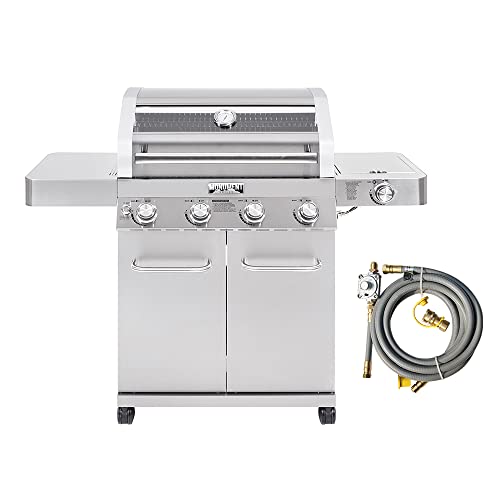
5. Monument Grills 4-Burner
A value-leaning four-burner grill offered in natural gas versions. Check the listing for the version that fits your hookup.
Suits: first-time natural gas owners. Strengths: good feature count. Weaknesses: brand history is shorter. Skip it if you want an old-line brand.


Best for backyard cooks wanting a value pick
6. Nexgrill 4-Burner
A four-burner grill sold in several gas versions. Different listings list different fuel types, so read the title closely.
Suits: backyard cooks wanting a value pick. Strengths: familiar big-box style. Weaknesses: variants differ between listings. Skip it if you want a premium build.

Care and Setup
- Have a licensed professional connect or inspect the gas line.
- Check connections and burners at the start of each season.
- Clean the grates after each cook and empty the grease tray.
- Cover the grill once it has cooled.
Mistakes to Avoid
- Ordering a propane version for a natural gas line.
- Using a conversion kit without following the manual.
- Skipping a soapy-water leak check after connecting.
- Placing the grill too close to a wall or deck rail.
Natural Gas or Propane: Weighing the Trade-Offs
The main appeal of natural gas is convenience. Once the grill is connected to your home’s supply, there are no tanks to swap, no mid-cookout run to the store and no guessing how much fuel is left. It suits households that grill often, entertain frequently or want a permanent spot on a patio. Fuel cost can be lower for heavy users, though that depends on local rates, so compare your own situation rather than relying on general claims.
The trade-off is flexibility. A natural gas line fixes the grill’s location, and moving it means disconnecting a hose or relocating a line. Propane grills can go anywhere, from a driveway to a campsite. Propane also carries more energy per volume than natural gas, so natural gas burners use larger orifices to deliver comparable heat. This is why the two fuel versions are not interchangeable without the right parts.
Think about layout. Where will the grill sit relative to the house, and where does the gas line run? Consider whether you might move in a few years or want the option to take the grill with you. Some households keep a propane grill for portability and add a natural gas grill for the patio. Check the listing for the exact fuel version and what is included, and remember that installation costs, permits and a licensed professional may be part of the real price of natural gas.
Installation Planning and Code Basics
Gas work is not a casual do-it-yourself job. Local codes often require a licensed professional to run or extend a gas line and to pressure test it, and some areas require permits or inspections. Before buying, contact your gas provider or a qualified installer to ask about line capacity, the location of the outdoor connection and what the work involves. Do not assume your existing line can support another appliance without checking.
Plan the connection point. A quick-connect fitting near the patio lets you attach and detach the grill hose easily, which helps with cleaning or moving the grill. Make sure the hose is rated for outdoor natural gas use, is the right length, and does not touch hot surfaces or run across walkways. Leave space to shut off the gas at the valve in an emergency.
Clearances matter. Keep the grill away from walls, railings, overhangs and combustible siding according to the manual, and never use it in an enclosed space. Consider wind direction and access for guests. After installation, perform a leak test with soapy water at every connection, as the manual describes, and keep the installer’s information handy. Keep copies of manuals and model numbers, and review local rules about outdoor gas appliances before the grill arrives.
Burners, Heat Zones and Grates
Burner count affects flexibility. More burners usually mean more separate heat zones, which lets you sear on one side and cook gently on the other. That helps with indirect cooking for larger cuts and with keeping delicate foods away from flames. But burner count is not everything. Burner design, spacing and the way heat is spread across the grates determine how evenly the grill cooks.
Look at the grates. Stainless steel, cast iron and porcelain-coated options each have trade-offs. Cast iron holds heat well and gives strong sear marks, but needs seasoning and care to avoid rust. Stainless is durable and easier to maintain, though it may not hold heat as long. Porcelain coatings resist sticking but can chip with rough handling. Check thickness and how the grates are supported.
Think about extras. A side burner can heat sauces, a warming rack keeps food hot, and a rotisserie option suits large roasts. A sear station gives high heat for steaks. These are useful only if you will use them, so avoid paying for features you will ignore. Check the lid for a thermometer, and plan to add a separate probe for meat. Look at the firebox and cart materials, since thin metal may warp or rust sooner. Cooking area matters too, so measure what you cook and compare with the stated grilling surface.
Build Quality and Weather Durability
A natural gas grill stays outdoors, often in one spot, and weather takes a toll. Stainless steel resists rust better than painted steel, but grades differ, and even stainless can discolor in coastal or humid air. Look for details on the construction: lid thickness, firebox material, hinges, handles and burner materials. The listing and manual may provide some of these details, and you should treat marketing claims with caution.
Check how the grill stands up to the elements. A good cover protects against rain, pollen and sun, but only after the grill has cooled. Cabinet-style bases can hide a gas line and store tools, though they may trap moisture if not ventilated. Wheels and a stable base matter if you plan to move the grill for cleaning, but remember that a natural gas hose limits how far it can roll.
Inspect regularly. Look for rust spots, warped components, loose bolts, and damaged knobs. Replace worn igniters and burners as needed. Burners can clog with spider webs or grease, causing uneven flames, so brush them clean and check the ports. A grill that has holes in the firebox, severe warping or failing gas components may be better replaced than repaired. Ask about parts availability and warranty terms before buying, and keep your receipt and serial number for service.
Cleaning Routines and Safe Operation
Good habits keep a gas grill performing and safe. Before lighting, open the lid, then follow the manual’s lighting steps. Lighting with the lid closed can allow gas to collect, which is dangerous. If the grill does not light after a short attempt, turn off the gas, wait the time the manual states, and try again. If you ever smell gas, shut off the supply and avoid ignition sources until the problem is fixed.
After cooking, burn off residue for a few minutes with the lid closed, then brush the grates while warm. Empty the grease tray regularly, because buildup can cause flare-ups and fires. Every so often, do a deeper clean: remove the grates and flavorizer bars, scrape the interior, and wash parts with warm soapy water. Check the burners and venturi tubes for blockages.
Use tongs, a long-handled spatula and a probe thermometer for safe, accurate cooking. Keep a clear area around the grill, and keep children and pets away. Do not leave the grill unattended while lit. When finished, turn off the burners and then the gas supply at the valve. Let the grill cool before covering. Keep a fire extinguisher rated for grease fires nearby, and never use water on a grease fire. A consistent cleaning routine also helps you spot problems early.
Natural Gas Grill Words Explained
Natural gas grills have their own vocabulary, which can be confusing when you have only used a propane tank before. Here are the terms you are likely to see.
- Natural gas hookup: a connection to your home’s gas supply, usually through a dedicated line and quick-disconnect fitting.
- BTU: a measure of heat output. It is a rough guide, not a promise about cooking results, because grill design and heat distribution matter.
- Burners: the tubes that produce flame. The number and layout affect how many heat zones you can create.
- Heat zones: areas you can set to different temperatures for searing on one side and gentle cooking on the other.
- Flavorizer bars or heat tents: plates above the burners that spread heat and catch drippings.
- Conversion kit: parts that convert a propane grill to natural gas, or the reverse. Use only what the maker approves for your model.
- Side burner: an extra burner on the side for pots and sauces.
Is Natural Gas the Right Choice for You?
You grill several times a week
A permanent hookup means no tank to refill. If you are always checking a propane level, natural gas can be convenient.
You like to move your grill around
Natural gas ties the grill to the hose and the hookup location, so check the hose length and whether the maker allows moving it.
You are building an outdoor kitchen
A built-in grill with a gas line suits a planned space. Gas line work should be done by a licensed professional following local codes.
You grill only on special occasions
A propane model may be simpler, since it needs no fixed gas line. Compare the effort of installing a hookup with how often you cook outside.
Propane and Natural Gas Compared
| Question | Natural gas | Propane |
|---|---|---|
| Fuel supply | From your home line | Refillable or exchangeable tanks |
| Portability | Limited by the hose | Move freely |
| Installation | Gas line, done by a professional | Connect a tank |
| Running out mid-cook | Not a concern | Possible if the tank is empty |
Safety, Installation and Local Rules
Gas appliances demand respect. Have a licensed professional run, inspect and connect any gas line, and follow the maker’s instructions and local building codes. Place the grill outdoors, on a stable surface, with the clearances the maker specifies from walls, railings and overhead structures. Never use a grill in an enclosed space or under a flammable awning.
Check for leaks according to the manual’s method before first use and when you reconnect any fitting. If you smell gas, follow the maker’s and local utility’s guidance immediately. Keep children and pets away from the grill, and never leave it unattended while lit. A conversion from propane to natural gas should only be done with the maker’s approved kit and instructions.
Reading a Natural Gas Grill Listing
Confirm first that the grill is built for natural gas, or comes with a conversion kit for it. Check the hose and regulator details and what is included in the package. Look at the cooking area, burner count and heat zone layout, and compare it with how many people you usually cook for. Note the materials, including the grates and the lid. Check the warranty terms, and read what the maker says about outdoor storage and covers.
Finally, read the delivery and assembly details. Gas grills can be heavy and take time to assemble, so plan your space and your helpers ahead of time.
Seasonal Care and Cleaning
Brush the grates after each use while they are warm, and empty the grease tray on the maker’s schedule. Wipe the exterior with a mild cleaner and cover the grill when not in use. Before the first cookout of the season, inspect the hose for cracks and the burners for blockages, as the manual describes. If anything looks damaged, have a qualified technician check it before you light the grill.
Learning Your Grill’s Heat Zones
A good grill session begins with knowing where the heat is. Light the burners according to the manual, close the lid and give the grill time to come up to temperature. Then try a simple test with slices of bread, laid out across the grates, to see which areas brown faster. Note the hot spots and cooler corners, and keep a little map in your head.
Use a two-zone approach for most cooking: one side with higher heat for searing and one side with lower heat for finishing thicker items gently. Move food between zones as needed, and keep the lid closed when you are not turning it. Allow a short rest for meats after cooking, following current food safety guidance from official sources for safe internal temperatures.
Keep a clean brush, long-handled tongs and a thermometer nearby. Wipe the grates before each session, and oil them lightly if the maker recommends it. A grill that you understand is a grill you will enjoy using, and a little observation in the first few weeks goes a long way.
Natural Gas Grill FAQ
Is natural gas better than propane?
It removes tank refills and gives steady supply, but needs a line installed. Propane is portable.
Can a propane grill be converted?
Some can with a kit made for that model. Follow the maker’s instructions.
Does natural gas cook hotter?
Not necessarily. Heat depends on the burners and design as well as the fuel.
Who should install the line?
A licensed professional, following local rules.
Can I run a natural gas grill from my existing house line?
Maybe, but the line must have enough capacity and a proper outdoor connection. Ask a licensed professional to check before you buy.
Can I convert a propane grill to natural gas?
Only with a conversion kit made for that exact model, installed as the manual describes. Some grills cannot be converted.
Is a quick-connect hose necessary?
It is not required, but it makes disconnecting easier for cleaning or moving. Use a hose rated for natural gas.
How do I check for leaks?
Brush soapy water on connections with the gas on and look for bubbles, following the manual. Fix any leaks before cooking.
Why are my flames uneven or yellow?
Clogged burner ports, spider webs or a poor air mix are common causes. Clean the burners and check the manual for adjustments.
How often should I replace burners or igniters?
When they fail to light, burn unevenly or show corrosion. Use parts approved for your model.
Do I need a permit to install a gas line?
Many areas require permits and inspections. Check local rules or ask your installer.
The Short Version
For a larger grill, the Weber Genesis. For a mid-size classic, the Weber Spirit II. For a sturdy build, the Broil King. For a familiar value, the Char-Broil. For a feature-rich value, the Monument. For a simple big-box style, the Nexgrill.
How the Picks in This Guide Compare, Buyer to Buyer
Specifications only take you so far with natural gas grills. What decides satisfaction is how each pick’s strengths line up with your routine, and how much its trade-offs matter in your home. The notes below revisit every pick already reviewed above — no new models, no new claims — and frame each one around the buyer it suits and the compromise it asks for, so you can shortlist with confidence before checking the current listing.
Weber Genesis: who it really suits
As the review above describes, this pick suits regular grillers and larger families. Suits: serious home grillers. Its stated strength is a strong brand and plenty of cooking room, and that is the quality to weigh first: if that strength answers your main frustration with your current setup, this is probably your pick. The honest limitation given above is large footprint, so consider whether that drawback touches your daily routine or only an edge case you rarely meet. The review’s own guidance is to skip it if you have a small patio. View Weber Genesis on Amazon — in that case, one of the other picks in this guide almost certainly fits better, and the comparison notes here will point you to it.
Weber Spirit II E-310: who it really suits
As the review above describes, this pick suits small to mid-sized families. Its stated strength is well-known design, and that is the quality to weigh first: if that strength answers your main frustration with your current setup, this is probably your pick. The honest limitation given above is fewer extras than premium models, so consider whether that drawback touches your daily routine or only an edge case you rarely meet. The review’s own guidance is to skip it if you want many side burners. View Weber Spirit II E-310 on Amazon — in that case, one of the other picks in this guide almost certainly fits better, and the comparison notes here will point you to it.
Broil King Baron 490: who it really suits
As the review above describes, this pick suits everyday family grilling. Its stated strength is sturdy build, and that is the quality to weigh first: if that strength answers your main frustration with your current setup, this is probably your pick. The honest limitation given above is heavy to move, so consider whether that drawback touches your daily routine or only an edge case you rarely meet. The review’s own guidance is to skip it if you want a portable cart. View Broil King Baron 490 on Amazon — in that case, one of the other picks in this guide almost certainly fits better, and the comparison notes here will point you to it.
Char-Broil Performance Series: who it really suits
As the review above describes, this pick suits budget-friendly gas hookup. Its stated strength is familiar design and parts, and that is the quality to weigh first: if that strength answers your main frustration with your current setup, this is probably your pick. The honest limitation given above is lighter build than premium grills, so consider whether that drawback touches your daily routine or only an edge case you rarely meet. The review’s own guidance is to skip it if you want heavy stainless. View Char-Broil Performance Series on Amazon — in that case, one of the other picks in this guide almost certainly fits better, and the comparison notes here will point you to it.
Monument Grills 4-Burner: who it really suits
As the review above describes, this pick suits first-time natural gas owners. Its stated strength is good feature count, and that is the quality to weigh first: if that strength answers your main frustration with your current setup, this is probably your pick. The honest limitation given above is brand history is shorter, so consider whether that drawback touches your daily routine or only an edge case you rarely meet. The review’s own guidance is to skip it if you want an old-line brand. View Monument Grills 4-Burner on Amazon — in that case, one of the other picks in this guide almost certainly fits better, and the comparison notes here will point you to it.
Nexgrill 4-Burner: who it really suits
As the review above describes, this pick suits backyard cooks wanting a value pick. Its stated strength is familiar big-box style, and that is the quality to weigh first: if that strength answers your main frustration with your current setup, this is probably your pick. The honest limitation given above is variants differ between listings, so consider whether that drawback touches your daily routine or only an edge case you rarely meet. The review’s own guidance is to skip it if you want a premium build. View Nexgrill 4-Burner on Amazon — in that case, one of the other picks in this guide almost certainly fits better, and the comparison notes here will point you to it.
Read across the six notes and a pattern emerges: there is rarely a single best choice among natural gas grills, only a best match. Owners who stay satisfied are the ones who chose by their dominant use — the meal, drink, room or routine that happens every day — and accepted a weakness in an area they seldom touch. Choose the same way, and verify the current listing’s dimensions and features before ordering, because line-ups and details change over time.
Buying Criteria in Depth: Natural Gas Grills
The short feature table near the top of this guide is the summary; this section is the reasoning behind it. Each criterion below is one of the checks experienced buyers run before ordering natural gas grills, explained in the order that matters — fit and function first, features second, ownership costs last. Work through them against your own home and the right pick usually identifies itself.
Burner count and cooking area, matched to your table
Choose a gas grill by the meals you actually cook. Two burners suit a couple grilling a few chops and vegetables; three or four burners give a family distinct heat zones so searing, gentle cooking and keeping warm can happen at once. Cooking area figures include warming racks in some listings, so look at the main grate dimensions and picture your largest regular load: a dozen burgers, two whole chickens, a tray of vegetables beside the steaks. A grill that forces you to cook in anxious batches is too small, whatever the headline area says, while a huge grill you mostly use for two sausages wastes fuel and preheat time.
Heat output is only half the story
Total burner output figures look impressive, but how a grill distributes and holds heat matters more. Heavy grates retain heat and mark food well, a well-fitting lid keeps temperatures steady, and even burner spacing prevents the hot-spot lottery where one corner chars while another lags. During your first cooks, map the grill: toast a layer of bread slices and note where they brown fastest. Every grill has a personality; learning yours in the first week makes the rest of ownership predictable. Favour build quality — solid grates, a sturdy cart, a lid that closes true — over raw output numbers.
Propane, natural gas and the practical choice
Propane models run from refillable bottles, can move around the garden and suit renters and occasional grillers. Natural gas models connect to a fixed line, never run out mid-cook and suit a permanent grilling station, but they need professional installation and the grill cannot wander. Conversion between fuels is only possible on models the maker designs for it, using their kit — never improvise fittings. Decide based on where the grill will live and how often you cook: frequent grillers with a fixed spot gain most from a plumbed line, while flexible garden layouts favour bottles.
Side burners, sear zones and extras that earn their space
Extras are worth having only if your cooking uses them. A side burner genuinely helps if you make sauces, boil corn or fry onions outdoors; a high-heat sear zone earns its place if thick steaks are your signature; a rotisserie suits households that roast whole birds regularly. Each extra adds cost, cleaning and another component to maintain. Be honest about your repertoire: the grill you use happily three times a week beats the feature showcase you use fully twice a year. Storage, by contrast, is never wasted — hooks, shelves and a cabinet for tools and the cover get used at every single cook.
Build, warranty and parts availability
A gas grill lives outdoors and faces heat, grease and weather, so construction quality decides its lifespan. Stainless steel varies in grade and thickness; painted steel needs its coating intact to resist rust; cast iron grates are superb but demand seasoning and care. Check that wear parts — burners, heat tents, igniters, grates — are available for the model, and read what the warranty actually covers and for how long on each component. A maker with a real parts catalogue turns a five-year grill into a twelve-year grill, because the parts that wear are the parts you can replace.
Natural Gas Grills in Real Life: Common Situations
Guides are written in general terms, but buying decisions are personal. The situations below describe the households and routines that natural gas grills are actually bought for. Find the one closest to yours and borrow its priorities — it is a faster route to the right pick than comparing every feature on every model.
Family weeknight grilling
On a school night the grill’s job is speed and simplicity: quick preheat, burgers or chops in one batch, vegetables in a basket beside them, everything off together. A three-burner layout with a reliable igniter and a lid thermometer you trust makes this a fifteen-minute routine. Keep the grill clean enough that lighting it is never a project in itself, and store the basic tools at the grill so starting dinner is never delayed by a search for tongs. For this rhythm, ease of lighting and cleaning outweighs exotic features.
Weekend entertaining for a crowd
Cooking for eight or more is a logistics exercise: stage food in waves, rest meats on the warming rack, and keep one zone cooler for holding finished items without overcooking them. A larger grate, a side burner for beans or corn and a work surface for trays all earn their keep here. Plan the order — thick items first, quick items last — and resist lifting the lid to admire progress, because each peek costs heat and time. The grill that entertains best is the one whose zones you understand, not necessarily the biggest one in the range.
The dedicated steak and sear cook
If your reputation rests on steaks, prioritise grate mass and peak surface heat. Heavy grates, a sear zone if offered and a lid that seals well give the crust you are after, while a cooler zone lets you finish thick cuts gently. Preheat thoroughly, pat steaks dry, and use a thermometer rather than the clock for doneness. A smaller, hotter, well-built grill will outperform a large, thin one for this style every time, so match the purchase to the plate you want to serve.
Small patios and balconies
Compact and portable gas grills bring real grilling to small outdoor spaces, provided local rules and your building allow them. Check the rules first — some balconies prohibit gas grills entirely. A two-burner or portable model with folding legs or a compact cart fits a modest patio, and a fitted cover protects it in place. Measure the space with the lid open and room for you to stand and work, not just the closed footprint, and think about where the gas bottle will live and how you will swap it.
Setup, Care and Keeping It Working Well
Ownership is the longer half of any appliance purchase. The guidance below covers the setup habits, routine care and storage practices that keep natural gas grills performing as they did on the first week — all of it general practice for this type of product, with the maker’s manual for your exact model always taking precedence where the two differ.
(‘The burn-off and brush routine’, ‘After cooking, run the grill on high briefly to carbonise residue, then brush the grates while warm with a brush in good condition — check for loose bristles and replace worn brushes, since a stray bristle in food is a genuine hazard; many owners prefer coil-style brushes or a ball of foil in tongs for this reason. Once cool, empty the grease tray: accumulated grease is the main cause of flare-ups and the occasional frightening fire. A grill cleaned little and often never needs the dreaded half-day deep clean, and it lights and heats evenly every time.’)
(‘Burners, heat tents and igniters’, ‘A few times a season, with the gas off and the grill cool, lift out the grates and heat tents and clear debris from the burner ports with a soft brush or a wooden pick — blocked ports cause uneven flames and lazy yellow burning. Check that the igniter clicks and sparks, and keep its electrode clean and dry. Spiders and insects famously nest in venturi tubes over winter, so a pre-season inspection there prevents the classic first-cook disappointment. Reassemble carefully and test each burner lights and burns with an even, mostly blue flame before the guests arrive.’)
(‘Covers, storage and winter care’, ‘A fitted cover keeps rain and debris off the grill, but trap moisture under it for months and you invite rust; in damp climates, air the grill on dry days and consider storing it under a roof. Before winter, clean it thoroughly, empty and disconnect the bottle if the maker advises, and store bottles outdoors, upright and away from heat sources — never indoors or in a garage attached to the house where local rules forbid it. In spring, do the full inspection: hoses for cracks, connections with a soapy-water leak test, burners clear, igniter working. Twenty minutes in April saves the first barbecue of the year.’)
More Questions Buyers Ask About Natural Gas Grills
How do I check a gas grill for leaks?
Whenever you connect a bottle or after any period of storage, brush soapy water over the hose, regulator and connections, open the gas with the burners off and watch for bubbles, which reveal escaping gas. If you find a leak, close the bottle, do not light the grill, and replace the faulty part or call a professional. Never test with a flame. Hoses perish over time, so inspect them for cracks and stiffness each season and replace them on the maker’s schedule or sooner if they look tired.
Why does my grill flare up?
Flare-ups happen when dripping fat lands on hot surfaces or open flame. Trim excess fat, keep the grease tray emptied, and cook very fatty items over a slightly cooler zone or on a raised rack. If a flare starts, move the food to a cooler area and close the lid to starve the flame rather than spraying water, which spreads burning grease. Persistent flaring usually means the grill needs a proper clean — built-up grease inside the firebox is fuel waiting for a spark.
How long should I preheat a gas grill?
Most grilling needs a thorough preheat with the lid down — long enough for the grates to become genuinely hot so food releases cleanly and marks well. Thin foods cooked too early stick and steam; thick steaks on a lukewarm grate never develop a crust. Use the lid thermometer as a guide but learn your grill’s timing, since fitted thermometers measure air near the lid rather than grate temperature. In cold or windy weather, allow extra time and keep the lid closed as much as possible during cooking.
Can I convert my grill between propane and natural gas?
Only if the maker designed the model for conversion and supplies a kit with the correct jets and fittings. The two fuels operate at different pressures and use different orifice sizes, so swapping a hose alone is unsafe and will not work properly. If conversion matters to you, choose a model listed as convertible at purchase time, have the work done exactly per the instructions or by a qualified fitter, and keep the original parts labelled in case you ever convert back.
Why is one side of my grill hotter than the other?
Some difference is normal — wind, burner design and lid shape all play a part — and experienced grillers use it as a feature, searing over the hot side and finishing on the cooler side. A sudden or extreme difference suggests a blocked burner, a clogged port row or a failing regulator. Clean the burners and check the flames with the grates off: they should be even and mostly blue along each burner. If cleaning does not restore balance, the affected burner may need replacing, which on most models is a straightforward parts swap.
How do I know when the gas bottle is nearly empty?
The most reliable method is weight: the bottle’s tare weight is stamped on it, so weighing the bottle tells you how much gas remains. Hot water poured down the side of the bottle on a cool day reveals the liquid level as a condensation line. Simple gauges exist but vary in accuracy. Practical owners keep the habit of a spare bottle during the entertaining season, because running out halfway through a cook for guests is the one grilling failure nobody forgets.
Zone cooking is the skill that separates gas grill owners from gas grill cooks. Set one side hot and one side gentle from the start of every session, even simple ones: it gives you a rescue space for anything cooking too fast, a holding area for finished food and a gentle zone for vegetables while the meat sears. The zones cost nothing and prevent most grilling disasters.
Keep a grill log for your first season — nothing elaborate, just times, settings and results for the meals you repeat. Gas grills vary, and your notes convert guesswork into routine: the exact minute your burgers are done, the burner setting your chicken needs. By the second season you will grill by feel, and the log becomes the household’s quiet reference.
Wind is the invisible variable in outdoor cooking. A grill that behaves perfectly on a calm evening can run cool and uneven on a breezy one. Position the grill sheltered where possible, allow longer preheats, and keep the lid down. If your garden is reliably windy, a grill with a heavy, well-sealing lid is worth prioritising over headline burner figures.
Finally, buy the cover and the basic tools with the grill, not after the first storm and the first burnt fingers. Long tongs, a wide spatula, a reliable thermometer and a brush in good condition are the working kit; everything else is optional and can wait until your cooking asks for it.
A Practical Decision Framework for Natural Gas Grills
When several picks in a guide all look capable, decide in three passes. First, eliminate on fit: any model whose dimensions, capacity or installation style cannot work in your space is out, however attractive its features. Second, rank the survivors by your dominant use — the job this appliance will do most weeks — using the comparison notes above, because a pick that excels at your everyday task beats one that excels at a task you perform twice a year. Third, break any remaining tie with ownership factors: cleaning effort, availability of spare parts, control simplicity for everyone in the household and how the design will age in your kitchen or garden. Three passes, in that order, resolve most shortlists of natural gas grills without regret.
It also helps to write down, before you look at any listing, the three things your current setup does worst. Buyers shop most successfully when they shop against a named frustration — too small, too slow, too loud, too fiddly to clean — rather than against an abstract idea of the best. Hold each candidate among natural gas grills up against those three frustrations in turn. The right pick is the one that removes at least two of them without introducing a new one you will meet daily. If no pick removes any of them, the honest conclusion is that your current appliance is better than you thought, and the money is better kept.
Checking the Current Listing Before You Order
Models in any guide to natural gas grills are revised quietly over time: capacities are restated, accessories move in or out of the box, and control layouts change between production runs. Before ordering, read the current listing for the exact dimensions including handles and doors, the included accessories, the electrical or fuel requirements and the warranty terms for your region. Confirm that the version described matches the version reviewed here, and check what the maker’s own page says where the two differ — the maker is the authority on their current production. This five-minute check prevents the most common disappointment in appliance buying, which is not choosing the wrong model but receiving a different variant of the right one.


