Crock-Pot is the brand name most people think of for slow cooking, and its larger models are built for family roasts, pots of chili and potluck dishes. Slow cooking also frees the oven and the stove, which matters most during holidays and busy weeknights. A big oval or round crock lets you cook a whole pork shoulder or a double batch of soup without cramming.
The six slow cookers below are all from the Crock-Pot line and come in different styles, from simple dial models to programmable ones and a multi-pot server. We have not used these products ourselves, and every detail should be confirmed on the current listing before you buy, since capacity, lids and controls change between versions. Always check the quart size and shape on the listing. Oval crocks suit roasts and ribs, while round crocks suit soups and dips.
As an Amazon Associate we earn from qualifying purchases. Links below are affiliate links, and they do not change the product information we give.
What to Look For
| Feature | Why it matters |
|---|---|
| Capacity | Larger crocks need more counter space and a roomy cabinet |
| Controls | Manual dials are simple, programmable timers add convenience |
| Lid | Locking or clip-on lids help with travel to potlucks |
| Crock material | Removable ceramic or stoneware is easier to wash |
In this guide
Specs at a Glance
| Model | Style | Size class | Notes |
|---|---|---|---|
| Crock-Pot 8 Quart Manual | Manual | Large | Simple dial with warm setting |
| Crock-Pot 8 Quart Programmable | Programmable | Large | Timer with automatic warm |
| Crock-Pot Cook and Carry | Programmable | Large | Locking lid with a carry handle |
| Crock-Pot Lift and Serve | Programmable | Large | Hinged lid that stays open for serving |
| Crock-Pot Choose-A-Crock | Programmable | Large | Interchangeable crocks |
| Crock-Pot Triple Slow Cooker | Multi-pot | Large | Three separate crocks in one unit |
The 6 Best Large Crock-Pot Slow Cookers
Top pickBest for no-fuss cooking
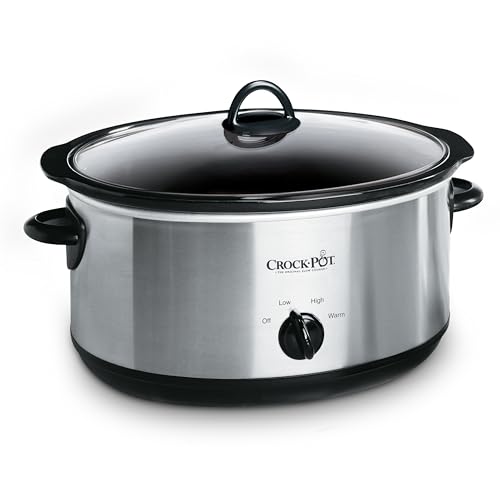
1. Crock-Pot 8 Quart Manual Slow Cooker
A straightforward oval slow cooker with a simple dial and a removable stoneware pot. It suits big roasts and large stews. Its dial offers low, high and warm, which covers most recipes.
Suits: no-fuss cooking. Strengths: easy use and a large crock. Weaknesses: no timer. Skip it if you need to schedule start and finish.

Best for work-day meals
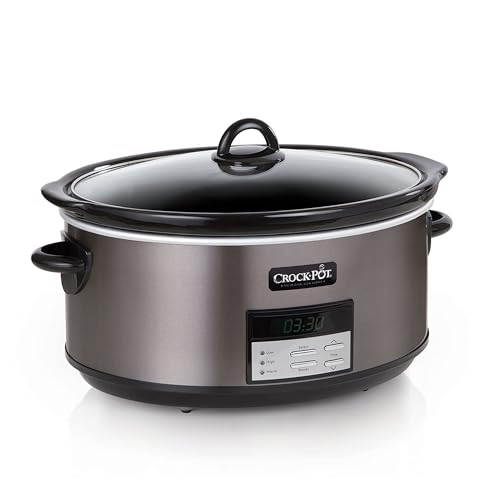
2. Crock-Pot 8 Quart Programmable Slow Cooker
A programmable large Crock-Pot with a countdown timer that switches to warm when cooking ends. It is useful when you are out all day. The switch to warm helps keep food safe and ready when you return.
Suits: work-day meals. Strengths: automatic warm switch. Weaknesses: extra buttons. Skip it if you prefer a basic dial.


Best for potlucks
3. Crock-Pot Cook and Carry Slow Cooker
A slow cooker with a locking lid and a carry handle, built for taking hot food to parties and church suppers. The seal helps limit spills. Lid clips or latches vary by version, so read the listing. Its simple controls suit casual cooks.
Suits: potlucks. Strengths: locking lid. Weaknesses: a tight lid is slightly harder to open. Skip it if you only cook at home.
Best for serving lines
4. Crock-Pot Lift and Serve Slow Cooker
A hinged lid design that rests open on the cooker so you can serve without finding a place for the lid. It stays tidy at a buffet. This design also suits dips and meatballs that guests serve themselves.
Suits: serving lines. Strengths: hinged lid and easy access. Weaknesses: a slightly larger lid. Skip it if you want a simple dome lid.
View Crock-Pot Lift and Serve on Amazon
Best for flexible batch sizes
5. Crock-Pot Choose-A-Crock Slow Cooker
A programmable slow cooker that comes with interchangeable crocks, so you can swap between sizes or cook two dishes. Check what comes in the box. It is a good fit for cooks who vary batch sizes.
Suits: flexible batch sizes. Strengths: multiple crocks. Weaknesses: storage for the extras. Skip it if you want one pot only.
View Crock-Pot Choose-A-Crock on Amazon

Best for entertaining
6. Crock-Pot Triple Slow Cooker
A multi-pot unit with three separate crocks that cook at once, handy for appetizers, sides and a main on one table. Each crock has its own control. It is a smart choice for game days and holiday tables.
Suits: entertaining. Strengths: three dishes at once. Weaknesses: a bigger footprint. Skip it if you cook one big dish.

Care and Setup
- Let the crock cool before washing to avoid cracking.
- Fill the pot at least half full for even cooking.
- Wash the lid and gasket, and dry the base without immersing it.
- Keep the lid on while cooking, since lifting it loses heat. Let large roasts rest before slicing.
Mistakes to Avoid
- Putting a cold crock into a hot base.
- Using the high setting for tough cuts without liquid.
- Overfilling the crock to the brim.
- Leaving a cooked dish on warm for many hours.
Oval or Round: Choosing the Crock Shape
For a big slow cooker, the shape of the crock decides what fits as much as the quart size does. Oval crocks are longer and suit roasts, whole chickens, racks of ribs and long cuts that would not lie flat in a round pot. They give you more surface area for browning and let the meat sit in a single layer. Round crocks suit soups, chili, dips, stews and sauces that are stirred, since there are no corners where food can sit and scorch.
If you plan to cook large cuts of meat, check the interior length and width on the listing rather than relying on the quart number alone. A pork shoulder or brisket that barely fits may touch the lid or the heating wall and cook unevenly. If you cook mostly liquid-based dishes, a round pot may be easier to stir and clean.
Consider storage as well. A large oval takes more shelf space and may not fit in a small cabinet. Round pots are usually more compact for their capacity. Look at the lid shape, too. A tall dome gives clearance for large roasts, while a flat lid saves storage room. If you cook for parties, think about how the pot will sit in the car and on the buffet table. If you want one pot to do everything, an oval is the more flexible choice for meat, while a round one favors soups and dips. Some households keep both a large oval and a smaller round pot.
Quart Size and Serving Math
Quart size is a measure of volume, not of how much food you can cook well. Most manuals recommend filling a slow cooker between about half and three-quarters full for good results, so an eight-quart pot works best for batches that fill it that far. Too little food can cook faster and dry out, while too much can cook unevenly or bubble over. Look at the fill guidance in the manual for your model.
Estimating servings depends on the recipe. Soups and stews yield more portions per quart than dense roasts, because much of the volume is liquid. A pot that serves a crowd of soup may serve fewer people when you cook a large piece of meat with bones. When in doubt, think about the biggest dish you plan to cook, not the average one, and check that it fits with room for the lid to close.
Think about weight and handling. A large crock filled with food can be heavy, and the insert may be hard to lift when hot. Handles on the crock and the base make carrying safer. If you will move it between kitchen and table, check whether the insert can be lifted out and whether the base has handles. Also consider counter space and cord reach. A large pot needs a stable spot away from the edge and away from cabinets that could be damaged by steam. For very large households or parties, a multi-pot design offers more flexibility than one giant crock.
Lid Styles and Serving Features
The lid affects how the cooker is used at home and away. A simple glass dome lid lets you see food without lifting it, which helps keep heat inside. Lids with clips or latches help in transport, since they hold the lid on while you carry the pot to a party. Hinged lids that rest in an open position can be handy for serving lines, because you do not need to put the lid down on a counter. Some lids have a gasket that improves the seal, and these need regular cleaning.
Think about how you will use it. If you often take food to gatherings, a locking lid or a carry handle is practical, but a tight seal can be harder to open, and it may not be right for every dish. Be careful when moving a pot filled with hot liquid, as a seal does not make it spill-proof. Let the pot cool slightly if possible and keep it level in the car.
Serving features include a warm setting that holds food at serving temperature after cooking, spoon rests or a built-in ladle holder, and a removable crock that can go to the table. Not every feature is needed. If you rarely transport food, a plain lid is fine. Check the listing for whether lid parts are dishwasher safe, and how the gasket should be cleaned. Always follow food safety advice for how long cooked food can stay on warm, and refrigerate leftovers promptly.
Programmable Timers and Food Safety
A programmable slow cooker lets you set a cooking time and then switches to a warm setting when the time ends. This is helpful if you are away during the day, since food does not keep cooking at full heat after it is done. A manual dial is simpler and often lasts a long time, but you must be there to switch it off or accept longer cooking. The decision comes down to your schedule and how much you want to rely on automation.
Food safety applies to every slow cooker. Start with food that is thawed unless the manual states otherwise, since frozen blocks of meat can take too long to reach safe temperatures. Keep the lid on, since lifting it releases heat and adds cooking time. Use the low or high setting recommended in the recipe, and make sure meat reaches a safe internal temperature measured with a thermometer. Do not leave cooked food on warm for many hours, and refrigerate leftovers within the time advised by food safety authorities rather than letting them sit in the pot.
Power outages and timers need attention. If the power goes out during cooking and you are not sure how long it lasted, discard the food rather than risk it. Do not reheat leftovers in the crock itself unless the manual says it is safe, since many cookers are designed for cooking, not for reheating cold food. Use a stove or microwave instead, then transfer to the pot to keep warm if needed. Check the cord and plug regularly and avoid using damaged parts.
Cleaning and Caring for a Large Crock
A big crock holds a lot of residue, so cleanup matters. Let the insert cool before washing to avoid thermal shock, which can crack stoneware. Soak stuck-on food in warm soapy water, then use a soft sponge. Avoid abrasive pads that scratch glazed surfaces. Many inserts and lids are dishwasher safe, but a large insert can be bulky for a dishwasher, so check your rack space and the manual.
Never immerse the base or the cord in water. Wipe the exterior with a damp cloth and dry it. Keep the heating surface free of spills, and check that food has not dripped between the insert and the base. If your cooker has a lid gasket or vent, clean it regularly and replace it if it becomes brittle or stained.
Storage also matters. Make sure the crock is fully dry before putting the lid on, and consider leaving a paper towel between the lid and pot to allow air circulation. Do not stack heavy items on the lid. Inspect the stoneware for chips or cracks, which can harbor bacteria and may spread. If you see a crack, stop using the insert and replace it. Keep the manual for temperature limits and oven or stovetop guidance, since not every insert may be used on a burner. A well-maintained slow cooker can serve a household for many years, but replace it when the heating becomes unreliable.
A Quick Checklist Before You Buy a Large Slow Cooker
Big cookers are handy for gatherings, but they take up room and need planning.
- Measure your counter, the cabinet where it will be stored and the clearance beneath wall cabinets.
- Think about the biggest dish you cook, such as a roast, a pot of chili or a tray of meatballs.
- Check the weight of the crock when full, since large ones can be heavy to carry.
- Look at the cord length and where the nearest outlet sits.
- Decide if you want manual dials or a programmable timer.
A bigger crock is not always better. Cooking small amounts in a very large pot may not suit the maker’s fill guidance, so check the manual for minimum and maximum levels.
Choosing by Situation
| Situation | What may fit |
|---|---|
| Big family dinners | An eight quart oval crock |
| Potluck or party travel | A model with a locking lid and carry handles |
| Serving several dishes at once | A multi-pot or divided unit |
| Busy workdays | A programmable timer that switches to a warm setting |
| Small kitchen | A compact body with a lid that stores neatly |
Think about where the cooker will sit while it runs. Leave space around it and keep the cord away from the edge of the counter.
Slow Cooker Words in Short
- Crock: the removable ceramic pot that holds the food.
- Base: the heating unit the crock sits in.
- Warm setting: a low temperature meant for holding finished food.
- Locking lid: a lid with clips or a latch for travel.
- Fill line: a mark or guidance on how full the crock may be.
- Programmable: able to set a cooking time and then switch automatically.
Common Slips With Big Batches
Do not overfill. Follow the fill guidance in the manual. Cut meat and vegetables into even pieces so they cook together, and keep the lid on, since each peek lets heat escape. Never lift a hot crock without grips or mitts, and do not move the crock from the fridge directly to the base unless the maker approves it. For food safety, follow official guidance on temperatures and on how long cooked food may be held.
Big Batch Cooking Tips
A large slow cooker invites big-batch meals. Follow the maker manual and official food safety guidance on filling levels, cooking times and storage.
- Fill the pot within the range the manual recommends.
- Cut ingredients to a similar size so they cook evenly.
- Keep the lid closed during cooking.
- Place root vegetables near the bottom.
- Cool leftovers promptly and store them in smaller containers.
- Remove the insert only when it is cool enough to handle.
Make sure the cooker sits on a heat-tolerant surface.
Manual, Programmable or Carry Style
| Type | Good for | Consider |
|---|---|---|
| Manual | Simple dial use | You manage the timing |
| Programmable | Set and switch to warm | More buttons |
| Carry style | Potlucks | Check latch design |
| Serving style | Parties | Takes counter space |
Choose the one that fits your schedule.
Cleaning and Storing a Big Cooker
A large insert is heavy and bulky, so cleaning needs a plan. Follow the manual for your model.
- Let the insert cool before washing it.
- Wash by hand or in a dishwasher only if the manual allows.
- Soak stuck-on food with warm water and soap.
- Wipe the base with a damp cloth and never submerge it.
- Dry all parts before storing.
- Keep the lid with the cooker so it does not go missing.
Store the insert where it will not be bumped, because the ceramic can chip.
Plan the counter space before the first use. A large cooker is wide and tall, and the lid may steam or drip when lifted, so leave room around it and a spot to rest the lid. Keep the cord clear of the hot sides. Check the capacity in the listing against your usual recipes.
Think about how you will carry it to a party, and whether the lid locks securely.
Large Crock-Pot FAQ
What size counts as large?
Look for models in the upper range of the Crock-Pot line, and compare the quart figure on the listing.
Can I put the crock in the oven?
Some crocks can, but check the manual for temperature limits and lid guidance.
Manual or programmable?
Manual is simpler. Programmable is better if you will be away while it cooks.
Is a larger slow cooker harder to use?
Not really, but it needs more liquid and a longer cook time to fill the volume.
How full should I fill a slow cooker?
Most manuals suggest between about half and three-quarters full for best results. Check your model's guidance, since overfilling can cause uneven cooking and spills.
Can I cook frozen meat in a slow cooker?
Many manuals advise thawing first, because frozen meat may take too long to reach a safe temperature. Follow your manual and use a thermometer to check doneness.
Is a locking lid safe for transport?
It helps hold the lid on but is not spill-proof. Keep the pot level, let it cool a little if you can, and do not carry it when it is full of boiling liquid.
Can I leave it on while I am at work?
Many people do, especially with a programmable model that switches to warm. Follow the manual and food safety guidance, and keep the cooker on a stable surface away from clutter.
Why is my food watery?
Slow cookers trap moisture, so food releases liquid that stays in the pot. Use less added liquid, or thicken the sauce at the end according to the recipe.
Can the stoneware crock go in the dishwasher?
Many can, but check the manual. Let it cool first, since sudden temperature changes can crack stoneware.
How do I reheat leftovers?
Use a stove or microwave, then keep warm in the pot if needed. Many manuals say not to reheat cold food in the slow cooker itself.
When should I replace the crock?
Replace it if you see cracks or chips, or if it no longer heats evenly. Check the manual for guidance on replacement inserts.
How to Judge Large crock pots slow cookers by the Meals You Actually Cook
Start with your own week, not with the marketing. Write down the dishes you make most often with an appliance like this, how many people you cook for, and how much time you usually have. A choice among large crock pots slow cookers only makes sense once those answers are clear, because the right size, layout and control style for a household that cooks from scratch every night is different from the right one for a household that reheats, batch cooks at weekends, or feeds a crowd a few times a month. The picks in this guide cover a range of shapes and approaches, so match the format to the routine first and only then compare the details on each listing.
Think about the largest job you ask the appliance to do, and the smallest. Many buyers shop only for the biggest load, a holiday meal or a double batch, and then live every day with a unit that feels clumsy for a single portion. The reverse mistake is just as common: a compact format that is pleasant for weeknight dinners but forces endless rounds when guests arrive. A good middle path is a size that handles your ordinary meals in one go, with a sensible plan, such as a second tray, a paired side dish, or a simple hold-warm routine, for the occasional big occasion.
Pay attention to how the controls fit the way you cook. Some people want presets that remove guesswork on familiar foods, while others prefer simple dials or buttons they can adjust without looking. Neither approach is better in the abstract. What matters is whether you can set, check and change the cooking partway through without fuss, whether the display is readable in your kitchen light, and whether the settings you will use weekly are easy to reach rather than buried. Check the listing and the manual for the exact control layout before you decide.
Use Cases Worth Planning For
Busy weeknights
On a weeknight the best appliance is the one you will actually use when you are tired. That means a short setup, a cooking surface or cavity that takes the food without rearranging the kitchen, and a cleanup you can face the same evening. When comparing large crock pots slow cookers, picture your most common weeknight meal from start to finish: where the appliance sits, what you set first, what you check halfway, and what gets washed afterwards. If any step sounds like a chore you would avoid, that model will slowly stop being used, whatever its other strengths.
Weekend batch cooking
Batch cooking rewards capacity and consistency. You want to run the same food in repeated rounds and get the same result each time, so even heating, a clear view of progress and parts that cool and clean quickly between rounds all matter. Plan the holding side of the job too: cooked food needs a clean tray, a covered dish or a low oven to wait in while the next round runs. Working through that sequence on paper, using the formats described in this guide, quickly shows which pick suits a cook who prepares lunches for the week in one session.
Cooking for guests and holidays
Entertaining changes the priorities. Timing matters more than novelty: dishes should finish close together, and the appliance should not demand constant attention while you are hosting. Think about which parts of a larger menu this appliance can own completely, and which parts belong elsewhere in the kitchen. A realistic plan, written before the day, beats a hopeful one. Also consider noise, steam and heat in the room where people gather, and whether the appliance can be moved or turned so its vents and doors work comfortably around serving dishes and helpers.
Setup, Placement and the First Week of Use
Unpack and set up slowly, even if the appliance looks simple. Keep the manual, check every part against the parts list, and wash the removable pieces that the maker says to wash before first use. Place the unit where it will live rather than where it is convenient on day one, because large crock pots slow cookers that have to be dragged out of a cupboard for every use tend to be used less. Confirm the surface is level and heat-safe where relevant, that cords reach the outlet without stretching, and that doors, lids and baskets can open fully without striking cabinets or walls.
Run the first few sessions with familiar food. A recipe you already know gives you a baseline, so any difference in timing or browning is information about the appliance rather than about an untested recipe. Take short notes during the first week: what you cooked, the setting you chose, what you would change. Those notes are worth more than memory, because small adjustments, a minute more, a stir halfway, a different tray position, are exactly how people get consistent results from a new appliance in their own kitchen.
Build a small routine around storage of the accessories. Trays, racks, probes, lids and spare parts get lost or damaged when they live in different drawers. Keep the pieces that belong to the appliance together, near where it is used, and keep the manual or a photo of its key pages in the same place. If other people in the household will use the appliance, walk them through the basics once: how to set it, how to check food safely, and what must be allowed to cool before washing. Shared understanding prevents most early mistakes.
Cleaning, Care and Keeping Results Consistent
Clean little and often. Food residue that is wiped away while it is fresh is a two-minute job; the same residue baked or dried through several more sessions becomes the hardest task in the kitchen and can affect flavour and smoke. Follow the maker guidance on which parts can be soaked, which are dishwasher-safe and which should be washed by hand, and never guess with coated surfaces. Use soft cloths and non-scratch tools on non-stick finishes, dry parts fully before reassembling, and leave doors or lids ajar where the manual allows so the interior airs out.
Keep a simple care rhythm. After each use, deal with crumbs, drips and splashes. Once a week, or after a run of rich or fatty foods, give the interior and removable parts a fuller clean. Periodically check the parts that move or seal: hinges, latches, gaskets, vents and filters where fitted. A surprising number of performance complaints trace back to a vent blocked by storage, a seal with crumbs in it, or a tray warped or loaded so air or heat cannot circulate. The manual for your model is the authority on what can be removed and how.
Store the appliance and its parts with the next use in mind. Cords should be looped loosely rather than wound tight or trapped under the unit. Heavy accessories stored on top can mark finishes or stress lids and doors. If counter space forces you to store the appliance away, measure the cupboard or shelf honestly, including the height with its lid or door closed and the depth with the cord behind it. A model that fits its storage place neatly is far more likely to stay in regular use than one that has to be wrestled in and out.
Comparing the Picks in This Guide, One by One
Crock-Pot 8 Quart Manual Slow Cooker: what to check before you choose it
Look at the Crock-Pot 8 Quart Manual Slow Cooker through the questions this guide has built up. Start with how its overall size and shape will sit in the space you have measured, and whether its day-to-day routine matches the way your household actually works. Then re-read the original description of this pick earlier in the article, including who it suits and the honest limitation noted there, and test those points against your own notes rather than against a general idea of what a good purchase looks like. If the strength named for the Crock-Pot 8 Quart Manual Slow Cooker answers your main problem and its limitation touches something you rarely do, it is a strong candidate. If the reverse is true, keep moving, even if the pick is popular.
Crock-Pot 8 Quart Programmable Slow Cooker: what to check before you choose it
Look at the Crock-Pot 8 Quart Programmable Slow Cooker through the questions this guide has built up. Start with what its listing says about the parts you will handle and wash most often, and whether that cleaning routine is one you will keep up without resentment. Then re-read the original description of this pick earlier in the article, including who it suits and the honest limitation noted there, and test those points against your own notes rather than against a general idea of what a good purchase looks like. If the strength named for the Crock-Pot 8 Quart Programmable Slow Cooker answers your main problem and its limitation touches something you rarely do, it is a strong candidate. If the reverse is true, keep moving, even if the pick is popular.
Crock-Pot Cook and Carry Slow Cooker: what to check before you choose it
Look at the Crock-Pot Cook and Carry Slow Cooker through the questions this guide has built up. Start with how its format lines up with the use cases described earlier in this guide, especially the meals or loads you repeat every week rather than the ones you cook once a year. Then re-read the original description of this pick earlier in the article, including who it suits and the honest limitation noted there, and test those points against your own notes rather than against a general idea of what a good purchase looks like. If the strength named for the Crock-Pot Cook and Carry Slow Cooker answers your main problem and its limitation touches something you rarely do, it is a strong candidate. If the reverse is true, keep moving, even if the pick is popular.
Crock-Pot Lift and Serve Slow Cooker: what to check before you choose it
Look at the Crock-Pot Lift and Serve Slow Cooker through the questions this guide has built up. Start with whether the controls and layout described for it suit the person who will use it most, including anyone who cooks less confidently and needs a setup that explains itself. Then re-read the original description of this pick earlier in the article, including who it suits and the honest limitation noted there, and test those points against your own notes rather than against a general idea of what a good purchase looks like. If the strength named for the Crock-Pot Lift and Serve Slow Cooker answers your main problem and its limitation touches something you rarely do, it is a strong candidate. If the reverse is true, keep moving, even if the pick is popular.
Crock-Pot Choose-A-Crock Slow Cooker: what to check before you choose it
Look at the Crock-Pot Choose-A-Crock Slow Cooker through the questions this guide has built up. Start with what is actually included in the box according to the current listing, since versions and bundles change, and whether anything you are counting on is listed as an optional extra. Then re-read the original description of this pick earlier in the article, including who it suits and the honest limitation noted there, and test those points against your own notes rather than against a general idea of what a good purchase looks like. If the strength named for the Crock-Pot Choose-A-Crock Slow Cooker answers your main problem and its limitation touches something you rarely do, it is a strong candidate. If the reverse is true, keep moving, even if the pick is popular.
Crock-Pot Triple Slow Cooker: what to check before you choose it
Look at the Crock-Pot Triple Slow Cooker through the questions this guide has built up. Start with how it compares with the pick listed just before and just after it in this guide on the single question that matters most to you, because narrowing by your top priority is the fastest honest way to choose. Then re-read the original description of this pick earlier in the article, including who it suits and the honest limitation noted there, and test those points against your own notes rather than against a general idea of what a good purchase looks like. If the strength named for the Crock-Pot Triple Slow Cooker answers your main problem and its limitation touches something you rarely do, it is a strong candidate. If the reverse is true, keep moving, even if the pick is popular.
Mistakes That Lead to Disappointing Results
Overloading and crowding
More food in one round rarely means a better meal. Crowding blocks the movement of hot air or steam, traps moisture and leaves some pieces overdone while others lag. The fix is unglamorous: cook in a single, spaced layer where the food needs dry heat, stir or turn at the halfway point where the recipe suggests it, and accept a second round for large amounts. Results improve immediately, and the total time is often no longer than one crowded round that has to be rescued at the end.
Trusting a preset without checking
Presets and default settings are starting points built around average portions and average starting temperatures. Frozen food, a thicker cut, a fuller load or a cold tray all shift the timing. Check progress a little before the expected end, use a food thermometer where the food calls for one, and treat doneness cues, colour, texture and temperature together, as more reliable than any single timer. Once you have cooked a dish twice in the same appliance, write down the setting that worked; your own record beats any generic chart.
Skipping the manual on materials
Not every dish, liner, rack or utensil suits every appliance. Heat limits, coatings and clearances differ, and the wrong accessory can damage a finish or spoil a meal. Before using foil, parchment, silicone, glass or metal inside a model you have not owned before, check what its manual permits and how it should be placed so circulation and sensors still work. The same care applies to sprays and cleaning products: if the maker warns against a type of coating spray or abrasive, that warning is there because it shortens the life of the surface.
A Calm Final Decision Worksheet
Before you order, answer five questions in writing. What will I cook most often? What is the largest load I realistically need? Where will it live, and have I measured that space including clearance and door swing? Which parts will I wash most, and am I happy with how they clean? And which pick in this guide matches those answers with the fewest compromises? Scoring each of the picks against the same five questions turns a vague preference into a decision you can defend, and it usually makes one option stand out clearly.
Finally, re-read the current listing for the model you choose on the day you buy. Versions, included accessories and bundles change, and the listing is where the exact configuration is stated. Confirm the size, the included parts and the care instructions match what this guide led you to expect, and keep your order details and the manual together. If two picks still feel equal after all of this, choose the one whose controls and cleaning routine fit your daily habits better; that is the tiebreaker that matters most over years of ordinary use.
Adapting Familiar Recipes to a New Appliance
Expect almost every familiar recipe to need a small translation. A different cavity shape, basket depth or heating arrangement changes how quickly surfaces brown and how evenly the middle cooks, even at the same marked setting. Change one element at a time, the setting, the timing, the load or the position, and judge by the food rather than by the clock alone. After two or three attempts at the same dish you will have a conversion you trust, and that personal conversion is worth writing on the recipe itself so future you does not have to rediscover it.
Build a small settings library for your household staples. A single page, kept with the manual or photographed on your phone, listing the dish, the amount, the setting and the result, turns guesswork into routine within a month. Include the failures as well as the successes, because knowing that a particular load was too deep or a particular dish dried out at a higher setting saves you from repeating the experiment. This habit matters more as the appliance ages into everyday use, when nobody wants to think hard about a Tuesday dinner.
Think about how the appliance works alongside the rest of the kitchen rather than in isolation. The most useful setups share the work: one dish holding, one cooking, one fresh element prepared on the counter. Planning that division before you start, even roughly, prevents the bottleneck where everything needs the same appliance in the same ten minutes. It also reveals the true value of capacity and layout, because an appliance that can be loaded, set and left alone frees the cook for everything else the meal needs.
More Questions Buyers Ask About Large crock pots slow cookers
Should I buy the largest size available?
Only if your cooking justifies it. A larger appliance takes more counter or storage room, more washing and often more time to preheat or to handle, while a size matched to your normal meals is quicker and easier every day. Use the biggest load you cook regularly, not the biggest you can imagine, as your guide, and plan a workaround for rare occasions.
How do I know if it will fit my kitchen?
Measure the space where it will live, including height under cabinets, depth for the cord and clearance for doors, lids or baskets to open, then compare those numbers with the dimensions on the listing. Also measure the route it takes if you plan to store it away. A model that fits the counter but cannot be put away comfortably will slowly take over the kitchen.
What should I cook first in a new appliance?
Choose a familiar dish you have made many times by another method. You will spot differences in timing and browning straight away, and you can adjust with confidence. Take a short note of the setting and the result, and change one thing at a time on the next attempt. Within a few sessions you will have your own reliable settings for your staple meals.
Do I need special accessories to get good results?
Usually not at first. Learn the appliance with the parts included in the box, and note anything you genuinely miss while cooking, a second tray, a rack, a particular dish, before buying extras. Accessories bought to solve a real, repeated problem earn their storage space; accessories bought speculatively tend to fill drawers. Always check the manual for which materials and sizes the maker allows.
How can I stop food cooking unevenly?
Look first at loading and arrangement. Spread food out, avoid deep stacking, turn or stir where the recipe suggests it, and do not block vents or circulation paths. Check that the appliance sits level and that seals and doors close properly. If one area consistently runs hotter, rotate the tray or basket partway through; most appliances have a character, and cooking with it, rather than against it, fixes most unevenness.
The Short Version
For simple use, the Crock-Pot 8 Quart Manual. For a timer, the programmable model. For travel, the Cook and Carry. For serving, the Lift and Serve. For flexible sizes, the Choose-A-Crock. For parties, the Triple. Check the quart size before ordering. Match the crock shape to the foods you cook most.