Disclosure: airfryerkitchensupply.com is reader-supported. When you buy through links on our site, we may earn an affiliate commission at no extra cost to you.
Where to buy
All six pillows below were verified through Amazon’s catalog data on the airfry site’s own API connection before being listed: MEGCXIT Leg Elevation Pillow (23.6×16.8×8 in) for the classic full-width wedge, KingPavonini Adjustable Leg Elevation Pillow for cooling gel foam and height adjustment, Kölbs Leg Elevation Pillow (Flat Top, 7 in) for a stable flat resting surface, TranquilRelax Leg Elevation Pillow for a single-leg U-shaped cradle, CRAURU Leg Elevation Pillow for a trapezoidal shape with a carry handle, and Kehangte Leg Elevation Pillow for four height settings at a budget tier. Measure your leg length and your bed width before ordering — elevation pillows are bulky, and the right height matters more than any other spec.
What a knee lifter pillow actually does
People searching for the best knee lifter pillows usually mean one specific product: a firm foam wedge or contoured pillow that rests under the calves and knees to lift the legs while you lie on your back. It is not the small hourglass pillow that goes between the knees of a side sleeper — that is a different product for a different position, and this guide does not mix the two. A knee lifter supports both legs (or, in single-leg designs, one leg) on an incline, so the knees rest slightly raised and the lower legs sit higher than they would flat on the mattress. People use them for evening rest after long days on their feet, for back sleeping with the knees comfortably raised, and — very commonly — during recovery periods at home when a clinician has advised keeping a leg raised.
Two honesty points frame this whole guide. First, these are comfort and support products, not medical devices, and this article makes no medical claims for them: if a clinician has given you specific elevation instructions after a procedure, follow those instructions and treat this list as a shopping aid for the physical product, not as advice. Second, the manufacturers’ own listings use recovery-oriented language, because that is the biggest audience for these pillows; we have deliberately described each pick by its verifiable physical features — dimensions, height, foam type, shape, cover — rather than repeating outcome claims. What you are buying is geometry and foam. Choose the geometry carefully and the pillow will do its simple job well.
In this guide
Quick Picks
| Pick | Badge | Key spec | Best for |
|---|---|---|---|
| MEGCXIT Leg Elevation Pillow | Best Overall | 23.6×16.8×8 in memory foam wedge | Back sleepers, both legs |
| KingPavonini Adjustable Leg Elevation Pillow | Best Adjustable | Cooling gel memory foam, non-slip, handles | Dialing in your height |
| Kölbs Leg Elevation Pillow | Best Flat Top | Flat top wedge, 7 in height | A stable, level resting surface |
| TranquilRelax Leg Elevation Pillow | Best Single-Leg | U-shaped cradle, adjustable height | Raising one leg only |
| CRAURU Leg Elevation Pillow | Best Portable | Trapezoidal, handle, removable cover | Moving between bed and sofa |
| Kehangte Leg Elevation Pillow | Best Budget | 4-height adjustable, single-leg, washable cover | Trying elevation affordably |
How These Picks Were Chosen
Every candidate was verified connection of this site, and the filters were strict. First, the product had to be a true knee lifter / leg elevation pillow: a wedge or contoured bolster that raises the legs of a back sleeper. Between-knee pillows for side sleepers — a large adjacent category — were excluded even when their listings mentioned knees prominently, because they solve a different problem. Second, the listing had to state real physical specifications: dimensions, a height, a foam type, or a shape feature we could describe honestly. Third, complete pillows only — no inserts, covers sold alone, or accessories. Fourth, we spread the six picks across the shapes that actually exist in this category: a standard full-width wedge, an adjustable model, a flat-top design, two single-leg cradles at different tiers, and a trapezoidal portable, so the choice becomes about your body and your sleeping position rather than about six copies of one wedge.
A note on the category’s language: nearly every listing in this niche is written for post-procedure recovery shoppers, and titles reflect that. We verified the products, not the promises. Where a pick’s height or dimensions are stated, we print them; where a detail like foam density is not stated in the catalog data, the review says so rather than guessing. Elevation comfort is mostly a matter of height and fit, and those are the numbers we prioritized.
The 6 Best Knee Lifter Pillows

MEGCXIT Leg Elevation Pillow (23.6×16.8×8 in) — Best Overall
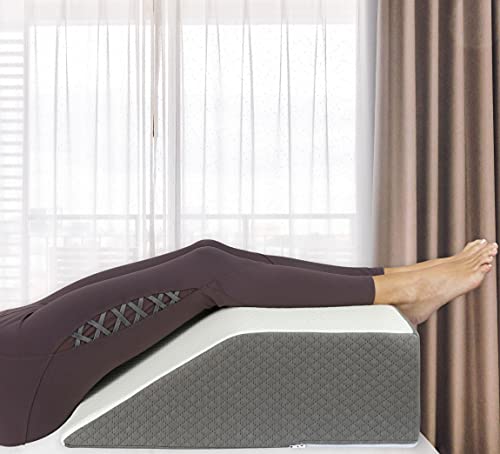
The MEGCXIT is the straightforward reference design for this category: a memory foam leg wedge measuring 23.6 by 16.8 inches with an 8-inch height, in a white and grey colorway, shaped to support both legs of a back sleeper with the knees resting on the incline. Eight inches is a substantial lift — the middle-to-upper range of what these pillows offer — and the 16.8-inch width gives both calves room without forcing the legs together. For a first knee lifter bought for general evening rest and back sleeping, this is the shape and size most people mean, executed without gimmicks.
Strengths
- Full stated dimensions — 23.6×16.8×8 in — so you can measure your bed and legs before buying.
- Memory foam surface softens the incline where the calves and heels rest.
- Both-leg width suits back sleepers who want symmetrical support.
Trade-offs
- An 8-inch fixed height cannot be lowered; shorter legs or a preference for gentle lift may suit an adjustable pick better.
- Both-leg design is the wrong tool when only one leg should be raised.
- Cover washability is not stated in the catalog title data — check the product page before assuming it removes.
Spec box: Dimensions: 23.6×16.8×8 in (per listing). Foam: memory foam (per listing). Design: both-leg wedge for back sleeping. Colorway verified: White/Grey. Cover: not stated in listing title data.
In use, a wedge like this lives at the foot of the bed or on the sofa and gets pulled into place for reading, television, and sleep. The memory foam top layer matters most at the heel and the calf’s narrowest point, where a plain foam wedge can feel like a plank edge; the incline should meet the leg smoothly, with no ridge pressing into the back of the knee. Position it so the knees rest just past the crest of the slope — that placement, more than any brand difference, decides whether a lifter feels supportive or strange. Check the current price on Amazon.
Best for: back sleepers wanting a classic both-leg wedge at a full 8-inch lift. / Not suited for: single-leg use or anyone who wants height adjustment.

KingPavonini Adjustable Leg Elevation Pillow — Best Adjustable
KingPavonini’s adjustable model answers the fixed wedge’s main weakness: it lets the user change the elevation height, and it builds the pillow from cooling gel memory foam with a breathable, washable cover, a non-slip base, and four carry handles. The listing notes it is designed to fit all heights — which is the honest point of adjustability, since the right lift for a 5’2″ frame and a 6’1″ frame are not the same number of inches. The gel-infused foam addresses the other common wedge complaint, warmth: a large foam block under the legs all night can feel hot, and gel foam plus a breathable cover is the category’s standard answer.
Strengths
- Adjustable height adapts the lift to your leg length and preference.
- Cooling gel memory foam and breathable cover for warmer sleepers.
- Non-slip base and four handles — it stays put and moves easily between rooms.
Trade-offs
- Adjustable designs cost more than fixed wedges within this category’s tiers.
- Exact height settings are not enumerated in the catalog title data — check the product page for the specific heights before ordering.
- Larger and heavier than a basic wedge; measure your storage spot.
Spec box: Foam: cooling gel memory foam (per listing). Height: adjustable (settings not stated in title data). Base: non-slip (per listing). Handles: 4 (per listing). Cover: breathable, washable (per listing).
This is the pick for households where the pillow will serve more than one person, or for a single user who honestly does not know their ideal height yet — which is most first-time buyers. Start at a middle setting for a few nights before judging; the temptation is to max the height immediately, and a moderate lift worn consistently beats a dramatic lift abandoned after two nights. The handles sound minor until the first time you carry the pillow downstairs one-handed with a cup in the other hand. Check the current price on Amazon.
Best for: shared use, uncertain height needs, and warm sleepers. / Not suited for: buyers who want the simplest, lowest-tier fixed wedge.
Kölbs Leg Elevation Pillow, Flat Top (7 in) — Best Flat Top
Most leg wedges peak in a curve or a point; the Kölbs design ends in a flat top, and that plateau is a genuinely different resting experience. The listing describes a flat top bed wedge bolster for legs — foot, knee, and ankle elevation — at a 7-inch flat-top height. On a flat top, the calves rest on a level surface rather than draping over a crest, which many users find steadier and easier to keep positioned through the night, especially restless sleepers whose legs migrate on a curved wedge. Kölbs is also an established name in the wedge-pillow space, which matters in a category full of newcomers.
Strengths
- Flat top gives a stable, level platform that legs stay parked on.
- 7-inch height is a moderate lift — substantial without being extreme.
- Bolster format works on the bed or a firm sofa.
Trade-offs
- Fixed height and fixed shape: no adjustment if 7 inches is not your number.
- Foam type is not stated in the catalog title data — check the product page if foam composition matters to you.
- The flat top’s firmer feel will not suit users who specifically want a cradling curve.
Spec box: Height: 7 in, flat top (per listing). Design: bed wedge bolster for both legs. Foam type: not stated in listing title data. Cover details: not stated in listing title data.
Choose the flat top if you have tried a curved wedge and spent the night chasing it, or if you simply prefer the predictability of a level surface — reading in bed with both calves resting flat is this design’s home turf. Seven inches also suits users who found an 8-inch wedge slightly too much: in this category, one inch is a real difference, and the moderate height is a feature, not a shortfall. Pair it with a pillow under the head as usual; the wedge only handles the leg end of the arrangement. Check the current price on Amazon.
Best for: restless sleepers and anyone who prefers a level resting surface at moderate height. / Not suited for: users wanting a contoured cradle or adjustable height.

TranquilRelax Leg Elevation Pillow, Single-Leg — Best Single-Leg
When only one leg needs raising — one knee is the sore one, one ankle is the one being rested — a both-leg wedge forces the other leg up too or leaves it dangling off the side. The TranquilRelax answers with a single-leg design: a U-shaped cradle that cups one leg and holds it centered, with adjustable height and supportive memory foam under a washable cover, in grey. The cradle is the key feature: a single leg on a flat wedge rolls off sideways during sleep, while the U-channel keeps it aligned without straps or effort from the sleeper.
Strengths
- U-shaped cradle keeps a single leg centered and aligned through the night.
- Adjustable height within a single-leg format — a rare combination.
- Washable cover over supportive memory foam.
Trade-offs
- One leg only, by design; both-leg users should look at the MEGCXIT or Kölbs picks.
- Specific height settings are not enumerated in the catalog title data — verify on the product page.
- The cradle fits a range of leg sizes, but very large calves should check the channel dimensions on the listing.
Spec box: Design: single-leg, U-shaped cradle (per listing). Height: adjustable (settings not stated in title data). Foam: memory foam (per listing). Cover: washable (per listing). Colorway verified: Grey.
The single-leg cradle is the most specialized shape in this guide and, for its intended user, the most valuable. It also earns a place in ordinary comfort life: the reader who rests one leg after a long shift, the runner nursing one tired knee on rest days (comfort, not treatment — the distinction this guide maintains). The washable cover matters here more than anywhere, because a single-leg pillow tends to become one person’s dedicated, nightly equipment. Check the current price on Amazon.
Best for: raising one leg with it kept centered — the recovery-shaped use case and one-sided rest. / Not suited for: both-leg elevation.

CRAURU Leg Elevation Pillow, Trapezoidal — Best Portable
The CRAURU takes a trapezoidal form — a broad base rising to a narrower top — with a carry handle and a removable cover, in grey. The trapezoid is a stability-first shape: the wide footprint resists tipping and sliding on both bed and sofa, and the geometry gives the legs a firm, predictable incline. The handle sounds like a small thing until the pillow’s daily migration begins, because elevation pillows rarely live in one room — they travel between the bed, the sofa, and the recliner, and a bulky foam shape without a handle is an armful every single time.
Strengths
- Trapezoidal wide-base shape stays planted on beds and sofas.
- Carry handle makes a bulky pillow genuinely portable around the house.
- Removable cover for washing — essential for a pillow that lives on the sofa too.
Trade-offs
- Exact dimensions and height are not stated in the catalog title data — measure against the product page specs before ordering.
- Foam type is not stated in the listing title data.
- The trapezoid’s firm, simple incline lacks the contoured cradle of the single-leg picks.
Spec box: Shape: trapezoidal (per listing). Cover: removable (per listing). Handle: yes (per listing). Dimensions, height, and foam type: not stated in listing title data — flagged honestly rather than estimated.
This is the household-shared pick: one pillow that follows whoever is resting, from the bedroom to the living room, without drama. Its simplicity is the point — no settings to learn, no inserts to lose — and the removable cover keeps a shared, sofa-living pillow presentable. If your use is strictly one person, one bed, every night, the shaped picks above will serve you more precisely; if the pillow’s home is “wherever someone is resting,” the CRAURU’s shape and handle win. Check the current price on Amazon.
Best for: shared households and bed-to-sofa portability. / Not suited for: buyers who need published dimensions or a contoured cradle.

Kehangte Leg Elevation Pillow, 4-Height Adjustable — Best Budget
The Kehangte brings the adjustable concept to the budget tier: a single-leg elevation pillow with four height settings and a washable cover. Four stated height options is the most explicit adjustability claim among these six listings, and it makes this pillow the category’s low-risk experiment — if you are unsure whether elevation will suit you, or which height your legs prefer, a four-position single-leg pillow at the budget tier answers both questions without a premium commitment. The single-leg format keeps the foam volume — and therefore the tier — down while still serving the most common use case.
Strengths
- Four height settings — the clearest adjustability spec on this list.
- Budget tier makes it the low-risk first elevation pillow.
- Washable cover, unusual at this tier.
Trade-offs
- Single-leg only; both-leg households need a different pick.
- The specific four heights in inches are not enumerated in the catalog title data — check the product page.
- Budget-tier foam and cover fabrics will not match the premium picks’ finish or longevity.
Spec box: Design: single-leg (per listing). Heights: 4 adjustable settings (inch values not stated in title data). Cover: washable (per listing). Foam type: not stated in listing title data.
Buy this pillow to learn. A week at each height teaches you more about your own comfort than any review can, and if elevation turns out not to be your thing, the experiment cost little and the pillow still serves guests and sofa rest. If it does suit you, you will know exactly which height your permanent, premium pick needs to offer — knowledge the fixed-wedge buyers had to guess at. That is an honest role for a budget pick, and the Kehangte fills it well. Check the current price on Amazon.
Best for: first-time elevation users and budget-conscious single-leg rest. / Not suited for: both-leg elevation or premium-finish expectations.
Shapes and Heights, Decoded
The standard wedge
The wedge is the original knee lifter: a triangular or gently curved ramp that raises the legs on a continuous incline. Its virtue is simplicity — one piece, no settings, works for both legs — and its feel is determined by the slope’s length. A longer, gentler slope distributes pressure along the whole calf; a short, steep one concentrates the lift and can press into the back of the knee if positioned carelessly. The MEGCXIT’s stated footprint, 23.6 inches long, is the kind of number to compare: length is what turns height into a comfortable angle instead of a step.
The flat top
A flat-top wedge trades the ramp’s continuous slope for a plateau. Legs climb the incline and then rest level, which changes two things: the calves bear weight on a horizontal surface (steadier, less tendency to slide down), and the effective knee bend is set more by the plateau’s height than by where you happen to stop on a curve. Restless sleepers and readers-in-bed are the flat top’s natural constituency, and the Kölbs pick’s moderate 7-inch plateau is the representative here.
The cradle
Single-leg cradles carve a channel into the foam so the leg rests in a shallow U. The channel’s walls do the positioning work the sleeper would otherwise do unconsciously all night, which is why cradles dominate the one-leg use case. When you evaluate a cradle, the channel’s width against your calf is the fit spec that matters; the TranquilRelax listing does not publish channel dimensions in its catalog data, so check the product page’s size details against your leg before ordering.
The trapezoid
The trapezoidal pillow is the wedge’s pragmatic cousin: a wide base, straight sides, and a top surface sized for the legs. It gives up sculpted contouring for stability and simplicity, and it is the shape least likely to rock, tip, or wander on a soft mattress or a sofa cushion. For shared, multi-room use — the CRAURU’s brief — that planted feel plus a handle beats a more sculpted pillow that lives in one place.
Adjustable designs: inserts, layers, and settings
Adjustable lifters change height by adding or removing foam layers or by repositioning an insert, and the two adjustable philosophies in this guide differ: the KingPavonini emphasizes adapting one pillow to different users and heights, while the Kehangte states four discrete height settings for a single leg. Either way, adjustability is insurance against the category’s biggest unknown — your personal ideal height — and it is worth a tier step if you have never slept with raised legs before. Set it once, honestly, after a few nights of testing; a pillow adjusted daily is a pillow whose owner has not yet found their position.
Foam, honestly
Memory foam conforms and distributes pressure, at the cost of warmth and a slower response when you move. Gel infusions moderate the warmth. Firmer conventional foams — where a listing does not specify, as with the Kölbs and CRAURU catalog data — typically feel more supportive and less enveloping. None of this is medical; it is upholstery. Choose the surface the way you would choose a mattress topper: by how you like to be held, and by how warm you sleep.
Comparison Table
| Pick | Badge | Key spec | Best for |
|---|---|---|---|
| MEGCXIT Leg Elevation Pillow | Best Overall | 23.6×16.8×8 in, memory foam, both legs | Classic back-sleeping wedge |
| KingPavonini Adjustable | Best Adjustable | Cooling gel foam, non-slip, 4 handles | Finding your height |
| Kölbs Flat Top | Best Flat Top | Flat top, 7 in height, bolster | Stable level rest |
| TranquilRelax Single-Leg | Best Single-Leg | U-cradle, adjustable, washable cover | One leg, kept centered |
| CRAURU Trapezoidal | Best Portable | Trapezoid, handle, removable cover | Bed-to-sofa sharing |
| Kehangte 4-Height | Best Budget | 4 heights, single-leg, washable cover | First-time experiment |
How to Choose a Knee Lifter Pillow
Decide one leg or two first. This is the category’s fork in the road, and no other spec matters until you answer it. Both legs up for back sleeping and general rest: a full-width wedge like the MEGCXIT or the Kölbs. One leg only — the common pattern when one knee or ankle is being rested: a cradle like the TranquilRelax or the Kehangte, because a single leg on a wide flat wedge wanders sideways all night.
Treat height as the comfort dial. The picks here span 7 to 8 inches at their fixed heights, plus adjustable models. More height is not more benefit: too much lift can feel like your legs are parked on a shelf and can bend the knee more than you want for sleep; too little feels pointless. Average-height back sleepers generally land in the 7–8 inch zone. If you are shorter, taller, or simply unsure, an adjustable model converts the guess into an experiment — that is why two of the six picks adjust.
Match the top shape to how you sleep. Curved and contoured tops cradle the calves and suit still sleepers. A flat top suits restless sleepers and anyone who repositions often, because the legs can slide and resettle on a level surface instead of rolling off a crest. A U-channel cradle is the maximum-guidance option for a single leg that must stay centered without effort.
Weigh foam and cover as a pair. Memory foam softens pressure points at the heel and calf; gel-infused versions answer the warmth a big foam block can trap. Whatever the foam, a washable or removable cover is close to essential — these pillows live against skin and bedding nightly, and the picks that state a washable cover (KingPavonini, TranquilRelax, Kehangte, and the removable-cover CRAURU) make long-term ownership simpler. Where a listing does not state cover care, as with the MEGCXIT and Kölbs catalog data, verify on the product page before buying.
Measure the bed, not just the body. A both-leg wedge 16.8 inches wide plus a sleeping partner plus bedding needs a queen or king to feel spacious; on a twin or a narrow sofa, a single-leg cradle may be the only shape that fits real life. Also check the pillow’s footprint against where you store it by day — a wedge that lives on the floor beside the bed gets used; one exiled to a closet slowly stops being used at all.
Think in tiers, not in bargains. This category’s prices cluster tightly, and the differences buy features rather than miracles: the budget tier (the Kehangte) buys the geometry and basic adjustability; the middle tier buys better foam, washable covers, and handles; the upper tier buys cooling gel foam, refined adjustment, and finish. Because a knee lifter is a nightly-use object for most buyers, the cost-per-night arithmetic favors buying the tier whose cover and foam you will still be happy with in a year. What no tier buys is a medical outcome — every pillow here is foam in a shape, and the honest differences are shape, height, foam, and cover, in that order.
Buy for the position you actually sleep in. This sounds obvious and is routinely violated: side sleepers buy wedges because a partner recommended one, then discover the wedge only works on their back and migrate back to their side by 2 a.m. If you are a committed side sleeper, this entire product category is the wrong aisle — the between-knee pillow exists for you, and the internal link at the end of this guide points to it. Knee lifters reward back sleepers and tolerate back-leaning sofa resters; they do not convert anyone’s sleep position, and no pillow should be asked to.
How to Use a Knee Lifter Pillow
Position by the knee, not by the foot. Slide the pillow under your legs so the incline rises under the calves and the knees rest at or just past the top of the slope, with the heels supported or just clearing the end — never let the back of the knee press hard into a sharp edge, and never park the pillow only under the feet, which hyperextends the knee. Small shifts of an inch or two change the feel completely; spend the first evenings micro-adjusting.
Start lower and shorter than you think. If your pillow adjusts, begin at a middle height. If it is fixed, begin with thirty to sixty minutes of evening rest before attempting a full night. Legs accustomed to sleeping flat need a few sessions to accept a new geometry, and judging any lifter by its first hour is the most common reason good pillows get returned.
Build the rest of the bed around it. A knee lifter changes your whole sleeping angle, so check your head pillow afterward: many back sleepers find they want a slightly thinner head pillow once the knees are raised, because the raised-leg position already opens the posture. Keep bedding loose over the pillow rather than tucking it tight, which would pull the legs down against the incline.
Travel with it deliberately. A knee lifter earns a place in the car on long trips more often than owners expect — hotel beds are unpredictable, and a familiar elevation turns a strange mattress into a workable one. Single-leg cradles and the handled CRAURU travel best; a full wedge consumes most of a trunk corner but rides fine for a road trip. At the destination, the pillow doubles as a reading bolster and a foot-of-the-bed prop, which is how many owners quietly justify the space. If you fly, leave it home and improvise with hotel pillows for a night or two; foam wedges are road-trip equipment, not carry-on equipment.
Keep it clean and keep it dry.
Wash removable covers on the same rhythm as your pillowcases if the pillow is in nightly use. Air the foam itself — never wash the foam core unless the manufacturer explicitly allows it — and keep the pillow out of damp storage. A non-slip base or a fitted sheet over the whole arrangement stops the slow overnight migration that wedges are prone to on smooth mattresses.
Common Buying Mistakes
Buying a between-knee pillow for a knee-lifter job. The two products share shelf space and vocabulary but not function. If you sleep on your back and want your legs raised, you want a wedge or cradle from this guide; the hourglass between-knee pillow serves side sleepers and will do nothing for you.
Assuming maximum height is maximum benefit. Elevation comfort peaks at the height that matches your legs and your mattress, then declines. An adjustable pillow or a moderate 7-inch flat top beats an extreme fixed wedge for most sleepers.
Ignoring the cover. A nightly-use foam pillow without a washable cover becomes unpleasant within a season. Two of this guide’s listings do not state cover details in their catalog data — check before you buy, not after the first month.
Expecting a pillow to follow medical instructions for you. If a clinician specified an elevation height or duration, a shopping guide cannot translate that into a product setting. Buy the shape that fits the instruction, set it as instructed, and ask the clinician when the product and the instruction seem to disagree.
Judging on night one. New foam smells, new geometry feels strange, and both fade within days. Give any lifter three or four sessions — at the right position, found by small adjustments — before concluding it is not for you.
Knee Lifters in Real Life: Four Scenarios
The back sleeper with a restless streak. You start the night composed and end it diagonal. Your pillow must forgive movement: the Kölbs flat top lets your legs resettle on a level surface instead of sliding off a crest, and its moderate height will not punish a leg that ends up half off the edge. Skip the cradles — guidance you fight all night is worse than none.
The evening rester. Your use is the sofa, a book, and an hour with your legs up after a day on your feet — sleep is not the plan. Portability and a washable cover outrank everything: the CRAURU’s handle and removable cover were made for this life, and the KingPavonini’s handles serve the same migration if you also want adjustment.
The one-leg rester. One knee is the tired one, one ankle is the one you are resting, and the other leg wants to stay flat and free. This is the cradle’s whole reason to exist: the TranquilRelax if you want adjustment with your guidance, the Kehangte if you want to learn your height at a budget tier first. A both-leg wedge will annoy you nightly; do not let a lower price talk you into the wrong shape.
The couple with one pillow budget. Two bodies, two leg lengths, one wedge-shaped compromise — unless the pillow adjusts. The KingPavonini is the shared-household pick precisely because its height changes: set it per user, or settle on the middle setting both of you can live with. If you truly cannot agree, two Kehangte singles cost less conflict than one fixed wedge neither of you loves.
Final Recommendation
For the classic both-leg wedge at full stated dimensions, choose the MEGCXIT. If you want to dial in height — or share the pillow between two different bodies — the KingPavonini Adjustable is the flexible answer, and warm sleepers will appreciate its gel foam. Restless sleepers should take the Kölbs Flat Top, single-leg users the TranquilRelax cradle, households that will carry the pillow room to room the CRAURU, and first-time experimenters the four-height Kehangte. Position it by the knee, start moderate, wash the cover on rhythm, and give it a few nights — geometry this simple rewards a little patience and honest placement.
More from the pillows cluster: Best 3 Inches Between Knee Gel Pillows. For related comfort reading on this site, see the pillow and bedding guides in the same program.
Frequently Asked Questions
What is the difference between a knee lifter pillow and a between-knee pillow?
A knee lifter raises the legs of a back sleeper: a wedge or cradle goes under the calves and knees so the legs rest on an incline. A between-knee pillow is a small contoured cushion that sits between the knees of a side sleeper. They solve different positions’ problems, and this guide covers only lifters — every pick here goes under the legs, not between them.
How high should a leg elevation pillow be?
The fixed picks in this guide stand 7 to 8 inches, which suits most back sleepers. The right height depends on your leg length, your mattress, and the position you find restful — which is why adjustable models exist. If a clinician has specified a height for your situation, follow that specification rather than any general guidance, including this page’s.
Can I sleep all night on a knee lifter pillow?
Many back sleepers do, once they have found their position and height over a few sessions. Start with evening rest periods, adjust the placement by small amounts, and let comfort be the judge. If you have been given specific instructions about elevation duration after a procedure, those instructions govern — a product guide does not override them.
Why does my leg slide off the pillow?
Usually one of three causes: the pillow is positioned too far down (under the feet instead of the calves), the top shape does not suit a restless sleeper, or the base is migrating on a smooth mattress. Reposition so the knees rest at the crest, consider a flat-top or cradle design, and use a non-slip base or a sheet over the arrangement to hold everything in place.
How do I clean a leg elevation pillow?
Wash the removable cover — most picks here state washable or removable covers — on a gentle cycle and dry it fully before refitting. The foam core itself should be aired, not washed, unless the manufacturer explicitly says otherwise; spot-clean the coverless areas and keep the pillow dry in storage. Check your specific listing’s care notes, since two picks in this guide do not state cover details in their catalog data.
Will a knee lifter fit on a twin bed or a sofa?
Single-leg cradles fit almost anywhere — a twin bed, a sofa, even a wide recliner. Both-leg wedges need width: the MEGCXIT’s 16.8-inch footprint is manageable on a twin for a solo sleeper but leaves little room to shift, and on a shared bed it argues for a queen or larger. Measure the space the pillow will actually occupy, including the bedding over it, and remember that a pillow that fits the sofa gets used in the evenings when a bed-only pillow would not be fetched.
My new foam pillow has a smell. Is that normal?
Yes — new memory foam carries a manufacturing odor that is strongest in the first days. Unzip the cover if it removes, air the pillow in a ventilated room for a day or two before first use, and expect the smell to fade to nothing. It is a nuisance, not a defect; every foam pick in this category shares it to some degree. If a strong odor persists well beyond the first week, contact the seller rather than sleeping on it out of stubbornness.
Can I use a knee lifter on top of a mattress topper?
Yes — the pillow sits on the bed’s surface, whatever that surface is. Two practical notes: a very soft, thick topper lets the pillow sink slightly, which effectively lowers its lift, so adjustable models can compensate by one setting; and a smooth topper cover can let the pillow migrate, which a non-slip base or a fitted sheet over the arrangement solves. Judge the setup by where your knees actually rest after five minutes, not by the geometry you arranged at minute one.
How long does a foam elevation pillow last?
With nightly use, expect the foam to hold its height and shape for a few years before it gradually softens and takes a set where the calves rest. Rotation helps: flip the pillow end-for-end weekly so wear distributes along its length instead of carving one hollow. Replace it when the crest height visibly sags or when you find yourself stacking a second pillow on top to recover the lift you started with — at that point the geometry you bought no longer exists, and a fresh pillow costs less than the nightly discomfort of a tired one.
Can I use a knee lifter with an adjustable bed?
You can, but you may not need to: an adjustable bed’s leg section does this pillow’s job mechanically. Where a lifter still helps is on the flat guest bed, the sofa, and travel — the places the adjustable frame is not. If you use both together, keep the combined elevation moderate; stacking a raised bed section and an 8-inch wedge produces more lift than most sleepers find restful, and comfort, not altitude, is the goal.
Is a single-leg or both-leg pillow better?
Neither — they answer different needs. Both-leg wedges suit general back sleeping and symmetrical rest. Single-leg cradles suit anyone raising one leg, and their U-shaped channel keeps that leg centered in a way a wide wedge cannot. Buy the shape that matches the leg or legs you actually intend to raise.

