Disclosure: airfryerkitchensupply.com is reader-supported. When you buy through links on our site, we may earn an affiliate commission at no extra cost to you.
Where to buy
This guide to the best indoor steak cookers is built entirely on verified listings, so every model below can be checked by its exact name and model number as you read. Indoor steak cooking is sold under the indoor grill name, and models vary enormously in peak temperature and plate design. Buy the verified listing whose stated temperature range and cooking surface match the review below — the sear ceiling is the spec that decides whether a machine is a steak cooker or merely a sandwich press with ambitions. The verified picks in this guide are sold through Amazon: Ninja Foodi Smart XL Indoor Grill & Air Fryer DG551, Cuisinart Griddler Elite GR-300, Chefman Smokeless Indoor Electric Grill — Extra Large, George Foreman Beyond Grill — 7-in-1 with Air Fry, Hamilton Beach Indoor Grill with Hot & Cold Smoke Infuser, Techwood 1500W Smokeless Electric Grill with Glass Lid. Check the current price on Amazon for the model you choose, because bundle contents, carafe styles, and included accessories change more often than model names do.
The best indoor steak cookers answer a specific frustration: you want a proper steak — crusted outside, blushing inside — in an apartment, in winter, without smoking out the kitchen or standing over a grill in the rain. The machines that earn the title share three traits: enough heat to sear rather than steam, a cooking surface that gives a steak room and contact, and smoke management that keeps the experience indoors-friendly.
Heat is where most indoor grills fail the steak test. A cooker that tops out at gentle temperatures will gray a steak before it browns it, and no marinade fixes physics. The picks below were chosen for verified sear capability — a stated 500-degree sear function, an adjustable range reaching 450 degrees, a smart grill with a thermometer-driven cook system, or honest high-wattage plates — so the crust is a plan, not a hope.
Every model was verified, with temperature ranges and surface details taken from the listed listings where stated. The list spans a smart grill that monitors doneness for you, a contact grill with a dedicated sear function, two smokeless tabletop designs, a grill with a genuine smoke infuser for outdoor flavor, and a grill-and-air-fry combination for households that want one appliance to do both jobs.
In this guide
Quick Picks
Six verified indoor grills that can genuinely cook a steak, ranked by sear power and indoor manners:
- Best Overall — Ninja Foodi Smart XL Indoor Grill & Air Fryer DG551: a smart indoor grill with a thermometer-driven cook system that monitors doneness for you, plus air frying in the same XL machine. Check price on Amazon.
- Best Sear Control — Cuisinart Griddler Elite GR-300: a 6-in-1 contact grill with a dedicated 500-degree sear function, dual-zone temperature control, and plates that open flat. Check price on Amazon.
- Best Big Surface — Chefman Smokeless Indoor Electric Grill — Extra Large: an extra-large smokeless tabletop grill with a nonstick surface sized for a full family steak layout. Check price on Amazon.
- Best Grill + Air Fry Combo — George Foreman Beyond Grill — 7-in-1 with Air Fry: a large 7-in-1 indoor grill with air fry technology from the original indoor-grill name, for households replacing two appliances. Check price on Amazon.
- Best for Smoky Flavor — Hamilton Beach Indoor Grill with Hot & Cold Smoke Infuser: an indoor grill with a 150-to-450-degree range for searing, a vented hood and fan, and a smoke infuser for real wood-smoke flavor. Check price on Amazon.
- Best Compact with Lid — Techwood 1500W Smokeless Electric Grill with Glass Lid: a compact 1500W smokeless grill with a tempered glass lid, six heat levels, and dishwasher-safe parts for small kitchens. Check price on Amazon.
How These Picks Were Chosen
Sear capability was the first filter, judged on evidence: a temperature ceiling at or near 450 to 500 degrees Fahrenheit, a dedicated sear function, or a smart cooking system with a thermometer — all confirmed in Amazon listing data-returned titles where the listing states them. Low-ceiling panini presses and sandwich grills were excluded no matter how popular; they make fine melts and poor steaks.
We then verified each model through the API — brand, model, and configuration matched to the returned title — and printed in the spec boxes only verified facts: temperature ranges, surface sizes, and wattage as listed. Where a listing did not state a number, the review describes the capability in words instead of inventing a figure.
The final balance covers the indoor cook’s real decision tree: thermometer-guided cooking for the anxious, contact grilling for speed, smokeless designs for apartments, a smoke infuser for flavor chasers, and a compact lidded grill for small kitchens. Smoke handling is graded honestly in every review, because ‘smokeless’ is a direction, not a destination.
The 6 Best Indoor Steak Cookers
Badges match the Quick Picks. The spec line that matters most is the temperature ceiling — it is the difference between searing and steaming.
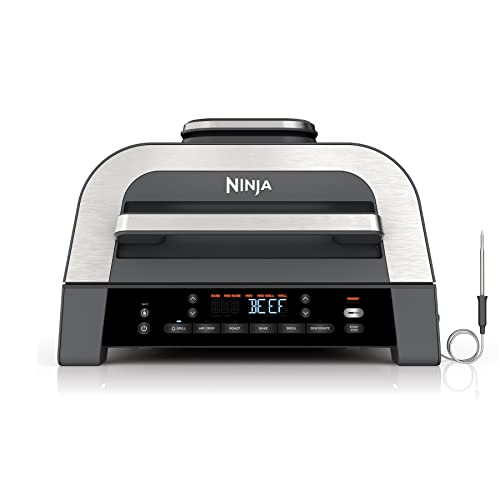
Ninja Foodi Smart XL Indoor Grill & Air Fryer DG551 — Best Overall
The Foodi Smart XL suits the steak cook who wants the guesswork removed. Its Smart Cook System works with the included thermometer: set the protein and the doneness, and the grill manages the cook and tells you when to flip and when to rest. The XL surface handles family steaks at once, and the air fryer function covers the fries, wings, and vegetables that share a steak night.
Strengths
- Thermometer-guided cooking takes doneness anxiety out of steak night
- XL surface cooks for the family in one batch
- Air fry function makes it a two-appliance replacement
Trade-offs
- Premium tier pricing and a substantial counter footprint
- More parts to wash than a simple contact grill
- Smart system rewards using the thermometer — skip it and you own an expensive basic grill
| Spec | Detail |
|---|---|
| Format | Indoor grill and air fryer, 6-in-1 |
| Guidance | Smart Cook System with Smart Thermometer |
| Size | XL family surface |
The thermometer system changes who can cook a great steak. Judging doneness by time and touch is a skill built over dozens of steaks; a probe that reads the center and a system that accounts for carryover lets a beginner serve a true medium-rare on the first try. For households where steak is a treat rather than a weekly habit, that reliability is worth more than raw sear power — the steak you cook four times a year should come out right all four times.
As a grill it brings genuine heat and a cyclonic air system that manages smoke respectably for an indoor appliance, while the air fryer side is no token: it crisps properly. The honest cost is size and washing — this is a flagship appliance that lives on the counter and asks for a few minutes of cleanup. Households that will use both functions weekly get their money’s worth; steak-only minimalists should read on.
Ownership notes: the Smart XL’s thermometer is a consumable-adjacent part — treat its cable gently, store it coiled loosely, and the guidance stays accurate for years. The grill’s air-fryer side means the machine earns weekday keep beyond steak: wings, fries, and roasted vegetables cycle through it constantly in real households, which is how a premium appliance justifies its footprint. Wipe the splatter shield after steak night specifically; it is the part whose neglect announces itself at the next cook.
Best for: families who want thermometer-guided, no-guesswork steak / Not suited for: small counters or steak-only minimalists
Check on Amazon — check the current price on Amazon before you buy.

Cuisinart Griddler Elite GR-300 — Best Sear Control
The Griddler Elite suits the hands-on steak cook. Its headline is the one this category is judged by: a 500-degree Fahrenheit sear function, stated right in the verified listing, with dual temperature controls for the upper and lower plates. It works as a contact grill for fast two-sided cooking, opens flat as a full griddle or grill for a bigger spread, and its top-melt position finishes cheese-topped steaks and open-face melts.
Strengths
- Dedicated 500°F sear function — the real steak specification
- Dual-zone plate temperatures for contact or open cooking
- Six configurations from contact grill to full griddle
Trade-offs
- Contact cooking presses steaks — thick cuts need care with the floating hinge
- No thermometer guidance; doneness is the cook’s skill
- Plates and drip tray make cleanup a small production
| Spec | Detail |
|---|---|
| Format | Electric grill and griddle, 6-in-1 |
| Sear | 500°F sear function (from verified listing) |
| Control | Dual-zone temperature control |
| Extras | Top melt position |
Five hundred degrees is the number that separates this guide from a sandwich-press roundup. At that ceiling, a steak’s surface dehydrates and browns before the interior overcooks — the crust physics every steak lover is chasing. The Griddler’s sear function holds that temperature deliberately rather than as a brief preheat spike, and the dual controls let you run the plates at different heats when the menu mixes steaks with gentler items.
The contact format is its own technique: both sides cook at once, times drop, and the floating hinge accommodates a thick ribeye without crushing it — if you let the lid rest rather than press. Purists who want open-grill theater should look at the smokeless picks below; cooks who want speed, sear, and weeknight practicality will find this the most steak-serious contact grill here.
Ownership notes: the Griddler Elite’s plates swap between grill and griddle, and steak households should designate the grill plates as the steak pair and keep them seasoned by use. The sear function’s discipline is preheat patience: let it arrive and stabilize, and the crust follows. Its drip tray fills faster than newcomers expect on fatty cuts — empty it before the cook, not during — and the floating hinge rewards a light touch that becomes instinct by the third ribeye.
Best for: hands-on cooks who want a true 500-degree sear indoors / Not suited for: anyone who wants the machine to judge doneness for them
Check on Amazon — check the current price on Amazon before you buy.

Chefman Smokeless Indoor Electric Grill — Extra Large — Best Big Surface
The Chefman suits the apartment cook feeding a family. Its extra-large surface lays out four generous steaks — or a mixed grill of steaks, peppers, and onions — in one batch, and its smokeless design uses a water tray beneath the element to catch drippings and cool the smoke at the source. It is the open-grill experience, scaled for a dining table and tuned for indoor air.
Strengths
- Extra-large surface cooks the family’s steaks at once
- Water-tray smokeless design suits apartments and condos
- Simple, open grilling that feels like a grill, not a press
Trade-offs
- Open grilling is slower than contact cooking
- Smokeless means reduced smoke, not zero — fatty cuts still whisper
- Large surface means large storage
| Spec | Detail |
|---|---|
| Format | Smokeless indoor electric grill |
| Surface | Extra large grilling surface |
| Surface finish | Nonstick |
The water tray is the honest smokeless technology in this category: fat drips into water instead of onto a screaming-hot surface, so much of the smoke is never created. Combined with a lid-free open design, the Chefman gives you the part of outdoor grilling people actually miss — food spread out, turning with tongs, cooking by eye — while keeping the kitchen livable. For steak specifically, preheat patience is the technique: let the surface come fully to temperature before the meat lands.
Capacity cuts both ways. A surface this size is a joy on steak night and a storage commitment the rest of the week; measure your cupboard before you fall for it. Households with the room, though, get the closest thing to a patio grill that an apartment lease allows — and a tabletop format that turns dinner into a social, cook-at-the-table event when you want it to.
Ownership notes: the Chefman’s water tray is both its smoke system and its cleanup gift — the drippings land in water, not on a baked surface, and the tray rinses in seconds. For the best crust, pat steaks extra dry and give the big surface its full preheat; large surfaces recover heat more slowly after cold meat lands, so cook in the center zone for the first steak night and learn your machine’s hot geography. It stores on its side in many cupboards, which rescues its footprint.
Best for: apartment families who want open grilling for several steaks / Not suited for: tiny kitchens with no storage for a large grill
Check on Amazon — check the current price on Amazon before you buy.

George Foreman Beyond Grill — 7-in-1 with Air Fry — Best Grill + Air Fry Combo
The Beyond Grill suits the household that wants the George Foreman simplicity it grew up with, updated into a grill-and-air-fryer. The sloped grilling tradition — fat draining away from the food — meets a large cooking area and air fry technology for the sides. It is the pick for cooks who value a familiar, press-and-go routine over thermometer systems and dual-zone controls.
Strengths
- Trusted indoor-grill format with fat-draining slope
- Air fry technology covers sides in the same appliance
- Large size for family steak batches
Trade-offs
- Less precise temperature control than the Cuisinart or Ninja
- Contact-style cooking will not satisfy open-grill purists
- Feature breadth means it is a counter resident, not a cupboard guest
| Spec | Detail |
|---|---|
| Format | Electric indoor grill with air fry, 7-in-1 |
| Size | Large |
There is a reason the Foreman format endures: it is the fastest route from fridge to steak dinner that indoor cooking offers. Preheat, season, close the lid, and both sides cook while the fat runs to the tray. The Beyond generation adds the air fryer that modern households expect, so the same appliance crisps the potatoes — one machine, one wash-up, and a weeknight steak dinner in well under half an hour of effort.
Judge it as a convenience champion rather than a sear laboratory. It will brown a steak honestly and cook it evenly, but the cook chasing a steakhouse crust with degree-by-degree control should take the Griddler Elite, and the cook who fears overcooking should take the Ninja’s thermometer. The Beyond Grill’s promise is different: good steak, zero fuss, every weeknight, for years.
Ownership notes: the Beyond Grill’s sloped plates do their fat-draining work best when the machine sits level and the drip tray is seated — small setup details that decide whether the routine feels clean. Its air fry side makes it the weeknight default in many homes: steak up top, fries crisping in the same appliance, one wash-up. Owners coming from older Foreman models will find the transition instant, which for busy households is the entire value proposition.
Best for: busy households wanting grill plus air fry with minimal fuss / Not suited for: precision sear chasers
Check on Amazon — check the current price on Amazon before you buy.

Hamilton Beach Indoor Grill with Hot & Cold Smoke Infuser — Best for Smoky Flavor
The Hamilton Beach suits the flavor chaser: the cook who finds indoor steaks delicious but faintly missing something. That something is smoke, and this grill infuses it — hot or cold smoke, per the verified listing — while a vented hood and fan manage the kitchen air. Its adjustable range runs from 150 to 450 degrees Fahrenheit, so the top end sears while the low end suits the gentle smoke work the machine is named for.
Strengths
- Hot and cold smoke infusion — outdoor flavor, indoors
- 450°F top end for a genuine sear
- Vented hood and fan manage smoke and splatter
Trade-offs
- Smoke infusion adds setup, chips, and cleanup to steak night
- 116 square inches is a two-to-three-steak surface
- The hood and fan make it taller than flat tabletop grills
| Spec | Detail |
|---|---|
| Temperature | 150°F–450°F adjustable (from verified listing) |
| Surface | 116 sq in non-stick |
| Extras | Hot & cold smoke infuser, vented hood & fan |
Smoke is the one outdoor variable indoor grills cannot fake with heat, and this machine does not fake it — it burns a small quantity of wood in an infuser and washes the food in the result. A steak finished with ten minutes of hickory smoke tastes like a different, better decision. The cold-smoke mode extends the trick to cheese, salmon, and cocktails-hour experiments that no other pick here can attempt.
The engineering around the smoke is what makes it livable: the hood contains it, the fan directs it, and the 450-degree ceiling means the steak itself is seared properly rather than merely perfumed. If your indoor-steak complaint has always been ‘good, but it tastes like indoors,’ this is the machine designed around your complaint — accept its extra five minutes of setup as the price of the flavor.
Ownership notes: the Hamilton Beach’s smoke infuser uses a small amount of wood chips — buy food-grade chips, soak nothing, and let the first wisps establish before the steak goes under the hood. The hood and fan make it the politest houseguest among high-flavor grills, but the chips’ aroma will pleasantly haunt the kitchen for an evening; most owners count that as the feature working. Its 450-degree top end also makes it a fine general searing station for chops and salmon.
Best for: cooks who miss wood-smoke flavor in indoor steaks / Not suited for: anyone who wants the fastest possible weeknight routine
Check on Amazon — check the current price on Amazon before you buy.
Techwood 1500W Smokeless Electric Grill with Glass Lid — Best Compact with Lid
The Techwood suits the small kitchen that still wants steak night. At 1500 watts it heats with real intent, the tempered glass lid traps heat for thicker cuts and lets you watch the cook without lifting and losing temperature, and its six-level control covers everything from gentle vegetables to a hard steak sear. When dinner ends, the parts go in the dishwasher — the feature that decides whether a small grill gets used weekly or annually.
Strengths
- Glass lid improves heat retention and splatter control
- 1500W heating with six control levels
- Dishwasher-safe parts make weekly use realistic
Trade-offs
- Compact surface means two steaks at a time, realistically
- Six levels are coarser control than a degree dial
- Lid and base storage still needs a home
| Spec | Detail |
|---|---|
| Power | 1500W (from verified listing) |
| Control | 6-level temperature control |
| Lid | Tempered glass |
| Cleanup | Dishwasher safe parts |
The lid is the design decision to appreciate. Open smokeless grills lose heat to the room and splatter to the counter; a glass lid holds a pocket of hot air over the steak, which helps thick cuts cook through after the sear, and it shows you the food the whole time. For a compact grill, that pocket of heat is the difference between a thin-steak-only machine and one that can handle a proper ribeye with a finish in its own heat.
Dishwasher-safe parts sound like a footnote and behave like a headline. Indoor grills die of cleanup friction more than of any defect: the third time a grill is a chore to wash, it moves to a high cupboard and becomes a memory. The Techwood’s wash-and-done design keeps it in the weekly rotation — which, for a compact budget-tier grill, is the highest praise available.
Ownership notes: the Techwood’s glass lid fogs mid-cook — normal, and briefly lifting it to check costs less heat than on an open grill because the lid has kept a pocket of heat over the food. Its six levels map quickly onto a household shorthand: top level for steak sear, middle for chicken, low for vegetables and warming. Dishwasher-safe parts mean the grill survives the weekly rotation; in small kitchens, that reliability is worth more than a larger surface used twice a year.
Best for: small kitchens wanting a lidded, easy-clean steak grill / Not suited for: families cooking four steaks at once
Check on Amazon — check the current price on Amazon before you buy.
Comparison Table
| Pick | Badge | Key spec | Best for |
|---|---|---|---|
| Ninja Foodi Smart XL Indoor Grill & Air Fryer DG551 | Best Overall | Smart thermometer system, XL grill + air fryer | families who want thermometer-guided, no-guesswork steak |
| Cuisinart Griddler Elite GR-300 | Best Sear Control | 500°F sear function, dual-zone, 6-in-1 | hands-on cooks who want a true 500-degree sear indoors |
| Chefman Smokeless Indoor Electric Grill — Extra Large | Best Big Surface | XL smokeless surface, water tray design | apartment families who want open grilling for several steaks |
| George Foreman Beyond Grill — 7-in-1 with Air Fry | Best Grill + Air Fry Combo | 7-in-1 grill + air fry, large, sloped plates | busy households wanting grill plus air fry with minimal fuss |
| Hamilton Beach Indoor Grill with Hot & Cold Smoke Infuser | Best for Smoky Flavor | 150–450°F, smoke infuser, 116 sq in, hooded | cooks who miss wood-smoke flavor in indoor steaks |
| Techwood 1500W Smokeless Electric Grill with Glass Lid | Best Compact with Lid | 1500W, glass lid, 6 levels, dishwasher safe | small kitchens wanting a lidded, easy-clean steak grill |
Read the table by ceiling and surface: the ceiling tells you whether a crust is possible, the surface tells you how many steaks share the moment. Then choose your guidance — thermometer, dial, or instinct.
How to Choose an Indoor Steak Cooker
Heat ceiling first. A steak needs its surface driven hard and fast: look for a stated sear function, a range reaching at least 450 degrees Fahrenheit, or a smart grill whose system is built for high-heat searing. Machines that top out far below that will cook a steak, eventually, to a gray doneness — safe, edible, and disappointing. The listings in this guide state their ceilings where the manufacturer publishes them; treat a missing ceiling as a warning.
Format second. Contact grills cook both sides at once — fast, even, and ideal for weeknights and thinner cuts — but they press the meat and offer less of the open-grill ritual. Open tabletop grills give you tongs, turning, and a view, at the cost of time and a little more splatter. Lidded open grills split the difference and help thick cuts finish. None is best; they are different answers to how you like to cook.
Smoke honesty third. ‘Smokeless’ in this category means engineered reduction — water trays, hoods, fans, and drip management — not the abolition of physics. A well-designed smokeless grill keeps a normal kitchen comfortable through steak night; it will not survive a forgotten, smoking-hot empty preheat, and fatty cuts will always announce themselves a little. If smoke flavor, rather than smoke absence, is your longing, the infuser pick in this guide is the honest route.
Finally, size the surface to your steak count and your storage to your honesty. Four-steak surfaces serve families and punish small cupboards; compact grills serve couples and get used weekly. The best indoor steak cooker is the one that is out, hot, and cooking on the nights you want steak — not the largest one in a box in the garage.
How to Cook a Great Steak Indoors: Sear, Rest, Slice
Start dry and seasoned. Pat the steak thoroughly dry — surface water is the enemy of crust — salt it generously, and let it stand while the grill preheats fully. A half-preheated indoor grill is the number one cause of the gray steak: the surface must be at its ceiling when the meat lands, so give the machine its full preheat without shortcuts.
Sear with intent. Lay the steak down and leave it alone for the first minutes; moving it tears the forming crust. Flip once, cook to a few degrees below your target — an inexpensive instant-read thermometer removes all doubt — and remember that thick steaks keep cooking as they rest. Contact-grill users should let the lid rest on the meat rather than pressing, which squeezes out the juices you worked to keep.
Rest like you mean it. Five to ten minutes under loose foil lets the juices redistribute; slice immediately and they run onto the board instead of staying in the bite. Slice against the grain, season the cut faces with a pinch of flaky salt, and serve on warm plates if the occasion deserves it. The indoor grill did the hard part; the rest is where you collect the credit.
Steak Selection and Indoor Technique: Getting the Most From Any Pick
The machine is half the equation; the steak is the other half. For indoor grills, choose cuts between three-quarters of an inch and an inch and a half thick: thinner steaks overcook before they crust, and very thick cuts challenge a contact grill’s hinge and an open grill’s finishing heat. Ribeye brings the fat and forgiveness, strip steak brings the beefy chew, filet brings tenderness that rewards the thermometer-guided picks, and flank or skirt bring value that slicing against the grain transforms.
Seasoning should be confident and simple at indoor temperatures. Salt generously and early — or immediately before cooking — and keep sugary rubs and marinades away from the sear, because sugars scorch on a 500-degree plate and read as bitterness. Pepper after the sear if you dislike its toasted edge. A brush of high-heat oil on the meat, rather than the grill, minimizes smoke while guaranteeing release — a small technique that improves every machine in this guide.
Doneness discipline closes the loop. Pull steaks a few degrees before the target — carryover is real, especially on thick cuts and under lids — and rest them on a warm plate, not a cold counter. Keep a tiny log for your grill: cut, thickness, setting, minutes per side, result. Indoor grills are consistent machines, and two logged cooks convert every future steak night into a repeat performance rather than a fresh gamble.
Marinades, Rubs, and Finishing: Flavor at Indoor Temperatures
Indoor heat changes the marinade rules. Sugars — in sweet rubs, glazes, and many bottled marinades — scorch on a 450-to-500-degree plate and turn bitter before the steak beneath them cooks, so the indoor cook’s marinades should lean savory: oil, salt, garlic, herbs, acid in moderation, and time measured in hours rather than days. Apply sweet glazes in the final minute, off the fiercest heat, or serve them at the table where they belong. A dry rub of salt, pepper, and spices applied to a thoroughly dried surface will outperform a wet marinade on any machine in this guide, because the crust is the flavor and water is the crust’s enemy.
Finishing is where indoor steaks gain their restaurant accent. A knob of butter — plain, or compounded with garlic and herbs — melting over the steak during its rest adds richness without a pan sauce’s effort. A sprinkle of flaky salt on the sliced faces seasons the bite you actually eat, and a rest on a warm plate keeps the finish from cooling the meat. For the smoke-infuser pick, a short post-sear smoke bath layers the outdoor note over the finished crust; for the air-fry picks, a minute of high heat at the end can re-crisp an edge that rested too long. These are thirty-second decisions that separate a good indoor steak from a memorable one.
Sauces, finally, should be built for the format. Pan sauces need a pan; indoor grills offer instead their drip trays’ collected juices — too thin and too scant to build on. Plan table sauces instead: a chimichurri made while the grill preheats, a mustard-cream whisked during the rest, a simple board sauce of herbs, oil, and the slicing juices themselves. The indoor steak dinner that works is designed as a system — dry surface, fierce sear, patient rest, bright sauce — and every machine in this guide is fully capable of playing its part in that system.
Care and Longevity for an Indoor Grill
Indoor grills age in one place: their cooking surfaces and the residue left on them. The discipline that extends a grill’s life is cleaning while warm — plates wiped or washed after each use, drip trays emptied before they overflow, and hoods and shields degreased before the film bakes into varnish. Nonstick surfaces reward soft tools and punish metal ones; treat the coating gently and it will release steaks cleanly for years, while one season of metal tongs and abrasive pads can end a grill’s useful life early.
The second longevity factor is storage honesty. A grill that lives on the counter gets used and gets wiped; a grill stored dirty in a high cupboard corrodes its own coating in its own grease. If your pick has dishwasher-safe plates, use that mercy without guilt — it exists because the manufacturer knows cleanup friction is what kills these appliances. Keep cords loose, lids unlatched where the design prefers it, and the thermometer probes of smart models coiled gently rather than kinked.
Do this and an indoor steak cooker is a long-service appliance: heating elements and plates in this category are simple, robust parts with little to fail. The machines in this guide were chosen partly for that durability — established platforms, replaceable trays and plates, and designs a home cook can actually keep clean. Buy the one whose cleanup matches your patience, keep it clean by routine rather than by effort, and steak night will stay a weeknight option for as long as you want it.
How to Set Up an Indoor Grill for Steak Night
Step 1: Place and prepare. Put the grill under or near your range hood if you have one, on a heat-safe surface with room for plates and tongs. Fill the water tray if your model uses one, empty the drip tray, and lay out the steak, salt, tongs, and a resting plate before any heat is involved.
Step 2: Preheat completely. Set the grill to its sear or maximum steak setting and wait for the full preheat signal — then give it one more minute. Indoor elements cycle; that extra minute is the difference between a surface that sears and one that merely starts cooking.
Step 3: Dry, season, and stage the steak. Pat the steak dry on all sides, salt it well, and add pepper after cooking if you dislike pepper’s taste when scorched. A dry, seasoned steak and a fully hot grill should meet within seconds of each other.
Step 4: Cook by temperature, not by hope. Use the machine’s thermometer system if it has one, or an instant-read thermometer of your own, and pull the steak a few degrees shy of the target. Note your times for your grill and your preferred cut — indoor grills are consistent machines, and two logged cooks make the third one automatic.
Step 5: Rest, slice, and clean while it rests. Move the steak to a warm plate, tent it loosely, and use the resting minutes to wipe the grill plates while they are still warm — residue releases now and resists later. Slice against the grain, serve, and let the dishwasher-safe parts, if your model offers them, finish the job.
Common Buying Mistakes
Putting a wet steak on a half-hot grill. The two classic errors compound: surface moisture steams the meat while the under-heated plate fails to sear it. Dry steak, full preheat — both, every time.
Pressing a contact grill like a panini. Pressing squeezes juice from a steak and flattens thick cuts unevenly. Let the floating hinge rest on the meat under its own weight; that contact is all a steak needs.
Cooking by the clock alone. Steak thickness varies more than recipes admit, and indoor grills vary in recovery heat. A thermometer — built-in or handheld — turns doneness from folklore into a number.
Skipping the rest to ‘eat it hot.’ An unrested steak bleeds its juices onto the board and eats drier than a rested one served slightly cooler. Five minutes is the cheapest tenderness in cooking.
Believing ‘smokeless’ means ‘no ventilation needed ever.’ These machines reduce smoke admirably, but a window or hood still improves steak night, especially with fatty cuts. Ventilate a little and the smokeless design handles the rest.
Final Recommendation
Most steak lovers should start with the Ninja Foodi Smart XL: its thermometer system makes doneness a setting rather than a skill, and the air fryer completes the meal. Hands-on cooks chasing a true crust should take the Cuisinart Griddler Elite and its 500-degree sear. Apartment families get the Chefman’s big smokeless surface, fuss-free households the George Foreman Beyond Grill, flavor chasers the Hamilton Beach smoke infuser, and small kitchens the lidded, dishwasher-friendly Techwood. Every pick here can put a real steak on a weeknight table — the choice is which kind of cook you are.
Whatever lands on your counter, honor the technique that makes it shine: dry steak, full preheat, a thermometer’s honesty, and a patient rest. The machine provides the heat; those four habits provide the steakhouse result.
A parting piece of advice for the buyer torn between two of these machines, because the tiebreaker is rarely on the spec sheet: choose by the steak night you will actually repeat. The thermometer-guided Ninja wins if your household cooks steak monthly and wants certainty every time; the Griddler Elite wins if steak is a weekly craft and you enjoy being the cook; the Chefman wins if steak night is a family gathering around a big surface; the Hamilton Beach wins if flavor nostalgia is the whole point; the Foreman and the Techwood win if the best machine is the one that asks the least. None of those answers is wrong, and all six machines will sear a steak properly — the differences are in ritual, guidance, and cleanup, which is to say in the parts of steak night that surround the steak. Picture your third month with each finalist, not your first evening: the plates being washed without resentment, the machine coming out of its home without a sigh, the steak landing to the same reliable sizzle. The machine you can picture happily in month three is the machine to buy, and with the technique in this guide — dry surface, full preheat, thermometer honesty, patient rest — it will serve you steaks that make the patio grill a choice rather than a necessity.
Best Immersion Cookers Best Induction Cookers Best Meat Thermometers Best Slow Cookers Best Pressure Cookers
Frequently Asked Questions
Can an indoor grill really sear a steak like an outdoor grill?
A high-ceiling indoor grill can produce a genuine crust — the physics of a dry surface on a 450 to 500 degree plate are the same indoors. What it cannot replicate is charcoal flavor, which is a fuel characteristic, not a heat one; the smoke-infuser pick in this guide exists for exactly that gap. For crust and doneness, a good indoor machine is a peer of the patio grill.
How thick a steak can these machines handle?
Contact grills with floating hinges handle steaks up to roughly an inch and a half comfortably; thicker cuts do better on open and lidded models, where you can sear and then finish with gentler, lid-held heat. For very thick steaks, a reverse approach works indoors too: warm the steak gently first, then sear it hard at the end.
Are smokeless grills really smokeless?
They are honestly smoke-reduced. Water trays, hoods, fans, and drip management stop most smoke from forming or escaping, and a normal steak night stays comfortable. Extremely fatty cuts, sugary marinades, and overheating an empty grill will still produce some smoke — ventilate sensibly and the systems in this guide will do the rest.
Do I need a thermometer if my grill has doneness settings?
Time-and-setting programs are estimates based on average steaks; thickness and starting temperature shift the result. A built-in probe system, like the Ninja’s, measures the actual steak and is trustworthy. Dial-only machines reward an inexpensive instant-read thermometer — it is the single accessory that most improves indoor steak.
How do I keep an indoor grill from stinking up the house?
Cook with the hood or a window fan running, trim excess external fat before grilling, avoid sugary marinades at sear temperatures, and wipe the plates while warm so old residue does not smoke next time. Most lingering odor is yesterday’s grease reheating, not tonight’s steak.
What else can an indoor steak grill cook well?
Nearly everything that likes direct heat: burgers, chicken breasts, pork chops, salmon fillets, shrimp skewers, peppers, onions, zucchini, and halloumi. Contact models add panini and quesadillas; lidded and air-fry models widen the range further. A steak grill earns its counter space by being a weeknight grill that happens to be great at steak.


