Disclosure: airfryerkitchensupply.com is reader-supported. When you buy through links on our site, we may earn an affiliate commission at no extra cost to you.
Where to buy
Every model below is a hard-shell acrylic spa sold through Amazon and confirmed through the airfry site Amazon listing. Prices in this segment move with freight promotions and seasonal demand, so each pick links out for the current delivered figure rather than printing a number here that could be stale within a week. Delivery terms matter as much as the sticker in this tier, so check whether curbside freight, a cover and start-up chemicals are included before you compare totals.
- Best Overall: AquaLife Grand Banks 6-Person 81-Jet Hot Tub — check price on Amazon
- Best for Entertainment: Bueno Spa Dallas 6-Person 82-Jet Hot Tub — check price on Amazon
- Best Therapy Focus: Hudson Bay HB29 6-Person Hot Tub — check price on Amazon
- Best for Cold Climates: Bueno Spa Jersey 6-Person 46-Jet Hot Tub — check price on Amazon
- Best Lounger Layout: AquaLife Edgewater 5-6 Person 28-Jet Hot Tub — check price on Amazon
- Best Feature Value: Jocisland 5-Person Hot Tub with 56 Stainless Steel Jets — check price on Amazon
Finding the best hot tubs under 9000 dollars is really a search for the point where a spa stops being an inflatable or entry plug-and-play tub and becomes a proper hard-shell acrylic spa with a real heater, real insulation and jets you will still be happy with in five winters. That is exactly the band this guide covers: six-seat and five-seat acrylic models with multi-dozen jet counts, insulated covers in the box and cabinets built for permanent outdoor placement. Nothing here is inflatable, and nothing here needs the compromises that define the cheapest end of the market.
The honest market picture is this. Under this budget ceiling you can buy a genuinely well-equipped acrylic spa, but you cannot buy everything at once. Models split into clear camps: high jet counts with loungers and stereo systems, simpler non-lounger layouts that seat more people upright, and therapy-focused tubs with fewer but better-placed jets. Shell quality, insulation and the heater matter more to your monthly running experience than a headline jet number, and the picks below were chosen to represent each camp with a model whose listing details could be verified.
This guide is organised so you can decide quickly and then verify slowly. The Quick Picks give the short answer, the full reviews explain who each spa suits and who should skip it, the buying guide walks through electrical, base and delivery decisions that catch buyers out, and the how-to section covers the setup sequence from pad to first soak. If you only read one section beyond the picks, read the electrical part of the buying guide, because most disappointment in this tier is electrical, not hydraulic.
Key Takeaways
- This budget buys a real acrylic spa, not an inflatable: six seats, multi-dozen jets and an insulated cover are the tier’s baseline.
- Choose the seat layout before the jet count: non-lounger for groups, lounger for couples, therapy layout for backs.
- Budget for the 220V circuit, GFCI disconnect and a level load-bearing base as part of the same purchase.
- Insulation and cover quality decide monthly running costs more than any feature on the showroom card.
- Verify delivery access with a tape measure before ordering; spas do not bend around corners.
In this guide
Quick Picks
Best Overall — AquaLife Grand Banks 6-Person 81-Jet Hot Tub
The Grand Banks is the easiest recommendation in this tier: six upright seats, an 81-jet layout, a stainless steel heater, an ozonator and an insulated cover, all in a non-lounger shell that wastes no space on a reclined seat many households rarely use.
Best for Entertainment — Bueno Spa Dallas 6-Person 82-Jet Hot Tub
The Dallas pairs an 82-jet layout with a built-in stereo system, LED lighting and an included ThermoCover, making it the pick for buyers whose hot tub is the centre of the garden party rather than a quiet retreat.
Best Therapy Focus — Hudson Bay HB29 6-Person Hot Tub
The HB29 ignores the jet-count arms race with 29 deliberately placed therapy jets, digital controls, a sterling acrylic interior and a mocha cabinet, and it includes the cover. It is the quiet, sensible pick in this tier.
Best for Cold Climates — Bueno Spa Jersey 6-Person 46-Jet Hot Tub
The Jersey’s Arctic Max insulation is the headline: a 46-jet, six-person Bueno with stereo and included cover, built for buyers whose winter energy bills matter as much as the soak itself.
Best Lounger Layout — AquaLife Edgewater 5-6 Person 28-Jet Hot Tub
The Edgewater is the lounger pick: a 5-6 person acrylic spa with 28 jets, a proper reclined seat and an ozonator, for couples who soak long and low rather than upright in a crowd.
Best Feature Value — Jocisland 5-Person Hot Tub with 56 Stainless Steel Jets
Two loungers, three seats, 56 stainless steel jets, twin waterfalls, cup holders and spare filters: the Jocisland packs the longest feature list here into a five-person 220V acrylic shell.
How These Picks Were Chosen
Each candidate was checked against Amazon listing for this site, and only models whose Amazon title confirmed the seat count, jet count, shell type and included extras named in the review were kept. That verification step removed several spas whose marketplace descriptions mixed specifications from larger siblings, and it is why the jet and seat figures quoted here match the listing title rather than a marketing banner.
The shortlist was then balanced deliberately: at least one non-lounger for buyers who want maximum upright seating, at least one lounger model for couples who soak more than they entertain, one insulation-led model for cold climates, and one therapy-led model where jet placement matters more than jet count. Running-cost features such as insulated covers, ozonators and full-foam or perimeter insulation were weighted heavily, because in this tier the purchase is the smaller half of what you will spend over the spa’s life.
The 6 Best Hot Tubs Under $9000

AquaLife Grand Banks 6-Person 81-Jet Hot Tub — Best Overall
The Grand Banks suits households that actually soak socially. Because there is no lounger, all six positions are upright seats, which makes conversation easier and keeps the footwell open. It is the pick for buyers who host, who have teenagers, or who simply know a lounger would become one person’s permanent seat while everyone else negotiates for the corner.
Strengths
- 81 jets spread across six upright seats rather than concentrated in one lounger
- Stainless steel heater and ozonator included for clearer, easier water care
- Insulated cover included, which matters for winter running costs
Trade-offs
- No lounger, so full-length reclining soaks are off the table
- Six upright seats need a genuinely level, strong base
- Large shell is a two-or-three-person move even when empty
Key details: 6-person acrylic non-lounger; 81 jets; LED lighting; insulated cover; stainless steel heater; ozonator.
What lifts the Grand Banks above similarly priced rivals is balance. The jet count is high but the layout is democratic, so no single seat feels like the consolation prize. The ozonator quietly reduces how much sanitiser the water needs between soaks, and the stainless heater is the component you want when a spa will live outside through winter, because heater elements are the classic corrosion failure point. LED lighting is tasteful rather than theatrical. If your household soaks in groups of three or more most weeks, this is the layout that will still make sense in year three, when novelty has worn off and only comfort and running costs remain.
Best for: Social soaking households wanting maximum upright seating / Not suited for: Dedicated lounger fans who mostly soak alone or as a couple
Check the current price on Amazon

Bueno Spa Dallas 6-Person 82-Jet Hot Tub — Best for Entertainment
Bueno Spa’s Dallas is aimed squarely at entertainers. Six seats, a stereo you do not have to carry outside, and lighting designed for evenings give it a resort feel that therapy-first tubs do not chase. It suits buyers who host friends, who want music without a separate waterproof speaker, and who will use the tub most on Friday nights rather than at six in the morning.
Strengths
- 82 jets across six seats with a built-in stereo system
- ThermoCover included, helping heat retention between sessions
- LED lighting package designed for evening use
Trade-offs
- Stereo and lighting add components that can age faster than the shell
- Entertainment layout is less focused on targeted therapy seating
- Speakers near water need the cover kept on to stay protected
Key details: 6-person acrylic; 82 jets; stereo system; LED lighting; ThermoCover included.
The Dallas makes sense when you cost the alternatives honestly. A separate outdoor audio setup, bought and weatherproofed properly, is its own project; here it arrives integrated and wired. The 82-jet count keeps it competitive with the Grand Banks on pure hydrotherapy, while the ThermoCover addresses the running-cost side that entertainment buyers sometimes forget. The trade-off is complexity: more electronics in a wet environment means more to maintain, and buyers in very cold climates should compare its insulation approach with the Jersey below before deciding which Bueno suits their winter.
Best for: Hosts who want music and lighting built in / Not suited for: Minimalists who want the fewest possible components
Check the current price on Amazon

Hudson Bay HB29 6-Person Hot Tub — Best Therapy Focus
Hudson Bay sells the HB29 on placement rather than numbers. Twenty-nine therapy jets, positioned for backs and shoulders, will suit buyers who soak for stiff muscles after work or training far better than a wall of small jets that mostly move water. The mocha cabinet and sterling shell also give it a more furniture-like look for patios where the tub is always on show.
Strengths
- 29 therapy jets placed for backs and shoulders rather than headline count
- Digital controls are simple for every household member to use
- Cover included; classic cabinet styling suits visible patios
Trade-offs
- Lowest jet count here, which showroom shoppers may underrate
- Spa steps are sold separately, so budget for access
- Fewer entertainment extras than the Bueno models
Key details: 6-person; 29 therapy jets; digital controls; sterling acrylic interior; mocha cabinet; cover included.
There is a real argument that the HB29 is the most honest tub in this guide. Jet count is the easiest number to inflate and the hardest to feel; what you feel is pressure, placement and whether a seat holds you in position against the flow. A therapy layout with digital controls that anyone can run without a manual tends to get used more, and a spa that gets used three times a week beats a more powerful one that becomes a garden ornament. Buyers recovering from physical jobs or regular training should sit in this class of tub, at least mentally, before paying for jets they cannot name a purpose for.
Best for: Soakers who prioritise targeted back and shoulder therapy / Not suited for: Buyers who equate value with the highest jet count
Check the current price on Amazon

Bueno Spa Jersey 6-Person 46-Jet Hot Tub — Best for Cold Climates
If your spa will live through real winters, insulation is not a footnote, it is the product. The Jersey leads with Bueno’s Arctic Max insulation package, keeps the stereo and cover from its Dallas sibling, and trades some jets for a shell that holds heat between soaks. It suits northern buyers, exposed gardens, and anyone who has priced what a poorly insulated tub costs to keep hot in January.
Strengths
- Arctic Max insulation targets winter heat loss directly
- Stereo system and cover included, like the Dallas
- 46 jets still give varied seating without excess complexity
Trade-offs
- Fewer jets than the Dallas for a similar footprint
- Insulation benefits are invisible in a showroom comparison
- Stereo adds maintenance considerations in harsh weather
Key details: 6-person acrylic; 46 jets; Arctic Max insulation; stereo system; cover included.
Heat loss happens through the shell, the cabinet and the cover, and it happens every hour the water sits hot, not just while you soak. That is why an insulation-led model can be the cheapest tub in this guide to own even when its shelf position looks mid-pack. The Jersey keeps enough entertainment equipment to feel complete, but its engineering priority is the right one for cold postcodes. Pair it with a tight-fitting cover habit, keep the cover strapped in wind, and the running-cost gap against a lightly insulated rival compounds quietly every single month you own it.
Best for: Cold-climate buyers focused on running costs / Not suited for: Mild-climate buyers who would rather have maximum jets
Check the current price on Amazon

AquaLife Edgewater 5-6 Person 28-Jet Hot Tub — Best Lounger Layout
Every line-up needs one honest lounger, and the Edgewater is it. The reclined seat changes how you use a tub: longer soaks, legs supported, head back. It suits couples and solo soakers who treat the spa as a nightly ritual, and households where one great seat matters more than six adequate ones. The ozonator helps water stay clear between those frequent sessions.
Strengths
- Dedicated lounger for full-length reclined soaking
- Ozonator supports easier water care with frequent use
- 28 focused jets keep the layout calm rather than turbulent
Trade-offs
- Lounger consumes space that could seat another person upright
- Shorter users can drift in a lounger without a booster cushion
- Lower jet count than the high-count models here
Key details: 5-6 person acrylic lounger; 28 jets; ozonator.
Loungers divide buyers, so decide with your real habits, not your showroom fantasy. If two of you soak four nights a week, the Edgewater’s reclined seat will earn its space every time. If six relatives descend every holiday, it will feel like a seat went missing. Body type matters too: taller soakers settle into loungers naturally, while shorter soakers sometimes need a weighted cushion to stop floating away from the jets. The modest jet count is a feature here, keeping the water movement gentle enough for the long, quiet soaks this layout exists for.
Best for: Couples and solo soakers who love a lounger / Not suited for: Large groups who need every seat upright
Check the current price on Amazon
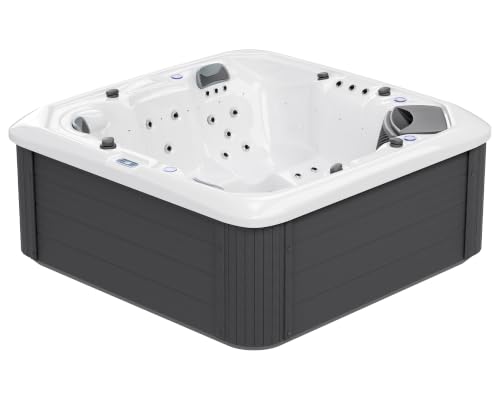
Jocisland 5-Person Hot Tub with 56 Stainless Steel Jets — Best Feature Value
The Jocisland is for the buyer who reads spec sheets happily. Two loungers rather than one, stainless steel jet faces, two waterfalls, LED lighting and even a second filter in the box give it a generosity that bigger brands ration. It suits feature hunters who still want an acrylic hard shell, and couples who argue over a single lounger will appreciate having two.
Strengths
- Two loungers plus three seats in a five-person shell
- 56 stainless steel jets with LED lights and two waterfalls
- Spare filter and cup holders included in the box
Trade-offs
- 220V hardwired installation is required, no plug-and-play option
- Two loungers leave only three upright seats for guests
- Newer brand name than AquaLife or Bueno for long-term parts confidence
Key details: 5-person acrylic; 56 stainless steel jets; 220V; 2 loungers, 3 seats; LED lights; 2 waterfalls; 2 filters.
Feature density is the Jocisland’s whole case, and on paper it wins several comparisons in this guide at once. Stainless jet faces resist the pitting that cheap chrome-effect plastic can suffer, twin waterfalls give the evening ambience buyers actually photograph, and a spare filter sounds dull until the first filter-cleaning weekend, when it suddenly seems inspired. The cautions are practical: it needs a proper 220V circuit, and a newer badge means you should confirm parts availability and warranty handling before purchase rather than after the first fault.
Best for: Feature hunters who want two loungers and waterfalls / Not suited for: Buyers who need plug-and-play simplicity
Check the current price on Amazon
Comparison Table
| Pick | Badge | Key spec | Best for |
|---|---|---|---|
| AquaLife Grand Banks 6-Person 81-Jet Hot Tub | Best Overall | 6-person, 81 jets, non-lounger | Social soaking households wanting maximum upright seating |
| Bueno Spa Dallas 6-Person 82-Jet Hot Tub | Best for Entertainment | 6-person, 82 jets, stereo | Hosts who want music and lighting built in |
| Hudson Bay HB29 6-Person Hot Tub | Best Therapy Focus | 6-person, 29 therapy jets | Soakers who prioritise targeted back and shoulder therapy |
| Bueno Spa Jersey 6-Person 46-Jet Hot Tub | Best for Cold Climates | 6-person, 46 jets, Arctic Max insulation | Cold-climate buyers focused on running costs |
| AquaLife Edgewater 5-6 Person 28-Jet Hot Tub | Best Lounger Layout | 5-6 person, 28 jets, lounger | Couples and solo soakers who love a lounger |
| Jocisland 5-Person Hot Tub with 56 Stainless Steel Jets | Best Feature Value | 5-person, 56 jets, twin loungers | Feature hunters who want two loungers and waterfalls |
How to Choose the Best Hot Tubs Under $9000
In this tier the differences that matter are structural: how the shell is insulated, how the water is heated, how the seats are shaped and what the installation really involves. Work through the four decisions below before you fall for a jet count.
Seats and loungers: buy for your real group size
Count the people who will soak weekly, not the people who visit at Christmas. A six-person non-lounger like the Grand Banks serves regular groups best, while a five-person twin-lounger like the Jocisland serves a couple superbly and guests adequately. Loungers add length to a soak and subtract a seat from the count, and shorter soakers should expect to use a booster cushion in one. If your group size varies wildly, upright seats with varied depths are the flexible compromise, because a deep corner seat can feel lounge-like without committing the space permanently.
Electrical supply: the decision that decides everything
Almost every spa in this tier needs a dedicated 220V circuit with a GFCI disconnect, installed by an electrician, within sight of the tub but at the distance your local code requires. That work is part of the real purchase, so get a quote before you order, not after the tub is on a truck. Plug-and-play 110V models exist lower down the market, but they heat slowly, cannot run heater and high jets together, and are not what this budget is for. Confirm panel capacity too: older homes sometimes need panel work that changes the maths entirely.
Insulation and running costs
A hot tub loses heat around the clock, so insulation quality is a monthly payment you choose once. Full perimeter packages like the Jersey’s Arctic Max, a well-fitting insulated cover, and an ozonator that reduces chemical demand all lower the cost of ownership in ways a jet count never will. Ask what the cover is made to do, keep it strapped against wind lift, and expect a tired, waterlogged cover after some years to double as a heating bill. In cold regions, place the tub out of prevailing wind or budget for a screen; wind strips heat from the shell surprisingly fast.
Base, access and delivery
A filled six-person spa weighs several thousand pounds, so it needs a reinforced deck or a proper concrete or paver pad that is level within tight tolerance. Measure the delivery path honestly: gate widths, corners, steps and overhead lines decide whether the tub arrives by a simple trolley run or needs a crane, which is a different day and a different bill. Freight delivery in this tier is usually curbside, so plan the crew and the route from kerb to pad before the truck is booked, and keep the packaging until the shell has been inspected and filled.
Running a Spa in Winter: What This Tier Handles Well
Cold weather is where the difference between a toy and a tool shows. Every spa in this guide is a hard-shell acrylic model designed to live outside year-round, holding hot water through frost rather than being drained and stored. That design brief changes ownership completely: the tub becomes part of the house’s routine, available on the coldest, darkest evenings when a soak is worth most, instead of a summer novelty that spends half the year under a tarp.
The physics are unforgiving but manageable. Heat escapes through the water surface first, which is why the insulated covers included with most of these picks matter more than their modest appearance suggests, and why keeping the cover strapped down in wind is a heating measure, not tidiness. Heat also leaves through the shell and cabinet, which is where insulation packages like the Jersey’s Arctic Max earn their keep over a whole winter rather than a single evening.
Freeze protection is the third winter discipline. Modern spas monitor water temperature and circulate automatically when it falls, but that protection depends on power, so a winter outage plan, even if it is only knowing how to drain the pumps or keep a small heat source in the equipment bay during a long cut, belongs in every cold-climate owner’s notebook. The manuals for these models describe their freeze behaviour; read that section before the first frost, not during it.
Used this way, winter becomes the spa’s best season rather than its risk. Steam rising into cold air, a short dash from the door, and water that stays hot because the shell and cover were chosen properly: that experience is exactly what this budget tier, spent on insulation and build rather than on gimmicks, is designed to deliver night after night.
Water Care in Plain Language
New owners often imagine spa water care as chemistry; veterans know it is mostly rhythm. The water is hot, small in volume and shared, so it changes faster than pool water, and the entire routine exists to stay ahead of that change in small, regular steps. Test the water two or three times a week with strips or a liquid kit, adjust in the order alkalinity, pH, sanitiser, and let each adjustment settle before judging the next.
Sanitiser does the protective work, and the ozonators fitted to several picks in this guide reduce how hard it has to work by oxidising contaminants between soaks. That is a genuine running-cost and water-feel benefit, but it is an assistant, not a replacement: ozone leaves no lasting residual in the water, so a measured sanitiser level remains the foundation of safe, clear soaking, whatever the sales card implies.
Filters are the third leg. Rinse them on a rotating schedule, keep a spare set so a clean set can go in while the dirty set dries, as the Jocisland’s included second filter anticipates, and deep-clean them periodically to remove the body oils and lotions that rinsing alone leaves behind. Cloudy water that resists correct chemistry is usually a filter asking for that deeper clean, or water that has simply served its months and wants changing.
Finally, showering before soaking is the cheapest water care ever devised. Every lotion, deodorant and hair product kept out of the water is chemistry the tub never has to perform. Households that adopt the shower-first habit routinely report longer water life and clearer water, which in a spa of this size is the difference between a ten-minute weekly routine and a recurring weekend project.
Ownership Costs Beyond the Purchase Price
The purchase price of a spa in this tier is best understood as the entry fee, not the cost. The years that follow carry a predictable set of expenses, and buyers who map them in advance enjoy their tubs more, because nothing about ownership arrives as a surprise. Electricity is the largest line: a well-insulated spa with a sound cover, kept at temperature around the clock, draws a steady, moderate load, while a poorly insulated one in a cold, windy garden can draw dramatically more for the same water temperature. The difference between those two ownerships is chosen at purchase, in the insulation and cover decisions this guide keeps returning to.
Chemicals are the second line, and they are modest when the routine is steady. Sanitiser, balancers and test supplies for a residential spa amount to a small monthly figure when water is kept in balance, and a much larger one when it is rescued repeatedly, because rescue chemistry is wasteful chemistry. The ozonators fitted to several picks here reduce the sanitiser share of that bill, and the shower-before-soaking habit reduces it further, which is why experienced owners sound evangelical about both.
Covers and filters form the third line. A cover lives outdoors, in ultraviolet light and steam, and after some years it becomes heavy with absorbed water and stops insulating; replacing it is routine maintenance, like tyres on a car, and budgeting for it in advance removes the sting. Filters rotate, rinse and eventually retire. None of these costs is large alone, and together they are the reason this guide advised spending the part of the budget you save on a model wisely rather than stretching for the highest jet count in the tier.
Set against those costs is the comparison that justifies the purchase for most owners: the cost per soak. A spa used three evenings a week delivers hundreds of soaks a year at home, with no travel, no booking and no closing time. Owners who use their tubs that way consistently describe them as among the cheapest pleasures they own. Owners who soak monthly describe the same tub as expensive. The arithmetic of this tier therefore ends where the guide began: choose the layout you will actually use, insulate it properly, and the under-9000 spa pays its way in evenings.
Accessories and Upgrades Worth Considering in This Tier
A cover lifter is the first accessory most owners wish they had bought with the tub. The insulated covers included with these spas are light when new and increasingly heavy as they age and absorb moisture, and a lifter turns removing and replacing one into a one-person, one-hand job. That matters more than it sounds, because a cover that is annoying to replace gets left off, and a cover left off is a heating bill and a safety lapse at the same time. Fit the lifter while the installation crew and the clearances are fresh in everyone’s mind.
Steps are the second consideration, and the Hudson Bay listing’s honesty about selling them separately is a useful prompt for the whole tier. A filled spa’s rim sits high enough that entry deserves a stable, non-slip step, especially for shorter bathers, children under supervision and anyone whose knees have opinions. Choose steps rated for outdoor use with a tread that grips when wet, and position them where the cover lifter’s arc does not sweep them, a small choreography that delivery day is the right time to rehearse.
Water care accessories repay their modest cost quickly. A second filter set, so one set can dry fully while the other works, is the veteran’s standard setup, and the Jocisland’s inclusion of a spare filter shows the idea reaching this tier. A floating dispenser where the maker approves one, a liquid test kit to back up the strips, and a simple log, paper or app, complete a kit that turns chemistry from guesswork into record-keeping. None of it is glamorous, and all of it is cheaper than one rescue of neglected water.
Lighting and privacy shape how often the tub gets used after dark, which for most owners is most of the time. A low, warm light on the path, a screen or planting that gives the soaking position privacy without trapping steam, and a hook or small bench for towels and robes within arm’s reach are the upgrades that convert a technically excellent spa into an evening ritual. Owners consistently rank these cheap comforts above electronic extras when asked, a year in, what they would buy again.
Finally, keep a modest contingency for the unphotogenic essentials: a spare drain cap, the maker’s recommended surface cleaner, a submersible pump for water changes that turns a half-day chore into an hour, and the electrician’s number kept with the manual. A spa in this tier is a long-term appliance, and the households that enjoy them most are the ones that equipped the whole ownership, not just the purchase, in the first month.
Pre-Delivery Checklist for a Spa in This Tier
- Confirm the electrical quote in writing: dedicated 220V circuit, GFCI disconnect position and any panel upgrade included.
- Measure the full delivery path, gates, corners, steps and overhead clearance, and photograph the tightest point.
- Prepare the base: level, load-bearing, with drainage that keeps water away from the equipment bay.
- Decide the tub’s orientation for view, privacy, wind shelter and the shortest dash from the door in winter.
- Arrange the delivery-day crew and any trolley or crane help before the truck is booked.
- Order start-up chemicals, test strips and a spare filter set so week one is bathing, not shopping.
- Read the manual’s freeze-protection and first-fill sections before the spa arrives.
- Plan where the cover will rest when open; a cover lifter is the accessory owners wish they had bought first.
How to Set Up a Hot Tub After Delivery
Setup is a sequence, and doing it in order avoids the two classic first-week problems: a tub that trips its breaker and water that clouds before the first soak.
- Position and level the tub. Set the spa on its prepared pad, confirm it sits level and fully supported, and leave working access to the equipment panel side. Never shim a full corner to fix a sloping pad; solve the pad instead.
- Complete the electrical connection. Have the electrician connect the dedicated circuit and GFCI disconnect, then test the breaker behaviour with pumps and heater running together before you fill. Electrical sign-off comes before water, always.
- Rinse and fill through the filter compartment. Wipe the shell, remove debris from manufacture and transport, then fill with the hose placed in the filter area so airlocks in the pumps are less likely. Fill to the line marked on the shell or skimmer.
- Power up and purge the pumps. Run each pump in turn, loosen a union briefly only if the manual directs it for an airlock, and confirm every jet circuit flows before heating. Check unions and fittings for drips while the cabinet is still open.
- Heat, then balance the water. Set your target temperature, let the spa reach it, then test and adjust alkalinity first, pH second and sanitiser third, in that order. Adding chemicals to cold, unbalanced water wastes them.
- Fit the cover and set the filtration schedule. Program filtration cycles per the manual, fit the cover with straps clipped, and record your starting water readings in a notebook or app so later changes are easy to spot.
- Take the first soak short. Keep the first session modest, shower before soaking as you intend guests to, and re-test the water the next day. The first week teaches you your tub’s appetite for sanitiser; write down what you add.
Most new-owner problems trace back to skipping the purge step or balancing chemicals in the wrong order. A calm first week, with readings written down, turns water care into a ten-minute weekly habit instead of a recurring emergency.
Common Buying Mistakes
Buying the jet count instead of the seat layout. Eighty jets in seats you dislike lose to thirty jets in a seat you love, every single week. Decide lounger versus non-lounger and seat depth first; let jet numbers break ties, not make decisions.
Forgetting the electrician in the budget. The tub price is not the installed price. Circuit, disconnect, possible panel work and any crane or extra delivery labour belong in the same spreadsheet as the spa itself, before you commit to a model.
Placing the tub before measuring the path. Spas do not bend. A gate that is an inch too narrow or a corner that cannot be turned turns delivery day into storage fees and a second attempt. Walk the route with a tape measure, not optimism.
Neglecting the cover. A sagging, waterlogged cover is a heating bill with a handle. Keep it strapped, clean it, prop it off standing water after storms, and plan its eventual replacement as routine maintenance rather than a surprise.
Treating water care as optional for a week. Warm water without sanitiser becomes a science project quickly. Test little and often in the first month, keep a simple log, and change or clean filters on schedule; clear water is a habit, not a product.
Final Recommendation
For most households the AquaLife Grand Banks is the right answer in this tier: six honest upright seats, a strong jet count, stainless heating and an ozonator, with the cover included. Entertainers should take the Bueno Spa Dallas for its stereo and lighting, cold-climate buyers the insulated Bueno Spa Jersey, and couples who live in the water should choose the Edgewater’s lounger or the twin-lounger Jocisland. The Hudson Bay HB29 remains the thinking buyer’s therapy pick. Whichever you choose, spend the saved part of the budget on the electrical work and the base, done properly once.
AquaLife Grand Banks 6-Person 81-Jet Hot Tub · Bueno Spa Dallas 6-Person 82-Jet Hot Tub · Hudson Bay HB29 6-Person Hot Tub
Best Hot Tubs Best 2 Person Outdoor Hot Tubs Best 3 4 Person Hot Tubs Best Cold Weather Hot Tubs Best 120v Hot Tubs Best Hot Tubs And Jacuzzis
Frequently Asked Questions
Is a hot tub under $9000 a real acrylic spa or an inflatable?
A real acrylic spa. This budget band is where hard-shell models with proper heaters, insulation and multi-dozen jet counts live. Inflatable spas sit far below it, and the picks in this guide are all rigid acrylic shells designed for permanent outdoor placement, which is why installation, base and electrical work feature so heavily in the advice.
How much does a spa in this tier cost to run?
Running cost depends on climate, insulation, cover condition and how hot you keep the water, so any single figure would be invented. What can be said honestly is that insulation-led models and a tight cover measurably reduce heat loss, and an ozonator reduces sanitiser demand. Your electrician and your first winter of meter readings will give you your real number.
Do I need a concrete pad?
You need a base that stays level under several thousand pounds of filled spa. A properly built concrete or paver pad is the common answer; a deck needs engineering confirmation that it can carry the load with people in the water. Grass, gravel alone and sloping slabs are not suitable, and a tub that settles unevenly stresses the shell and voids goodwill with the manufacturer.
Can I install the electrical supply myself?
In most places the spa circuit must be installed or at least signed off by a licensed electrician, and it involves a dedicated breaker, a GFCI disconnect and bonding requirements. Treat it as professional work. The cost belongs in your purchase budget from the start, which is why this guide raises it before you choose a model rather than after.
How often does the water need changing?
With balanced chemistry and clean filters, a residential spa typically goes a few months between full water changes, but heavy use shortens that and neglected water shortens it dramatically. Testing two or three times a week, rinsing filters regularly and showering before soaking stretch the interval. When water becomes hard to keep clear despite correct readings, changing it is cheaper than chasing it with chemicals.
Are more jets always better?
No. Jet count says nothing about pressure, placement or whether a seat holds you comfortably against the flow. A therapy layout with fewer, larger jets can feel stronger and more useful than a dense field of small ones. Use jet count to compare similar layouts, and use seat shape, depth and your own soaking habits to make the actual decision.
How long do acrylic spas in this tier last?
The shell and structure of a well-kept acrylic spa are long-life components, commonly serving for many years, while pumps, heaters, covers and pillows are the wear items that get serviced or replaced along the way. Longevity follows care: balanced water protects heaters and seals, a sound cover protects both water and shell, and winter freeze discipline protects the plumbing. Buyers in this tier should expect a durable appliance with maintainable parts, not a disposable purchase.
Can a hot tub sit on a deck?
Only on a deck engineered for it. A filled six-person spa concentrates several thousand pounds on a small footprint, far beyond what a casual deck is built to carry. Many owners reinforce an existing deck or pour a pad beside it instead. The safe sequence is structure first, spa second: have the deck assessed for the specific filled weight of the model you chose, and let that answer, not optimism, decide the position.


