Disclosure: airfryerkitchensupply.com is reader-supported. When you buy through links on our site, we may earn an affiliate commission at no extra cost to you.
Where to buy
Every linked pick in this guide to the best high end countertop microwaves was verified against Amazon’s catalog on 2026-11-21, so the model name and specification on this page are the ones on the listing you land on. Premium listings attract lookalike marketing, so buy the verified model number whose listing names the technology you are paying for. Start with Café 1.5 Cu.Ft Countertop Convection Microwave (Stainless Steel), GE Profile PEB9159SJSS 1.5 Cu.Ft Countertop Convection Microwave (Stainless Steel), Panasonic NN-SN97JS 2.2 Cu.Ft Cyclonic Inverter Countertop Microwave (Silver). Check the current price on Amazon from any pick’s link, because finishes and bundle configurations rotate.
The best high end countertop microwaves separate themselves from the mainstream on three axes: how evenly they cook, what else they can do and how they are built. This guide ranks six verified premium countertop models, inverter flagships from Panasonic, convection flagships from Café and GE Profile, a four-in-one multi-oven and the inverter value that embarrasses them all, and it is deliberately countertop-only: mounted and drawer formats get their own guide, because high-end means something different in every format.
A word on what the premium actually buys, since this category attracts marketing fog. It does not buy faster boiling: a mainstream 1000-watt oven heats water as fast as these do. It buys continuous low power instead of pulsed power, sensors that judge food instead of timers that guess, convection elements that brown, and cabinets, doors and controls built to a standard you feel every time you touch them. Every pick below was verified on 2026-11-21, with specifications taken from the listings, so the technologies named here are the technologies in the boxes.
In this guide
Quick Picks
Six models made the cut for this guide. Each carries its own badge, and the same badge follows it into the full review below so you can track a recommendation from summary to verdict.
- Best Overall High-End — Café 1.5 Cu.Ft Countertop Convection Microwave (Stainless Steel): The design-led flagship: Café’s convection countertop microwave with scan-to-cook, WiFi and hardware-grade styling for kitchens that show. Key spec: 1.5 cu ft / 1000W / convection + scan-to-cook + WiFi.
- Best High-End Convection — GE Profile PEB9159SJSS 1.5 Cu.Ft Countertop Convection Microwave (Stainless Steel): The cook’s high-end choice: a 22-inch Profile convection microwave that works as a genuine second oven for serious small kitchens. Key spec: 1.5 cu ft / convection-microwave combination / 22-inch format.
- Best Inverter Performance — Panasonic NN-SN97JS 2.2 Cu.Ft Cyclonic Inverter Countertop Microwave (Silver): The performance flagship: Panasonic’s Cyclonic Inverter at 1250 watts in a huge 2.2 cu ft cavity that can also build in. Key spec: 2.2 cu ft / 1250W / Cyclonic Inverter + Genius Sensor / built-in capable.
- Best Multi-Oven — Panasonic HomeChef 4-in-1 NN-CV Countertop Multi-Oven: Four ovens in one high-end body: inverter microwave, air fryer, convection oven and broiler, with app-linked recipes and 20 presets. Key spec: 1.2 cu ft / 1000W inverter / air fry + convection + broil + microwave / 20 presets.
- Best High-End Technology Value — Toshiba 1.6 Cu.Ft Inverter Countertop Microwave (Black Stainless Steel): The engineer’s bargain: genuine inverter cooking and 1250 watts with a smart sensor, at a position below the flagship brands. Key spec: 1.6 cu ft / 1250W / inverter + smart sensor / 13.6-inch turntable.
- Best Sensor Cooking — Panasonic NN-SN76LS 1.6 Cu.Ft Cyclonic Inverter Countertop Microwave (Stainless Steel): The reheating perfectionist’s pick: Cyclonic Inverter evenness with Panasonic’s Genius Sensor in a family-size stainless body. Key spec: 1.6 cu ft / 1250W / Cyclonic Inverter + Genius Sensor / stainless.
How These Picks Were Chosen
We defined high-end by technology and build rather than by price tags, which move too much to rank by: a pick needed at least one flagship capability, true inverter power, convection cooking, sensor judging with connected features, or a multi-oven design, from a maker with a premium line to support it. Each model was then verified against Amazon’s catalog, matching the listing title to the capacity, wattage and technology we describe. Models that were merely large or merely expensive, with mainstream technology inside, were excluded; size is not a premium feature.
The six badges map the premium’s real branches: design-led convection, cooking-led convection, inverter performance at maximum size, multi-oven consolidation, inverter technology at a value position and sensor-led reheating perfection. Two brands dominate because two brands dominate the technology: Panasonic owns the inverter story and GE’s Profile and Café lines own countertop convection. We let the ranking say so rather than manufacturing diversity, because a high-end guide’s job is to tell you where the top of the market actually is.
The 6 Best High End Countertop Microwaves

Café 1.5 Cu.Ft Countertop Convection Microwave (Stainless Steel) — Best Overall High-End
The Café countertop convection microwave suits the buyer for whom the microwave is part of the kitchen’s design, not an appliance tolerated in it. Café is GE Appliances’ design-forward line, and this 1.5 cu ft model pairs a convection oven that bakes, roasts and broils with scan-to-cook convenience and WiFi connectivity, in a stainless body styled to sit beside premium ranges. It is the high-end countertop pick for renovated kitchens, keen cooks and anyone who has ever hidden a ugly microwave before guests arrive.
Strengths
- True convection cooking with microwave speed: bakes, roasts and broils in a countertop footprint
- Scan-to-cook and WiFi bring genuine convenience technology, not decorative smart badges
- Design and finish quality are the point of the Café line, and it shows in person
Trade-offs
- Premium tier positioning is the highest in this guide alongside the Profile convection
- Convection mode needs ventilation clearance and preheat time; it is an oven, with an oven’s manners
- 1.5 cu ft is generous but the Panasonic flagship below is larger for pure capacity
| Capacity | 1.5 cu ft |
| Power | 1000 watts |
| Modes | Microwave + convection: bake, roast, broil |
| Technology | Scan-to-cook, WiFi connectivity |
| Finish | Stainless steel |
| Safety | Child lock technology |
High-end countertop microwaves justify themselves in two currencies, capability and presence, and the Café is the rare model rich in both. The convection system is a real oven: it holds baking temperatures, browns and crisps, and combines with microwave energy to cook faster than either mode alone. Around that capability, the details are finished like furniture rather than appliances, panel fit, control feel and a stainless presentation designed to coordinate with Café’s ranges and refrigerators. In an open-plan kitchen where the microwave is always on stage, that presence is a daily dividend, not vanity.
The technology layer is equally considered. Scan-to-cook lets the oven set itself from a packaged product’s barcode through the connected ecosystem, which sounds like a gimmick until a household that cooks packaged meals weekly realizes the oven has quietly eliminated its most common error, the mistyped time. WiFi brings remote monitoring and voice convenience. None of it excuses the premium if you will not use it, and the guide’s later picks offer rawer performance per tier position. But as a complete high-end countertop statement, this is the model the others are measured against.
Best for: design-led renovations and cooks who want convection plus presence / Not suited for: pure performance-per-dollar shoppers, or tight cubbies without ventilation
Check the current price on Amazon for the Café 1.5 Cu.Ft Countertop Convection Microwave (Stainless Steel).

GE Profile PEB9159SJSS 1.5 Cu.Ft Countertop Convection Microwave (Stainless Steel) — Best High-End Convection
The GE Profile PEB9159SJSS suits the accomplished home cook whose countertop microwave must earn its space as a second oven. Where the Café leads with design, the Profile leads with cooking: a 1.5 cu ft convection and microwave combination in a 22-inch format that bakes, roasts and combination-cooks at a level basic microwaves cannot approach. It is the high-end pick for small kitchens without room for double wall ovens, for holiday-overflow cooking and for anyone whose microwave standards were set by a real oven.
Strengths
- Convection and combination cooking deliver oven-quality browning with microwave speed
- Profile-series engineering and a 22-inch format suit built-in-style installations with a trim kit
- 1.5 cu ft cavity handles a roast, a baking dish or a tray, not just reheating vessels
Trade-offs
- The joint-largest footprint here: depth and ventilation clearance must be planned, not assumed
- No scan-to-cook or design-line styling; the premium buys cooking, not theatre
- Owners who only reheat will strand most of its capability, and its price, unused
| Capacity | 1.5 cu ft |
| Format | 22-inch countertop convection/microwave |
| Finish | Stainless steel |
| Modes | Microwave + convection combination cooking |
| Type | Countertop, built-in capable with trim kit |
The way to understand this oven is to stop calling it a microwave with extras. It is a compact convection oven that also microwaves, and judged as an oven it is impressive: even baking, real roasting temperatures and combination modes that use microwave energy to accelerate the interior while hot air finishes the surface. A small kitchen equipped with this and a cooktop can produce a roast dinner with sides entirely without a full-size oven, which is why the model anchors so many galley renovations and accessory dwelling kitchens.
High-end ownership here means oven ownership: racks to position, a preheat habit for baking, ventilation clearance for a case that runs hot in convection mode and a manual worth an evening’s reading. Buyers who invest that evening get a decade of second-oven service. Buyers who do not will own an expensive reheater with mysterious buttons, which is why this pick sits second in the guide despite arguably the deepest cooking capability: the Café is easier to love casually, the Profile is better to cook with seriously.
Best for: serious cooks and small kitchens needing a real second oven / Not suited for: reheat-only households, or buyers prioritizing design styling
Check the current price on Amazon for the GE Profile PEB9159SJSS 1.5 Cu.Ft Countertop Convection Microwave (Stainless Steel).
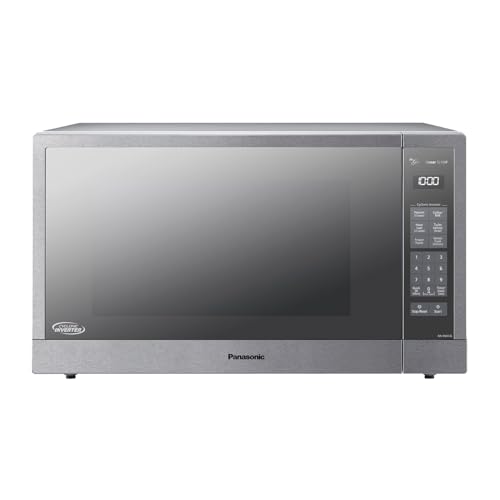
Panasonic NN-SN97JS 2.2 Cu.Ft Cyclonic Inverter Countertop Microwave (Silver) — Best Inverter Performance
The Panasonic NN-SN97JS suits the buyer whose definition of high-end is engineering: the most even microwave cooking the countertop format offers. Panasonic’s Cyclonic Inverter distributes energy in a three-dimensional pattern rather than blasting from a single point, at 1250 watts, inside the largest cavity in this guide at 2.2 cu ft, with a Genius Sensor judging doneness. It fits large households, batch cooks and anyone whose microwave frustration is specifically unevenness, scorched edges, raw centers, rubbery defrosts.
Strengths
- Cyclonic Inverter technology is the class benchmark for even cooking and gentle defrosting
- 1250 watts and 2.2 cu ft: the strongest and largest countertop specification in this guide
- Countertop or built-in installation flexibility protects the purchase through a remodel
Trade-offs
- The footprint is enormous by countertop standards; many counters will not forgive it
- Silver finish and functional styling: performance-first design, not a design-line piece
- Inverter evenness is wasted on households that only boil water and pop popcorn
| Capacity | 2.2 cu ft |
| Power | 1250 watts |
| Technology | Cyclonic Wave Inverter, Genius Sensor |
| Finish | Silver / stainless steel |
| Installation | Countertop or built-in |
| Model | NN-SN97JS |
Inverter technology is the one microwave upgrade whose effect you can taste blind. A conventional oven delivers low power by pulsing full power on and off, so delicate food alternately blasts and rests; an inverter delivers true continuous low power, so butter melts without exploding, sauces hold without splitting and defrosting thaws without cooking the edges. Panasonic’s Cyclonic variant adds a distribution pattern designed to fill the cavity evenly, and at 1250 watts in 2.2 cu ft it does all of it at family scale. This is the high-end pick for cooks who judge appliances by results on the plate.
The costs are space and subtlety. Two point two cubic feet is a lot of countertop, and this oven’s presence is industrial rather than decorative. Its genius is also quiet: nothing about a plate of perfectly reheated risotto announces the technology that produced it, so owners who want their premium visible should look at the Café. Owners who want their premium edible should buy this Panasonic and clear the counter it demands. In a large kitchen, it is arguably the best countertop microwave in this entire program, full stop.
Best for: large households and results-obsessed cooks who prize even cooking / Not suited for: small counters, or buyers who want the premium to be visible
Check the current price on Amazon for the Panasonic NN-SN97JS 2.2 Cu.Ft Cyclonic Inverter Countertop Microwave (Silver).
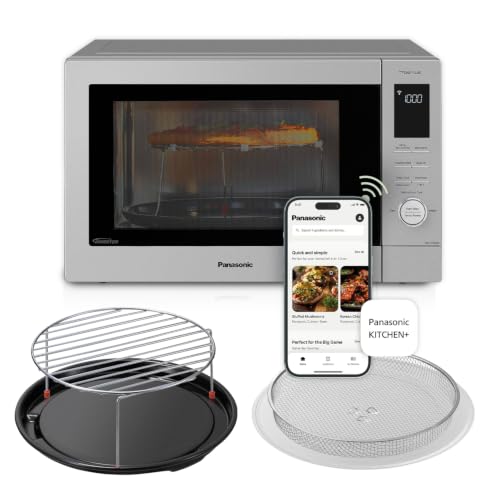
Panasonic HomeChef 4-in-1 NN-CV Countertop Multi-Oven — Best Multi-Oven
The Panasonic HomeChef 4-in-1 suits the high-end buyer whose kitchen strategy is consolidation: one premium appliance that microwaves with inverter evenness, air fries, bakes by convection and broils, replacing a countertop crowd. Twenty presets and app-linked recipes support the multi-oven brief, and the 1.2 cu ft cavity is sized for couples and small families rather than banquets. It is the pick for the cook who uses every mode, in a kitchen where counter space is the scarcest resource of all.
Strengths
- Four genuine cooking methods in one footprint, with inverter quality on the microwave side
- 20 presets and app-linked recipes make the multi-oven brief usable, not just possible
- Air fry and broil modes handle the browning jobs microwaves alone cannot
Trade-offs
- 1.2 cu ft limits batch size in every mode; air fry loads for a family need runs
- Multi-oven interiors need the most cleaning discipline in this guide
- Mode-rich panels reward owners who learn them and punish those who will not
| Capacity | 1.2 cu ft |
| Power | 1000 watts |
| Technology | Inverter multi-oven with convection |
| Modes | Microwave, air fry, convection, broil |
| Presets | 20 presets + app-linked recipes |
| Model | HomeChef NN-CV series |
Most multi-function microwaves are a microwave with a heating element attached as an afterthought. The HomeChef was designed as a multi-oven, and the difference shows in the details owners report caring about: an air fry mode with enough airflow to crisp, a convection mode that holds temperature like an oven, and an inverter microwave underneath it all, so the base job is done to Panasonic’s standard rather than a compromise. The preset library and app recipes matter here because multi-ovens live or die on whether owners can remember how to use mode four; the guidance is built in.
The honest boundary is volume. Every mode in a 1.2 cu ft cavity serves two to three people comfortably and a family in batches, and air frying in particular punishes crowding: food needs air space to crisp. Households of five who air fry nightly should keep a large dedicated air fryer and buy a simpler microwave. Households of two who cook varied meals in a small kitchen will find this the hardest-working appliance they own, and its premium the easiest in this guide to justify on a per-mode basis.
Best for: couples and small kitchens consolidating four appliances into one premium unit / Not suited for: large families, or high-volume air frying
Check the current price on Amazon for the Panasonic HomeChef 4-in-1 NN-CV Countertop Multi-Oven.

Toshiba 1.6 Cu.Ft Inverter Countertop Microwave (Black Stainless Steel) — Best High-End Technology Value
This Toshiba suits the buyer who has read the high-end brief, inverter evenness, real wattage, sensor judgment, and wants those technologies without flagship-brand pricing. It delivers a 1.6 cu ft cavity, 1250 watts of inverter power, a smart sensor and auto defrost on a 13.6-inch turntable, in black stainless. It is the high-end pick for value engineers: households that buy specification sheets, not badges, and would rather the premium live in the cooking than in the logo.
Strengths
- True inverter technology at 1250 watts: the flagship cooking method at a friendlier tier
- Smart sensor and 1.6 cu ft family cavity cover the complete high-end checklist
- Black stainless finish looks the premium part without design-line pricing
Trade-offs
- Brand prestige and design detailing sit a step below Café and Profile models
- No convection or air fry: this is a pure, excellent microwave, nothing more
- Black stainless is a commitment to a darker appliance palette
| Capacity | 1.6 cu ft |
| Power | 1250 watts |
| Technology | Inverter technology, smart sensor |
| Turntable | 13.6-inch turntable |
| Finish | Black stainless steel |
| Features | Auto defrost |
There is a moment in every high-end category where the technology commoditizes, and inverter microwaves have reached it: the cooking method that defined Panasonic’s premium is now available in this Toshiba at a noticeably friendlier tier, with the same practical consequences, continuous low power for delicate work, even reheats, defrosting that does not cook the edges. Blindfolded, most cooks could not rank this oven’s reheated leftovers below the flagships’. The premium it declines to charge for is everything around the cooking: brand, styling and ecosystem.
That makes it the easiest recommendation in this guide to a specific person: the buyer who asked for high-end performance and winced at flagship positions. Its limits are equally clear. It will not bake, broil or air fry, it will not scan a barcode, and its black stainless finish will not coordinate with a bright Café suite. It is a microwave, perfected rather than extended. For a large share of high-end shoppers, that is exactly the right product, and the money saved buys a great deal of cookware to use in it.
Best for: specification-led buyers wanting inverter performance without flagship pricing / Not suited for: buyers wanting convection, multi-modes or design-line presence
Check the current price on Amazon for the Toshiba 1.6 Cu.Ft Inverter Countertop Microwave (Black Stainless Steel).

Panasonic NN-SN76LS 1.6 Cu.Ft Cyclonic Inverter Countertop Microwave (Stainless Steel) — Best Sensor Cooking
The NN-SN76LS suits the household whose microwave life is reheating, and wants reheating done as well as physics allows. It pairs Panasonic’s Cyclonic Inverter with the Genius Sensor in a 1.6 cu ft, 1250-watt stainless body: the inverter delivers even, continuous power while the sensor watches the food’s steam and ends the cycle at doneness. Families who live on leftovers, meal prep and batch cooking, where the microwave runs six times a day and every cycle is a reheat, are this model’s exact audience.
Strengths
- Genius Sensor plus Cyclonic Inverter is the strongest reheating combination in this guide
- 1.6 cu ft and 1250 watts handle family portions at full flagship pace
- Stainless family format fits standard counters more easily than the 2.2 cu ft flagship
Trade-offs
- No convection, air fry or broil: a single-purpose, if perfected, appliance
- Two Panasonic flagships in one guide is a real choice: this one trades the NN-SN97JS’s size for handiness
- Premium tier for a microwave-only brief; preset ovens cost less for timed cooking
| Capacity | 1.6 cu ft |
| Power | 1250 watts |
| Technology | Cyclonic Inverter, Genius Sensor cooking |
| Finish | Stainless steel |
| Model | NN-SN76LS |
| Dimensions note | 19.44-inch depth per listing |
Reheating is a harder problem than cooking, because the oven cannot know the portion’s size, shape, starting temperature or container, and a timer knows none of them either. The Genius Sensor sidesteps the ignorance by measuring the food itself: as the portion heats, it releases steam, and the sensor reads that signal to judge doneness and stop. Layer the Cyclonic Inverter’s even energy underneath and the two chronic reheat failures, cold centers and dried edges, both recede. Meal-prep households, who reheat the same containers all week, feel this as a daily quality-of-life upgrade that is difficult to give up once owned.
Choosing between this and its bigger Panasonic sibling is a countertop question, not a cooking one: the NN-SN97JS adds capacity and built-in flexibility, this model keeps the same cooking intelligence in a footprint standard counters accept. Choosing between this and the multi-ovens is a cooking-style question: sensors and inverters perfect the microwave arts, while convection and air fry extend into new ones. Households should buy the extension only if they will use it; the perfection, they will use every day without thinking, which is the strongest argument in this entire guide.
Best for: meal-prep and leftover-led families who reheat constantly / Not suited for: buyers wanting convection or multi-mode cooking
Check the current price on Amazon for the Panasonic NN-SN76LS 1.6 Cu.Ft Cyclonic Inverter Countertop Microwave (Stainless Steel).
Comparison Table
| Pick | Badge | Key spec | Best for |
|---|---|---|---|
| Café 1.5 Cu.Ft Countertop Convection Microwave (Stainless Steel) | Best Overall High-End | 1.5 cu ft / 1000W / convection + scan-to-cook + WiFi | design-led renovations and cooks who want convection plus presence |
| GE Profile PEB9159SJSS 1.5 Cu.Ft Countertop Convection Microwave (Stainless Steel) | Best High-End Convection | 1.5 cu ft / convection-microwave combination / 22-inch format | serious cooks and small kitchens needing a real second oven |
| Panasonic NN-SN97JS 2.2 Cu.Ft Cyclonic Inverter Countertop Microwave (Silver) | Best Inverter Performance | 2.2 cu ft / 1250W / Cyclonic Inverter + Genius Sensor / built-in capable | large households and results-obsessed cooks who prize even cooking |
| Panasonic HomeChef 4-in-1 NN-CV Countertop Multi-Oven | Best Multi-Oven | 1.2 cu ft / 1000W inverter / air fry + convection + broil + microwave / 20 presets | couples and small kitchens consolidating four appliances into one premium unit |
| Toshiba 1.6 Cu.Ft Inverter Countertop Microwave (Black Stainless Steel) | Best High-End Technology Value | 1.6 cu ft / 1250W / inverter + smart sensor / 13.6-inch turntable | specification-led buyers wanting inverter performance without flagship pricing |
| Panasonic NN-SN76LS 1.6 Cu.Ft Cyclonic Inverter Countertop Microwave (Stainless Steel) | Best Sensor Cooking | 1.6 cu ft / 1250W / Cyclonic Inverter + Genius Sensor / stainless | meal-prep and leftover-led families who reheat constantly |
How to Choose a High End Countertop Microwave
Inverter versus conventional: the core high-end technology
A conventional microwave can only run its magnetron at full power or off, so ‘power level 5’ means full power half the time, in pulses. Delicate food experiences that as alternating blasting and resting: edges cook, centers lag, butter explodes, sauces split and defrosting thaws the outside while the middle stays frozen. An inverter power supply delivers genuinely continuous power at the level you set, so level 5 is a steady half-strength field. The practical consequences, even reheats, gentle melting, defrosting without cooked edges, are the single largest quality jump in modern microwaves, and three of the six picks here are built around it.
Panasonic’s Cyclonic variant adds an energy distribution pattern intended to fill the cavity in three dimensions, reducing the hot and cold spots that turntables exist to average out. Toshiba’s inverter implementation delivers the same continuous-power benefit at a friendlier tier. If you take one idea from this guide, take this: in a high-end microwave, the power supply matters more than the wattage number, and 1250 inverter watts cook better than 1250 pulsed watts in every way except raw speed, where they tie.
Convection and multi-ovens: when a microwave becomes an oven
Convection models, the Café, the GE Profile and the HomeChef here, add a heating element and fan that hold true baking temperatures. That converts the appliance from a reheater into a second oven: it can roast, bake and brown, and in combination mode it uses microwave energy to accelerate cooking while hot air finishes the surface. The HomeChef extends the idea with air fry and broil modes. The questions to ask are behavioral, not technical: will you bake in it weekly, and is your alternative a full-size oven that is busy, absent or expensive to heat for small loads? Yes answers justify the premium and the ventilation clearance convection demands.
Multi-oven ownership also changes cleaning. Dry heat bakes splatter onto cavity surfaces, racks need washing and air fry sessions with fatty food coat interiors in a way microwave-only use never does. High-end buyers should budget the wipe-down habit alongside the purchase. An owner who will not clean a convection cavity should buy the sensor-led pure microwave instead and enjoy its perfection without the housekeeping.
Sensors, scan-to-cook and the connected layer
Sensor cooking measures the steam food releases and infers doneness, replacing the timer’s guess with a measurement. It is the highest-value convenience technology in this guide because reheating, the task sensors serve, is the task microwaves do most. Panasonic’s Genius Sensor is the benchmark implementation; Toshiba’s smart sensor delivers the same idea at a lower tier. Scan-to-cook, on the Café, attacks a different error, human data entry, by setting the oven from a packaged product’s barcode through the connected app. WiFi across the premium tier adds remote monitoring and voice control.
Judge the connected layer by your household’s real habits. A family that cooks packaged meals weekly will use scan-to-cook constantly; a scratch-cooking household will use it never, and should weight the sensor and inverter instead. Connectivity also ages faster than hardware: apps and ecosystems evolve on a software clock, while a magnetron and an inverter age on a decade clock. Buy the hardware for ten years and treat the connected features as a welcome bonus with a shorter horizon.
Size and installation at the premium end
Premium countertop models are big: the picks here run from 1.2 to 2.2 cu ft, and their exterior footprints, especially depth, exceed mainstream models’. The Panasonic flagship’s listed dimensions make the point, a body over 19 inches deep before door swing and clearance. Measure your counter’s depth, the height under wall cabinets and the swing of nearby doors before falling for a flagship, and give convection models the ventilation clearance their manuals specify, because their cases run hot in oven modes.
Several high-end countertop models, including the Panasonic flagship and the GE Profile convection, are built-in capable with manufacturer trim kits, which changes the purchase’s horizon: today’s countertop flagship can become tomorrow’s fitted installation in a remodel, without replacing the appliance. If a renovation is anywhere in your five-year plan, built-in capability is a high-end feature worth weighting like a technology, because it converts a countertop purchase into a kitchen asset.
Reading High-End Specifications Without the Fog
Premium microwave listings mix real technologies with decorative vocabulary, and the discipline is to ask what each named feature does physically. Inverter names a power supply: real. Cyclonic names an energy distribution pattern: real. Sensor names a measurement: real. Convection names an element and a fan: real. Beyond those, treat trademarked cooking-mode names as presets, which are software, until a listing ties them to hardware. The verified listings behind this guide were read with exactly that discipline, which is why the spec boxes here list power supplies, elements and sensors rather than trademark collections.
Wattage needs the same skepticism in reverse. At the high end, wattage differences of 100 watts matter less than the power supply behind them, and a 1000-watt convection model is a more capable appliance than a 1200-watt pulsed reheater for almost every household. Rank by technology first, capacity second and wattage third, and the high-end market suddenly reads clearly, which is precisely what its marketing departments work to prevent.
How to Set Up and Calibrate a High-End Countertop Microwave
Premium technology only pays back when it is commissioned properly. This first-week sequence turns a flagship’s features from brochure lines into household habits.
Step 1: Place it like the oven it also is
Give a high-end countertop microwave the clearances its manual specifies, with extra respect for convection models whose cases heat in oven modes. Keep the rear and side vents unobstructed, avoid tight cubbies for convection and multi-oven models entirely, and confirm the counter can carry a flagship’s substantial weight without flex. Premium ovens are heavy because they are built like ovens; place them like it.
Step 2: Commission the technology on day one
Run the water test, then deliberately exercise each flagship feature once: a sensor reheat of a real leftover portion, an inverter low-power melt of butter or chocolate, and, on convection models, a small bake. Connect the app and WiFi now if your model offers them, while you have the manual open. Owners who commission features on day one use them for a decade; owners who postpone it use the +30 button for a decade.
Step 3: Calibrate the sensor and the inverter to your dishes
Sensors judge steam, and your containers change the signal: a tight lid traps steam and fools the timing, a vented cover reads honestly. Reheat your three most common dishes on sensor mode with the covers you actually use and learn how your oven responds. On inverter models, find the power levels your regular delicate tasks need, melting, softening, defrosting, and note them. This calibration week is the difference between owning technology and benefiting from it.
Step 4: Keep premium surfaces premium
Wipe the cavity after convection and air fry sessions while it is still warm, wash racks and trays in the sink, and clean the door seals and sensor window area as the manual directs, because a splattered sensor reads its world through a dirty lens. Stainless exteriors want a microfiber cloth and the grain’s direction, not abrasives. High-end finishes stay high-end through habits, not through hope.
Calibrated and kept clean, a high-end countertop microwave stops feeling like an appliance purchase and starts feeling like a kitchen capability you simply have.
Common Buying Mistakes
Mistake 1: Buying wattage when you needed a power supply
The classic high-end error is choosing the biggest wattage number and receiving a pulsed mainstream oven in a shiny box. If even cooking, defrosting and delicate work are your goals, the word that matters is inverter. Check for it by name before admiring any other number on the listing.
Mistake 2: Paying for convection you will never preheat
Convection premiums buy a second oven. Households that reheat and defrost only will strand that oven unused while paying its costs: footprint, clearance and cleaning. The sensor-led pure microwaves in this guide exist for you, and they are not lesser picks, they are correctly aimed ones.
Mistake 3: Cramming a flagship into a mainstream space
High-end countertop models are deeper, heavier and, in convection modes, hotter than the ovens they replace. A flagship wedged under a low cabinet with blocked vents underperforms and ages early. Measure the space as carefully as the specification; the premium deserves its clearances.
Mistake 4: Judging the premium by its showroom shine
Design-line models look magnificent under retail lighting, and cooking-led models can look plain beside them. Decide which currency you are buying, presence or performance, before the showroom decides for you. This guide’s first two picks embody the fork: Café for presence with capability, Profile for capability with presence. Neither is the wrong answer; buying one while wanting the other is.
Mistake 5: Ignoring built-in capability in a home you will remodel
A flagship that can convert to a fitted installation with a trim kit survives a remodel; one that cannot becomes a countertop problem in a newly fitted kitchen. If renovation is plausible within the appliance’s life, weight built-in capability like the major feature it quietly is.
Mistake 6: Letting the app substitute for calibration
Connected features set times and modes, but they do not know your dishes, your containers or your sensor’s view of them. Owners who skip the calibration week blame the technology for results their own unvented lids caused. The app is an assistant; the calibration is yours.
High-End Countertop vs Drawer and Built-In: Where the Premium Sits Best
Buyers cross-shopping formats should know that the countertop is where microwave technology currently peaks: the largest cavities, the strongest inverters and the fullest convection systems all live here, because the format has no installation geometry to satisfy. Drawer microwaves sell ergonomics and design integration, built-ins sell the fitted look, and both ask compromises in capacity or technology for their position. Our companion high-end guide covers those formats on their own terms. If your kitchen plan allows a countertop flagship the counter space, it remains the performance summit of the category.
The countertop premium also travels: it moves house, changes kitchens and survives remodels that strand fitted appliances. For households whose five-year housing is uncertain, a countertop flagship is the high-end purchase with the least location risk, which is a financial feature no specification sheet lists and every mover appreciates.
What High-End Ownership Costs Over a Decade
Premium countertop microwaves carry almost no consumable costs: no filters, no bags, nothing but electricity and cleaning attention. Their cost curve is the purchase itself, amortized over a service life that good examples measure in many years of daily use. The two ownership taxes are space, flagship footprints are a standing claim on your counter, and discipline: convection cavities and sensor windows reward regular cleaning. Neither tax appears on a receipt, and both decide whether owners still love the appliance in year five. Bought with eyes open on both, the high end is not an extravagance; it is the cheapest way to own the best cooking results the format offers, once, for a long time.
Final Recommendation
Start with the Café 1.5 cu ft convection model if your high-end brief includes the kitchen’s look: it cooks like an oven and presents like furniture. Choose the GE Profile PEB9159SJSS if cooking depth matters more than styling, and the Panasonic NN-SN97JS if sheer inverter performance at family scale is the whole point of the exercise.
Consolidators should take the Panasonic HomeChef 4-in-1, value engineers the Toshiba inverter, and reheating perfectionists the Panasonic NN-SN76LS. Every pick is a verified listing with its technology named in the listing itself. Decide which premium you are buying, evenness, oven capability, versatility or presence, and this category’s fog lifts: one of these six is plainly yours.
The shortlist one more time, so you can jump straight to a listing: Café 1.5 Cu.Ft Countertop Convection Microwave (Stainless Steel) (Best Overall High-End); GE Profile PEB9159SJSS 1.5 Cu.Ft Countertop Convection Microwave (Stainless Steel) (Best High-End Convection); Panasonic NN-SN97JS 2.2 Cu.Ft Cyclonic Inverter Countertop Microwave (Silver) (Best Inverter Performance); Panasonic HomeChef 4-in-1 NN-CV Countertop Multi-Oven (Best Multi-Oven); Toshiba 1.6 Cu.Ft Inverter Countertop Microwave (Black Stainless Steel) (Best High-End Technology Value); Panasonic NN-SN76LS 1.6 Cu.Ft Cyclonic Inverter Countertop Microwave (Stainless Steel) (Best Sensor Cooking). Whichever badge matches your kitchen, check price on Amazon before you decide, because finish and bundle pricing moves between visits.
Keep exploring this category with these related guides from the same program: Best High End Microwaves Best Ge Countertop Microwaves Best Hanging Microwaves Best High Power Microwaves Best 1.6 Cu Ft Counter Top Microwaves
Frequently Asked Questions
What makes a countertop microwave ‘high-end’?
Technology and build, not size or price alone: true inverter power supplies that deliver continuous low power, convection elements that bake and brown, sensors that judge doneness, connected features like scan-to-cook, and cabinet and control quality you can feel. A large mainstream oven with none of those is not high-end, whatever it costs during a pricing anomaly.
Is inverter technology worth the premium?
For most households that cook and reheat varied food, yes: it is the one upgrade whose effect shows up in the food itself, even reheats, defrosting without cooked edges and gentle low-power work without pulsing. Households that only boil water and reheat coffee will not notice it, and for them the premium is genuinely wasted.
Can a high-end countertop microwave replace a second oven?
Convection models can, for most purposes: the Café and GE Profile picks bake, roast and broil at real oven temperatures, and combination cooking makes them faster than a conventional oven for many dishes. They will not match a full-size oven’s capacity, so holiday-scale baking still belongs to the main oven, but weeknight second-oven duty is exactly their design brief.
Why are there two Panasonic flagships in this guide?
Because they answer different questions. The NN-SN97JS maximizes capacity and built-in flexibility at 2.2 cu ft. The NN-SN76LS keeps the same Cyclonic Inverter and Genius Sensor intelligence in a 1.6 cu ft body that standard counters accept. Choose by the space you have; the cooking intelligence is shared.
Do high-end microwaves need special electrical supply?
They plug into standard household outlets, but flagship and convection models draw substantial current and deserve a circuit not shared with other heavy appliances running simultaneously. Convection models also need their specified ventilation clearances because their cases heat in oven modes. Neither requirement is exotic; both are worth confirming before delivery day.
How long should a high-end countertop microwave last?
A premium model in daily service should be planned as a many-year appliance, with longevity driven more by usage intensity and cleaning habits than by any single component. Convection cavities cleaned regularly and sensors kept clear age best. The practical advice is to buy the technology you will use for a decade, because that is the horizon the purchase should be judged on.


