Disclosure: airfryerkitchensupply.com is reader-supported. When you buy through links on our site, we may earn an affiliate commission at no extra cost to you.
Where to buy
All six rugs below are sold through Amazon, where you can check the current price on Amazon and — critically for hide rugs — study the listing photos carefully. With genuine hides, no two pieces are alike, so the photos show a representative piece, not the exact markings you will receive. With faux hides, the print is consistent from rug to rug, which is itself one of the reasons to choose faux.
- HIDES BAZAAR Dark Brown Brindle Cowhide Rug 6×8 ft — Check on Amazon
- Genuine Tricolor Cowhide Rug — Check on Amazon
- IRIWOOL Premium Genuine Sheepskin Rug, Single Pelt — Check on Amazon
- AOGELAN Genuine New Zealand Sheepskin Rug, Single Pelt — Check on Amazon
- BENRON Faux Cowhide Rug 4.6 x 5.2 ft — Check on Amazon
- Faux Cowhide Rug 6’3″ x 8’2″ — Check on Amazon
Introduction
The best hide rugs do something no rectangular rug can: they bring an organic, irregular silhouette into a room, and that silhouette softens everything around it — the straight lines of a sofa, the grid of floorboards, the boxiness of a coffee table. “Hide rug” covers two real product families, and being clear about them is the whole game. The first is genuine hide: cowhide with the hair on, tanned and cut in the animal’s natural outline, and sheepskin pelts with their deep wool pile. Every genuine piece is one of one — its markings, scars and shading are a record of a real animal, which is either exactly why you want it or exactly why you do not. The second family is faux hide: a printed cowhide pattern on a synthetic pile, shaped like a hide, consistent from piece to piece, washable, and free of the ethical and variability questions that come with the real thing.
This guide includes both families deliberately, and labels them in every pick title and badge so you never have to guess which you are looking at. Three picks are genuine cowhide or sheepskin, chosen for tanning quality, honest sizing and markings that suit real rooms. Three are faux, chosen for print realism, backing grip and washability. What we did not include: thin, glossy printed rugs whose “cowhide” pattern looks like a photograph of a cow from across the room, and genuine hides sold with fantasy sizing — a persistent problem in this category, where a “6×8” hide may be measured at its two longest points with a great deal of empty air in between. More on that in the buying guide, because with hide rugs, understanding the measurement is half the purchase.
Below: six verified picks, how we chose them, a comparison table, and the full buying guide — genuine versus faux, how hide sizing really works, where these rugs succeed and fail underfoot, and how to clean and place them so they look deliberate rather than dropped.
In this guide
Quick Picks
- Best Overall Genuine Cowhide: HIDES BAZAAR Dark Brown Brindle Cowhide 6×8 ft — real hair-on hide in a versatile dark brindle that anchors rustic and modern rooms alike. Check the current price on Amazon
- Best One-of-a-Kind Statement: Genuine Tricolor Cowhide Rug — bold three-tone markings; the rug is the room’s artwork. Check the current price on Amazon
- Best Genuine Sheepskin: IRIWOOL Premium Genuine Sheepskin Rug — Australian sheepskin single pelt with deep natural wool pile. Check the current price on Amazon
- Best Small Accent: AOGELAN Genuine New Zealand Sheepskin Rug — a 2 x 3 ft single pelt for chairs, benches and bedside warmth. Check the current price on Amazon
- Best Faux Cowhide: BENRON Faux Cowhide Rug 4.6 x 5.2 ft — washable, non-slip, consistent print; the practical cowhide look. Check the current price on Amazon
- Best Large Faux: Faux Cowhide Rug 6’3″ x 8’2″ — a room-scale faux hide with faux suede grip backing, washable and non-shedding. Check the current price on Amazon
How These Picks Were Chosen
Verification matters more in this category than most, because hide-rug listings are where optimistic language goes to flourish. We checked three things for every candidate. First, material honesty: does the listing clearly state genuine hair-on hide, genuine sheepskin, or faux — and does the rest of the listing stay consistent with that claim? Rugs that blurred the line were cut. Second, sizing honesty: genuine hides are irregular, so we favored listings that describe the piece’s approximate area fit or pelt dimensions plainly, and we explain the measurement convention in the buying guide so you can judge any listing, including these. Third, backing and care: a hide rug lives directly on hard floors, so grip, thickness and realistic cleaning instructions decided the faux picks, while tanning quality and hair retention decided the genuine ones.
We also enforced a room-reality rule. A hide rug is an accent and layering piece, not a wall-to-wall comfort surface. Picks had to make sense in the roles hides actually perform — under a coffee table, layered over a larger flatweave, draped at the foot of a bed zone, warming a reading chair — and we say so in each review rather than pretending a single pelt is a living-room rug for a family of five.
The 6 Best Hide Rugs
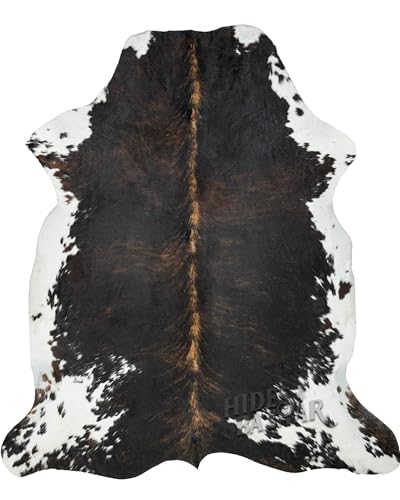
HIDES BAZAAR Dark Brown Brindle Cowhide Rug 6×8 ft — Best Overall Genuine Cowhide
If you want one genuine cowhide that works in the widest range of rooms, this is it. The dark chocolate-brown brindle pattern — fine darker striping through a deep brown field — is the most forgiving colorway in the cowhide world: it reads rich rather than loud, hides everyday dust between cleanings, and sits as comfortably under a modern leather sofa as it does in a cabin or ranch-style room. The listing describes a genuine hair-on hide, tanned soft, at a 6×8 ft class size, which in hide terms means a large piece whose longest points approach those dimensions, with the natural irregular outline filling most of a generous area under a coffee table arrangement.
Hair-on cowhide has a feel no synthetic matches: short, sleek hair with a natural sheen, cool in summer and surprisingly warm underfoot in winter, over a suede-like leather back that grips hard floors reasonably well on its own. Brindle hides also age gracefully — the pattern disguises the gentle hair thinning that high-traffic genuine hides eventually show at their center. Place the busy traffic lane off the hide’s center, or layer it, and a good brindle will look right for many years.
Strengths
- Genuine hair-on hide with the natural sheen and hand-feel faux cannot replicate
- Dark brindle is the most versatile, soil-forgiving genuine colorway
- Large-piece presence: anchors a full seating arrangement, not just a chair
Trade-offs
- One of one: your markings will differ from the listing photos — that is the nature of the product
- Hair can thin over years in a heavy traffic lane; best layered or placed off the main path
- Not machine washable — shake, vacuum on suction-only, spot clean
Best for: buyers who want the real material in a colorway that suits almost any room. Not suited for: anyone who needs the exact pattern in the photo, or a rug that goes in the washing machine. Check the current price on Amazon

Genuine Tricolor Cowhide Rug — Best One-of-a-Kind Statement
Tricolor hides — brown, black and white in bold patches — are the extroverts of the category, and this listing leans into it: a vibrant one-of-a-kind hide described as fitting an 8×10 area, with the actual rug approximately 6×7 ft. That pair of numbers is the most honest sizing language in this category, and we wish every seller used it: the footprint the piece visually commands is larger than its measured extremes because the eye reads the whole organic shape. In a room with quiet furniture — a plain sofa, a simple wood table — a tricolor hide does the work of art, pattern and texture simultaneously.
The listing also notes the hide is easy to clean and suitable around kids and pets, which matches cowhide’s real nature: hair-on leather is naturally resistant to absorbing spills, and most messes lift off the hair rather than soaking in. The flip side of a bold tricolor is commitment. This pattern will be the loudest thing in the room, it will not match the photo (each tricolor’s patch layout is unique), and if your taste runs minimalist, a brindle or a sheepskin will age better with you. Buy the tricolor because you love the drama, not despite it.
Strengths
- Bold, genuinely unique pattern — no other room will have your rug
- Honest area-fit sizing language (8×10 fit, approx. 6×7 ft piece)
- Hair-on cowhide shrugs off spills better than pile rugs do
Trade-offs
- The pattern dominates; quiet rooms only, or it fights the furniture
- Patch layout is random — you cannot choose where the white falls
- Same genuine-hide care limits: no machine washing, keep out of harsh direct sun
Best for: western, rustic and eclectic rooms that need one bold natural element. Not suited for: minimalists, or anyone furnishing around an existing busy pattern. Check the current price on Amazon

IRIWOOL Premium Genuine Sheepskin Rug — Best Genuine Sheepskin
Sheepskin is the other genuine hide, and its personality is opposite to cowhide’s sleekness: deep, dense wool you sink fingers — and toes — into. This IRIWOOL pelt is genuine Australian sheepskin, a single pelt at roughly 2 x 3 ft in a light brown tone. That size is a feature when you place it correctly: over the back and seat of a reading chair, beside a bed where bare feet land first thing, across a bench, or layered on top of a larger rug to build a soft island exactly where you sit. Single pelts are how sheepskin has been used for centuries, and the format’s honesty is refreshing — it does not pretend to be a room-size rug.
Wool brings real functional gifts: it is naturally temperature-regulating, warm in winter and not sweaty in summer, and lanolin in the fibers resists dirt penetration, which is why a sheepskin that looks delicate actually shrugs off daily life with a shake and a brush. What it asks in return is gentle handling — no machine washing unless the listing explicitly allows it, no soaking, and a wool-safe approach to spot cleaning. Treated that way, a good pelt’s pile stays springy for years; the cheap failure mode is matting, prevented by regular brushing and by not placing the pelt where shoes grind across it.
Strengths
- Genuine Australian sheepskin with deep, resilient natural wool pile
- Temperature-regulating and naturally dirt-resistant fibers
- Perfect single-pelt format for chairs, benches and bedside placement
Trade-offs
- Small by design: it is an accent, not floor coverage
- Wool needs brushing to prevent matting in its contact zone
- Light tones show soil more than cowhide brindle does
Best for: reading chairs, bedside luxury, and layering over larger rugs. Not suited for: entryways, shoe traffic, or anyone wanting a big rug for little money. Check the current price on Amazon

AOGELAN Genuine New Zealand Sheepskin Rug — Best Small Accent
The AOGELAN is the second genuine sheepskin on this list, and it earns its own slot on color and intent: a New Zealand single pelt, 2 x 3 ft, in white/ivory. Where the IRIWOOL’s light brown suits warm, woody rooms, the ivory AOGELAN is the Scandinavian and modern accent — bright against dark floors, soft against pale ones, and classic draped over a molded chair or a window bench. The listing suggests the uses honestly: chair and sofa seat cover, bedroom rug, even a generous mat where a dog will inevitably claim it as the best bed in the house.
Two genuine sheepskins in one guide is not repetition; it is how this category is actually bought. Pelt rugs are purchased for a specific chair or spot, in a specific tone, and the choice between a warm natural brown and a clean ivory changes the room. New Zealand sheepskins have a reputation for consistent pelt quality and dense wool, and at single-pelt size the cost of going genuine stays modest — this is the lowest-risk way to own the real material. The cautions mirror the IRIWOOL’s: brush the pile, keep it out of shoe lanes, spot clean gently, and expect the ivory to ask for a little more cosmetic upkeep than darker wool.
Strengths
- Genuine New Zealand sheepskin in a bright ivory that suits modern rooms
- Single-pelt size makes genuine material affordable and placeable anywhere
- Versatile: chair throw, bench cover, bedside mat, pet-claimed luxury
Trade-offs
- Ivory shows soil; plan on more frequent shaking and brushing
- Accent scale only — it will not furnish a seating area alone
- Wool pile can mat where a chair’s occupant twists to stand; rotate it
Best for: modern and Scandinavian rooms needing one soft, bright natural accent. Not suited for: high-soil homes that want set-and-forget flooring. Check the current price on Amazon

BENRON Faux Cowhide Rug 4.6 x 5.2 ft — Best Faux Cowhide
The BENRON is the pick for buyers who love the cowhide look and want none of the genuine material’s terms and conditions. It is a faux cowhide — a cow print on a synthetic pile, cut in the irregular hide outline at 4.6 x 5.2 ft, in a khaki-brown colorway. The listing’s key words are the practical ones: washable and non-slip. A rug you can wash is a rug you can put where life actually happens — under a dining table’s end, in a kid’s western-themed bedroom, in front of a sofa that hosts dogs and snacks — and a non-slip backing matters because shaped rugs with curled-point tendencies are a trip hazard cheap versions are famous for.
Set expectations correctly and the BENRON delights: the print is consistent, so the rug in your room looks like the rug in the photo; the pile is soft rather than hair-sleek; and there is no natural variation, no hair shedding season, and no ethical debate at the door. What faux cannot do is the genuine article’s cool sheen and leather smell, and a printed pattern repeats its logic if you stare — in a room, at normal distances, most guests will simply read “cowhide rug.” For the price tier faux occupies, that is a fair trade, honestly made.
Strengths
- Washable and non-slip — the practical cowhide for busy rooms
- Consistent print: what you see in the listing is what arrives
- Right-sized accent for bedrooms, offices and under coffee tables
Trade-offs
- Printed pile lacks genuine hair’s sheen and variation up close
- Smaller than the genuine cowhides here; it accents rather than anchors
- Synthetic pile can show wear paths in heavy traffic sooner than hair-on hide
Best for: families, pet households and anyone who wants the look with washable practicality. Not suited for: purists who want real hair-on leather underfoot. Check the current price on Amazon

Faux Cowhide Rug 6’3″ x 8’2″ — Best Large Faux
Most faux hides are accent-sized, which leaves a gap for buyers who want the shape at living-room scale without going genuine. This rug fills it: a faux cowhide at 6’3″ x 8’2″, brown cow print, described as washable, non-shedding and allergen-free, with a faux suede grip backing to hold the big outline in place. At this size the hide shape does its full decorative job — softening a large rectangular seating arrangement, defining a zone in an open-plan room — while the faux suede backing addresses the big shaped rug’s known vice, which is creeping and corner-lift on hard floors.
The allergen-free and non-shedding claims are the practical heart of the pick: households managing dust sensitivity, or simply tired of fiber shed, get the western look with a surface that vacuums cleanly and can be washed per the listing’s care directions. It remains a print, and at this scale a discerning eye will notice the pattern’s regularity across a big field — the correct frame is “convincing room-scale decor,” not “counterfeit.” Judged as decor with excellent practical manners, it is the strongest large faux we verified.
Strengths
- Rare room-scale faux hide size with grip backing to keep it planted
- Washable, non-shedding and allergen-free positioning for sensitive households
- Defines a full seating zone the way a genuine large hide does
Trade-offs
- Pattern regularity is more visible across a large field
- Washing a rug this size needs a large-capacity machine or a trip out
- No genuine-hair sheen or leather backing feel
Best for: open-plan living rooms and sensitive households wanting the hide look at full scale. Not suited for: buyers who will inspect it at arm’s length for realism. Check the current price on Amazon
Comparison Table
| Pick | Badge | Key spec | Best for |
|---|---|---|---|
| HIDES BAZAAR Brindle Cowhide | Best Overall Genuine | Genuine hair-on hide, 6×8 ft class, dark brindle | Anchoring a seating area |
| Genuine Tricolor Cowhide | Best Statement | Genuine, approx. 6×7 ft, 8×10 area fit | Bold rustic and western rooms |
| IRIWOOL Sheepskin | Best Genuine Sheepskin | Australian single pelt, ~2 x 3 ft, light brown | Chairs, bedside, layering |
| AOGELAN Sheepskin | Best Small Accent | New Zealand single pelt, 2 x 3 ft, ivory | Modern rooms, chair throws |
| BENRON Faux Cowhide | Best Faux | Faux print, 4.6 x 5.2 ft, washable, non-slip | Busy family rooms |
| Faux Cowhide 6’3″ x 8’2″ | Best Large Faux | Faux print, grip backing, non-shedding | Open-plan zones |
How to Choose a Hide Rug
Decide genuine versus faux on lifestyle, not just looks. Genuine cowhide gives you natural sheen, one-of-one markings and a material that can last decades with light care; it asks you to accept variation, avoid machine washing, and keep it out of punishing traffic lanes. Genuine sheepskin gives unmatched tactile warmth in small formats; it asks for brushing and gentleness. Faux gives consistency, washability and a clear conscience at a lower tier; it asks you to accept a printed pattern and a synthetic service life. Households with muddy dogs, toddlers and a washing-machine-first philosophy are usually happiest faux. Buyers furnishing a “forever” room, who enjoy natural materials and their patina, are usually happiest genuine.
Learn how hide sizes are measured before you compare anything. A genuine hide is an irregular outline. Sellers measure the longest length and the widest width, which means a “6×8” hide includes points and curves with air between them; the usable area is meaningfully less than 48 square feet. Honest listings say “area fit” or give approximate dimensions, as our tricolor pick does. Practical method: decide the furniture arrangement first, note the footprint you want the hide to visually fill, then buy the hide whose measured extremes are a little larger than that footprint, expecting the curves to pull the effective coverage in. For sheepskin, single pelts run roughly 2 x 3 ft to 2 x 4 ft; multi-pelt rugs are several pelts sewn together and priced accordingly.
Match the hide to the traffic. Cowhide’s short hair handles moderate traffic well and releases spills; its weakness is a concentrated pivot point — the spot where everyone turns at a doorway — where hair can thin over years. Sheepskin’s weakness is soil visibility on light colors and matting under twisting feet; its strength is resilience when brushed. Faux’s weakness is pile wear in a fixed lane. In every case the fix is placement: offset the hide from the main walking line, or layer it under a coffee table where feet rest rather than pass.
Think in layers. The most professional-looking hide installations are layered: a large, quiet flatweave or sisal rug defines the seating zone, and the hide floats on top at an angle, adding shape and texture where eyes and feet land. Layering also solves the sizing problem — the base rug provides coverage, the hide provides character — and it protects genuine hides from being the sole surface in a traffic path.
Genuine Hide Quality: What to Look For
With cowhide, quality lives in the tanning. A well-tanned hide is supple — it drapes rather than crackles — with hair that sits flat and resists shedding when you run a hand firmly against the grain. The leather back should look even and smell like leather, not chemicals. Markings are a matter of taste, but symmetry matters more than buyers expect: a hide whose pattern is roughly balanced left-to-right sits calmly under furniture, while a hide with one dramatic patch at a single corner draws the eye to that corner forever. Since you cannot choose your exact piece online, favor colorways — like brindle — where randomness stays graceful, and treat bold tricolors as a delightful lottery you enter on purpose.
With sheepskin, quality is pile density and pelt integrity. The wool should spring back when pressed, with no thin patches where the leather shows through, and the leather side should be soft and uncracked. Longer pile looks luxurious and feels wonderful on a chair, but mats faster under a seated body; a medium, dense pile is the practical sweet spot for pelts that will actually be sat and stepped on daily.
How to Place, Clean and Care for a Hide Rug
Placement first. Unroll or unfold a genuine hide and give it a day to relax; creases from shipping fall out under its own weight, helped by placing books along a stubborn fold for a few hours — never iron a hide. On hard floors, cowhide’s leather back grips moderately; on smooth tile or polished wood, add a thin rug pad cut slightly smaller than the outline, which also cushions the step. Angle the hide deliberately — hides look best rotated off the room’s grid, with the narrower “head” end pointing toward the room’s focal point. Sheepskin pelts go where bodies linger: chair seats and backs, benches, the bedside landing strip.
Cleaning genuine cowhide is simpler than its reputation: shake it outside weekly, vacuum with suction only (a beater bar can tear hair out), and wipe spills immediately with a damp cloth working in the direction of the hair. A little mild soap on the cloth handles most real accidents. Never soak a cowhide, never machine wash it, and keep it out of prolonged direct sun, which dries leather and fades markings. Sheepskin care centers on the pile: shake, brush with a wool or pet slicker brush to lift and separate fibers, spot clean with a wool-safe cleaner, and dry away from direct heat. Faux hides follow their listing’s wash instructions — generally a gentle machine cycle and low or line drying — with the same shake-and-vacuum routine between washes.
Storage, for seasonal users: roll genuine hides hair-side out around a tube, never fold them long-term, and store them breathable, not sealed in plastic. A rolled hide unrolls flat again; a folded one remembers.
Common Buying Mistakes
- Expecting the photo’s exact markings. With genuine hides, the photo is a sibling of your rug, not your rug. If exact pattern placement matters, buy faux or buy in person.
- Reading hide dimensions like rectangle dimensions. Longest-by-widest overstates coverage. Buy a size up from your footprint math.
- Putting sheepskin in a shoe lane. Pelts belong where bare feet and seated bodies land, not where gritty soles grind.
- Machine washing genuine hide. Water and agitation damage leather and hair. Shake, suction-vacuum, spot clean — that is the whole routine.
- Skipping the pad on slick floors. A shaped rug that slides is a fall waiting for a distracted moment. A thin pad cut inside the outline fixes it invisibly.
- Buying a single pelt to cover a living room. Pelts are accents. For coverage, buy a large cowhide, a large faux, or layer.
Final Recommendation
For the genuine article in its most livable form, choose the HIDES BAZAAR brindle cowhide — check the current price on Amazon. For drama, the tricolor is the room’s artwork. For tactile luxury in the spots bodies actually touch, the IRIWOOL and AOGELAN sheepskins cover warm and bright rooms respectively. And for washable, worry-free everyday life, the BENRON faux for accents and the 6’3″ x 8’2″ faux for full rooms deliver the look with none of the leather rules.
Related reading in this cluster: Best Hide Rugs Cheetah, Best Gray Rugs, Best Hypoallergenic Rugs, Best Kid Friendly Rugs.
Hide Rugs Room by Room
Living room. This is the hide’s home turf. The winning arrangement is a large cowhide — genuine brindle for the classic look, large faux for washable practicality — angled under the coffee table with its outline breaking the rectangle of the seating group. If the room already has a wall-to-wall neutral rug or a big flatweave, layer the hide on top at roughly thirty degrees to the furniture lines. The angle is not a stylistic quirk: a hide aligned perfectly with the sofa looks like a spill; a hide rotated looks like a decision.
Bedroom. Bedrooms reward sheepskin most. A pelt on each side of the bed gives bare feet a warm landing that no woven rug matches, and a cowhide at the foot of the bed, half under the frame, adds the organic shape without competing with bedding. Keep genuine hides out of the direct morning-sun stripe across the floor if you can; leather fades slowly, but bedrooms get the longest sun exposure of any room.
Home office. A cowhide under a desk chair is a veteran move — hair-on hide lets a chair’s casters roll more kindly than deep pile does, and the shape defines a work zone in a multi-use room. Choose brindle or a mid-tone faux so the inevitable caster lane blends into the pattern, and use a pad: office chairs migrate rugs more than any other furniture.
Nursery and kids’ rooms. Faux, washable, full stop — the BENRON’s size suits a reading corner or a western theme, and when the inevitable spill cascade happens, it goes in the wash. Genuine sheepskin has a long tradition in nurseries as a supervised play and tummy-time surface, and it is lovely there, but it should be treated as a textile you place and put away, not as the room’s working floor covering.
Entryways and halls. The honest answer is: mostly no. Entries concentrate grit, moisture and pivot traffic — the three things genuine hides like least. If the look is irresistible, use the large faux inside the door’s swing but off the direct line to the kitchen, and shake it out far more often than feels necessary. It will still age faster there than anywhere else in the house.
The Ethics Question, Answered Plainly
Some buyers arrive at this category with a genuine question: should I buy a real hide at all? We will give you the facts we work from and let you decide. Cowhides sold as rugs are a byproduct of the meat and dairy industries — the animals are not raised for their skins, and using the hide converts an industrial leftover into a durable good that can serve for decades. Sheepskins similarly come overwhelmingly from sheep raised for food, with the pelt as a secondary product. Tanning quality varies, and better tanneries manage their chemistry responsibly; a hide that smells of leather rather than solvents is a reasonable consumer-level signal. Against that, some households simply prefer not to bring animal products into the home, and the faux category now serves them well — the prints in this guide are convincing at room distance, washable, and improving every year. What we advise against is the muddled middle: buying a genuine hide while hoping it is somehow not one, or paying genuine prices for a listing too vague to confirm what it sells. Choose real or faux with your eyes open; both are defensible, and this guide labels every pick so the choice is actually yours.
Troubleshooting: Curling, Shedding, Odors and Mats
Curling edges. New genuine hides often arrive with a curled point or edge from shipping. Lay the hide flat with the curl bent gently the opposite way and weight it with books for a day or two; humidity from a steamy bathroom (not direct steam on the leather) helps it relax. Persistent curl at one point usually means that point is being caught by a door swing or a chair leg — move the obstacle, not the hide.
Shedding. A new hair-on hide sheds loose hairs for the first weeks — these are cutting and handling remnants, not the hide failing. Shake it outside twice in the first week and the shedding should taper to nothing. Continued heavy shedding after a month suggests rough treatment: check for a beater-bar vacuum or a pivot point in a traffic lane.
Odors. A mild leather smell on unboxing is normal and fades within days in a ventilated room. A strong chemical smell is a tanning-quality warning; air the hide outdoors in shade, and if the smell persists, that is a legitimate reason to return it — good hides should never gas out a room.
Matted sheepskin. Matting is a maintenance debt, not damage. Work a wool brush or clean pet slicker through the pile in sections, starting from the tips; a light mist of water helps release compressed fibers. Ten patient minutes restores most neglected pelts. Afterward, a thirty-second brush after heavy-use days keeps the debt from accumulating again.
How a Hide Rug Ages: The First Year and Beyond
Buyers often ask how long a hide rug “lasts,” and the honest answer is that genuine and faux age on completely different curves. A quality cowhide’s first year is mostly settling: loose hairs shed in the first weeks, shipping creases relax, and the hide takes a subtle set from the furniture it lives under. Years two through five are its prime — the hair develops a gentle directional sheen from use, the leather stays supple, and the rug looks better than the day it arrived, the way a good leather chair does. The long-term enemies are specific, not general: ultraviolet light drying one stripe of the hide, a single pivot point wearing thin, and moisture trapped underneath on a damp floor. Manage those three and a decade of service is a normal expectation, with the hide gradually becoming more matte and more yours.
Sheepskin ages by pile behavior. A brushed pelt holds its loft for years; a neglected one mats in its contact patch within a season, though as the troubleshooting section notes, matting is usually reversible with patient brushing. The leather side slowly stiffens if the pelt is stored folded or kept against a heat source, so flat or rolled storage away from radiators preserves it. Light-colored pelts also pick up a gradual warmth of tone — not dirt, exactly, but the accumulated tint of life in a real room; households bothered by that should choose the IRIWOOL’s light brown over ivory from the start.
Faux hides age like the synthetic textiles they are: the print does not fade much and the backing does most of the aging. Expect the pile in the main traffic lane to flatten and lose its softness gradient over a few years, edges to show wear first where shoes turn, and the grip backing to gradually lose authority on slick floors — at which point a fresh pad underneath extends the rug’s useful life. None of this is failure; at the faux tier, three to five good-looking years is a fair return, and the washability that defines the category means it will look cleaner across those years than a neglected genuine hide would. Choose your curve when you choose your material: genuine for the long, improving arc; faux for the clean, replaceable one.
Styling Notes: Making a Hide Look Intentional
The difference between a hide that looks styled and one that looks spilled is a handful of small decisions. First, overlap something. A hide with one edge tucked slightly under a sofa, a bench or the foot of a bed reads as placed; a hide floating alone in open floor reads as lost. Second, echo its tones once elsewhere in the room — a leather cushion near a brindle hide, a wool throw near a sheepskin — so the eye connects the texture to the scheme rather than isolating it. Third, respect negative space: the hide’s outline needs a margin of visible floor around at least two sides, or the shape that justifies the whole purchase disappears into clutter. Fourth, with tricolor and bold prints, quiet the nearest textiles — solid cushions, plain throws — and let the hide be the single pattern at floor level. Finally, rotate genuine hides a half-turn every few months. The outline is asymmetric, so rotation changes the room subtly, evens out light exposure and traffic wear, and doubles the time before any single area shows its age. None of this costs anything, and together it is most of what separates magazine photos from real rooms that bought the same rug.
Hide Rugs and Resale, Rental and Real Life
A final practical lens: how these rugs behave in the life you actually lead. Renters should weight the faux picks and the sheepskins heavily — both move easily, neither requires anything of the floor beneath, and a pelt draped over a chair transforms a rental’s neutrality without a single nail. Homeowners furnishing for the long term can justify the genuine cowhides on cost-per-year grounds that few floor coverings match. Sellers staging a home should know that a brindle hide under a coffee table photographs as “curated” in listing photos with almost no effort — and then travels to the next house, unlike most staging purchases. Households with toddlers should simply accept the rotation: faux in the play years’ blast radius, genuine in the calm rooms, and a household peace treaty that keeps shoes, snacks and art supplies flowing toward the washable surfaces. The hide category rewards buyers who place the rug where their life is gentle and choose the material their life can maintain — and it punishes, with perfect fairness, anyone who places a delicate thing in a hard life and calls the result a product flaw.
Frequently Asked Questions
Are hide rugs hard to keep clean?
Genuine cowhide is one of the easiest rug surfaces to live with: spills sit on the hair rather than soaking in, and routine care is shaking, suction-only vacuuming and damp-cloth spot cleaning. Sheepskin asks a little more — regular brushing keeps the pile from matting. Faux hides are the simplest of all, since the picks here are washable.
Will my genuine cowhide look like the listing photo?
It will look like the same family — same colorway and general character — but the exact markings, patches and shading are unique to each animal. Sellers photograph a representative hide. If you need precise pattern placement, a faux hide’s consistent print is the safer purchase.
Do hide rugs work with dogs and cats?
Cowhide handles pets well: hair releases pet hair easily and accidents wipe off the surface. Expect any sheepskin in the house to be claimed as a bed — the wool is fine with that, though claws and digging are not its friends. Faux washable hides are the lowest-stress choice for young or accident-prone pets.
What size hide rug do I need under a coffee table?
Choose a hide whose measured extremes extend at least a foot beyond the table on the long sides, remembering the irregular outline covers less than a rectangle of the same numbers. A 6×8-class cowhide under a standard coffee table, layered over a larger base rug, is the classic arrangement.
Can a hide rug go on carpet?
Yes, and layering over a low-pile carpet or flatweave rug is one of the best uses — the hide adds shape and texture while the base provides coverage and keeps the hide from migrating. Avoid deep plush carpet underneath, where a hide will creep and bunch.
Is a sheepskin rug warm in summer too?
Wool regulates rather than simply warming: it insulates in winter and breathes in summer, which is why sheepskin works year-round on chairs. A pelt underfoot on a hot day feels dry rather than sweaty, though most people still reserve floor pelts for bedrooms and chairs rather than sun-baked rooms.


