Disclosure: airfryerkitchensupply.com is reader-supported. When you buy through links on our site, we may earn an affiliate commission at no extra cost to you.
Where to buy
Every linked product in this guide was verified against Amazon’s catalog — brand, model and listing matched — before it received its purchase link. Five of the six picks below are verified products; the quilt-style slot is covered without a link, because no listing we could verify honestly fills that specific brief, and we do not guess product identities or product codes to fill space. The warmth science, sizing method and care instructions in the rest of this article stand alongside the picks — and with heavyweight bedding, where fill weight is the whole product and the wrong warmth level ruins a winter of sleep, that guidance is the part of the purchase that matters most.
- Best Overall — ACCURATEX Duvet Insert Queen, 400GSM Down Alternative Comforter — Check the current price on Amazon
- Best for Cold Sleepers — GROOSE Australian Wool Comforter King, 450 GSM — Check the current price on Amazon
- Best Quilt-Style Comforter — covered without a link (see the review below): a heavyweight comforter-quilt hybrid with dense stitched quilting; no verified listing currently fills this brief, so no link is printed.
- Best Natural Fill — WOOLROOM Deluxe Washable Wool Comforter King — Check the current price on Amazon
- Best Budget Heavyweight — Winter Extra Warm Queen Down Alternative Comforter (Heavyweight) — Check the current price on Amazon
- Best Oversized — Egyptian Bedding Heavyweight Goose Down Feather Fiber Comforter, Oversize Cal King 108 x 98 — Check the current price on Amazon
Introduction: Warmth Is a Weight, Not an Adjective
The search for the best heavyweight comforter quilts runs into the bedding industry’s favorite fog: warmth described in adjectives. “Cozy,” “plush,” “winter-ready,” “ultra-warm” — none of these phrases is a measurement, and all of them appear on comforters whose actual fill ranges from a summer whisper to an arctic system. A heavyweight comforter is a specific thing: a comforter built with a high weight of insulating fill, quilted — through baffle boxes or dense stitching, which is where the “quilt” in this search earns its place — so that the fill stays distributed instead of migrating to the corners. The honest way to shop the category is by fill weight and construction, and this guide is organized to teach exactly that, because a sleeper who can read a fill specification no longer needs anyone’s adjectives.
Who needs the heavyweight end of the bedding shelf? Cold sleepers, first — the people who are cold under ordinary comforters in ordinary rooms. Cold rooms, second: the farmhouse bedroom, the drafty rental, the household that keeps the thermostat low at night for economy or preference and lets the bedding do the heating. And third, the sleepers who simply love the physical sensation of a substantial blanket — the tucked-in, weighted-down feeling that a light comforter cannot imitate at any temperature. That third group should read the warmth warnings in this guide as carefully as the first two: a heavyweight comforter in a warm room is not luxury, it is a sweating apparatus, and the category’s most common regret is warmth bought beyond the room it sleeps in.
The six slots split the heavyweight idea by its real branches: the all-round down-alternative with proper baffle-box construction, the maximum-warmth specialist, the quilt-stitched hybrid for sleepers who want the traditional quilted feel at comforter warmth, the natural-fill premium option, the budget heavyweight that proves fill weight matters more than brand, and the oversized cut for sleepers whose heavyweight keeps losing the midnight tug-of-war. Each slot’s profile names the specifications that define it — fill weight, construction, shell — so the verified products, when linked, can be held to them.
In this guide
Quick Picks: The Best Heavyweight Comforter Quilts
- Best Overall — ACCURATEX Duvet Insert Queen, 400GSM: the down-alternative heavyweight with its fill weight stated as a number — 400 grams per square meter — warmth without animal fill, in a 90 x 90 queen insert with 8 corner tabs. — check price on Amazon
- Best for Cold Sleepers — GROOSE Australian Wool Comforter King, 450 GSM: the maximum-warmth build for cold rooms and cold bodies — thick Australian wool fill in a cotton sateen shell, sized 102 x 90 — the comforter that lets the thermostat stay low all winter. — check price on Amazon
- Best Quilt-Style Comforter — unlinked specification: the stitched-quilt hybrid: traditional quilted texture and drape, at genuine heavyweight warmth. No verified listing currently fills this brief, so this slot is a specification to shop by, not a link.
- Best Natural Fill — WOOLROOM Deluxe Washable Wool Comforter King: the natural-fill heavyweight: 100% natural wool that regulates temperature through the night, and — rare for wool — washable, in the premium tier. — check price on Amazon
- Best Budget Heavyweight — Winter Extra Warm Queen Down Alternative Comforter: proof that fill weight, not branding, makes warmth — a synthetic heavyweight at the budget tier that out-warms mid-priced lightweights. — check price on Amazon
- Best Oversized — Egyptian Bedding Heavyweight Goose Down Feather Fiber Comforter: the wide-cut California king, 108 x 98 with a stated 90 oz fill weight, that drapes deep on all sides and ends the coverage war. — check price on Amazon
How These Picks Were Chosen
The framework for this guide is thermal, not decorative. Each slot was defined by a warmth-and-construction brief: a target fill class, a quilting construction that keeps that fill working, and a shell suited to the sleeper. Fill weight — expressed by honest makers as a total fill weight for the size, or as a grams-per-square-meter figure — is the category’s master specification, and the slots are sequenced by it: the maximum-warmth slot carries the heaviest brief, the overall slot the balanced one, the budget slot the heaviest brief its tier can honestly hold. Construction ran second: baffle-box quilting, where internal fabric walls let the fill loft fully in each chamber, outperforms sewn-through quilting at heavyweight fills because sewn-through seams are cold lines where the insulation is pinched to nothing — a distinction that matters little in a summer comforter and enormously in a winter one.
Four criteria ran across all slots. Warmth honesty: the profile must state its warmth in specifications, and any product whose warmth exists only in adjectives fails the slot. Fill stability: quilting, box size and edge construction that keep heavy fill distributed through years of washing, because a heavyweight comforter whose fill has migrated is a heavy edge and a cold middle. Shell sense: the shell must be quiet (heavyweight bedding that rustles wakes the partner), breathable enough not to turn insulation into a sauna, and — for down fills — woven tightly enough to keep the fill inside. And care realism: a heavyweight comforter is a serious laundry object, so washability in realistic machines, or honest dry-care labeling, was treated as a specification rather than fine print.
On verification: our picks are linked only after the product’s identity is confirmed against Amazon’s catalog — brand, model and listing matched; the five linked picks below were confirmed on 2026-11-22. One exclusion deserves stating: the patchwork quilt sets common in this search’s search results are lightweight, all-season bedding — beautiful, and the wrong product for a heavyweight brief — so they were excluded from these slots deliberately. The same honesty governs the quilt-style slot: no verified listing in the current catalog pass is a genuinely heavy quilted comforter-quilt hybrid distinct from the duvet inserts that fill the other slots, so that slot remains a prose specification rather than a link.
The 6 Best Heavyweight Comforter Quilts
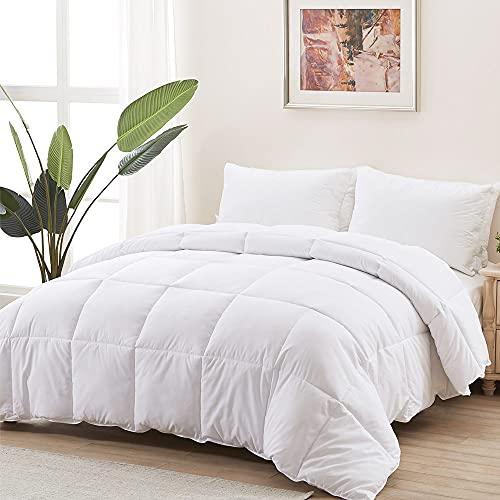
Best Overall — ACCURATEX Duvet Insert Queen, 400GSM Down Alternative Comforter
The best all-around heavyweight comforter is the one whose warmth is a number, and the ACCURATEX states it: 400 grams per square meter of down-alternative fill in a 90 x 90 queen insert — squarely in the heavyweight, thick-winter class, and positioned by its maker for hotel-collection warmth. The down-alternative fill delivers that warmth without animal products and with a tolerance for home washing that down cannot match, and the 8 corner tabs make it a proper duvet insert: tied into a cover, it stays distributed instead of migrating to the corners. For most cold sleepers in most cold rooms, this is the heavyweight to buy.
Strengths
- Stated 400GSM fill weight — warmth you can compare numerically instead of guessing from adjectives.
- Down-alternative fill washes at home and suits households avoiding animal fill.
- 8 corner tabs anchor it inside a duvet cover, keeping heavy fill where it belongs.
Trade-offs
- Synthetic fill regulates temperature less gracefully than natural fills — it is warm, and when the room warms, it stays warm.
- A true heavyweight is a commitment: in shoulder seasons this comforter may be too much, and many owners pair it with a lighter layer for spring and autumn.
- As an insert, it wants a duvet cover for its finished look and easiest care — budget the cover into the purchase.
| Fill | Down alternative, 400GSM (per Amazon listing) |
| Size | Queen, 90 x 90 in |
| Fastening | 8 corner tabs |
The duvet cover question belongs to this pick because the overall pick is the one most owners keep longest: used inside a cover, the comforter’s own shell is protected and the cover takes the weekly wash — a mercy with an object this size. Decide at purchase, buy the cover with the comforter, and the heavyweight’s care becomes a solved problem instead of a seasonal wrestle.
Best for: most cold sleepers and cold rooms wanting one serious winter comforter. / Not suited for: warm rooms, hot sleepers, or anyone wanting a single comforter for all four seasons.
Check on Amazon — check the current price on Amazon before you decide.

Best for Cold Sleepers — GROOSE Australian Wool Comforter King, 450 GSM
The maximum-warmth slot goes to the heaviest stated fill in this guide: the GROOSE packs 450 grams per square meter of Australian wool into a king insert, 102 x 90 inches, inside a breathable cotton sateen jacquard shell — and its listing names its buyer without hedging: extra warm, for cold sleepers. Wool is the cold sleeper’s fill for a physical reason: it insulates heavily while still moving moisture, so the warmth does not turn clammy at 3 a.m. the way a sealed synthetic can. In a genuinely cold room, this is the comforter that lets the thermostat stay low all winter.
Strengths
- 450 GSM wool fill — the heaviest warmth class in this guide, stated as a number.
- Wool regulates moisture as it insulates, so maximum warmth stays dry rather than sweaty.
- Cotton sateen shell is breathable and quiet — no rustling at heavyweight scale.
Trade-offs
- King size only in this listing — queen beds must size up deliberately or look elsewhere.
- This is a winter instrument: in a normally heated room it will be too warm for many sleepers.
- Wool fill is a premium material with a premium tier position to match.
| Fill | Australian wool, 450 GSM (per Amazon listing) |
| Size | King, 102 x 90 in |
| Shell | Cotton sateen jacquard |
Buy this pick for the room you actually sleep in, not the room you wish you had: if the bedroom runs cold — farmhouse, drafty rental, thermostat kept low on purpose — the GROOSE is the honest answer. If the room is warm, its virtue becomes its defect, and the overall pick’s balanced fill is the wiser heavyweight.
Best for: genuinely cold sleepers in genuinely cold rooms. / Not suited for: warm bedrooms, hot sleepers, or queen beds that cannot take a king insert.
Check on Amazon — check the current price on Amazon before you decide.
Best Quilt-Style Comforter — Heavyweight Quilted Comforter-Quilt Hybrid (Unlinked Specification)
The search’s second half — “quilts” — names a construction and a feeling: the stitched-through quilting of a traditional quilt, with its patterned seams, its drape that follows the body, and its flatter, denser hand. A true quilt is a light object, but the hybrid in this slot carries comforter-class fill weight beneath quilted stitching, trading the baffle box’s loft for the quilt’s closeness. Some sleepers prefer exactly that trade: a heavyweight that hugs rather than billows, whose warmth comes from density and contact as much as from lofted air. It is also the slot for traditionalists — the quilted surface, especially in a patchwork or stitched pattern, is the bed’s decoration in a way a plain comforter inside a cover never tries to be.
Strengths of this profile
- Body-following drape: the quilted build settles onto the sleeper instead of tenting, sealing the edges where lofted comforters leak warmth.
- The stitched surface is the decoration — no duvet cover required for a finished bed.
- Dense quilting keeps fill mechanically locked in place through years of washing.
Trade-offs of this profile
- Sewn-through seams are inherent cold lines; the hybrid compensates with fill density, and its warmth-per-weight trails the baffle box.
- Exposed decorative surfaces take the wear a duvet cover would otherwise absorb — spills and friction land on the product itself.
- Heavier in the hand than a lofted comforter of similar warmth; the laundry wrestle is real.
What to look for: fill weight stated (the hybrid’s honesty test — many quilt-styled products are lightweights in costume), quilting density that keeps chambers small, and a reverse side finished as carefully as the face, since quilts get used from both sides.
The hybrid is where this search’s two product families honestly meet, and the slot’s warning bears repeating: the market is full of patchwork quilts photographed to look substantial that weigh what a summer blanket weighs. The defense is the number — a heavyweight hybrid states a heavyweight fill, and a product that will not state it is telling you what it is. For sleepers who grew up under quilts and find lofted comforters alien, a genuine heavy hybrid is the best of both inheritances; just make the seller prove the weight.
Best for: traditionalists, hug-over-loft sleepers, and beds styled without a duvet cover. / Not suited for: maximum-warmth seekers, or anyone unwilling to wash the decorative surface itself.
Why this slot carries no link: in the 2026-11-22 Amazon listing data verification pass, the quilted comforters that could be confirmed were lightweight patchwork sets, and the confirmed heavyweights were duvet inserts rather than quilt-style hybrids. Rather than mislabel either group, this slot stays a specification — shop it by the fill-weight and quilting criteria above.

Best Natural Fill — WOOLROOM Deluxe Washable Wool Comforter King
The natural-fill slot belongs to wool, and the WOOLROOM is the wool comforter that removes wool’s traditional objection: it is washable. The fill is 100% natural wool, positioned for winter months and cold sleepers, with the heat-regulating behavior that makes natural fill worth its premium — warming when the room is cold, releasing heat when the sleeper warms, instead of the synthetic pattern of warm-then-sweaty. For sleepers who run hot and cold in the same night, that regulation is not a luxury feature; it is the difference between sleeping through and kicking the comforter off at midnight.
Strengths
- 100% natural wool fill with genuine temperature regulation across the night.
- Washable — the care profile that wool comforters almost never offer.
- Natural fill ages gracefully, holding loft through years of winters.
Trade-offs
- Premium tier positioning — the most considered purchase in this guide.
- King size in this listing; other sizes mean shopping the same line carefully by fill description.
- Wool has a faint natural character when new that airing handles, but sensitive noses should know it exists.
| Fill | 100% natural wool (per Amazon listing) |
| Size | King |
| Care | Washable |
Judge this pick against the sleeper, not the room: if your temperature swings through the night — cold at lights-out, warm by morning — wool’s regulation earns its tier every single night, and the washable build means the premium purchase is also a practical one. If your temperature is steady and cold, the maximum-warmth pick above is the straighter answer.
Best for: temperature-variable sleepers who want natural fill without dry-clean-only care. / Not suited for: strict budgets, or sleepers who want maximum warmth above regulation.
Check on Amazon — check the current price on Amazon before you decide.
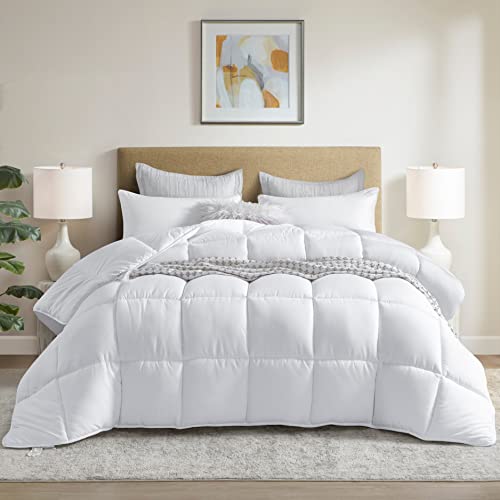
Best Budget Heavyweight — Winter Extra Warm Queen Down Alternative Comforter (Heavyweight)
The budget slot exists to prove this guide’s thesis: fill weight, not branding, makes warmth. This unbranded queen insert — sold under the Dorrin Nessin storefront — is a heavyweight fiberfill comforter, 90 x 90 inches, with corner tabs and an ultra-soft brushed microfiber shell, positioned honestly as a winter extra-warm layer at the budget tier. Nothing about it pretends to be luxury, and that is its virtue: the money went into fill, which is the only place money in a comforter actually becomes warmth.
Strengths
- Genuine heavyweight class at the lowest tier in this guide — warmth per dollar is its whole design.
- Corner tabs make it a working duvet insert, not just a loose blanket with ambitions.
- Brushed microfiber shell is soft, quiet and easy to wash — the right shell for a budget workhorse.
Trade-offs
- Unbranded consistency varies more than the named picks; inspect the fill distribution on arrival.
- Synthetic fill at budget tier will compress sooner over the years than the premium fills above.
- Microfiber shells breathe less well than cotton — warm-room sleepers should pass.
| Fill | Fiberfill down alternative, heavyweight class (per Amazon listing) |
| Size | Queen, 90 x 90 in |
| Shell | Brushed microfiber; corner tabs fitted |
This is the pick for guest rooms, rentals, first apartments and spare-bed insurance — anywhere a real winter comforter is needed and the budget is a fact rather than a failing. Pair it with a decent duvet cover and the system loses nothing that matters against comforters several tiers up.
Best for: budgets, guests, rentals — any bed that needs true winter warmth at the lowest tier. / Not suited for: buyers wanting a decade-long heirloom, or hot sleepers in warm rooms.
Check on Amazon — check the current price on Amazon before you decide.

Best Oversized — Egyptian Bedding Heavyweight Goose Down Feather Fiber Comforter, Oversize Cal King 108 x 98
The oversized slot is a coverage argument, and this comforter makes it with dimensions and a number: 108 x 98 inches of California king coverage carrying a stated 90 ounces of goose down and feather fiber fill, in a 100% Egyptian cotton shell with a pinch pleat design, in gray. The extra width is the point — on a deep mattress, or under a two-sleeper tug-of-war, a standard king heavyweight runs out of drape at exactly the moment it is needed, and those missing inches are where the cold gets in. Ninety ounces of fill across that span keeps the warmth class heavyweight even spread over the larger area.
Strengths
- True oversized cut — 108 x 98 — drapes deep on deep mattresses and ends the coverage war.
- Stated 90 oz fill weight keeps the warmth heavyweight across the extra area.
- Egyptian cotton shell and pinch pleat finish give the oversized workhorse a made-bed look.
Trade-offs
- Down and feather fiber fill needs fluffing and airs best with a cover; it is not the wash-and-forget pick.
- On a standard-depth mattress the extra drape can pool — measure before you commit.
- California king sizing narrows the duvet cover selection; buy the cover with the comforter.
| Fill | Goose down / feather fiber, 90 oz fill weight (per Amazon listing) |
| Size | Oversize California king, 108 x 98 in |
| Shell | 100% Egyptian cotton, pinch pleat design, gray |
Couples recognize this pick instantly: the midnight negotiation over a shared comforter is a sizing failure, not a relationship issue, and the fix is square inches. If your current heavyweight is warm enough but never quite wide enough, this is the upgrade — same warmth class, honestly bigger blanket.
Best for: couples, deep mattresses and California king beds losing the coverage war. / Not suited for: twin or full beds, shallow mattresses, or anyone wanting machine-wash simplicity above all.
Check on Amazon — check the current price on Amazon before you decide.
Comparison Table
| Pick | Badge | Key spec | Best for |
|---|---|---|---|
| ACCURATEX Duvet Insert Queen 400GSM | Best Overall | Down-alternative, 400GSM stated fill, 8 corner tabs | Most cold sleepers and rooms |
| GROOSE Australian Wool Comforter King 450 GSM | Best for Cold Sleepers | 450 GSM wool fill, cotton sateen shell | Genuinely cold rooms and sleepers |
| Heavyweight quilted comforter-quilt hybrid (unlinked specification) | Best Quilt-Style | Heavy fill under dense stitched quilting | Traditional, hug-over-loft sleepers |
| WOOLROOM Deluxe Washable Wool Comforter King | Best Natural Fill | 100% natural wool, washable, premium tier | Temperature-variable sleepers |
| Winter Extra Warm Queen Down Alternative Comforter | Best Budget | Synthetic heavyweight, real fill class, lowest tier | Budgets, guests, rentals |
| Egyptian Bedding Heavyweight Down Feather Comforter 108 x 98 | Best Oversized | Oversized Cal king cut, 90 oz stated fill | Couples, deep mattresses |
How to Choose a Heavyweight Comforter Quilt
Shop by fill weight, and make sellers state it. Fill weight — the total weight of insulation in the comforter, or its grams per square meter — is the only warmth specification that cannot be faked by photography. Loft in a listing photo is air and staging; fill weight is physics. Compare like sizes (a king’s total fill naturally exceeds a twin’s), prefer listings that state the number, and treat a heavyweight claim without a number as a lightweight claim with confidence. This single discipline, applied ruthlessly, is most of what separates buyers who get warm from buyers who get adjectives.
Match the warmth to the room’s real temperature. The correct heavyweight is a function of your bedroom’s night temperature and your own sleeping temperature — two variables only you can measure. Cold room or cold sleeper: the heavy classes serve. Heated room and average sleeper: a mid-heavy build is the ceiling, and the maximum slot will punish ambition. When in doubt, buy one class lighter than your enthusiasm suggests and keep a throw at the foot for the coldest nights; a layer you can remove beats a comforter you must endure, because sleep temperature is managed in both directions.
Choose the construction for the fill. At heavyweight fills, baffle-box quilting is the performance construction — full loft in every chamber, no pinched cold seams. Sewn-through quilting suits the quilt-style hybrid’s denser, drapier brief and lighter heavyweights. Box size matters too: smaller chambers control heavy fill better through washing. And inspect the edges in descriptions and photos — a comforter whose fill can migrate to its borders will, usually in the first wash.
Solve the two-temperature couple honestly. If one partner runs hot and the other cold, no single comforter is the answer, and the mature solutions are structural: two smaller comforters on one bed (the Scandinavian system, which ends the tug-of-war and the temperature war in the same gesture), or a mid-weight shared comforter plus a personal throw on the cold side. Heavyweight purchases made to settle a two-body disagreement settle nothing; buy for the bodies you have.
Plan the laundry before the warmth. A heavyweight comforter, wet, is one of the heaviest textiles in a home. Confirm it fits your machine’s drum with room to move — a comforter packed tight does not wash, it marinates — or confirm the duvet-cover system that keeps the insert out of the wash, or confirm the laundromat run you are genuinely willing to make each season. The care plan is part of the product; a heavyweight without one becomes a heavyweight avoided, then resented, then replaced.
Understand tog and fill power without being ruled by them. Two secondary specifications circulate in this market and confuse buyers in opposite directions. Tog is a warmth rating used mainly in duvet markets: higher tog, warmer bedding, and winter-class duvets sit at the top of the tog scale. It is a useful cross-check when stated, but it measures the finished product’s insulation rather than its contents, and many comforter listings never state it. Fill power, by contrast, describes down alone — the volume an ounce of down lofts to — and a high fill power means warmth at less weight, not more warmth in total: a heavyweight down comforter pairs generous fill weight with its fill power, and either number alone is half the story. For synthetic fills, neither term applies cleanly, which is why this guide keeps returning to the one universal: the fill’s actual weight in the size you are buying.
Read the shell as part of the insulation. The shell is not packaging. A tightly woven cotton shell keeps down inside and breathes with the sleeper; a microfiber shell costs less, washes easily and can rustle or trap heat depending on its quality; a loosely woven shell on any fill is a slow leak of the product’s working material. At heavyweight fills the shell also carries structural duty — it is the quilting’s other half — so threadbare shells fail as warmth before they fail as fabric. Run a hand over the choice in your mind: quiet, tight, breathable is the brief, and a shell described only as “soft” has told you the least important of its properties.
Think in bedding systems, not single products. The heavyweight comforter is the winter layer of a system that most comfortable sleepers actually run: a light layer for summer, the heavyweight for winter, and a throw or an opened window for the margins. Households that expect one comforter to serve July and January end up owning one that serves neither, and the “all-season” heavyweight is usually a midweight with ambitions. Buy the heavyweight for winter without apology, keep the light layer for the rest of the year, and let the change of bedding mark the seasons the way it has for centuries — it is a system that works because each piece is honest about its job.
How to Wash and Care for a Heavyweight Comforter
- Check the care label and your drum size first. The label’s word governs — some natural fills have specific requirements — and the drum must fit the comforter loosely. If it does not, the laundromat’s large machines are the correct tool, not a failure.
- Pre-treat and inspect. Treat stains before washing, and check seams and quilting for openings — a small tear becomes a fill escape in the wash. Mend first, wash second.
- Wash gentle, with modest detergent. A gentle cycle, warm or cool water as the label allows, and less detergent than instinct suggests: residue left in heavy fill dulls its loft and its warmth.
- Rinse thoroughly — twice if the machine allows. Heavy fill holds soap the way it holds air. An extra rinse is the difference between a comforter that lofts back and one that feels permanently tired.
- Dry completely, with patience and agitation. Low-to-medium heat, a long cycle, and dryer balls or clean tennis balls to break up fill clumps and restore loft. Stop and redistribute the comforter midway. A heavyweight that feels dry at the surface can hold moisture in its core — give it more time than you think, because stored damp is mildew.
- Rest and fluff before use or storage. Let the comforter loft for a day after washing. For storage, keep it in a breathable cotton bag, uncompressed or loosely compressed, in a dry place — never in a sealed plastic vacuum bag for a whole season, which crushes fill (down especially) into a long recovery.
Between washes, the duvet cover (if your system uses one) takes the weekly wash and the comforter takes the airing: a morning shake and an occasional hour in fresh air and indirect sun keep a heavyweight fresher than its wash schedule suggests. Treat the insert as seasonal equipment and the cover as weekly linen, and the whole system’s care becomes proportionate.
Rotate and rest the fill. A heavyweight comforter works hardest where the sleeper’s torso lies, and fill — synthetic, wool or down — compresses gradually under that nightly load. The countermeasure costs nothing: rotate the comforter head-to-foot every week or two when the bed is made, so the compression duty is shared across its whole area, and give it a proper airing on a dry day each season, draped over chairs or a line in moving air. Airing does double duty: it lets natural fills release the moisture they absorbed (wool’s regulation works by taking moisture up, and it must be allowed to give it back), and it restores loft that a stuffy closet flattens. Owners who rotate and air routinely get visibly more winters from the same fill weight than owners who treat the comforter as a static object.
Store it loose, never crushed. The off-season mistake that kills heavyweights is the vacuum bag. Compressing any fill to a fraction of its volume for months breaks synthetic clusters, mats wool and fractures down’s structure — the comforter that comes out in November is measurably thinner than the one that went in. Store a heavyweight in the largest breathable cotton bag that fits the shelf, loosely folded, in a dry place; if space forces compression, choose the lightest compression that works and release it a week before first use, with a day of airing to recover what loft it can. The fill weight you paid for is stored loft as much as stored grams, and storage is where the careless quietly spend it.
Common Buying Mistakes
Believing loft photographs. A comforter photographed fresh from fluffing, in a cold studio, at a flattering angle, tells you nothing about its fill. Weight is the spec; the photo is the advertisement. Buy the number.
Buying maximum warmth for a heated room. The most returned heavyweight is the one bought for a winter that happens outdoors. Your room’s temperature, not the season’s branding, sets the correct class.
Confusing quilts with heavyweight comforters. Patchwork and stitched quilts are usually light, all-season layers. The word “quilt” in this search refers to quilted construction at comforter fill weights — verify the fill before assuming the warmth.
Ignoring the wet weight. A heavyweight comforter in a too-small home machine washes badly and dries worse. The laundry plan — drum, cover system or laundromat — is part of the purchase decision, made before, not discovered after.
Sizing by the label instead of the mattress. “King” comforters vary, mattresses have grown deeper, and drape is arithmetic. Measure the bed, add the drops you want, and buy the dimensions — especially before choosing between standard and oversized.
Letting one partner’s temperature choose for both. A heavyweight bought to end one sleeper’s cold can begin the other’s sweating. The two-comforter system and the comforter-plus-throw compromise exist because bodies differ; a purchase that ignores the second body in the bed has solved half the problem at full price.
Storing it crushed and sealed. A season in a vacuum bag can cost a fill its loft for weeks of recovery, and a damp-stored comforter is a mildew farm. Breathable bag, dry room, loose fold — storage is the last specification of ownership.
Final Recommendation
Most cold sleepers should take the Best Overall slot: a baffle-box, down-alternative heavyweight whose fill weight is stated and serious — the warmth, the washability and the construction in one balanced purchase. The genuinely cold-roomed take the maximum-warmth slot without apology; traditionalists take the quilt-style slot’s specification and check any candidate’s fill weight against it; variable-temperature sleepers invest in the natural slot’s regulation; strict budgets take the budget heavyweight plus a good duvet cover and lose nothing that matters; and couples on deep mattresses take the oversized cut and end the coverage war. In every case: buy the number, match the room, plan the wash.
Related bedding guides in this series include Best Bed Sheet And Comforter Sets for buyers furnishing the whole bed at once, and the wider quilt coverage in our bedding library for the lightweight end of the quilt family.
The heavyweight comforter is, in the end, the simplest product in this entire bedding series to buy correctly, because its virtue is a number. Everything in this guide — the constructions, the shells, the systems — exists to protect that number’s work through years of nights and washes. Find the fill weight, match it to your room, and winter becomes a solved problem for good, season after season, without fail or any further fuss at all.
Frequently Asked Questions
What makes a comforter “heavyweight”?
Fill weight. A heavyweight comforter carries a high weight of insulating fill for its size — the specification honest listings state as a total fill weight or a grams-per-square-meter figure — quilted so the fill stays distributed. Loft, adjectives and photography do not define it. If a listing will not state its fill weight, assume it is not heavyweight, whatever its title claims.
What is the difference between a comforter and a quilt?
Construction and fill. A comforter is a thick, filled bedding piece whose insulation is held in quilted chambers — baffle boxes or stitched sections. A quilt is a thinner, three-layer construction (face, batting, backing) held by stitching, traditionally much lighter. The “comforter quilt” in this search is the overlap: comforter-class fill weight with quilted construction, including the stitched hybrids in the quilt-style slot.
Is a heavyweight comforter too warm for most people?
It depends entirely on the room and the sleeper, which is why this guide insists on matching them. In a cold room or for a cold sleeper, a heavyweight is simply correct. In a normally heated bedroom, an average sleeper will find a true heavyweight — and especially the maximum-warmth class — too much for most of the night. When unsure, buy one class lighter and add a removable throw for the coldest nights.
Can I wash a heavyweight comforter at home?
If your machine’s drum fits it loosely, yes — gentle cycle, modest detergent, thorough rinsing, and a long, patient dry with dryer balls to restore loft. If the drum packs it tight, use a laundromat’s large machines instead; a compressed wash cleans nothing. Many owners use a duvet cover precisely so the insert itself needs washing only seasonally. Down and wool fills add their own care specifics — follow their labels.
Should a heavyweight comforter go in a duvet cover?
It is the system this guide recommends for most owners. The cover protects the insert, takes the weekly wash that the insert is too large for, and lets you change the bed’s look without changing its warmth. Use the comforter’s corner loops or ties and the cover’s matching fasteners, or the insert will migrate inside its cover and bunch — the one annoyance of the system, and entirely preventable at setup.
Why does my heavyweight comforter feel thinner than it looks in photos?
Because photographs sell loft and sleepers feel fill. A comforter can be fluffed for a photo into a cloud and still carry a modest fill weight — and after its first wash, it settles to what its fill actually is. This is the category’s central disappointment and the reason this guide shops by stated fill weight. If a new comforter feels thin, check its stated specification against what arrived; if no weight was ever stated, the lesson is the purchase method, and it is cheaper learned once.
Is a weighted blanket the same as a heavyweight comforter?
No — they are different products that share an adjective’s neighborhood. A weighted blanket gets its weight from dense fillers like glass beads and is chosen for pressure, with modest insulation. A heavyweight comforter gets its substantial feel from a large volume of insulating fill and is chosen for warmth. A sleeper wanting warmth should buy the comforter; a sleeper wanting pressure should buy the weighted blanket; confusing them buys a warm sleeper unwanted pressure or a pressure-seeker a merely warm night.
How long should a heavyweight comforter last?
Years, with the range set by fill and care: quality down and wool fills are decade-class bedding; good down-alternatives serve for years before their loft noticeably tires; budget synthetics give their best for a shorter prime. The lifespan levers are yours — correct washing, complete drying, breathable uncompressed storage, and a cover taking the weekly wear. Treat the insert as seasonal equipment rather than weekly laundry and it will repay the respect.


