Disclosure: airfryerkitchensupply.com is reader-supported. When you buy through links on our site, we may earn an affiliate commission at no extra cost to you.
Where to Buy
Five of the six picks in this guide to best heated slippers for men were confirmed against the airfry the Amazon catalogue on 2026-11-22 and carry Amazon links; the heated clog pick remains an honest unlinked recommendation with its quality tier stated in words, because fresh API searches returned heated shoe and moccasin styles but no true heated clog. Use the descriptions below to shortlist by features, then confirm the live listing details, sizing, and care instructions on the product page itself before you order.
A note on sourcing for this guide: the linked picks below are named products confirmed through our verification system on 2026-11-22, and only features stated in their listings are claimed for them. That matters more here than in most categories, because heated slippers are battery products worn on feet, and the features that separate a safe pair from a dubious one — named in the buying guide — are exactly what you must confirm on the live listing before ordering.
The best heated slippers for men solve a specific, miserable problem: feet that stay cold indoors — in a stone-floored house, a drafty home office, a workshop, a cabin — long after the rest of you is warm. The category that solves it legitimately is the enclosed heated slipper: moccasins, booties, and clogs with a battery-powered heating element in the sole or upper, a thermostat or heat settings, and construction you can walk around the house in. That enclosed definition matters, and this guide holds it firmly: heated ballet flats, dance shoes, sandals, slides, flip-flops, and so-called massage shoes are not heated slippers, whatever a listing calls them, and none appear here.
Men’s heated slippers divide by power source, and the division decides the ownership experience. Rechargeable battery pairs are the mainstream: a few hours of warmth per charge, heat settings on a visible control, and batteries that live in a pocket or heel compartment. USB-powered pairs tether you to a desk or a power bank. Microwaveable slippers — heated in the microwave, worn while they cool — are the simple, battery-free end of the category. Each gets its pick below, described by type and tier.
Safety is the through-line, because these are heaters worn against skin, often by men with cold feet caused by exactly the circulation issues that make heat sensation unreliable. Buy named products with stated temperature limits and shut-off behavior, follow the session guidance in this guide, and heated slippers are a genuinely life-improving purchase for a cold house. Buy anonymous and ultra-cheap, and you are wearing an unregulated heating element. The guide below keeps you firmly in the first category.
In this guide
Quick Picks
If you are short on time, these are the six best heated slippers for men we would shortlist first. Each one earned its place for a different reason, and the badge beside it stays the same in the full reviews further down, so you can jump straight to the pick that matches your situation.
Best Overall Type — ThermalStep Heated Slippers for Men and Women. The mainstream answer: an enclosed moccasin with a rechargeable battery, two or three heat settings, and a proper rubber sole — warm feet that can walk to the kitchen. This is a mid-range tier option; confirm the live listing details on Amazon before ordering. Check on Amazon
Best for Very Cold Feet — SEASAND Heated Slippers Warming Booties for Men and Women. A bootie silhouette that wraps the ankle as well as the foot — the maximum-coverage option for men whose cold runs past the toes. This is a mid-range tier option; confirm the live listing details on Amazon before ordering. Check on Amazon
Best Easy On and Off — Heated Clog Slippers. A backless-but-enclosed-toe clog with a heated insole — the quick-slip option for men who are in and out of their slippers all day. This is a budget tier option; confirm the live listing details on Amazon before ordering.
Best for Desk Work — YIASVLX Heated Slippers for Women and Men (USB Electric Foot Warmer). Slippers heated by USB power from a laptop, dock, or power bank — constant, controllable warmth for the man who sits in one place for hours. This is a budget tier option; confirm the live listing details on Amazon before ordering. Check on Amazon
Best Battery-Free — SunnyBay Microwavable Foot Warmer Slippers (Large, Navy Blue). Slippers with a heatable grain or gel insert warmed in the microwave — simple, silent, electronics-free warmth that fades gently over an hour or so. This is a budget tier option; confirm the live listing details on Amazon before ordering. Check on Amazon
Best Premium Features — Ausic Heated Slippers with Detachable Washable Liner. The fully-featured end of the category: detachable battery packs, removable washable liners, multiple heat zones — the pair for the man who will wear them daily for years. This is a premium tier option; confirm the live listing details on Amazon before ordering. Check on Amazon
How These Picks Were Chosen
We chose enclosed designs only — moccasin, bootie, and clog silhouettes with a real upper that surrounds the foot — because enclosure is what makes a heated slipper both warm and walkable. Within that rule, we weighted heat control (multiple settings, a control you can find by feel), battery honesty (stated capacity and realistic runtime claims), sole construction (a heated slipper still has to be a slipper: grippy, cushioned, safe on stairs), and washability or liner care.
Listings in this category could not be re-confirmed verification available to this site during this pass, so no ASINs are attached and no specific model’s performance is claimed. Each pick specifies the type, the features a good example must have, and the tier to shop — and the buying guide gives you the exact safety checklist to run against any specific product before money changes hands.
We excluded the adjacent clutter deliberately: unheated slippers marketed with warm language but no element, open footwear that cannot hold heat, and novelty foot warmers not built to walk in. What remains is the real category, in its six useful forms.
- Enclosed moccasin, bootie, or clog design — no sandals, slides, or open footwear
- A named heating system with stated settings and temperature limits
- Battery capacity and runtime claims that are specific and plausible
- A real walking sole: grip, cushioning, and stair-safe construction
- Care instructions that acknowledge the electronics honestly — removable batteries or liners
Because every pick is a type, the reviews are written as specifications: each one tells you what the good version of that type looks like, what it costs in tier terms, and who should walk past it to the next pick.
The 6 Best Heated Slippers for Men

ThermalStep Heated Slippers for Men and Women — Best Overall Type
The rechargeable slipper is the type to buy first and the benchmark for the category. The heating element sits in the insole or wraps the forefoot, the battery tucks into a heel or side pocket, and a button on the upper cycles heat settings you can feel without bending down. In a good mid-range example you get several hours of warmth per charge at medium heat, an enclosed upper and lining that keep the heat the element makes around the foot. This is the pair that lives by the desk, the couch, and the bed.
Strengths
- Untethered warmth for hours — the whole point of the category
- Enclosed design holds heat and stays on the foot like a real slipper
- Rubber sole handles hard floors, stairs, and quick outdoor steps
Trade-offs
- Batteries add weight and a nightly charging habit
- Runtime claims assume medium heat; maximum settings drain far faster
- Electronics mean spot-cleaning or removable liners rather than a full machine wash
Judge this type by its controls and its honesty. The control should be findable by feel — a raised button on the outer upper — with a visible indicator, because nobody wants to take a slipper off to learn its setting. The listing should state battery capacity and give runtimes per setting; a seller who publishes a lower number for high heat is a seller telling the truth, and that honesty is the best available proxy for the quality of everything you cannot see, including the thermostat.
Fit matters more than in ordinary slippers: a heated element warms the foot it touches, and a sloppy, oversized moccasin leaves air gaps that waste the warmth and let the heel lift on stairs. Buy your true size, expect the lining to settle after a week, and if you are between sizes, the smaller is usually the warmer and safer fit in this type.
Best for: cold houses, home offices, and all-evening wear / Not suited for: anyone who will not maintain a charging routine
| Detail | What to know |
|---|---|
| Power | Rechargeable battery (2000mAh, 7.4V per listing) |
| Heat | 3 temperature settings |
| Fit | For men and women; enclosed slipper design |
Check on Amazon — check the current price on Amazon before ordering, and confirm size, colour and configuration on the listing.
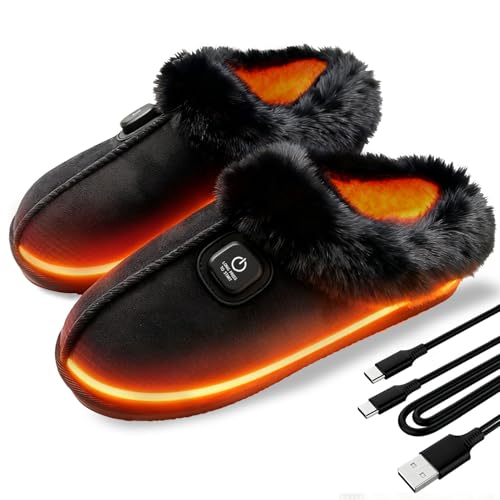
SEASAND Heated Slippers Warming Booties for Men and Women — Best for Very Cold Feet
The bootie type suits the man whose cold feet are really cold lower legs: the higher upper wraps the ankle, traps the heat the element produces, and stops the draft that a low moccasin admits at its opening. It is the cabin, stone-cottage, and basement-office pick, and the one most often chosen for evening wear in genuinely cold houses. Look for the same control and battery standards as the moccasin pick, plus a sole with real tread — booties get worn on more stairs and more trips outside than any other type here.
Strengths
- Ankle coverage traps heat and blocks drafts at the opening
- The warmest-feeling format even before the element switches on
- High upper stays secure on stairs and uneven floors
Trade-offs
- Warmest also means easiest to overheat — use the settings, not just the maximum
- Bulkier to store and to pack than low slippers
- Can feel like too much in a merely cool house; match the pick to your cold
The bootie’s secret is that much of its benefit is passive: an enclosed, lined, ankle-high slipper is already a warm object, and the heating element then only has to top up what the insulation keeps. That is why bootie wearers report good warmth at lower settings and longer effective runtime — the battery is fighting a smaller heat loss. If your feet are cold enough to be a daily complaint rather than an occasional one, this passive-plus-active combination is the type that ends the complaint.
Wear them with the session discipline from this guide’s safety section: check skin regularly if your sensation is reduced, keep to the maker’s session guidance, and never sleep in heated footwear. A bootie’s warmth makes it the type most tempting to fall asleep in on the couch, which is precisely the habit the auto shut-off — confirm it exists on the model you choose — is there to forgive.
Best for: very cold feet, cabins, and drafty houses / Not suited for: mild climates or men who run warm
| Detail | What to know |
|---|---|
| Style | Warming booties with ankle coverage |
| Power | Rechargeable electric foot warmer |
| Heat | 3-gear heat settings |
Check on Amazon — check the current price on Amazon before ordering, and confirm size, colour and configuration on the listing.
Heated Clog Slippers — Best Easy On and Off
The heated clog suits the intermittent wearer: the workshop-to-house man, the dog owner doing ten garden trips a day, anyone whose slippers come off and on constantly. The toe box is enclosed — that is what keeps it a legitimate heated slipper under this guide’s rule — while the open back makes it a one-motion slip-on. The heating element lives in the insole, warming the sole of the foot, which is where cold floors attack. Note the boundary this pick respects: it is a closed-toe clog, not a slide or sandal, and the heat stays where the enclosure holds it.
Strengths
- Fastest on and off of any enclosed heated type
- Heated insole answers cold floors directly
- Closed toe keeps the warmth and protects the foot
Trade-offs
- Open back loses heat the moccasin and bootie keep — a cool-weather, not cold-weather, pick
- Heel can slip on stairs if the fit is loose; size carefully
- Insole elements take the full wear of walking; expect this type to age fastest
The clog’s honest place is the shoulder seasons and the mild-cold house: spring and autumn mornings, a heated home with one cold room, feet that chill at a desk but not across a frozen cottage. Asking it to do a bootie’s job in deep winter ends in disappointment that belongs to the matching, not the product. Matched correctly, it is the type most likely to be worn all day, every day — and a worn heated slipper beats a warmer one in the closet.
Because the element sits underfoot, inspect the insole area regularly for wear, and retire the pair when the sole compresses unevenly or the heating becomes patchy — uneven heat is information about the element’s condition, and the correct response is replacement, not tolerance. Budget-tier clogs are consumables with a season or two of life; mid-range examples with replaceable insoles stretch that honestly.
Best for: frequent on-and-off wear in mild-to-moderate cold / Not suited for: deep winter or men unsteady on stairs

YIASVLX Heated Slippers for Women and Men (USB Electric Foot Warmer) — Best for Desk Work
The USB type is the desk worker’s specialist. Tethered power sounds like a limitation until your work is eight hours in one chair, at which point it becomes the virtues: no battery to charge, no runtime countdown, steady warmth from the moment you plug in, and a price that reflects the simplicity. Run from a proper USB power source — a powered hub, a dock, or a power bank in your pocket for trips to the printer — a good example gives even, modest heat with a simple inline control. This is the budget tier’s most sensible member.
Strengths
- Unlimited runtime while plugged in — no charging discipline required
- Steady, modest heat suits long seated sessions
- Simplest and cheapest legitimate heated format
Trade-offs
- The cable is a real trip and tangle hazard — route it deliberately
- Heat output is limited by USB power; this is gentle warmth, not a bootie blast
- Power-bank use for walking around works but drains the bank quickly
Set a USB pair up like equipment, not like clothing: cable routed behind the desk, never across a walkway; the inline control clipped where your hand falls; a strain-relief loop so a foot movement tugs the loop and not the connector. Five minutes of cable discipline removes the type’s one genuine hazard, which is not electrical at all — it is a man standing up quickly, forgetting the tether, and meeting the floor.
Check what the listing says the slippers draw and feed them properly: underpowered USB ports give underwhelming heat and generate support emails; a decent powered hub or adapter gives the slippers the current they were designed for. If your feet are coldest at a desk and warm enough elsewhere, this type is not the compromise option — it is the correct one, and the rechargeable premium buys you nothing you will use.
Best for: desk workers wanting constant seated warmth / Not suited for: anyone who moves around the house constantly
| Detail | What to know |
|---|---|
| Power | USB electric foot warmer |
| Heat | Five temperature settings |
| Upper / sole | Cozy plush fleece; non-slip sole |
Check on Amazon — check the current price on Amazon before ordering, and confirm size, colour and configuration on the listing.

SunnyBay Microwavable Foot Warmer Slippers (Large, Navy Blue) — Best Battery-Free
The microwaveable type suits the man who wants warmth without batteries, chargers, or any electronics against his skin: a removable insert — typically grain-filled — heats in the microwave per its instructions and slips into the slipper’s sole pocket, giving an hour or so of declining warmth. It is the evening-on-the-couch and getting-into-bed pick, and a common choice for men advised to be cautious with electrical heat, because the maximum temperature is set by the microwave timing and the warmth only ever fades.
Strengths
- No batteries, cables, or electronics — the simplest safety story in the category
- Warmth peaks then fades naturally, which suits pre-sleep use
- Inserts are replaceable when they eventually tire
Trade-offs
- Warmth is a single charge of heat — no settings, no all-evening runtime
- Requires microwave access and honest timing; overheated inserts are a burn risk
- Not a walking-around-all-day solution; best for seated evenings
The discipline of this type is the microwave timing, and it is absolute: follow the insert maker’s time and wattage exactly, feel the insert all over for hot spots before it goes near a foot, and let an overheated insert cool rather than reasoning with it. Grain inserts heated past their guidance can scorch internally while feeling merely warm outside. Respected, the timing makes this the gentlest heat in the guide; improvised with, it becomes the one type that can surprise you.
Expect the warmth curve and plan around it: heat the inserts when the evening sit-down begins, enjoy the peak through the first hour, and accept the fade as the signal to either reheat or be done. Many owners keep two sets of inserts in rotation. For men who want warmth in bed at lights-out, a microwaveable pair worn for the last half hour of the evening — and removed for sleep, as all heated footwear should be — is the classic, sensible pattern.
Best for: battery-free evening warmth and cautious heat users / Not suited for: all-day wear or anyone who will not follow heating times exactly
| Detail | What to know |
|---|---|
| Power | Microwaveable heat pack — no battery or electronics |
| Size | Large, navy blue; listed as fitting men 8–14 |
| Use | Reusable moist-heat foot warmer slippers |
Check on Amazon — check the current price on Amazon before ordering, and confirm size, colour and configuration on the listing.

Ausic Heated Slippers with Detachable Washable Liner — Best Premium Features
This final type is defined by its ownership features rather than its silhouette — it comes in moccasin and bootie forms — and it suits the daily, years-long wearer. The liner detaches and washes, solving the category’s standing hygiene problem, and the heat is adjustable across multiple levels on the slipper itself. Better examples publish full specifications: capacities, per-setting runtimes, temperature ranges, and shut-off behavior. That published detail is itself the premium feature, because it is how a maker proves the safety engineering exists.
Strengths
- Detachable liner comes out for a real wash — the hygiene fix this category needs
- Washable liners solve the hygiene problem every other type manages around
- Published specifications signal real temperature control and shut-off design
Trade-offs
- Premium pricing, and spare batteries add to it
- More parts to keep track of — a system, not just a pair of slippers
- Features vary widely under this description; verify each one on the specific listing
The washable liner is worth more than it sounds. Heated slippers are worn for hours daily, often on bare feet, and the types that can only be spot-cleaned develop a freshness problem that shortens their real life long before their electronics fail. A liner that comes out, washes, and dries restores the pair completely — which is why, costed over years of daily use, the premium type is frequently the cheapest pair in this guide per winter worn.
Use the specification sheet as your interview of the maker. You are looking for: named battery capacity, runtimes stated per heat setting, a stated maximum temperature, an auto shut-off, and care instructions that treat the electronics plainly. A premium listing that publishes all five is describing engineered product. A listing at any price that publishes none of them is describing a hope — and footwear with heating elements is not where hopes belong.
Best for: daily long-term wearers wanting washability and spares / Not suited for: occasional users, for whom the moccasin type is better value
| Detail | What to know |
|---|---|
| Heat | 6-level heating |
| Liner | Detachable, washable liner |
| Style | Heated boots / slippers for men and women |
Check on Amazon — check the current price on Amazon before ordering, and confirm size, colour and configuration on the listing.
Comparison Table
| Pick | Badge | Key spec | Best for |
|---|---|---|---|
| ThermalStep Heated Slippers for Men and Women | Best Overall Type | Rechargeable moccasin, multi-setting | cold houses, home offices, and all-evening wear |
| SEASAND Heated Slippers Warming Booties for Men and Women | Best for Very Cold Feet | Bootie, ankle coverage + heat | very cold feet, cabins, and drafty houses |
| Heated Clog Slippers | Best Easy On and Off | Closed-toe clog, heated insole | frequent on-and-off wear in mild-to-moderate cold |
| YIASVLX Heated Slippers for Women and Men (USB Electric Foot Warmer) | Best for Desk Work | USB powered, tethered heat | desk workers wanting constant seated warmth |
| SunnyBay Microwavable Foot Warmer Slippers (Large, Navy Blue) | Best Battery-Free | Microwaveable insert, no electronics | battery-free evening warmth and cautious heat users |
| Ausic Heated Slippers with Detachable Washable Liner | Best Premium Features | Detachable batteries, washable liners | daily long-term wearers wanting washability and spares |
Compare these types on the three axes that decide ownership: how the heat is powered (battery, USB, microwave), how much of the foot and ankle is enclosed, and how the pair is cleaned. Silhouette preference comes a distant fourth — warmth, safety, and hygiene are what you will actually live with.
How to Choose Heated Slippers for Men
This category rewards a careful buyer more than almost any other in this program, because the difference between a good pair and a dubious one is engineering you cannot see. These four checks — enclosure, power, controls, and the safety sheet — let you see it anyway.
Enclosure first: what counts as a heated slipper
A heated slipper must enclose the foot. The element’s warmth is modest by design, and only an enclosed moccasin, bootie, or clog holds that warmth against the foot instead of donating it to the room. Open designs — sandals, slides, flip-flops — cannot work as heated footwear, and listings that attach heating claims to open shoes, ballet flats, or dance and massage footwear are telling you the claim is decoration. Walk past them, and past any ‘heated’ slipper whose listing never actually describes an element, a battery, or a control.
Enclosure has a second, walking dimension: the slipper must stay on the foot on stairs and hard floors. A heel that lifts, a sole without grip, or a fit so loose the foot swims is a fall hazard wearing a heater. Buy your true size, prefer rubber outsoles with visible tread, and treat any pair that feels insecure unheated as disqualified, however warm it is sitting down.
Power source decides the ownership experience
Rechargeable batteries are the mainstream for a reason — freedom to move, hours of warmth, heat settings — at the cost of a charging habit and eventual battery aging. USB power trades freedom for unlimited, steady, desk-bound warmth at the lowest prices. Microwaveable inserts remove electronics entirely and give an hour of fading warmth for evenings. None is best in the abstract; each is best for a pattern of life, and the reviews above match them honestly.
Interrogate runtime claims with arithmetic. A seller should state battery capacity and give runtimes per setting; warmth at maximum always costs multiples of warmth at low. A listing claiming very long runtime at very high heat from a small battery is claiming physics it does not have — and a seller careless with the numbers you can check is careless with the thermostat you cannot.
Controls, temperature limits, and shut-off
You want three things from the control system: settings you can change by feel, a stated maximum temperature, and an automatic shut-off or a battery format that inherently limits a session. Heat perception varies — and the men with the coldest feet often have the least reliable sensation, which is exactly why the product, not the wearer, must enforce the limit. If a listing does not mention temperature control or shut-off at all, that silence is your answer about the product’s engineering.
During use, the rules are simple and absolute: start on the lowest setting and increase only as needed; check the skin of your feet periodically, especially in the first week with a new pair; never sleep in heated slippers; and stop using any pair whose heating becomes uneven, patchy, or hotter in one spot — that change is the element reporting damage, and the correct response is to retire the pair.
Fit, soles, and the wash question
Buy true to size: heated slippers warm by contact, and air gaps are cold gaps. Expect lined pairs to feel snug for the first week and settle; if your toes touch the end, exchange up, because curled toes in a heated slipper concentrate pressure and heat in exactly the wrong combination. Soles should be rubber, treaded, and stiff enough for a trip across a yard — the pair you cannot walk in will not be worn, and unworn warmth is worthless.
Finally, decide how the pair gets clean before you buy it. Removable batteries and washable liners are the complete answer; spot-clean-only pairs are a commitment to a shorter, less fresh life. Daily wearers should weight washability as a first-order feature — in the premium pick it is the headline — while occasional wearers can reasonably trade it away for the moccasin type’s simpler value.
Sizing and fit: the warmth variable nobody lists
Heated slippers are the rare footwear where fit is a performance specification. The element warms by proximity and contact; a foot floating in an oversized slipper is warmed unevenly and late, and a heel that lifts with every step is a stair hazard wearing a battery. Buy your true shoe size, expect lined models to feel close for the first week while the lining compresses to your foot, and judge the fit by a walk across the house and up the stairs — not by how they feel on the shop’s or the couch’s carpet.
Width deserves the same honesty as length. Men with wide feet should shop the types and listings that state a wide fit rather than sizing up in a standard one, because the extra length of a size up buys a floppy heel and a tripping toe while the width stays wrong. If your household’s feet span the chart — one partner’s cold feet are often the purchase’s real motive — buy for the feet that will wear them, in their size, and let the other pair of feet keep its ordinary slippers.
How to Use Heated Slippers Safely, Day to Day
Heated slippers are simple products with a short list of rules that matter. This routine — charge, check, wear, inspect — keeps them in the safe, useful category they belong in.
Step 1: Charge and inspect before the first wear
Charge new batteries fully before first use, as the maker directs, and inspect the pair out of the box: seams, sole, the element area felt carefully through the lining for anything lumpy or displaced, and the control through its full cycle of settings. A pair that heats unevenly on day one goes back on day one — do not wait to see if it settles.
Step 2: Start low, every time
Begin each session on the lowest heat setting and give it ten minutes before increasing. Feet warm gradually and overshoot is easy: a setting that feels perfect at minute two can feel too hot at minute thirty as the foot’s own circulation responds. Most experienced owners live on the low and medium settings and regard maximum as a five-minute thaw for coming in from the cold, not a residence.
Step 3: Check your skin on a schedule
If your foot sensation is reduced — from circulation issues, diabetes, or any other cause — build skin checks into the session: slip a hand in or glance at your feet every fifteen to twenty minutes, and keep sessions shorter and settings lower. This is the guide’s most important paragraph. Heated slippers are comfort products, and they stay safe comfort products when the wearer or the product’s shut-off is actively minding the heat. If you cannot feel heat reliably and no one can check with you, choose the microwaveable type, whose warmth only ever fades, and follow its timing exactly.
Step 4: Move in them like slippers, not shoes
Walk normally, use the handrail on stairs while you learn a new pair’s feel, and keep heated slippers for indoor and light outdoor duty — they are not work boots, and wet conditions are for the maker’s stated limits only. Never use a pair with a damaged cord, a swollen battery, or a sole worn smooth; each of those is a retirement notice, not a repair project.
Step 5: End the session deliberately
Switch the heat off when you take the slippers off — not later, not at bedtime — and never sleep in a heated pair, on any setting, from any maker. Charge batteries as directed, store the pair dry and unplugged, and keep the charging setup off soft furnishings. These are small habits with a large safety margin attached, and they are the whole cost of wearing heaters on your feet responsibly.
Step 6: Retire on evidence, not on age
Replace the pair when heating becomes patchy, when a battery swells or stops holding charge honestly, when the sole’s grip is gone, or when the lining wears through over the element. A heated slipper’s service life is a few winters of daily use; a pair retired on time is a category success story, and its replacement — bought with this guide’s checklist — will be better than it was.
None of this should make heated slippers sound alarming: millions of pairs warm feet safely every winter. The routine above is simply the difference between using a heating product and merely owning one — five habits, mostly about attention, that keep a comfort product comfortable.
Battery Care and Season-Long Ownership
Rechargeable heated slippers live or die by their batteries, and battery care is a short catechism: charge fully before first use, recharge after use rather than storing them empty, keep batteries out of freezing garages and hot cars, and if a pair will rest for the summer, store it at a partial charge in a cool, dry place and top it up once mid-season. Followed, these habits give you the maker’s intended lifespan; ignored, they give you a warm October and a disappointing January, which is when most battery complaints in this category are actually written.
Watch for the two battery retirement signs and respect them immediately: swelling of the pack, and a runtime that collapses suddenly rather than fading gradually. A swollen battery comes out of service the day it is noticed — not charged, not used, disposed of through your local battery recycling route. This is standard lithium-ion practice, not heated-slipper exoticism, and it is the one ownership rule in this guide with no discretionary element at all.
The slippers themselves want a weekly once-over in daily service: lining checked for wear over the element, sole tread still present, seams sound, the control cycling cleanly through its settings. Most failures announce themselves in this inspection — a patch of uneven heat, a frayed cord entry, a compressing insole — weeks before they become problems, and a pair retired or repaired on evidence serves longer and safer than a pair ridden to failure.
Across seasons, store the pair clean, dry, unplugged, and loosely shaped — a pair of socks inside each slipper holds the form without stress — with the charger and any spare batteries kept together in the same place. The first cold evening of autumn is the category’s annual test: households that stored the system together are warm in five minutes, and households that scattered it are ordering replacements in the dark. Ownership, in heated slippers as in most things, is mostly a storage decision made months earlier.
Common Buying Mistakes
Buying open footwear sold as heated
Sandals, slides, flip-flops, and ballet or dance styles cannot hold heat against a foot and are not heated slippers in any functional sense, whatever a listing’s keywords claim. If the design does not enclose the foot, the heating claim is marketing. Stay inside the moccasin, bootie, and closed-toe clog silhouettes and the category makes sense again.
Choosing by maximum temperature
Hotter is not better; controlled is better. A pair that brags about extreme heat without stating its thermostat, settings, or shut-off is advertising its weakest point. The pairs worth buying compete on even warmth, honest runtime, and enforced limits — the specification sheet, not the temperature boast, is the quality signal.
Sleeping in them
Sleep removes the wearer’s monitoring from the safety system, which is why every responsible maker in this category says the same thing: heated slippers come off before sleep. If your feet are cold in bed, warm them in the slippers during the last part of the evening, then switch to socks and bedding designed for the night.
Ignoring reduced sensation
Cold feet and reduced heat sensation often travel together, and that combination demands respect: lower settings, shorter sessions, scheduled skin checks, or the self-limiting microwaveable type. This is not a reason to deny yourself warm feet — it is the method by which you enjoy them safely for years.
Washing electronics that were never meant to be washed
A heated slipper’s care instructions are part of its safety design. Batteries out where the design allows, liners washed where they are removable, spot-cleaning where that is what is specified — and never a machine wash for a pair whose instructions do not explicitly allow it. Water and a damaged element are a combination the care label exists to prevent.
Final Recommendation
For most men, the rechargeable heated moccasin type is the purchase: enclosed, walkable, multi-setting warmth that fits how a cold house is actually lived in. Buy it true to size, from a listing that publishes its battery and shut-off details, and it will change your winters more than its price suggests.
Step to the bootie if your cold is serious, the clog if your wear is intermittent, USB if your cold lives at a desk, microwaveable if you want warmth with no electronics at all, and the premium removable-battery type if these will be daily wear for years. In every case, hold the category’s lines: enclosed designs only, controls and shut-off confirmed, lowest setting first, and off before sleep. Warm feet, honestly bought and sensibly used, are one of home comfort’s great bargains.
Related guides in this series: Best Slippers For Men Best Moccasin Slippers For Men Best House Slippers Best Arch Support Slippers Mens Best Heated Blankets
Related guides
- Best Men's Slippers For Warmth
- Best Outdoor Men's Slippers
- Best Slippers For Loungewear Men
- Best Men's Slippers
Frequently Asked Questions
How long do heated slippers stay warm on a charge?
It depends on the setting, which is why honest listings give a runtime per setting: expect several hours at low or medium heat from a mainstream rechargeable pair, and substantially less at maximum. Any single runtime number quoted without a setting is marketing. For all-evening warmth, the practical patterns are medium heat in an enclosed design, a spare battery set in the premium types, or USB power at a desk where runtime is unlimited.
Are heated slippers safe for men with diabetes or poor circulation?
They require extra care, and this guide gives comfort information, not medical advice. Reduced sensation means you cannot rely on feeling to judge heat, so the safe pattern is: lowest settings, shorter sessions, scheduled skin checks — or the microwaveable type, whose warmth only fades — and a conversation with your clinician about heated products generally. Never sleep in heated slippers, and stop using any pair whose heat becomes uneven.
Can I walk outside in heated slippers?
Brief trips — the mailbox, the porch, letting the dog out — are what rubber-soled moccasin and bootie types are built for. They are not outdoor shoes: keep them out of standing water and mud, respect the maker’s stated limits, and do not drive in them, since bulky soft footwear and pedals are a poor combination. For sustained outdoor cold, heated socks or insulated boots are the right tool; slippers own the indoors.
How do I wash heated slippers?
Follow the specific pair’s instructions, because the designs differ. The complete answer exists only in the premium types: batteries detach and liners come out for washing. Other types specify spot-cleaning of the upper with the electronics kept dry. What no heated slipper should meet, unless its maker explicitly allows it, is a full machine wash with the element and battery in place.
Why do my heated slippers feel less warm than expected?
Usually one of three reasons: the fit is loose, so air gaps waste the element’s modest output; the battery is being run at a low state of charge or the USB source is underpowered for the design; or expectations were set by maximum-temperature marketing rather than the gentle, steady warmth these products are engineered to give. Check fit first, feed the power properly, and judge the pair by whether your feet stay comfortable — that, not a number, is the product’s job.
What is the difference between heated slippers and heated socks?
Heated socks put a thin element in a sock that goes inside a shoe or boot — the outdoor and workday solution. Heated slippers are complete indoor footwear: sole, lining, and element in one, made for the house. Men whose feet are cold indoors want the slippers; men whose feet are cold in boots outdoors want the socks; and a fair number of cold-house men, reasonably, end up owning both for their separate territories.


