Disclosure: airfryerkitchensupply.com is reader-supported. When you buy through links on our site, we may earn an affiliate commission at no extra cost to you.
Where to buy
Start your search for best gaucho grills with the pick that matches your space, fuel and headcount, then check price on Amazon before you commit. Every linked model below was confirmed against the Amazon catalog data we pulled for this guide, and availability can shift with the season, so use the links here as your shortlist rather than wandering the full category:
- Brand-Man Santa Maria Grill Argentine with Brasero (Best Overall) — Check the current price on Amazon
- Backyard Discovery Argentine Santa Maria Heritage Grill (Best Fire-Brick Firebox) — Check the current price on Amazon
- BIG HORN Santa Maria Grill, Argentine Parrilla (Large) (Best Large Open Fire Grill) — Check the current price on Amazon
- Hickory Summit Argentine Santa Maria Grill with Brasero and Plancha (Best Complete Kit) — Check the current price on Amazon
- Argentine Santa Maria Grill with Fire Bricks (Compact) (Best Compact Brick-Lined) — Check the current price on Amazon
- BIG HORN Santa Maria Grill Portable Argentinian Parrilla (Best Portable Parrilla) — Check the current price on Amazon
Shopping for the best gaucho grills means shopping for the oldest idea in grilling: an open wood fire, a grate you can raise and lower over it, and time. The gaucho style — the Argentine parrilla tradition, closely related to Santa Maria grilling — cooks over real wood or charcoal embers, using grate height instead of burner dials to control heat. There is no lid, no ignition button and no shortcut. What there is, when it is done well, is flavor and theater that no enclosed grill can reproduce: steaks kissed by wood smoke, chimichurri glistening, a fire you tend like a campfire with better tools.
Modern gaucho grills organize themselves around a few design elements. The firebox or brasero is where wood burns down to embers; in the best designs a side brasero lets you make embers continuously and rake them under the grate as needed. The grate itself — often V-shaped channels that run fat away from the fire to a drip tray — cranks up and down on a wheel or lever, giving you instant heat control. Fire bricks line serious fireboxes, protecting the steel and holding heat. Sizes range from portable tabletop parrillas to backyard installations that anchor an outdoor kitchen.
This guide is honest about who this style suits. Gaucho grilling is active, unhurried cooking for people who enjoy the fire as much as the food. It is not weeknight-fast, it is not set-and-forget, and it asks for space, a supply of real wood or lump charcoal, and comfort cooking outdoors in the open air. If that description sounds like a warning, look at the gas guides instead. If it sounds like an invitation, the six picks below — all confirmed against the Amazon catalog for this guide — are the parrillas worth your money, from a full brasero-equipped Argentine grill to a portable model you can take to the fire’s edge anywhere.
In this guide
Quick Picks
Brand-Man Santa Maria Grill Argentine with Brasero — Best Overall. The complete Argentine formula in one unit: a brasero for making embers, a height-adjustable V-grate for classic parrilla cooking, and a griddle surface alongside. If you want one purchase that teaches and serves the whole gaucho tradition, this is it. Check price on Amazon.
Backyard Discovery Argentine Santa Maria Heritage Grill — Best Fire-Brick Firebox. A heritage-styled Santa Maria with fire bricks lining the firebox and adjustable grates over a wood and charcoal fire. The bricks are the story: they protect the steel, hold heat like an oven wall and smooth out the fire’s moods. Check price on Amazon.
BIG HORN Santa Maria Grill, Argentine Parrilla (Large) — Best Large Open Fire Grill. A large open-fire parrilla with an adjustable-height grate, a chimney to draw smoke up and away from the cook, and a firewood rack underneath. It is the Santa Maria format scaled for serious gatherings and serious appetites. Check price on Amazon.
Hickory Summit Argentine Santa Maria Grill with Brasero and Plancha — Best Complete Kit. Brasero, plancha griddle and included tools — the Hickory Summit arrives as a working asado station rather than a grill you accessorize over the following year. For a buyer entering the style, that completeness is worth real money. Check price on Amazon.
Argentine Santa Maria Grill with Fire Bricks (Compact) — Best Compact Brick-Lined. The brick-lined Santa Maria formula in a more compact, heavy-duty format: adjustable-height grates over a wood and charcoal fire, with fire bricks steadying the heat. For smaller spaces that still want the real ritual, this is the entry point. Check price on Amazon.
BIG HORN Santa Maria Grill Portable Argentinian Parrilla — Best Portable Parrilla. A portable parrilla with adjustable height and grates that rotate a full 360 degrees over an open charcoal fire. It takes the gaucho method to the campsite, the beach or the tailgate — anywhere a real fire is welcome. Check price on Amazon.
How These Picks Were Chosen
Every grill here was verified through the Amazon catalogue data for this site before review — a necessary step in a niche where listings come and go and many products are kits or accessories rather than complete grills. Accessory kits were excluded from the picks; a gaucho grill must be a complete cooking appliance with its own firebox and adjustable grate. The evaluation then focused on the elements that define the style: the height-adjustment mechanism and its smoothness under load, grate design and material, whether a brasero is included for ember production, and firebox lining and steel weight.
Practical ownership counted heavily. Open-fire grills live hard lives — extreme heat cycles, ash, weather — so construction and the availability of the maker’s support mattered. Portability was scored separately, since the category spans cart-sized installations and genuinely portable parrillas. The final six cover the full range: two full-size Argentine grills with braseros, a brick-lined heritage model, a large open Santa Maria, a compact brick-lined option and a portable rotating-grate design.
The 6 Best Gaucho Grills

Brand-Man Santa Maria Grill Argentine with Brasero — Best Overall
Check the current price on Amazon
Buy this if you are committing to the style properly. The brasero is the feature that separates real parrilla cooking from grilling over a fire you lit under the food: you burn wood down to embers in the side basket, then rake glowing embers beneath the grate as the cook demands, keeping heat steady for hours without ever flaming the meat. The V-grate channels fat away to a tray, which means fewer flare-ups and the option of basting with the collected juices. Add the griddle for vegetables, provoleta cheese and flatbreads, and you have the full Argentine Sunday asado in a single footprint.
Strengths
- Dedicated brasero enables true ember management, the heart of parrilla cooking
- Height-adjustable V-grate gives instant, precise heat control and drains fat from the fire
- Griddle section covers vegetables, cheese and breads alongside the grate
Trade-offs
- Learning curve is real — your first cooks are fire school, not dinner theater
- Large footprint and a full wood supply are part of ownership
- Open-fire cooking is weather-dependent in a way lidded grills are not
| Spec | Detail |
|---|---|
| Format | Argentine parrilla / Santa Maria grill |
| Fire system | Brasero ember maker (per Amazon title) |
| Grate | Height-adjustable V-grate, plus griddle |
What makes this grill the top pick is that it includes the whole system rather than a gesture at it. Many Santa Maria grills give you an adjustable grate over a firebox and leave ember production to improvisation; the brasero changes the cooking completely, because your fire and your heat source become two separate things you control independently. You keep a lively fire cracking in the brasero for atmosphere and supply, while under the grate there is only the clean, even radiation of embers. The crank adjustment then does the fine work — drop the grate for a hard sear on entraña or vacío, raise it for the slow roast of a whole chicken or a thick asado cut. The V-grate’s fat management is the quiet hero: Argentine cuts are rich, and channeling the drippings away prevents the flare-ups that scorch exteriors before interiors cook. This is a grill that rewards ritual and repays it with food that tastes unmistakably of the tradition it comes from.
Best for: Committed asado cooks who want the complete Argentine system / Not suited for: Anyone wanting weeknight speed or lid-down convenience

Backyard Discovery Argentine Santa Maria Heritage Grill — Best Fire-Brick Firebox
Check the current price on Amazon
Choose the Heritage if you love the open-fire style but want the most forgiving firebox in the category. Fire bricks change the cooking physics: they absorb heat while the fire is young and radiate it back as the embers settle, which steadies the temperature under the grate and reduces the constant ember-shuffling that bare steel boxes demand. The heritage styling also makes this the parrilla most likely to be welcomed as patio furniture rather than tolerated as equipment. It suits the cook who hosts around the fire — the grill as gathering point — and cooks thick cuts, whole vegetables and flatbreads over a long evening.
Strengths
- Fire-brick lining steadies heat and protects the firebox steel
- Adjustable grates give classic height-based heat control
- Heritage design looks like furniture, not equipment
Trade-offs
- Bricks add weight — this is a place-it-and-leave-it grill
- No dedicated brasero, so embers are made in the main firebox
- Brick care matters: avoid thermal shock from water on hot bricks
| Spec | Detail |
|---|---|
| Format | Argentine Santa Maria grill |
| Firebox | Fire-brick lined (per Amazon title) |
| Fuel | Wood fire and charcoal |
The Heritage earns its place by solving the open-fire grill’s core frustration: uneven, fading heat. A bare steel firebox gives you the fire you have, moment to moment. A brick-lined box gives you the fire’s average — stored heat radiating steadily while you add fuel in stages. For long cooks and thick cuts, that steadiness is the difference between tending and chasing. The adjustable grates work as they should, with enough range to go from ember-kissing sear to a gentle roast height. Because there is no separate brasero, you will manage embers in the traditional in-box way: build the fire to one side, let it collapse to embers, and rake them under the food as needed — a technique as old as the style itself, and one the bricks make considerably easier. As a backyard centerpiece that cooks as good as it looks, this is the most complete heritage package in the guide.
Best for: Hosts who want steady open-fire heat and a centerpiece look / Not suited for: Anyone who needs to move the grill often — brick is heavy

BIG HORN Santa Maria Grill, Argentine Parrilla (Large) — Best Large Open Fire Grill
Check the current price on Amazon
This is the grill for the cook whose asado serves a crowd. The large grate takes whole racks, multiple chickens or a flank of steaks at once, and the firewood rack keeps fuel at hand instead of in a pile across the yard — a small thing that matters at hour three of a cook. The chimney deserves special mention: open-fire grilling’s everyday annoyance is smoke in the cook’s face, and a chimney that draws the smoke upward transforms long sessions. If your gatherings run to a dozen people and your style runs to whole-animal-adjacent ambition, this is your instrument.
Strengths
- Large grate capacity for crowd-sized asados
- Chimney draws smoke away from the cook — a genuine comfort upgrade
- Firewood rack keeps fuel organized and dry under the unit
Trade-offs
- Big and heavy; it claims its patio corner permanently
- Consumes real quantities of wood — fuel supply is an ongoing consideration
- No brasero, so ember management happens in the main fire
| Spec | Detail |
|---|---|
| Format | Large Santa Maria / Argentine parrilla |
| Grate | Adjustable height (per Amazon title) |
| Extras | Chimney and firewood rack |
Scale changes open-fire cooking from a technique into an event, and the BIG HORN is built for the event scale. The adjustable grate spans enough area to run zones by height and position — searing cuts low over fresh embers at one end, slow-roasting at height at the other — which is how experienced parrilleros feed a crowd in waves. The chimney is more than comfort: a steady draw keeps the fire breathing evenly and pulls smoke through rather than letting it stagnate over the food, which keeps flavors clean on long cooks. The firewood rack underneath sounds like a footnote until you have cooked a five-hour asado; having split wood dry and arm’s-length is the difference between a rhythm and a chore. Construction is appropriately burly for the format. Feed it good hardwood, learn its ember cycle, and it will anchor gatherings the way a fireplace anchors a room.
Best for: Crowd-sized asados and open-fire entertaining / Not suited for: Small patios, small households or the smoke-sensitive

Hickory Summit Argentine Santa Maria Grill with Brasero and Plancha — Best Complete Kit
Check the current price on Amazon
Choose this if you are new to parrilla cooking and want the learning curve shortened by having the right equipment from day one. The brasero teaches ember management, the plancha covers the vegetables, provoleta and chorizo that complete an asado, and the included tools mean your first cook is not delayed by a shopping list. Experienced cooks will appreciate it too — a plancha over wood embers produces a crust and smoke note that a stovetop cannot imitate. It suits buyers who value a curated, ready-to-cook package over assembling components from different makers.
Strengths
- Brasero and plancha included — the full asado toolkit in one purchase
- Tools included, so the first cook needs only wood and food
- Plancha over embers gives vegetables and cheese a unique smoke-kissed crust
Trade-offs
- Package pricing reflects the completeness — a bare grill costs less
- Included tools are a starting set; specialists will upgrade favorites over time
- Like all full parrillas, it needs space, wood storage and weather cooperation
| Spec | Detail |
|---|---|
| Format | Argentine Santa Maria parrilla |
| Fire system | Brasero (per Amazon title) |
| Extras | Plancha griddle and tools included |
There is a particular pleasure in a purchase that is complete on arrival, and the Hickory Summit delivers it. The brasero-and-grate core follows the classic Argentine layout, and the plancha is not an afterthought — in real asado cooking it works constantly, crisping provoleta, blistering peppers and onions, and toasting bread in the meat’s drippings. Cooking a full meal across grate and plancha over one ember bed is the authentic rhythm of the tradition, and this unit makes it available without a season of accessorizing. The tools round out the first-cook experience. Long-term, the steel and mechanism are the ownership story, as with all parrillas: keep the firebox ash-free and dry, oil the plancha like the cooking surface it is, and the station will serve for years of Sundays.
Best for: New parrilla cooks who want a complete, ready-to-cook station / Not suited for: Minimalists who prefer to assemble their own kit piece by piece

Argentine Santa Maria Grill with Fire Bricks (Compact) — Best Compact Brick-Lined
Check the current price on Amazon
Buy this if your space is limited but your standards are not. A compact parrilla cannot host a whole-neighborhood asado, but for a household of two to six it does everything the big grills do — ember cooking, height control, brick-steadied heat — on a footprint a modest patio can hold. It is also the natural first parrilla: big enough to learn the techniques honestly, small enough that a fire is an armful of wood rather than a wheelbarrow. Gardeners and terrace cooks who want fire cooking as a weekly ritual rather than an event production will find the scale exactly right.
Strengths
- Fire bricks give big-grill heat stability in a compact body
- Adjustable grates preserve the essential parrilla technique
- Heavy-duty build suited to frequent, real use
Trade-offs
- Capacity tops out at family size — crowds need the large picks
- No brasero or plancha included at this size
- Still an open fire: check local rules before lighting up on small terraces
| Spec | Detail |
|---|---|
| Format | Compact Argentine Santa Maria grill |
| Firebox | Fire bricks (per Amazon title) |
| Grate | Adjustable height |
Compact parrillas live or die by whether they preserve the technique, and this one does. The height adjustment has the range that matters — low for searing over fresh embers, high for gentle roasting — and the fire bricks do the same stabilizing work as on the larger Heritage model, scaled to a smaller fire. That combination makes the cooking surprisingly forgiving for a beginner: the bricks forgive a young fire, and the crank forgives a hot one. Capacity is the honest limit. A couple of chickens, a rack or two of ribs, a family load of steaks and vegetables — that is the working envelope, and within it the food quality matches any grill in this guide. For the cook who wants the ritual weekly rather than monumentally, this is the sweet spot of the category.
Best for: Small patios and households wanting authentic parrilla technique / Not suited for: Crowd cooking — step up to the large models
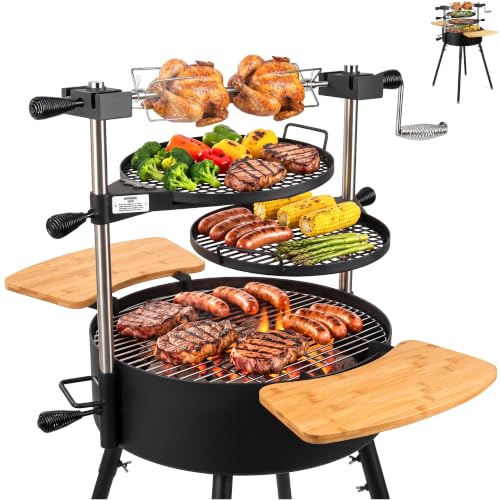
BIG HORN Santa Maria Grill Portable Argentinian Parrilla — Best Portable Parrilla
Check the current price on Amazon
This is for the cook whose fire is not always in the backyard. The rotating grate is the clever part: instead of moving food around hot and cool spots, you rotate the whole cooking surface, which evens out cooking over an open fire’s natural unevenness and lets you swing food away from a flare-up instantly. Combined with height adjustment, it gives surprising control for a portable unit. Campers, overlanders and beach cooks who find ordinary portable grills soulless will recognize this as the real tradition, made travel-sized. It runs on charcoal and open fire, so it suits places where a fire is already part of the plan.
Strengths
- 360-degree rotating grates even out open-fire hot spots
- Height adjustment preserves true parrilla heat control
- Portable format takes gaucho cooking to camp, beach and tailgate
Trade-offs
- Charcoal open-fire only — no wood-fire brasero ritual at this size
- Capacity is trip-sized, not crowd-sized
- Open fire rules apply wherever you take it — check before you light
| Spec | Detail |
|---|---|
| Format | Portable Argentinian parrilla |
| Grate | Adjustable height, 360-degree rotating (per Amazon title) |
| Fuel | Charcoal open fire |
Portability usually means abandoning technique, but the rotating grate makes this little parrilla cook more cleverly than many full-size grills. Over any open fire, heat is a landscape of hot and cool zones; rotation turns that landscape into a tool, letting every piece of food take its turn over the heart of the embers. Add the height crank and you have the two controls that define the style, in a package that travels. The charcoal focus suits travel cooking — cleaner to transport, quicker to light, easier to extinguish responsibly. Build is appropriately simple: fewer parts, fewer failures, easy cleaning at a campsite. For the fire cook who refuses to leave the ritual at home, this is the pick that keeps the tradition mobile.
Best for: Campers and travelers who cook over real fire away from home / Not suited for: Backyard hosts needing capacity — this is the travel companion, not the anchor
Comparison Table
| Pick | Badge | Key spec | Best for |
|---|---|---|---|
| Brand-Man Santa Maria Grill Argentine with Brasero | Best Overall | Brasero + adjustable V-grate + griddle | Committed asado cooks who want the complete Argentine system |
| Backyard Discovery Argentine Santa Maria Heritage Grill | Best Fire-Brick Firebox | Fire-brick firebox, adjustable grates | Hosts who want steady open-fire heat and a centerpiece look |
| BIG HORN Santa Maria Grill, Argentine Parrilla (Large) | Best Large Open Fire Grill | Large grate, chimney, wood rack | Crowd-sized asados and open-fire entertaining |
| Hickory Summit Argentine Santa Maria Grill with Brasero and Plancha | Best Complete Kit | Brasero + plancha + tools included | New parrilla cooks who want a complete, ready-to-cook station |
| Argentine Santa Maria Grill with Fire Bricks (Compact) | Best Compact Brick-Lined | Compact, brick-lined, adjustable grate | Small patios and households wanting authentic parrilla technique |
| BIG HORN Santa Maria Grill Portable Argentinian Parrilla | Best Portable Parrilla | Portable, rotating + adjustable grates | Campers and travelers who cook over real fire away from home |
How to Choose the Best Gaucho Grills: Brasero, Bricks and Grate Design
The brasero question comes first. A brasero — a separate basket where wood burns down to embers — is what separates a true parrilla from a firebox with a crank. With one, you control heat supply and cooking independently, and long cooks become calm. Without one, you build the fire in the box and rake embers under the food, which works beautifully for shorter cooks and is how the tradition began. Decide by your menu: whole-animal ambitions and multi-hour asados argue for a brasero; steak-and-vegetable evenings do not require one.
Fire bricks come second. A brick-lined box holds heat, evens the fire’s temperament and protects the steel from the worst thermal punishment. Bricks add weight and ask for gentle treatment — no cold water on hot brick — but for a stationary backyard grill they are the single best upgrade in the category. Grate design comes third: V-channel grates drain fat away from the fire and reduce flare-ups on rich Argentine cuts, while round-bar grates mark food more traditionally and suit a wider range of items. Either cooks well; V-grates forgive fatty cuts.
Finally, interrogate the mechanism. The crank or wheel that raises the grate will be operated with one hand, under load, over a fire, hundreds of times. It should move smoothly, hold position without creep, and be serviceable. Check the chain, cable or gear design in owner reports, and favor grills whose makers sell replacement parts. A parrilla is a decade-scale purchase of steel and fire; the mechanism is where decades are won or lost.
Wood, Embers and the Gaucho Method
Gaucho cooking is ember cooking. The fire’s job is manufacturing embers; the embers’ job is cooking the food. Hardwoods are the traditional fuel — dense woods that collapse into long-lived, high-heat coals. Lump charcoal is the practical substitute and the sensible starter fuel while you learn, giving predictable embers without the woodpile. What you avoid is cooking over flames: flame means soot, scorching and bitter surfaces. Patience — letting the fire mature to glowing embers with a white ash coat — is the entire secret, and it is not really a secret at all.
Heat control is choreography between ember depth and grate height. A deep, fresh ember bed with the grate low is your sear; the same bed with the grate raised becomes a roasting oven; a thinning bed at height is a gentle finisher. Salt generously and late, rest meat properly, and keep chimichurri within reach. The method rewards attention with a quality of crust and smoke that enclosed grills approximate but never quite reach — which is why this centuries-old design still sells.
Setting Up Your Parrilla Space: Safety, Surface and Setup
An open-fire grill deserves a proper home, and an hour spent on placement pays back for years. Choose a level, non-combustible surface — stone, concrete, gravel or bare earth — with generous clearance from fences, siding, overhangs and anything that overhangs the chimney of sparks a wood fire occasionally sends up. Think about wind: a spot sheltered from the prevailing breeze makes ember management calmer, while a wind tunnel turns every cook into a fight. Keep a fire extinguisher or a bucket of sand within reach, and never treat the parrilla as a patio heater under a roof or inside a garage, however tempting a rainy evening makes it.
Around the grill, plan the working triangle of the asador: wood storage dry and close, a side table or surface for trays and tools that is not the grill itself, and seating placed for the audience every fire attracts — near enough for conversation, far enough for comfort. Lighting matters more than people expect; most asados run into the evening, and a cook who cannot see the meat’s color is guessing. A simple outdoor light aimed at the grate transforms night cooking. Set the space up once, this way, and every cook afterward starts at the fire instead of with a scramble.
The Cuts of Asado: What to Cook on a Gaucho Grill
A parrilla cooks anything, but it sings with the cuts of its tradition. Asado de tira — cross-cut short ribs — are the emblem: rich, beefy, cooked over embers until the fat renders and the edges crisp. Vacío, the flank-like cut prized in Argentina, cooks whole at moderate height and slices across the grain into rosy, juicy strips. Entraña — skirt steak — wants the opposite treatment: the grate low, the embers fresh, a fast fierce sear and an immediate rest. Sweetbreads, chorizo and morcilla open the meal; provoleta, the grilled provolone round, bubbles on the plancha or in a small pan until its edges caramelize.
Beyond the classics, the method flatters anything that benefits from ember heat and smoke: whole chickens flattened and cooked slowly at height, thick pork chops, whole vegetables buried at the ember bed’s edge, and flatbreads kissed directly on the grate. The common thread is patience and salt. Season generously with coarse salt, cook by ember and height rather than by timer, rest everything, and slice at the grill as the tradition demands. Master those four habits and the specific cut in front of you matters far less than the fire beneath it.
Gaucho Grilling vs Santa Maria vs a Kettle Grill: Choosing Your Fire
Shoppers often arrive at gaucho grills from two directions — from Santa Maria cooking, its close cousin, or from ordinary kettle grilling, its distant one — and the differences are worth making plain. Against a kettle grill, the parrilla’s advantages are control and scale: the kettle fixes its grate and asks you to manage heat with vents and coal placement, while the parrilla raises and lowers the cooking surface itself, over an open fire you can feed and shape continuously. The kettle wins on lidded cooking — roasting, baking, smoking with the lid down — and on weather protection and price. They are different instruments; many serious fire cooks own both and would not trade either.
Against Santa Maria style, the gaucho or Argentine parrilla differs in emphasis rather than kind. The Santa Maria tradition centers on the adjustable grate over an oak fire, often cooking tri-tip and linguica at height. The Argentine tradition adds the brasero as a separate ember factory and the V-grate as a fat-management system, in service of a wider asado menu cooked in courses. Modern products blend the vocabularies freely — several picks in this guide carry both names — and the cooking method matters more than the flag on the box.
Choose the parrilla when the fire itself is part of the pleasure, when your menu runs to the asado cuts and courses, and when your gatherings gather around the cooking rather than waiting inside for it. Choose the kettle when lidded versatility and simplicity rule. And choose with your space and local fire rules in view, because an open-fire grill asks more of both than any lidded appliance — and gives more back, to the cooks who want what it gives.
What to Budget Beyond the Grill Itself
A parrilla’s purchase price is the beginning of its budget, and planning the rest honestly prevents the false economy of a great grill and no way to feed it. Fuel is the recurring headline: hardwood by the stack or lump charcoal by the bag, bought in quantity and stored dry. Add a proper set of long fire tools — tongs, a poker, a small shovel for ember work — a sturdy side table if your setup lacks one, and coarse salt and chimichurri ingredients as the standing pantry of the style. A fitted cover or a sheltered spot protects the investment between fires.
None of this is extravagant, and all of it together typically adds a modest fraction to the grill’s own cost in the first year, then settles into fuel alone. The cooks who regret gaucho purchases are rarely surprised by the grill; they are surprised by the woodpile they did not plan and the tools they improvised badly. Budget the whole ritual and the ritual rewards you — that has been the economics of cooking over fire for several thousand years, and the modern parrilla does not change it.
How to Cook Your First Asado on a Gaucho Grill
Your first asado should be a small one — a few cuts, a plancha of vegetables, people you like. The goal is learning your grill’s ember cycle, not feeding thirty. Work in this order and the rhythm will make sense by the second cook.
- Build the fire early. Start the fire a full hour before you intend to cook. Use hardwood or lump charcoal, build it in the brasero if you have one, and let it burn down toward embers. Rushing this step is the only real way to ruin an asado — everything after it is adjustment.
- Make your ember bed. Rake a layer of glowing embers under the grate, deeper where you will sear and thinner where food will roast gently. You are building a landscape of heat zones across the grill, and you will replenish it from the brasero or the fire’s edge as it settles.
- Set the grate and test the heat. Lower the grate toward the embers and hold your hand at cooking height — a few seconds of tolerance means searing heat; a comfortable linger means you are in roasting territory. Adjust height until the zones feel right, then trust the crank for fine control during the cook.
- Cook in the Argentine order. Start with chorizo and morcilla if you serve them, then provoleta on the plancha, then the large cuts — asado ribs and vacío-style flanks — giving thick pieces the longest time at moderate height. Finish thin steaks and entraña last, low and fast over the freshest embers.
- Salt and baste with intention. Salt cuts generously with coarse salt as they cook, and if your grate has V-channels collecting juices, use them — a brush of the collected juices, or a salmuera brine splash, is the traditional baste. Keep chimichurri for the table, not the fire.
- Rest, slice and serve at the grill. Rest large cuts briefly, then slice across the grain and serve in waves straight from the parrilla, as tradition dictates. The cook eats standing up, tasting everything — that is not a flaw in the system, it is the system.
- Close down safely. Let the fire burn down fully, spread the embers to cool, and once everything is cold, remove the ash and store it in a metal container away from combustibles. Oil the grate lightly while the grill is still faintly warm to protect it for the next fire.
Take notes on your first asado the way you would for any craft: how long the fire took to become embers, how deep the bed ran, which grate heights suited which cuts. Parrilla cooking is learned by the hands, and two or three cooks will teach you more than any manual.
Common Buying Mistakes
Cooking over flames instead of embers. The defining beginner error. Flames scorch and soot the food; embers cook it. If your fire is still flaming, your asado has not started yet — pour a drink, tend the fire, and wait for the glow.
Skipping the brasero logic. Even without a brasero, think like one: keep a live fire zone for making embers and a cooking zone of settled embers. One mixed pile gives you neither good supply nor steady heat.
Buying a kit and calling it a grill. The category is full of grate kits and accessory sets that assume you already own a fire structure. Confirm you are buying a complete grill with its own firebox before comparing prices — the picks in this guide are all complete units.
Ignoring local fire rules. Open-fire grills are real fires. Many municipalities, parks and rental properties restrict them, and dry-season rules can change weekly. Know your local position before the first cook, not during it.
Neglecting ash and steel care. Ash left in a firebox absorbs moisture and eats steel. Empty it cold after every cook, keep the mechanism’s moving parts clean, and a parrilla will outlast several gas grills. Neglect it and rust starts in the first season.
Final Recommendation
For the complete Argentine system, the Brand-Man with its brasero, V-grate and griddle is the gaucho grill to buy, with the Hickory Summit close behind as the ready-to-cook kit. The Backyard Discovery Heritage makes the strongest case for fire bricks and patio presence, the large BIG HORN serves the crowd-scale asado, its compact brick-lined cousin serves the small patio honestly, and the portable BIG HORN carries the tradition to wherever your fire is lit.
Whichever parrilla you choose, commit to the method: real wood or lump charcoal, embers before food, height as your thermostat. Gaucho grilling does not reward hurry. It rewards presence — and the food it produces explains why the tradition has outlived every grilling fashion since.
The shortlist, one more time: Brand-Man Santa Maria Grill Argentine with Brasero (Best Overall); Backyard Discovery Argentine Santa Maria Heritage Grill (Best Fire-Brick Firebox); BIG HORN Santa Maria Grill, Argentine Parrilla (Large) (Best Large Open Fire Grill); Hickory Summit Argentine Santa Maria Grill with Brasero and Plancha (Best Complete Kit); Argentine Santa Maria Grill with Fire Bricks (Compact) (Best Compact Brick-Lined); BIG HORN Santa Maria Grill Portable Argentinian Parrilla (Best Portable Parrilla). Check price on Amazon for the linked models before you buy, since availability shifts with the season.
Keep exploring the cluster: Best Gas Wood Grills Best Grills Best Gas Grills Best Charcoal Grills Best Santa Maria Grills
Frequently Asked Questions
What is the difference between a gaucho grill and a Santa Maria grill?
They are close relatives. Santa Maria grilling comes from California’s central coast and classically uses an adjustable grate over an oak fire, often with round-bar grates. The Argentine parrilla — the gaucho style — typically adds a brasero for ember production and V-shaped grates that drain fat. Modern products blend the two freely, and the cooking method matters more than the label.
What wood is best for a gaucho grill?
Dense hardwoods that burn down to long-lived embers are the traditional choice. Lump charcoal is an excellent, predictable alternative and the easiest way to learn. Avoid softwoods and anything treated or painted — they burn fast, spark and flavor food badly.
Do I really need a brasero?
For short cooks of steaks and vegetables, no — embers made in the main firebox serve well. For long asados with thick cuts and multiple courses, a brasero transforms the experience by separating ember production from cooking, so your heat supply never depends on disturbing the food.
How do I control temperature without a lid or dials?
With ember depth and grate height. More embers and a lower grate means more heat; fewer embers and a raised grate means gentler cooking. It sounds primitive and works beautifully — after two or three cooks your hands will read the fire the way they once read a dial.
Can I cook with the grate all the way down?
That is your searing position, suited to thin cuts and short bursts. Prolonged cooking at the lowest height over fresh embers will scorch most foods. Use the full range of the crank — it is the grill’s only control and it is a good one.
How do I care for fire bricks?
Let them cool gradually, never douse hot bricks with water, and brush ash off rather than washing. Hairline cracks over time are normal and do not affect cooking. Replace a brick only if it crumbles or breaks through.


