Disclosure: airfryerkitchensupply.com is reader-supported. When you buy through links on our site, we may earn an affiliate commission at no extra cost to you.
Where to buy
A direct gas line hookup means one thing: the grill is built for natural gas and connects to your home’s gas supply through a patio outlet and a quick-connect hose — no propane tank, no refills, no conversions improvised in the backyard. Every pick below is sold as a natural gas grill in the exact listing linked, and that configuration is what we reviewed.
- Best Overall: Weber Genesis S-335 Natural Gas Grill — check price on Amazon before you buy, because grill pricing moves with the season.
- Best Built-In: Blaze LTE PRO 40-Inch 5-Burner Built-In Natural Gas Grill — check price on Amazon before you buy, because grill pricing moves with the season.
- Best With Rotisserie Burner: Broil King Baron 490 Pro Shadow Natural Gas Grill — check price on Amazon before you buy, because grill pricing moves with the season.
- Best Budget Plumb-In: Dyna-Glo Premier 3 Burner Natural Gas Grill — check price on Amazon before you buy, because grill pricing moves with the season.
- Best Compact Plumbed Grill: Broil King Signet 320 Shadow Natural Gas Grill — check price on Amazon before you buy, because grill pricing moves with the season.
- Best Mid-Size Freestanding: Weber Spirit E-425 Natural Gas Grill — check price on Amazon before you buy, because grill pricing moves with the season.
Do not order a grill from this page planning to ‘convert it later’ unless the manufacturer sells a conversion kit for that exact model and you are prepared to fit it correctly, with the orifices changed and the work checked. The six listings linked here need no conversion at all: they arrive ready for a natural gas line, which is the entire point of this category, and that readiness is worth more than any small saving on a propane equivalent.
The best gas grills with direct gas line hookup solve the oldest annoyance in grilling: the empty propane tank discovered twenty minutes before guests arrive. A plumbed natural gas grill draws fuel from your home’s supply through a fixed patio outlet, so it is always ready, always full, and cheaper to run per cook than bottled propane. For households that grill weekly, the convenience compounds quietly for years.
There are two shapes of plumbed grill in this guide. Freestanding cart grills — the Webers, Broil Kings and the Dyna-Glo — wheel up to the outlet and connect with a flexible quick-connect hose, and can still be moved a few feet for cleaning. Built-in grill heads — the Blaze — drop into an outdoor kitchen island and connect as a permanent fixture. Both are ‘direct hookup’ in the only sense that matters: factory-built for natural gas, with the correct orifices, regulator setup and hose fittings from the manufacturer.
There is also a quiet environmental and household-logistics dividend. No tanks means no tank storage in the garage, no exchanges in the car, no half-full bottle anxiety before a party, and one less heavy object to wrestle every few months. Owners consistently report the same behavioural change after plumbing a grill: they grill more often, for smaller meals, because starting the grill became as easy as starting the stove — and that, more than any specification, is what this category is really selling.
What this category is not is a conversion project. Running a propane grill on natural gas, or the reverse, without the manufacturer’s kit and correct orifices is a safety hazard, not a hack, and nothing in this guide suggests it. Every pick below was verified as a natural gas model in its listing, and the buying guide explains how to confirm your home’s line, pressure and outlet before you spend anything.
In this guide
Quick Picks
Six plumbed grills from a budget cart to a built-in flagship. Here is the short version, with the installation thinking in the guide sections after the reviews. If you are still deciding whether to plumb at all, read the badges for the grills and the guide sections for the gas line — both decisions deserve a clear head, and they are best made in that order.
- Best Overall — Weber Genesis S-335 Natural Gas Grill: Three PureBlu burners, a sear zone, a side burner and a storage locker in stainless — the complete freestanding plumbed grill.
- Best Built-In — Blaze LTE PRO 40-Inch 5-Burner Built-In Natural Gas Grill: A 40-inch built-in head in 304 stainless with a rear infrared burner, rotisserie kit and internal lights — the outdoor kitchen anchor.
- Best With Rotisserie Burner — Broil King Baron 490 Pro Shadow Natural Gas Grill: Four burners, a side burner and a rear rotisserie burner on a gas line — plumbed convenience meets Sunday roast hardware.
- Best Budget Plumb-In — Dyna-Glo Premier 3 Burner Natural Gas Grill: The straightforward route onto a gas line: three burners, factory natural gas, no conversion kits and no flagship pricing.
- Best Compact Plumbed Grill — Broil King Signet 320 Shadow Natural Gas Grill: Broil King’s heavy-box cooking in a three-burner natural gas footprint for smaller patios with a gas line.
- Best Mid-Size Freestanding — Weber Spirit E-425 Natural Gas Grill: Four burners, sear boost and porcelain-enameled cast-iron grates on a gas line — the Spirit formula, plumbed.
How These Picks Were Chosen
Configuration verification ruled this list. Each candidate’s listing had to state natural gas as the fuel for the exact model sold — not ‘convertible’, not ‘propane with kit available’, but a natural gas grill in the box. Convertible models were set aside for this guide even when excellent, because a buyer searching for a direct gas line hookup wants to connect and cook, not to rebuild a fuel system on delivery day.
Within that filter we balanced the two formats and the realistic budgets of plumbed-grill buyers. Freestanding models dominate because most patios with a gas outlet still want a cart grill; one built-in head represents the outdoor-kitchen route. Burner counts run from three to five, and features from honest basics to rear infrared rotisserie burners, so the list maps onto real patios rather than a single price point.
We also considered the patio reality behind the keyword. A direct hookup buyer usually has one of two situations: an existing outlet waiting for a grill, or a renovation that can add one. The list serves both — every pick connects the same standard way, so the choice can be made on cooking merit — and the guide sections cover the existing-outlet checks and the new-line decisions in the order a homeowner actually meets them.
Finally, we favoured brands with established natural gas support — correct hoses, quick-connect fittings and parts availability — because a plumbed grill is a long-term fixture of the house, closer to an appliance than a gadget. Where a listing publishes output or area we quote it in the spec boxes; where it does not, we say so by omission rather than borrowing figures from a sibling model. Prices change; check price on Amazon on each listing.
The 6 Best Gas Grills With Direct Gas Line Hookup
Each review covers the grill itself and its hookup reality — hose, format and placement — because on a plumbed grill the installation is part of the product. Strengths, trade-offs, verified specs and a verdict close every review.
A note on what is not in the spec boxes: total BTU and cooking area appear only where the verified listing states them. Several excellent plumbed models publish neither figure prominently, and we would rather leave a cell out than fill it from a different trim level. Burner counts, fuel type and named features are stated for every pick, because those are the facts the hookup decision actually turns on.

Weber Genesis S-335 Natural Gas Grill — Best Overall
The Genesis S-335 is the freestanding natural gas grill we would recommend to most plumbed patios. Three PureBlu burners under stainless-steel grates, a dedicated sear zone, a side burner for the supporting acts, and an enclosed storage locker for tools — all in a stainless Genesis body with Weber’s parts network behind it. It is the plumbed category’s centre of gravity.
Strengths
- PureBlu burners are designed to resist clogging, keeping flames even across the box for years
- Sear zone plus side burner cover high-heat finishing and sauce work without extra appliances
- Storage locker and stainless build make it feel like a permanent patio fixture, which it is
Trade-offs
- Stainless grates need a proper preheat and light oil to release food as cleanly as cast iron
- Premium pricing among freestanding natural gas models
- Three burners will feel small to households that regularly cook for eight or more
| Specification | Detail |
|---|---|
| Burners | 3 PureBlu burners plus side burner |
| Sear feature | Sear Zone |
| Grates | Stainless steel |
| Extras | Storage locker |
| Fuel | Natural gas |
The Genesis platform’s virtue is consistency: temperatures hold where you set them, the sear zone genuinely outruns the main burners for crust work, and the whole grill feels engineered rather than assembled. On a gas line that consistency is available every single day with zero fuel errands, which is how a grill becomes the default weeknight cooker instead of a weekend project.
Ownership details suit a plumbed fixture. The locker swallows tools and a drip-pan supply, the stainless wipes down easily, and Weber’s support means a burner or grate in year eight is a phone call, not a farewell. If your patio has the outlet and your household is three to six people, this is the natural gas grill to beat.
Best for: households with a patio gas line wanting the most complete, best-supported freestanding NG grill / Not suited for: very large families, or buyers who prefer cast iron grates to stainless
Check the current price on Amazon

Blaze LTE PRO 40-Inch 5-Burner Built-In Natural Gas Grill — Best Built-In
Outdoor kitchens need a different animal: a grill head built to drop into an island, survive weather without a cart’s shelter, and look like architecture rather than equipment. The Blaze LTE PRO 40 is that animal — five burners across 40 inches, 304 stainless steel construction, a rear infrared burner with a rotisserie kit, and internal lights for evening cooking, all factory-configured for natural gas.
Strengths
- 304 stainless steel construction is the right material for a permanent outdoor installation
- Rear infrared burner and included rotisserie kit cover slow-roasted whole birds and roasts
- Internal lights and a five-burner span make it a genuine outdoor kitchen centrepiece
Trade-offs
- Requires a built island or cart designed for a 40-inch head — it is not a freestanding grill
- The highest investment on this page by a wide margin, before island costs
- Installation demands professional gas work; this is a project, not a purchase-and-cook product
| Specification | Detail |
|---|---|
| Burners | 5 main burners plus rear infrared burner |
| Format | 40-inch built-in grill head (BLZ-5LTEPRO-NG) |
| Construction | 304 stainless steel |
| Extras | Rotisserie kit, internal lights |
| Fuel | Natural gas |
Judged as a fixture, the Blaze justifies itself in materials and completeness. The 304 stainless resists the corrosion that eats lesser built-ins from inside the island, the rear infrared burner produces the even radiant heat rotisserie cooking wants, and five burners across 40 inches give a host separate climates for a genuinely large cook. This is a grill you design a kitchen around, not one you add afterwards.
The cautions are about commitment. Measure the cut-out twice, plan ventilation and access for the gas connection and future servicing, and have a licensed professional make the hookup — built-in gas appliances are not a DIY category. Households ready for that project get the most capable direct-hookup grill in this guide; everyone else should stay with the freestanding picks and keep their options open.
Best for: outdoor kitchen builds wanting a premium, permanent natural gas grill head / Not suited for: freestanding buyers, renters, or anyone not ready for island construction and professional installation
Check the current price on Amazon
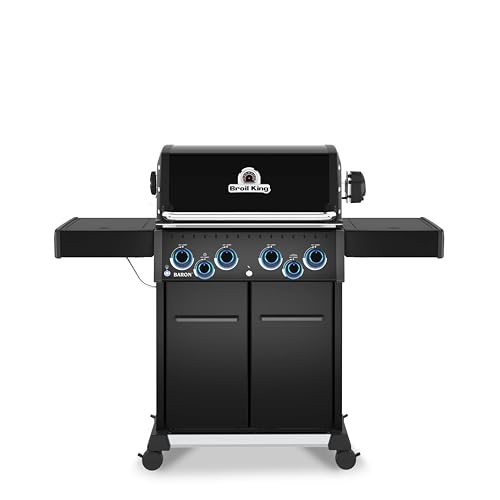
Broil King Baron 490 Pro Shadow Natural Gas Grill — Best With Rotisserie Burner
The Baron 490 Pro in natural gas form pairs Broil King’s heavy cook box with the two supporting burners plumbed-grill owners actually use: a side burner for sauces and sides, and a rear rotisserie burner for whole chickens and roasts. On an endless gas supply, the rear burner becomes a weekly tool rather than a special occasion, because long rotisserie cooks never threaten a fuel gauge.
Strengths
- Rear rotisserie burner plus side burner on a four-burner box covers roasting and searing workflows
- Broil King’s thick cook box holds heat in wind and cold better than thin-walled rivals
- Natural gas fuel makes long, slow rotisserie sessions worry-free
Trade-offs
- Rotisserie kit components should be confirmed on the listing; burners and kits are sometimes bundled differently
- Shadow black finish shows dust and pollen more than stainless does
- A substantial, heavy cart — position it thoughtfully relative to the gas outlet
| Specification | Detail |
|---|---|
| Burners | 4 main burners, side burner, rear rotisserie burner |
| Model | 674147, Baron 490 Pro Shadow |
| Fuel | Natural gas |
Broil King’s reputation rests on cook boxes that keep their heat, and that matters doubly for rotisserie work, where the bird turns for an hour or more and every degree of box stability shows in the result. The rear burner bathes the spit in dedicated heat while the main burners stay free — or off — which is exactly how a rotisserie session should run.
As a plumbed freestanding grill it asks only for a sensible parking spot within hose reach of the outlet. Families who roast whole birds, porchetta or prime rib outdoors will use the rear burner constantly; households that never rotisserie should take the Weber S-335 instead and spend the difference on the gas line installation.
Best for: rotisserie fans with a gas line who want a heavy-box freestanding grill / Not suited for: cooks who never use a spit, or patios where the outlet position fights this grill’s footprint
Check the current price on Amazon

Dyna-Glo Premier 3 Burner Natural Gas Grill — Best Budget Plumb-In
Not every plumbed patio needs a flagship. The Dyna-Glo Premier is a three-burner grill built from the factory for natural gas — model DGP397CNN-D — at the accessible end of the category. It covers the core plumbed experience honestly: light it, cook on it, never think about fuel. For smaller households with an existing outlet, it is the rational first plumbed grill.
Strengths
- Factory natural gas configuration at a budget-friendly position in the category
- Three burners suit everyday family cooking with a workable two-zone setup
- Simpler hardware means fewer features to maintain on a permanent fixture
Trade-offs
- Build materials and finish are a class below the Weber and Broil King picks
- No side burner or specialty zones in this configuration
- Dyna-Glo’s parts depth is thinner than the premium brands’ for very long-term ownership
| Specification | Detail |
|---|---|
| Burners | 3 main burners |
| Model | DGP397CNN-D, Premier series |
| Fuel | Natural gas |
The Premier’s job is to make the gas line useful without a four-figure ceremony, and it does it. Burgers, chicken, sausages and vegetables for a household cook exactly as they should, the two-zone trick works with two burners lit and one dark, and the fuel simply arrives. Owners upgrading from a tank grill notice the missing side burner more than any cooking difference, so be honest about your sauce habits before choosing it.
Longevity expectations should be calibrated: keep it covered, keep the burners brushed and the grease managed, and it will serve well; expect the premium picks to outlast it. As a first plumbed grill — or the grill for a rental property with a gas outlet — it is the sensible spend on this page.
Best for: smaller households with an existing gas outlet wanting plumbed convenience on a budget / Not suited for: entertainers needing area and features, or buyers expecting flagship lifespan
Check the current price on Amazon

Broil King Signet 320 Shadow Natural Gas Grill — Best Compact Plumbed Grill
The Signet 320 brings Broil King’s cook-box quality to a three-burner natural gas grill sized for modest patios. Where the Dyna-Glo competes on price, the Signet competes on the box itself: thick walls that hold heat, steady performance in a breeze, and a compact footprint that parks neatly beside a patio outlet without dominating the space.
Strengths
- Heavy cook box delivers steadier heat than most three-burner rivals, especially in wind
- Compact footprint suits smaller plumbed patios and decks
- Broil King parts and support give it a longer ownership horizon than budget alternatives
Trade-offs
- Three burners and a mid-size grate cap the guest list it can serve in one batch
- Fewer headline features — no side burner theatre here, just the core grill
- Shadow finish needs a wipe-down habit to look its best
| Specification | Detail |
|---|---|
| Burners | 3 main burners |
| Model | 844157, Signet 320 Shadow |
| Fuel | Natural gas |
Cooks in exposed or northern patios will feel the Signet’s advantage most: the box holds temperature when the wind picks up, so chicken finishes evenly and roasts do not stall. That steadiness, on an endless gas supply, makes it a quietly excellent weeknight grill for two to four people — light, cook, close, done.
Choose it over the Dyna-Glo if the grill will live outdoors year-round and you value the box and the brand support; choose the Dyna-Glo if price rules. Either way, confirm the outlet sits within the hose’s comfortable reach of where this grill will stand, because a compact grill still cannot stretch a short connection.
Best for: small-to-medium households on windy or cool patios wanting a quality compact NG grill / Not suited for: big-party hosts, or buyers who want side burners and specialty zones
Check the current price on Amazon

Weber Spirit E-425 Natural Gas Grill — Best Mid-Size Freestanding
The Spirit E-425 in natural gas form is the mid-size sweet spot of this guide: four burners with a boosted Sear Zone, porcelain-enameled cast-iron grates, and Weber’s support network, running on house gas. It suits the household that has outgrown a three-burner but does not need a five-burner flagship — which is to say, most plumbed patios.
Strengths
- Four burners give wide two-zone control for family-plus cooking
- Sear Zone with Boost burners delivers a genuine high-heat corner for steaks
- Porcelain-enameled cast-iron grates sear deeply and are replaceable through Weber’s parts system
Trade-offs
- No side burner on this configuration — sauces share the grate or stay indoors
- Fixed side tables widen the footprint; check the parking spot against the outlet position
- Cast iron grates need the usual light oiling and gentle cleaning routine
| Specification | Detail |
|---|---|
| Burners | 4 main burners |
| Sear feature | Sear Zone with Boost burners |
| Grates | Porcelain-enameled cast-iron |
| Extras | Weber Works rails |
| Fuel | Natural gas |
Four burners is where two-zone cooking stops being a compromise: a wide searing side, a wide gentle side, and room to park finished food without crowding. The Boost function concentrates extra fire exactly where a steak lands first, and the cast iron grates store that heat and print it onto the food. On natural gas, the whole performance is available on a Tuesday without a thought about the tank.
Against its sibling the Genesis S-335, the Spirit trades stainless grates, the sear-zone refinement and the locker for a friendlier price and cast iron’s searing character. Neither is wrong; they are different answers for different cooks. If cast iron and four burners describe your cooking, the E-425 NG is the plumbed grill you will be happiest with at this level.
Best for: families of four to six with a gas line who want four burners and cast iron searing / Not suited for: side-burner devotees, or households needing a storage locker and stainless build
Check the current price on Amazon
Comparison Table
Format is the first split: five freestanding carts and one built-in head. After that, burner count and specialty burners separate the everyday grills from the entertainers.
| Pick | Badge | Key spec | Best for |
|---|---|---|---|
| Weber Genesis S-335 Natural Gas Grill | Best Overall | 3 PureBlu burners, sear zone, side burner, natural gas | households with a patio gas line wanting the most complete, best-supported freestanding NG grill |
| Blaze LTE PRO 40-Inch 5-Burner Built-In Natural Gas Grill | Best Built-In | Built-in 40-inch, 5 burners, rear infrared burner, 304 stainless | outdoor kitchen builds wanting a premium, permanent natural gas grill head |
| Broil King Baron 490 Pro Shadow Natural Gas Grill | Best With Rotisserie Burner | 4 burners, rear rotisserie burner, side burner, natural gas | rotisserie fans with a gas line who want a heavy-box freestanding grill |
| Dyna-Glo Premier 3 Burner Natural Gas Grill | Best Budget Plumb-In | 3 burners, factory natural gas, budget freestanding | smaller households with an existing gas outlet wanting plumbed convenience on a budget |
| Broil King Signet 320 Shadow Natural Gas Grill | Best Compact Plumbed Grill | 3 burners, heavy cook box, natural gas, compact | small-to-medium households on windy or cool patios wanting a quality compact NG grill |
| Weber Spirit E-425 Natural Gas Grill | Best Mid-Size Freestanding | 4 burners, Sear Zone Boost, cast-iron grates, natural gas | families of four to six with a gas line who want four burners and cast iron searing |
Every grill here shares the same fuel story — endless natural gas — so the decision is about format and features. Built-in buyers have one clear destination; freestanding buyers should choose by household size and whether rotisserie or side-burner hardware will actually be used. The gas line serves them all equally, forever, which is rather the point. One practical note when comparing rows: because these grills stay in one place for years, weight and footprint matter less than on a tank grill you might wheel into a garage each winter — judge them as fixtures, by cooking merit and build, and let the patio keep them.
How a Direct Gas Line Hookup Actually Works
A residential natural gas grill connects to the same supply as your furnace and stove, through a dedicated outdoor outlet — usually a stub-out with a shut-off valve and a quick-connect fitting, installed on a patio wall or deck post. The grill’s hose clicks into the quick-connect, the valve opens, and the grill draws low-pressure gas exactly as an indoor range does. No regulator bottle, no gauge, no refill: the meter handles the accounting.
Two technical facts matter before you buy. First, natural gas is delivered at much lower pressure than propane, which is why the gases need different orifices and are never interchangeable without a proper manufacturer conversion. A grill built for natural gas has larger orifices sized for that pressure, fitted at the factory on every pick in this guide. Second, your line’s capacity matters if the grill shares a run with other appliances; a licensed gas fitter can confirm the supply handles the grill’s demand, which for residential grills it almost always does.
If your patio lacks an outlet, budget for a licensed installer to run one from the nearest gas line, with permits where your jurisdiction requires them. It is a routine job for a gas fitter, typically a few hours, and it permanently raises the usefulness of the patio. Renters should get written landlord permission before any gas work — and most should simply buy propane instead.
Freestanding vs Built-In Plumbed Grills
Freestanding plumbed grills keep most of the freedom of a cart grill. They connect by flexible hose, can be rolled aside for cleaning or patio works, and can even be disconnected and stored. Their limit is reach: the grill lives within the hose’s radius of the outlet, so patio layout starts at the wall where the gas emerges. For most homes this format is the right answer — permanent fuel, temporary placement.
Built-in heads like the Blaze LTE PRO are the opposite bargain: zero mobility in exchange for a genuine outdoor kitchen. They demand a properly built island with the correct cut-out, ventilation, access panels for the connection and servicing, and weatherproof surroundings. The result is the most capable and best-looking installation in grilling, at the highest total cost — the island usually costs more than the grill head.
Decide with your housing horizon. If you will live in the home for a decade and cook outdoors weekly, a built-in repays its project cost in use and in the simple pleasure of a permanent station. If there is any chance of moving, renovating the patio, or rearranging the outdoor space, a freestanding plumbed grill gives you ninety percent of the experience with none of the demolition.
How to Choose the Right Size and Features on a Gas Line
Size a plumbed grill exactly as you would a propane one — by your biggest regular cook — with one adjustment: because fuel is endless and instant, plumbed grills get used for smaller, more frequent cooks. A household that grilled monthly on propane often grills weekly on gas, and weeknight cooking favours a fast, right-sized firebox over a cavernous one. Three burners serve two to four people beautifully; four is the family sweet spot; five belongs to entertainers and built-ins.
Features deserve the same honesty. A rear rotisserie burner transforms whole-bird cooking and justifies itself if you roast monthly; it is dead weight if you do not. A side burner earns its shelf if sauces, corn and sautés happen outdoors. Sear zones matter to steak households and barely register for chicken-and-burger cooks. On a plumbed grill you will live with these choices for a long time, attached to your house — so buy for your real menu, not your aspirational one.
Finally, plan the parking spot before the grill arrives: within hose reach of the outlet, level, clear of overhangs and combustible fencing per the manufacturer’s clearances, and with room to open the lid and stand at the side shelves. The best plumbed setup is the one where the grill’s home position is so convenient that lighting it is easier than preheating the oven.
The True Cost of Going Plumbed, Counted Honestly
A plumbed setup has three cost layers, and clear-eyed buyers price all of them. The grill itself is layer one, and natural gas versions typically sit close to their propane equivalents. Layer two is the line: an existing outlet costs nothing, while a new run from a licensed fitter is a real but one-time expense that varies with distance and local rates. Layer three is the small stuff — the correct hose if one is not included, a cover sized to the grill’s permanent home, and the leak-test habit that costs nothing but attention.
Against those costs, set the propane baseline honestly. Tank grills look cheaper until you count a decade of refills, the spare tank most owners buy, the fuel wasted in ‘probably empty’ swaps, and the one ruined dinner a year that an empty tank causes at the worst moment. Natural gas fuel itself costs less per cook, and the meter never needs a trip to the store. Frequent grillers — twice a week or more — recover a new line’s cost in convenience quickly and in fuel over the years.
The conclusion most owners reach is that plumbed grilling is a quality-of-life purchase that also happens to save money slowly. If you grill rarely, propane’s zero installation wins and this whole category is a pleasant curiosity. If the grill is a weekly appliance, the line is infrastructure, like the patio itself — and infrastructure is judged on decades, not seasons.
Safety and Code Basics for Plumbed Grills
Gas work is regulated for good reason, and the rules are simple to respect. The line, outlet and shut-off should be installed or inspected by a licensed gas fitter, with permits where required. The grill connects with the manufacturer-supplied hose and fittings — never hardware-store improvisations — and every connection gets a soapy-water leak test before first use and after any disconnection.
Know where your shut-off valve is and keep it accessible, not buried behind storage. Close it when the grill will sit unused for long stretches, and always close it before disconnecting the hose. Keep the area around the outlet clear, teach every adult in the house how the quick-connect works, and never store a spare propane tank under or beside a plumbed grill out of old habit.
If you ever smell gas with the grill off, treat it seriously: close the shut-off, keep flames and switches away, and call your gas utility or a licensed fitter. Plumbed grills are among the safest appliances in the home when installed correctly — the entire safety programme is correct installation, leak tests, and respect for that one rule.
How to Hook Up a Natural Gas Grill to a Direct Gas Line
Connecting a factory natural gas grill to an existing patio outlet is a short job — but it sits downstream of professional work. If the outlet does not exist yet, step one is a licensed gas fitter, not a wrench.
- Confirm the foundation first: the outlet should be a proper outdoor gas stub-out with a shut-off valve and quick-connect fitting, installed or inspected by a licensed professional. If you are unsure of its history, have it checked before connecting anything.
- Position the grill in its home spot within comfortable hose reach of the outlet, on level ground, respecting the manufacturer’s clearances from walls, fences and overhangs. Connect before you load the grill with accessories and tools.
- With the shut-off valve closed, push the grill’s hose fitting into the quick-connect until it clicks positively, then give it a gentle tug to confirm it is seated. Route the hose so it cannot touch hot parts of the firebox or be tripped over.
- Open the shut-off valve slowly and leak-test: brush soapy water over the quick-connect and hose ends and watch for bubbles. Any bubbling means a bad seat — close the valve, disconnect, inspect the fitting for grit, reconnect and test again.
- Light the grill per its manual and run all burners for ten minutes, checking that flames are steady and blue along every burner. Then close the lid and let the grill complete its first burn-off of factory coatings before any food goes on.
- Finish the installation properly: note the shut-off location for the household, keep the hose’s path clear, and store the grill’s manual with the connection details. Reconnect and leak-test the same way after any future disconnection.
A last discipline: if anything about the outlet, valve or hose looks corroded, damaged or improvised, stop and call a licensed gas fitter. The convenience of a plumbed grill is only worth having on top of gas work you trust completely — and trustworthy gas work is a professional’s job, not a weekend experiment.
Common Buying Mistakes
Buying a propane grill for a gas line. The fuels are not interchangeable. A direct hookup needs a grill built for natural gas, like every pick here, or a manufacturer conversion kit fitted correctly — never a hose swap and hope.
Skipping the licensed installer. New outlets, extended lines and any hard-piped work belong to licensed gas fitters with permits. The grill connection is simple; the supply behind it is professional territory.
Stretching a short hose. If the grill’s home spot is beyond the hose’s comfortable reach, move the grill or have the outlet relocated — never extend with random fittings, and never cook with a strained connection.
Forgetting the leak test. Every new connection and reconnection gets sixty seconds with soapy water. It is the cheapest safety check in the house and the one most often skipped.
Parking the grill against clearances. A plumbed grill tends to stay where it lands for years. Respect the manufacturer’s distances from walls, fences and overhangs from day one, not after the siding discolours.
Assuming bigger is better on a line. Endless fuel tempts buyers into five-burner flagships for two-person dinners. The firebox you light nightly should match your household, or every weeknight cook wastes time and heat.
Final Recommendation
Most plumbed patios should start with the Weber Genesis S-335: the most complete freestanding natural gas grill here, with the support network a house fixture deserves. It is the pick we would connect to our own gas line, because it balances cooking range, build quality and long-term parts support more evenly than anything else in this guide, and it does so without demanding an island, a renovation or a flagship budget. Cast-iron loyalists and four-burner households take the Spirit E-425 NG, rotisserie families the Broil King Baron 490 Pro, and windy-patio cooks the Signet 320. The Dyna-Glo Premier covers the budget route onto a line honestly.
Outdoor kitchen builders have their own answer in the Blaze LTE PRO, a built-in head worth designing an island around. Whichever pick suits your patio, the sequence is the same: confirm the outlet, use a licensed fitter for any line work, leak-test the connection, and then enjoy the defining pleasure of this category — a grill that is always, always ready. Check price on Amazon, and check your gas line before the delivery truck rolls.
Start your shortlist with the Weber Genesis S-335 Natural Gas Grill (best overall) if its strengths match the way you actually cook.
Start your shortlist with the Blaze LTE PRO 40-Inch 5-Burner Built-In Natural Gas Grill (best built-in) if its strengths match the way you actually cook.
Start your shortlist with the Broil King Baron 490 Pro Shadow Natural Gas Grill (best with rotisserie burner) if its strengths match the way you actually cook.
Keep researching within this grill cluster: Best Gas Grills With Natural Gas Best Gas Grills Under $800 Dollars Best Gas Grills With Cast Iron Grates Best Gas Grills With Rotisserie Best Gas Grills With High Btu
Frequently Asked Questions
Can I hook any gas grill up to my home’s natural gas line?
No. Only grills built for natural gas — like every pick in this guide — or models converted with the manufacturer’s own kit and correct orifices can connect safely. Propane and natural gas run at different pressures, so a propane grill on a gas line (or the reverse) will burn wrongly and unsafely.
How much does it cost to add a patio gas outlet?
Costs vary with the distance from your existing gas line and local labour rates, and the work needs a licensed gas fitter and usually a permit. It is a routine half-day job in most homes. Compare it against years of propane refills: frequent grillers usually find the line pays for itself in convenience long before it does in fuel savings.
Is natural gas cheaper to grill with than propane?
Yes, per cook, and the difference grows with every year of regular use. Natural gas from a house line costs noticeably less than bottled propane for the same cooking, and it never runs out. The savings are real but modest; the true prize is convenience — no tanks to gauge, swap, store or refill.
Can I move a plumbed grill around the patio?
Within the hose’s reach, yes — freestanding picks here connect by flexible quick-connect hose and can be rolled aside for cleaning, patio work or seasonal rearranging of the furniture around them. They cannot roam the garden like a tank grill, and built-in heads cannot move at all. Plan the grill’s home position around the outlet.
Do natural gas grills cook differently from propane models?
The cooking experience is essentially identical in every way that matters at the grate — same burners, same techniques, same results. Owners notice two small things: natural gas grills sometimes take a touch longer to reach extreme searing heat, and there is no tank gauge to watch. Neither changes how you cook dinner.
What maintenance does the gas connection itself need?
Very little: keep the quick-connect clean and capped when disconnected, inspect the hose for cracks or damage each season, leak-test after every reconnection, and keep the shut-off accessible. If anything looks corroded or improvised, have a licensed fitter inspect it rather than cooking on a question mark.


