Disclosure: airfryerkitchensupply.com is reader-supported. When you buy through links on our site, we may earn an affiliate commission at no extra cost to you.
Where to buy
This guide covers grills that combine a side burner with genuine infrared cooking power — an infrared sear burner, an infrared rear burner, infrared emitter plates, or several of those at once. Every model below was verified against its Amazon listing, and every link goes to the exact configuration reviewed, because infrared hardware varies between versions of the same grill line.
- Best Overall: Charbroil Pro Series Amplifire Infrared 4-Burner Gas Grill — check price on Amazon before you buy, because grill pricing moves with the season.
- Best Infrared Sear Station: Napoleon Rogue PRO 425 Gas Grill with Infrared Side Burner — check price on Amazon before you buy, because grill pricing moves with the season.
- Best Premium All-Rounder: Napoleon Prestige 500 RSIB Gas Grill — check price on Amazon before you buy, because grill pricing moves with the season.
- Best for Big Families: Broil King Baron S 590 Pro IR Gas Grill — check price on Amazon before you buy, because grill pricing moves with the season.
- Best Luxury: Weber Summit FS38 Premium Gas Grill — check price on Amazon before you buy, because grill pricing moves with the season.
- Best Natural Gas: Napoleon Rogue PRO 625 Natural Gas Grill with Infrared Side Burner — check price on Amazon before you buy, because grill pricing moves with the season.
Infrared features are the first thing manufacturers trim on cheaper variants, so if a listing’s price looks surprisingly low, re-check that the infrared burner is actually included before you order. The six configurations linked here are the ones whose listings confirm the hardware in writing. Where a grill line offers a rotisserie kit, a cover or a conversion kit as a separate bundle, the listing options will show it — choose the bundle deliberately rather than discovering after delivery that the accessory you wanted was in the other box.
Searching for the best gas grills with burner and infrared means you want two specific tools in one appliance: a side burner for the pots and pans that support a cookout, and infrared heat for the searing work that ordinary tube burners do slowly and unevenly. Infrared burners glow far hotter than conventional burners, heating food directly with radiant energy. Steaks crust faster, chicken skin crisps without endless flare-up management, and preheat times shrink.
The catch is that ‘infrared’ on a grill box can mean three different things. A dedicated infrared sear burner is a small, extremely hot zone for finishing steaks. Infrared emitter plates, like Charbroil’s Amplifire system, sit over every burner and convert the whole grate to flare-up-free infrared cooking. An infrared rear burner is a rotisserie specialist, radiating gentle, even heat at turning meat. The six picks below cover all three approaches, and each review states plainly which type you are getting.
Price spreads widely across the six, and that is honest rather than accidental. Infrared hardware costs money to build well: ceramic burners, emitter plates and rear radiant panels are precision parts, and they sit on grills that also need strong main fireboxes to be worth owning. The Charbroil proves the technology itself is not inherently expensive; the Napoleon and Weber flagships prove how far the full package can go when the rest of the grill is built to the same standard.
We also insisted every pick carry a real side burner — not a token ring, but a burner sized for an actual saucepan or skillet — because the search asks for both features together. Read the badges to find your style: whole-grate infrared, sear-station infrared, rotisserie infrared, or the luxury grills that bundle all of it.
In this guide
Quick Picks
Six grills, six different answers to the same brief. Here is the fast version before the deep dives, with the infrared type named in every line so you can filter by technique at a glance.
- Best Overall — Charbroil Pro Series Amplifire Infrared 4-Burner Gas Grill: The whole grate is infrared thanks to Amplifire emitter plates, plus a side burner and an enclosed cabinet — the most infrared cooking per dollar here.
- Best Infrared Sear Station — Napoleon Rogue PRO 425 Gas Grill with Infrared Side Burner: A compact three-burner with Napoleon’s infrared Sizzle Zone side burner, 56,000 BTU and cast iron grates — a steak specialist’s layout.
- Best Premium All-Rounder — Napoleon Prestige 500 RSIB Gas Grill: Infrared side burner and infrared rear rotisserie burner on a stainless four-burner flagship — both infrared jobs covered in one grill.
- Best for Big Families — Broil King Baron S 590 Pro IR Gas Grill: Five burners, an infrared side burner and a rear rotisserie burner in stainless — the biggest infrared toolkit in a freestanding cart here.
- Best Luxury — Weber Summit FS38 Premium Gas Grill: Weber’s flagship brings an infrared broiler, integrated rotisserie, side burner, smoker box and crafted grates — every infrared interpretation in one grill.
- Best Natural Gas — Napoleon Rogue PRO 625 Natural Gas Grill with Infrared Side Burner: The plumbed version of the infrared brief: five burners, 74,000 BTU, 988 square inches and an infrared side burner on a natural gas line.
How These Picks Were Chosen
Verification came first: each candidate’s listing had to state the infrared hardware and the side burner explicitly. Several well-known grills were dropped because the infrared burner belonged to a different trim level than the one listed, and we do not review features a buyer might not receive. What survived are six grills whose listings confirm both features in the configuration sold.
Next we separated the infrared approaches, because they cook differently. Whole-grate infrared systems reward cooks who grill lots of burgers, chicken and seafood and hate flare-ups. Sear-burner models reward steak specialists who want a conventional main grate plus one ferociously hot corner. Rear infrared burners reward rotisserie cooks. A balanced list needed all three, at prices from mid-range to luxury, and that is the list below.
We also read the infrared claims sceptically, because marketing language blurs the three systems together. A grill described as having ‘infrared technology’ might have emitter plates, a sear burner, or merely a perforated heat tent. For this list we required the listing itself to name the infrared component — infrared side burner, infrared rear burner, infrared broiler, or the Amplifire emitter system — so that the feature we describe is the feature in the box.
Finally we checked the supporting hardware: grate material, burner count, total cooking area and fuel type all come from the verified listings. Where a listing states output in BTU or area in square inches, we quote it; where it does not, we describe performance in plain terms rather than inventing numbers. Prices are never printed — check price on Amazon on each listing, as infrared models move with seasonal promotions.
The 6 Best Gas Grills With Burner and Infrared
Each review names the infrared type first, because that decision matters more than any other on this page. Then come strengths, trade-offs, the verified specs, and a plain verdict about who should and should not buy it.

Charbroil Pro Series Amplifire Infrared 4-Burner Gas Grill — Best Overall
Charbroil’s Amplifire system takes the opposite approach to a sear station: instead of one hot corner, every burner fires up through an emitter plate, so the entire grate cooks with infrared energy. Fat drips onto the plate and vaporises or drains instead of igniting, which is why this grill is famous for two things — almost no flare-ups, and food that stays noticeably juicier.
Strengths
- Amplifire infrared plates cover the whole grate, eliminating flare-ups and evening out hot spots
- Four main burners plus a proper side burner in an enclosed cabinet that hides the propane tank
- The most accessible price route into genuine infrared cooking on this page
Trade-offs
- Emitter plates need regular cleaning; baked-on drippings blunt performance if neglected
- Infrared everywhere means no traditional open-flame zone for cooks who like visible flame
- Searing is fast and intense, so timings from a conventional grill need adjusting at first
| Specification | Detail |
|---|---|
| Burners | 4 main burners plus side burner |
| Technology | Amplifire infrared emitter system |
| Body | Cabinet style, black (model 463281024) |
| Fuel | Propane |
Day to day, this is the calmest grill to cook on in the guide. Chicken thighs with skin, fatty burgers and sausages — the foods that turn lesser grills into fire hazards — simply cook, sizzling on the emitter surface while you get on with the sides on the side burner. Beginners produce good results quickly because the heat is uniform; experienced cooks appreciate not babysitting flare-ups during a big cook.
The maintenance bargain is real, though. Plan a few minutes after fatty cooks to brush the plates while warm and wipe them down, and a deeper clean a few times a season. Owners who keep that rhythm report the system performing for years; owners who do not end up cooking on a layer of carbon and wondering where the infrared magic went. If you accept that trade, this is the infrared grill most households should buy.
Best for: families who grill lots of chicken, burgers and sausages and want flare-ups gone for good / Not suited for: open-flame purists, or anyone who knows they will not keep emitter plates clean
Check the current price on Amazon
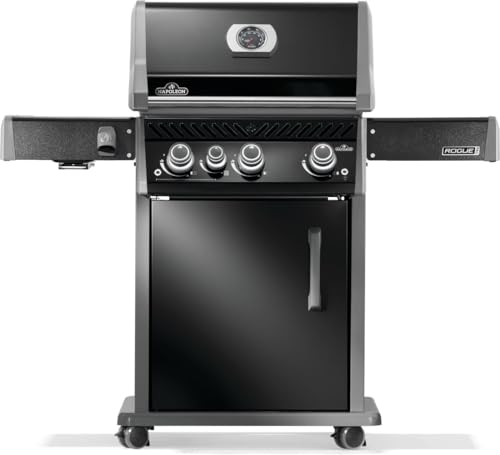
Napoleon Rogue PRO 425 Gas Grill with Infrared Side Burner — Best Infrared Sear Station
The Rogue PRO 425 puts its infrared money exactly where steak lovers want it: in the side burner. Napoleon’s infrared side sear station gets ferociously hot while the three main burners handle conventional grilling on cast iron grates. It is the classic two-tool layout — sear outside the box, roast inside it — in a grill that still fits a modest patio.
Strengths
- Infrared side burner sears steaks and chops at temperatures the main burners cannot reach
- Cast iron grates on the main box hold heat and mark food properly
- 56,000 BTU total with a folding shelf, backlit knobs and locking casters for easy moving
Trade-offs
- Three main burners limit the indirect zone for very large roasts
- 716 square inches is generous for the class but big parties will still cook in batches
- Premium pricing for the size — you are paying for the infrared hardware and build, not raw area
| Specification | Detail |
|---|---|
| Burners | 3 main burners plus infrared side burner |
| Output | 56,000 BTU |
| Cooking area | 716 sq. in. |
| Grates | Cast iron |
| Extras | Backlit knobs, folding shelf, locking caster wheels |
| Fuel | Propane |
The workflow this grill encourages is the one steakhouses use: bring thick cuts up to temperature gently in the main box, then finish them on the infrared side burner for a deep, even crust without the grey band of overcooked meat under the surface. Because the sear station lives outside the firebox, the main grate stays free for vegetables, potatoes and the next batch — a layout advantage built-in sear zones cannot match.
Napoleon’s build quality shows in the details: the lid feels substantial, the knobs are backlit for evening cooks, and the folding shelf and locking casters make it a genuinely movable grill rather than patio furniture. If your grilling revolves around steaks, chops and seafood with the occasional roast, this is the most focused tool in the guide.
Best for: steak-focused cooks who want a dedicated high-heat sear station without buying a huge grill / Not suited for: hosts who regularly cook for ten or more, or buyers maximising grate area per dollar
Check the current price on Amazon

Napoleon Prestige 500 RSIB Gas Grill — Best Premium All-Rounder
The Prestige 500 RSIB is the grill for buyers who read this guide’s keyword literally and want every infrared job done: the side burner is infrared for searing, and the rear burner is infrared for rotisserie work. Between them sits a four-burner stainless firebox with the build quality Napoleon is known for. It is the most complete conventional answer to ‘burner and infrared’ we verified.
Strengths
- Infrared side burner for searing plus infrared rear burner for rotisserie — both systems included
- Stainless steel construction with the fit and finish expected at this level
- Four main burners give wide two-zone control for large and mixed cooks
Trade-offs
- Premium price — the highest commitment among the mid-size picks here
- Rotisserie cooking needs the spit kit, so check what the listing bundles before assuming
- Stainless shows fingerprints and heat tint; keeping it pretty takes regular wiping
| Specification | Detail |
|---|---|
| Burners | 4 main burners, infrared side burner, infrared rear burner |
| Body | Stainless steel |
| Model | P500RSIBPSS-3 |
| Fuel | Propane |
What separates the Prestige from the Rogue below it in Napoleon’s range is completeness. The infrared rear burner transforms rotisserie cooking: instead of a conventional burner cycling hot and cold, the radiant panel bathes the turning chicken or roast in steady heat, producing the evenly bronzed skin rotisserie cooks chase. Add the infrared side burner for steaks and you have a grill that covers the full infrared map without compromise positions.
Ownership matches the flagship brief — heavy lid, smooth controls, and a parts pipeline from an established premium brand. It asks more money than the other picks in this guide, and buyers should be honest about whether they will use both infrared systems. If the answer is yes, the Prestige 500 RSIB is the one-grill answer; if you only sear, the Rogue PRO 425 does that job for less.
Best for: enthusiasts who will genuinely use both a sear burner and rotisserie infrared, and want one premium grill / Not suited for: budget-conscious buyers, or cooks who only need infrared for steaks
Check the current price on Amazon

Broil King Baron S 590 Pro IR Gas Grill — Best for Big Families
The Baron S 590 Pro IR is Broil King’s answer for large households: five main burners under a big grate, an infrared side burner for searing and finishing, and a rear rotisserie burner for whole birds and roasts. Broil King builds its reputation on thick cook boxes that hold heat in cold weather, and this stainless Baron carries that DNA into the infrared category.
Strengths
- Five main burners spread heat across a family-size grate with room for true two-zone cooking
- Infrared side burner plus rear rotisserie burner cover searing and spit-roasting
- Stainless construction with Broil King’s heavy cook box, which shrugs off wind and cold better than thin rivals
Trade-offs
- Big footprint and big weight — measure the patio and the delivery route
- Five burners plus two specialty burners is complexity some households will never fully use
- Sits at the premium end of the freestanding market
| Specification | Detail |
|---|---|
| Burners | 5 main burners, infrared side burner, rear rotisserie burner |
| Body | Stainless steel (model 678344) |
| Fuel | Propane |
Cooking for eight or more changes what you ask of a grill: you need a grate that holds a full load without cold corners, and burners that recover heat when the lid opens for turning. The Baron’s five-burner layout and heavy box deliver exactly that, while the infrared side burner keeps the steak-finishing station clear of the crowd on the main grate. The rear rotisserie burner then covers Sunday roasts without occupying the main burners at all.
Broil King’s long-standing strengths — solid grates, a cook box that keeps its heat in a breeze, and controls that feel mechanical in the best way — make this the workhorse pick for big families who entertain outdoors. It is more grill than a couple needs, and priced like it, but households that cook volume will use every burner it has.
Best for: large families and frequent hosts who cook big loads and want infrared searing and rotisserie on tap / Not suited for: small households, small patios, or anyone who will not use the rotisserie and fifth burner
Check the current price on Amazon

Weber Summit FS38 Premium Gas Grill — Best Luxury
The Summit FS38 is what happens when budget stops being the question. Weber’s flagship freestanding grill includes a top-mounted infrared broiler for finishing and browning, an integrated rotisserie, a side burner, a smoker box for wood-chip flavour, and the WEBER CRAFTED grate system that swaps in griddles, baskets and sear inserts. It is the luxury interpretation of this entire category.
Strengths
- Infrared broiler adds a finishing and browning tool no other pick here offers
- Integrated rotisserie, side burner and smoker box cover every cooking style in one appliance
- WEBER CRAFTED grates accept a system of inserts that expands what the grill can cook
Trade-offs
- Flagship pricing — several times the cost of the mid-range picks
- Size and weight make it a permanent patio fixture, not a movable grill
- Feature depth will be wasted on households that grill burgers twice a month
| Specification | Detail |
|---|---|
| Burners | PureBlu burners plus side burner |
| Infrared | Infrared broiler |
| Extras | Integrated rotisserie, smoker box, WEBER CRAFTED grates |
| Body | Stainless steel |
| Fuel | Propane |
The infrared broiler is the Summit’s party trick and it is a genuinely useful one: gratins, garlic bread, the final blister on peppers, and the top crust of a steak finished from above all become easy, in a way that neither a sear burner nor emitter plates replicate. Combined with the integrated rotisserie — no separate kit to store — the Summit covers techniques that normally require two or three appliances.
Weber supports its flagship accordingly, and the CRAFTED accessory system means the grill grows with your cooking. None of that changes the value maths: this is a purchase for committed outdoor cooks who will use the broiler, the rotisserie and the inserts regularly. For them, it is the most capable grill in this guide by a clear margin. For everyone else, it is a beautiful answer to a question they were not asking.
Best for: committed outdoor cooks who want one flagship grill that covers searing, rotisserie, smoking and broiling / Not suited for: value shoppers, occasional grillers, or anyone who needs to move the grill seasonally
Check the current price on Amazon
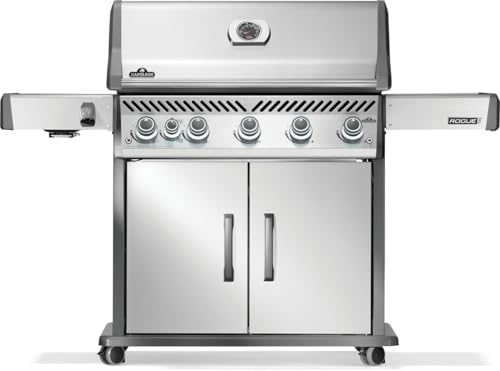
Napoleon Rogue PRO 625 Natural Gas Grill with Infrared Side Burner — Best Natural Gas
If your patio has a natural gas line and you want the infrared sear station too, the Rogue PRO 625 NG is the pick built for you. Five main burners, 74,000 BTU and 988 square inches of cooking space put it among the largest freestanding grills here, and the infrared side burner delivers the high-heat finishing zone the search promises — all without a propane tank in sight.
Strengths
- Natural gas fuel means endless cooking with no tank swaps or mid-cook runouts
- Infrared side burner sears at temperatures the main burners cannot match
- Huge 988 sq. in. cooking area with five burners for serious two-zone and volume cooking
Trade-offs
- Requires a natural gas outlet in the right place — the grill effectively lives where the line is
- Stainless grates need a touch more technique to prevent sticking than cast iron
- Large, heavy and premium-priced; overkill for small households
| Specification | Detail |
|---|---|
| Burners | 5 main burners plus infrared side burner |
| Output | 74,000 BTU |
| Cooking area | 988 sq. in. |
| Grates | Stainless steel |
| Extras | Backlit knobs, folding shelf, locking caster wheels |
| Fuel | Natural gas |
The ownership experience is the story here: walk out, turn the knobs, cook. No tank gauge anxiety before a party, no emergency refill run, and fuel that costs less per cook than propane. The five-burner box handles a party load with a genuine indirect zone, and when steaks need finishing, the infrared side burner does in a couple of minutes what the main grate does unevenly in twice the time.
Two honest cautions. Stainless grates reward preheating and a light oil wipe; treat them like cast iron and food will stick until you learn the release timing. And the gas line fixes the grill’s position, so plan the patio layout before the plumber arrives. Meet those conditions and this is the lowest-hassle big grill in the guide.
Best for: homes with a patio gas line that entertain often and want infrared searing without tank management / Not suited for: renters, propane households, or anyone who rearranges the patio seasonally
Check the current price on Amazon
Comparison Table
The infrared column is the one to study: it tells you which infrared job each grill actually does, because no two systems on this page work the same way.
| Pick | Badge | Key spec | Best for |
|---|---|---|---|
| Charbroil Pro Series Amplifire Infrared 4-Burner Gas Grill | Best Overall | Whole-grate Amplifire infrared, 4 burners, side burner | families who grill lots of chicken, burgers and sausages and want flare-ups gone for good |
| Napoleon Rogue PRO 425 Gas Grill with Infrared Side Burner | Best Infrared Sear Station | Infrared side sear burner, 56,000 BTU, cast iron grates | steak-focused cooks who want a dedicated high-heat sear station without buying a huge grill |
| Napoleon Prestige 500 RSIB Gas Grill | Best Premium All-Rounder | Infrared side + rear burners, 4 main burners, stainless | enthusiasts who will genuinely use both a sear burner and rotisserie infrared, and want one premium grill |
| Broil King Baron S 590 Pro IR Gas Grill | Best for Big Families | 5 burners, infrared side burner, rear rotisserie burner | large families and frequent hosts who cook big loads and want infrared searing and rotisserie on tap |
| Weber Summit FS38 Premium Gas Grill | Best Luxury | Infrared broiler, integrated rotisserie, side burner, smoker box | committed outdoor cooks who want one flagship grill that covers searing, rotisserie, smoking and broiling |
| Napoleon Rogue PRO 625 Natural Gas Grill with Infrared Side Burner | Best Natural Gas | Natural gas, infrared side burner, 74,000 BTU, 988 sq. in. | homes with a patio gas line that entertain often and want infrared searing without tank management |
Read the table as a map of techniques. Whole-grate infrared (Charbroil) changes every cook; a side sear burner (both Napoleons, Broil King) adds one ferocious station to a conventional grill; the Summit’s broiler finishes from above. Pick the technique you will use weekly, not the one that sounds most impressive on the box, because the best infrared system is the one that matches your ordinary Tuesday dinner rather than your most ambitious Sunday project.
The Three Kinds of Infrared on Gas Grills, Explained
Infrared burners heat differently from conventional tube burners. A tube burner heats air, and the hot air cooks your food. An infrared burner heats a ceramic or metal surface until it glows, and that surface radiates energy directly at the food. The practical differences are higher surface temperatures, faster preheats, less drying airflow over the food, and — because the burner sits behind a barrier — far less contact between dripping fat and open flame.
On a sear station, infrared means a compact burner that can push a steak’s surface into deep browning in a minute or two per side. These burners are specialists: too hot and too small for general cooking, perfect for finishing. On rotisserie duty, a rear infrared panel spreads gentle, even radiant heat across a turning roast, which is why premium grills use it there. As emitter plates over every burner, infrared becomes the grill’s whole personality — even, calm, flare-up-free cooking that keeps juices in the food.
None of the three is ‘best’ in the abstract. Steak specialists should buy the sear station, rotisserie fans the rear burner, and high-volume family cooks should seriously consider whole-grate infrared. The mistake is buying a grill whose infrared type does not match the food you actually cook, which is why every review in this guide names the type before anything else.
How to Choose the Right Infrared Grill for Your Cooking
Start with an honest inventory of your last twenty cooks. If most were burgers, chicken pieces, sausages and seafood, flare-ups and dryness are your real enemies, and whole-grate infrared or a strong conventional grill will serve you best. If most were steaks and chops, a sear burner earns its place immediately. If whole chickens and roasts feature regularly, prioritise the rear infrared burner and a firebox tall enough for a bird on a spit.
Next, size the main grill independently of the infrared feature. The infrared burner does not cook dinner for eight; the main grate does. Count main burners and cooking area for your household exactly as you would on a conventional grill — three burners for small families, four for the middle ground, five for volume — and then add the infrared hardware that matches your technique.
Finally, think about maintenance temperament. Emitter plates and ceramic sear burners are not fragile, but they reward owners who brush, wipe and cover. If you know the grill will be neglected between cooks, a simpler infrared layout — a side sear burner on an otherwise conventional grill — survives neglect better than a full emitter-plate system.
Side Burners: What They Are Actually Good For
The side burner is the most mocked feature in grilling, usually by people who have only used a weak one. A good side burner boils a pot of corn, simmers barbecue sauce without scorching the sugars on a too-hot stove, sautés onions and mushrooms in a skillet, fries in a cast-iron pan you do not want smoking up the kitchen, and keeps beans or gravy hot while the main event rests. During a power cut, it is also a fully functional outdoor hob.
What a side burner cannot do is rescue a bad main grill. Treat it as the second criterion, never the first: choose the firebox, grates and infrared system for your cooking, then let the side burner break ties. Check that the burner is sized for a real saucepan, that the side shelf around it is sturdy enough for a full pot, and that the lid or cover protects it from weather when closed.
On the infrared picks in this guide the side burner often is the infrared burner — the Napoleon layout — which collapses two features into one station. That is efficient design, but note the consequence: while you are searing on it, it is not simmering your sauce. Households that do both at once should look at the Charbroil or the Broil King, where the side burner and the infrared system are separate pieces of hardware.
Keeping Infrared Hardware Working for Years
Infrared components live harder lives than tube burners: they run hotter, sit closer to dripping fat, and fail gradually rather than suddenly. The first sign of trouble is uneven performance — a sear burner that browns one side of the steak faster, or emitter plates that leave pale stripes on burgers. Both usually mean the same thing: the surface is fouled. A ceramic burner clogged with grease ash radiates unevenly, and a carbon-coated plate absorbs heat instead of passing it through.
The fix is rhythm, not heroics. After cooks on an infrared station, leave the burner running hot for several minutes to burn residue to ash, let it cool fully, then brush the surface gently with a soft brush. Emitter plates want the same treatment plus an occasional lift-out wash once they are cold. What you must never do is pour water or cleaning spray onto hot ceramic: the thermal shock can craze or crack the tile, and a cracked infrared burner is a replacement part, not a repair.
Budget honestly for consumables. On heavily used grills, emitter plates and infrared burners are wear items with a lifespan measured in years, not decades, and replacements are brand-specific. This is another quiet argument for the established names in this guide — Napoleon, Weber, Broil King and Charbroil all maintain parts pipelines for their infrared models, so a worn burner in year six is an order, not an obituary.
Fuel Choice on Infrared Grills: Propane vs Natural Gas
Infrared hardware works identically on both fuels; the choice is about ownership, not cooking. Propane keeps the grill movable and the installation free, at the cost of tank management. Natural gas, offered here by the Rogue PRO 625 NG, removes refills forever and lowers running costs, at the cost of a fixed position and a professional line installation if your patio lacks an outlet.
One infrared-specific note: because sear burners run extremely hot, their fuel consumption during a sear is brief and small — nobody’s tank dies mid-steak. The fuel decision should therefore be made on the main grill’s usage pattern, not the infrared station. Frequent, long, whole-grill cooks benefit most from the endless supply of a gas line.
Never attempt to convert fuels casually. Natural gas and propane require different orifice sizes and regulator setups, and only a manufacturer kit fitted correctly makes the swap safe. If a listing is sold as natural gas, treat it as natural gas; if propane, propane — and budget the plumbing honestly if the line is part of your plan.
How to Use an Infrared Sear Burner and Side Burner Together
The classic infrared workflow — reverse-sear a thick steak while the sides cook — shows off both burners at once. It works for chops, tuna steaks and thick burgers with small adjustments.
- Bring the meat to room temperature for 30–45 minutes, pat it completely dry, and season it. Moisture is the enemy of crust, and infrared rewards a dry surface more than any other heat type.
- Set the main burners to a gentle medium-low and place the meat on the main grate, away from direct high heat. Close the lid and let the interior come up slowly — this is the low, even phase that cooks the centre without burning the outside.
- While the main box works, use the side burner for the accompaniments: onions in a skillet, sauce in a small pot, or corn in boiling water. If your side burner is the infrared station, do the sides first and keep them warm in the closed main box.
- When the meat is roughly ten degrees below your target doneness, move it to the infrared sear burner. Sear about one to two minutes per side, watching constantly — infrared crusts form fast and go from perfect to burnt while you are reaching for your tongs.
- Rest the meat on a warm plate for at least five minutes before slicing. The crust stays crisp, the juices redistribute, and the temperature evens out.
- Finish with the burners: run the infrared burner on high for a few minutes after cooking to burn residue off the ceramic or plate, let it cool, then brush gently. Never pour water on a hot ceramic infrared burner — thermal shock can crack it.
Two safety habits matter with infrared. First, never leave a sear burner unattended; its whole purpose is extreme heat in a small area. Second, keep the grease management underneath clean, because infrared plates and burners sit close to where drippings collect, and a neglected tray is the one route flare-ups still have into an infrared grill.
Common Buying Mistakes
Buying the wrong infrared type. A sear burner will not give you flare-up-free whole-grate cooking, and emitter plates will not match a sear station’s crust. Match the infrared hardware to the technique you actually use, as the guide above lays out.
Assuming every trim includes the infrared burner. Manufacturers sell near-identical grills with and without infrared hardware. Verify the exact listing configuration before ordering — every pick here was checked for exactly that reason.
Searing for conventional-grill times. Infrared surfaces run far hotter. Steaks that took four minutes a side over tube burners may need ninety seconds. Stay at the grill, tongs in hand, especially for the first few cooks.
Neglecting emitter plates and ceramics. Baked-on drippings choke infrared output, and water on hot ceramic can crack it. Brush warm, wipe down, burn off residue — and let ceramics cool before any cleaning liquid touches them.
Judging the grill by its side burner. A great side burner on a mediocre firebox is still a mediocre grill. Choose the main box first, the infrared type second, and the side burner third.
Plumbing natural gas without a plan. A natural gas infrared grill is fixed where the line is. Decide the patio layout, confirm the outlet location, and use a licensed installer before the grill arrives, not after.
Final Recommendation
If one grill has to represent this category, it is the Charbroil Amplifire: infrared cooking across the whole grate, a real side burner, a cabinet, and the friendliest price of the six. Steak specialists should step to the Napoleon Rogue PRO 425 and its dedicated infrared sear station, while cooks who want both sear and rotisserie infrared in a premium box should take the Prestige 500 RSIB.
Big families belong on the Broil King Baron S 590 Pro IR, natural-gas homes on the Rogue PRO 625 NG, and buyers for whom only the flagship will do should look at the Weber Summit FS38 and its infrared broiler. Whichever route you take, verify the infrared configuration on the listing, check price on Amazon, and give the new grill a gentle first sear while you learn its timing — infrared heat rewards attention and punishes autopilot, and that is exactly why the food tastes better.
Start your shortlist with the Charbroil Pro Series Amplifire Infrared 4-Burner Gas Grill (best overall) if its strengths match the way you actually cook.
Start your shortlist with the Napoleon Rogue PRO 425 Gas Grill with Infrared Side Burner (best infrared sear station) if its strengths match the way you actually cook.
Start your shortlist with the Napoleon Prestige 500 RSIB Gas Grill (best premium all-rounder) if its strengths match the way you actually cook.
Keep researching within this grill cluster: Best Gas Grills Under $800 Dollars Best Gas Grills With Natural Gas Best Gas Grills With Rotisserie Best Gas Grills With Cast Iron Grates Best Gas Grills With High Btu
Frequently Asked Questions
What does an infrared burner do on a gas grill?
It heats a ceramic or metal surface until it glows, and that surface radiates intense heat directly at the food instead of relying on hot air. The results are faster preheats, deeper searing, less drying airflow and — where fat cannot reach open flame — far fewer flare-ups.
Is an infrared side burner better than a built-in sear zone?
Neither is universally better. A side infrared burner keeps searing outside the main box, so the grate stays free and the station doubles as a (very hot) hob. A built-in sear zone keeps everything under one lid and loses less heat in wind. Choose based on whether you sear while other food cooks — if yes, the side burner layout wins.
Can I cook normally on a whole-grate infrared grill?
Yes — that is the point of emitter-plate systems like Charbroil’s Amplifire. They cook everything a conventional grill cooks, with more even heat and fewer flare-ups. The differences are a short learning curve on timing, since searing is faster, and a firmer cleaning routine for the plates.
Do infrared burners use more gas?
A sear burner runs very hot but only for a few minutes per cook, so its total fuel use is small. Whole-grate infrared systems are broadly comparable to conventional grills of the same size. Fuel choice and how long you run the main burners matter far more than the infrared hardware.
Are infrared burners fragile?
Ceramic infrared burners are durable in normal use but dislike two things: thermal shock from cold water on a hot burner, and heavy baked-on grease. Brush gently, burn off residue after cooks, and never douse a hot ceramic burner. Emitter plates are simpler — they mainly need regular cleaning.
Does the rotisserie need an infrared rear burner?
Not strictly — rotisserie works over conventional burners too — but an infrared rear burner gives steadier, more even radiant heat along the whole spit, which produces more evenly browned skin and fewer hot spots. If rotisserie cooking is a weekly habit, it is worth prioritising, as on the Prestige 500 RSIB and the Baron S 590 Pro IR.


