Disclosure: airfryerkitchensupply.com is reader-supported. When you buy through links on our site, we may earn an affiliate commission at no extra cost to you.
Where to buy
If you are shopping for the best gas grills for small home living, start with the verified shortlist below — every model was confirmed against a live Amazon listing, and every one was chosen to fit the way a small home actually stores, moves, and uses a grill.
A small home changes the grill equation in ways that have little to do with cooking. The grill competes for the garage corner with the bikes, crosses a narrow side gate or a doorway to reach its spot, shares a modest patio with everything else the household owns, and may need to move when the household does. The picks below were judged on that whole life — storage, moving, and daily use — as well as on the food, and each listing was verified before it earned a place.
- Weber Spirit E-310 Gas Grill (Best Overall) — Check the current price on Amazon
- Char-Broil Classic 3-Burner Propane Gas Grill (Best Budget) — Check the current price on Amazon
- Weber Traveler Compact Portable Gas Grill (Best for Storage) — Check the current price on Amazon
- Nexgrill Deluxe 2-Burner Gas Grill (Best Small-Footprint Cart) — Check the current price on Amazon
- Monument Grills Mesa400MF 4-Burner Propane Gas Grill (Best for Small Homes That Host) — Check the current price on Amazon
- Royal Gourmet GT2009 2-Burner Portable Gas Grill with Folding Cart (Best Folding Cart Value) — Check the current price on Amazon
Prices and stock on every pick in this guide move constantly, so this page never prints a fixed figure for any product. Use the links above to check price on Amazon at the moment you are ready to buy, and treat any budget language in this article as a guide to the tier a product sits in rather than a promise about a specific listing on a specific day.
The best gas grills for small home households are the ones that fit the home, not just the meal. In a small house, townhouse, or duplex, outdoor space is usually a modest patio or a strip of yard, storage is a garage corner or a shed shared with everything else, and the grill is one appliance among many competing claims on the same square footage. A grill that is merely good at cooking but bad at living in that environment — too wide for the gate, too heavy to move for a patio wash-down, too fussy to store for winter — becomes a resentment with a lid.
This guide therefore judges six verified grills on the full small-home brief. Can it be stored without dominating the garage? Can one person move it through a standard doorway or gate? Does it cook for the two to five people a small home actually feeds, without heating a banquet’s worth of empty grate on a Tuesday? And when the household grows, moves, or starts hosting, does the grill adapt — or does it become the first thing listed for sale?
The six picks span the realistic strategies: a compact three-burner cart that acts as the home’s only grill, value carts sized for small patios, folding designs that genuinely disappear, and a clearview-lid four-burner for the small home that hosts big. Each review is honest about what the format costs as well as what it saves, and the buying guide that follows covers measuring your storage, your gates, and your household before any of the cooking talk begins.
A note on what this guide deliberately leaves out: full-size four- and five-burner carts marketed at suburban yards, built-in grill heads that assume an outdoor kitchen, and novelty miniatures that cook a single burger as a joke. The first group fails the small home’s space test no matter how it cooks, the second fails its permanence test, and the third fails the only-grill test — a small home cannot afford a grill that is a punchline. Everything below passed all three tests before its cooking was even considered, which is why the list is six grills long rather than sixteen.
In this guide
Quick Picks
Short on time? These are the six best gas grills for small home worth your attention, each matched to a different buyer. The full reviews below explain who each one suits, where it compromises, and what to check before you order.
- Weber Spirit E-310 Gas Grill — Best Overall: a three-burner cart Weber itself lists as a small propane grill — porcelain-enameled cast-iron grates, Snap-Jet ignition, and the size most small homes can actually house.
- Char-Broil Classic 3-Burner Propane Gas Grill — Best Budget: 30,000 BTU and 360 square inches in a compact cart with side shelves — three-burner versatility at a value tier.
- Weber Traveler Compact Portable Gas Grill — Best for Storage: a folding grill on wheels that opens and closes with one hand and stores upright in a garage corner or closet.
- Nexgrill Deluxe 2-Burner Gas Grill — Best Small-Footprint Cart: 28,000 BTU and 401 square inches in a compact cart with foldable shelves — full cart convenience that shrinks when parked.
- Monument Grills Mesa400MF 4-Burner Propane Gas Grill — Best for Small Homes That Host: a four-burner cart with a Clearview lid window and one foldable shelf — hosting capacity that still respects a modest patio.
- Royal Gourmet GT2009 2-Burner Portable Gas Grill with Folding Cart — Best Folding Cart Value: 17,000 BTU and 349 square inches on a folding cart with big wheels, a side shelf, and a storage basket — the store-away cart at a value tier.
How These Picks Were Chosen
Every grill in this guide was verified for airfryerkitchensupply.com — burner configuration, BTU output, cooking area, folding features, and shelf designs quoted in the spec boxes come from the live listings themselves. Models whose listings did not support a small-home role were excluded regardless of their general popularity.
The criteria were weighted for small-home life. Stored dimensions and one-person movability counted alongside cooking area. Fold-down shelves, folding carts, and enclosed tank storage scored heavily because they shrink the grill’s claim on shared space. Cooking capacity was judged against a small home’s real pattern — weeknight dinners for two to four, weekend gatherings of five or six — rather than against a caterer’s spreadsheet. Finally, each pick had to be a credible only-grill: in a small home there is rarely room for a second one, so versatility outranked specialization in every badge decision.
One further filter deserves stating plainly: no pick appears here in a second badge costume. Several grills in this batch’s sibling guides — the small-deck and single-chef lineups — overlap this one because good compact hardware serves several constraints, but within this guide each model was judged fresh against the small-home brief, and its badge reflects the role it plays for a small household specifically, not its reputation elsewhere.
The 6 Best Gas Grills for a Small Home

Weber Spirit E-310 Gas Grill — Best Overall
The Spirit E-310 earns the top badge for a small home because it threads the needle the whole category aims at: three burners and genuine cooking range in a cart that Weber’s own listing describes as a small propane grill. Three burners give a small household the full technique set — a hot zone, a gentle zone, and a true indirect middle for a whole chicken — while the cart stays narrow enough for a modest patio and rolls easily for cleaning or winter repositioning.
Strengths
- Three burners cover direct, indirect, and mixed cooking
- Enclosed tank and tidy cabinet suit a furnished patio look
- Cast-iron grates deliver full-size sear performance
Trade-offs
- Permanent footprint — needs its own corner year-round
- Assembly is a substantial project
- No folding tricks for tight storage
| Burners | 3 |
| Grates | Porcelain-enameled cast-iron |
| Ignition | Snap-Jet |
| Extras | Weber Works rails |
| Format | Cart grill, tank in cabinet |
Daily-life details suit a small home particularly well. The tank disappears into the cabinet, so the patio reads as furnished rather than equipped. Snap-Jet ignition lights each burner from its own knob, which is the kind of reliability a household notices in year three, not week one. Porcelain-enameled cast-iron grates sear properly and, split into sections, clean in a standard sink. The Weber Works rails accept small prep accessories that substitute for the side table a small patio does not have.
The honest costs: it is a permanent resident, not a store-away grill, and its assembly is a real afternoon project. A small home must grant it a corner — on the patio or in the garage — permanently. For most small households that grant is easy, because the E-310 replaces any thought of a second grill: it is sized for Tuesday and capable on Saturday, which is the entire small-home brief in one sentence.
A word on moving house, since small-home households move more often than most: the E-310 is heavy enough to be a two-person carry but compact enough to ride in a small moving van without disassembly beyond the grates and tank. Owners who keep the manual and the assembly hardware — a ziplock bag taped inside the cabinet door is the classic trick — find the grill survives moves that kill cheaper carts, whose fasteners and frames rarely tolerate a second assembly.
Best for: small homes wanting one permanent grill that does everything / Not suited for: households that must store the grill away between uses

Char-Broil Classic 3-Burner Propane Gas Grill — Best Budget
The Classic 3-Burner is the small-home value play: a compact cart — the listing itself calls it a compact outdoor grill — with 360 square inches of cooking area and 30,000 BTU across three burners. For a small household, three burners at this tier buy the indirect zone that makes roasts and ribs practical, and 360 square inches cover a family dinner without heating a cavern. The side shelves give the cook landing space that a small patio otherwise lacks.
Strengths
- Three burners and 360 sq. in. at a value tier
- Compact cart suits modest patios
- Side shelves substitute for missing prep space
Trade-offs
- Porcelain-coated grates need gentle cleaning tools
- Lighter build wants a cover outdoors
- Heat retention trails premium lids
| Burners | 3 |
| Output | 30,000 BTU (per listing) |
| Cooking area | 360 sq. in. |
| Grates | Porcelain-coated |
| Extras | Side shelves |
| Format | Compact cart grill |
Ownership at this tier is a fair trade when entered honestly. Porcelain-coated grates clean easily but want a gentle brush; the sheet metal is lighter than premium carts and rewards a cover; and the assembly is typical value-cart fare — an hour, a screwdriver, and patience with the instructions. None of that is disqualifying for a first home or a rental, where the grill’s job is to cook well for several seasons at the lowest sensible tier.
For small homes specifically, the Classic’s proportions are its quiet strength. It is big enough to be the only grill and small enough to share a patio with a table, chairs, and a life. Households that later upgrade tend to keep it as the second grill at a cabin or hand it down intact — a value cart that fits everywhere never really becomes waste.
Fuel economy deserves a note at this tier: three modest burners heating 360 square inches cost noticeably less propane per family dinner than a big four- or five-burner heating its cavern, and over a season of small-home cooking that difference is a tank refill or two. The Classic’s efficiency is a side effect of its correct sizing — one more way the right-sized grill quietly pays its owner back.
Best for: first homes and rentals needing a capable only-grill at a value tier / Not suited for: buyers expecting premium materials and decade-long finish
Weber Traveler Compact Portable Gas Grill — Best for Storage
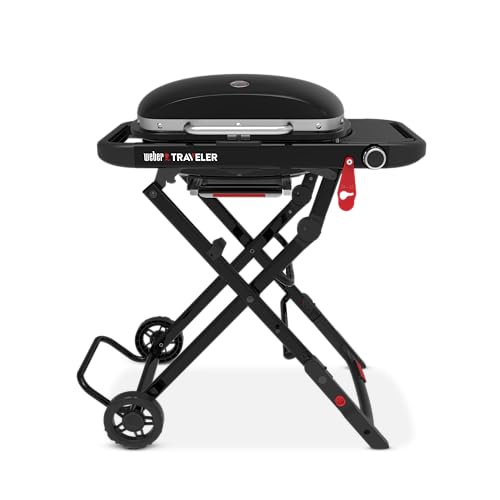
The Traveler Compact is the small-home storage champion. It folds down to a slim, upright package that parks against a garage wall, in a utility closet, or behind the water heater — spaces no cart grill can use — and rolls out on its wheels when dinner calls. The listing highlights an easy open-and-close design, and in practice that one-motion setup is what makes a stored grill get used: the barrier between ‘grill is in the closet’ and ‘grill is preheating’ drops to about a minute.
Strengths
- Folds slim and stores upright in shared spaces
- Wheels and one-motion setup make stored use realistic
- Real portable-grill cooking for two to four
Trade-offs
- Capacity caps at small gatherings
- Folding hardware needs seasonal checks
- No enclosed tank storage
| Format | Folding portable cart with wheels |
| Operation | Easy one-hand open and close (per listing) |
| Fuel | 1 lb canister or hose to bulk tank |
As a cooker it is a genuine Weber portable rather than a toy: the Q-family firebox design concentrates heat well, the grate handles burgers, chicken, and vegetables for two to four people, and the folding cart puts it at proper standing height with a work surface beside it. For a small home, that combination — real cooking, zero permanent footprint — is the strongest storage proposition in this guide.
The compromises are format constants. Capacity tops out at small-gathering size, there is no enclosed tank cabinet, and the folding mechanism adds moving parts that want a rinse and a check each season. A small home that hosts eight regularly will outgrow it; a small home that cooks for two to four and stores everything in shared space will wonder why anyone buys a grill that cannot fold.
Renters should note one more Traveler Compact virtue: it leaves nothing behind. No bolted-down installation, no permanent patio footprint, no landlord conversation — the grill arrives folded, cooks for years, and leaves folded. For a household whose home is temporary but whose standards are not, that clean exit is worth real money at deposit time.
Best for: small homes where storage space outranks patio permanence / Not suited for: regular cooking for groups larger than four

Nexgrill Deluxe 2-Burner Gas Grill — Best Small-Footprint Cart
The Nexgrill Deluxe splits the difference between the permanent carts and the folders: it is a real cart grill — standing height, enclosed lower body, electronic ignition, built-in thermometer — whose shelves fold down so its parked width shrinks to near its firebox. For a small home whose patio doubles as the kids’ play strip or the dog’s run, a grill that is full-size at 6 p.m. and narrow at 7 p.m. is not a gimmick; it is the feature that makes ownership work.
Strengths
- Foldable shelves shrink the parked width
- 401 sq. in. and 28,000 BTU are strong for the footprint
- Full cart convenience with electronic ignition
Trade-offs
- Mid-tier materials need a cover and care
- Two burners limit elaborate multi-zone menus
- Thermometer is a guide, not an instrument
| Burners | 2 |
| Output | 28,000 BTU (per listing) |
| Cooking area | 401 sq. in. (per listing) |
| Extras | Foldable shelves, built-in thermometer, electronic ignition |
| Format | Compact cart grill |
The cooking numbers are strong for the footprint: 28,000 BTU across two burners and 401 square inches per the listing, counting its warming area. That is weeknight-for-four capacity with a two-zone layout, in a cart that parks like a two-burner should. Electronic ignition and a lid thermometer cover the convenience bases a household grill is judged on daily.
Tier honesty applies: this is a value-to-mid cart, and its materials and hardware reflect that positioning next to the Weber picks. With a cover and ordinary care it serves a small home well; without them, the patio will age it quickly. Buy it for the folding-shelf footprint logic, maintain it like the mid-tier equipment it is, and it returns exactly the service its badge promises.
Consider the Nexgrill’s thermometer-equipped lid in small-home terms: when the grill is the household’s only outdoor cooker, the lid gauge — approximate as all of them are — still anchors roast chicken and baked-potato timing without extra gadgets to store. Small homes reward equipment that folds its accessories into itself, and between the folding shelves, the enclosed body, and the built-in gauge, this cart carries more of its own support system than most.
Best for: small patios that must return to other uses after dinner / Not suited for: buyers who want premium build above footprint flexibility

Monument Grills Mesa400MF 4-Burner Propane Gas Grill — Best for Small Homes That Host
Some small homes host like big ones — the extended family lands monthly, the neighbors gather for games, and the grill is expected to feed ten. The Mesa400MF is the pick for that household: four burners of genuine capacity in a cart that keeps one small-home courtesy, a foldable shelf, so at least part of its width gives back when the crowd goes home. It is the largest grill in this guide and makes no apology for it; its badge is about matching a real hosting pattern, not about minimalism.
Strengths
- Four burners feed a crowd without a second grill
- Clearview lid checks food without losing heat
- One foldable shelf returns some parked width
Trade-offs
- Largest permanent footprint in this guide
- Too much grill for weeknight dinners for two
- Higher fuel use on small cooks
| Burners | 4 |
| Lid | Clearview window lid (per listing) |
| Extras | One foldable shelf |
| Format | Cart grill, stainless steel |
The Clearview lid window is more useful than it sounds for a host: you can check a full grate of chicken without lifting the lid and dumping the heat, which is the difference between calm hosting and frantic hosting when the grill is loaded edge to edge. Four burners also allow a true buffet layout — proteins searing on one side, vegetables holding warm on the other, buns toasting in the middle zone.
The small-home costs are obvious and must be accepted with open eyes: this grill claims a permanent, generous corner, it will not fold, roll through a narrow gate easily, or store in a closet. It earns its place only when the hosting pattern is real and recurring. If your small home feeds ten once a year, rent the capacity by borrowing a portable; if it feeds ten monthly, this is your grill.
Hosting households should also weigh the Mesa400MF’s stainless surfaces in a small patio’s social geometry: the grill is the backdrop of every gathering, and a finish that wipes clean in minutes before guests arrive is worth more in a small space — where nothing is out of sight — than in a big yard where the grill is scenery. Presentation is a shallow criterion until your entire outdoor room is twelve feet wide.
Best for: small homes with a genuine, recurring hosting habit / Not suited for: households cooking mainly for two to four

Royal Gourmet GT2009 2-Burner Portable Gas Grill with Folding Cart — Best Folding Cart Value
The GT2009 applies the folding idea at a friendlier tier than the Weber Traveler Compact. Its cart folds for storage or transport, the large wheels roll it across a lawn or a garage floor without drama, and at cooking time it stands as a proper two-burner grill with 349 square inches — enough for a small household’s full menu — plus a side shelf and a basket that swallows tools and a towel. For a small home with a shed rather than a garage, that fold-and-roll package fits the storage that actually exists.
Strengths
- Folding cart stores in a shed or garage corner
- Large wheels make moving genuinely easy
- 349 sq. in. covers a small household’s menu
Trade-offs
- 17,000 BTU sears adequately, not spectacularly
- Value-grade build and finish throughout
- Folding mechanism adds parts to maintain
| Burners | 2 |
| Output | 17,000 BTU (per listing) |
| Cooking area | 349 sq. in. |
| Extras | Folding cart, large wheels, side shelf, storage basket |
| Format | Portable cart grill |
Seventeen thousand BTU across two burners is modest on paper and adequate in practice for this grate size: burgers, chicken pieces, sausages, and vegetables cook properly, with a hotter side and a gentler side. Thick steaks will sear acceptably rather than spectacularly — the honest line for this tier — and the build is value-grade throughout, from the hardware to the finish.
As a small-home proposition it is compelling where budgets are real: one purchase covers patio duty, camping trips, and the tailgate, then folds into the shed. Households choosing between this and the Traveler Compact are choosing tier and finish more than concept — both fold, both roll, both disappear. This one simply does it for less commitment, and for many small homes that is the correct answer.
The GT2009’s basket-and-shelf kit deserves a final mention for shed-stored grills: everything the cook needs rides with the grill, so the trip from shed to patio is one trip, with the grill in one hand’s push and nothing forgotten in the kitchen. In a small home, where the cook is also the runner, that single-trip design is the difference between grilling on a weeknight and deciding it is too much trouble.
Best for: budget-conscious small homes needing a store-away cart grill / Not suited for: steak-focused cooks wanting maximum sear power
Comparison Table
| Pick | Badge | Key spec | Best for |
|---|---|---|---|
| Weber Spirit E-310 Gas Grill | Best Overall | 3 burners, cast-iron grates, compact cart | small homes wanting one permanent grill that does everything |
| Char-Broil Classic 3-Burner Propane Gas Grill | Best Budget | 3 burners, 30,000 BTU, 360 sq. in. | first homes and rentals needing a capable only-grill at a value tier |
| Weber Traveler Compact Portable Gas Grill | Best for Storage | Folding cart, wheels, one-hand open/close | small homes where storage space outranks patio permanence |
| Nexgrill Deluxe 2-Burner Gas Grill | Best Small-Footprint Cart | 2 burners, 28,000 BTU, 401 sq. in. | small patios that must return to other uses after dinner |
| Monument Grills Mesa400MF 4-Burner Propane Gas Grill | Best for Small Homes That Host | 4 burners, Clearview lid, foldable shelf | small homes with a genuine, recurring hosting habit |
| Royal Gourmet GT2009 2-Burner Portable Gas Grill with Folding Cart | Best Folding Cart Value | 2 burners, 17,000 BTU, 349 sq. in., folding cart | budget-conscious small homes needing a store-away cart grill |
How to Choose the Best Gas Grills for Small Home Living
Measure three things before any product page: the grill’s parking spot, the route to it, and your storage fallback. The parking spot measurement is the parked footprint including shelves — folded if they fold. The route measurement is the narrowest gate, doorway, or step between storage and cooking position; a grill that cannot travel its own route will live wherever it was assembled, whether that suits the home or not. The storage fallback is where the grill goes for winter, for a patio party it is not cooking at, or when you move — and ‘we will figure it out’ is how grills end up rusting in the rain.
Then size for your household’s real pattern. Count the weeknight dinners (usually two to four people) at full weight, the weekend gatherings at half weight, and the annual big party at nearly zero — renting or borrowing capacity once a year is cheaper than heating it weekly. Most small homes land on a compact two- or three-burner, and this guide’s badges reflect that: the hosting four-burner is the exception pick, not the default.
Renters and movers: weight and wheels matter
If your small home is rented or your next move is foreseeable, treat the grill as luggage. Folding carts and lighter two-burners move in one trip and survive a van ride; heavy premium carts are effectively fixtures you will sell at a loss. The Traveler Compact and the GT2009 exist in this guide precisely for households whose address is not permanent.
One grill or two small ones?
A few small homes solve capacity with two small grills — a tabletop for weeknights and a folding cart for gatherings — instead of one mid-size cart. The strategy costs more storage but matches each cook to its tool and adds redundancy when one grill is mid-repair. It suits households that grill in two distinct modes; for everyone else, one right-sized grill is simpler and cheaper to own.
Storage, Covers, and the Small-Home Off-Season
A small home’s grill storage succeeds or fails on the cover and the corner. Every pick in this guide should live under a fitted cover outdoors or be stored dry indoors; a grill left bare on a small patio ages in public, in front of the living-room window, and gets used less because it looks like a chore. If the grill stores in a garage or shed, disconnect and store the tank upright outdoors per its safety guidance, clean the grease tray before storage rather than after, and brush the grates one last time — the spring version of you is grateful every year.
Vertical thinking helps small homes: folding grills store upright, tools hang on wall hooks rather than occupying a shelf, and the cover, brush, and light live in one lidded bin that stacks. The households that keep grilling for years in small homes are not the ones with the most space — they are the ones whose storage system takes ninety seconds to open and close.
Grill Placement in a Small Yard: Sun, Wind, and Neighbors
Where the grill stands in a small yard shapes every cook. Put it where the prevailing breeze carries smoke away from your seating and your windows — and, in a small-home neighborhood, away from the neighbor’s windows too, because fences are low and goodwill is a cooking ingredient. Avoid the spot directly under a tree canopy or the eaves: heat and soot rise, and a small yard concentrates them. Keep the grill out of the yard’s traffic spine — the path from door to gate to bins — because a hot grill in a walkway is a daily hazard in a space where every route is a main route.
Sun matters more than most buyers expect. A grill parked in full afternoon sun is unpleasant to stand at during the dinner hour in summer, and its cover and finish age faster. The shaded corner is usually the right corner, provided clearances from fences and structures are respected. Finally, think about the view from inside: in a small home the grill is visible from the kitchen and often the living room, and a tidy, covered grill in a considered corner reads as part of the home rather than as equipment awaiting a bigger life.
The Small-Home Grill Budget: Total Cost, Not Sticker Tier
A small home should budget a grill the way it budgets any appliance: purchase tier plus the cost of keeping it. The predictable extras are a fitted cover, a grill mat for the patio surface, a brush matched to the grate material, and fuel — canisters for the folding picks, a tank and its refills for the carts. None of these is large, but together they are a real fraction of a value-tier grill’s cost, and skipping the cover to save money is the classic false economy: it converts a five-year grill into a two-year grill.
The less obvious saving runs the other way. A right-sized grill burns less fuel per meal than an oversized one, needs smaller replacement grates and fewer burners when service time comes, and — in a small home — avoids the storage-unit math entirely. The most expensive grill a small home can own is the big one that forces compromises everywhere else: the patio it dominates, the shed it will not enter, the move it complicates. Total cost favors the grill that fits, which is the thesis of this entire guide expressed in money.
When the Small Home Grows: Upgrade Paths
Households change faster than grills wear out, so it is worth asking what each pick becomes when life shifts. The compact carts — the Spirit, the Classic, the Nexgrill — step down gracefully into second-grill duty at a bigger home or a family cabin, because a right-sized grill is useful everywhere. The folding picks simply follow you, which is their entire design philosophy. Even the hosting Monument, if outgrown, holds the strongest resale shape because capacity is always in demand. The only true dead end in small-home grilling is the grill bought for a fantasy household — the giant cart bought for parties that never happened — and the discipline of this guide, sizing for the real pattern, is what keeps every pick here on a graceful path.
How to Set Up a Grill Station in a Small Home Patio
A small patio becomes a real outdoor kitchen with a deliberate half-hour of setup. The pattern below works for every pick in this guide.
- Pick the grill’s permanent or parking corner first: level ground, clear of doors and windows that open, away from the main seating smoke path, and on a grill mat if the surface stains or softens with heat.
- Run the route test: wheel or carry the grill from its storage spot to the cooking spot once, noting gates, steps, and tight turns. Fix route problems now — a stepping stone, a ramp board — rather than at every cook.
- Connect the fuel and leak-check with soapy water at the connections. Bubbles mean stop and reseat; no bubbles means you are ready for the first burn-off.
- Burn off at high heat for fifteen minutes with the lid closed to clear manufacturing residue, then let the grill cool and wipe the grates.
- Stage the support kit in one bin or basket: tongs, spatula, brush, thermometer, and a light. In a small home the kit lives with the grill, not scattered through kitchen drawers.
- Cook the first meal simply — burgers or chicken thighs — and learn your grill’s hot spots with cheap food before trusting it with the expensive cuts.
That half-hour converts a purchase into a station. Small homes do not have space for equipment that needs a production to use; a grill that is parked, fueled, and kitted is a grill that cooks dinner on a Wednesday, which is the entire point. Keep the station exactly where you set it for the first month before rearranging anything — small spaces reveal their real traffic patterns slowly, and the grill’s corner should be chosen by a month of dinners, not by the first afternoon’s guess.
Common Buying Mistakes
- Measuring the patio but not the gate. The grill must travel from delivery point to patio and from patio to storage. A cart that fits the patio but not the side gate is a permanent resident by accident.
- Buying for the biggest party of the year. Size for the weekly pattern. One oversized cook a year does not justify fifty weeks of wasted preheat and lost patio.
- Storing the grill ‘temporarily’ in the rain. Temporary outdoor storage without a cover is how igniters die and burners clog. Cover it or bring it in — there is no third state.
- Forgetting the tank in the storage plan. A 20 lb tank needs a legal, ventilated, upright home. If your storage spot cannot host it, choose a folding pick on canisters or plan the tank’s spot explicitly.
- Letting the grill become the patio’s storage shelf. In a small home every flat surface attracts clutter. A grill buried under plant pots and paint cans does not get used. Keep its top clear and its cover on.
Final Recommendation
If one pick has to represent this guide, it is the Weber Spirit E-310 — the compact three-burner that lets a small home grill like a big one without living like a warehouse. Homes where storage is the binding constraint should choose the Weber Traveler Compact and give the patio back, and value-first households will be well served by the Char-Broil Classic 3-Burner.
The small-home lens overlaps two sibling guides in this series, and reading the right one sharpens the decision: Best Gas Grills For Small Decks judges these same formats purely by deck footprint and clearance, while Best Gas Grills For Single Chef judges them by household size and cleanup burden. If your constraint is really the budget rather than the building, Best Gas Grills For Under $500 Dollars maps the tier landscape across the whole market.
Frequently Asked Questions
What size grill does a small home actually need?
For most small households, a compact two- or three-burner with roughly 280 to 400 square inches covers weeknight dinners and small gatherings. Buy for your weekly pattern, not your largest annual party.
Can a gas grill be stored in a garage or shed?
The grill itself, yes, once cool and clean. The propane tank should be stored upright outdoors in a ventilated area away from heat sources, per standard tank safety guidance — disconnect it before the grill goes into enclosed storage.
Is a folding grill sturdy enough to be a home’s only grill?
The folding carts in this guide are built as primary grills, not camping toys — standing height, real burners, and hundreds of square inches of grate. Their mechanisms need seasonal checks, but for two-to-four-person households they are legitimate only-grills.
How do I get a cart grill through a narrow gate?
Measure the gate and the grill’s narrowest profile — usually with shelves folded or removed — before buying. Many compact carts pass a standard gate; some need a shelf removed, which is a five-minute job if you plan it rather than discover it.
Should a small home choose two burners or three?
Two burners suit households cooking mostly direct-grilled weeknight food. Three burners add a true indirect zone for roasts, ribs, and whole chickens. If your menu includes Sunday roasts, the third burner earns its width.
What is the best grill style for a rental home?
Folding or light two-burner carts. They move with you, store in a shed or garage corner, and leave no permanent footprint — the three properties a rental household actually needs.
How much patio does a small home need for a grill?
Less than most people fear: a compact cart needs a level patch roughly the size of its footprint plus standing room for the cook, and folding picks need only their cooking-hour footprint. If you can stand at the spot with a tray and turn around, you can grill there — measure the route and the clearances, not just the patch.
Are built-in or freestanding grills better for a small home?
Freestanding, almost always. A built-in commits scarce patio permanently, complicates moving, and costs far more to install and service. Every pick in this guide is freestanding or folding, because a small home’s scarcest resource is flexible space.
Can a small home use a grill on a shared or HOA-managed patio?
Often yes, but the rules belong to the HOA or landlord, not to this guide — check size, fuel, and storage restrictions before buying, and favor the folding and compact picks if the rules cap dimensions or require the grill to be stored out of sight. A grill that complies on paper and folds away in practice almost never becomes a dispute.
What is the easiest grill here to move to a new home?
The folding picks, by design: the Traveler Compact and the GT2009 collapse, roll, and ride in a vehicle without disassembly. Among the carts, the two-burners move easiest; keep the assembly hardware and manual with any cart and a move becomes an hour’s work rather than a farewell.
One more branch worth exploring: several folding picks here double as travel grills, and Best Gas Grills For Tailgating rates that same hardware by how it packs, rolls, and cooks in a parking lot — a useful second opinion before you commit to a folding design. A small home rewards the buyer who measures twice and orders once — the right grill disappears into the household and simply cooks, season after season.


