A gas cooktop gives a home chef instant heat control, since the flame responds the moment you turn the knob. The cooktops that suit serious cooking usually have five burners, sturdy cast-iron grates and at least one high-output burner for searing and boiling.
The six cooktops below come from KitchenAid, Bosch, Whirlpool, Frigidaire, Samsung and LG. We have not used these products ourselves, so burner outputs, cutout sizes and gas requirements should be confirmed on the current listing and in the installation guide before you buy. Install clearances and local codes also matter, so have a qualified installer review the plan.
As an Amazon Associate we earn from qualifying purchases. Links below are affiliate links, and they do not change the product information we give.
What to Look For
| Feature | Why it matters |
|---|---|
| Burner layout | Five burners give room for several pots at once |
| Grates | Continuous cast-iron grates let you slide pans around |
| Burner range | A strong burner and a true simmer burner cover both extremes |
| Cutout size | Check it against your counter opening before ordering |
| Controls | Front or side knobs affect how easy they are to reach |
In this guide
Specs at a Glance
| Cooktop | Width class | Burners | Notes |
|---|---|---|---|
| KitchenAid KCGS556ESS | 36 in. class | Five | Popular home-chef layout |
| Bosch NGM8056UC | 36 in. class | Five | Sleek, European-style design |
| Whirlpool WCG97US6DS | 36 in. class | Five | Lift-friendly grates |
| Frigidaire Gallery FGGC3047QS | 30 in. class | Five | Compact five-burner top |
| Samsung NA36R5310FS | 36 in. class | Five | Continuous grates |
| LG LCG3611ST | 36 in. class | Five | Large-pot friendly layout |
The 6 Best Gas Cooktops for Home Chefs
Top pickBest for keen cooks
1. KitchenAid KCGS556ESS 36 Inch Gas Cooktop
A five-burner 36-inch class cooktop from a brand tied to serious home cooking. It offers a mix of burner sizes so you can sear, simmer and boil at once. Confirm the exact outputs on the listing. Look for the manual to see recommended range hood clearances.
Suits: keen cooks. Strengths: a full range of burner sizes. Weaknesses: a bulky 36 inch cutout. Skip it if your counter opening is narrower.
View KitchenAid KCGS556ESS on Amazon
Best for design-minded kitchens
2. Bosch 800 Series NGM8056UC Gas Cooktop
A gas cooktop from Bosch’s upper line, known for a clean European look and sealed burners. It suits kitchens that want a premium style while keeping cleanup simple. Sealed burners keep spills from dropping beneath the surface.
Suits: design-minded kitchens. Strengths: a sleek look and easy cleanup. Weaknesses: a higher tier of features. Skip it if you want basic knobs only.
View Bosch NGM8056UC on Amazon
Best for family cooks
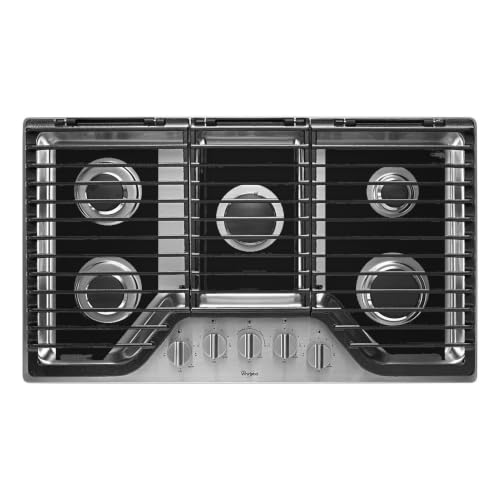
3. Whirlpool WCG97US6DS Gas Cooktop
A five-burner cooktop with grates designed so heavy pots can slide across. Whirlpool is a long-time appliance name, so parts and service are easy to find. Confirm the burner sizes on the listing. Spare grates and caps are usually easy to order.
Suits: family cooks. Strengths: slidable grates and a trusted brand. Weaknesses: less design flair. Skip it if you want a premium look.
Best for smaller kitchens
4. Frigidaire Gallery FGGC3047QS Gas Cooktop
A compact five-burner cooktop in the 30-inch class, useful if your counter cannot take a wider unit. Gallery models add upgrades over basic Frigidaire cooktops. Check that your gas line sits within reach of the cutout.
Suits: smaller kitchens. Strengths: five burners in a narrower body. Weaknesses: less cooking space than a wide cooktop. Skip it if you need extra-large pot room.
View Frigidaire Gallery FGGC3047QS on Amazon

Best for modern kitchens
5. Samsung NA36R5310FS Gas Cooktop
A five-burner 36-inch class cooktop with continuous grates and a modern look. Samsung is best known for electronics, so check the listing for service coverage in your area.
Suits: modern kitchens. Strengths: a contemporary design. Weaknesses: less cooktop history than older brands. Skip it if you want a long-running line.


Best for matching LG kitchens
6. LG LCG3611ST Gas Cooktop
A five-burner cooktop with a layout meant to hold larger pots without crowding. LG sells a wide range of kitchen appliances, so this cooktop can match other pieces in the same line.
Suits: matching LG kitchens. Strengths: a layout for large pots. Weaknesses: not much brand history in cooktops. Skip it if you prefer a pro-style brand.

Care and Setup
- Clean spills quickly, then wipe the surface once it has cooled.
- Soak the grates and burner caps in warm soapy water.
- Clear the igniter area with a soft brush or toothpick.
- Make sure the burner caps sit flat before lighting.
Mistakes to Avoid
- Buying without measuring the counter cutout.
- Forgetting that gas cooktops need a licensed gas hookup.
- Cleaning wet igniters and then lighting the burner right away.
- Ignoring clearances to cabinets and range hoods.
Burner Output, Simmer Control and How Real Cooking Uses Them
Burner output is usually listed in BTU, a measure of heat energy per hour, and it is tempting to chase the biggest figure. What matters more is the range across the cooktop. A strong burner boils large pots of water quickly and sears meat and vegetables, while a low simmer burner holds sauces, melted chocolate and delicate dishes without scorching. A good layout offers both extremes and a few mid-range burners for everyday use.
Think about the jobs you do most. If you stir-fry, boil pasta in a big pot or sear steaks, a high-output burner is useful, but it needs a sturdy grate and a pan large enough to use the heat. If you cook sauces, custards and rice, a true low simmer matters more, and you should check how low the flame can go and whether it stays lit at the lowest setting. The manual or listing should give burner outputs; ask the seller if they are missing.
Note where each burner sits. A powerful burner in a corner may be awkward for a large pot, and burners that are too close together can crowd cookware. A center burner on a five-burner layout often serves as an oval or oblong spot, or a medium burner, and the manual describes its purpose.
- Power burner: for boiling and searing.
- Simmer burner: for sauces and gentle heat.
- Standard burners: for daily cooking.
Grates, Burner Caps and How Pans Move Across Them
The grates are where you work, so test them in your mind with the pans you own. Continuous cast-iron grates let you slide heavy pots from burner to burner without lifting, which is handy when moving a hot pan aside. Separate grates may be lighter to lift and clean but can interrupt a smooth slide. Cast iron is strong and holds heat, but it is heavy and can chip enamel if dropped.
Check the grate size and shape against your cookware. Large pans, griddles and woks need stable support, and small pots need to sit safely without tipping. A flat, even grate surface helps stability. Consider whether the grates are dishwasher safe, and how many pieces there are, as that affects cleaning.
Burner caps and heads sit under the pan and spread the flame. They must be seated properly, or the flame will be uneven or fail to light. Sealed burners keep spills on the surface rather than letting them drop into the base, which makes cleaning easier. Removable caps and heads allow better cleaning but need to be replaced correctly after washing.
- Test fit: your biggest pan on the grates.
- Look for stable support for round-bottom woks if you use one, and ask whether a wok ring is available.
Minor details, such as rubber feet on the grates, help keep them quiet and stable.
Ignition, Flame Safety and Control Layout
Gas cooktops should relight and operate safely, so check the ignition system. Most use electric spark igniters, which click until the flame lights. Some have a re-ignition feature that sparks again if a flame goes out, and some have a flame failure device that cuts the gas if the flame is not detected. The listing should state what is included, and the manual describes how the system behaves, including what to do during a power outage, when many models can be lit with a match carefully.
Controls matter in use. Front knobs are easy to reach, but they may be within reach of children, so a knob lock or a design with side or recessed controls may suit a family. Knobs should be clearly marked, turn smoothly and be easy to match to burners. Heavy metal knobs feel solid, and plastic ones are lighter. Digital controls are rare on gas but may appear on some designs.
Safety also means smell and ventilation. If you smell gas, turn off the supply, open windows, do not use switches or flames, and call your gas supplier or an emergency number. Make sure there is a carbon monoxide detector in the home, as recommended by local guidance.
- Check the lockout or safety features on the listing.
- Keep flammable items away from the burners.
- Use the right cookware size so flames do not wrap around the pan sides.
Gas Line, Cutout and Installation Planning
A new cooktop needs more planning than swapping a countertop appliance. Start with the cutout. Measure the existing opening width, depth and the thickness of the counter, then compare these with the new cooktop’s cutout dimensions in the installation sheet, not with the visible top size. Cooktops of the same width class can have different cutouts and different depths below the counter, so check for obstacles such as drawers, cabinet frames and the oven below.
Check the clearances. The installation guide gives minimum distances to side walls, to cabinets above and to the range hood. A hood should be installed at the stated height, and the ventilation should suit the output of the burners. The gas connection position and the regulator must also fit. A licensed professional should make the gas hookup, check the connection for leaks and confirm the right pressure.
Know your fuel. Many cooktops ship set for natural gas and need a conversion kit and professional adjustment for propane. Check what is included and whether the conversion kit is sold separately. Also check the electrical requirement: gas cooktops need a power outlet for the igniters, so ensure one is accessible and grounded.
- Ask a professional about codes and permits where you live.
- Plan the gas shut-off so it is accessible.
Cleaning Routine and Long-Term Care for a Busy Cooktop
A home chef’s cooktop takes a lot of splatter, so a routine keeps it working. Wipe spills once the surface has cooled, using a soft cloth and a mild cleaner suitable for the finish. Stainless steel surfaces are cleaned along the grain, and enamel and glass surfaces generally need non-abrasive products. Avoid harsh chemicals on knobs and markings, and do not spray cleaner directly into burner openings.
Take the grates, caps and heads off periodically. Soak them in warm soapy water, scrub gently, rinse and let them dry completely before replacing them, because wet burner parts can cause poor ignition. Clear the igniter and the burner ports with a soft brush, a toothpick or a similar tool as the manual suggests. Blocked ports lead to uneven or yellow flames.
A healthy flame is mostly blue and steady. A yellow, floppy flame or a strong odor can indicate a problem with the burner or the air mix. Check that the caps are seated, clean the ports and call a technician if it continues. Clicking that does not stop after the burner lights can be caused by moisture or dirt on the igniter.
- After each use: wipe the surface.
- Monthly: deep clean grates and caps.
- Yearly: have a professional inspect the gas connections if recommended.
How to Read BTU Numbers Without Being Misled
Gas cooktop listings love to quote BTU figures for each burner, and it is tempting to treat the highest number as the winner. In practice, the number describes the maximum energy the burner can use, not how well it cooks. A very strong burner can boil a large pot quickly and give a good sear, yet it is only useful if your pans can take the heat and if the controls let you turn it down smoothly. Equally important is the low end, since a burner that cannot hold a gentle simmer will scorch sauces and melt chocolate unevenly. Look for information about the lowest setting as well as the highest.
- High-output burner: Helps with boiling large pots of water and with stir-frying, as long as your pan is wide enough to use the flame.
- Medium burners: Handle everyday cooking such as sauteing and shallow frying.
- Simmer burner: Keeps delicate sauces gentle without cycling off.
- Control feel: Knobs should turn smoothly and give clear feedback about flame height.
- Pan size matching: Choose pans whose bases suit the burner size, so heat does not lick the sides.
The maker’s manual usually states the safe cookware sizes for each burner, and it is worth reading before you buy.
Five-Burner Layouts and Where Your Pots Will Actually Sit
A five-burner layout offers flexibility, but only if the burners are arranged so that large pots do not collide. Look at a diagram of the layout rather than the photo alone. Some cooktops put the fifth burner in the center, others along the back or the side, and each placement affects how you manage a crowd of pans. Think about whether you often use a griddle or a large stockpot, and whether the grates are continuous so you can slide pans from one burner to the next without lifting.
| Layout | Advantage | Consideration |
|---|---|---|
| Center burner | Accessible from all sides, handy for a wok or oval pot | Surrounding pans can crowd it |
| Four corners plus a side burner | Clear spacing for large cookware | The extra burner may sit farther from the controls |
| Continuous grates | Slide pans without lifting | Heavier grates are harder to clean |
| Separate grates | Easier to remove and wash | Pans must be lifted between burners |
Gas Supply, Ignition and Installation Realities
Gas cooktops need a proper supply, ventilation above and a safe installation. Check whether your home uses natural gas or propane, since cooktops are set up for one or require a conversion kit for the other. Follow the maker’s instructions precisely and use a licensed professional for gas connections. Ask about electrical needs too, because electronic ignition requires a power outlet. Know how to relight burners manually during a power cut if the manual describes it.
- Confirm the gas type and pressure supplied to your home.
- Check cutout dimensions and clearance to combustibles.
- Plan for a hood or other ventilation above the cooktop.
- Arrange for a licensed installer to connect the gas and check for leaks.
- Read the manual for ignition and safety features.
Cleaning Grates, Caps and Spills
Remove grates and burner caps once cool, wash them according to the manual, and keep burner ports clear using the method the maker describes. Wipe spills quickly to prevent baked-on residue.
Cookware That Pairs Well With Open Flames
Gas flames wrap around the base of a pan, so the cookware you own shapes the results as much as the cooktop does. Flat-bottomed pans with solid handles work best, and round-bottomed woks need a ring or a grate designed to hold them securely. Thin pans heat fast but can create hot spots, while heavy pans spread heat and stay steady. Cast iron and thick stainless sets do well on gas, and nonstick pans work if you keep the flame under the base rather than licking up the sides, since flames that rise past the edge can damage handles and coatings.
- Wok cooking: Check the grates and consider a wok ring if the maker allows one.
- Large stockpots: Make sure the grate supports the weight and the pot sits stable.
- Small saucepans: A simmer burner or a reducer grate can keep small pans steady.
- Griddles: Use only those the cooktop maker approves, and watch for heat buildup.
- Handles: Turn them inward so they do not sit above a flame.
Lowering the flame as soon as liquid boils saves gas and reduces splatter.
Choosing With Confidence: The Criteria That Actually Decide It
A gas cooktop is the part of the kitchen you touch every day, so choose it like a tool, not an ornament. Burner configuration leads: most serious cooking needs one genuinely powerful burner for boiling and searing, one true simmer burner that can hold a sauce without catching, and mid burners that take everyday pans without crowding. Look at the layout with your own pans in mind — two large pans side by side is the test most cooktops quietly fail — and at whether the grates are continuous, so heavy pots slide between burners instead of being lifted.
Size is a trade between burners and workspace. A wider cooktop gives five burners and room for a griddle or a big preserving pan, but only if your pans and habits use them; a smaller top with four well-spaced burners often cooks better than a crowded five. Measure the cut-out and the cabinet below as carefully as the top, because cooktops drop into the worktop and their underside needs the clearances the maker specifies. Changing size later means changing worktops, so this decision deserves the tape measure twice.
Grate and surface materials decide the cleaning life. Heavy cast-iron grates are stable, durable and keep their looks, but they are heavy to lift to the sink; enamelled steel is lighter and less forgiving of knocks. Sealed burners are close to non-negotiable for a sane cleaning life, containing spills on a surface that wipes rather than into a well that festers. Glass-topped gas designs clean beautifully and show every splash; stainless shows every fingerprint. Pick the surface whose flaws your household tolerates best.
Controls and safety close the case. Knobs should be where you can reach them without leaning over a lit burner, turn with a precise feel, and be removable for cleaning. Flame-failure protection, which cuts the gas if a flame blows out, is a feature to insist on rather than admire. If your cooking involves long, low simmers, test the simmer claim seriously in reviews and specifications: the difference between a gentle hold and a scorched béchamel is the difference between a cooktop you love and one you supervise.
Real Homes, Real Routines
Serious home cooking and entertaining
Cooks who regularly run three or four pans at once — a sauce holding, pasta boiling, greens wilting, steaks searing — need spacing and range more than raw burner count. This pattern rewards continuous grates, a centre or side power burner, and controls laid out so adjusting the back burner does not mean reaching across the front one’s steam. If you entertain, rehearse your biggest menu mentally across the burners before you buy; the cooktop that fits that day fits every day.
Wok cooking and high-heat styles
Stir-frying lives or dies on heat and on the wok sitting stable and close to the flame. A dedicated high-output burner, ideally with a wok ring or grate designed for a round base, transforms the dish: ingredients sear instead of stewing in their own juices. Home wok cooks should weight this feature above almost everything else, and check that the burner layout lets a wok and a second pan of rice or greens coexist without a territorial dispute.
Family kitchens and everyday reliability
For family cooking, the virtues are sturdiness, safe controls and a surface that forgives the daily spill. Burners that light first time, grates that do not rock under a full pot, and a simmer burner gentle enough for porridge and custards matter more than spectacle. Households with children should think about knob position and flame-failure devices with the seriousness they deserve, because the cooktop will be used by tired people at busy times for a decade.
Use, Cleaning and Day-to-Day Care
Clean as you go and a gas cooktop stays handsome with minutes a week. Sealed burners keep spills on the surface; wipe them once cool, lift caps and grates for a proper wash regularly, and dry everything fully before refitting so ignition stays crisp. A mis-seated burner cap is the commonest cause of a strange, lopsided flame after cleaning, so refit with care and check the first lighting of each burner before you start cooking in earnest.
Burner ports and igniters need gentle attention. Food debris and boil-overs block ports and give uneven flames; clear them with a soft brush or the maker’s recommended method, never by forcing wire into precision holes. Igniter electrodes that are greasy or damp click without lighting — a clean and a thorough dry usually cures them. Yellow, lifting flames after cleaning usually mean something is still damp or misaligned; persistent yellow flames on a dry, correctly assembled burner deserve a service call.
Gas safety is a habit, not a feature list. Know your shut-off valve’s location. Keep tea towels, packaging and wooden utensils from living beside burners. If a burner is turned on unlit, turn it off and ventilate before any attempt to light it, and treat any unexplained smell of gas as a professionals-only event. An annual service is worthwhile for a heavily used cooktop, and essential if flames change character across several burners at once.
Where Buyers Commonly Go Wrong
The expensive mistake is choosing by burner count and discovering your two biggest pans cannot sit side by side, or that the fifth burner is a decorative centrepiece too close to its neighbours to use. Judge layouts with pan diameters, not brochure photographs. The second mistake is ignoring the cut-out: cooktops are not interchangeable between sizes, and a beautiful new top that needs the worktop re-cut is a project, not a purchase.
Buyers also underrate the simmer end of the range because showrooms demo power. Ask specifically how low each burner goes and whether the lowest setting holds without constant attention. And check knob placement against your habits: front controls are reachable but also reachable by small children; top controls near burners can mean sleeves over flames. There is no universal right answer — there is only the answer that fits your household, chosen deliberately.
Getting Professional Results From a Home Gas Cooktop
Step 1: Match pan to burner, every time
Build the habit of choosing the burner by the pan in your hand: wide pans on the strong burners, small pans on the gentle ones, never the reverse. A flame licking up the sides of a small pan is wasted gas and a burnt handle; a big pan starved on a small burner is a slow, uneven cook. This single habit improves everything you cook more than any other adjustment available to you.
Step 2: Preheat the pan, not the air
Give heavy pans a minute or two on a medium flame before food goes in, and test readiness the cook’s way — a flick of water that dances rather than sits. Food added to a properly heated pan sears; food added to a cold pan and heated together steams in its own juices. The difference between a crust and a sigh, on almost everything you fry, is those two patient minutes.
Step 3: Use the simmer burner as your finishing station
Assign the gentlest burner the role of finisher: sauces holding, butter melting, finished dishes resting at the edge of warmth while the power burner does the violent work. Cooking in parallel — one pan active, one holding — is how a four-burner top feeds a table without panic, and the simmer burner, unglamorous as it is, is what makes the pattern possible.
Step 4: Season cast iron and griddles on the flame
A gas cooktop is the natural home for cast iron and flat griddles: heat them gradually, cook, and let the surface build its seasoning over months of use. The wide, even flame of a good burner treats a griddle kindly across its whole surface. Wipe, dry on the flame for a moment, and store dry — the ritual is two minutes and the payoff is a pan that outperforms non-stick for decades.
Step 5: Finish with the two-minute reset
After cooking, once surfaces are safe to touch: caps and grates checked for spills, a wipe across the top, knobs back to off with a conscious glance at each one. The glance is the point — a household ritual of verifying every knob off is the cheapest safety device ever fitted to a kitchen, and the wipe keeps tomorrow’s cleaning at two minutes instead of twenty.
How the Picks on This List Compare
Six products made this list of gas cooktops for home chefs, and they are not six versions of the same idea. The reviews above judge each one on its own terms; this section is about the shape of the list as a whole, so you can see where your own priorities land before you commit. Read it alongside the individual reviews and the specs table near the top of the page, which together contain every fact you need — this comparison adds no new claims about the products, it simply arranges the decision.
The list opens with KitchenAid KCGS556ESS 36 Inch Gas Cooktop and Bosch 800 Series NGM8056UC Gas Cooktop. These are the two the editors put first, and for most readers the honest shortlist starts here: read their two reviews back to back and note which one’s strengths match the job you described in the buying criteria above. If either fits your space, your habits and your constraints, you can stop early with confidence — the rest of the list exists for readers whose situation is more specific.
The remaining picks — Whirlpool WCG97US6DS Gas Cooktop, Frigidaire Gallery FGGC3047QS Gas Cooktop, Samsung NA36R5310FS Gas Cooktop, LG LCG3611ST Gas Cooktop — earn their places by serving narrower briefs: a tighter space, a heavier workload, a particular installation, a preference for one design approach over another. That is not a polite way of saying they are worse. For the reader whose kitchen matches one of those briefs, the fourth or sixth pick may be the only correct answer on the page, while the top pick would be a daily frustration. Matching the brief matters more than matching the ranking.
A practical way to finish the decision: take the two or three criteria that the earlier sections identified as decisive for gas cooktops for home chefs — the measurements, the capacity question, the one feature your household will use daily — and score only your shortlist against only those. Buyers who compare everything against everything end up with a spreadsheet and no decision; buyers who compare their shortlist against their own two or three decisive criteria end up with the right product and a quiet kitchen.
What Using It Day to Day Is Really Like
Cooking seriously at home changes what ‘good’ means in a cooktop: it is the simmer that holds a béarnaise while you sear, the burner that recovers its boil the moment the pasta drops, the grate that lets a full sauté pan slide off the heat instead of being lifted mid-shake. Home chefs should audition layouts against their own repertoire — list the five dishes you cook most and walk each across the burners mentally. Precise, repeatable knob control matters more at this level than any headline output figure, because your cooking lives in adjustments of an eighth of a turn.
Whatever the brochures promise, ownership of the right choice for gas cooktops for home chefs settles into a routine within a month: the features you use daily become invisible, the one compromise you accepted becomes the thing you plan around, and the details that decided the purchase — a measurement, a control you liked, a layout that fit your habits — quietly prove themselves several times a day. That is why this guide weights fit and habits so heavily over headline specifications. A product that matches your routine disappears into your life in the best way; a product that fights it will be renegotiated at every use, and no specification on a box makes up for that.
A Final Checklist Before You Buy
Before you order, run through this short list. It takes five minutes and prevents most of the regrets readers write in about gas cooktops for home chefs.
- Measure the space — and the route to it — one final time, and compare the numbers against the specific model, not the category average.
- Write down the two or three jobs your choice for gas cooktops for home chefs must do weekly, and confirm the model you picked is the one whose review answers those jobs.
- Check what the installation needs — power, plumbing, ventilation, clearances — and decide honestly which parts are DIY and which are a professional’s.
- Confirm what is included and what is not, so any fitting, cord, connector or accessory the job needs is ordered with the product, not discovered without it.
- Read the warranty terms for the specific model and keep the paperwork somewhere findable; a decade-long appliance deserves a filed receipt.
- Plan the first week: where it goes, what it replaces, and the one habit — cleaning, checking, rotating — that will keep it at its best.
Long-Term Ownership: What Year Three Looks Like
Products for gas cooktops for home chefs are rarely replaced on a schedule; they are replaced when a small annoyance becomes a daily one. Planning for year three at the buying stage means asking unglamorous questions now: which parts wear, which parts are replaceable, and whether the maker supports the model with spares and a service network you can actually reach. A product whose wearing parts are cheap and available stays young for a decade; one built as a sealed mystery becomes landfill at the first tired component, however well it performed in month one.
Keep the paperwork and the habits that protect the purchase. Register the warranty, keep the receipt somewhere findable, and note the model details in your phone. Then run the simple maintenance rhythm the care sections above describe — none of it is heroic, and that is the point. Almost every premature failure in this category traces back to skipped basics: a filter never changed, a seal never cleaned, a small leak left to become a big one. Ten minutes on a schedule outperforms a weekend of rescue work every single time.
Finally, judge the purchase by the routine it creates. The right choice for gas cooktops for home chefs disappears into daily life: it is used without thought, cleaned without dread and trusted without checking. If, a month in, you are still working around your purchase — still measuring twice, still apologising for it to guests, still keeping the old workaround alive — that is information worth acting on while returns and warranties are still on your side. Good buying is not just choosing well; it is noticing early when you have not.
Gas Cooktop FAQ
Do I need a range hood?
A hood removes heat, grease and combustion byproducts, so most installers recommend one with gas cooking. Follow the installation guide for clearances.
Is a 36-inch cooktop worth it?
If you cook large meals often, the extra width gives more room for pots. A narrower unit is fine for smaller households.
Can I convert to propane?
Many cooktops ship for natural gas and need a conversion kit for propane. Check the listing and the manual before you order.
What is a simmer burner?
It is a low-output burner designed to hold a gentle heat for sauces and melting without scorching.
How many BTU do I need?
There is no single number. Look at the range of burners: one strong burner for boiling and searing and one low simmer burner cover most cooking. The listing should state outputs for each burner.
Why does my burner click after it is lit?
Moisture, food debris or a poorly seated cap can keep the igniter sparking. Let parts dry, clean the igniter and make sure the cap is flat. If it continues, contact a technician.
Can I use a wok on a gas cooktop?
Flat-bottomed woks work on most grates, and round-bottom woks need a stable support or ring if the maker allows. Check the grate design and the manual.
What does a sealed burner mean?
A sealed burner has a gasket or design that prevents spills from dropping into the cooktop base. It makes cleaning easier, though the burner parts still need regular washing.
Do gas cooktops work in a power cut?
Many can be lit manually with a match when the power is out, but check the manual because safety systems and procedures vary. Take great care when lighting by hand.
Can I put a cooktop above any oven?
Not always. Installation guides state the required clearances and cabinet depth. Check the guide for the cooktop and the oven, and ask a professional.
How long do gas cooktops last?
Lifespan depends on use and care. Keeping burners and igniters clean and having problems fixed promptly helps. Check the warranty period on the listing.
How powerful a burner do I really need?
One strong burner covers boiling large pots and proper searing; beyond that, range and control matter more than headline power. Excess power on small pans wastes gas and overheats handles. Judge a cooktop by its spread — the gentlest simmer to the strongest boil — and by how many burners hold their character at once, rather than by the single biggest number in the brochure.
Can I use a wok on any gas cooktop?
You can stir-fry on any burner, but a round-based wok needs support: a wok ring or a grate designed to cradle it, on the strongest burner you have. Flat-based woks sit on ordinary grates and work well with strong heat. Keep the wok’s handle orientation in mind and never leave a wok balanced unstably — if it rocks, change the support, not your grip.
Why does my burner keep clicking after cleaning?
Moisture is the usual culprit: igniters dislike being wet and will click without sparking properly until dry. Let the burner area dry fully, check the cap is seated exactly, and make sure the electrode is clean. If clicking persists on a dry, correctly assembled burner, the igniter or its switch may be failing and a service visit is the efficient answer.
How do I clean cast-iron grates?
Wash them in hot soapy water, dry them thoroughly and immediately — cast iron rusts when left damp — and avoid leaving them soaking for hours. Burnt-on deposits soften with a paste of bicarbonate and patience. Some makers allow a light seasoning-like oiling to keep them looking deep black; follow your manual. Never put cold water on a very hot grate, which can crack enamel coatings.
Is a five-burner cooktop always better than four?
Only if the spacing lets you use them. Five burners on a wide top with genuine elbow room is a joy for busy cooks; five burners crowded onto a narrow top is four usable burners and a ornament. Take your largest pans’ diameters to the decision and simulate your biggest meal. The layout that fits your pans beats the layout with the bigger number, every time.
What is flame-failure protection and do I need it?
It is a device that senses when a flame has gone out and cuts the gas supply to that burner, so unburned gas does not accumulate. On modern cooktops it is widely standard and worth insisting on, particularly in households where a breeze through a window, a boil-over or a distracted moment could kill a flame on a low burner without anyone noticing.
Can a gas cooktop be converted between gas types?
Many models can be converted between natural gas and bottled gas with the correct jet kit and adjustment, but it is work for a qualified gas engineer following the manufacturer’s procedure, not a DIY afternoon. If your supply might change — a renovation, a move to a rural property — confirm convertibility of the specific model before buying, and keep the conversion kit and paperwork with the manual.
How do I stop pans sliding on the grates?
Pans slide when grates are greasy, when pan bases are warped, or when a light pan sits on a powerful burner whose draught moves it. Clean grates grip better; flat, heavy bases sit better. If a particular pan wanders, use it on a smaller burner with a steadier fit. A grate that rocks in its seating should be reseated or checked — stability is a safety feature, not a nicety.
How do I boil a large pot of water faster?
Use the strongest burner, a lid, and a pot sized to the burner so the flame heats the base rather than escaping around it. Start with hot water from the kettle if speed truly matters — a hybrid approach most cooks use without admitting it. Salt once the water boils rather than before, and keep the lid on between checks: an uncovered pot is a steam engine wasting your gas on the kitchen’s humidity.
Can I use a griddle across two burners?
Yes, on cooktops whose layout and grates support it, and it is one of gas cooking’s pleasures — pancakes, smash burgers, a full breakfast in one landscape. Preheat the griddle gradually and evenly across both burners to avoid warping, and expect the zone between burners to run slightly cooler, which becomes a holding area with practice. Confirm your model’s guidance on bridging burners before making it a habit.
Why does my smallest burner keep going out at low settings?
A very low flame is vulnerable to draughts and to a partially blocked port, and some burners simply have a higher minimum than others. Clean the ports, shelter the flame from a window’s breeze, and if the burner still will not hold low, use a heat diffuser or move the gentle work to the burner whose low end behaves. A burner that repeatedly dies at its designed minimum deserves a service check of its flame-failure device.
How do I clean under the knobs and around the controls?
Most knobs pull off — confirm with the manual — and wash in warm soapy water while the area beneath gets a careful wipe. Do not flood the control area; water in the switches causes clicking and misbehaviour. Dry everything fully before refitting. This is a monthly job that keeps the controls feeling precise and stops the slow build-up that makes knobs sticky to turn.
What pans should I avoid on a gas cooktop?
Warped pans that rock, pans far smaller than the burner with flammable handles overhanging the flame, and anything not rated for direct heat, such as most oven-to-table ceramics not designed for hobs. Very large pans that overhang the cooktop’s edge can overheat the controls and the worktop. Beyond that, gas is the most forgiving of surfaces — if a pan is flat, stable and heatproof, it will cook.
The Short Version
For a home-chef staple, the KitchenAid. For a premium look, the Bosch. For sliding grates, the Whirlpool. For a compact top, the Frigidaire Gallery. For modern styling, the Samsung. For large pots, the LG.

