Disclosure: airfryerkitchensupply.com is reader-supported. When you buy through links on our site, we may earn an affiliate commission at no extra cost to you.
Where to buy
If you are shopping for the best gas and charcoal grills, you are really shopping for a way to own both fires — and there is more than one way to do it. Start with the verified shortlist below: every grill on it was confirmed against a live Amazon listing before it earned a place here. The list deliberately mixes the three real routes to owning both fuels, because the right route matters more than any single model.
The three routes, plainly: an integrated combo cart (two chambers, one footprint — the subject of its own dedicated guide in this programme, represented here by its strongest examples); two separate grills, a gas cart and a charcoal kettle, each full-sized for its fuel; and the compact 2-in-1 designs that switch a single small chamber between fuels for tight spaces. This article compares the routes head-to-head and stocks each with verified picks, so you can choose a system, not just a product. Check the current price on Amazon on each listing before ordering.
- Char-Griller Texas Trio Gas & Charcoal Grill and Smoker, Model 3070 (Best Integrated Combo) — Check the current price on Amazon
- Royal Gourmet ZH3002N 2-Burner Propane Gas and Charcoal Grill Combo (Best Value Integrated Combo) — Check the current price on Amazon
- Oklahoma Joe’s Canyon Combo Dual Fuel Gas and Charcoal Smoker and Grill (Best Integrated for Smokers) — Check the current price on Amazon
- Charbroil Bistro Pro 2-in-1 Gas & Charcoal Grill, 240 Sq. In. (Best Compact Convertible) — Check the current price on Amazon
- Weber Spirit E-325 Gas Grill (LP) (Best Gas Half of a Two-Grill System) — Check the current price on Amazon
- Weber Original Kettle Premium Charcoal Grill, 22-Inch, Black (Best Charcoal Half of a Two-Grill System) — Check the current price on Amazon
Gas and charcoal are not rivals so much as tools with opposite virtues. Gas is a utility: instant, controllable, clean to shut down, and honest about weeknight cooking — light, cook, eat, off. Charcoal is an event: slower to start, alive to manage, and capable of smoke flavour and searing theatre that gas approximates but never quite reproduces. Most households that grill weekly end up wanting both, which is why this search exists — and why the interesting question is not which fuel, but which architecture for owning the pair.
Architecture decides almost everything that follows. An integrated combo gives each fuel a mid-size chamber on one cart: one purchase, one cover, one patio slot, and the unique party trick of running both fires at once for one meal. Two separate grills give each fuel a full-size stage and independent lifespans — the kettle can be replaced without touching the gas cart — at the cost of two footprints, two covers, and usually more money in total. A compact 2-in-1 gives a small space a taste of both fuels in a single chamber that converts between them, at the cost of cooking on one fuel at a time and at small scale.
The six picks below are organised by route rather than by rank: two integrated combos (the enthusiast benchmark and the value standard), the compact convertible, and the two halves of the classic two-grill system (a benchmark gas cart and the benchmark charcoal kettle), plus a smoker-leaning combo for households whose charcoal side is really about low-and-slow. Read the route comparison first if you are undecided — it is the decision this whole page exists to help you make.
In this guide
Quick Picks
Char-Griller Texas Trio Gas & Charcoal Grill and Smoker, Model 3070 — Best Integrated Combo. Route one, at its fullest: a 3-burner gas chamber and a charcoal chamber on one cart, plus a side burner and an included side firebox for offset smoking — 1,390 square inches of total listed cooking space across its surfaces. As the integrated route’s representative, it shows both the appeal (everything, one footprint) and the cost (the biggest, heaviest cart here). Check the current price on Amazon
Royal Gourmet ZH3002N 2-Burner Propane Gas and Charcoal Grill Combo — Best Value Integrated Combo. The integrated route at its most accessible: a 2-burner gas chamber (20,000 BTUs per the listing) beside a charcoal chamber, 759 square inches in total, two side shelves, a stainless lid, value tier. It is how a household finds out its true fuel ratio — how often each fire actually gets lit — before committing enthusiast money to either route. Check the current price on Amazon
Oklahoma Joe’s Canyon Combo Dual Fuel Gas and Charcoal Smoker and Grill — Best Integrated for Smokers. The smoker’s integrated option: a 3-burner propane chamber beside a charcoal chamber built by a smoker brand for smoker work, 1,031 square inches of listed area in total. In route terms, it is the pick when the charcoal half of your ambition is less about searing and more about ribs, shoulders, and long afternoons. Check the current price on Amazon
Charbroil Bistro Pro 2-in-1 Gas & Charcoal Grill, 240 Sq. In. — Best Compact Convertible. Route three, the space-saver: a compact single grill, 240 square inches per the listing, built as a 2-in-1 that cooks with gas or with charcoal in the same small chamber — the listing itself aims it at patios and balconies. It cannot run both fuels at once and it will not feed a crowd; what it does is give a small outdoor space a genuine choice of fire, which no other design at this size offers. Check the current price on Amazon
Weber Spirit E-325 Gas Grill (LP) — Best Gas Half of a Two-Grill System. Route two, gas half: Weber’s 3-burner Spirit E-325, with a Sear Zone with Boost per its listing — a full-size, full-standard gas cart that asks for no combo compromises, because its charcoal partner stands separately. In a two-grill system this is the weeknight engine: three zones, a boosted sear area, and the brand’s long parts support behind it. Check the current price on Amazon
Weber Original Kettle Premium Charcoal Grill, 22-Inch, Black — Best Charcoal Half of a Two-Grill System. Route two, charcoal half: the 22-inch Original Kettle Premium, the most proven charcoal grill design in existence, with a built-in thermometer per its listing. As half of a system it needs no apology and no partner features — it sears, roasts, and cooks low-and-slow with a banked fire, and it costs a fraction of any cart in this article. Check the current price on Amazon
How These Picks Were Chosen
Every pick was verified the same way: searched by brand and model on this site, matched against the returned listing title, and only then given a link. Specifications quoted in the boxes — burner counts, areas, the kettle’s diameter, the Bistro’s cooking space — come from those returned titles, with combo totals explicitly flagged as cross-chamber sums.
The shortlist was constructed by route, not by brand balance: the integrated route is represented by its enthusiast benchmark, its smoker-leaning variant, and its value standard (the full six-model integrated comparison lives in the dedicated combo guide); the two-grill route by a mainstream-best gas cart and the benchmark kettle; the compact route by the one convertible design verified for it. Routes were then compared on footprint, chamber size per fuel, simultaneity, maintenance, and replacement logic.
Badges name each pick’s role in the system decision, and they follow each pick from Quick Picks into its review.
The 6 Best Gas and Charcoal Grills: Routes and Picks in Detail

Char-Griller Texas Trio Gas & Charcoal Grill and Smoker, Model 3070 — Best Integrated Combo
If the integrated route wins your decision, this is its flagship in this programme. The Trio runs three gas burners for the week, a full charcoal chamber for the weekend, and — uniquely here — a side firebox that converts the charcoal side into an offset smoker, with a side burner besides. Dual temperature gauges, one per fire, are named in the listing. Read the 1,390 square inch figure as the sum of all its cooking surfaces, firebox included; each chamber individually is family-sized, not event-sized, which is the integrated route’s defining trade in one number.
Strengths
- Gas, charcoal, and offset smoking on a single cart — the most complete one-purchase answer
- Side firebox and side burner included per the listing
- Simultaneous two-fuel cooking: the integrated route’s unique advantage, fully realised here
Trade-offs
- Largest footprint and assembly in this roundup; measure the patio honestly
- Three fire systems to maintain — burners, ash, and smoker grease
- Chamber sizes are mid-class; crowd cooking on a single fuel still means batches
| Specification | Detail (from the verified listing) |
|---|---|
| Gas side | 3 burners, push-button ignition (per listing) |
| Charcoal side | Charcoal chamber with side firebox (per listing) |
| Total area | 1,390 sq in across all surfaces (per listing) |
| Extras | Side burner, dual temperature gauges (per listing) |
Within this comparison article, the Trio’s job is to define what integrated buys at its best: total method coverage with zero additional purchases. If your household’s cooking genuinely spans weeknight gas, weekend charcoal, and monthly smoking, no two-grill system assembles that menu in one footprint at one purchase. The counterweight is concentration: one cart carries all your cooking, so its maintenance is your cooking’s maintenance, and its eventual replacement replaces everything at once. Households comfortable with that concentration — and with the ash-and-cover discipline it demands — get the most cooking per patio square in this entire guide.
The dedicated combo guide in this programme reviews this model and its five integrated siblings in full; here it stands as the route’s benchmark, and it earns the position.
Best for: Households wanting every method on one cart and willing to maintain it / Not suited for: Big-batch single-fuel cooks or anyone who wants their two fires independently replaceable
Check the current price on Amazon

Royal Gourmet ZH3002N 2-Burner Propane Gas and Charcoal Grill Combo — Best Value Integrated Combo
Every comparison needs its low-commitment option, and in the integrated column that is the ZH3002N. It is a genuine combo — real gas chamber with two-zone capability, real charcoal chamber beside it — sized and priced for small households and first experiments. Its analytical value in this article is as much diagnostic as culinary: a season with this cart teaches you whether your household is a combo household at all, and if so, which chamber deserved to be bigger — knowledge worth more than the grill costs, whichever route you take next.
Strengths
- True dual-fuel ownership at the value tier and a modest footprint
- Two side shelves — essential when two fires are being juggled
- A low-risk way to learn your household’s real fuel ratio
Trade-offs
- Compact chambers: single-fuel crowd cooking is batch work
- Value-tier build expects covering and ash discipline
- Modest gas output suits everyday grilling, not high-heat heroics
| Specification | Detail (from the verified listing) |
|---|---|
| Gas side | 2 burners, 20,000 BTUs (per listing) |
| Total area | 759 sq in (per listing) |
| Extras | Two side shelves, stainless steel lid (per listing) |
Judge this pick as the integrated route’s trial size. Households that discover an 80/20 gas habit can later invest in a great gas grill with a clear conscience, keeping the combo as the charcoal option. Households that light both sides weekly have proven the concept and can shop the enthusiast combos — or graduate to the two-grill system below — knowing exactly why. The only wrong outcome is skipping the learning step and buying the biggest version of a route your household has not tested.
As with every value charcoal chamber, the ash habit decides its lifespan: out when cold, every cook, no exceptions.
Best for: First-time dual-fuel buyers and small households learning their fuel ratio / Not suited for: Established cooks who already know they cook big on both fuels
Check the current price on Amazon
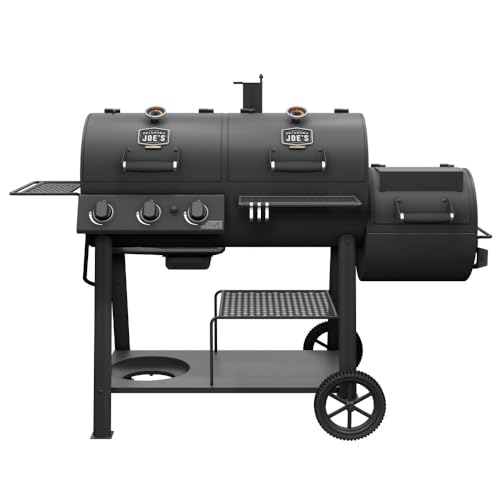
Oklahoma Joe’s Canyon Combo Dual Fuel Gas and Charcoal Smoker and Grill — Best Integrated for Smokers
Not all charcoal sides are equal, and the Canyon is the proof. Oklahoma Joe’s builds smokers first, and its combo’s charcoal chamber is designed for fire management over hours — the listing bills the whole unit as a smoker and grill, not a grill with a smoker footnote. Paired with a proper 3-burner gas side for the week’s ordinary cooking, the Canyon is the integrated route tilted, deliberately, toward the smoke end of the menu.
Strengths
- Charcoal chamber with genuine smoker design heritage
- 1,031 sq in listed total: family scale on both fuels
- 3-burner gas side holds full weeknight standards — no forgiven weaknesses
Trade-offs
- Heavy steel, two-person assembly and moves
- Smoker-grade steel wants cover and ash discipline to stay ahead of rust
- If you never smoke, you are carrying capability you paid for and do not use
| Specification | Detail (from the verified listing) |
|---|---|
| Gas side | 3-burner propane (per listing) |
| Charcoal side | Charcoal smoker and grill chamber (per listing) |
| Total area | 1,031 sq in (per listing) |
In the route comparison, the Canyon marks the point where integrated and specialist overlap: a two-grill household chasing this menu would pair a gas cart with a dedicated smoker, spending more patio and more money for more capacity in each role. The Canyon compresses that pairing into one cart at family scale. The compression is the trade — a dedicated offset smoker out-smokes it, a dedicated kettle out-sears at volume — but for the household whose smoking is monthly and whose patio is finite, the compression is exactly the point.
Choose it over the Texas Trio if your smoking is the charcoal side’s main job and you do not need the Trio’s side burner; choose the Trio if the firebox-and-burner maximalism matches your menu better.
Best for: Integrated-route households whose charcoal cooking is mostly smoking / Not suited for: Charcoal searing purists or strict gas-only weeknight cooks
Check the current price on Amazon

Charbroil Bistro Pro 2-in-1 Gas & Charcoal Grill, 240 Sq. In. — Best Compact Convertible
The Bistro Pro exists for the spaces the other routes cannot serve: the apartment balcony, the tiny townhouse patio, the deck where a full cart would consume the furniture budget of space. Its 2-in-1 design converts one compact chamber between gas convenience and charcoal flavour — not simultaneously, but in the same footprint, which for a small household cooking for two is often all the duality anyone needs. The listing’s own positioning — compact, for patio and balcony — is honest, and this review will be equally honest about the scale: 240 square inches is dinner for two to three, cooked in one wave.
Strengths
- Both fuels in a balcony-class footprint — unique in this roundup
- One chamber to buy, cover, and maintain instead of two fire systems
- A real answer for small-space households the other routes exclude
Trade-offs
- One fuel at a time: no simultaneous two-fire cooking
- 240 sq in is a hard ceiling — guests mean batches or a different plan
- Converting between fuels means handling the chamber setup between cooks
| Specification | Detail (from the verified listing) |
|---|---|
| Cooking space | 240 sq in (per listing) |
| Design | 2-in-1 gas & charcoal, single chamber (per listing) |
| Positioning | Compact, for patio & balcony (per listing) |
Judge the Bistro Pro against its actual competition, which is not the big carts in this article — it is having only one fuel, or no grill at all, in a small space. Against that competition it wins clearly: weeknight gas for two, weekend charcoal for two, one small footprint, one modest purchase. Small-space cooks should still verify their building’s rules before buying any grill — some balconies restrict charcoal or all open-flame cooking — because the best grill for a prohibited fuel is no grill. Within the rules, this is the compact route done properly.
It also makes a thoughtful second grill for a larger household: the small convertible by the kitchen door for two-person dinners, while the big cart rests under its cover.
Best for: Balcony and small-patio households of one to three people wanting both fuels / Not suited for: Anyone feeding crowds, or buildings that restrict charcoal or open flame
Check the current price on Amazon

Weber Spirit E-325 Gas Grill (LP) — Best Gas Half of a Two-Grill System
The two-grill route begins by refusing to compromise the gas side, and the E-325 is what that refusal looks like: a dedicated 3-burner cart whose listing adds a Sear Zone with Boost — extra heat exactly where steaks want it — to the Spirit formula of even burners and durable grates. Nothing about it is shared with a charcoal chamber, because nothing needs to be: the kettle below handles the smoke and the coals, at full size, on its own stand. That separation is the route’s whole philosophy, and this grill is its strongest mainstream expression.
Strengths
- Full-size gas cooking with a dedicated sear zone — no chamber-sharing compromises
- Three burners for true zoning across a full grate
- Independent lifespan: replace or upgrade it without touching the charcoal half
Trade-offs
- Costs a full grill’s money and a full grill’s footprint — the route’s known price
- No charcoal capability of its own, by design
- Two-grill households maintain two covers, two grease systems, two everything
| Specification | Detail (from the verified listing) |
|---|---|
| Burners | 3 (per listing) |
| Feature | Sear Zone with Boost (per listing) |
| Fuel | Liquid propane (per listing) |
Paired with the kettle below, the E-325 forms the system this article quietly considers the connoisseur’s default: each fuel at full size, each tool best-in-class at its job, each replaceable on its own schedule. The combined footprint is roughly a large combo cart plus a kettle’s circle — less additional space than people fear, because kettles tuck into corners carts cannot use. The combined cost is more than a value combo and comparable to an enthusiast one, spread across two purchases that can be years apart: buy the gas cart now, add the kettle when the charcoal itch proves real. That staged buying is itself an advantage no integrated cart can offer.
If you already own a decent gas grill, you own this half — skip to the kettle and complete the system for the price of the charcoal half alone.
Best for: Households choosing the two-grill route, or gas owners adding their charcoal half later / Not suited for: Single-purchase, single-footprint shoppers — that is the integrated route’s promise
Check the current price on Amazon

Weber Original Kettle Premium Charcoal Grill, 22-Inch, Black — Best Charcoal Half of a Two-Grill System
If the two-grill route has a hero, it is this kettle. The 22-inch format is the charcoal standard: enough grate for a family’s burgers or a pair of chickens, a bowl shape that manages airflow and ash the way seventy years of iteration teaches, and a built-in thermometer on this Premium version per the listing. Bank the coals to one side and it is a two-zone cooker; spread them and it is a searing stage; add a water pan and patience and it holds a gentle smoke for ribs. No other single charcoal tool covers this much menu at this tier.
Strengths
- The benchmark charcoal design: searing, roasting, and banked-fire low-and-slow in one bowl
- Costs a fraction of any cart here — the two-grill route’s economics live in this pick
- Nearly indestructible simplicity: almost nothing to break, everything replaceable
Trade-offs
- Charcoal’s honest costs: lighting time, ash, and a fire to manage rather than a dial to turn
- No gas convenience of its own, by design — that is the other half’s job
- 22 inches is family scale, not event scale
| Specification | Detail (from the verified listing) |
|---|---|
| Size | 22-inch kettle (per listing) |
| Extras | Built-in thermometer (per listing) |
| Colour | Black (per listing) |
The kettle reframes the whole comparison’s economics. A household can own this and the Spirit above — the best mainstream expression of each fuel — for a combined outlay in the enthusiast combo’s neighbourhood, with more cooking area per fuel and two independent lifespans. What it asks in return is patio geometry: a cart’s rectangle plus a kettle’s circle, and the willingness to keep two simple machines instead of one complex one. For households with the space, this article’s verdict is that the two-grill system is not the expensive option; it is the benchmark the integrated route must justify itself against — and on small patios and single purchases, it does.
Kettle skills transfer everywhere: vents for temperature, coal placement for zones, ash out when cold. Learn them here and every charcoal chamber in this programme makes sense afterwards.
Best for: Charcoal lovers completing a two-grill system, or anyone adding charcoal to an existing gas setup / Not suited for: Households with one small patio slot — the integrated or compact routes serve them better
Check the current price on Amazon
Comparison Table
| Pick | Badge | Key spec | Best for |
|---|---|---|---|
| Char-Griller Texas Trio Gas & Charcoal Grill and Smoker, Model 3070 — Check price | Best Integrated Combo | 3-burner gas + charcoal + side firebox, 1,390 sq in total per listing | One-cart households that also smoke |
| Royal Gourmet ZH3002N 2-Burner Propane Gas and Charcoal Grill Combo — Check price | Best Value Integrated Combo | 2-burner gas + charcoal, 759 sq in total per listing | Testing the integrated route at a value tier |
| Oklahoma Joe’s Canyon Combo Dual Fuel Gas and Charcoal Smoker and Grill — Check price | Best Integrated for Smokers | 3-burner gas + charcoal smoker/grill, 1,031 sq in per listing | Integrated buyers whose charcoal side means low-and-slow |
| Charbroil Bistro Pro 2-in-1 Gas & Charcoal Grill, 240 Sq. In. — Check price | Best Compact Convertible | Single convertible chamber, 240 sq in per listing, compact | Balconies and small patios wanting both fuels in miniature |
| Weber Spirit E-325 Gas Grill (LP) — Check price | Best Gas Half of a Two-Grill System | 3 burners with Sear Zone with Boost per listing | The gas anchor of the separate-grills route |
| Weber Original Kettle Premium Charcoal Grill, 22-Inch, Black — Check price | Best Charcoal Half of a Two-Grill System | 22-inch kettle, built-in thermometer per listing | The charcoal anchor: searing, smoking-adjacent, and everything between |
How to Choose Between Gas and Charcoal Routes
Choose the architecture first and the model second. These are the five questions that decide the architecture honestly.
How much patio do you actually have?
Measure the working footprint, not the grill alone: cart or carts, open lids, shelves, fuel storage, and the cook’s standing room. One integrated cart needs one generous rectangle. The two-grill system needs that rectangle plus a kettle’s circle — often placeable in a corner a cart cannot use, which is why the system’s true extra cost in space is smaller than it looks on paper. Balconies and small patios may only fit the compact convertible, and some buildings restrict fuels entirely — check before any of this matters.
How big do you cook, per fuel?
This is the question that eliminates routes. If your gas cooking and your charcoal cooking are both family-scale (four to six people), every route here works. If either fuel regularly feeds eight or more, integrated chambers will pinch on that fuel’s big days, and the two-grill system’s full-size stages win. If both fuels only ever feed two or three, the compact convertible stops being a compromise and becomes the correctly sized tool. Answer per fuel, not in general — most households are big on one fuel and small on the other, and the chamber split or system should reflect that asymmetry.
Do you want both fires at once?
Simultaneous two-fuel cooking — gas holding the sides while charcoal finishes the main, both landing together — is only possible with two fires burning: an integrated combo, or two separate grills. The compact convertible cannot do it by design. If your entertaining style is a mixed menu served at one moment, simultaneity is a requirement, not a luxury, and it eliminates route three. If your meals are one-fire affairs, simultaneity is a brochure feature you will rarely use, and it should not drive the purchase.
Maintenance and replacement: one patient or two?
An integrated combo concentrates upkeep and fate: one cart to cover and clean, two fire systems within it, and one eventual replacement that replaces everything. Two grills distribute both — simpler machines, staggered replacements, but two covers and two cleaning routines. There is no lazy winner; there is only the distribution you prefer. Households that enjoy equipment care often prefer two simple machines; households that want one appliance to look after often prefer the combo, and should budget its upkeep honestly at one-and-a-half single grills.
Budget shape: one purchase or staged?
Integrated combos concentrate spend into one decision. The two-grill route stages naturally: the gas cart this season, the kettle when the charcoal habit proves itself — or the kettle first, at a fraction of the cost, while a household saves toward the gas cart it really wants. Staging also de-risks the fuel-ratio question: you learn which fire you actually light before buying its expensive half. If cash flow and learning matter, staging is a genuine architectural advantage, not just a payment plan.
The fuel comparison underneath it all
Strip the hardware away and the fuels keep their characters. Gas: ten minutes to cooking, dial control, no ash, clean shutdown, flavour from the food and its marinades rather than the fire. Charcoal: thirty minutes to cooking, control by vents and coal placement, ash to manage, flavour with a smoke signature gas cannot duplicate, and a searing ceiling that rewards steak lovers. Neither is more ‘authentic’ — they are different instruments. The households that thrive own the instrument their Tuesday needs and the instrument their Saturday wants, in whichever architecture their patio and budget arrange best.
What simultaneity is actually worth, in meals
It helps to price the routes in dinners rather than features. The two-fire meal that justifies simultaneity looks like this: ribs finishing their last hour over charcoal smoke while gas handles burgers for the kids, corn, and a pan of beans, everything landing within ten minutes. Households that cook that meal monthly get real value from two live fires — combo or separate. Households whose entertaining is a single protein and a salad will light one fire at a time forever, and for them the routes differ only in chamber size, storage, and replacement logic. Neither household is wrong; they are simply buying different things, and the honest menu history — not the aspirational one — should hold the pen.
A staged plan for the undecided
If this article has left you genuinely torn, here is the sequence that resolves it with the least regret. Start with the kettle: it is the cheapest verified way to learn whether charcoal earns a permanent place in your cooking, and it remains useful forever as the system’s charcoal half. Cook a season. If charcoal thrives and gas convenience calls, add the gas cart and you own the benchmark two-grill system. If charcoal fades to monthly, keep the kettle for those days and invest the cart money in the best single gas grill for your real life. If patio space forbids both, the season’s learning transfers directly to choosing between the integrated combo and the compact convertible. Every path from the kettle leads somewhere good, which is why it is the right first step.
How to Run a Two-Fuel Cook, Whichever Route You Own
Combo cart or two separate grills, the choreography of a meal that uses both fires is the same. Learn it once and the hardware becomes interchangeable.
- Assign dishes to fires by temperament. Fast, forgiving, and sauce-heavy dishes go to gas, where control is instant. Smoke-wanting, sear-wanting, and slow dishes go to charcoal. Write the assignment down for big meals; two fires punish improvisation.
- Light the charcoal first, by a full half hour. Coals set the schedule. Chimney starter, no exceptions worth making, and build the gas preheat backwards from the moment the coals ash over. Gas needs ten minutes; charcoal needs thirty; the meal’s timeline belongs to the slower fire.
- Zone both fires. Bank the coals for a hot and a safe side; set the gas burners high-low. Every dish then has a home at every stage — searing, cooking, holding — on whichever fire suits it, and nothing burns for want of a cool parking spot.
- Cook in waves, finish together. Start the slow charcoal items first, the gas items timed to land with them, and use the gas side’s low zone as the universal holding station. Resting meat holds beautifully over the gentlest gas heat while the last sides finish.
- Serve from the fires, not the kitchen. The two-fuel system’s pleasure is theatre as much as flavour: slice the rested meat at the patio table, pull the last skewers straight off the coals. Plan the platter and board into your setup so the meal lands where the fires are.
- Shut down by fuel, properly. Gas: burn off, brush, tank valve first, then burners. Charcoal: vents closed to starve the fire, ash out when fully cold into a metal container. Two shutdowns, every time — the system’s only real tax, paid in minutes.
Fuel staging is the invisible half of the choreography: a full tank plus a spare for the gas side, a dry bin of charcoal with a chimney and starters for the charcoal side, and an ash container with a metal lid for the morning after. Two-fuel cooking fails socially when a fire cannot be lit — an empty tank at guest o’clock is the system’s most preventable embarrassment, and a Sunday five-minute fuel check prevents all of it.
Compact convertible owners run the same meal in sequence rather than parallel: charcoal items first, held warm wrapped while the chamber converts, or gas items first and charcoal as the finishing fire. The choreography adapts; the principle — each dish on its best fire — does not change.
Common Buying Mistakes
Choosing the route by the brochure instead of the patio. The best architecture is the one that fits your measured space, your building’s rules, and your real headcount per fuel. Start with the tape measure and the honest guest list, not the feature list.
Assuming combo totals equal single-grill area. A combo’s headline area is two chambers summed. Your dinner cooks in one of them. Compare chamber sizes to your actual meals before assuming a combo replaces a full-size grill of either fuel.
Buying both halves of a system at flagship tier on day one. Stage it: the kettle teaches you your charcoal habit for a fraction of the system’s cost, and the gas decision gets easier with a season of evidence. Flagship-everything is how patios fill with underused metal.
Forgetting that two fires means two shutdowns. Ash discipline and grease discipline, on two machines or one combo, are the ownership tax of dual-fuel cooking. Households unwilling to pay it should buy one excellent single-fuel grill instead — this guide means that as genuine advice, not a warning.
Letting one fuel’s romance starve the other’s basics. A glorious kettle beside a neglected, rusting gas cart is a failed system. Whichever route you choose, both fires get covers, cleaning, and working igniters — or the system’s weak half will decide your menus for you.
Counting a warming rack as main cooking area. Listings for every route sometimes fold warming-rack and secondary surfaces into headline areas. Compare primary grate to primary grate when routes compete — that is the surface your dinner actually cooks on.
Ignoring building and local rules for charcoal. Balconies and some municipalities restrict charcoal or open-flame cooking. Verify before buying the charcoal half of any system; the compact electric-adjacent options exist in other guides for spaces where combustion is off the table.
Final Recommendation
The verdict by household, plainly: one patio slot and one purchase — the integrated route, with the Texas Trio as its benchmark, the Canyon for smokers, and the ZH3002N as its value trial. Space for two and patience to stage — the two-grill system, Spirit E-325 plus the 22-inch kettle, which this guide regards as the benchmark architecture where it fits. A balcony and a household of two — the Charbroil Bistro Pro convertible, honestly sized and genuinely dual-fuel.
Whichever route you take, you are buying the same underlying freedom: the right fire for the dish and the day, every day. Choose the architecture that fits your patio and your habits, and the best gas and charcoal grills stop being a debate and become a system that simply works.
- Char-Griller Texas Trio Gas & Charcoal Grill and Smoker, Model 3070 (Best Integrated Combo) — Check the current price on Amazon
- Royal Gourmet ZH3002N 2-Burner Propane Gas and Charcoal Grill Combo (Best Value Integrated Combo) — Check the current price on Amazon
- Oklahoma Joe’s Canyon Combo Dual Fuel Gas and Charcoal Smoker and Grill (Best Integrated for Smokers) — Check the current price on Amazon
Keep exploring the range with these related guides from the same programme: Best Gas And Charcoal Combo Grills Best Freestanding Outdoor Grills Best Gas Barbecue Grills Best Charcoal Grills Best 3 Burner Gas Grills
Frequently Asked Questions
What is the difference between a combo grill and owning gas and charcoal grills?
A combo grill puts a gas chamber and a charcoal chamber on one cart — one purchase, one footprint, mid-size chambers. Owning both means two separate full-size grills: more total space and money, but each fuel gets a full stage, and each grill can be replaced independently. This article compares the routes in full; the dedicated combo guide reviews the integrated models in depth.
Can any grill burn gas and charcoal in the same chamber at once?
Not in any design in this guide. Combo grills keep the fuels in separate chambers; the compact Bistro Pro converts one chamber between fuels for different cooks. What you can do — on a combo or with two grills — is run both fires at the same time for different dishes, which is the useful version of ‘both at once’.
Which route is best for a small patio or balcony?
Usually the compact convertible (the Bistro Pro here), or a modest integrated combo if the space allows a cart. Check your building’s rules first: some balconies prohibit charcoal or open-flame cooking entirely, which settles the fuel question before the architecture question.
Is it cheaper to buy a combo or two separate grills?
A value combo is the cheapest single route to both fuels. A two-grill system built from a mainstream gas cart and a kettle lands near enthusiast-combo money in total, but it can be staged across seasons — kettle first — which changes the cash-flow answer even when the total is similar. Compare chamber sizes, not just totals, when you compare prices.
Which fuel is better for flavour?
Charcoal adds a smoke signature and a searing character that gas does not reproduce; gas gives the food’s own flavour a cleaner stage and far more control and convenience. Most experienced grillers stop ranking them and assign dishes to fires — which is exactly the system thinking this article recommends.
How much maintenance does owning both fuels really take?
Roughly one-and-a-half times a single grill’s upkeep: gas wants grate brushing, grease management, and burner checks; charcoal wants ash removal after every cook and dry storage. In minutes, it is a few extra per cook and a deeper clean per season — modest, but real, and households should choose the route whose upkeep they will actually perform.
I already own a gas grill. Should I buy a combo or a kettle?
A kettle, in almost every case. You already own the gas half of the benchmark two-grill system; the kettle completes it at a fraction of a combo’s cost, at full charcoal size. A combo would duplicate your gas capability in a smaller chamber while adding nothing your kettle cannot do.


