Disclosure: airfryerkitchensupply.com is reader-supported. When you buy through links on our site, we may earn an affiliate commission at no extra cost to you.
Where to buy
Every tub in this guide to the best freestanding stone resin tubs was cross-checked against the live Amazon catalogue before it earned a place here. Most bathrooms should start with the WOODBRIDGE 61-inch Stone Resin Freestanding Soaking Tub; small bathrooms should look first at the WOODBRIDGE 55-inch. We never print product prices — they change too often to stay honest — so use the check-price links throughout, and read the material and floor sections below before ordering anything this heavy.
Stone Resin, Explained Honestly: What These Tubs Are Actually Made Of
The best freestanding stone resin tubs come with a name that needs translating before anything else, so here it is in the first hundred words: stone resin is not carved stone. It is a solid-surface composite — mineral filler (typically aluminium trihydrate, the same mineral base as many stone-effect worktops) bound in resin, cast as one piece and finished matte. That is not a disappointment; it is the engineering that makes these tubs good. The composite is warm to the touch compared with real stone, lighter than cast iron or carved stone while still feeling dense and permanent, repairable because the material is the same all the way through, and castable into the clean oval and slipper forms that define the modern freestanding look.
What stone resin gives you over acrylic — its real rival — is substance: thicker walls, better heat retention, a matte surface that does not flex or drum, and scratches that can be sanded out rather than lived with. What it asks in return is weight (plan the delivery and the floor), a gentler cleaning routine (no harsh abrasives on the matte finish), and a freestanding installation planned around drain position and a floor- or wall-mounted filler, none of which are included with any tub here.
Our six span the useful sizes — 51 to 67 inches — and the two honest shapes, oval and double slipper, led by the brand that built the category and including smaller brands bought with the inspection discipline their shorter histories require. Every one was verified against Amazon’s catalogue, with sizes and overflow designs taken from the listings themselves.
One more expectation to set before the reviews: a stone resin tub is a decade-scale purchase installed semi-permanently, and it should be shopped like one — slowly, with measurements, and with the installer in the conversation before the order. Every section of this guide after the reviews exists to make that process go right the first time, because with a product that arrives on a pallet, the cost of a mistake is measured in freight, not in trips to a returns desk.
In this guide
Quick Picks
Best Overall — WOODBRIDGE 61″ Stone Resin Freestanding Soaking Tub: A 61-inch modern oval solid-surface tub with an integrated slotted overflow and drain, in matte white — the balanced centre of the stone resin category from its most established brand.
Best for Tall Bathers and Long Soaks — WOODBRIDGE 67″ Stone Resin Freestanding Soaking Tub: The 67-inch version of the category’s benchmark oval: full-length soaking for tall bathers, with the same integrated overflow and matte solid-surface build.
Best for Small Bathrooms — BCANHOME 51″ Stone Resin Freestanding Bathtub: A 51-inch stone resin oval made for small bathrooms — genuine solid-surface soaking in a footprint that fits where standard tubs cannot.
Best Classic Shape — MEDUNJESS 65″ Stone Resin Freestanding Tub, Double Slipper: A 65-inch double-slipper silhouette in stone resin with a stated 20mm wall thickness — the traditional raised-ends profile executed in modern solid surface.
Best Mid-Size Alternative — MUIRYN 63″ Stone Resin Freestanding Bathtub: A 63-inch contemporary oval in stone resin with drain and integrated slotted overflow included — the middle size, with the full feature pattern, from a value-leaning brand.
Best Compact from the Proven Brand — WOODBRIDGE 55″ Stone Resin Freestanding Soaking Tub: A 55-inch stone resin oval with integrated overflow — the small-bathroom size, backed by the category’s most established name.
How These Picks Were Chosen
We chose these six by starting with the material claim, because it is the keyword. A pick had to be sold and specified as stone resin / solid surface — acrylic tubs with stone language in their marketing were excluded, however good they may be as acrylic tubs, and one such exclusion pattern is recorded in the sources. Within the true material class, we weighted: size honesty (stated dimensions that match the model), overflow engineering (integrated slotted overflows keep the silhouette clean and remove an external pipe run), wall substance where stated, and brand history in the category.
Every tub was verified with its title matched to the product described. Where a brand’s history is short, the review says so and prescribes the arrival-inspection discipline that substitutes for a track record. Weight and capacity figures vary by configuration and region, so this guide deliberately keeps them qualitative and instructs buyers to confirm the exact figures on the listing and with their installer — a tub is the one purchase in this series where a wrong assumption arrives on a pallet.
The 6 Best Freestanding Stone Resin Tubs

1. WOODBRIDGE 61″ Stone Resin Freestanding Soaking Tub — Best Overall
WOODBRIDGE is the name that built the modern stone resin category on Amazon, and the 61-inch oval is its centre of gravity: long enough for a genuine soak for most adults, compact enough for a real-world bathroom, with the integrated slotted overflow and included drain that mark the brand’s cleaner installations.
Strengths
- Integrated slotted overflow: no external overflow pipe to spoil the silhouette
- Established brand with a track record in this exact material
- 61-inch size balances soaking depth against bathroom footprint
Trade-offs
- Matte solid surface wants the care routine described in the guide
- Heavier than acrylic equivalents; plan the delivery route
- Freestanding filler is a separate purchase, as with all picks here
| Length | 61 inches |
| Material | Stone resin / solid surface |
| Overflow | Integrated slotted, drain included |
| Finish | Matte white |
Judge a stone resin tub on three things: the material’s consistency, the overflow engineering, and the brand’s history with both. This WOODBRIDGE scores on all three. The solid surface is uniform through the wall — the same matte material at the rim as at a sanded scratch, which is the repairability argument made physical — and the slotted overflow disappears into the tub wall, so the oval stays a single clean gesture from every angle, which is the entire aesthetic point of a freestanding tub. At 61 inches it is the honest middle size: adults of average height soak to the shoulders with knees bent slightly; taller bathers should read the 67-inch review below. Installation is the standard freestanding pattern — floor drain position and a freestanding or wall-mounted filler to plan — and the guide’s installation section walks through it. For most bathrooms and most bathers, this is the tub the rest of the list is compared against.
Ownership detail that separates the brands: the slotted overflow is not just styling. With no external overflow pipe, there is one less chrome fitting to clean, one less joint to weep, and the tub can sit further from the wall without plumbing sculpture behind it — which is exactly where freestanding tubs want to sit.
Best for: most bathrooms wanting the definitive stone resin oval / Not suited for: very tall bathers or very small bathrooms
Check on Amazon: WOODBRIDGE 61″ Stone Resin Freestanding Soaking Tub — check the current price on Amazon.
2. WOODBRIDGE 67″ Stone Resin Freestanding Soaking Tub — Best for Tall Bathers and Long Soaks
Six extra inches of length is the difference between a soak and a sprawl. The 67-inch WOODBRIDGE stretches the same modern oval, integrated slotted overflow and matte stone resin construction to a size where bathers over six feet can extend their legs and still keep their shoulders under water.
Strengths
- 67-inch length genuinely fits tall bathers at full stretch
- Same integrated overflow and drain package as the 61-inch
- Large water capacity makes for a deep, stable-temperature soak
Trade-offs
- Needs the bathroom to match: check doorways, turning space and floor area
- Fills take longer and use more water; check your water heater’s capacity
- The heaviest class of tub in this roundup to manoeuvre
| Length | 67 inches |
| Material | Stone resin / solid surface |
| Overflow | Integrated slotted, drain included |
| Finish | Matte white |
Length in a soaking tub is not a luxury dimension; it is the dimension. A bather’s comfort is decided by whether the knees must stay bent and breaking the surface — cooling, and breaking the spell — or whether the body can lie along the tub’s slope with everything submerged. At 67 inches, most adults under about six-foot-three achieve the second state, and the tub’s generous capacity means the water temperature holds through a long soak because there is simply more of it. The costs are logistical and they are real: this tub needs a bathroom planned around it, a delivery route measured for it (door widths, stair turns, the final pivot into position), and a water heater that can fill it without running tepid at two-thirds. None of those are flaws; they are the entry requirements of the size class, and the guide’s measuring section exists to check them before the order rather than after the delivery truck arrives.
A sizing confession from the category’s veterans: bathers consistently overestimate the length they need and underestimate the depth they want. If you are between the 61 and the 67, choose by your bathroom’s generosity rather than your height’s vanity — a 61 in a room that breathes beats a 67 that crowds every other fixture.
Best for: tall bathers and primary bathrooms with space to spare / Not suited for: compact bathrooms or small water heaters
Check on Amazon: WOODBRIDGE 67″ Stone Resin Freestanding Soaking Tub — check the current price on Amazon.

3. BCANHOME 51″ Stone Resin Freestanding Bathtub — Best for Small Bathrooms
The 51-inch BCANHOME exists for the bathroom that every other pick in this guide quietly assumes away: the small one. At 51 inches it brings real stone resin — matte solid surface, oval soaking form — into ensuites, converted closets and compact apartments where a 60-inch tub simply does not fit.
Strengths
- 51-inch footprint fits genuinely small bathrooms
- Real stone resin material, not an acrylic stand-in
- Oval soaking shape keeps a proper bathing well despite the size
Trade-offs
- A compact soak: most adults bathe knees-up; it is not a stretch-out tub
- Lesser-known brand than the WOODBRIDGE picks
- Small tubs show waterline marks sooner; keep the care routine
| Length | 51 inches |
| Material | Stone resin / solid surface |
| Shape | Oval soaking |
| Finish | Matte white |
Small soaking tubs live or die by their interior shaping, because the exterior inches are fixed by the room. The BCANHOME’s oval well is scooped to make a seated soak feel generous — back supported, water deep over the torso — which is the honest compact compromise: depth instead of length. Japanese soaking culture built an entire tradition on exactly this trade, and in a small bathroom a deep 51-inch soaker is a better bath than a shallow 60-inch rectangle that fits on paper and pleases nobody. The brand caveat applies: BCANHOME does not carry WOODBRIDGE’s history in the category, so lean on the arrival inspection and the return window, and check the drain and overflow hardware with a plumber’s eye before the installation day. For the small bathroom that refuses to give up on a freestanding tub, this is the pick that respects the room.
For renters of a certain ambition and owners of very old houses, the 51-inch size has one more virtue: it is the most manoeuvrable tub in this guide through period doorways and tight turns. Small is sometimes not a compromise but the only route by which a real soaking tub enters the building at all.
Best for: small bathrooms, ensuites and compact apartments / Not suited for: tall bathers wanting a full-length soak
Check on Amazon: BCANHOME 51″ Stone Resin Freestanding Bathtub — check the current price on Amazon.

4. MEDUNJESS 65″ Stone Resin Freestanding Tub, Double Slipper — Best Classic Shape
The double slipper — both ends raised and rolled for reclining — is the classic freestanding silhouette, and MEDUNJESS builds it in stone resin at 65 inches with a stated 20mm wall thickness. It is the pick for bathrooms where the tub is the room’s furniture piece and a plain oval is too quiet.
Strengths
- Double-slipper profile: recline at either end, a true furniture silhouette
- Stated 20mm wall thickness suggests substantial solid-surface build
- 65-inch length suits most bathers while keeping the classic shape
Trade-offs
- Raised ends reduce the flat rim space for bottles and candles
- Shaped interior fits reclining soaks better than upright bathing
- Brand is less established than the category leader
| Length | 65 inches |
| Material | Stone resin, 20mm wall (maker stated) |
| Shape | Double slipper |
| Finish | Matte white |
Shape is function in a slipper tub: the raised ends are backrests, angled for a long recline with the head supported, and the double form means the tub has no wrong end — it can sit in the room’s centre with the filler at the side, and two bathers’ worth of orientation is built in. In stone resin the silhouette gains what acrylic versions lack: the material’s density makes the raised ends feel carved rather than moulded, and the matte surface keeps the traditional shape contemporary. The 20mm wall figure, stated by the maker, is the specification to verify on arrival — substantial walls are what give solid-surface tubs their heat retention and their dead, stone-like knock. Compromises are inherent to the shape: the sculpted interior is for reclining, not for sitting upright with a book and a coffee, and the rolled rim holds fewer bottles than a flat oval deck. Bought as the room’s centrepiece, it earns the role.
The double slipper’s height deserves a mobility note: the raised ends that make the silhouette also raise the step-over at the middle less than you would expect, because the rim dips between the ends — but any bather with hip or knee limitations should test the entry geometry mentally against the stated dimensions, and the oval picks will usually serve them better.
Best for: traditional and transitional bathrooms wanting a centrepiece / Not suited for: upright bathers or anyone needing wide flat rim space
Check on Amazon: MEDUNJESS 65″ Stone Resin Freestanding Tub, Double Slipper — check the current price on Amazon.

5. MUIRYN 63″ Stone Resin Freestanding Bathtub — Best Mid-Size Alternative
MUIRYN’s 63-inch oval sits in the size gap between the 61 and the 67: a contemporary stone resin tub with the drain and integrated slotted overflow included, positioned as the value-leaning route to the category’s full feature set.
Strengths
- 63-inch size suits bathers the 61 leaves slightly short
- Integrated slotted overflow and drain included, matching the leaders
- Contemporary oval profile at a value-leaning tier
Trade-offs
- Brand track record is shorter than WOODBRIDGE’s
- Matte finish care routine applies, as with all solid surface
- Verify hardware quality on arrival before installation day
| Length | 63 inches |
| Material | Stone resin / solid surface |
| Overflow | Integrated slotted, drain included |
| Finish | Matte white |
The honest way to read MUIRYN is as the specification challenger: on paper it matches the category leader’s pattern — solid-surface stone resin, contemporary oval, integrated overflow, drain in the box — at the in-between size and a friendlier tier. What a shorter brand history cannot prove on paper is the decade view: how the surface ages, how the hardware holds, how support responds in year three. That uncertainty is priced in, and the rational buyer manages it with process rather than hope: inspect the tub thoroughly on arrival (surface consistency, drain fit, overflow alignment), keep the packaging until the plumber has water-tested it, and buy through a channel with a painless return window. Managed that way, the MUIRYN is a sensible way to buy two extra inches and the full feature pattern without the leader’s premium — and if the arrival inspection disappoints, the WOODBRIDGE 61 is the known-quantity fallback at nearly the same size.
On the value question honestly: what the friendlier tier buys down is certainty, not specification. Some MUIRYN owners will have a flawless decade; the brand simply has not yet had the decade in public. If that asymmetry bothers you at 2 a.m. more than the saving pleases you at checkout, the WOODBRIDGE premium is the price of the sleep, and it is rationally bought.
Best for: value-conscious buyers wanting 63 inches and full features / Not suited for: buyers who prioritise brand history over specification
Check on Amazon: MUIRYN 63″ Stone Resin Freestanding Bathtub — check the current price on Amazon.
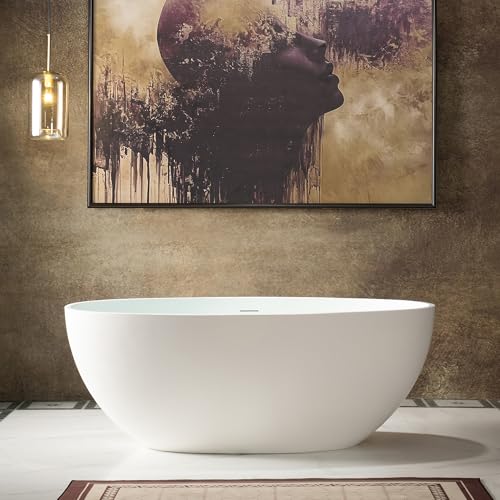
6. WOODBRIDGE 55″ Stone Resin Freestanding Soaking Tub — Best Compact from the Proven Brand
If the BCANHOME is the small-bathroom pick, the WOODBRIDGE 55 is the small-bathroom pick with the established badge: the same integrated slotted overflow, matte solid surface and brand support as the 61-inch leader, in a 55-inch footprint for tighter rooms.
Strengths
- Category-leading brand in a compact 55-inch size
- Integrated slotted overflow and drain, as on the larger models
- Deeper soaking well than the footprint suggests
Trade-offs
- Still a compact soak for tall adults
- Costs more than lesser-known compact rivals
- Freestanding filler is a separate purchase
| Length | 55 inches |
| Material | Stone resin / solid surface |
| Overflow | Integrated slotted, drain included |
| Finish | Matte white |
The choice between this and the BCANHOME 51 is the small-bathroom decision in miniature: four more inches and the proven brand, against the smallest possible footprint. At 55 inches the soak opens up noticeably — the average adult can sit deeper with legs less folded — while the tub still fits bathrooms that reject a 60. WOODBRIDGE’s consistency across its sizes is the quiet argument here: the overflow engineering, the drain package and the surface quality of the flagship are present at 55 inches, which is not true of every brand’s smaller models, where corners get cut first. Measure the room both ways before choosing between the two compact picks: if 55 fits with clearance to clean around it, buy this one and take the brand; if only 51 truly fits, the BCANHOME is the honest answer and its review explains how to buy it well.
Between the two compact picks, one more consideration: resale and renovation timelines. A branded tub reads better in a future bathroom refit or a house listing than an unknown one, and in a small bathroom the tub is a large share of the room’s value. Where the four inches fit, the brand premium is partly an investment in the room, not only in the bath.
Best for: small-to-medium bathrooms wanting brand assurance / Not suited for: the very smallest bathrooms, which need the 51-inch pick
Check on Amazon: WOODBRIDGE 55″ Stone Resin Freestanding Soaking Tub — check the current price on Amazon.
Comparison Table
| Pick | Badge | Key spec | Best for |
|---|---|---|---|
| WOODBRIDGE 61″ Stone Resin Freestanding Soaking Tub | Best Overall | 61 inches | most bathrooms wanting the definitive stone resin oval |
| WOODBRIDGE 67″ Stone Resin Freestanding Soaking Tub | Best for Tall Bathers and Long Soaks | 67 inches | tall bathers and primary bathrooms with space to spare |
| BCANHOME 51″ Stone Resin Freestanding Bathtub | Best for Small Bathrooms | 51 inches | small bathrooms, ensuites and compact apartments |
| MEDUNJESS 65″ Stone Resin Freestanding Tub, Double Slipper | Best Classic Shape | 65 inches | traditional and transitional bathrooms wanting a centrepiece |
| MUIRYN 63″ Stone Resin Freestanding Bathtub | Best Mid-Size Alternative | 63 inches | value-conscious buyers wanting 63 inches and full features |
| WOODBRIDGE 55″ Stone Resin Freestanding Soaking Tub | Best Compact from the Proven Brand | 55 inches | small-to-medium bathrooms wanting brand assurance |
How to Choose a Freestanding Stone Resin Tub
Four decisions, in the order a bathroom imposes them: the room, the bather, the floor, and the plumbing. A beautiful tub that fails any one of them is an expensive ornament.
Size: measure the room, then the bather
Length first: bathers under average height are well served at 55-61 inches; average-to-tall bathers should look at 61-67; the compact 51-inch pick is a deep-seated soak, not a stretch. Then the room: leave clearance to walk and to clean around a freestanding tub — a tub wedged wall-to-wall loses the freestanding point and gains a cleaning nightmare. Measure the delivery route too: door widths, hallway turns, stair landings. The 67-inch WOODBRIDGE is the finest soak here and the most demanding arrival.
The floor: load and level
A filled stone resin tub with a bather is a heavy, concentrated load — lighter than cast iron, far heavier than acrylic. On upper floors, and in older houses, have the joists’ capacity confirmed by a builder before the order; it is a short conversation that prevents an expensive one. The floor must also be level where the tub sits, because a freestanding tub on an unlevel floor rocks, stresses its drain connection and pools its overflow geometry wrong.
Plumbing: drain position and the filler
Freestanding tubs drain through the floor; the drain position relative to your existing waste decides whether installation is a simple connection or a floor-opening project, and it should be settled with a plumber before purchase. The filler is separate: a freestanding floor-mounted filler is the classic pairing (budget for it), a wall-mounted spout works if the tub sits near the wall, and rim-mounted fillers need rim width these slim solid-surface rims generally do not offer.
Shape: oval versus slipper
Ovals are the versatile default: symmetrical, easy to place, easy to enter. Double slippers are furniture: higher, sculptural, made for reclining, and harder to step into for anyone with limited mobility. Choose with the bather’s body in view, not only the room’s photograph.
Matte white and the rest of the bathroom
Every pick here is matte white, which is the material’s native finish and the easiest colour decision in the bathroom: it sits with chrome, black or brass fillers, with tile of any colour, and it hides the minor water marking that gloss white advertises. If your scheme wants a coloured tub, know that you are leaving the mainstream of this category — coloured solid-surface tubs exist but the verified choice thins quickly, and an honest guide would rather tell you that than pad this list with them.
Water capacity and your heater
Large soaking tubs hold a great deal of water, and a tank water heater that serves a household’s showers may not fill a 67-inch tub to a hot depth in one draw. Check your heater’s capacity against the tub’s stated volume — leaving headroom, because the fill is mixed hot and cold — before choosing the largest sizes. Tankless systems sidestep the question. This is the least glamorous check in the guide and the one most likely to decide whether the biggest tubs delight or disappoint on their first evening.
Where the tub sits in the room
Freestanding tubs earn their keep visually when they have air around them: centred on a wall, angled in a corner with space behind, or placed under a window with clearance on all sides. Before ordering, tape the tub’s footprint on the bathroom floor and live with the tape for a day — walk the routes you actually walk, open the door, use the basin. The tape test has saved more bathrooms than any other advice in this guide, and it costs a roll of painter’s tape.
Acrylic, cast iron, stone resin: the three-way honestly
Since the same bathrooms consider all three: acrylic is the light, warm-to-the-touch, budget-friendly shell that flexes slightly and scratches visibly; cast iron is the century-scale enamelled monument that holds heat superbly and demands the most from floors and delivery teams; stone resin sits deliberately between them — denser and more repairable than acrylic, lighter and warmer to the touch than iron, matte where both rivals are gloss. Households that want the freestanding look with the least structural anxiety choose acrylic; those building a forever bathroom with a builder already involved choose between iron’s tradition and stone resin’s modernity, and this guide exists for the second group.
Reading a stone resin listing like an installer
Four lines of any listing deserve your eyes before the photographs get them: the exterior dimensions (length, width, and the height at the rim — and at the raised ends, for slippers), the drain location (centred or offset, because it must meet your waste), the overflow type (integrated slotted or external), and what is in the box (drain included or not). A listing that answers all four cleanly is a listing written by a seller who installs what they sell. A listing that answers none is asking your plumber to discover the answers at pallet-side, which is the most expensive classroom in home improvement.
Living with Matte Solid Surface: Care, Heat and Repairs
Stone resin’s matte finish is its beauty and its one demand. The surface is non-porous and hygienic, but matte finishes show water marks and product residue more visibly than gloss, and they punish abrasive cleaners by polishing shiny patches into the matte. The correct routine is gentle: rinse after use, clean with a soft cloth and a mild, non-abrasive cleaner, and dry the rim where bottles stand. Bath oils and strongly dyed products should be rinsed away rather than left to sit, as with any light-coloured tub.
Heat retention is where the material earns its keep nightly. Thick solid-surface walls absorb the bathwater’s heat and return it slowly, so a soak stays warm markedly longer than in a thin acrylic shell — the difference between topping up the hot tap twice and not at all. Pre-warming the tub with a first fill of warm water on cold days makes the effect stronger still, because the walls start the soak already holding heat.
And the repairability is real. Because the material is uniform through the wall, a scratch or a dull patch can be sanded back through fine grades and the matte finish restored — the same maintenance logic as solid-surface worktops. Keep any care instructions the maker supplies, test any repair in the least visible spot, and a stone resin tub can look new at year ten in a way no coated or enamelled surface can promise.
Children and stone resin deserve one reassuring paragraph: the matte surface is less slippery when wet than gloss acrylic, the thick walls do not flex under a standing child the way thin shells can, and the material tolerates bath toys, bubbles and the general artillery of family bathing. The care rule that matters most in family service is the rinse — dyed bubble baths and bath bombs should be washed out after the fun rather than left to stand overnight on any light-coloured tub.
A final care distinction that saves finishes: the matte surface dislikes two household staples — scouring powders and the green abrasive side of a kitchen sponge. Both work by scratching, and on matte solid surface the scratches read as shiny streaks that catch light exactly where you cleaned hardest. Keep a dedicated soft cloth and a microfibre pad in the bathroom so the wrong tool is never the nearest tool; most finish damage in this category is a crime of proximity, not of intention.
Hard water households will see mineral spotting on the matte finish sooner than gloss households do, because the matte texture holds the eye on deposits. A weekly wipe with a mild bathroom cleaner formulated for the purpose keeps it invisible; left for a season, the same deposits need the maker’s restoration routine. As with the squeegee logic in our bathroom guides, minutes weekly beat hours quarterly, and the matte finish rewards the habit disproportionately.
How to Plan the Installation of a Freestanding Stone Resin Tub
- Before ordering: confirm floor load capacity with a builder if the bathroom is upstairs or the house is older; measure the full delivery route; fix the drain position with a plumber and choose the filler type.
- On delivery: inspect the tub on the pallet before signing — rim, walls, drain and overflow fittings — and photograph any damage. Keep packaging until after the water test.
- Position and level: set the tub in place, level it precisely, and mark the drain alignment before any connection is made permanent.
- Connect and test: connect the drain (flexible connectors ease alignment on freestanding installs), fill the tub, and check every joint dry-eyed before the tub is finally set and sealed at the base if your installer advises it.
- Fit the filler and test its reach: the spout should deliver into the tub’s well without splashing the rim at full flow.
- First use: rinse the tub, fill warm, and let the material take the heat gradually the first time — a habit worth keeping on the coldest days.
None of this is beyond a competent DIYer with plumbing experience, but the combination of weight, floor work and waste connections is why most owners use a plumber for the connection day even when they do the rest themselves. Budget the installation when you budget the tub; a freestanding tub’s true cost is tub plus filler plus fitting, and guides that quote only the first number are how projects surprise people.
Problem: the tub rocks almost imperceptibly → the floor is unlevel at one foot point; do not shim casually — have the installer level it properly, because a rocking tub works its drain joint loose over months. Problem: the filler splashes the far rim → the spout’s reach or flow is mismatched to the tub’s well; an aerator change or a slight reposition solves most cases. Problem: water marks show on the matte rim → they are mineral and product residue, not damage; the mild-cleaner routine in the care section removes them, and a wipe-down habit prevents them.
Common Buying Mistakes
- Believing “stone resin” means stone. It is a mineral-resin solid surface — an excellent material with its own care rules. Buy it for what it is and it will delight you; buy it expecting quarried stone and you will misjudge its weight, care and price all at once.
- Ordering before measuring the route. A 67-inch tub that cannot turn on the stair landing is a return, not a bathtub. Measure doors, turns and the final pivot, not just the bathroom.
- Skipping the floor check. Filled weight plus bather is a serious point load. The builder’s conversation is cheap; joist work after the fact is not.
- Forgetting the filler in the budget. No tub in this guide includes one. A freestanding filler is a significant second purchase, and wall-mounted alternatives need the tub placed to suit them.
- Cleaning matte with abrasives. Scouring a matte solid surface polishes shiny scars into it. Soft cloth, mild cleaner, and the sanding repair route for real damage — never the scouring pad.
- Taping nothing, imagining everything. Photographs lie about scale in both directions. The taped footprint on your own floor, lived with for a day, is the only honest preview of a freestanding tub.
- Choosing size by the room’s empty dimensions. The room will contain a basin, a toilet, a door swing and a person carrying towels. Judge the tub against the working room, not the empty box.
- Placing the tub before the filler decision. A floor-mounted filler needs its own floor position and supply lines; a wall spout needs the tub within its reach. Fix the filler plan first and place the tub to serve it, not the other way around.
- Sealing the base before the water test. Sealant hides leaks beautifully and briefly. Test every joint under a full tub first; seal after, if at all.
- Letting the delivery crew leave before inspection. Five minutes with the pallet open is the cheapest insurance in the entire project; damage found after signature is a negotiation, damage found before it is a replacement.
- Storing the tub outdoors before installation. A matte tub left in weather and site dust arrives at its own installation pre-aged; keep it indoors, covered, until the day.
Final Recommendation
Buy the WOODBRIDGE 61-inch for the definitive stone resin oval, the 67-inch if you are tall and the room allows, the MEDUNJESS double slipper if the tub is the room’s centrepiece, and the compact WOODBRIDGE 55 or BCANHOME 51 if the room is small. The MUIRYN is the value route to 63 inches, bought with an inspector’s eye. Whichever arrives, measure the route, check the floor, and plan the filler before the pallet does. A stone resin tub is one of the few purchases that can still be in daily use, looking as it does today, when everything else in the bathroom has been replaced around it — buy the size and shape your room and your body actually ask for, and it will pay that compliment back for a very long time.
Related guides in this series: Best Solid Surface Freestanding Tubs · Best Acrylic Freestanding Bathtubs · Best Freestanding Iron Tubs · Best Small Freestanding Soaking Tubs · Best Freestanding Tubs For Small Spaces · Best 6ft Soaking Bathtubs
Frequently Asked Questions
Is stone resin the same as real stone?
No. Stone resin is a solid-surface composite of mineral filler and resin, cast in one piece. It mimics stone’s matte look and density while being warmer to the touch, lighter than carved stone or cast iron, and repairable because the material is uniform throughout. It should be bought on those real virtues, not on the name.
How heavy is a stone resin tub, and will my floor take it?
Substantially heavier than acrylic, lighter than cast iron — and the filled weight with a bather is what matters, which is considerable. Ground floors on solid construction rarely raise questions; upper floors and older joists deserve a builder’s confirmation before ordering. Exact weights vary by model, so confirm the figure on the listing for your chosen size.
Does stone resin keep bathwater warm?
Yes — thick solid-surface walls retain heat far better than thin acrylic shells, and a long soak needs fewer hot top-ups. Pre-warming the tub with warm water on cold days strengthens the effect, because the walls begin the soak already warm.
Can scratches be removed from a stone resin tub?
Generally yes, which is one of the material’s signature advantages. Because the surface is the same material all the way through, fine sanding through progressively finer grades can remove scratches and restore the matte finish. Follow the maker’s guidance and test in a discreet area first.
What else do I need to buy with a freestanding tub?
A filler (freestanding floor-mounted, or wall-mounted if the tub sits near a wall), the drain connection hardware your plumber specifies, and possibly floor work if the waste position moves. None of the tubs in this guide include a filler, so budget the installation as part of the purchase.
Stone resin or acrylic: which should I choose?
Stone resin for substance, heat retention, matte looks and repairability, at more weight and cost. Acrylic for light weight, easy handling, gloss finishes and gentler budgets. Both are legitimate; the mistake is buying acrylic while expecting stone resin’s feel, or stone resin while needing acrylic’s weight.
How long does a stone resin tub last?
The material itself is among the longest-lived in the category: a solid-surface tub has no coating to fail and can be re-matte finished by sanding, so its lifespan is set more by fashion and by its fittings than by the shell. Drains and overflow hardware are the wear items; choose tubs whose fittings are standard enough to replace, and the tub can serve for decades.


