Disclosure: airfryerkitchensupply.com is reader-supported. When you buy through links on our site, we may earn an affiliate commission at no extra cost to you.
The best flushing residential toilets are not the strongest toilets money can buy — they are the strongest toilets a home can happily live with. Commercial pressure-assist units flush harder, and nobody wants one roaring beside a bedroom at 2 a.m. Residential duty means a balance struck deliberately: decisive clearance, civilized noise, standard repair parts, a height the whole household can use, and water use that does not punish a septic system or a municipal bill. This guide judges six verified toilets against that residential brief specifically, which is why some picks here differ from the cluster’s raw-power overview.
Two realities shape the residential market. First, the modern gravity toilet has quietly become excellent: swirling rim washes, glazed trapways, and large flush valves mean the best 1.28 GPF residential models clear as reliably as the commercial-adjacent designs, without the vessel, the noise, or the specialized parts. Second, residential also means varied: the same house contains a primary bathroom, a kids’ bathroom, and a guest bath, and the right answer differs by room. The picks below are therefore framed by room and household role, not just by mechanism.
Every pick was cross-checked against this site’the Amazon catalogue data before writing. Where a listing states a feature — a quiet-flush design brief, an included install kit, a certified water rate — the review attributes it to the listing. Where it does not, the review stays silent rather than guessing.
Where to buy
Residential duty is a specific brief: a toilet that flushes hard, runs quietly enough for a hallway bathroom at night, and can be repaired with parts from any hardware store in ten years. Every linked pick below was verified as a complete residential toilet in its listed configuration before it was written up.
- TOTO UltraMax II One-Piece Elongated 1.28 GPF Toilet (Best Overall Residential) — Check the current price on Amazon
- Gerber Avalanche Select Chair Height Elongated 1.28 GPF Toilet (Best Quiet Flush for Homes) — Check the current price on Amazon
- Kohler Santa Rosa One-Piece Compact Elongated 1.28 GPF Toilet (Best Compact for Residential Bathrooms) — Check the current price on Amazon
- WOODBRIDGE T-0018 One-Piece Dual-Flush Toilet (Best Modern One-Piece Value) — Check the current price on Amazon
- Gerber Maxwell Crest Elongated Two-Piece Toilet (Best Budget Residential) — Check the current price on Amazon
- HOROW 17-Inch Two-Piece Dual-Flush Toilet (Best for Tall and Senior Households) — Check the current price on Amazon
In this guide
Quick Picks
TOTO UltraMax II One-Piece Elongated 1.28 GPF Toilet — Best Overall Residential. A seamless one-piece with a glazed, swirling flush and the seat included — the residential ideal of strong, quiet, and nothing to maintain but the cleaning. Check price on Amazon.
Gerber Avalanche Select Chair Height Elongated 1.28 GPF Toilet — Best Quiet Flush for Homes. Gerber’s listing leads with the pairing homes actually want — quiet and powerful — plus a stain-resistant glaze and the install kit in the box. Check price on Amazon.
Kohler Santa Rosa One-Piece Compact Elongated 1.28 GPF Toilet — Best Compact for Residential Bathrooms. Kohler’s compact elongated trick: a full elongated bowl’s comfort and wash in a one-piece body sized for the bathrooms most homes actually have. Check price on Amazon.
WOODBRIDGE T-0018 One-Piece Dual-Flush Toilet — Best Modern One-Piece Value. A clean-lined one-piece with dual flush and a soft-closing seat included — the modern residential look without the flagship-brand commitment. Check price on Amazon.
Gerber Maxwell Crest Elongated Two-Piece Toilet — Best Budget Residential. The homeowner-friendly package: elongated bowl, soft-close seat, and a tool-free install kit with the wax ring included — nothing else to buy to finish the job. Check price on Amazon.
HOROW 17-Inch Two-Piece Dual-Flush Toilet — Best for Tall and Senior Households. A 17-inch chair-height two-piece with dual flush, a soft-close seat, and a listing-stated maximum clearance figure — specified for the households that feel height most. Check price on Amazon.
How These Picks Were Chosen
The residential filter came first: each candidate had to be a complete toilet sold for home installation, in a configuration a homeowner can actually receive and install — no tank-only listings, no commercial flushometer bowls, no RV or marine fixtures wearing residential keywords. That filter quietly removes a surprising share of what a raw search returns, and it is why verification against the catalog mattered more than search rankings.
Within that filter, picks were scored on the four things homeowners actually live with: clearance reliability (the flush must finish the job), acoustic manners (a residential flush should not announce itself through a bedroom wall), serviceability (flappers, fill valves, and seats must be standard parts), and household fit (height, footprint, and styling that suits a home rather than a facility). The six survivors spread across those priorities deliberately, so the final recommendation can route you by the room you are furnishing instead of declaring one winner for every bathroom in the house.
Residential also means honest about who is excluded. Every candidate that turned out to be a commercial flushometer bowl, an RV or marine fixture, a tank or vessel sold alone, or a bidet seat wearing a toilet’s keywords was removed before scoring, however strong its flush claims were. The six reviews below are therefore shorter on spectacle and longer on the thing a home actually needs: complete, installable, serviceable toilets whose listings survived being read to the last line.
The 6 Best Flushing Residential Toilets

TOTO UltraMax II One-Piece Elongated 1.28 GPF Toilet — Best Overall Residential
For the primary bathroom of a home you plan to stay in, the UltraMax II is the residential brief executed without compromise. Its one-piece body removes the tank seam that dates every two-piece bathroom, the CEFIONTECT glaze named in the listing keeps the bowl releasing waste and rinsing clean, and the 1.28 GPF flush is engineered to be decisive at a volume a septic system barely notices. The SS124 SoftClose seat arrives in the box, which sounds minor until you have lived with a seat that does not slam at night.
Strengths
- One-piece body: no seam, no tank joint, and a calmer silhouette for a home bathroom
- Glazed bowl surface reduces the residue that makes residential toilets look tired between cleanings
- SoftClose seat included and WASHLET+ ready, so a future bidet upgrade needs no new toilet
Trade-offs
- One-piece weight makes the set a two-person job and rules out carrying it up stairs alone
- Premium tier within this lineup; the guest bathroom rarely justifies it
- Universal Height is adult-friendly but tall for households where small children are the main users of this bathroom
| Flush volume | 1.28 GPF |
| Bowl shape | Elongated |
| Height | Universal Height |
| Seat | SS124 SoftClose seat included |
| Construction | One-piece |
Residential ownership is measured in years of small moments: the flush that does not wake the house, the bowl that still looks clean on day four, the seat that closes without a bang. The UltraMax II wins this article because it is engineered for exactly those moments while still clearing with genuine authority — the swirling wash and glazed trapway do the work that older toilets needed raw volume to do.
Put the renovation money here if this is the bathroom you use twice a day for the next fifteen years. The two-piece picks below flush nearly as hard and cost the household less commitment, but none of them matches the one-piece’s combination of quiet competence and zero seam maintenance.
Best for: owner-occupied primary bathrooms renovated for the long term / Not suited for: rentals and quick-turn bathrooms where the premium cannot pay itself back
Check on Amazon — check price on Amazon before you order, and confirm the rough-in and configuration on the listing page.
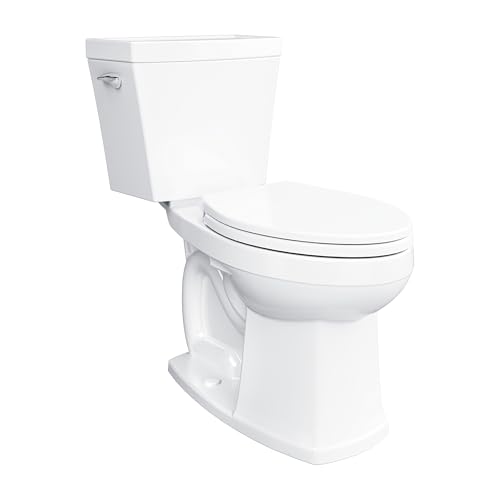
Gerber Avalanche Select Chair Height Elongated 1.28 GPF Toilet — Best Quiet Flush for Homes
The Avalanche Select is the pick for the bathroom whose door opens onto a hallway of sleeping people. Its verified listing describes the flush with the two words that define residential success — quiet and powerful — and backs the ownership side with a stain-resistant glaze, a soft-close seat, and an install kit included in the box. At chair height with an elongated bowl and a WaterSense-certified 1.28 GPF rate, it is specified like a toilet designed by someone who has installed one in their own home.
Strengths
- Listing-described quiet, powerful flush — the acoustic profile a home actually needs
- Install kit and soft-close seat included, so the box contains the whole job
- Stain-resistant glaze helps the bowl stay presentable between cleanings
Trade-offs
- Chair height throughout: wonderful for adults, tall for younger kids using this bathroom daily
- Two-piece format keeps the tank seam that one-piece designs eliminate
- Gerber’s retail presence is thinner than TOTO’s or Kohler’s in some regions, though parts are standard
| Flush volume | 1.28 GPF |
| Bowl shape | Elongated |
| Height | Chair Height |
| Seat | Soft-close seat and install kit included |
| Construction | Two-piece |
Noise is the specification nobody lists and everybody hears. A residential flush happens a few feet from bedrooms, often at night, and a toilet that sounds like a commercial fixture will be resented no matter how well it clears. The Avalanche’s design brief — power delivered quietly — is the correct engineering trade for a home, and the included kit removes the two extra purchases (seat, ring and bolts) that make budget installs stumble.
Choose it for ensuites and hallway bathrooms. Choose the UltraMax II above it when the budget allows the one-piece upgrade, and choose the Champion-style picks in the overview article when the household’s problem is outright clogging rather than everyday refinement.
Best for: ensuites and hallway bathrooms where nighttime noise matters / Not suited for: households whose primary problem is chronic clogging rather than refinement
Check on Amazon — check price on Amazon before you order, and confirm the rough-in and configuration on the listing page.

Kohler Santa Rosa One-Piece Compact Elongated 1.28 GPF Toilet — Best Compact for Residential Bathrooms
Most residential bathrooms are not the sprawling suites in renovation photos, and the Santa Rosa is Kohler’s answer to the real floor plans: a one-piece toilet with a compact elongated bowl that keeps elongated seating comfort and bowl-wash geometry while taking less of the room. The verified listing names its Revolution 360 swirl flushing technology — water that enters the bowl in a full swirling sweep — at an efficient 1.28 GPF.
Strengths
- Compact elongated format fits smaller residential bathrooms without dropping to a round bowl
- Swirling flush technology washes the full bowl circumference as it clears
- One-piece body with a right-hand lever in a clean, condo-friendly silhouette
Trade-offs
- The listing configuration is the right-hand lever version; confirm lever side against your bathroom’s layout
- Compact bowls trade a little seating depth for their footprint — taller users should sit before committing to two
- Seat inclusion varies by configuration; verify on the listing before ordering
| Flush volume | 1.28 GPF |
| Bowl shape | Compact elongated |
| Flush system | Revolution 360, per listing |
| Lever | Right-hand |
| Construction | One-piece |
The Santa Rosa’s residential logic is space honesty. A standard elongated one-piece can crowd a 5-by-8 bathroom until knees meet the tub; the compact format returns those inches while keeping the flush and the seat adult-sized. For condos, older homes with small original bathrooms, and primary baths in modest floor plans, that is not a compromise pick — it is the correct pick.
Its swirl flush also suits residential duty: the full-circumference wash is what keeps a bowl looking clean in a home where the toilet is scrubbed weekly, not daily. Pair that with the one-piece body’s easy exterior and the Santa Rosa becomes the low-maintenance heart of a small bathroom.
Best for: condos and smaller primary bathrooms that still want elongated comfort / Not suited for: large bathrooms where a full-size one-piece costs nothing in space
Check on Amazon — check price on Amazon before you order, and confirm the rough-in and configuration on the listing page.
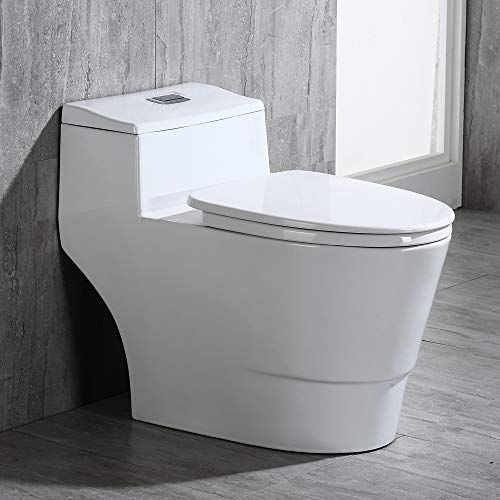
WOODBRIDGE T-0018 One-Piece Dual-Flush Toilet — Best Modern One-Piece Value
WOODBRIDGE built its name on giving remodelers the modern one-piece silhouette at a direct-to-consumer tier, and this T-0018 configuration shows the formula: elongated bowl, dual flush at 1.0 and 1.6 GPF, and a soft-closing seat in the box. For a home remodel where the bathroom must look current — flat planes, no exposed trapway fuss — it delivers the aesthetic that used to require a flagship budget.
Strengths
- Dual flush lets the household spend 1.0 GPF on liquids and reserve 1.6 for solids
- Soft-closing seat included, matching the one-piece modern brief out of the box
- Clean one-piece profile suits contemporary residential design better than plumber-channel styling
Trade-offs
- Top-button dual flush is a habit change for lever households, and guests will guess wrong occasionally
- Brand service network is online-first; plan on ordering parts rather than finding them on a local shelf
- One-piece handling weight applies, as with every one-piece pick
| Flush volume | Dual flush 1.0/1.6 GPF |
| Bowl shape | Elongated |
| Seat | Soft-closing seat included |
| Construction | One-piece |
The honest question with value one-pieces is longevity of support, and the residential answer is nuanced: the wear parts that matter — the dual-flush valve assembly and fill valve — are the service items, and buyers should confirm parts availability for the model when they register the purchase. The porcelain itself, like all vitreous china here, will outlast the bathroom around it.
As a flushing toilet, the 1.6 full flush gives it genuine clearance headroom, and the 1.0 light flush suits the liquid-heavy pattern of a home bathroom, where most flushes are light duty. In a style-led remodel of a guest or primary bath, it is the pick that lets the budget flow to tile and glass without installing a weak toilet as the price.
Best for: style-led home remodels that need a modern one-piece at a controlled tier / Not suited for: buyers who want a walk-in local parts shelf for every component
Check on Amazon — check price on Amazon before you order, and confirm the rough-in and configuration on the listing page.

Gerber Maxwell Crest Elongated Two-Piece Toilet — Best Budget Residential
The Maxwell Crest elongated is the residential budget pick done properly. Gerber’s listing bundles the things first-time installers forget — a tool-free install kit with the wax ring — with a soft-close seat and a glazed trapway the listing credits with preventing clogs. It is a two-piece elongated toilet specified so that a homeowner with a wrench and an hour can remove the old toilet and finish with this one, in one trip, with no second hardware run.
Strengths
- Install kit with wax ring included removes the classic mid-job hardware-store run
- Glazed trapway, per the listing, resists the snagging that turns into repeat clogs
- Soft-close seat included at a budget tier where seats are often sold separately
Trade-offs
- The listing does not headline a flush-volume figure; confirm the current listing’s water rate if that number drives your decision
- Two-piece styling is plain and functional rather than design-led
- Budget tier means fewer refinements — no specialty glaze or bidet-ready channel is claimed
| Bowl shape | Elongated |
| Seat | Soft-close seat included |
| Install | Tool-free install kit with wax ring included |
| Construction | Two-piece |
Budget residential picks fail in two ways: they flush weakly, or they nickel-and-dime the install until the savings evaporate. The Maxwell Crest avoids both traps — the flush brief is efficiency with a glazed trapway, and the box contains the installation. For a first home, a rental you maintain yourself, or the kids’ bathroom that needs competence rather than luxury, this is the rational spend.
It also makes a sensible landlord standard: one model across several units means one set of spare parts on your shelf and one install you can do in your sleep. Standardize on it and the whole portfolio’s toilet maintenance becomes a solved problem.
Best for: first homes, self-maintained rentals, and second bathrooms / Not suited for: the showcase primary bathroom, where the one-piece picks justify themselves
Check on Amazon — check price on Amazon before you order, and confirm the rough-in and configuration on the listing page.

HOROW 17-Inch Two-Piece Dual-Flush Toilet — Best for Tall and Senior Households
Height is a residential feature with a human face: for tall adults, older parents, and anyone whose knees file complaints, a 17-inch chair-height bowl turns the toilet from furniture you negotiate with into furniture that helps. The HOROW two-piece pairs that height with dual flush at 1.1 and 1.6 GPF, a soft-close seat, a standard 12-inch rough-in, and a listing that states a MAP 1000g clearance figure — the top grade in that test protocol — for its flush.
Strengths
- 17-inch comfort height eases sitting and standing for tall and senior users
- Dual flush matches water to the load, with the full 1.6 GPF behind solids
- Soft-close seat included and a standard 12-inch rough-in keeps installation ordinary
Trade-offs
- Chair height is genuinely tall for children and shorter adults who use the same bathroom
- Two-piece format at this height makes the tank stack visually prominent in a small room
- Listing-stated clearance figures are laboratory results; your drain line still has the final word
| Flush volume | Dual flush 1.1/1.6 GPF |
| Bowl shape | Elongated |
| Height | 17-inch comfort height |
| Rough-in | 12 inch |
| Seat | Soft-close seat included |
| Construction | Two-piece |
The residential case for this pick is a household composition, not a specification sheet. If the home includes aging parents, a tall teenager, or an adult recovering from a knee or hip procedure, the extra height is used and appreciated at every single visit, while the dual flush quietly keeps the water rate honest across the day’s mostly-light use.
Pair it with grab-bar planning and a night-light and you have the bathroom that lets people age in place gracefully. If the household is young children and shorter adults, the standard-height picks elsewhere in this cluster will fit better — height is the one specification that should be matched to bodies, not bought by default.
Best for: households with tall adults, seniors, or mobility considerations / Not suited for: homes where small children are the primary users of this bathroom
Check on Amazon — check price on Amazon before you order, and confirm the rough-in and configuration on the listing page.
Comparison Table
| Pick | Badge | Key spec | Best for |
|---|---|---|---|
| TOTO UltraMax II One-Piece Elongated 1.28 GPF Toilet | Best Overall Residential | 1.28 GPF, one-piece, CEFIONTECT glaze | The primary bathroom you renovate once |
| Gerber Avalanche Select Chair Height Elongated 1.28 GPF Toilet | Best Quiet Flush for Homes | 1.28 GPF WaterSense, chair height, install kit included | Hallway and ensuite bathrooms near bedrooms |
| Kohler Santa Rosa One-Piece Compact Elongated 1.28 GPF Toilet | Best Compact for Residential Bathrooms | 1.28 GPF, compact elongated, one-piece | Smaller primary bathrooms and condos |
| WOODBRIDGE T-0018 One-Piece Dual-Flush Toilet | Best Modern One-Piece Value | Dual flush 1.0/1.6 GPF, one-piece, seat included | Style-led home remodels on a controlled budget |
| Gerber Maxwell Crest Elongated Two-Piece Toilet | Best Budget Residential | Elongated two-piece, tool-free install kit included | First homes, rentals you own, and second bathrooms |
| HOROW 17-Inch Two-Piece Dual-Flush Toilet | Best for Tall and Senior Households | Dual flush 1.1/1.6 GPF, 17-inch height, 12-inch rough-in | Homes where sitting down and standing up should be easy |
How to Choose a Residential Toilet: The Homeowner’s Criteria
Begin with the room’s role. A primary ensuite wants quiet manners, a bowl that stays clean, and a silhouette you enjoy looking at — the one-piece picks. A kids’ bathroom wants standard height, indestructible simplicity, and a seat that cannot slam — the two-piece value picks. A guest bath wants to look intentional for a weekend and then be ignored — the compact and modern picks. Residential choosing fails when one specification, usually flush power, is asked to answer every room’s different question.
Then weigh serviceability, the criterion renters never think about and owners always end up paying for. Every toilet in this guide uses broadly standard wear parts, but the two-piece formats remain the easiest to service: tanks open fully, valves swap in minutes, and any plumber — or confident homeowner — can restore one to new behavior with commodity parts. That is a genuine residential virtue, and it is why this article keeps three two-piece picks in a six-pick lineup despite the one-piece aesthetic advantage.
Noise: the unwritten residential specification
No listing in this category prints a decibel figure, so judge noise by mechanism. Gravity flushes with well-designed rim wash are the quiet residential default. Pressure-assist is the loud exception, justified on problem drain lines rather than in ordinary homes. Dual-flush valves add a small mechanical vocabulary of clicks. If the bathroom shares a wall with a bedroom, weight this paragraph as heavily as any clearance figure.
Water Rates for Homes: Septic, Municipal, and the 1.28 Settlement
Residential water math differs by house. On a municipal supply, the difference between 1.28 and 1.6 GPF across a family’s daily flushes is real but modest money. On a septic system, every gallon flushed is a gallon the tank and drain field must process, and lower rates genuinely extend the system’s comfortable life — which is why the efficient picks lead this article. Well-water homes sit between: volume matters less than the pump cycles it causes.
The market has effectively settled at 1.28 GPF as the residential default, with dual-flush models offering a lighter rate for liquids. The full-volume 1.6 GPF format survives for specific houses — long drain runs, marginal slopes, hard-earned distrust — and this cluster’s dedicated 1.6 GPF article treats that case on its merits. For the typical home on typical plumbing, buy the engineering, not the volume.
Heights and Households: Matching the Toilet to the People
Chair-height bowls, around 17 inches and up before the seat, are now the residential mainstream because adult bodies prefer them. Universal-height models sit in the same family. Standard-height bowls, a couple of inches lower, remain the right answer where children are the main users or where shorter adults find chair height leaves their feet dangling — an underrated comfort and stability issue. The HOROW pick in this article serves the tall end of the household; the value two-pieces serve mixed households; the correct move is to measure the current toilet your family likes and buy that height again.
While measuring, confirm the residential basics: 12-inch rough-in is standard but not universal, elongated bowls need their extra inches of room, and the shut-off valve behind your current toilet should be exercised before installation day — a valve that has not moved in a decade sometimes chooses installation day to fail, and that is a plumbing call, not a toilet problem.
- Match seat height to the household’s actual bodies, not the showroom default
- Prefer included install kits and seats at budget tiers — they prevent the second trip
- On septic, weight the efficient and dual-flush picks more heavily
- Exercise the shut-off valve a week before installation day
How to Install a Residential Toilet Without a Callback
A residential install is a Saturday-morning job with the right sequence and a miserable one without it. The steps below assume a standard 12-inch rough-in floor flange and a working shut-off valve — verify both before the old toilet comes out, because both are much easier to address while the bathroom still works.
- Measure the rough-in and the room, confirm the new toilet’s configuration matches, and stage the new toilet, its included kit, a sponge, and towels in the bathroom.
- Close the shut-off valve, flush to empty the tank, and sponge out the remainder; disconnect the supply line over a towel.
- Remove the bolt caps and nuts, rock the old toilet gently to break the wax seal, and lift it straight off the flange.
- Plug the drain temporarily with a rag, scrape the flange to clean porcelain-free metal or plastic, and check the flange is not cracked or sitting below floor level.
- Dry-fit the new bowl to confirm it sits level and stable; shim only with toilet-rated shims if the floor demands it, then lift it off again.
- Press the new wax ring onto the flange (or fit the kit’s ring as its instructions direct), remove the rag, and lower the bowl straight down in one motion.
- Snug the flange bolts alternately, connect the supply, and open the valve slowly while watching every joint for the first fill.
- Set the tank parts per the manual, adjust the water level to the marked line, and fit the seat.
- Flush five times across ten minutes, checking the base perimeter and supply joints each time; a dry tissue wiped around the base seam reveals weeps your eyes miss.
Live with the toilet for a week before caulking around the base, and if you caulk, leave the back edge open — a hidden leak should announce itself on the floor, not rot silently under a sealed base. Keep the model’s manual and a note of its flapper and fill-valve type in the house file; future you will be grateful.
Common Buying Mistakes
Buying commercial muscle for a residential room. Pressure-assist and flushometer designs flush ferociously and sound like it, need specialized parts, and solve problems most homes do not have. Residential excellence is power with manners.
Defaulting every bathroom to chair height. Height should follow the household. A chair-height toilet in the kids’ bathroom trades their stability for a specification nobody in that room requested.
Forgetting the septic system in the math. On septic, flush volume is system load. Efficient and dual-flush picks are not eco-decoration in a septic home; they are capacity management.
Caulking the base shut immediately. A fully sealed base hides flange leaks until the subfloor pays for them. Leave the back open, or skip base caulk where your code allows.
Throwing away the manual and parts numbers. The flapper and valve your toilet needs in year six are identified in the paperwork you recycled in week one. Photograph the parts page and keep it with the house records.
Final Recommendation
For most homes, the shortlist resolves by room: the UltraMax II for the primary bathroom you are keeping, the Avalanche Select where quiet matters, the Santa Rosa where space is tight, the WOODBRIDGE where the remodel’s look leads, the Maxwell Crest where the budget leads, and the HOROW where the household’s bodies ask for height. Every one of them flushes with genuine authority — the residential question is never whether they clear, but which set of manners your house needs around that clearance.
If your home’s defining constraint is different — a round bowl for a small room, a skirted body for easier cleaning, or an old drain line that defeats ordinary toilets — the sibling articles in this cluster re-run the analysis for exactly those houses.
Best Flushing Toilets Best Flushing Toilets For Home Best Flushing Toilets For Old Plumbing Best Flushing Skirted Toilets Best Flushing Toilets 1.6 Gpf
The Residential Flush, Room by Room
A home is not one bathroom repeated; it is a small system of rooms with different physics and different politics. The primary ensuite wants the flush to be an event nobody in the bed notices — which is why glazed one-piece designs with composed, swirling washes lead this article. The family bathroom wants throughput and forgiveness: multiple users, imperfect aim, a cleaning rhythm measured in weeks, and a flush that never becomes a family story. The guest bathroom wants to make a brief, good impression and then be ignored for months, which rewards simple, complete packages over exotic mechanisms that sit idle and stiffen.
The powder room deserves its own paragraph because it is the most judged and least used toilet in the house. Its flush will be evaluated by guests in thirty seconds, and its tank internals will sit unused between weekends. Simple gravity mechanisms with standard parts are the correct engineering for intermittent duty, and a soft-close seat does more for the room’s impression than any flush specification. Match the toilet to the room’s actual duty cycle and the whole house’s plumbing stops generating complaints.
Basement and below-grade bathrooms are the residential exception that proves the rule: where the toilet sits below the main drain’s easy reach, standard gravity fixtures still rule most homes, but any history of backup in that room is a drainage diagnosis to have before choosing the fixture, exactly as the old-plumbing article in this cluster prescribes.
The rental within the home
Accessory units, in-law suites, and basement apartments inside a home inherit the residential brief with a landlord’s twist: the user is not the owner, and every service call is a scheduling event. Standardize those rooms on the two-piece value picks, keep one spare flapper and fill valve per model in the house, and the suite’s toilet becomes the least interesting — and therefore best — fixture in the building.
Residential Water Stewardship Without the Lecture
Homes sit on three different water realities, and residential choosing should name which one is yours. Municipal homes pay for volume directly; for them the efficient picks in this guide return their small premium in saved water across thousands of flushes, without any sacrifice in clearance that a modern drain can detect. Septic homes treat volume as system capacity: every gallon flushed is a gallon the tank must settle and the field must absorb, and a household that has already stretched a septic system with additions and extra occupants should weight the 1.28 and dual-flush picks as infrastructure decisions, not preferences.
Well homes occupy the thoughtful middle: the water is not metered, but every flush is pump work and pressure-tank cycles, and a house on a marginal well feels a wasteful toilet in its pressure switch long before it sees a bill. For all three realities, the modern settlement this article reflects — engineered 1.28 as the default, dual flush where habits support it, full volume reserved for the lines that demand it — is less an environmental position than an accurate map of where the engineering now stands.
What stewardship never requires is a weak flush. A toilet that needs two flushes uses more water than a decisive one at any volume, and a toilet that clogs teaches a household to fear it. The greenest residential toilet is the one that clears once, every time, at the lowest rate its drain line allows — which is a per-house answer, and why this guide refuses to give a single number as a universal verdict.
- Municipal: efficient picks repay themselves across thousands of flushes
- Septic: treat flush volume as system capacity, not just consumption
- Well: volume is pump cycles — waste shows up as wear, not a bill
- A decisive 1.28 flush uses less water than a weak 1.6 flushed twice
Residential Comfort Details Nobody Puts in the Headline
Beyond the flush, three residential details decide whether a toilet is loved or merely used, and none of them photograph well. The first is seat ergonomics over years: a seat’s shape, its hinge stability, and whether it can be removed for the deep clean determine the daily experience far more than the tank’s silhouette, which is why this guide’s reviews keep returning to which picks include a proper soft-close seat and which leave the seat to chance. The second is tank stability: a two-piece tank that rocks a millimeter at every flush is a leak rehearsing, and the residential installer who snugs the tank bolts evenly and re-checks them after the first week has prevented the most common callback in the category.
The third is the sound of the refill, the flush’s forgotten second half. A residential toilet speaks twice per use — the flush and the refill — and a fill valve that whistles, hammers, or drones for a full minute taxes a household’s patience out of all proportion to its mechanical innocence. Modern fill valves in the platforms chosen here are quiet by design, but the homeowner’s part matters too: a partially closed shut-off valve, opened fully, silences more refill complaints than any part swap. Judge a residential toilet with your ears at both ends of the cycle.
These details share a moral: residential quality is the accumulation of small correct things, sustained over years, in a fixture nobody wants to think about. The picks in this guide were chosen by people who thought about them so the household does not have to.
A Note on Residential Finishes and Hardware Matching
Residential bathrooms accumulate finishes over decades — a chrome faucet from one era, a brushed handle from another — and the toilet sits in the middle of that archaeology, wearing the room’s most permanent finish decision. The picks in this guide are predominantly white, with the warm beige-tone options appearing where the verified configurations offer them, and the residential rule is simple: the toilet should match the tub and the sink, the two fixtures it will be compared against at every glance, and it should be allowed to ignore the faucet metals entirely, because porcelain-to-porcelain mismatch is visible while porcelain-to-metal contrast is just design.
Lever finishes deserve their one sentence: a chrome lever on a white toilet in a brushed-nickel room is a detail nobody has ever noticed, and buyers should spend exactly zero anxiety on it. Spend the anxiety where this guide has spent its words — on the flush, the height, the seat, and the parts shelf — and the residential bathroom will reward the priorities in the right order.
Frequently Asked Questions
What is the best flushing toilet for a typical home?
For a typical primary bathroom, a modern 1.28 GPF gravity toilet with a glazed trapway and an energetic rim wash — the UltraMax II or the Drake platform in the overview article — gives decisive clearance with quiet manners and standard parts. Typical homes do not need commercial-style pressure systems.
Are residential toilets different from commercial toilets?
Yes, in mechanism and manners. Commercial toilets often use flushometer valves or pressure-assist vessels for raw power in high-traffic settings. Residential toilets use tank gravity, flush more quietly, use standard repair parts, and are styled and sized for homes. This guide only includes genuine residential models.
Which toilet height is right for my household?
Chair height, around 17 inches and above, suits most adults and is a genuine help for tall users and anyone with knee or hip issues. Standard height suits children and shorter adults better. Measure the toilet your household currently finds comfortable and match that height when you replace it.
Is dual flush worth it in a home?
It is worth it when the household will actually use the light flush, which in most homes is the majority of flushes. On municipal water the savings are modest; on septic, the reduced load is a real benefit. The mechanism adds one more part that can eventually need service, so weigh it honestly.
How long should a residential toilet last?
The porcelain body lasts decades. The wear parts — flapper, fill valve, flush valve seals — typically need attention every five to ten years depending on water quality, and they are inexpensive and standardized on the picks in this guide. A toilet that ‘flushes weakly’ at year eight usually needs a flapper and a fill-level adjustment, not a replacement.
Can I install a residential toilet myself?
Most homeowners can: the job is unbolting, a wax ring, and reconnecting one water line, and picks with included install kits make it friendlier still. The exceptions are a damaged flange, a non-standard rough-in, or a shut-off valve that will not close — those three discoveries justify a plumber.
Which toilet should a home have if it can only standardize on one model?
A two-piece 1.28 GPF platform with a glazed trapway and an included seat — the Drake-class pick in this cluster’s overview — because it balances clearance, serviceability, and household fit across the widest range of rooms. Standardizing buys you one spare-parts shelf and one install you can do from memory.
Do residential toilets need a wax ring or a silicone ring?
Both work when installed correctly. Wax is the traditional, forgiving choice and is what most included install kits assume; reusable silicone rings tolerate repositioning during the set, which helps first-time installers. The seal’s enemy is a rocking toilet, not the ring material — a level, stable set matters more than the choice.


