Disclosure: airfryerkitchensupply.com is reader-supported. When you buy through links on our site, we may earn an affiliate commission at no extra cost to you.
Where to buy
The best flushing new toilets in this guide are new-generation models: current flushing technologies — tornado and tornado-style bowl wash, tankless smart flushing, foam-shield smart systems, pressure-assist at 1.0 gpf, ultra-low dual flush — rather than last decade’s gravity designs in fresh packaging. Every pick was verified against its exact model title before linking, and any performance figure printed appears in the manufacturer’s own listing.
- TOTO Drake Transitional Two-Piece Toilet, CST786CEFG#01 — check price on Amazon
- EPLO U8MAX Smart Toilet (E18MAX line) — check price on Amazon
- HOROW T30 Tankless Bidet Toilet — check price on Amazon
- Kohler Leap One-Piece Smart Toilet — check price on Amazon
- Los Flexi Pressure Assisted Two-Piece Toilet, 1.0 GPF — check price on Amazon
- VORTEXTOVE W2111 One-Piece Elongated Toilet — check price on Amazon
The best flushing new toilets are defined by what has actually changed in toilet engineering over the last product generation. Four things have: bowl wash has gone rotational (tornado and swirl systems that wash the whole bowl), flushing has gone electronic in the smart segment (tankless designs with stated 1000g MaP figures and foam shields), pressure-assist has reached a frugal 1.0 gpf, and dual-flush volumes have dropped below 0.9 gallons on the reduced setting. This guide compares six verified new-generation models, one per direction the technology has moved, so ‘new’ is a specification you can check rather than a launch date you must trust.
That framing is deliberate. Toilet model years are marketing fiction — a design can be sold as new for a decade — so this guide admits a model on its technology generation, not its birthday. A gravity toilet with a genuinely new bowl-wash system qualifies; a conventional toilet with a new colour does not. Every pick below states its generation-defining feature in its own verified listing, and where a listing publishes a flush-test figure, it is quoted as the manufacturer’s claim, labelled as such.
In this guide
Quick Picks — the best flushing new toilets
Best New-Generation Gravity: TOTO Drake Transitional Two-Piece Toilet, CST786CEFG#01 — The new gravity benchmark: TOTO’s TORNADO FLUSH rimless-style wash and CEFIONTECT glaze in the Drake line’s transitional two-piece body at 1.28 gpf. Check price on Amazon.
Best New Smart System: EPLO U8MAX Smart Toilet (E18MAX line) — The new smart formula in one listing: a stated 1000G MaP flush, a foam shield that pre-coats the bowl, auto open/close and auto flush in a one-piece with a built-in tank. Check price on Amazon.
Best New Tankless Design: HOROW T30 Tankless Bidet Toilet — Tankless without the electronics: a non-electric bidet toilet whose listing states a MaP 1000g flush, in a one-piece body with no tank at all. Check price on Amazon.
Best New Premium Smart: Kohler Leap One-Piece Smart Toilet — Kohler’s new-generation intelligent entry: a one-piece elongated smart toilet with built-in bidet and dual-flush, wearing the badge the cautious smart buyer wants. Check price on Amazon.
Best New Pressure-Assist: Los Flexi Pressure Assisted Two-Piece Toilet, 1.0 GPF — Pressure-assist grows up: commercial clearing force at just 1.0 gpf, in an ADA elongated two-piece with an 18.8-inch comfort tall height. Check price on Amazon.
Best New Ultra-Low-Water Design: VORTEXTOVE W2111 One-Piece Elongated Toilet — The water-frugal frontier: a dual flush whose reduced setting is 0.8 gpf, in a compact one-piece with a quick-release soft-close seat. Check price on Amazon.
How These Picks Were Chosen
Candidates were searched through the airfry site’s Amazon listing data and screened for generation: the returned title had to state a current-generation technology — TORNADO FLUSH, a smart or tankless system with a stated MaP figure, pressure-assist at 1.0 gpf, or an ultra-low dual-flush pairing. Conventional gravity models, however excellent, were held for other guides in this programme; this one is reserved for what is genuinely new under the lid.
The six picks map the new landscape without overlap: TOTO’s Drake Transitional as the new-generation gravity benchmark, EPLO’s U8MAX and HOROW’s T30 for the smart and tankless directions, Kohler’s Leap as the premium brand’s new intelligent entry, Los Flexi’s 1.0 gpf pressure-assist for the power direction, and VORTEXTOVE’s 0.8/1.28 dual flush for the ultra-low-water direction. Prices are never printed; tiers are described in words, and figures quoted are the listings’ own.
The 6 Best Flushing New Toilets, Reviewed

TOTO Drake Transitional Two-Piece Toilet, CST786CEFG#01 — Best New-Generation Gravity
The Drake name is old; this Drake is not. The Transitional model carries TOTO’s current-generation package: TORNADO FLUSH, which drives water in a powerful rotational wash from rimless-style jets, and CEFIONTECT, the ultra-smooth glaze that gives waste less to grip. Together they are the modern answer to the oldest toilet complaint — a bowl that stays clean — achieved with water movement and surface science rather than volume, at an efficient 1.28 gpf in a Universal Height elongated two-piece. It suits households that want the newest flushing technology in a conventional, serviceable format. Buyers wanting electronics should look at the smart picks; buyers wanting the smartest gravity toilet of its generation should stop here.
Strengths
- TORNADO FLUSH rotational bowl wash — the current TOTO generation
- CEFIONTECT glaze resists waste adhesion between flushes
- Conventional two-piece format: serviceable anywhere, by anyone
Trade-offs
- Two-piece body lacks the seamless look of one-piece rivals
- New-generation TOTO pricing sits at the premium end of two-piece
- Seat specification should be confirmed on the listing before ordering
| Format | Two-piece, elongated |
| Flush system | TORNADO FLUSH (per listing) |
| Glaze | CEFIONTECT (per listing) |
| Rating | 1.28 gpf, Universal Height (per listing) |
Rotational washing changes what a flush is for. A conventional flush evacuates; a tornado flush evacuates and scrubs, sending water around the full bowl circumference with enough energy to carry the surface clean. Add a glaze engineered at the nanoscale to be smoother than conventional ceramic, and the compounding effect is a bowl that needs the brush as an occasional courtesy rather than a weekly necessity. That is the real product of the new generation: not more power, but less residue.
The Drake’s other virtue is where the technology lives — in a mainstream two-piece that any plumber can install and service with TOTO’s deep parts network. New-generation flushing does not have to mean electronics, apps or outlets, and for many households the correct ‘new toilet’ is exactly this: the newest bowl science in the most conventional possible furniture. If that sentence describes your renovation, the search ends at this pick.
Best for: Households wanting current-generation bowl science in a conventional two-piece / Not suited for: Buyers seeking smart features, bidet functions or a one-piece silhouette
Check the current price on Amazon

EPLO U8MAX Smart Toilet (E18MAX line) — Best New Smart System
The U8MAX represents the smart segment’s current spec sheet. Its listing states a 1000G MaP flush — the top band of the bulk-flush test, as published by the manufacturer — and adds the feature that marks the newest generation of smart toilets: a foam shield, which lays a layer of foam on the water to suppress splashing, odour and adhesion before use. Around that core sit auto open and close, auto flush, a heated seat and a moving dryer, in an ADA chair-height one-piece with a built-in tank. It suits primary suites being built around a smart fixture. It needs power, and its electronic richness is a deliberate trade against the gravity picks’ simplicity.
Strengths
- 1000G MaP flush figure stated in the manufacturer’s listing
- Foam shield — the newest smart-toilet hygiene feature
- Auto open/close, auto flush, heated seat and dryer in one fixture
Trade-offs
- Requires a power outlet and brings electronics’ service horizon
- Smart-segment pricing — a different tier from gravity toilets
- Feature depth means a learning curve for guests and grandparents
| Format | One-piece, elongated, smart |
| Flush figure | 1000G MaP (per listing) |
| Signature feature | Foam shield (per listing) |
| Height | ADA chair height (per listing) |
The foam shield deserves its headline. Smart toilets spent a generation adding washlets and warm seats; the foam layer is the first feature that improves the flush event itself — cushioning impact, trapping odour at the surface and making the bowl harder for waste to stick to, so the stated MaP power starts from a cleaner position. Combined with auto flushing that never forgets and a lid that opens on approach, the U8MAX is the fullest expression of what ‘new’ means in this category right now.
Buy it as a system with its requirements understood: a GFCI outlet within reach, a household comfortable with remotes and settings, and acceptance that electronic fixtures carry a service horizon gravity toilets do not. Within the smart brief, its specification is the most complete in this guide at its tier — the Kohler Leap below is the premium-brand alternative, and the choice between them is brand ecosystem versus feature density per pound.
Best for: Smart-home primary suites wanting the newest hygiene features and auto everything / Not suited for: Buyers without nearby power, or anyone prioritising mechanical simplicity
Check the current price on Amazon
HOROW T30 Tankless Bidet Toilet — Best New Tankless Design
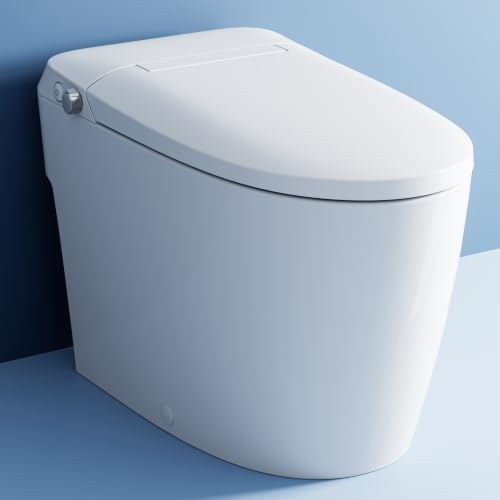
The T30 is the contrarian of the new generation: it takes the tankless silhouette — no tank, a low one-piece profile — and pairs it with a non-electric bidet and a flush its listing states at MaP 1000g. Where the smart picks pursue newness through electronics, HOROW pursues it through plumbing: direct-pressure flushing energy without a stored tank, and bidet cleansing that needs no outlet. It suits bathrooms without power near the toilet that still want the new tankless look and a stated flush figure, on a standard 12-inch rough-in. Buyers wanting heated seats, dryers and automation should take the EPLO or Kohler smart picks instead — this model’s newness is deliberately analogue.
Strengths
- Tankless one-piece profile with no visible tank
- MaP 1000g flush figure stated in the listing
- Non-electric bidet — no outlet required for its features
Trade-offs
- Non-electric bidet means unheated water and no dryer
- Tankless flushing depends on your home’s water pressure
- Less common format — confirm parts support before committing
| Format | One-piece, tankless |
| Flush figure | MaP 1000g (per listing) |
| Bidet | Non-electric (per listing) |
| Rough-in | 12 in (per listing) |
Tankless design is more than a look. Removing the tank removes the refill wait between flushes, the tank’s condensation and seams, and a gallonage of stored water sitting above your floor — and it gives the bathroom a low, continuous profile that reads as the newest thing in the room. The engineering price is dependence on supply pressure: a tankless flush draws its energy from the line, so homes with weak pressure should verify theirs before choosing this direction, a check your plumber can do in minutes.
The non-electric bidet is the same philosophy applied to cleansing: water-powered, always available, nothing to plug in or programme. It will not warm the water or dry you afterwards, and this guide will not pretend otherwise. What it offers is the new generation’s silhouette and stated flush power with a mechanical soul — the pick for buyers who want their toilet new in its plumbing, not in its software.
Best for: Bathrooms without nearby power wanting tankless design and a stated flush figure / Not suited for: Buyers wanting heated, automated smart features
Check the current price on Amazon

Kohler Leap One-Piece Smart Toilet — Best New Premium Smart
Every new technology segment has a moment when the premium legacy brand’s entry becomes the safe way to buy it, and the Leap is that moment for smart toilets in this guide. It is Kohler’s current one-piece intelligent model: elongated, with a built-in bidet, dual-flush efficiency and the brand’s Quiet-Close seat technology. Where the EPLO competes on feature density, the Leap competes on ecosystem — Kohler’s parts, service and design coherence for buyers who intend to keep the fixture for a very long time. It suits primary suites in brand-loyal renovations. It is a premium-tier purchase, and like all smart toilets it needs power at the fixture.
Strengths
- Kohler’s current intelligent platform with built-in bidet
- Dual-flush efficiency with Quiet-Close seat technology
- Legacy brand parts and service behind a smart fixture
Trade-offs
- Premium-tier pricing, above the feature-led smart rivals
- Requires a power outlet at the toilet
- Feature set is curated rather than maximal — spec-sheet shoppers may prefer EPLO
| Format | One-piece, elongated, smart |
| Flush system | Dual-flush (per listing) |
| Bidet | Built in (per listing) |
| Seat | Quiet-Close (per listing) |
The Leap’s argument is about the second decade. Smart toilets concentrate electronics in a wet room; the question is never whether they delight in year one but who answers in year nine. Kohler’s answer — a national service network and a parts catalogue with a long memory — is the substance beneath this model’s premium. Its dual-flush core keeps the water brief modern, and the integrated bidet removes the add-on seat compromises that date so quickly.
Position it honestly against the EPLO U8MAX: the EPLO’s listing states more — a MaP figure, a foam shield, a longer feature roll — while the Leap offers the brand, the design restraint and the ecosystem. Neither is the ‘correct’ smart toilet; they are the segment’s two philosophies, innovation-led and institution-led. Buyers who keep fixtures for twenty years and renovate in Kohler will find the Leap the natural terminus of this guide’s smart direction.
Best for: Brand-loyal primary suites wanting a premium smart toilet with long-term support / Not suited for: Feature-per-pound shoppers, or bathrooms without power at the fixture
Check the current price on Amazon

Los Flexi Pressure Assisted Two-Piece Toilet, 1.0 GPF — Best New Pressure-Assist
Pressure-assist used to be the commercial world’s noisy secret; its new generation is about efficiency as much as force, and this Los Flexi is the evidence — a pressure-assisted two-piece whose listing states a water-saving 1.0 gpf, the lowest full-flush volume in this guide, alongside an elongated ADA bowl at an 18.8-inch comfort tall height and a standard 12-inch rough-in. It suits the same problem bathrooms pressure-assist has always served — flat runs, chronic blockers, high-traffic facilities — now with a water specification that leads the category. The standing pressure-assist trade applies: the flush is brief and loud, and the vessel is a specialised part.
Strengths
- Pressure-assist force at only 1.0 gpf — power and frugality together
- ADA elongated bowl at a tall 18.8-inch comfort height
- Standard 12-inch rough-in and conventional two-piece installation
Trade-offs
- Pressure-assist flushes are loud — not for quiet ensuites
- 18.8-inch height is too tall for shorter users and children
- Pressure vessel is a specialised replacement part
| Format | Two-piece, elongated, pressure-assist |
| Rating | 1.0 gpf (per listing) |
| Height | 18.8 in comfort tall (per listing) |
| Rough-in | 12 in (per listing) |
The physics deserve a paragraph in any new-generation guide: a pressure vessel stores water under air pressure and releases it as a jet, so bowl wash and trapway velocity peak together. That is why pressure-assist clears what gravity cannot — and why it can do so on a single gallon, because velocity substitutes for volume. A 1.0 gpf rating on a pressure toilet is not a compromise figure; it is the technology’s party trick, and this model’s listing states it plainly.
Choose it for the bathroom that needs it and forgive it the rest. The height is genuinely tall — measure your household, because 18.8 inches is a specification for tall and mobility-aided users, not for children. The noise is real and brief. In exchange, the household with the problem drain gets the newest answer the category offers: commercial force, residential efficiency, and a plunger retired to the garage. Verified by live API search for this batch, it is the power direction of the new generation, complete.
Best for: Problem drains and high-traffic bathrooms wanting maximum force at minimum volume / Not suited for: Noise-sensitive rooms, or shorter households for whom 18.8 inches is too tall
Check the current price on Amazon

VORTEXTOVE W2111 One-Piece Elongated Toilet — Best New Ultra-Low-Water Design
The W2111 pushes the dual-flush idea to its current limit: its listing states 0.8 gpf on the reduced flush — the lowest figure anywhere in this programme’s toilet guides — paired with a full 1.28 for solids, in a compact elongated one-piece with a top-press button and a quick-release soft-close seat. It is the new generation expressed as arithmetic: most flushes in a home are liquid, and a toilet that spends 0.8 gallons on them compounds its saving across thousands of uses. It suits metered-water households, eco-led renovations and compact bathrooms. Households with doubtful drains should weight the full-flush performance of the pressure and tornado picks more heavily than the reduced figure here.
Strengths
- 0.8 gpf reduced flush — the lowest stated figure in this programme
- Full 1.28 gpf flush retained for solids
- Compact one-piece with quick-release soft-close seat
Trade-offs
- Savings depend on the household actually using the reduced flush
- Newer direct brand — online-era support
- Ultra-low volumes are unforgiving of poor drain condition
| Format | One-piece, elongated, compact |
| Flush system | Dual flush 0.8/1.28 gpf (per listing) |
| Seat | Quick-release soft-close (per listing) |
| Rough-in | 12 in (per listing) |
Dual-flush arithmetic is the quiet revolution of the new generation. A household flushes thousands of times a year; if the majority are liquid and each saves half a gallon against a single-flush baseline, the annual figure reaches into thousands of gallons — from a button. The engineering requirement is that the reduced flush be trustworthy, because a household that loses faith and double-flushes loses the entire saving, and the W2111’s bet is that a well-shaped modern trapway makes 0.8 gallons honest for its purpose.
Around the headline, the specification is sensibly current: a compact one-piece body that cleans quickly, a top-press button that makes the two volumes a fingertip choice, and a quick-release seat that acknowledges where bathroom hygiene is actually won. Treat the brand as the online-era proposition it is, record the model at installation, and this is the pick for households whose new-toilet brief starts with the water meter.
Best for: Metered-water and eco-led households wanting the lowest stated flush volumes / Not suited for: Homes with poor drain condition that need maximum full-flush force
Check the current price on Amazon
Comparison Table
Compare by direction of newness — rotational gravity, smart, tankless, premium smart, pressure-assist or ultra-low-water — because each pick leads a different technology line, and the right line matters more than any single figure.
| Pick | Badge | Key spec | Best for |
|---|---|---|---|
| TOTO Drake Transitional Two-Piece Toilet, CST786CEFG#01 | Best New-Generation Gravity | TORNADO FLUSH, CEFIONTECT, 1.28 gpf | Households wanting current-generation bowl science in a conventional two-piece |
| EPLO U8MAX Smart Toilet (E18MAX line) | Best New Smart System | 1000G MaP per listing, foam shield, auto flush | Smart-home primary suites wanting the newest hygiene features and auto everything |
| HOROW T30 Tankless Bidet Toilet | Best New Tankless Design | Tankless, MaP 1000g per listing, non-electric bidet | Bathrooms without nearby power wanting tankless design and a stated flush figure |
| Kohler Leap One-Piece Smart Toilet | Best New Premium Smart | Smart dual-flush, built-in bidet, Kohler platform | Brand-loyal primary suites wanting a premium smart toilet with long-term support |
| Los Flexi Pressure Assisted Two-Piece Toilet, 1.0 GPF | Best New Pressure-Assist | Pressure-assist, 1.0 gpf, 18.8-inch height | Problem drains and high-traffic bathrooms wanting maximum force at minimum volume |
| VORTEXTOVE W2111 One-Piece Elongated Toilet | Best New Ultra-Low-Water Design | Dual flush 0.8/1.28 gpf, compact one-piece | Metered-water and eco-led households wanting the lowest stated flush volumes |
How to Choose the Best Flushing New Toilet: Pick Your Technology Line
New toilets divide into lines, and choosing the line is the real decision. Rotational gravity (the TOTO Drake) is newness without risk: the newest bowl science in a fixture any plumber can service forever. Smart and tankless lines (EPLO, HOROW, Kohler Leap) trade mechanical simplicity for hygiene features, automation and new silhouettes — the right trade in a primary suite with power available, the wrong one in a rental. Pressure-assist (Los Flexi) is the power line, now with efficiency credentials. Ultra-low dual-flush (VORTEXTOVE) is the water line, whose returns are arithmetic and behavioural.
Match the line to the bathroom’s job. Guest and family bathrooms reward the gravity line’s indestructibility. The primary suite is where smart money is spent, because its users enjoy the features daily. A problem bathroom gets the pressure line regardless of fashion. And a metered household should run the dual-flush numbers honestly — including whether its members will use the small button — before paying for the water line’s promise.
Whatever the line, apply the standing evidence rule of this programme: a new toilet should state its technology and, where it claims a score, publish the figure in its own listing, as the EPLO and HOROW do with their MaP figures. ‘New’ that cannot be specified is a colour, not a generation.
- Gravity line for serviceability; smart line for the primary suite
- Pressure line for problem drains — now at 1.0 gpf
- Water line pays only if the household uses the small flush
- Smart and tankless lines need power or pressure checks first
- Require stated technology and stated figures, not launch language
What Is Actually New in Toilets Right Now
Four developments are real. Rotational bowl wash (tornado and vortex systems) has replaced rim jets as the serious way to clean a bowl. Surface science — glazes like CEFIONTECT — now does half the cleanliness work before water moves. Smart systems have added genuinely functional hygiene features, of which the foam shield is the current frontier, alongside auto flushing that removes the forgotten flush from household life. And volume engineering has matured: pressure-assist at 1.0 gpf and dual-flush reduced settings at 0.8 gpf would have been implausible a generation ago.
Just as important is what is not new: the trapway still decides whether waste leaves, the flange still decides whether the floor stays dry, and porcelain is still porcelain. The new generation improves the wash, the surface, the automation and the arithmetic — it does not repeal plumbing. Buy the new features on top of sound conventional fundamentals, which is exactly how the six picks here were screened.
MaP Scores and Flush Figures: How to Read the New Numbers
MaP testing measures the bulk solid waste a single flush clears, in grams, under a standard protocol; 1000g is the protocol’s top band, and figures of 800–1000g describe strong flushes. This guide prints a MaP figure only where the manufacturer’s own listing states it — the EPLO and HOROW picks — and presents it as the manufacturer’s published claim, because a listing figure is evidence of what the maker asserts, not an independent test this programme performed.
Read all flush figures with the same discipline. Gallons per flush describe volume, not clearing; a figure without a system behind it (rotational wash, pressure vessel, a well-shaped trapway) is half a specification. The new generation’s honest listings state both the volume and the mechanism — which is the pattern to demand from any toilet that calls itself new, in this guide or anywhere else.
Early Adoption, Honestly: What the New Generation Still Has to Prove
A guide that champions new technology owes its readers the other side of the ledger. The new generation’s gravity advances — tornado wash, modern glazes — are proven in the only way plumbing proves anything: they are refinements of mechanisms with long service records, and their risk is minimal. The smart generation’s risk is different in kind. Heated seats, foam systems, dryers and auto lids are appliance features in a wet room, and their service horizon is measured in electronics years, not porcelain decades. A smart toilet bought today should be bought the way a good appliance is bought: registered, documented, from a maker whose support operation you have actually considered.
There is also a parts horizon to price in. A conventional toilet’s wear parts are generic and eternal; a smart toilet’s pump, board or foam cartridge is model-specific, and its availability in year ten depends on the maker’s commitment to the platform. This is the substance beneath the Kohler Leap’s premium in this guide — not the badge, but the probability-weighted cost of keeping the fixture whole across its life — and it is why the guide presents the feature-led EPLO and the institution-led Leap as a genuine philosophical fork rather than a ranking.
None of this argues against the new generation; it argues for buying it with open eyes. The households that love their smart toilets in year five are the ones that chose the support story alongside the feature list, kept the documentation, and installed the outlet properly the first time. New technology rewards deliberate owners. It punishes impulse buyers exactly as reliably as old technology ever did.
The New Toilet in the Smart Home: What Connects, What Should Not
The current smart-toilet generation is mostly, and sensibly, self-contained: its automations — lid, flush, wash, dry — happen at the fixture, triggered by presence and use rather than by apps and voice assistants. That restraint is a feature. A toilet has no need to join a home network to do its job perfectly, and every connected surface is a maintenance surface: passwords, updates, ecosystems that sunset. When evaluating a new smart model, count its standalone completeness as a virtue — the EPLO and Leap in this guide perform their full brief at the fixture itself.
What genuinely benefits from the smart home’s infrastructure is the bathroom around the toilet: leak sensors under the supply line that alert a phone before a floor is ruined, humidity-sensing extraction that protects the room the fixture lives in, and lighting scenes that make a night visit safe without full brightness. Those are the intelligent investments, and they protect a new toilet of any line — gravity included — better than any connected feature inside the porcelain.
The buying rule that emerges is simple enough to state in one sentence: let the toilet be smart at flushing and dumb at networking, and spend the connectivity budget on the room. The new generation’s best models already follow it. A shopper who finds a toilet whose headline feature is its app has found a product whose priorities are inverted, and this guide’s six picks were screened, among everything else, for having theirs the right way up.
- Smart features should work fully at the fixture, without an app
- Register and document electronic fixtures like appliances
- Spend connectivity money on leak sensors and extraction, not on the toilet
- Judge a smart premium partly by the maker’s ten-year parts commitment
Timing a New-Toilet Purchase: Launch Cycles, Line-Ups and When to Buy
Toilet product cycles are measured in years, not seasons, which makes timing advice simpler than in consumer electronics: there is no keynote next month that obsoletes a toilet. What does move is the line-up around a technology’s maturity. Rotational gravity flushing is fully mature — the Drake generation is a refined product at stable pricing, and waiting buys nothing. Smart toilets are mid-maturity: features like the foam shield are new enough to carry early pricing, while the previous smart generation — auto flush, heated seat, integrated bidet without the newest additions — is discounted precisely because listings like the U8MAX’s exist. A buyer who does not need the frontier feature can buy the mature smart specification at the frontier’s expense.
The same maturity logic applies within this guide’s other lines. Pressure-assist at 1.0 gpf is a mature mechanism at a new efficiency point — a safe buy at any time. Tankless non-electric design is the youngest line here, and its buyers should weight the maker’s support commitment most heavily, because young lines are where parts stories are written or neglected. Ultra-low dual-flush is mature mechanism with new arithmetic, and its risk is behavioural rather than technical, as this guide has noted.
Renovation timing matters more than market timing. A toilet bought inside a planned remodel installs at marginal cost; the same toilet bought as an emergency replacement installs at panic cost, with the household’s least favourite plumber available at short notice. The genuinely optimal moment to buy a new-generation toilet is therefore boring: when the bathroom is already open, the outlet or pressure check can be done calmly, and the model can be chosen by the evidence standards of this guide rather than by what is in stock within driving distance on a Sunday. Plan the purchase, and the new generation’s benefits arrive without its risks.
What to Do With the Old Toilet: Removal, Recycling and the Upgrade Moment
Every new toilet in this guide implies an old one leaving, and the upgrade moment is worth planning because it is the cheapest time to fix everything around the fixture. The flange that has served under the old toilet should be inspected and, if corroded or below floor level, corrected while access is free; the shutoff valve that has not moved in a decade should be exercised and, if it weeps, replaced while the water is already off; the supply line is a consumable and should simply be renewed. None of these jobs costs much beside an open bathroom, and all of them cost a callout beside a closed one.
Disposal has its own small etiquette: porcelain is recyclable as aggregate in many municipalities, charity reuse centres accept clean, complete fixtures in some regions, and a toilet that still works has no business in landfill while someone nearby is renovating on a budget. Check the local route before the skip is ordered. The new generation’s efficiency story is quietly completed by an old fixture that goes on serving somewhere — or is crushed into roadbed — rather than buried whole, and the ten minutes of checking is the last task of a well-run upgrade.
New Toilets and Resale, Warranties and the Paperwork Habit
A new-generation toilet is the first toilet in most homes that behaves like an appliance for paperwork purposes, and treating it that way pays twice. At resale, a documented smart or pressure-assist installation — receipt, registration, the electrician’s invoice for the outlet — reads to a buyer’s surveyor as a considered renovation rather than an experiment, and the fixture’s remaining warranty transfers as a fact instead of a rumour. During ownership, the same file turns every future question — a cartridge, a vessel, a board — into a lookup rather than an investigation. Gravity picks need only the model photograph; smart picks deserve a folder. Either way, the habit costs one drawer and ten minutes at installation, and it is the cheapest upgrade available anywhere in this guide.
How to Set Up a New-Generation Toilet Correctly (Power, Pressure and Levels)
New-generation toilets add setup steps their predecessors never had. None is difficult; all are cheaper to do at installation than to retrofit after the first disappointing week.
- For smart models, confirm a GFCI outlet within cord reach before the toilet leaves its box — and if one must be installed, have it done while the bathroom is already disrupted.
- For tankless models, have your supply pressure checked; tankless flushing draws energy from the line, and weak pressure is the one condition that defeats the design.
- Set the tank or system water level exactly to the marked line — rotational and dual-flush systems are tuned to their stated volumes.
- Configure the smart basics on day one: auto flush on, seat temperature to a neutral setting, and the foam or wash functions demonstrated to the household so features get used rather than ignored.
- Run the flush test that matters for your line: a full normal load, one flush, for gravity and pressure picks; for dual-flush, test the reduced setting on liquid waste and confirm the household trusts it.
- Register the product and photograph the model plate and internals — new-generation parts are model-specific to a degree conventional toilets never were.
Keep remotes, manuals and the installer’s details together in one drawer. New-generation toilets reward owners who treat them like the appliances they now are: documented, registered and set up deliberately rather than discovered by accident.
Common Buying Mistakes
Buying ‘new’ by launch language instead of stated technology. A new colour on an old gravity design is not a new toilet. Require the listing to state its generation: tornado wash, smart system, pressure-assist rating or dual-flush volumes.
Installing a smart toilet where no outlet exists. The EPLO and Leap need power at the fixture. Discovering that on delivery day turns a flagship purchase into an emergency electrician booking.
Choosing tankless on a low-pressure supply. Tankless designs draw flush energy from the water line. Check pressure first; a tank model is the right answer for weak supplies.
Quoting MaP figures a listing never published. Scores belong to specific tested models. This guide prints them only where the manufacturer states them — apply the same rule to any claim made to you.
Paying for the water line and never using the small flush. Ultra-low dual-flush savings are behavioural. If the household will not press the small button, the gravity line serves it better.
Final Recommendation
For most households the newest toilet worth buying is the TOTO Drake Transitional: current-generation tornado flushing and glaze science in a conventional two-piece that will be serviceable for decades. The smart direction peaks at the EPLO U8MAX’s stated MaP figure and foam shield, with the Kohler Leap as the premium-brand alternative; the HOROW T30 takes tankless design analogue, with a stated 1000g figure and no outlet required. Problem drains get the Los Flexi’s 1.0 gpf pressure-assist, and metered households get the VORTEXTOVE’s 0.8-gallon reduced flush.
Choose the technology line that matches the bathroom’s job, verify the figure in the listing’s own words, and set the toilet up deliberately on day one. That is how a new toilet stays new — in performance, long after the launch language is forgotten.
Start with the headline picks: TOTO Drake Transitional Two-Piece Toilet, CST786CEFG#01, EPLO U8MAX Smart Toilet (E18MAX line), Los Flexi Pressure Assisted Two-Piece Toilet, 1.0 GPF.
Keep exploring: Best Flushing Toilets Best Flushing Modern Toilets Best Smart Toilets Best Tankless Toilets Best Flushing Kohler Toilets
Frequently Asked Questions
What makes a toilet part of the new generation?
Stated current technology: rotational tornado or vortex bowl wash, smart or tankless systems, pressure-assist at around 1.0 gpf, or ultra-low dual-flush volumes such as 0.8/1.28 gpf. A new colour or a relaunched name on a conventional gravity design does not qualify — which is the filter this guide applied.
What is a foam shield on a smart toilet?
A feature, seen on the EPLO U8MAX in this guide, that lays a layer of foam on the bowl water before use. It suppresses splashing and odour and makes the surface harder for waste to stick to, so the flush starts from a cleaner position. It is the current frontier of smart-toilet hygiene features.
Are tankless toilets reliable?
Tankless designs remove the tank’s parts and refill wait, but they draw flush energy from your water supply pressure, so they suit homes with healthy pressure. The HOROW T30 in this guide pairs the tankless format with a non-electric bidet and a manufacturer-stated MaP 1000g figure.
What does a MaP score of 1000g mean?
MaP testing measures how much bulk solid waste, in grams, one flush clears under a standard protocol; 1000g is its top band. This guide prints MaP figures only where the manufacturer’s own listing states them, as a published claim — not as a test this programme ran.
Is pressure-assist still relevant in the new generation?
More than ever: the Los Flexi in this guide pairs pressure-assist force with a stated 1.0 gpf, the lowest full-flush volume here. Velocity substitutes for volume, so the power line now leads on efficiency too — at the standing cost of a louder flush.
Do new toilets need electricity?
Only the smart ones. The EPLO and Kohler Leap in this guide need a GFCI outlet for their bidet, heating and automation features. The gravity, pressure-assist, dual-flush and non-electric tankless picks need no power at all.


