Disclosure: airfryerkitchensupply.com is reader-supported. When you buy through links on our site, we may earn an affiliate commission at no extra cost to you.
Where to buy
Start with the short version: every pick in this guide to the best flat griddle pans for gas grills is sold through Amazon. Every pan below is sold on Amazon. Before ordering, measure your grill’s grate area and compare it with the pan dimensions in each review — fit is the whole game with this accessory. Use the links to check price on Amazon once the size is confirmed.
- Lodge Reversible Cast Iron Grill/Griddle Pan, 16.75 x 9.5 Inches (LPGI3) — check price on Amazon
- Lodge Pro-Grid Reversible Grill/Griddle, 20 x 10.5 Inches — check price on Amazon
- Lodge Blacklock Double Burner Griddle, 10 x 20 Inches — check price on Amazon
- Victoria Rectangular Cast Iron Griddle, 20 x 14 Inches — check price on Amazon
- NutriChef Cast Iron Reversible Griddle, 18 x 10 Inches — check price on Amazon
- SENSARTE Nonstick Griddle Grill Pan, Two Burner Cast Aluminum — check price on Amazon
The best flat griddle pans for gas grills solve a specific problem: you already own a good gas grill, and you want a flat surface on it — for smash burgers, breakfast, and vegetables — without buying a second appliance. A griddle pan is a heavy flat plate, usually cast iron, that sits on your grill’s grates and turns part or all of the firebox into a flat top. It is an accessory, not a grill, and this guide treats it that way: fit, material, and heat behavior are the whole story.
That distinction matters because the pans are bought wrong more often than they are bought badly. A pan that overhangs the grates, blocks the lid, or covers so much of the firebox that the burners cannot breathe will disappoint no matter how good its iron is. So this guide leads with verified sizes, covers both reversible grill/griddle designs and flat-only plates, and spends as much time on measuring and seasoning as on the picks themselves.
All six pans were verified through Amazon’s product data for this site. Five are cast iron — the traditional, correct material for sitting over gas burners — and one is a nonstick cast-aluminum option for cooks who want the flat experience without the seasoning religion. Every one of them also works on a stovetop, which is the quiet second life that makes a good griddle pan one of the best-value accessories in outdoor cooking.
One expectation to set before the picks: a griddle pan will not turn your gas grill into a restaurant flat top, and it does not need to. What it does — for the price of a single accessory — is add the entire flat repertoire to a grill you already own, at batch sizes that suit families. Judged as that, it is among the highest-value purchases in outdoor cooking. Judged as a replacement for a dedicated station, it will feel small. This guide judges it as the accessory it is.
In this guide
Quick Picks
Six verified griddle pans that sit on a gas grill’s grates — sized, seasoned, and compared. Badges match the reviews.
| Pick | Badge | Why it made the list | Buy |
|---|---|---|---|
| Lodge Reversible Cast Iron Grill/Griddle Pan, 16.75 x 9.5 Inches (LPGI3) | Best Overall | The classic double-burner Lodge: flat on one side, ridged on the other, sized for most grills. | Check on Amazon |
| Lodge Pro-Grid Reversible Grill/Griddle, 20 x 10.5 Inches | Best for Big Grills | Twenty inches of cast iron for wide grills and serious batch cooking. | Check on Amazon |
| Lodge Blacklock Double Burner Griddle, 10 x 20 Inches | Best Lightweight Cast Iron | Blacklock’s lighter cast iron at full double-burner size — easier to live with daily. | Check on Amazon |
| Victoria Rectangular Cast Iron Griddle, 20 x 14 Inches | Best Extra-Wide Surface | A 20×14-inch preseasoned reversible — the widest working surface here. | Check on Amazon |
| NutriChef Cast Iron Reversible Griddle, 18 x 10 Inches | Best Budget Cast Iron | An 18×10 pre-seasoned reversible at a friendly tier — flat and ridged in one. | Check on Amazon |
| SENSARTE Nonstick Griddle Grill Pan, Two Burner Cast Aluminum | Best Nonstick and Lightweight | Cast aluminum with a nonstick coating — the no-seasoning, easy-wash option. | Check on Amazon |
How These Picks Were Chosen
We chose these pans the way you should: by measurement first. Each candidate’s dimensions were checked against the grate sizes of common two-, three-, and four-burner gas grills, and pans that only fit one exotic grill were set aside. Then we judged material and build — cast iron thickness and preseasoning quality for the traditional picks, coating honesty for the nonstick one — and the practical details: whether the reverse side is a ridged grill surface, whether handles or pour spouts help or hinder under a closing lid, and whether the pan lies flat without rocking.
Every product was matched against Amazon data for this site before it earned a link, and the dimensions quoted in the spec boxes are the verified listing dimensions — the numbers you should measure your own grill against. Where a pan’s listing gives a size, that size is what we print, because with this accessory a quarter inch is the difference between ‘fits perfectly’ and ‘the lid will not close’.
We also weighed the pans as stovetop citizens, because most will live a double life. A pan that only works on the grill earns half its storage space; every pick below spans two stove burners as happily as it sits on grates, and that second life is part of why the category is worth your money at all. Handles, weight, and rim height were judged for both stages, not just the outdoor one.
- Verified dimensions matched to common gas grill grate sizes.
- Cast iron mass for heat retention over gas burners (one nonstick exception, honestly labeled).
- A flat side that is truly flat, with a reversible ridged side as a bonus, not a substitute.
- Low-profile design that lets the grill lid close over the pan.
- Preseasoning quality and care demands stated plainly.
The 6 Best Flat Griddle Pans for Gas Grills
Measure before you fall in love: the reviews give each pan’s verified dimensions up front, and the buying guide below shows exactly how to measure your grill. A pan that fits is a great pan; a pan that does not is a return.

Lodge Reversible Cast Iron Grill/Griddle Pan, 16.75 x 9.5 Inches (LPGI3) — Best Overall
The LPGI3 is the griddle pan most gas grill owners should buy first, because its 16.75 by 9.5-inch footprint is the double-burner standard: it drops across the grates of most three- and four-burner grills, spans two burners on a stovetop, and leaves room beside it on wider grills for food cooking directly over flame. One side is a true flat griddle for eggs, pancakes, and smash burgers; flip it and the ridged side gives grill marks to steaks and vegetables when you want them.
Lodge’s preseasoning is the reliable kind — a real base you cook on immediately and build from there — and the iron’s mass evens out the hot stripes gas burners print on thinner pans. It is heavy, as cast iron must be, and it wants the standard iron care: dry it, oil it lightly, store it dry. In exchange it will outlive the grill it sits on, and probably the next one. That combination of fit, versatility, and permanence is why it leads the list.
The LPGI3’s stovetop life deserves emphasis: across two burners it is the pancake and grilled-cheese engine of a household, and its ridged side indoors is a winter steak solution for cooks without ventilation for a grill pan’s smoke. Few accessories earn their cabinet space in all four seasons; this one does, which is part of why it has remained the default recommendation in its class for so long.
A final practical word on the LPGI3: buy it before a holiday weekend and its first three cooks will season it past the sticky phase entirely. By the fourth cook — the one where the eggs slide — you will understand why this unglamorous rectangle of iron is the accessory other grill owners recommend unprompted. Some products earn their reputation one breakfast at a time; this is the category’s clearest example.
Strengths
- Standard double-burner size fits most gas grills
- True flat side plus a ridged grill side in one pan
- Lodge preseasoning and iron quality are proven over decades
Trade-offs
- Heavy — a two-hand lift when hot
- Cast iron care: dry and oil after use, every time
- 9.5-inch width is breakfast for four, not eight
| Dimensions | 16.75 x 9.5 inches (per listing) |
| Material | Cast iron |
| Design | Reversible — flat griddle / ridged grill |
| Span | Double burner |
Best for: Most gas grill owners adding a flat surface / Not suited for: Anyone unwilling to maintain cast iron
Check on Amazon — check the current price on Amazon before you decide, because grill pricing moves with the season.

Lodge Pro-Grid Reversible Grill/Griddle, 20 x 10.5 Inches — Best for Big Grills
The Pro-Grid is the LPGI3’s bigger sibling: 20 by 10.5 inches of reversible cast iron for grills with the grate area to host it. On a wide four- or five-burner grill it becomes a genuine flat-top station — a full breakfast in one batch, a dozen smash burgers without crowding, a pile of fajita vegetables with room to toss them. The extra width over the standard pan is exactly the difference between cooking in waves and cooking once.
Size is also its condition: measure twice, because on a compact grill this pan will overhang, crowd the lid, or sit over burners it cannot balance on. It is listed as PFAS-free, a plain statement of what the iron is not coated with, which is the cast iron proposition in a phrase — the surface is metal and seasoning, nothing else. For owners of big grills who cook for groups, this is the pan that turns the whole firebox flat, and it earns the badge on capacity alone.
Owners of the Pro-Grid should plan its storage like a piece of equipment, not a pan: a vertical slot in a sturdy cabinet or a dedicated spot in the garage near the grill. Its weight makes it the pan you fetch deliberately for the big cook rather than the Tuesday improvisation — and for that big cook, the extra inches are the difference between confidence and crowd management. Every kitchen has one tool like this; the Pro-Grid earns the role honestly.
The Pro-Grid also has a winter argument: spanning two stovetop burners, it is the largest indoor flat surface most kitchens can host, and its ridged side handles stove-top grilling for a crowd. A pan that serves the July cookout and the January dinner party with equal legitimacy has no storage guilt attached to it — it is never the thing in the way; it is the thing in use.
Strengths
- Largest flat area among the traditional picks
- Reversible flat and ridged faces
- Nothing but iron and seasoning — no coating to wear out
Trade-offs
- Too wide for compact grills — measure carefully
- The heaviest pan here; plan its storage
- Needs a big grill’s burner spread to heat evenly
| Dimensions | 20 x 10.5 inches (per listing) |
| Material | Cast iron, PFAS-free (per listing) |
| Design | Reversible — flat / ridged |
Best for: Wide four- and five-burner grills and group cooking / Not suited for: Compact or two-burner grills
Check on Amazon — check the current price on Amazon before you decide, because grill pricing moves with the season.

Lodge Blacklock Double Burner Griddle, 10 x 20 Inches — Best Lightweight Cast Iron
Blacklock is Lodge’s answer to cast iron’s one real objection: the weight. The line is cast thinner and lighter than traditional Lodge, and this 10 by 20-inch double-burner griddle keeps the full working area of the big pans while being noticeably easier to lift, wash, and store. For cooks who will use a griddle pan three times a week — on the grill in summer, on the stove all winter — that daily handling difference is not a detail, it is the feature.
The trade is thermal mass: a lighter pan responds faster and stores less heat, so it forgives less when a pile of cold food lands. In practice the difference shows with very large, cold loads; for ordinary breakfasts and burgers it cooks like iron, because it is iron, with the same seasoning-based surface and the same dry-and-oil care. Choose it when you know the pan will be a daily tool and your wrists have a vote.
The Blacklock’s lighter casting has a subtle cooking benefit beyond the lifting: it responds faster when you cut the burner, which delicate work appreciates. Eggs and fish forgive more on a pan that sheds heat quickly than on a thermal flywheel. Cooks whose flat cooking skews delicate — crepes on the stove, scallops on the grill — may find the Blacklock not merely easier to carry but genuinely better suited to their menu.
Blacklock ownership comes with one pleasant surprise: because the pan is easier to move, it gets washed properly more often, and a well-kept lighter pan out-seasons a neglected heavy one within a season. Maintenance follows convenience in real kitchens. If your household’s pattern is ‘the heavy pan stays dirty on the grill,’ the Blacklock is not a compromise — it is the upgrade.
Strengths
- Full double-burner size at reduced weight
- Easier to wash, move, and store than traditional iron
- Same seasoning-based surface as classic cast iron
Trade-offs
- Less heat storage than heavy iron under big cold loads
- Premium line — costs more than standard Lodge
- Still cast iron: it wants drying and oiling
| Dimensions | 10 x 20 inches (per listing) |
| Material | Cast iron, lightweight design (per listing) |
| Span | Double burner |
Best for: Frequent users who find standard cast iron too heavy / Not suited for: Maximum-load searing where thermal mass rules
Check on Amazon — check the current price on Amazon before you decide, because grill pricing moves with the season.

Victoria Rectangular Cast Iron Griddle, 20 x 14 Inches — Best Extra-Wide Surface
The Victoria’s claim is width: 20 by 14 inches is the broadest flat working area on this list, wide enough to run two cooking lanes at once — pancakes on one side, bacon on the other — on a grill big enough to host it. It arrives preseasoned and reversible, and Victoria’s seasoning, built with flaxseed oil in the brand’s tradition, gives a good starting surface that improves quickly with fatty first cooks.
Fourteen inches of depth is a commitment, though: on many grills this pan covers most of the firebox, which is wonderful for an all-flat cook and limiting when you want flame and flat side by side. It also needs the grill’s lid clearance checked, since a pan this size plus food is a real stack. For the owner of a genuinely large grill who wants the closest thing to a bolt-on flat-top station, nothing else here offers this much continuous iron.
The Victoria’s width makes it the natural choice for a specific beloved ritual: the full diner breakfast, eggs in one lane, pancakes in another, bacon across the back, all timed to land together. If that photograph is your goal, measure for this pan first. Its preseasoning also gives the quickest route to a working surface among the big irons — a few fatty cooks and it behaves like a pan you have owned for a year.
The Victoria asks for one verification before ordering that the others do not: with the pan in place and food aboard, can you still close your grill’s lid and reach the handle safely? On most large grills the answer is yes, and the reward is the biggest flat canvas in the category. On a marginal grill, choose the Pro-Grid instead and keep the lid’s friendship.
Strengths
- Widest flat area here — two cooking lanes at once
- Preseasoned and reversible out of the box
- Covers a big firebox for full flat-top sessions
Trade-offs
- Covers most of the firebox — little room for flame cooking beside it
- Large and heavy to store and handle
- Needs a large grill and lid clearance confirmed
| Dimensions | 20 x 14 inches (per listing) |
| Material | Cast iron, preseasoned (per listing) |
| Design | Reversible |
Best for: Large grills and all-flat group cooking / Not suited for: Small grills or cooks wanting flat and flame together
Check on Amazon — check the current price on Amazon before you decide, because grill pricing moves with the season.

NutriChef Cast Iron Reversible Griddle, 18 x 10 Inches — Best Budget Cast Iron
The NutriChef splits the difference between the standard and large pans: 18 by 10 inches, pre-seasoned, reversible between a flat top and a ridged grill side, at a budget-friendly tier. For a first griddle pan — the cook who wants to test smash burgers and Sunday breakfasts before investing in the premium names — it covers the format completely and honestly.
Expect the usual budget-iron realities: the factory seasoning is a starting point rather than a finish, so give it a few oily cooks or a home seasoning round before judging its release, and check the casting for the occasional rough edge that a few minutes of cooking wear smooths out. None of that prevents it from doing the job for years, because the job is done by iron and heat, and both are present. It is the value pick, and it knows it.
The NutriChef is the pan to lend without anxiety and the one to buy for a second home, a rental property, or a college graduate’s first real kitchen. Its virtues are democratic: real iron, real size, a price that does not require a family discussion. Season it properly at the start — the how-to below takes twenty minutes — and it will cook indistinguishably from pans costing far more, which is the quiet truth about cast iron generally.
NutriChef buyers get the most from one upgrade habit: season it yourself on day one using the routine in this guide, rather than trusting the factory coat. Twenty minutes converts a budget pan into a properly started one, and from there the iron does what iron does. It is the rare case where the cheapest pick and the best-prepared pick can be the same pan.
Strengths
- Mid-large size at a budget tier
- Pre-seasoned and reversible
- A low-cost way to test the flat-on-grill format
Trade-offs
- Factory seasoning benefits from a home seasoning round
- Finish is less refined than the premium brands
- Budget iron can have minor casting roughness
| Dimensions | 18 x 10 inches (per listing) |
| Material | Cast iron, pre-seasoned (per listing) |
| Design | Flat top side / ridged grill side (per listing) |
Best for: First-time griddle pan buyers on a budget / Not suited for: Buyers wanting heirloom finish out of the box
Check on Amazon — check the current price on Amazon before you decide, because grill pricing moves with the season.
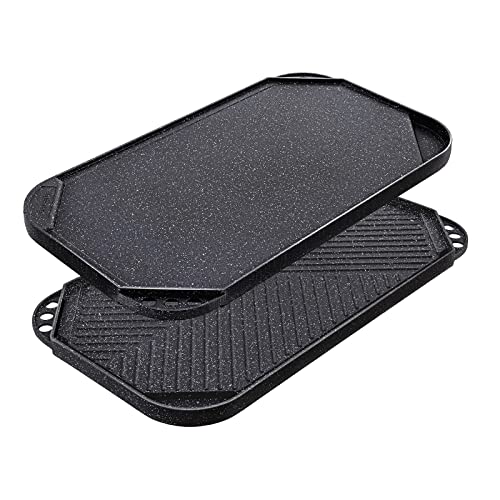
SENSARTE Nonstick Griddle Grill Pan, Two Burner Cast Aluminum — Best Nonstick and Lightweight
The SENSARTE is the deliberate exception on this list: cast aluminum with a nonstick coating instead of cast iron. The advantages are real and immediate — it is light, it heats fast, eggs release from day one with no seasoning project, and it washes like a pan instead of a ritual. For renters, occasional cooks, and anyone who has already decided that cast iron care is not happening in their kitchen, this is the honest way to get a flat surface over gas burners.
The limits are equally real. Nonstick coatings have a temperature ceiling and a lifespan; over a gas grill’s hottest burners, used carelessly, the coating will age faster than it would on a stovetop, and metal tools will shorten its life further. Use it at moderate grill heat, with silicone or wood tools, and it will serve well for its span. It is a convenience pick with a finite life, chosen knowingly — and for the right household, knowingly is enough.
The SENSARTE’s ideal owner cooks flat food a few times a month, values a five-minute cleanup over a fifty-year lifespan, and grills at moderate heat by temperament. In that household it is not the compromise pick; it is the correct one. It is also the only pan here a teenager can be handed for pancake duty without a cast iron safety lecture, which families will recognize as a genuine feature.
The SENSARTE closes the list with a reminder about honest categories: not every buyer wants a lifetime tool, and a pan designed for convenience is not a failed cast iron pan — it is a successful convenience pan. Match it to moderate heat and gentle tools, replace it when the coating tires in some years’ time, and it will have delivered exactly the easy flat cooking it promised.
Strengths
- No seasoning — nonstick from the first cook
- Light aluminum is easy to handle and store
- Fast heating and simple washing
Trade-offs
- Coating has a heat ceiling — avoid maximum burner blasts
- Finite coating life, unlike cast iron’s permanence
- Less heat retention than iron for hard searing
| Material | Cast aluminum (per listing) |
| Surface | Nonstick (per listing) |
| Design | Reversible grill & griddle, two burner (per listing) |
Best for: Cooks who want flat cooking without cast iron care / Not suited for: High-heat searing purists or heirloom buyers
Check on Amazon — check the current price on Amazon before you decide, because grill pricing moves with the season.
Comparison Table
| Pick | Badge | Key spec | Best for |
|---|---|---|---|
| Lodge Reversible Cast Iron Grill/Griddle Pan, 16.75 x 9.5 Inches (LPGI3) | Best Overall | 16.75 x 9.5 in, reversible cast iron | Most gas grill owners adding a flat surface |
| Lodge Pro-Grid Reversible Grill/Griddle, 20 x 10.5 Inches | Best for Big Grills | 20 x 10.5 in, reversible cast iron | Wide four- and five-burner grills and group cooking |
| Lodge Blacklock Double Burner Griddle, 10 x 20 Inches | Best Lightweight Cast Iron | 10 x 20 in, lightweight cast iron | Frequent users who find standard cast iron too heavy |
| Victoria Rectangular Cast Iron Griddle, 20 x 14 Inches | Best Extra-Wide Surface | 20 x 14 in, preseasoned, reversible | Large grills and all-flat group cooking |
| NutriChef Cast Iron Reversible Griddle, 18 x 10 Inches | Best Budget Cast Iron | 18 x 10 in, pre-seasoned, reversible | First-time griddle pan buyers on a budget |
| SENSARTE Nonstick Griddle Grill Pan, Two Burner Cast Aluminum | Best Nonstick and Lightweight | Cast aluminum, nonstick, reversible, two-burner | Cooks who want flat cooking without cast iron care |
Fit first, then philosophy. The Lodge LPGI3 fits the most grills; the Pro-Grid and Victoria reward the biggest grills; the Blacklock lightens the daily lift; the NutriChef lowers the entry cost; the SENSARTE trades permanence for convenience. Every one is a good pan on the right grill — and a return on the wrong one.
Notice the shape pattern in the table: the traditional irons cluster around two footprints — the 9.5 to 10.5-inch-wide double-burner standard, and the 14-inch-wide firebox-filler. That is not a coincidence; it is the category’s two philosophies made physical. Decide which philosophy matches your grill and your menu, and the table narrows to two or three candidates immediately.
How to Choose the Best Flat Griddle Pans for Gas Grills: Measure First
Open the lid, take the grates’ measurements, and write down three numbers: the total grate width, the depth from front to back, and the clearance from grate to closed lid. Your pan must sit within the width and depth with a little air around it — burners need airflow, and a pan wall-to-wall over the firebox starves the flame and cooks unevenly. A good rule is to leave at least an inch of open grate somewhere for exhaust and heat circulation.
Then decide coverage philosophy. A standard double-burner pan (roughly 17 to 20 inches long, 9.5 to 10.5 wide) covers two burners and leaves flame space beside it — the flexible setup most owners love. A firebox-filling pan like the 20×14 Victoria turns the whole grill flat for big sessions but commits the whole grill when it is on. Neither is wrong; they are different cooking styles, and your typical menu should choose.
Finally, the lid test: the pan plus a stack of burgers must clear the closed lid, because half of griddle-on-grill cooking — melting cheese, finishing thick items — happens with the lid down. Tall handles and raised rims eat clearance, so favor low-profile designs, and check the listing photos against your grill’s shape before ordering.
- Measure grate width, depth, and lid clearance before shopping.
- Leave breathing room around the pan — never wall-to-wall over the firebox.
- Choose partial coverage for flexibility, full coverage for batch sessions.
- Prefer low-profile rims and handles so the lid closes over food.
- Match burner spread to pan size so the iron heats evenly.
Cast Iron vs. Nonstick Aluminum: The Material Decision
Cast iron is the traditional answer for a reason: it stores the heat gas burners deliver in stripes and re-radiates it evenly, it sears at temperatures that would destroy coatings, and its surface is seasoning — renewable forever with oil and heat. Its costs are weight and care. A cast iron griddle pan that is dried and oiled after use will outlive its owner; the same pan left wet in the grill will rust within a season. The material is a contract: permanence in exchange for a two-minute routine.
Nonstick aluminum is the convenience answer: light, fast, forgiving, and washable like ordinary cookware, with a surface that works from the first morning. Its contract is the opposite — a finite coating life, a heat ceiling, and gentle tools only. On a gas grill, where burners can run far hotter than the coating wants, discipline matters: preheat on medium, cook, and never leave the empty pan blasting. Households choose correctly when they choose the contract they will actually keep.
Using a Griddle Pan on a Gas Grill Without Wrecking Either
Preheat the pan with the grill, lid down, on medium for a good ten minutes — slamming cold iron onto roaring burners and then judging the hot spots is how pans get blamed for burner patterns. Gas burners heat in lines and rings; the iron’s job is to spread that heat, and it needs time to do it. Cook a test pancake or a slice of bread across the surface if you want to see your grill’s true heat map through the pan.
Manage grease deliberately. A flat pan has no drain; fat pools, and pooled fat over gas burners is a flare-up waiting for the lid to open. Push excess grease to a corner and sop it with a wadded paper towel held in tongs, or choose pans and positions that let you tilt drippings away from open flame. And never move a ripping-hot, fat-covered pan casually — plan the lift with two hands, mitts, and a destination before the cook starts.
Troubleshooting a Griddle Pan on a Gas Grill: Hot Spots, Smoke, and Sticking
Hot spots that print burner shapes onto pancakes mean the pan was rushed: give iron a full ten minutes at medium with the lid down and the heat evens itself. Smoke pouring from under the pan usually means pooled grease has found a burner — push fat to a cool corner, sop it with a towel in tongs, and lower the heat a notch; a flat pan has no drain, so the cook is the drainage system. Sticking on new iron means the seasoning is young, not that the pan is bad: fatty cooks, patience, and the seasoning round in the how-to fix it in order of likelihood.
A pan that rocks on the grates has either a warped base or a grate problem, and the distinction matters: test it cold on a flat counter. Quality cast iron rarely warps under sane use; the usual culprit is thermal shock — cold water on a ripping-hot pan. Let iron cool on the grates, wash it warm, and it will stay flat for decades. That single habit protects every pan in this guide.
Griddle Pan Storage, Rust Rescue, and Long-Term Care
Store the pan where it stays dry — a cabinet, a pantry shelf, a hook in the garage — with a paper towel between it and anything stacked on it while the seasoning is young. If rust appears anyway, and on a grill-stored pan it eventually tries, the rescue is simple: scrub the spot with a paste of coarse salt and a cut potato or a stiff brush, rinse, dry with heat, and re-season that patch with two thin oil coats. Cast iron’s great mercy is that almost every sin is reversible with abrasives and oil.
Long-term, the pan asks for almost nothing beyond the post-cook routine in the how-to: scrape, wipe, dry, oil-kiss. Do that and the surface you hand to the next decade is better than the one you bought, which is a sentence no nonstick pan will ever let you write. That asymmetry is the whole material argument, and it is why five of the six picks here are iron.
Griddle Pan Recipes That Justify the Purchase
If a pan needs a reason to exist in your kitchen, these are the cooks that provide it, in rough order of persuasion. Smash burgers first: balls of ground beef pressed thin on the ripping-hot flat side, laced edges crisping in their own fat, cheese under the closed lid — the single dish that converts skeptics. Then the full diner breakfast, where the pan’s zones let bacon render, hash browns crisp in the fat, and eggs finish gently at the cool edge, all on one surface over two burners.
After that, the repertoire widens quietly: fajita peppers and onions with real char at the edges, fried rice that actually fries instead of steaming, quesadillas and grilled cheese with even, edge-to-edge browning no skillet matches, scallops and fish fillets that never threaten to fall through a grate, and pancake batches on the stovetop that feed a table in two rounds. A pan that cooks seven things this well is not an accessory anymore; it is the second grill you already owned without knowing it.
How to Season a Cast Iron Griddle Pan and Cook Its First Breakfast
Most pans here arrive preseasoned, but a home seasoning round makes the surface yours and noticeably improves release. Do it once, on the grill itself, before the first real cook.
- Wash the new pan in hot water, dry it fully, and set it on the grill over medium heat for five minutes to drive off every trace of moisture.
- With a paper towel in tongs, wipe the thinnest possible film of high-smoke-point oil over the flat side — it should look almost dry.
- Close the lid and heat on medium-high until the oil smokes and the sheen turns matte, about fifteen minutes; let the pan cool on the grates.
- Repeat the film-and-smoke cycle two or three times. Thin coats are the whole secret — thick coats bake sticky.
- Cook the first meal fatty and forgiving: bacon, then eggs in the bacon fat on a medium zone of the pan. Expect good release now and better release in a month.
- After cooking, scrape the warm pan, wipe it clean, dry it on the warm grill, and finish with the lightest oil wipe before storing it dry.
From then on the routine is thirty seconds: scrape, wipe, dry, oil-kiss, store. The pan’s surface will darken and slick with use, and the grill underneath stays cleaner than grate cooking ever left it — one of this accessory’s underappreciated gifts.
[‘One safety habit belongs in every griddle-pan routine: before the cook, decide where the hot pan will go if it must come off the grill — a trivet or a clear stretch of side shelf, never the grass, never a plastic table. Hot iron covered in fat is the most awkward object in outdoor cooking, and the time to plan its landing is before it is hot, not during.’]
Common Buying Mistakes
Griddle pans fail in predictable ways, and nearly all of them are sizing and heat mistakes rather than product defects.
- Skipping the tape measure. The number one return reason. Grate width, depth, and lid clearance decide fit — not the pan’s marketing photos.
- Covering the whole firebox wall-to-wall. Burners need airflow. A sealed-over firebox cooks unevenly and can damage the grill.
- Blasting an empty nonstick pan. Coatings die from empty high heat. Preheat nonstick gently and cook at moderate settings.
- Judging iron by its first cook. Preseasoning is a base coat. Release improves over the first dozen cooks — that is the material working as designed.
- Leaving the pan stored in the grill outdoors. Trapped moisture rusts iron fast. Store the pan dry indoors, or oiled and under a covered, dry grill.
- Using the ridged side for eggs. The ridges are for marks on meat and vegetables. Flat food belongs on the flat side — that is why the pan has two.
Final Recommendation
For most gas grill owners, the Lodge LPGI3 is the griddle pan to buy: the standard size, honest iron, two surfaces in one. Big grills graduate to the Pro-Grid or the extra-wide Victoria; daily users who feel the weight choose the Blacklock; the NutriChef opens the door on a budget; and the SENSARTE serves cooks who want the flat life without the iron ritual. Measure your grates, and any of the six will change what your gas grill cooks.
Round out the picture with the sibling guides: Best Flat Grills covers complete flat grills if you would rather own the whole appliance, Best Flat Surface Grills ranks the big continuous surfaces, Best Flat Top Griddle Grills spans the wider flat-top family, Best Cooking Grates For Gas Grills handles the grated side of your grill’s life, and Best Flat Griddle Pans For Gas Grills is this guide to share with a fellow grill owner.
If you are deciding today, the shortlist is Lodge Reversible Cast Iron Grill/Griddle Pan, 16.75 x 9.5 Inches (LPGI3), Lodge Pro-Grid Reversible Grill/Griddle, 20 x 10.5 Inches, and Lodge Blacklock Double Burner Griddle, 10 x 20 Inches — check price on Amazon for each, in that order, and let your space and budget make the final call.
Frequently Asked Questions
Will a griddle pan fit my gas grill?
Measure your grate area and lid clearance, then compare with the pan dimensions in each review above. The 16.75 x 9.5-inch Lodge fits most three- and four-burner grills; the 20-inch pans need wide grills; compact two-burners suit the smaller standard pans. Leave an inch of breathing room — the pan should never seal the firebox wall-to-wall.
Can I use a griddle pan on the stovetop too?
Yes — double-burner pans are designed to span two stovetop burners, and that dual life is a major part of their value. The same pan does Saturday burgers on the grill and winter pancakes on the stove. Just expect the underside to carry grill seasoning and keep it dry between uses.
Reversible pan or flat-only — which is better?
Reversible pans give you a ridged side for grill marks on meat and vegetables, which most owners use occasionally and enjoy. Flat-only designs maximize the flat area and are simpler to season evenly. If marks matter to you, reversible; if breakfast and smash burgers are the whole mission, either works and flat area should decide.
How do I stop food sticking to a new cast iron griddle?
Preheat fully, use enough fat for the first cooks, and let food release on its own — proteins let go when the crust forms. New preseasoning improves over the first dozen cooks. If sticking persists, a home seasoning round of two or three thin oil coats, as in the how-to above, usually transforms the surface.
Is a griddle pan as good as a dedicated flat top grill?
For small and medium batches, remarkably close — the cooking physics is the same iron-over-heat. A dedicated flat top wins on area, zone control, grease drainage, and hood design. The pan wins on price, storage, and using the grill you already own. Many households start with the pan and some never need more.
How do I clean the pan after grilling?
Scrape it warm, wipe it out, and dry it with heat — on the grill as it cools or on a stove burner. A brief rinse is fine; soaking is not. Finish with the lightest wipe of oil while warm. Nonstick aluminum is the exception: let it cool, wash it like a pan, and keep metal tools away from the coating.


