Disclosure: airfryerkitchensupply.com is reader-supported. When you buy through links on our site, we may earn an affiliate commission at no extra cost to you.
Where to buy
The best flappers for toilets are sold on Amazon by the two measurements that matter — flush valve size (2-inch or 3-inch) and material — from the two brands that dominate the category, Korky and Fluidmaster. Every pick below is a verified exact listing. Measure your flush valve opening before ordering: a flapper that is the wrong size for your valve cannot seal, no matter how good it is.
- Korky Standard 2-Inch Ultra High Performance Universal Toilet Flapper — check price on Amazon
- Korky Large 3-Inch Premium Toilet Flapper — check price on Amazon
- Fluidmaster 502P21 PerforMAX Universal Water-Saving Long Life Toilet Flapper (2-Inch) — check price on Amazon
- Fluidmaster 5403 Universal 3-Inch Toilet Flapper, Silicone Seal — check price on Amazon
- Korky 2-Inch 2X Long-Life Ultra Universal Toilet Flapper (2017) — check price on Amazon
- Korky Standard 2-Inch Flapper, Fits Kohler Hinge-Style Valves — check price on Amazon
The best flappers for toilets share an unglamorous truth: this small rubber disc is responsible for more wasted water, more phantom flushes and more mysteriously weak flushing than every other toilet part combined. The flapper seals the flush valve at the bottom of your tank. When you flush, it lifts, the tank’s water rushes into the bowl, and then it settles back onto the valve seat to seal the tank for the next fill. When it warps, hardens or grows a slimy film — and in chlorinated water, it eventually does all three — the tank leaks silently into the bowl around the clock. The toilet still works. It just works worse, wastes water around the clock, runs up a bill for flushes nobody took, and periodically refills itself in the middle of the night for no visible reason at all.
The good news is that a flapper is the cheapest meaningful repair in all of plumbing: a few minutes, no tools beyond your hands in most cases, and a part that costs less than a pizza. The only real decisions are size and material. Size is non-negotiable — 2-inch and 3-inch flush valves need their matching flappers, and a minority of toilets use brand-specific designs (certain Kohler hinge-style valves, tower/canister systems that use seals instead of flappers). Material is where quality lives: standard rubber degrades fastest in chlorinated or hard water, while the chlorine-resistant compounds — Korky’s Chlorazone rubber is the famous example, with claims stated in its listings — are made to survive years longer in exactly that water.
The six picks below cover the full decision space: the best universal 2-inch, the best 3-inch, an adjustable water-tuning design, a silicone long-life 3-inch, a hard-water specialist, and a brand-specific fit for Kohler hinge valves. Every performance or longevity claim is tied to the pick’s verified listing — we do not print review counts or star ratings, because a flapper should be chosen by fit and material, not by applause.
In this guide
Quick Picks
- Korky Standard 2-Inch Ultra High Performance Universal Toilet Flapper — Best Overall: the default answer for the standard 2-inch valve: a universal-fit Korky in the brand’s signature red rubber, with a listing that spans 1.28, 3.5 and 5 gpf toilets — one flapper for old and new tanks alike. — Check on Amazon
- Korky Large 3-Inch Premium Toilet Flapper — Best 3-Inch Flapper: the 3-inch counterpart: Korky’s premium large flapper for the bigger flush valves used by many modern high-efficiency and performance toilets. — Check on Amazon
- Fluidmaster 502P21 PerforMAX Universal Water-Saving Long Life Toilet Flapper (2-Inch) — Best Adjustable / Water-Saving: the tuner’s flapper: an adjustable solid-frame design for 2-inch valves that lets you dial how much water each flush uses — the fix for tanks that flush too long or too short. — Check on Amazon
- Fluidmaster 5403 Universal 3-Inch Toilet Flapper, Silicone Seal — Best Long-Life 3-Inch: a 3-inch flapper whose listing leads with its silicone seal — claimed to last up to 10x longer — plus an adjustable water-saving dial and a kink-free chain. — Check on Amazon
- Korky 2-Inch 2X Long-Life Ultra Universal Toilet Flapper (2017) — Best for Hard / Harsh Water: the harsh-water specialist: Korky’s Chlorazone II rubber, which the listing states resists harsh water and lasts 2x longer, in the universal 2-inch ultra fit. — Check on Amazon
- Korky Standard 2-Inch Flapper, Fits Kohler Hinge-Style Valves — Best for Kohler Hinge Valves: the exception that proves the fit rule: a Korky flapper shaped for Kohler’s hinge-style flush valves, for the Kohler owners a universal flapper will never seal properly. — Check on Amazon
How These Picks Were Chosen
We verified every pick through the site’s Amazon product data as an exact brand-and-model match, then organized the shortlist the way a plumber stocks a truck: by valve size first, because fit is binary, and by material and adjustability second. Standard rubber flappers are the baseline; chlorine-resistant rubber compounds earn their premium in municipal water, which is most homes; silicone seals are the longevity play where the design supports them. Adjustable flappers — with a dial or a movable float that controls how long the flapper stays open — earned a place because they let one part serve both old high-volume toilets and modern low-flow ones.
We also weighted the failure modes honestly. A flapper’s enemies are chlorine, hard-water scale, and time; listings that address those enemies with named materials outranked generic equivalents. Brand-specific fits were included where a major toilet family genuinely needs one, because forcing a universal flapper onto a hinge-style valve is how a ten-minute repair becomes a recurring leak that survives three replacement parts and convinces an innocent toilet’s owner that the whole fixture is cursed, when the truth is a two-inch disc of the wrong shape.
The 6 Best Flappers for Toilets

Korky Standard 2-Inch Ultra High Performance Universal Toilet Flapper — Best Overall
If a plumber could stock only one flapper, it would look like this: a 2-inch universal design from Korky, the flapper specialist, in the red rubber the brand is known for. The verified listing’s spread of toilet volumes — from modern 1.28 gpf models back to thirsty 5 gpf antiques — tells the story: the buoyancy and seal geometry are tuned to close correctly across generations of toilets.
Strengths
- Universal 2-inch fit covers the majority of flapper-valve toilets ever installed
- Korky’s rubber compounds are the category benchmark for chlorine resistance
- Works across 1.28 to 5 gpf toilets per the listing — ideal when you do not know the tank’s exact spec
Trade-offs
- 2-inch only — measure first; 3-inch valves need the larger picks below
- Not the fit for tower/canister flush systems, which use seals rather than flappers
- Chain and hook are standard hardware; corroded old chains may still deserve replacement while you are in the tank
| Specification | Detail |
|---|---|
| Valve size | 2-inch flush valve |
| Fit | Universal (from verified listing) |
| Compatibility | 1.28, 3.5 and 5 gpf toilets (from verified listing) |
| Material | Korky rubber compound, red |
Why does one flapper serve both a 1.28 gpf modern toilet and a 5 gpf antique? Because a flapper is a buoyancy device as much as a seal. It must float open long enough to release the designed flush volume, then sink and seal. Too buoyant in a low-flow tank and it wastes water holding the valve open; too heavy in an old tank and it slams shut mid-flush, producing the classic weak, double-flush toilet. Korky’s “ultra” geometry is the brand’s answer to that spread, and it is why this model is the category’s default recommendation.
The material is the second half of the case. Municipal chlorine is flapper poison — it is what turns a supple seal into a warped, leaking disc in a couple of years. Korky built its name on rubber that resists exactly that attack, and owners in chlorinated city water routinely get multiples of a generic flapper’s service life from the brand’s compounds.
Installation is the standard five minutes: water off, old flapper unhooked from the valve’s pegs and the lever chain, new flapper on, chain adjusted with a whisper of slack. If your toilet has a 2-inch valve and a flapper at all, start here.
One ownership habit multiplies this flapper’s value: write the install date on the tank lid’s underside with a marker. Flapper diagnosis years later — is this seal two years old or seven? — becomes a glance instead of a guess, and a household that tracks the date replaces on evidence rather than on suspicion. It is the kind of unglamorous discipline that separates homes whose toilets always work from homes where the plunger lives in the bathroom permanently, and it costs one pen stroke.
Best for: the standard 2-inch valve in most homes — the first flapper to try / Not suited for: 3-inch valve toilets or canister/tower flush systems
Check the current price on Amazon

Korky Large 3-Inch Premium Toilet Flapper — Best 3-Inch Flapper
Modern toilets increasingly use 3-inch flush valves — the bigger opening dumps the tank faster and powers the strong flushes of the last two decades. Those valves need a flapper that matches their diameter, and Korky’s Large 3-Inch Premium is the specialist’s standard for the size.
Strengths
- Correct seal geometry for 3-inch flush valves — the size most newer toilets use
- Premium Korky rubber for chlorine resistance and a long service interval
- Direct replacement simplicity: same pegs-and-chain mounting as the flapper it replaces
Trade-offs
- Useless on a 2-inch valve — the sizes do not interchange, so measure before ordering
- Some 3-inch systems are canister designs that take a seal, not a flapper — confirm your toilet actually has a flapper
- Premium tier within a cheap category: costs a little more than generic 3-inch flappers
| Specification | Detail |
|---|---|
| Valve size | 3-inch flush valve |
| Fit | Large/premium 3-inch (from verified listing) |
| Material | Korky rubber, red |
The 3-inch valve exists because flow rate matters: a bigger opening lets the tank deliver its water before the flapper’s buoyancy gives out, and the result is the decisive flush modern toilets are known for. That same physics makes the flapper’s job more demanding — it must seal a larger seat against the same tank pressure, and any warp leaks proportionally more water. A premium compound that stays flat and supple is not a luxury in this size; it is the difference between a sealed tank and a silent, continuous leak you will meet on the water bill.
Identification is easy once you know to look: with the tank lid off, the flush valve opening at the tank’s bottom center is visibly wider than a soda can’s mouth on a 3-inch system — roughly three inches across, as the name promises. When in doubt, measure the flapper you remove; the old one’s diameter is the specification for the new one.
Fit this, set the chain slack correctly, and a 3-inch toilet’s phantom refills and weak flushes usually end on the spot.
Best for: modern toilets with 3-inch flush valves and a flapper-style seal / Not suited for: 2-inch valves or canister flush towers
Check the current price on Amazon
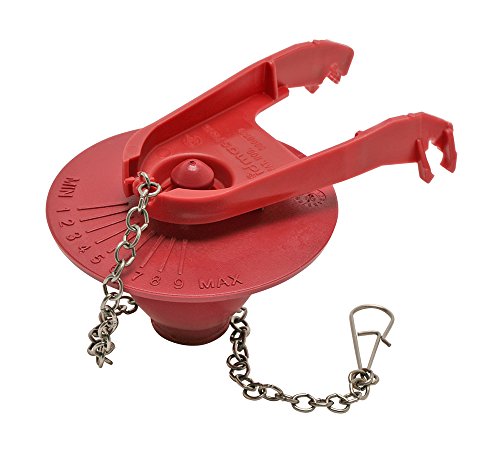
Fluidmaster 502P21 PerforMAX Universal Water-Saving Long Life Toilet Flapper (2-Inch) — Best Adjustable / Water-Saving
Fluidmaster’s PerforMAX 502 approaches the flapper as an adjustable instrument rather than a fixed part. Its solid frame carries an adjustment that changes how long the flapper stays open, which changes the flush volume — letting one part correct both the water-wasting long flush and the feeble short one.
Strengths
- Adjustable design tunes flush volume to the toilet — genuinely useful across mixed-age plumbing
- Solid frame holds its shape and alignment better than all-flexible economy flappers
- Fluidmaster’s distribution means the same part is on the shelf in most hardware stores
Trade-offs
- Adjustment is a feature you must actually set — installed carelessly at an extreme, it can under- or over-flush
- 2-inch valves only
- The frame design is slightly bulkier in very compact vintage tanks
| Specification | Detail |
|---|---|
| Valve size | 2-inch flush valves (from verified listing) |
| Design | Adjustable, solid frame (from verified listing) |
| Line | Fluidmaster PerforMAX 502P21 |
The PerforMAX’s adjustment deserves a concrete explanation. A flapper closes when its trapped air escapes or its buoyancy is overcome; adjustable designs meter that timing. Set it one way and the flapper drops early — a water-saving short flush for a modern bowl. Set it the other and it rides longer, giving an older bowl the full volume its trapway was designed around. In a house with toilets from three different decades, that single adjustable part replaces a drawer of size-and-buoyancy guesses.
The solid frame matters for a duller reason: sealing alignment. A flapper that lands on the valve seat slightly rotated or cupped leaks at the edge, and all-flexible flappers gradually take a set in whatever shape they were stored. The frame keeps the sealing face true, which is why this design carries a long-life positioning in Fluidmaster’s line.
Tune it in small steps: adjust, flush five times across a day, and judge by clearing, not by sound. The correct setting is the shortest open time that still clears completely — that is the water-saving the product promises, delivered honestly.
Best for: mixed-age households and anyone who wants to tune flush volume precisely / Not suited for: 3-inch valves, or owners who want a part with nothing to adjust
Check the current price on Amazon

Fluidmaster 5403 Universal 3-Inch Toilet Flapper, Silicone Seal — Best Long-Life 3-Inch
The 5403 is Fluidmaster’s longevity play in the 3-inch size: a silicone sealing surface instead of plain rubber, an adjustable dial for flush volume, and the small civilized detail of a chain designed not to kink — the humble cause of many a flapper held half-open.
Strengths
- Silicone seal: the listing claims up to 10x longer life than standard seals — silicone shrugs off chlorine that eats rubber
- Adjustable dial lets you tune the flush volume like the PerforMAX
- Kink-free chain removes a classic cause of flappers sticking open
Trade-offs
- The 10x figure is the maker’s listing claim; real life varies with water chemistry
- 3-inch valves only
- Silicone’s different feel can surprise installers used to rubber — it seals by fit, not by squish
| Specification | Detail |
|---|---|
| Valve size | 3-inch flush valve |
| Seal | Silicone (listing claims up to 10x longer life) |
| Adjustment | Adjustable dial (from verified listing) |
| Chain | Kink-free chain (from verified listing) |
Silicone changes the flapper’s aging curve. Rubber degrades by chemistry — chlorine and chloramine attack it continuously, which is why rubber flappers in city water are a consumable. Silicone is largely indifferent to that chemistry, so its service life is set by mechanical wear rather than by the water supply’s disinfectant. For a household that has replaced rubber flappers on a two-year rhythm, that difference is the entire value proposition, and the listing’s up-to-10x claim — reported here as the maker’s claim — is the marketing form of a real material advantage.
The adjustable dial gives the 5403 the PerforMAX’s tuning virtue in the larger size, and the kink-free chain is worth more than it sounds: a kinked chain shortens itself, holds the flapper cracked open, and produces the running toilet that owners blame on the flapper’s seal. Eliminating the chain as a failure mode is honest engineering.
Pair this with the Korky 3-inch as the size’s two philosophies: premium rubber from the flapper specialist, or silicone from the valve giant. Both are defensible; water chemistry and brand trust decide.
Best for: 3-inch valve owners tired of replacing rubber flappers in chlorinated water / Not suited for: 2-inch valves or canister systems
Check the current price on Amazon
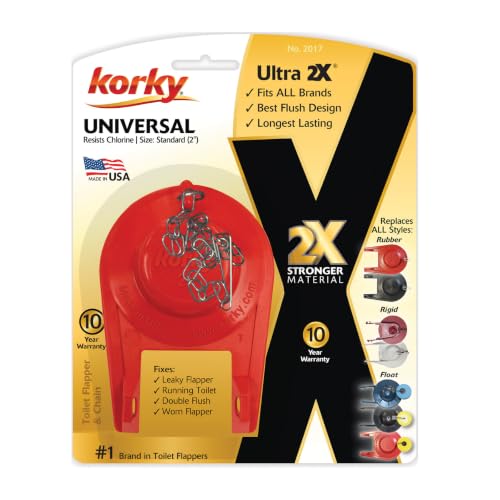
Korky 2-Inch 2X Long-Life Ultra Universal Toilet Flapper (2017) — Best for Hard / Harsh Water
Some water eats flappers. High chlorine, chloramine, hard mineral content — the listing calls it harsh water, and Korky’s answer is its Chlorazone II rubber, a proprietary compound the brand rates at twice the service life in those conditions. This is the 2-inch universal fit built from it.
Strengths
- Chlorazone II rubber is formulated specifically against chlorine and harsh-water degradation
- Listing states 2x longer life — the pick for homes that chew through standard flappers
- Universal 2-inch ultra fit covers the standard-valve majority
Trade-offs
- The longevity premium only pays in genuinely harsh water; in gentle water the standard Korky lasts nearly as long
- 2-inch valves only
- As with all flappers, scale on the valve seat itself must be wiped clean or even the best seal leaks
| Specification | Detail |
|---|---|
| Valve size | 2-inch flush valve |
| Material | Chlorazone® II rubber (from verified listing) |
| Claim | Resists harsh water, lasts 2X longer (listing claim) |
| Fit | Ultra universal |
Diagnose before you upgrade: if your current flapper failed by warping, cracking or turning gummy in under three years, your water is the aggressor and this is your flapper. If it failed after a decade of slow hardening, any quality flapper will do and the standard Korky above is the value play. The 2017’s premium is small in absolute terms — this is an inexpensive category — but it buys its keep specifically where water chemistry is the enemy.
Chlorazone’s trick, in plain terms, is a rubber formulation that keeps its flexibility and surface integrity under disinfectant attack, so the sealing face stays flat and the buoyancy stays calibrated. The “2X” figure is the brand’s listing claim, and we report it as such; the direction of the claim matches the material science, which is what a buyer can reasonably rely on.
Installation tip specific to harsh-water homes: while the tank is drained, wipe the valve seat with a cloth to remove the mineral ridge that builds there. A premium flapper sealing against a scaled seat still leaks — the seat is half the seal.
Best for: homes with chlorinated or hard water that destroy standard flappers quickly / Not suited for: gentle-water homes (save the premium) or 3-inch valves
Check the current price on Amazon

Korky Standard 2-Inch Flapper, Fits Kohler Hinge-Style Valves — Best for Kohler Hinge Valves
Not every 2-inch valve is a standard valve. A generation of Kohler toilets uses a hinge-style flapper arrangement whose geometry a universal flapper approximates badly — sealing most of the time, leaking the rest. Korky makes this dedicated fit for exactly those tanks.
Strengths
- Correct geometry for Kohler hinge-style valves — ends the almost-sealing leak universal flappers leave
- Korky rubber quality in the brand-specific shape
- Costs no more than a universal flapper — the right fit is not a premium product
Trade-offs
- Fits the Kohler hinge design only — it is not a universal spare
- Only relevant to the specific Kohler models with hinge valves; other Kohlers use standard or canister systems
- Confirm your Kohler’s valve style before ordering — the model number lookup matters
| Specification | Detail |
|---|---|
| Valve size | 2-inch, Kohler hinge-style (from verified listing) |
| Fit | Fits Kohler hinge valves |
| Brand | Korky |
This pick exists to teach the category’s most valuable lesson: “universal” describes most toilets, not all, and the exceptions concentrate in specific brand families. Kohler’s hinge-style flapper pivots differently from the standard peg-and-ear mounting, and its sealing face is shaped to match. Owners of those toilets who buy universal flappers often conclude their toilet is defective when the third universal in a row still seeps; the toilet is fine, and the part was almost right.
Identification is simple with the lid off: a hinge flapper attaches at a hinge point at the back of the valve rather than snapping onto two side pegs, and it usually carries the Kohler name in the tank’s documentation. When in doubt, the toilet’s model number — stamped inside the tank lid or the tank wall — settles every parts question, for this flapper and for everything else in the tank.
If your Kohler has the hinge valve, this inexpensive, correct part is the difference between a ten-minute fix and a recurring mystery leak.
Best for: Kohler owners whose toilets use the hinge-style flush valve / Not suited for: standard peg-mount valves — the universal picks above fit those
Check the current price on Amazon
Comparison Table
| Pick | Badge | Key spec | Best for |
|---|---|---|---|
| Korky Standard 2-Inch Ultra High Performance Universal Toilet Flapper | Best Overall | 2-inch universal, fits 1.28–5 gpf toilets per listing | the standard 2-inch valve in most homes — the first flapper to try |
| Korky Large 3-Inch Premium Toilet Flapper | Best 3-Inch Flapper | 3-inch premium flapper, Korky rubber | modern toilets with 3-inch flush valves and a flapper-style seal |
| Fluidmaster 502P21 PerforMAX Universal Water-Saving Long Life Toilet Flapper (2-Inch) | Best Adjustable / Water-Saving | 2-inch adjustable solid-frame flapper, water-saving dial | mixed-age households and anyone who wants to tune flush volume precisely |
| Fluidmaster 5403 Universal 3-Inch Toilet Flapper, Silicone Seal | Best Long-Life 3-Inch | 3-inch, silicone seal, adjustable dial, kink-free chain | 3-inch valve owners tired of replacing rubber flappers in chlorinated water |
| Korky 2-Inch 2X Long-Life Ultra Universal Toilet Flapper (2017) | Best for Hard / Harsh Water | 2-inch, Chlorazone II rubber, 2x life claim per listing | homes with chlorinated or hard water that destroy standard flappers quickly |
| Korky Standard 2-Inch Flapper, Fits Kohler Hinge-Style Valves | Best for Kohler Hinge Valves | 2-inch, dedicated Kohler hinge-valve fit | Kohler owners whose toilets use the hinge-style flush valve |
How to Choose the Right Flapper: Size, Material, Adjustability
Size first, because nothing else matters if it is wrong. Remove the tank lid and look at the flush valve — the opening the flapper covers at the bottom center of the tank. Measure the flapper itself across its sealing face: roughly 2 inches or roughly 3 inches. That single measurement divides this entire guide in half. While the lid is off, note the mounting style: two side pegs (standard), a hinge at the back (the Kohler exception above), or no flapper at all because your toilet uses a canister or tower with a flat seal — in which case this guide’s honest advice is to shop seals for your model instead, through the flush-system guide linked below.
Material second. Standard rubber is the budget baseline and a false economy in chlorinated water. Chlorine-resistant compounds — Korky’s Chlorazone line is the reference — are the right default for municipal water. Silicone, as in the Fluidmaster 5403, is the longevity alternative with the same chemical indifference. If your last flapper died young and gummy, upgrade the material, not just the part.
Adjustability third. If your toilets span eras — an old 3.5 or 5 gpf bowl beside a modern 1.28 — an adjustable flapper (PerforMAX, 5403) lets you set the open time per toilet instead of accepting one buoyancy for all. Finally, buy the chain some respect: a kinked or corroded chain defeats any flapper, and several picks address it directly. Match size, upgrade material for your water, tune if you can — that is the whole discipline.
How to Replace a Toilet Flapper in Ten Minutes
Step one: turn the water off at the stop valve behind the toilet and flush to drain the tank; hold the lever to empty it fully, then sponge the last inch of water out of the tank bottom so you are working dry rather than dripping. Step two: unhook the old flapper’s chain from the flush lever, then pop the flapper’s ears off the valve’s side pegs (or unhinge it, on hinge models). Note how the old one sat — a phone photo saves guesswork. Step three: wipe the valve seat — the rim the flapper seals against — with a cloth. Grit and scale on the seat cause leaks that get blamed on new flappers constantly.
Step four: mount the new flapper on the pegs and connect the chain to the lever with a small amount of slack — the chain should hang with a gentle curve, roughly half an inch of play. Too tight and the flapper cannot seat (a running toilet you just installed); too loose and it can slip under the flapper and hold it open. Step five: turn the water on, let the tank fill, and watch one full cycle: fill, stop cleanly at the water line, no trickling into the bowl. Step six: the dye test for certainty — a few drops of food coloring in the tank, wait twenty minutes without flushing, and check the bowl. Color in the bowl means the seal leaks; no color means the cheapest repair in plumbing just succeeded.
If an adjustable flapper is fitted, tune it now: set the dial mid-range, flush several times over a day, and shorten the open time gradually until the flush is just still complete — that is your water-saving setting.
Diagnosing Flapper Problems: Running, Phantom Flushing and Weak Flushes
Three symptoms, one small part, and one reliable order of investigation that finds the culprit without replacing parts at random. A toilet that runs intermittently — the fill valve chirping on for a few seconds every so often, day and night — is losing tank water past the flapper until the float drops enough to trigger a refill. Plumbers call it phantom flushing, and a worn flapper is its first cause. A toilet that runs continuously after flushing usually has a chain problem (too short, kinked, or caught under the flapper) or a flapper that has warped off its seat. A toilet whose flush has gone weak — needing a second press or a held lever — often has a flapper that has waterlogged or hardened and now slams shut early, cutting the flush short.
The dye test separates flapper leaks from fill-valve leaks with certainty: color migrating from tank to bowl without flushing indicts the flapper seal; a tank that loses water with a clean dye test points elsewhere. Also run a finger around the valve seat before condemning any flapper — a ridge of scale there leaks under a brand-new seal, and thirty seconds with a cloth is the fix.
Replace on condition, not on calendar: warping you can see, edges that no longer feel supple, a sealing face that has gone slimy or pitted. In harsh water that can be two years; in gentle water, the premium compounds in this guide stretch it far longer. Either way, in every water type and every era of toilet, the part is cheap and the water it wastes when ignored is not — and the diagnosis costs nothing but a few drops of food coloring, twenty patient minutes, and the willingness to lift a tank lid before reaching for a wallet or a plumber’s phone number.
Flapper or Canister Seal? Knowing Which System You Own
Before any flapper is ordered, one identification matters more than size: does your toilet have a flapper at all? Lift the lid and look at the flush mechanism. A flapper system shows a flexible disc, hinged or pegged at the base of an open flush valve, lifted by a chain from the lever. A canister system shows a cylindrical tower in the tank’s center that lifts straight up when flushed, sealing with a flat washer-like gasket at its base. A dual-flush tower shows a column with buttons on top. Each system has its own wear part, and none of the parts interchange.
If yours is a canister or tower, the flapper aisle is the wrong aisle: your refresh part is the model’s seal or gasket kit, found by the toilet’s model number, and a full mechanism renewal is the subject of the flush-system guide in this series. If yours is a flapper, everything in this guide applies. This sixty-second inspection is the difference between a repair that lands and a return label, and it is the step big-box shoppers most often skip because the flapper display was closer to the door.
One hybrid deserves a mention: some older toilets use a flapper on an angled or raised valve seat, and some use a tank ball on a lift wire — antiques, mostly. The universal picks here cover the mainstream peg-mount designs; genuinely vintage hardware is a specialty-supplier conversation, and honesty requires saying so.
Flappers for Older Toilets: Keeping 3.5 and 5 GPF Bowls Honest
Millions of pre-1990s toilets are still in service, flushing 3.5 or even 5 gallons through bowls and trapways designed for exactly that volume. Their flappers face a different calibration problem from modern toilets: the flapper must stay open long enough to release a large designed volume, and an economy flapper tuned for modern tanks will slam shut early and leave the old bowl half-flushed — the owner then holds the lever, defeating the part entirely. The Korky Ultra pick leads this guide partly because its listing explicitly spans the 5 and 3.5 gpf generations alongside the 1.28: its buoyancy is designed for the long ride an old tank demands.
Adjustable flappers offer the other route: dial the open time long for the antique, and the same part family serves the modern toilet down the hall at a shorter setting. What not to do is install a water-saving early-close flapper in a high-volume bowl and blame the porcelain — the bowl was designed around water the new part refuses to deliver.
A word on whether to keep the antique at all: a sound old bowl with a correct flapper is a working toilet, and replacing its flapper is always the right first move. The water-economics of full replacement are a household decision; the flapper’s job is to make the existing toilet flush as its designer intended, and judged on that job, the right flapper succeeds completely.
The Real Cost of Putting It Off
A leaking flapper is a quiet, continuous expense with three line items. The first is water itself: a seal that seeps runs day and night, and even a modest leak, multiplied by every hour of every month, arrives on the utility bill as real money spent flushing a toilet nobody used. The second is the fill valve, which cycles thousands of extra times a year chasing the falling tank level and wears toward its own failure — a second part consumed by the first part’s neglect. The third is the flush itself, which weakens as the flapper hardens, until the household is double-flushing a toilet whose only fault is a disc of tired rubber.
Against those costs, the repair is a few minutes and one of the least expensive parts in the home. There is no category of home maintenance with a kinder ratio of effort to return, which is why plumbers check the flapper first on every running-toilet call — and why this guide treats a humble part with complete seriousness.
Common Buying Mistakes
The first mistake is guessing the size — ordering a 2-inch flapper for a 3-inch valve (or the reverse) and concluding flappers “don’t work.” Measure the old flapper against the valve it has to seal; it takes a minute with a ruler and saves a return trip, a second order, and a week of living with the leak you meant to fix. Second: buying the cheapest generic rubber for chlorinated city water and repeating the purchase every eighteen months, when a chlorine-resistant compound costs marginally more and lasts multiples longer. Third: ignoring the chain — replacing the flapper while leaving a kinked, corroded chain that holds the new one open. Fourth: forcing a universal flapper onto a brand-specific valve (the Kohler hinge case) instead of buying the dedicated fit. Fifth: replacing the flapper when the toilet has no flapper — canister and tower systems use flat seals, and the correct part is the model’s seal kit. Lift the lid and look before you shop; the tank always tells the complete truth to anyone willing to spend sixty seconds reading it before spending anything at all on parts that may not even fit the particular mechanism that happens to live inside it today, whatever its age, style or brand happens to be in your house or rental property.
Final Recommendation
The defaults cover nearly every tank in every era of toilet: the Korky 2-Inch Ultra for the standard valve, the Korky 3-Inch Premium for the larger modern valve, the Fluidmaster 5403 when silicone longevity appeals, the PerforMAX when you want to tune the flush, the Chlorazone II Korky when your water eats rubber, and the Kohler hinge fit when your tank demands the exception. Measure first, match the material to your water, and set the chain slack with care.
If the flapper is fine but the flush system around it is tired, the next step up is Best Flush System For Toilets — towers and conversion kits that renew the whole mechanism. And if the porcelain itself is the problem, the replacement shortlists are Best Flush Performance Toilets for power, Best Flush Toilets And Easy To Install for painless swaps, and Best Flow Augmented Toilets for the modern flush engines explained.
Shop the shortlist: Korky Standard 2-Inch Ultra High Performance Universal Toilet Flapper; Korky Large 3-Inch Premium Toilet Flapper; Fluidmaster 502P21 PerforMAX Universal Water-Saving Long Life Toilet Flapper (2-Inch); Fluidmaster 5403 Universal 3-Inch Toilet Flapper, Silicone Seal; Korky 2-Inch 2X Long-Life Ultra Universal Toilet Flapper (2017); Korky Standard 2-Inch Flapper, Fits Kohler Hinge-Style Valves.
Frequently Asked Questions
How do I know if my toilet needs a 2-inch or 3-inch flapper?
Measure the flapper you are replacing across its sealing face, or measure the flush valve opening it covers: about 2 inches or about 3 inches. Most older and standard toilets are 2-inch; many modern high-efficiency and performance toilets are 3-inch. The sizes do not interchange, so this measurement is the one step not to skip.
What are the signs a flapper needs replacing?
Phantom refills (the tank topping itself up unprompted), a toilet that runs on after flushing, a flush that has gone weak or needs the lever held, and visible warping, cracking or sliminess on the flapper itself. The food-coloring dye test confirms a leaking seal in twenty minutes.
How long should a flapper last?
It depends on water chemistry more than on the calendar. Standard rubber in chlorinated municipal water can fail in a couple of years; chlorine-resistant compounds and silicone seals last substantially longer — the listings for the Korky Chlorazone II and Fluidmaster silicone picks state their makers’ longevity claims (2x and up to 10x respectively), which we report as claims rather than guarantees.
Can a bad flapper really waste much water?
Yes — a leaking flapper passes water continuously, not just at flush time, and the loss runs around the clock whether anyone is home or not. It is one of the most common causes of a mysteriously rising water bill, and the cheapest to fix.
My toilet has no flapper — what do I buy?
Many modern toilets use a canister or tower flush with a flat silicone seal instead of a flapper. Those seals are model-specific; shop by your toilet’s model number (stamped inside the tank or lid), and see the flush-system guide linked in the final recommendation for towers and conversion kits.
Should I replace the flapper and fill valve together?
Only if both are actually failing. The dye test indicts the flapper; a tank that fills slowly, noisily or past its line indicts the fill valve. Replacing a healthy fill valve ‘while you are in there’ adds cost and new leak points to a finished repair. The exception is a full tank renewal on an elderly toilet — if every component is original and tired, a complete repair kit renews the whole system at once, and the flush-system guide in this series covers those kits.
Does chain length really matter?
It is the most common self-inflicted flapper problem. Too tight, and the flapper cannot seat — the toilet runs. Too loose, and the chain slips under the flapper and holds it open — the toilet runs. Aim for roughly half an inch of slack with the flapper closed, and prefer the kink-free chains on picks like the Fluidmaster 5403 if yours tangles.


